

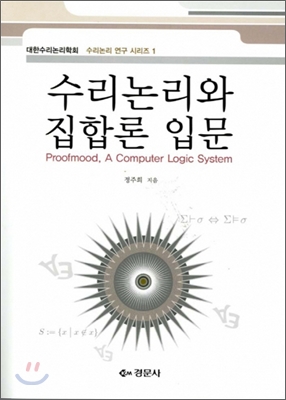
Introduction to Mathematical Logic and Set Theory
 |
Description
Book Introduction
The solution adopted in this book is a computer formal proof system.
That is, by having the computer determine whether there are errors in the proofs written by students, students are trained in rigorous mathematical proofs.
I started developing the computer logic system Proofmood in the spring of 2009 and have been using it to teach logic to gifted middle school students and undergraduate students.
In the beginning, it mainly dealt with logical puzzle problems using propositional logic, which was able to attract the interest of many students.
That is, by having the computer determine whether there are errors in the proofs written by students, students are trained in rigorous mathematical proofs.
I started developing the computer logic system Proofmood in the spring of 2009 and have been using it to teach logic to gifted middle school students and undergraduate students.
In the beginning, it mainly dealt with logical puzzle problems using propositional logic, which was able to attract the interest of many students.
index
Preface iii
Chapter 1 Propositions and Logical Formulas 1
1 Syntax of logical expressions
2 Meaning of logical expressions
3 Logical Consequences and Models
4 Regular format
Proposition with 5 variables, Venn diagram
Chapter 2: Logic Diagram 29
1 Validity of inference
2 Logical diagram
3 Logic Diagram Software
4. Bursting and Inference
Chapter 3 Fitch Attestation System 53
1 Introduction to the Pitch System
Structure of the 2-pitch proof
3 Pitch Inference Rules
4 Proof Writing Techniques
Chapter 4 First-Order Logic 77
1 Why first-order logic?
2 Syntax and meaning of first-order logic
2.1 Syntax
2.2 Syntax of the pitch system
2.3 Semantics
2.4 Scope and substitution of determiners
3-Pitch 1st-Order Logic Inference Rules
3.1 Propositional logical consequence
3.2 Introduction and elimination of qualifiers
3.3 Introduction and elimination of the equal sign
3.4 Expansion of inference rules
Chapter 5: First-Order Logic Proof Writing Techniques 125
1. Group theory
1.1 Axioms and fundamental theorems of the military
1.2 The equation a · x = b has a unique solution
1.3 a · x = a · y ⇒ x= y (left elimination)
1.4 Page 1 - Axioms
2 Peano arithmetic
2.1 Definition and axioms of Peano arithmetic
2.2 Peano Arithmetic Theorem
2.3 Formulas and techniques for first-order logic proofs
Chapter 6 Set Theory 151
1 Sets, Proofs, and Paradoxes
1.1 Basic Concepts and Terminology
1.2 Formal and informal proofs
1.3 Basic properties of sets
1.4 Cardinal numbers, paradoxes, and the axiom of the existence of sets
2 Relationships and Functions
2.1 Cartesian product
2.2 Relationships
2.3 Function
Chapter 7: Foundations of Mathematics and Axiomatic Set Theory 205
1 ordered set
2 Equivalence relations, superstructures, and homomorphisms
3-part structure and Cartesian product structure
4 Some topics
4.1 Pepo Operation
4.2 Mathematical induction and string complexity
4.3 Number theory
5. Cardinal numbers and ordinal numbers
5.1 Definition of cardinal numbers and ordinal numbers
5.2 Inductive proof and recursive definition
5.3 Jorn's Lemma
5.4 Operations on ordinal and cardinal numbers
5.5 Infinity and Finity, the Proof We Deferred
6 Axiomatic set theory
Reference 283
Search 284
Chapter 1 Propositions and Logical Formulas 1
1 Syntax of logical expressions
2 Meaning of logical expressions
3 Logical Consequences and Models
4 Regular format
Proposition with 5 variables, Venn diagram
Chapter 2: Logic Diagram 29
1 Validity of inference
2 Logical diagram
3 Logic Diagram Software
4. Bursting and Inference
Chapter 3 Fitch Attestation System 53
1 Introduction to the Pitch System
Structure of the 2-pitch proof
3 Pitch Inference Rules
4 Proof Writing Techniques
Chapter 4 First-Order Logic 77
1 Why first-order logic?
2 Syntax and meaning of first-order logic
2.1 Syntax
2.2 Syntax of the pitch system
2.3 Semantics
2.4 Scope and substitution of determiners
3-Pitch 1st-Order Logic Inference Rules
3.1 Propositional logical consequence
3.2 Introduction and elimination of qualifiers
3.3 Introduction and elimination of the equal sign
3.4 Expansion of inference rules
Chapter 5: First-Order Logic Proof Writing Techniques 125
1. Group theory
1.1 Axioms and fundamental theorems of the military
1.2 The equation a · x = b has a unique solution
1.3 a · x = a · y ⇒ x= y (left elimination)
1.4 Page 1 - Axioms
2 Peano arithmetic
2.1 Definition and axioms of Peano arithmetic
2.2 Peano Arithmetic Theorem
2.3 Formulas and techniques for first-order logic proofs
Chapter 6 Set Theory 151
1 Sets, Proofs, and Paradoxes
1.1 Basic Concepts and Terminology
1.2 Formal and informal proofs
1.3 Basic properties of sets
1.4 Cardinal numbers, paradoxes, and the axiom of the existence of sets
2 Relationships and Functions
2.1 Cartesian product
2.2 Relationships
2.3 Function
Chapter 7: Foundations of Mathematics and Axiomatic Set Theory 205
1 ordered set
2 Equivalence relations, superstructures, and homomorphisms
3-part structure and Cartesian product structure
4 Some topics
4.1 Pepo Operation
4.2 Mathematical induction and string complexity
4.3 Number theory
5. Cardinal numbers and ordinal numbers
5.1 Definition of cardinal numbers and ordinal numbers
5.2 Inductive proof and recursive definition
5.3 Jorn's Lemma
5.4 Operations on ordinal and cardinal numbers
5.5 Infinity and Finity, the Proof We Deferred
6 Axiomatic set theory
Reference 283
Search 284
Publisher's Review
This book was written to be used as a textbook for mathematical logic and set theory at universities. Since mathematical logic is approached through mathematical methods, it is difficult to study it without knowing set theory, the language of mathematics.
However, set theory is difficult to study without training in rigorous proof, that is, without a foundation in logic.
The solution adopted in this book to resolve this dilemma is a computer formal proof system.
That is, by having the computer determine whether there are errors in the proofs written by students, students are trained in rigorous mathematical proofs.
I started developing the computer logic system Proofmood in the spring of 2009 and have been using it to teach logic to gifted middle school students and undergraduate students.
In the beginning, it mainly dealt with logical puzzle problems using propositional logic, which was able to attract the interest of many students.
The first-order logic proof system required for set theory classes was functional enough to be used properly in classes by the spring of 2011, and the first-order logic proof system was successfully used in graduate classes in the fall semester of 2011.
Since it was their first time with a formal proof, many students were initially scared, but as they gradually got used to it, they all did better than expected, which gave me great pleasure.
Starting in 2012, we plan to utilize this in set theory, which is offered as a first-year subject every spring semester.
Chapters 1 through 3 of this book cover propositional logic, and if a teacher provides kind and thorough guidance, even middle school students will be able to study it with interest.
Chapter 4 is an introduction to first-order logic. Since a thorough understanding of the semantics of first-order logic requires knowledge of set theory, I think it would be okay to just briefly understand it.
In Chapter 5, we study first-order logic formal proofs in depth using examples from group theory and number theory.
After training in formal proofs and mathematical logic from Chapters 1 to 5, set theory begins in Chapter 6.
It covers almost all the content covered in typical introductory textbooks on set theory, and adds just enough to understand the most basic concepts and methodology of axiomatic set theory.
It is regrettable that Gödel's completeness and incompleteness theorems, the most famous and important theorems in mathematical logic, were not included in this book.
These theorems can be properly understood only when one has sufficient mathematical maturity, and in particular, the incompleteness theorems are omitted because I believe that the right order of study is to begin after learning computational theory, recursive function theory, and, if possible, formal languages and computational complexity.
However, set theory is difficult to study without training in rigorous proof, that is, without a foundation in logic.
The solution adopted in this book to resolve this dilemma is a computer formal proof system.
That is, by having the computer determine whether there are errors in the proofs written by students, students are trained in rigorous mathematical proofs.
I started developing the computer logic system Proofmood in the spring of 2009 and have been using it to teach logic to gifted middle school students and undergraduate students.
In the beginning, it mainly dealt with logical puzzle problems using propositional logic, which was able to attract the interest of many students.
The first-order logic proof system required for set theory classes was functional enough to be used properly in classes by the spring of 2011, and the first-order logic proof system was successfully used in graduate classes in the fall semester of 2011.
Since it was their first time with a formal proof, many students were initially scared, but as they gradually got used to it, they all did better than expected, which gave me great pleasure.
Starting in 2012, we plan to utilize this in set theory, which is offered as a first-year subject every spring semester.
Chapters 1 through 3 of this book cover propositional logic, and if a teacher provides kind and thorough guidance, even middle school students will be able to study it with interest.
Chapter 4 is an introduction to first-order logic. Since a thorough understanding of the semantics of first-order logic requires knowledge of set theory, I think it would be okay to just briefly understand it.
In Chapter 5, we study first-order logic formal proofs in depth using examples from group theory and number theory.
After training in formal proofs and mathematical logic from Chapters 1 to 5, set theory begins in Chapter 6.
It covers almost all the content covered in typical introductory textbooks on set theory, and adds just enough to understand the most basic concepts and methodology of axiomatic set theory.
It is regrettable that Gödel's completeness and incompleteness theorems, the most famous and important theorems in mathematical logic, were not included in this book.
These theorems can be properly understood only when one has sufficient mathematical maturity, and in particular, the incompleteness theorems are omitted because I believe that the right order of study is to begin after learning computational theory, recursive function theory, and, if possible, formal languages and computational complexity.
GOODS SPECIFICS
- Date of issue: March 5, 2012
- Page count, weight, size: 300 pages | 188*254*20mm
- ISBN13: 9788961055499
- ISBN10: 8961055496
You may also like
카테고리
korean


korean

![GQ KOREA Mark (Monthly): December [2025]](http://librairie.coreenne.fr/cdn/shop/files/8ef265dbbfbf186523ed75ba7319009d.jpg?v=1765340328&width=3840)


