

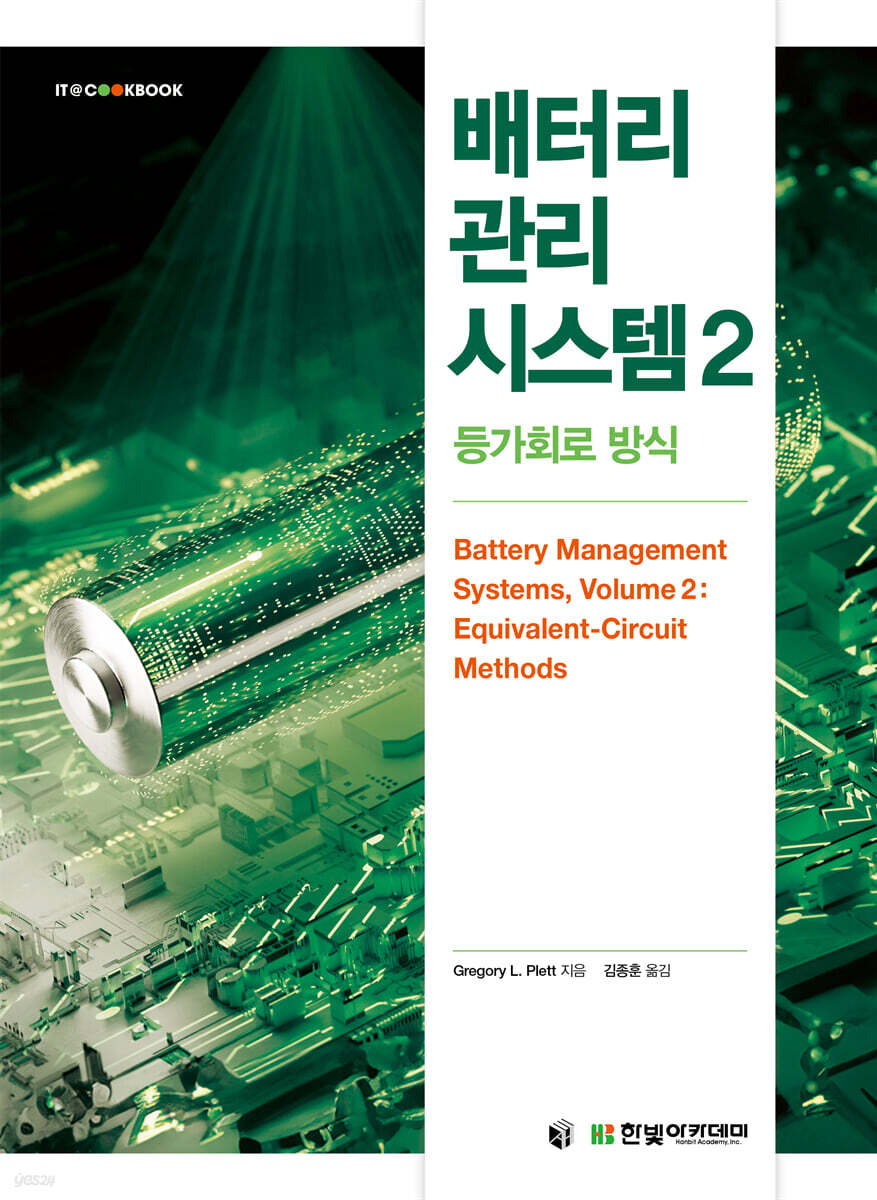
Battery Management System 2: Equivalent Circuit Method
 |
Description
Book Introduction
Presented by experts in the BMS field
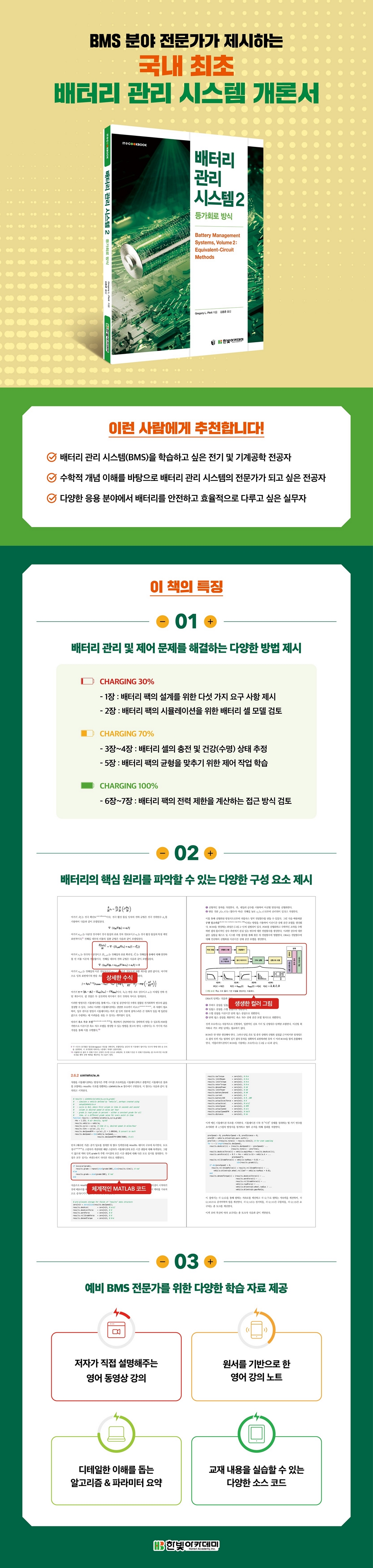
Korea's first battery management system introduction
This book is intended for electrical and mechanical engineering students aiming to become battery management system (BMS) experts, as well as practitioners in the battery industry.
Gregory L. Platt, a world authority on batteries,
This book is a translation of Professor Plett's book to suit the domestic situation, and was completed by adding the professional knowledge and experience of Professor Kim Jong-hoon, the first BMS doctorate holder in Korea.
Volume 2 explains how to solve battery management and control problems based on the mathematical equations and models derived from Volume 1.
We introduced the concept of physics-based optimal battery control, utilized the latest equivalent circuit model, and provided an in-depth understanding of BMS through intuitive illustrations and systematic mathematical expressions.
Korea's first battery management system introduction
This book is intended for electrical and mechanical engineering students aiming to become battery management system (BMS) experts, as well as practitioners in the battery industry.
Gregory L. Platt, a world authority on batteries,
This book is a translation of Professor Plett's book to suit the domestic situation, and was completed by adding the professional knowledge and experience of Professor Kim Jong-hoon, the first BMS doctorate holder in Korea.
Volume 2 explains how to solve battery management and control problems based on the mathematical equations and models derived from Volume 1.
We introduced the concept of physics-based optimal battery control, utilized the latest equivalent circuit model, and provided an in-depth understanding of BMS through intuitive illustrations and systematic mathematical expressions.
- You can preview some of the book's contents.
Preview
index
CHAPTER 01 BMS Requirements
1.1 Battery Pack Topology
1.2 Requirements for BMS design
1.3 Requirement 1a: Voltage Sensing
1.4 Requirement 1b: Temperature Sensing
1.5 Requirement 1c: Current Sensing
1.6 Requirement 1d: High Voltage Contactor Control
1.7 Requirement 1e: Isolated Sensing
1.8 Requirement 1f: Thermal Control
1.9 Requirement 2: Protection
1.10 Requirement 3a: Charger Control
1.11 Requirement 3b: Communication via CAN bus
1.12 Requirement 3c: Logbook Functionality
1.13 Requirement 4a: State of Charge Estimation
1.14 Requirement 4b: Energy Estimation
1.15 Requirement 4c: Power Estimation
1.16 Requirement 5: Diagnostics
1.17 Conclusion and Future Directions
CHAPTER 02 Battery Pack Simulation
2.1 Battery Cell Modeling
2.2 Empirical Modeling Approach
2.3 Physically Based Modeling Approach
2.4 EV Simulation
2.5 Vehicle dynamics equations
2.6 EV Simulation Code
2.7 EV simulation results
2.8 Constant power and constant voltage simulation
2.9 Battery Pack Simulation
2.10 PCM simulation code
2.11 PCM Results Example
2.12 SCM simulation code
2.13 Example of SCM results
2.14 Conclusion and Future Directions
CHAPTER 03 Battery Health Estimation
3.1 SOC estimation
3.2 Precise definition of charge state
3.3 Some approaches to estimating SOC
3.4 Random Process Review
3.5 Sequential Probabilistic Inference
3.6 Linear Kalman Filter
3.7 Extended Kalman Filter
3.8 Implementation of EKF using ESC cell model
3.9 Problems with EKF improved by sigma point method
3.10 Sigma Point Kalman Filter
3.11 SPKF implementation using the ESC cell model
3.12 Practical Issues Related to Sensors and Initialization
3.13 Bar - Reducing Computational Complexity Using Delta Filtering
3.14 Conclusion and Future Directions
3.15 Algorithm for State Estimation
3.16 Critical value of χ^2_υ(α, df)
CHAPTER 04 Battery Health Estimation
4.1 The Need for Battery Health Estimation
4.2 Cathode aging
4.3 Bipolar aging
4.4 Voltage sensitivity for R0
4.5 Code to estimate R0
4.6 Sensitivity of voltage to total capacity Q
4.7 Parameter estimation using Kalman filter
4.8 EKF parameter estimation
4.9 SPKF parameter estimation
4.10 Joint Estimation and Dual Estimation
4.11 Robustness and Speed
4.12 Unbiased estimates of total capacity through linear regression
4.13 Weighted ordinary least squares method
4.14 Total weighted least squares method
4.15 Excellent model fit
4.16 Confidence intervals
4.17 Simplified total least squares
4.18 Approximate full solution
4.19 Simulation code by method
4.20 HEV Simulation Example
4.21 EV Simulation Example
4.22 Discussion of Simulation
4.23 Conclusion and Future Directions
4.24 Nonlinear Kalman Filter Algorithm
CHAPTER 05 CELL BALANCING
5.1 Causes of imbalance
5.2 What is not the cause of the imbalance
5.3 Considerations in Balancing Design
5.4 Circuit for Balancing
5.5 How quickly should balance be achieved?
5.6 Balancing Simulation Results
5.7 Conclusion and Future Directions
CHAPTER 06 Voltage-Based Power Limit Estimation
6.1 Voltage-based power limiting
6.2 Power Limiting Using a Simple Cell Model
6.3 Power Limiting Using the Whole Cell Model
6.4 Dichotomy
6.5 Conclusion and Future Directions
CHAPTER 07 Physics-Based Optimal Control
7.1 Minimizing Performance Degradation
7.2 SEI formation and growth
7.3 SEI ROM Results
7.4 Lithium plating during overcharge
7.5 ROM plating results
7.6 Power Limit Optimization
7.7 Plug-in charging
7.8 Fast charging example
7.9 Dynamic Power Calculation
7.10 Conclusion and Future Directions
7.11 Parameters used in simulation
Search
1.1 Battery Pack Topology
1.2 Requirements for BMS design
1.3 Requirement 1a: Voltage Sensing
1.4 Requirement 1b: Temperature Sensing
1.5 Requirement 1c: Current Sensing
1.6 Requirement 1d: High Voltage Contactor Control
1.7 Requirement 1e: Isolated Sensing
1.8 Requirement 1f: Thermal Control
1.9 Requirement 2: Protection
1.10 Requirement 3a: Charger Control
1.11 Requirement 3b: Communication via CAN bus
1.12 Requirement 3c: Logbook Functionality
1.13 Requirement 4a: State of Charge Estimation
1.14 Requirement 4b: Energy Estimation
1.15 Requirement 4c: Power Estimation
1.16 Requirement 5: Diagnostics
1.17 Conclusion and Future Directions
CHAPTER 02 Battery Pack Simulation
2.1 Battery Cell Modeling
2.2 Empirical Modeling Approach
2.3 Physically Based Modeling Approach
2.4 EV Simulation
2.5 Vehicle dynamics equations
2.6 EV Simulation Code
2.7 EV simulation results
2.8 Constant power and constant voltage simulation
2.9 Battery Pack Simulation
2.10 PCM simulation code
2.11 PCM Results Example
2.12 SCM simulation code
2.13 Example of SCM results
2.14 Conclusion and Future Directions
CHAPTER 03 Battery Health Estimation
3.1 SOC estimation
3.2 Precise definition of charge state
3.3 Some approaches to estimating SOC
3.4 Random Process Review
3.5 Sequential Probabilistic Inference
3.6 Linear Kalman Filter
3.7 Extended Kalman Filter
3.8 Implementation of EKF using ESC cell model
3.9 Problems with EKF improved by sigma point method
3.10 Sigma Point Kalman Filter
3.11 SPKF implementation using the ESC cell model
3.12 Practical Issues Related to Sensors and Initialization
3.13 Bar - Reducing Computational Complexity Using Delta Filtering
3.14 Conclusion and Future Directions
3.15 Algorithm for State Estimation
3.16 Critical value of χ^2_υ(α, df)
CHAPTER 04 Battery Health Estimation
4.1 The Need for Battery Health Estimation
4.2 Cathode aging
4.3 Bipolar aging
4.4 Voltage sensitivity for R0
4.5 Code to estimate R0
4.6 Sensitivity of voltage to total capacity Q
4.7 Parameter estimation using Kalman filter
4.8 EKF parameter estimation
4.9 SPKF parameter estimation
4.10 Joint Estimation and Dual Estimation
4.11 Robustness and Speed
4.12 Unbiased estimates of total capacity through linear regression
4.13 Weighted ordinary least squares method
4.14 Total weighted least squares method
4.15 Excellent model fit
4.16 Confidence intervals
4.17 Simplified total least squares
4.18 Approximate full solution
4.19 Simulation code by method
4.20 HEV Simulation Example
4.21 EV Simulation Example
4.22 Discussion of Simulation
4.23 Conclusion and Future Directions
4.24 Nonlinear Kalman Filter Algorithm
CHAPTER 05 CELL BALANCING
5.1 Causes of imbalance
5.2 What is not the cause of the imbalance
5.3 Considerations in Balancing Design
5.4 Circuit for Balancing
5.5 How quickly should balance be achieved?
5.6 Balancing Simulation Results
5.7 Conclusion and Future Directions
CHAPTER 06 Voltage-Based Power Limit Estimation
6.1 Voltage-based power limiting
6.2 Power Limiting Using a Simple Cell Model
6.3 Power Limiting Using the Whole Cell Model
6.4 Dichotomy
6.5 Conclusion and Future Directions
CHAPTER 07 Physics-Based Optimal Control
7.1 Minimizing Performance Degradation
7.2 SEI formation and growth
7.3 SEI ROM Results
7.4 Lithium plating during overcharge
7.5 ROM plating results
7.6 Power Limit Optimization
7.7 Plug-in charging
7.8 Fast charging example
7.9 Dynamic Power Calculation
7.10 Conclusion and Future Directions
7.11 Parameters used in simulation
Search
Detailed image
Publisher's Review
This book is the second in a three-volume series describing battery management systems.
The goal of this series is not to simply explain things in an encyclopedic manner, but to provide sound examples and the basic background knowledge to fully understand them.
While Volume 1 focused on deriving mathematical equations or models that describe how batteries work internally and externally, Volume 2 focuses on applying equivalent circuit models to solve battery management and control problems.
We also provide a variety of learning aids, including the author's original English lectures and lecture notes, and source code for practice.
The goal of this series is not to simply explain things in an encyclopedic manner, but to provide sound examples and the basic background knowledge to fully understand them.
While Volume 1 focused on deriving mathematical equations or models that describe how batteries work internally and externally, Volume 2 focuses on applying equivalent circuit models to solve battery management and control problems.
We also provide a variety of learning aids, including the author's original English lectures and lecture notes, and source code for practice.
GOODS SPECIFICS
- Date of issue: July 7, 2025
- Page count, weight, size: 360 pages | 729g | 188*257*16mm
- ISBN13: 9791173400124
You may also like
카테고리
korean


korean

![ELLE 엘르 스페셜 에디션 A형 : 12월 [2025]](http://librairie.coreenne.fr/cdn/shop/files/b8e27a3de6c9538896439686c6b0e8fb.jpg?v=1766436872&width=3840)


