

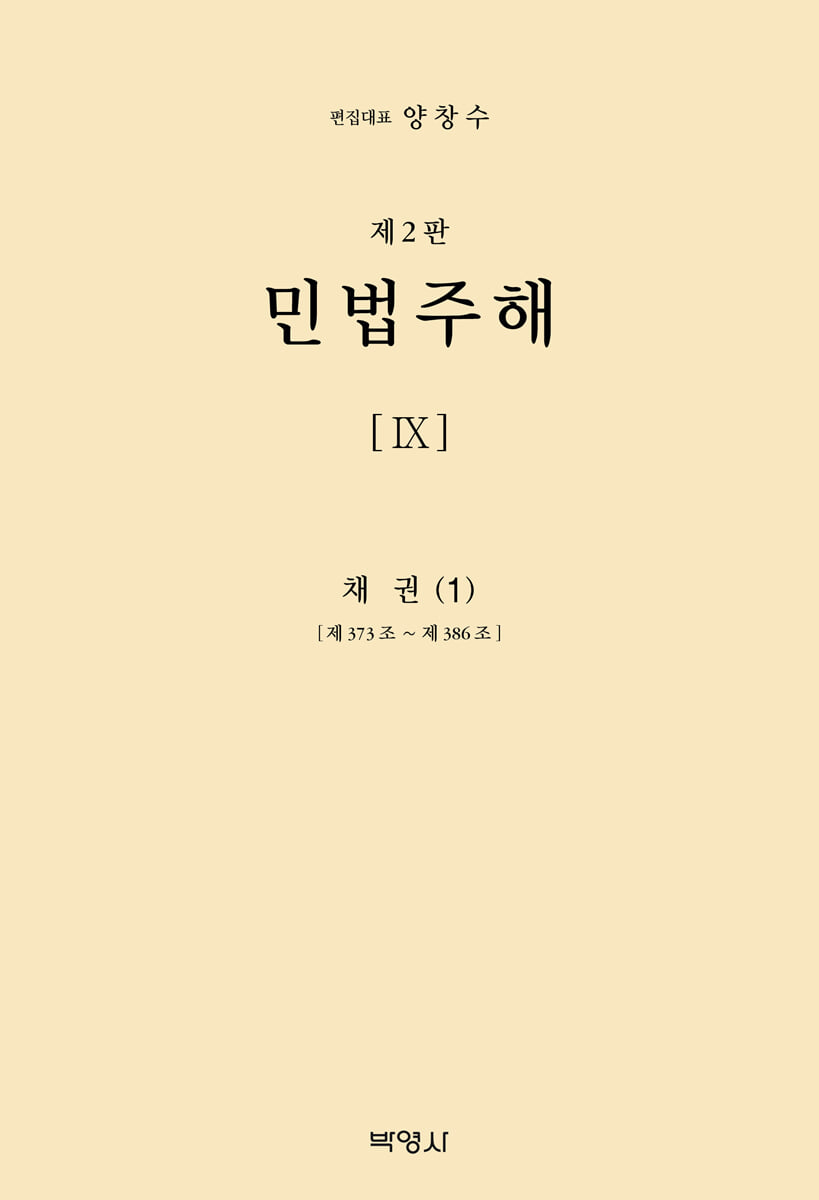
Civil Code Commentary, Volume 9
 |
Description
index
General discussion
Chapter 1
Article 1 The purpose of the law
General discussion
Article 373 (Special purpose of authority)
Article 374 (Good conduct of property marketers)
Article 375
Article 376 Taxation of gold
Article 377 (External Expense Rights)
Article 378 (before)
Article 379
Afterword (Interest Limitation Act)
Article 380
Article 381 Transfer of authority
Article 382 (Execution of the current affairs authority)
Article 383 (Execution of the authority of Article 3)
Article 384 (Removal of the rights of Article 3)
Article 385 (Determination of the right to transfer due to non-performance)
Article 386 (Departure of action)
Huron (voluntary bond)
Item Index
Chapter 1
Article 1 The purpose of the law
General discussion
Article 373 (Special purpose of authority)
Article 374 (Good conduct of property marketers)
Article 375
Article 376 Taxation of gold
Article 377 (External Expense Rights)
Article 378 (before)
Article 379
Afterword (Interest Limitation Act)
Article 380
Article 381 Transfer of authority
Article 382 (Execution of the current affairs authority)
Article 383 (Execution of the authority of Article 3)
Article 384 (Removal of the rights of Article 3)
Article 385 (Determination of the right to transfer due to non-performance)
Article 386 (Departure of action)
Huron (voluntary bond)
Item Index
Publisher's Review
Preface to the Second Edition
『Commentary on the Civil Code』 Volume 9 covers the entire text of Part 3 of the Civil Code, the entire text of Chapter 1, the purpose of claims, as well as all of the provisions of Chapter 1 (Articles 373 to 386), and further the Interest Restriction Act.
The Interest Rate Limit Act was abolished in January 1998 due to the aftermath of the so-called IMF economic crisis, but was re-enacted in March 2007 and has been in effect since June 30 of the same year.
However, although the new law contains many provisions similar to those in previous laws, it is notable that it also establishes new, significant provisions.
This is especially true for Article 2, Paragraph 4, which concerns cases where interest exceeds the maximum interest rate is paid, Article 3, which concerns advance deduction of interest, and Article 5, which concerns restrictions on compound interest.
Nearly 30 years have passed since the first edition of Volume 9 was published in November 1995.
In the meantime, it is clear that the transaction patterns related to the purpose of bonds, especially those related to interest-bearing bonds, have changed significantly.
There are many cases where new legal issues that did not exist before are raised and discussed, and existing legal issues are dealt with from a new perspective.
Against this backdrop, we must first and foremost emphasize “our capacity for interpreting and applying civil law, which has become much more faithful.”
Thus, the tendency to blindly follow foreign theories has been largely eliminated, the comparative legal perspective has broadened, and in particular, awareness of the position of civil trial practice and 'precedents' has become sharper, leading to a more objective and critical attitude.
I believe that such a change or shift in direction is clearly evident in the second edition of this 9th volume.
I sincerely hope that this book, which has overcome many difficult hurdles and has been published, will not greatly disappoint your expectations.
August 20, 2025
Editorial representative
Yang Chang-su
『Commentary on the Civil Code』 Volume 9 covers the entire text of Part 3 of the Civil Code, the entire text of Chapter 1, the purpose of claims, as well as all of the provisions of Chapter 1 (Articles 373 to 386), and further the Interest Restriction Act.
The Interest Rate Limit Act was abolished in January 1998 due to the aftermath of the so-called IMF economic crisis, but was re-enacted in March 2007 and has been in effect since June 30 of the same year.
However, although the new law contains many provisions similar to those in previous laws, it is notable that it also establishes new, significant provisions.
This is especially true for Article 2, Paragraph 4, which concerns cases where interest exceeds the maximum interest rate is paid, Article 3, which concerns advance deduction of interest, and Article 5, which concerns restrictions on compound interest.
Nearly 30 years have passed since the first edition of Volume 9 was published in November 1995.
In the meantime, it is clear that the transaction patterns related to the purpose of bonds, especially those related to interest-bearing bonds, have changed significantly.
There are many cases where new legal issues that did not exist before are raised and discussed, and existing legal issues are dealt with from a new perspective.
Against this backdrop, we must first and foremost emphasize “our capacity for interpreting and applying civil law, which has become much more faithful.”
Thus, the tendency to blindly follow foreign theories has been largely eliminated, the comparative legal perspective has broadened, and in particular, awareness of the position of civil trial practice and 'precedents' has become sharper, leading to a more objective and critical attitude.
I believe that such a change or shift in direction is clearly evident in the second edition of this 9th volume.
I sincerely hope that this book, which has overcome many difficult hurdles and has been published, will not greatly disappoint your expectations.
August 20, 2025
Editorial representative
Yang Chang-su
GOODS SPECIFICS
- Date of issue: September 25, 2025
- Format: Hardcover book binding method guide
- Page count, weight, size: 280 pages | 176*244*20mm
- ISBN13: 9791130337388
- ISBN10: 1130337383
You may also like
카테고리
korean


korean

![ELLE 엘르 스페셜 에디션 A형 : 12월 [2025]](http://librairie.coreenne.fr/cdn/shop/files/b8e27a3de6c9538896439686c6b0e8fb.jpg?v=1766436872&width=3840)


