

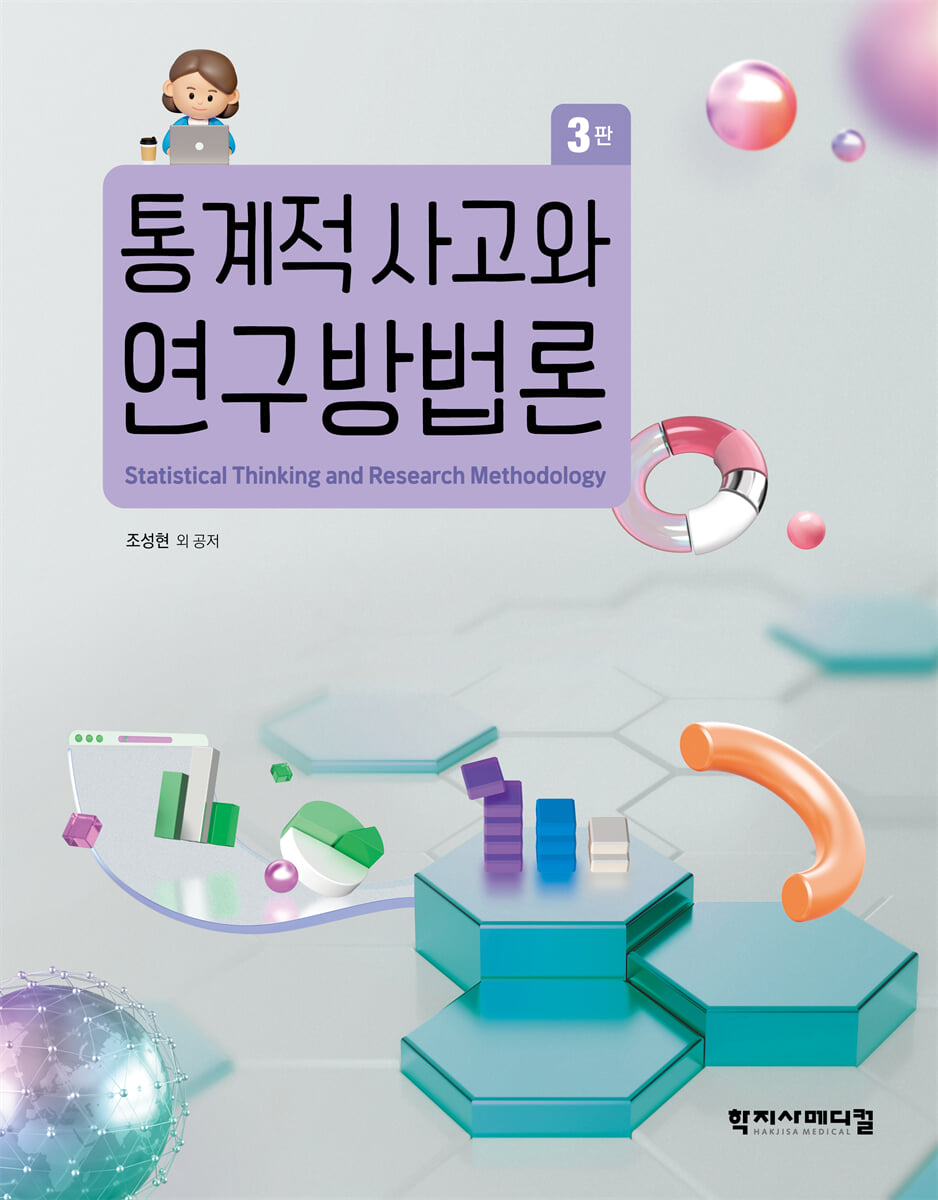
Statistical Thinking and Research Methodology
 |
Description
Book Introduction
The theory and practice of statistics, upgraded and made easy to understand
The academic environment of the 21st century is rapidly changing, and especially with the advent of the Fourth Industrial Revolution, the importance of research design and data analysis is increasingly highlighted.
When you first start learning statistical thinking and research methodology, you might wonder, "Why should I learn this?" and feel overwhelmed by the need to understand complex equations and formulas.
However, knowing and using equations goes beyond simply solving problems and greatly helps improve logical thinking and problem-solving skills.
This kind of logical thinking is useful not only in academic research but also in everyday life, helping us analyze complex problems and make optimal decisions.
Analyzing data, identifying patterns, and predicting the future to make better choices—this is the ultimate goal of learning statistical thinking and research methodology.
Accordingly, it is essential for researchers and students to learn statistical thinking and systematic research methodology.
This textbook, "Statistical Thinking and Research Methodology," is designed to meet these contemporary demands by providing an academic foundation while also fostering practical research capabilities.
This third revised edition has been supplemented and strengthened to substantially support readers' learning and research.
The content has been updated to reflect the latest trends in academic research and statistics, providing readers with insights they can apply immediately in their daily lives.
Appendices and examples have been strengthened to systematically guide the entire research process, from writing a research plan, collecting and analyzing data, to writing a paper.
Newly added appendices include a journal of team-based project-based learning topic selection, and learning notes using the WSQ (Watch, Summarize, Question) strategy.
Additionally, we added practical materials and explanations for data analysis and visualization, allowing learners to experience actual research design and analysis.
Each chapter is structured with study tips and practical examples so that readers can learn on their own and apply the material directly to their own research.
This textbook provides fundamental statistical and research methodology knowledge applicable to a variety of academic fields, and is designed to foster data-driven decision-making skills based on this foundation.
This revised edition is designed to provide practical value to everyone, from undergraduates seeking to learn the fundamentals of research to graduate students and researchers aiming for advanced research design and paper writing.
I sincerely hope that this textbook will enable readers to solve problems based on statistical thinking, design evidence-based research, and write high-quality papers.
The academic environment of the 21st century is rapidly changing, and especially with the advent of the Fourth Industrial Revolution, the importance of research design and data analysis is increasingly highlighted.
When you first start learning statistical thinking and research methodology, you might wonder, "Why should I learn this?" and feel overwhelmed by the need to understand complex equations and formulas.
However, knowing and using equations goes beyond simply solving problems and greatly helps improve logical thinking and problem-solving skills.
This kind of logical thinking is useful not only in academic research but also in everyday life, helping us analyze complex problems and make optimal decisions.
Analyzing data, identifying patterns, and predicting the future to make better choices—this is the ultimate goal of learning statistical thinking and research methodology.
Accordingly, it is essential for researchers and students to learn statistical thinking and systematic research methodology.
This textbook, "Statistical Thinking and Research Methodology," is designed to meet these contemporary demands by providing an academic foundation while also fostering practical research capabilities.
This third revised edition has been supplemented and strengthened to substantially support readers' learning and research.
The content has been updated to reflect the latest trends in academic research and statistics, providing readers with insights they can apply immediately in their daily lives.
Appendices and examples have been strengthened to systematically guide the entire research process, from writing a research plan, collecting and analyzing data, to writing a paper.
Newly added appendices include a journal of team-based project-based learning topic selection, and learning notes using the WSQ (Watch, Summarize, Question) strategy.
Additionally, we added practical materials and explanations for data analysis and visualization, allowing learners to experience actual research design and analysis.
Each chapter is structured with study tips and practical examples so that readers can learn on their own and apply the material directly to their own research.
This textbook provides fundamental statistical and research methodology knowledge applicable to a variety of academic fields, and is designed to foster data-driven decision-making skills based on this foundation.
This revised edition is designed to provide practical value to everyone, from undergraduates seeking to learn the fundamentals of research to graduate students and researchers aiming for advanced research design and paper writing.
I sincerely hope that this textbook will enable readers to solve problems based on statistical thinking, design evidence-based research, and write high-quality papers.
index
UNIT 1 Research Methods and Writing
CHAPTER 01 What is Research?
CHAPTER 02 Choosing a Topic and Writing an Introduction
CHAPTER 03 RESEARCH METHODS
CHAPTER 04: Summarizing Research Results
CHAPTER 05 Writing a Review and Conclusion
CHAPTER 06 Research Ethics
CHAPTER 07 Submitting a Paper
UNIT 2 Theory for Basic Statistics
CHAPTER 08 Estimation and Hypothesis Testing
CHAPTER 09 Parametric and Nonparametric Tests
UNIT 3 Practical Statistics and Practice
CHAPTER 10 Basic SPSS Utilization
CHAPTER 11 One-Group and Two-Group Analysis
CHAPTER 12 AGE GROUP ANALYSIS
CHAPTER 13 Repeated Measures Analysis of Variance
CHAPTER 14 Analysis of Covariance
CHAPTER 15 Multivariate Analysis of Variance
CHAPTER 16 CROSS-ANALYSIS
CHAPTER 17 CORRELATION ANALYSIS
CHAPTER 18 Validity and Reliability Analysis
CHAPTER 19 REGRESSION ANALYSIS
CHAPTER 20 Logistic Regression Analysis
CHAPTER 21 Meta-Analysis with RevMan
supplement
CHAPTER 01 What is Research?
CHAPTER 02 Choosing a Topic and Writing an Introduction
CHAPTER 03 RESEARCH METHODS
CHAPTER 04: Summarizing Research Results
CHAPTER 05 Writing a Review and Conclusion
CHAPTER 06 Research Ethics
CHAPTER 07 Submitting a Paper
UNIT 2 Theory for Basic Statistics
CHAPTER 08 Estimation and Hypothesis Testing
CHAPTER 09 Parametric and Nonparametric Tests
UNIT 3 Practical Statistics and Practice
CHAPTER 10 Basic SPSS Utilization
CHAPTER 11 One-Group and Two-Group Analysis
CHAPTER 12 AGE GROUP ANALYSIS
CHAPTER 13 Repeated Measures Analysis of Variance
CHAPTER 14 Analysis of Covariance
CHAPTER 15 Multivariate Analysis of Variance
CHAPTER 16 CROSS-ANALYSIS
CHAPTER 17 CORRELATION ANALYSIS
CHAPTER 18 Validity and Reliability Analysis
CHAPTER 19 REGRESSION ANALYSIS
CHAPTER 20 Logistic Regression Analysis
CHAPTER 21 Meta-Analysis with RevMan
supplement
GOODS SPECIFICS
- Date of issue: September 20, 2025
- Format: Hardcover book binding method guide
- Page count, weight, size: 608 pages | 188*257*35mm
- ISBN13: 9791175310087
You may also like
카테고리
korean


korean

![GQ KOREA Mark (Monthly): December [2025]](http://librairie.coreenne.fr/cdn/shop/files/8ef265dbbfbf186523ed75ba7319009d.jpg?v=1765340328&width=3840)


