

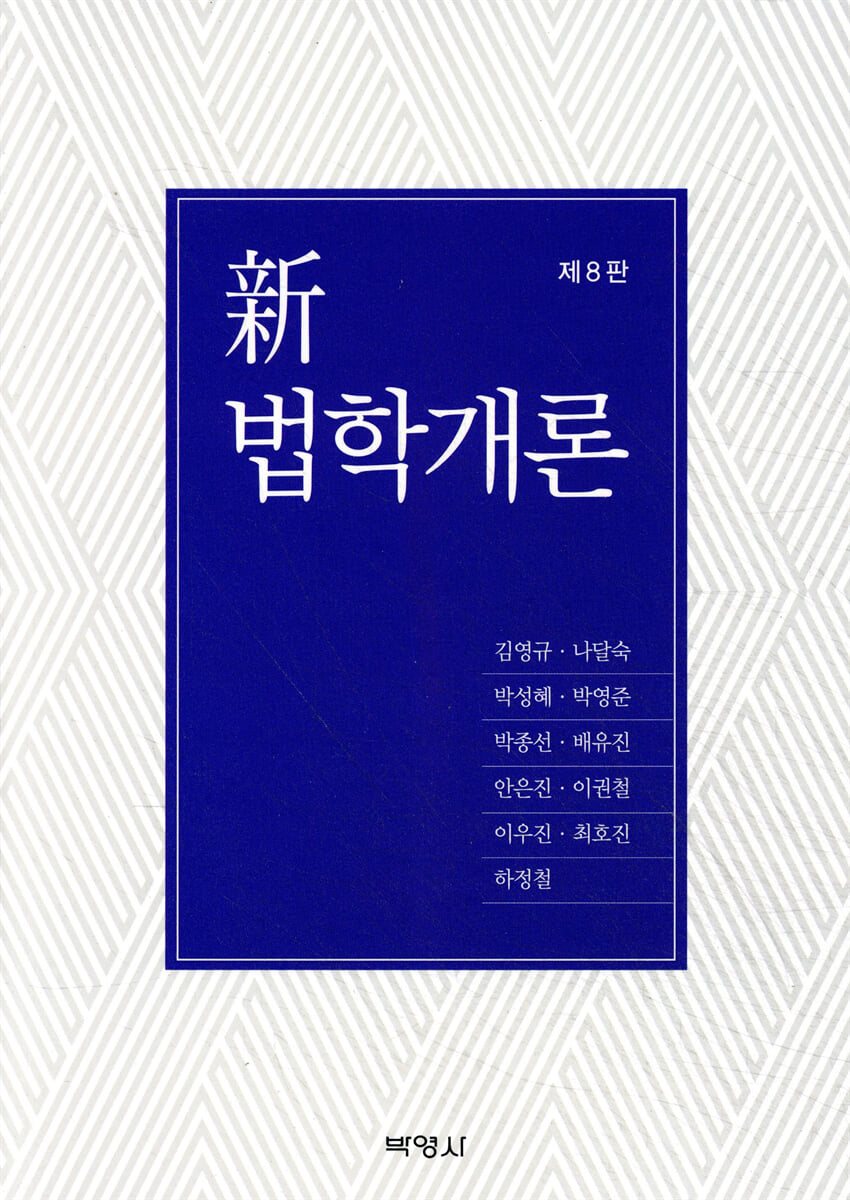
Introduction to New Law
 |
Description
Book Introduction
This book aims to help those new to law gain a basic understanding of the law, to provide those majoring in law or pursuing a related field with a systematic knowledge of the law as a whole, and to be a helpful resource for those preparing to obtain necessary qualifications.
Although this book is an introductory book on law, legal experts in each field have attempted to cover as much of the basic content as possible of substantive law (constitution, administrative law, criminal law, international law, civil law, commercial law, labor law, economic law, social security law, etc.) and procedural law (constitutional litigation, criminal litigation, civil litigation, domestic litigation) along with basic legal theories.
Overall, it was written with legal theory and related case law and examples included, so that not only can you acquire the necessary legal knowledge, but you can also consider its application in legal practice.
Although this book is an introductory book on law, legal experts in each field have attempted to cover as much of the basic content as possible of substantive law (constitution, administrative law, criminal law, international law, civil law, commercial law, labor law, economic law, social security law, etc.) and procedural law (constitutional litigation, criminal litigation, civil litigation, domestic litigation) along with basic legal theories.
Overall, it was written with legal theory and related case law and examples included, so that not only can you acquire the necessary legal knowledge, but you can also consider its application in legal practice.
index
Part 1: Basic Theory of Law
Chapter 1: The Essence of Law 3
Section 1: Concept of Law 3
Section 2: Distinctive Concepts of Law and Structure of Law 8
Chapter 2: The Form of Existence of Law 11
Section 1: The Form of Existence of Courts and Law 11
Section 2: Written Law 12
Section 3 Unwritten Law 15
Chapter 3 Classification and System of Law 20
Section 1 Introduction 20
Section 2 International Law and Domestic Law 20
Section 3 Public Law, Private Law, and Social Law 21
Section 4 General and Special Laws 25
Section 5 Substantive and Procedural Law 26
Section 6 Mandatory and Optional Laws 27
Chapter 4 Interpretation of Law 29
Section 1: The Significance of Legal Interpretation 29
Section 2: Methods of Interpreting the Law 29
Chapter 5 Application and Effect of Law 35
Section 1 Application of the Law 35
Section 2. Effect of Law 36
Chapter 6 Legal Relationships and Rights and Obligations 40
Section 1 Legal Relationships 40
Section 2 Rights and Obligations 41
Section 3 Classification of Rights 45
Part 2 Public Law
Part 1 Constitution 53
Chapter 1 General Provisions of the Constitution 54
Chapter 2 General Provisions of the Constitution of the Republic of Korea 63
Section 1 Components of the Republic of Korea 63
Section 2: Basic Order of the Constitution 65
Section 3 Institutional Guarantees 68
Chapter 3 Basic Law 72
Section 1 General Provisions of Fundamental Rights 72
Section 2: Human Dignity and Value? The Right to the Pursuit of Happiness? The Right to Equality 78
Section 3: Equality Rights 79
Section 4: Fundamental Rights of Liberty 81
Section 5. Right to Participate 90
Section 6 Claims 91
Section 7 Social Rights 93
Chapter 4: State Power Structure 96
Section 1: The Significance and Fundamental Ideology of the National Power Structure 96
Section 2: Principles of the National Power Structure 97
Section 3: Form of Government 98
Section 4 National Assembly 98
Section 5 Government 100
Section 6: The Law 101
Section 7 Constitutional Court 102
Part 2 Administrative Law 105
Chapter 1 Administration and Administrative Law 106
Section 1 Administration 106
Section 2 Administrative Law 108
Section 3: The Principle of Legal Conformity in Administration (Principle of Rule of Law Administration) 109
Section 4 Sources of Administrative Law 111
Chapter 2 Administrative Legal Relations (Administrative Legal Relations) 116
Section 1: Concept of Administrative Legal Relationships 116
Section 2 Contents of Administrative Legal Relations 119
Section 3 Effect of Administrative Law 121
Chapter 3: Administrative Action Forms 123
Section 1 Administrative Legislation 123
Section 2 Administrative Acts 125
Section 3 Administrative Plan 134
Section 4 Other Act Forms 135
Chapter 4: Administrative Procedures and Administrative Information 138
Section 1 Administrative Procedures 138
Section 2 Right to Request Disclosure of Information 140
Chapter 5: Ensuring Administrative Effectiveness 143
Section 1 Administrative Punishment 143
Section 2 Administrative Enforcement 144
Section 3 Immediate Administrative Enforcement 146
Section 4 Administrative Investigation 148
Section 5 New Means 148
Chapter 6 State Liability Act (Compensation and Indemnification) 151
Section 1 Administrative Damages Compensation System (State Compensation System) 151
Section 2 Administrative Loss Compensation System 154
Chapter 7 Administrative Litigation Act 156
Section 1 Administrative Appeals Act 156
Section 2 Administrative Litigation Act 158
Part 3 Criminal Law 169
Chapter 1: The Concept of Criminal Law and the Principle of Legality 170
Section 1: Concept of Criminal Law 170
Section 2: Principle of Legality 173
Section 3 Scope of Application of Criminal Law 179
Chapter 2 Crimes 183
Section 1: The Meaning of Crime 183
Section 2: Applicability of Elements 187
Section 3: Illegalities 195
Section 4 Responsibilities 201
Section 5 Attempted Crime 207
Section 6: Offenses of Omission 209
Section 7: Theory of Criminal Participation 213
Chapter 3: Punishment and Security Measures 217
Section 1 Introduction 217
Section 2 Punishment 217
Section 3 Suspended Sentences, Suspended Sentences, and Parole 222
Section 4 Security Measures 224
Chapter 4 Criminal Law Provisions 226
Section 1 Introduction 226
Section 2 Personal Legal Interests 227
Section 3 Social Legal Interests 229
Section 4 National Legal Interests 230
Part 4 International Law 233
Chapter 1: Foundations of International Law 234
Section 1: The Significance of International Law 234
Section 2: Sources of International Law 235
Section 3: The Relationship Between International Law and Domestic Law 237
Section 4 Subjects of International Law 239
Chapter 2: The State 240
Section 1: The Meaning, Rights, and Duties of the State 240
Section 2 State Approval 241
Section 3: Succession of the State 243
Chapter 3: State Jurisdiction and Sovereign Immunities 246
Section 1. Exercise of State Jurisdiction 246
Section 2: Sovereign Immunity of States 248
Section 3 Diplomatic Immunity 250
Chapter 4 State Responsibility 252
Section 1 Introduction 252
Section 2 Requirements for Establishing State Responsibility 252
Section 3: Contents of State Responsibility 254
Section 4: Investigating State Responsibility and Exercising Diplomatic Protection 254
Chapter 5 Treaty Law 256
Section 1: Significance of the Treaty 256
Section 2 Conclusion of the Treaty 256
Section 3 Entry into Force and Application of the Treaty 257
Section 4: Reservations to the Treaty 257
Section 5 Interpretation of the Treaty 258
Section 6. Invalidity and Termination of Treaties 258
Chapter 6: National Territory and the Law of the Sea 259
Section 1 National Territory 259
Section 2 Maritime Law 261
Chapter 7 International Organizations and the Resolution of International Disputes 265
Section 1: The Significance of International Organizations 265
Section 2 United Nations (UN) 265
Section 3: Peaceful Resolution of International Disputes 266
Section 4: The Use of Force in the International Community 267
Chapter 8: The Development of Modern International Law 269
Part 3 Judicial
Part 1 Civil Code 273
Chapter 1 General Provisions 274
Section 1 General Provisions 274
Section 2 Subject of Rights 277
Section 3 Objects of Rights 281
Section 4 Changes in Rights 282
Chapter 2 Water Rights Law 289
Section 1 General Provisions 289
Section 2 Changes in Property Rights 290
Section 3 Basic Property Rights 293
Section 4 Usufruct 296
Section 5: Security Rights 298
Chapter 3 Bond Law 301
Section 1 General Theory of Bonds 301
Section 2: Bonds 311
Chapter 4 Family Law 328
Chapter 2 Commercial Law 341
Chapter 1: Basic Theory of Commercial Law 342
Section 1: Concepts of Commercial Law 342
Section 2: The Idea and Characteristics of Commercial Law 343
Section 3, Commercial Law, Courts 344
Chapter 2 General Provisions of Commercial Law 345
Section 1 Merchants 345
Section 2 Commercial Employment 346
Section 3 Mutual Affiliation 346
Section 4: Commercial Ledgers 347
Section 5 Commercial Registration 347
Section 6 Transfer of Business 348
Chapter 3: The Upper Room 349
Section 1 General Provisions 349
Section 2, Article 352
Chapter 4 Company 356
Section 1 General Provisions 356
Section 2 General Partnership 358
Section 3 Limited Partnership 359
Section 4 Limited Liability Company 359
Section 5 Joint Stock Company 360
Section 6 Limited Liability Company 368
Chapter 5 Insurance 370
Section 1: The Significance of the Insurance System 370
Section 2 Insurance Contracts 370
Section 3 Non-life Insurance 372
Section 4: Human Insurance 372
Chapter 6: Bills and Checks 374
Section 1: Characteristics and Types of Bills and Checks 374
Section 2 Issue 375
Section 3: Bae Seo 375
Section 4: Person 376
Section 5 Guarantee 376
Section 6 Payment 376
Section 7 Claim for Repayment (Recourse) 377
Part 4 Social Law
Part 1 Labor Law 381
Chapter 1 General Provisions of Labor Law 382
Section 1 Purpose of Labor Law 382
Section 2: Concepts and Subjects of Labor Law 382
Chapter 2: Basic Labor Rights 383
Section 1: The Significance of Basic Labor Rights 383
Section 2: Right to Work 383
Section 3 Labor Rights 384
Chapter 3 Individual Labor Relations Act 387
Section 1 Labor Standards Act Article 387
Section 2 Industrial Safety and Health Act 390
Section 3 Equal Employment Opportunity Act 391
Chapter 4 Collective Labor-Management Relations Law 393
Section 1 Trade Union and Labor Relations Adjustment Act 393
Section 2 Labor Relations Commission Act 395
Part 2 Economic Law 399
Chapter 1 General Provisions 400
Section 1: The Emergence of Economic Law 400
Section 2 Regulations under Economic Law 402
Chapter 2 Monopoly Regulation and Fair Trade Act 403
Section 1 Introduction 403
Section 2 Prohibition of Abuse of Dominant Market Position 404
Section 3 Restrictions on Corporate Combinations 406
Section 4: Suppression of Concentration of Economic Power 407
Section 5 Restrictions on Unfair Joint Actions 408
Section 6 Prohibition of Unfair Trade Practices 410
Section 7. Prohibited Acts of Business Groups and Restrictions on Resale Price Maintenance 411
Part 3 Social Security Act 415
Chapter 1 Social Security Law and the State 416
Section 1 Social Security and the State 416
Section 2: Social Security and Its Limitations in Korea 418
Chapter 2 Basic Social Security Act 420
Section 1. History of the Basic Social Security Act 420
Section 2 Purpose of the Basic Social Security Act 420
Section 3 Characteristics of the Basic Social Security Act 421
Section 4 Contents of the Basic Social Security Act 421
Chapter 3 Social Insurance Act 423
Section 1 National Pension Act 423
Section 2 National Health Insurance Act 426
Section 3 Employment Insurance Act 427
Section 4 Industrial Accident Compensation Insurance Act 429
Chapter 4 Public Assistance Act 431
Section 1 National Basic Livelihood Security Act 431
Section 2 Medical Aid Act 432
Chapter 5 Social (Welfare) Services Act 433
Section 1 Welfare of Persons with Disabilities Act 433
Section 2 Elderly Welfare Act 436
Section 3 Child Welfare Act 436
Part 5 Litigation Law
Part 1 Constitutional Litigation 441
Chapter 1 General Theory of Constitutional Litigation 442
Section 1: The Significance of Constitutional Litigation 442
Section 2 Composition of the Constitutional Court and General Judgment Procedures 443
Chapter 2 Types of Constitutional Litigation 445
Section 1: Unconstitutionality Review 445
Section 2 Impeachment Trial 449
Section 3: Judgment on the Dissolution of a Political Party 451
Section 4 Judgment on Disputes over Authority 452
Section 5 Constitutional Petition Review 454
Part 2 Criminal Procedure 459
Chapter 1: Fundamentals of Criminal Procedure 460
Section 1: The Significance of Criminal Procedure 460
Section 2: The Idea and Structure of Criminal Procedure 461
Chapter 2 Subjects of Litigation 464
Section 1 Subject of the Litigation 464
Section 2: Court 465
Section 3 Inspection 468
Section 4 Defendant 469
Section 5: Defense Counsel 470
Chapter 3 Investigation and Prosecution 472
Section 1 Investigation 472
Section 2: Compulsory Disposition and Compulsory Investigation 477
Section 3: Conclusion of the Investigation 484
Section 4 Filing of a Public Prosecution 486
Chapter 4 Trial 489
Section 1 Trial Procedure 489
Section 2 Evidence 498
Chapter 5 Trial 503
Chapter 6 Appeals, Emergency Relief Procedures, and Special Procedures 505
Section 1, Appeal 505
Section 2 Emergency Rescue Procedures 506
Section 3: Execution of Judgments and Criminal Compensation 506
Section 4 Special Procedures 507
Part 3 Civil Procedure 513
Chapter 1 Civil Procedure and the Civil Procedure Act 514
Section 1 Civil Litigation 514
Section 2 Civil Procedure Act 515
Chapter 2: Collection Procedures and Preservation Measures 516
Section 1. Urging Procedure 516
Section 2 Preservation Measures 517
Chapter 3: Filing a Petition 518
Section 1. Filing a lawsuit and the principle of the parties' right to dispose of the case 518
Section 2 Types of Cattle 518
Section 3 Litigation Requirements 519
Section 4 Object of Litigation - Litigation Matter 520
Section 5. Details of the petition and petition review 521
Section 6: Effect of the Firearm 523
Chapter 4: The Law 524
Section 1 Jurisdiction of the Court 524
Section 2: Recusal, Refusal, and Avoidance of Judges 527
Chapter 5 Parties to the Litigation 528
Section 1 Confirmation of Parties 528
Section 2 Capacity of Parties 529
Section 3 Qualifications of Parties 529
Section 4 Capacity to Act in Litigation (Litigation Capacity) 529
Section 5: Ability to Argue 530
Section 6. Litigation Attorneys 530
Chapter 6: Argument 531
Section 1 Introduction 531
Section 2: The Significance of Argument (Trial) 531
Section 3: Principles of Psychology 532
Section 4 Contents of the Argument (Parties' Litigation Actions in Argument) 534
Section 5 Absence of Parties at the Argument Date 536
Chapter 7 Evidence 537
Section 1: The Significance of Evidence 537
Section 2 Evidence Methods 537
Section 3: Subject of Proof 538
Section 4: Examination of Evidence 538
Section 5: Free Evidence 541
Section 6 Burden of Proof 541
Chapter 8: Termination of Litigation 543
Section 1. Reasons for Termination of Litigation 543
Section 2: Pronouncement of Judgment 543
Chapter 9 Appeal Procedures for Decisions 546
Section 1, Appeal 546
Section 2 Retrial 547
Chapter 10: Small Claims Trial Procedures 548
Part 4 Domestic Litigation 551
Chapter 1: The Meaning of 552
Chapter 2: Characteristics of Domestic Litigation Procedures 553
Section 1: Preemptive Coordination 553
Section 2: Principle of Ex officio Investigation 553
Section 3: Attendance Requirement 553
Section 4: Prohibition on Reporting 554
Chapter 3: Characteristics of the Family Lawsuit Procedure 555
Section 1 Overview 555
Section 2. Method of Claim 555
Section 3 Participation of Interested Parties and Evidence Investigation 556
Section 4: La Ryu's Household Litigation Case 556
Section 5: The Maru Family Litigation Case 557
Chapter 4 Ensuring Implementation 558
Index 559
Chapter 1: The Essence of Law 3
Section 1: Concept of Law 3
Section 2: Distinctive Concepts of Law and Structure of Law 8
Chapter 2: The Form of Existence of Law 11
Section 1: The Form of Existence of Courts and Law 11
Section 2: Written Law 12
Section 3 Unwritten Law 15
Chapter 3 Classification and System of Law 20
Section 1 Introduction 20
Section 2 International Law and Domestic Law 20
Section 3 Public Law, Private Law, and Social Law 21
Section 4 General and Special Laws 25
Section 5 Substantive and Procedural Law 26
Section 6 Mandatory and Optional Laws 27
Chapter 4 Interpretation of Law 29
Section 1: The Significance of Legal Interpretation 29
Section 2: Methods of Interpreting the Law 29
Chapter 5 Application and Effect of Law 35
Section 1 Application of the Law 35
Section 2. Effect of Law 36
Chapter 6 Legal Relationships and Rights and Obligations 40
Section 1 Legal Relationships 40
Section 2 Rights and Obligations 41
Section 3 Classification of Rights 45
Part 2 Public Law
Part 1 Constitution 53
Chapter 1 General Provisions of the Constitution 54
Chapter 2 General Provisions of the Constitution of the Republic of Korea 63
Section 1 Components of the Republic of Korea 63
Section 2: Basic Order of the Constitution 65
Section 3 Institutional Guarantees 68
Chapter 3 Basic Law 72
Section 1 General Provisions of Fundamental Rights 72
Section 2: Human Dignity and Value? The Right to the Pursuit of Happiness? The Right to Equality 78
Section 3: Equality Rights 79
Section 4: Fundamental Rights of Liberty 81
Section 5. Right to Participate 90
Section 6 Claims 91
Section 7 Social Rights 93
Chapter 4: State Power Structure 96
Section 1: The Significance and Fundamental Ideology of the National Power Structure 96
Section 2: Principles of the National Power Structure 97
Section 3: Form of Government 98
Section 4 National Assembly 98
Section 5 Government 100
Section 6: The Law 101
Section 7 Constitutional Court 102
Part 2 Administrative Law 105
Chapter 1 Administration and Administrative Law 106
Section 1 Administration 106
Section 2 Administrative Law 108
Section 3: The Principle of Legal Conformity in Administration (Principle of Rule of Law Administration) 109
Section 4 Sources of Administrative Law 111
Chapter 2 Administrative Legal Relations (Administrative Legal Relations) 116
Section 1: Concept of Administrative Legal Relationships 116
Section 2 Contents of Administrative Legal Relations 119
Section 3 Effect of Administrative Law 121
Chapter 3: Administrative Action Forms 123
Section 1 Administrative Legislation 123
Section 2 Administrative Acts 125
Section 3 Administrative Plan 134
Section 4 Other Act Forms 135
Chapter 4: Administrative Procedures and Administrative Information 138
Section 1 Administrative Procedures 138
Section 2 Right to Request Disclosure of Information 140
Chapter 5: Ensuring Administrative Effectiveness 143
Section 1 Administrative Punishment 143
Section 2 Administrative Enforcement 144
Section 3 Immediate Administrative Enforcement 146
Section 4 Administrative Investigation 148
Section 5 New Means 148
Chapter 6 State Liability Act (Compensation and Indemnification) 151
Section 1 Administrative Damages Compensation System (State Compensation System) 151
Section 2 Administrative Loss Compensation System 154
Chapter 7 Administrative Litigation Act 156
Section 1 Administrative Appeals Act 156
Section 2 Administrative Litigation Act 158
Part 3 Criminal Law 169
Chapter 1: The Concept of Criminal Law and the Principle of Legality 170
Section 1: Concept of Criminal Law 170
Section 2: Principle of Legality 173
Section 3 Scope of Application of Criminal Law 179
Chapter 2 Crimes 183
Section 1: The Meaning of Crime 183
Section 2: Applicability of Elements 187
Section 3: Illegalities 195
Section 4 Responsibilities 201
Section 5 Attempted Crime 207
Section 6: Offenses of Omission 209
Section 7: Theory of Criminal Participation 213
Chapter 3: Punishment and Security Measures 217
Section 1 Introduction 217
Section 2 Punishment 217
Section 3 Suspended Sentences, Suspended Sentences, and Parole 222
Section 4 Security Measures 224
Chapter 4 Criminal Law Provisions 226
Section 1 Introduction 226
Section 2 Personal Legal Interests 227
Section 3 Social Legal Interests 229
Section 4 National Legal Interests 230
Part 4 International Law 233
Chapter 1: Foundations of International Law 234
Section 1: The Significance of International Law 234
Section 2: Sources of International Law 235
Section 3: The Relationship Between International Law and Domestic Law 237
Section 4 Subjects of International Law 239
Chapter 2: The State 240
Section 1: The Meaning, Rights, and Duties of the State 240
Section 2 State Approval 241
Section 3: Succession of the State 243
Chapter 3: State Jurisdiction and Sovereign Immunities 246
Section 1. Exercise of State Jurisdiction 246
Section 2: Sovereign Immunity of States 248
Section 3 Diplomatic Immunity 250
Chapter 4 State Responsibility 252
Section 1 Introduction 252
Section 2 Requirements for Establishing State Responsibility 252
Section 3: Contents of State Responsibility 254
Section 4: Investigating State Responsibility and Exercising Diplomatic Protection 254
Chapter 5 Treaty Law 256
Section 1: Significance of the Treaty 256
Section 2 Conclusion of the Treaty 256
Section 3 Entry into Force and Application of the Treaty 257
Section 4: Reservations to the Treaty 257
Section 5 Interpretation of the Treaty 258
Section 6. Invalidity and Termination of Treaties 258
Chapter 6: National Territory and the Law of the Sea 259
Section 1 National Territory 259
Section 2 Maritime Law 261
Chapter 7 International Organizations and the Resolution of International Disputes 265
Section 1: The Significance of International Organizations 265
Section 2 United Nations (UN) 265
Section 3: Peaceful Resolution of International Disputes 266
Section 4: The Use of Force in the International Community 267
Chapter 8: The Development of Modern International Law 269
Part 3 Judicial
Part 1 Civil Code 273
Chapter 1 General Provisions 274
Section 1 General Provisions 274
Section 2 Subject of Rights 277
Section 3 Objects of Rights 281
Section 4 Changes in Rights 282
Chapter 2 Water Rights Law 289
Section 1 General Provisions 289
Section 2 Changes in Property Rights 290
Section 3 Basic Property Rights 293
Section 4 Usufruct 296
Section 5: Security Rights 298
Chapter 3 Bond Law 301
Section 1 General Theory of Bonds 301
Section 2: Bonds 311
Chapter 4 Family Law 328
Chapter 2 Commercial Law 341
Chapter 1: Basic Theory of Commercial Law 342
Section 1: Concepts of Commercial Law 342
Section 2: The Idea and Characteristics of Commercial Law 343
Section 3, Commercial Law, Courts 344
Chapter 2 General Provisions of Commercial Law 345
Section 1 Merchants 345
Section 2 Commercial Employment 346
Section 3 Mutual Affiliation 346
Section 4: Commercial Ledgers 347
Section 5 Commercial Registration 347
Section 6 Transfer of Business 348
Chapter 3: The Upper Room 349
Section 1 General Provisions 349
Section 2, Article 352
Chapter 4 Company 356
Section 1 General Provisions 356
Section 2 General Partnership 358
Section 3 Limited Partnership 359
Section 4 Limited Liability Company 359
Section 5 Joint Stock Company 360
Section 6 Limited Liability Company 368
Chapter 5 Insurance 370
Section 1: The Significance of the Insurance System 370
Section 2 Insurance Contracts 370
Section 3 Non-life Insurance 372
Section 4: Human Insurance 372
Chapter 6: Bills and Checks 374
Section 1: Characteristics and Types of Bills and Checks 374
Section 2 Issue 375
Section 3: Bae Seo 375
Section 4: Person 376
Section 5 Guarantee 376
Section 6 Payment 376
Section 7 Claim for Repayment (Recourse) 377
Part 4 Social Law
Part 1 Labor Law 381
Chapter 1 General Provisions of Labor Law 382
Section 1 Purpose of Labor Law 382
Section 2: Concepts and Subjects of Labor Law 382
Chapter 2: Basic Labor Rights 383
Section 1: The Significance of Basic Labor Rights 383
Section 2: Right to Work 383
Section 3 Labor Rights 384
Chapter 3 Individual Labor Relations Act 387
Section 1 Labor Standards Act Article 387
Section 2 Industrial Safety and Health Act 390
Section 3 Equal Employment Opportunity Act 391
Chapter 4 Collective Labor-Management Relations Law 393
Section 1 Trade Union and Labor Relations Adjustment Act 393
Section 2 Labor Relations Commission Act 395
Part 2 Economic Law 399
Chapter 1 General Provisions 400
Section 1: The Emergence of Economic Law 400
Section 2 Regulations under Economic Law 402
Chapter 2 Monopoly Regulation and Fair Trade Act 403
Section 1 Introduction 403
Section 2 Prohibition of Abuse of Dominant Market Position 404
Section 3 Restrictions on Corporate Combinations 406
Section 4: Suppression of Concentration of Economic Power 407
Section 5 Restrictions on Unfair Joint Actions 408
Section 6 Prohibition of Unfair Trade Practices 410
Section 7. Prohibited Acts of Business Groups and Restrictions on Resale Price Maintenance 411
Part 3 Social Security Act 415
Chapter 1 Social Security Law and the State 416
Section 1 Social Security and the State 416
Section 2: Social Security and Its Limitations in Korea 418
Chapter 2 Basic Social Security Act 420
Section 1. History of the Basic Social Security Act 420
Section 2 Purpose of the Basic Social Security Act 420
Section 3 Characteristics of the Basic Social Security Act 421
Section 4 Contents of the Basic Social Security Act 421
Chapter 3 Social Insurance Act 423
Section 1 National Pension Act 423
Section 2 National Health Insurance Act 426
Section 3 Employment Insurance Act 427
Section 4 Industrial Accident Compensation Insurance Act 429
Chapter 4 Public Assistance Act 431
Section 1 National Basic Livelihood Security Act 431
Section 2 Medical Aid Act 432
Chapter 5 Social (Welfare) Services Act 433
Section 1 Welfare of Persons with Disabilities Act 433
Section 2 Elderly Welfare Act 436
Section 3 Child Welfare Act 436
Part 5 Litigation Law
Part 1 Constitutional Litigation 441
Chapter 1 General Theory of Constitutional Litigation 442
Section 1: The Significance of Constitutional Litigation 442
Section 2 Composition of the Constitutional Court and General Judgment Procedures 443
Chapter 2 Types of Constitutional Litigation 445
Section 1: Unconstitutionality Review 445
Section 2 Impeachment Trial 449
Section 3: Judgment on the Dissolution of a Political Party 451
Section 4 Judgment on Disputes over Authority 452
Section 5 Constitutional Petition Review 454
Part 2 Criminal Procedure 459
Chapter 1: Fundamentals of Criminal Procedure 460
Section 1: The Significance of Criminal Procedure 460
Section 2: The Idea and Structure of Criminal Procedure 461
Chapter 2 Subjects of Litigation 464
Section 1 Subject of the Litigation 464
Section 2: Court 465
Section 3 Inspection 468
Section 4 Defendant 469
Section 5: Defense Counsel 470
Chapter 3 Investigation and Prosecution 472
Section 1 Investigation 472
Section 2: Compulsory Disposition and Compulsory Investigation 477
Section 3: Conclusion of the Investigation 484
Section 4 Filing of a Public Prosecution 486
Chapter 4 Trial 489
Section 1 Trial Procedure 489
Section 2 Evidence 498
Chapter 5 Trial 503
Chapter 6 Appeals, Emergency Relief Procedures, and Special Procedures 505
Section 1, Appeal 505
Section 2 Emergency Rescue Procedures 506
Section 3: Execution of Judgments and Criminal Compensation 506
Section 4 Special Procedures 507
Part 3 Civil Procedure 513
Chapter 1 Civil Procedure and the Civil Procedure Act 514
Section 1 Civil Litigation 514
Section 2 Civil Procedure Act 515
Chapter 2: Collection Procedures and Preservation Measures 516
Section 1. Urging Procedure 516
Section 2 Preservation Measures 517
Chapter 3: Filing a Petition 518
Section 1. Filing a lawsuit and the principle of the parties' right to dispose of the case 518
Section 2 Types of Cattle 518
Section 3 Litigation Requirements 519
Section 4 Object of Litigation - Litigation Matter 520
Section 5. Details of the petition and petition review 521
Section 6: Effect of the Firearm 523
Chapter 4: The Law 524
Section 1 Jurisdiction of the Court 524
Section 2: Recusal, Refusal, and Avoidance of Judges 527
Chapter 5 Parties to the Litigation 528
Section 1 Confirmation of Parties 528
Section 2 Capacity of Parties 529
Section 3 Qualifications of Parties 529
Section 4 Capacity to Act in Litigation (Litigation Capacity) 529
Section 5: Ability to Argue 530
Section 6. Litigation Attorneys 530
Chapter 6: Argument 531
Section 1 Introduction 531
Section 2: The Significance of Argument (Trial) 531
Section 3: Principles of Psychology 532
Section 4 Contents of the Argument (Parties' Litigation Actions in Argument) 534
Section 5 Absence of Parties at the Argument Date 536
Chapter 7 Evidence 537
Section 1: The Significance of Evidence 537
Section 2 Evidence Methods 537
Section 3: Subject of Proof 538
Section 4: Examination of Evidence 538
Section 5: Free Evidence 541
Section 6 Burden of Proof 541
Chapter 8: Termination of Litigation 543
Section 1. Reasons for Termination of Litigation 543
Section 2: Pronouncement of Judgment 543
Chapter 9 Appeal Procedures for Decisions 546
Section 1, Appeal 546
Section 2 Retrial 547
Chapter 10: Small Claims Trial Procedures 548
Part 4 Domestic Litigation 551
Chapter 1: The Meaning of 552
Chapter 2: Characteristics of Domestic Litigation Procedures 553
Section 1: Preemptive Coordination 553
Section 2: Principle of Ex officio Investigation 553
Section 3: Attendance Requirement 553
Section 4: Prohibition on Reporting 554
Chapter 3: Characteristics of the Family Lawsuit Procedure 555
Section 1 Overview 555
Section 2. Method of Claim 555
Section 3 Participation of Interested Parties and Evidence Investigation 556
Section 4: La Ryu's Household Litigation Case 556
Section 5: The Maru Family Litigation Case 557
Chapter 4 Ensuring Implementation 558
Index 559
Publisher's Review
Introducing the 8th edition
It has been 15 years since the first publication of the Introduction to Law, and now, with the publication of the 8th edition, all of the co-authors would like to express their deepest gratitude to our readers.
The role of law in human life is so great that it can be said that human life is a life governed by law, and knowing the law also becomes a means of living well in society.
This book aims to help you understand the law in a more systematic and professional way, starting with the general theory of law necessary for legal life.
In this revised edition, the authors have maintained the basic direction of writing that they initially intended, and have tried to reflect changes in individual laws.
This book aims to help those new to law gain a basic understanding of the law, to provide those majoring in law or pursuing a related field with a systematic knowledge of the law as a whole, and to be a helpful resource for those preparing to obtain necessary qualifications.
Although this book is an introductory book on law, legal experts in each field have attempted to cover as much of the basic content as possible of substantive law (constitution, administrative law, criminal law, international law, civil law, commercial law, labor law, economic law, social security law, etc.) and procedural law (constitutional litigation, criminal litigation, civil litigation, domestic litigation) along with basic legal theories.
Overall, it was written with legal theory and related case law and examples included, so that not only can you acquire the necessary legal knowledge, but you can also consider its application in legal practice.
We will continue to strive to improve upon any shortcomings in this book to ensure that it remains a useful resource for readers. We hope that readers will achieve their desired goals through the use of this book.
I would like to express my gratitude to Chairman Jong-man Ahn and CEO Sang-jun Ahn of Park Young-sa, who permitted publication despite the difficult circumstances of the publishing industry, with the sole purpose of enhancing the public's legal knowledge. I also express my gratitude to the editorial team, including Manager Yeon-hwan Jeong of the Marketing Team and Deputy Manager Seung-hyeon Lee of the Editorial Team, for their hard work in bringing this book to publication.
2025.
8. 15.
Co-authored
It has been 15 years since the first publication of the Introduction to Law, and now, with the publication of the 8th edition, all of the co-authors would like to express their deepest gratitude to our readers.
The role of law in human life is so great that it can be said that human life is a life governed by law, and knowing the law also becomes a means of living well in society.
This book aims to help you understand the law in a more systematic and professional way, starting with the general theory of law necessary for legal life.
In this revised edition, the authors have maintained the basic direction of writing that they initially intended, and have tried to reflect changes in individual laws.
This book aims to help those new to law gain a basic understanding of the law, to provide those majoring in law or pursuing a related field with a systematic knowledge of the law as a whole, and to be a helpful resource for those preparing to obtain necessary qualifications.
Although this book is an introductory book on law, legal experts in each field have attempted to cover as much of the basic content as possible of substantive law (constitution, administrative law, criminal law, international law, civil law, commercial law, labor law, economic law, social security law, etc.) and procedural law (constitutional litigation, criminal litigation, civil litigation, domestic litigation) along with basic legal theories.
Overall, it was written with legal theory and related case law and examples included, so that not only can you acquire the necessary legal knowledge, but you can also consider its application in legal practice.
We will continue to strive to improve upon any shortcomings in this book to ensure that it remains a useful resource for readers. We hope that readers will achieve their desired goals through the use of this book.
I would like to express my gratitude to Chairman Jong-man Ahn and CEO Sang-jun Ahn of Park Young-sa, who permitted publication despite the difficult circumstances of the publishing industry, with the sole purpose of enhancing the public's legal knowledge. I also express my gratitude to the editorial team, including Manager Yeon-hwan Jeong of the Marketing Team and Deputy Manager Seung-hyeon Lee of the Editorial Team, for their hard work in bringing this book to publication.
2025.
8. 15.
Co-authored
GOODS SPECIFICS
- Date of issue: August 27, 2025
- Page count, weight, size: 604 pages | 176*248*35mm
- ISBN13: 9791130324289
- ISBN10: 1130324281
You may also like
카테고리
korean


korean

![GQ KOREA Mark (Monthly): December [2025]](http://librairie.coreenne.fr/cdn/shop/files/8ef265dbbfbf186523ed75ba7319009d.jpg?v=1765340328&width=3840)


