

Cost-benefit analysis
 |
Description
Book Introduction
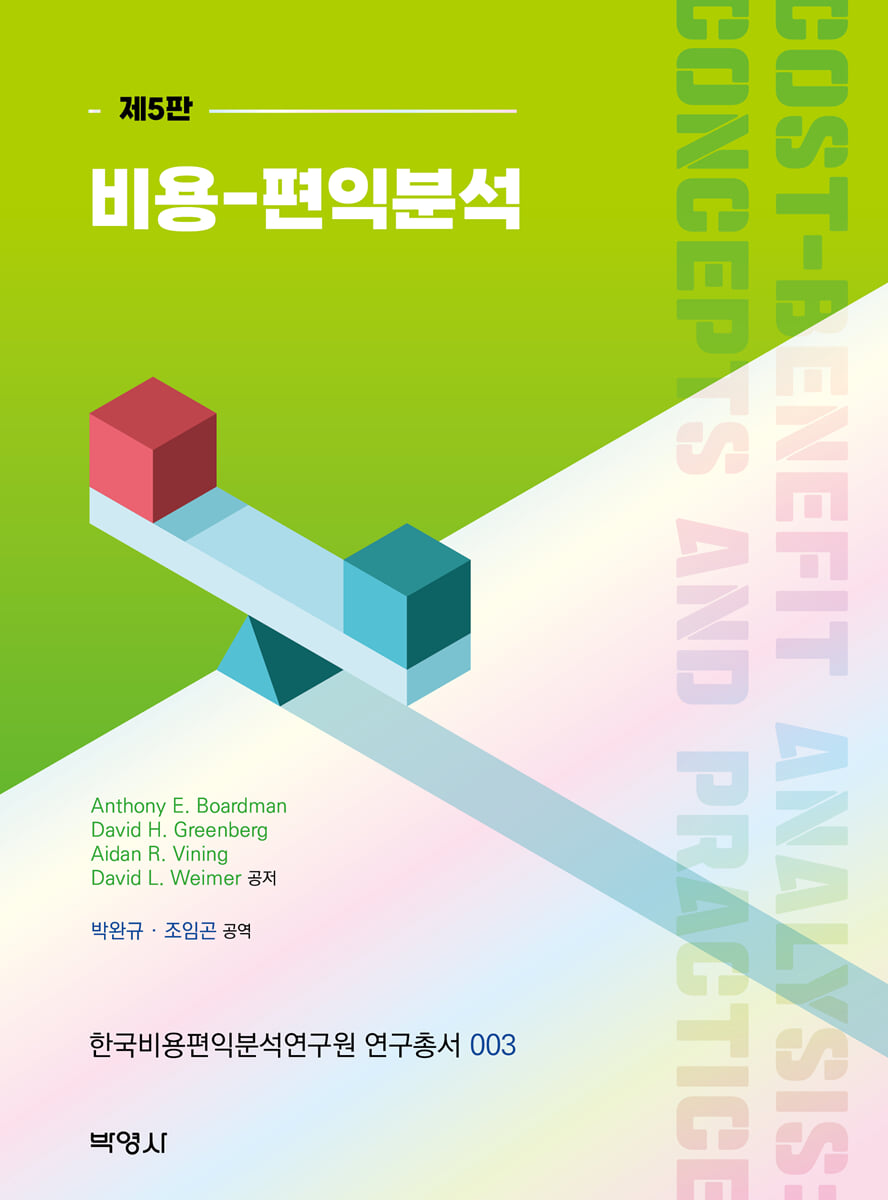
『Cost-Benefit Analysis』 is a translation of the world's most widely known book on cost-benefit analysis from an economics perspective.
index
Author's Preface i
Translator's Preface iii
CHAPTER 1: Introduction to Cost-Benefit Analysis 1
CHAPTER 2: THE CONCEPTUAL BASICS OF COST-BENEFIT ANALYSIS 39
CHAPTER 3: Microeconomic Foundations of Cost-Benefit Analysis 75
Appendix 3A Consumer Surplus and Willingness to Pay 105
CHAPTER 4 Measuring Influence from Observed Behavior: Direct Estimation of the Demand Curve 117
Appendix 4A Introduction to Multiple Regression Analysis 141
Case 4: Using Demand Curves in Regulatory Impact Analysis 149
CHAPTER 5: Valuing Impact in Output Markets 161
CHAPTER 6: Valuing Impact in Input Markets 193
CHAPTER 7: Valuing Influence in the Secondary Market 221
CHAPTER 8: Predicting and Monetizing Impacts 247
Case 8: WSIPP CBA 266 for the Nurse-Family Partnership Program
CHAPTER 9 Discounting Future Impacts and Treating Inflation 271
Appendix 9A: Formula for Calculating the Present Value of Fixed and Permanent Annuities 310
Case 9: CBA 316 for the Northeast Coal Mine Development Project
CHAPTER 10 The Social Discount Rate 321
CHAPTER 11 Dealing with Uncertainty: Expected Values, Sensitivity Analysis, and the Value of Information 359
Appendix 11A Monte Carlo Sensitivity Analysis Using Commonly Available Software 400
Case 11: Using Monte Carlo Simulation: Evaluating the Net Benefits of Early Detection of Alzheimer's Disease 409
CHAPTER 12 Risk, Option Price, and Option Value 417
Appendix 12A Option Value Code 442
CHAPTER 13: The Value of Existence 447
Appendix 13A Expenditure Function and Benefit Partitioning 460
CHAPTER 14 Evaluating the Impact of Observed Behavior: Experiments and Quasi-Experiments 467
Case 14: CBA Results for the Welfare-Job Program 502
CHAPTER 15 Evaluating the Impact of Observed Behavior: Indirect Market Methods 507
CHAPTER 16 Contingent Valuation: Using Surveys to Obtain Information About Costs and Benefits 551
Case 16: Estimating the Benefits of Higher Education Using Conditional Valuation 595
CHAPTER 17: Potential Prices Using Secondary Data 601
Case 17: Pricing the High School Diploma 651
CHAPTER 18 Cost-Effectiveness Analysis and Cost-Utility Analysis 659
CHAPTER 19 Distribution-Weighted CBA 693
Case 19: Tulsa Asset Development Support Program 720
CHAPTER 20 How Accurate Is CBA? 727
Biographical Index 746
Item Index 752
Translator's Preface iii
CHAPTER 1: Introduction to Cost-Benefit Analysis 1
CHAPTER 2: THE CONCEPTUAL BASICS OF COST-BENEFIT ANALYSIS 39
CHAPTER 3: Microeconomic Foundations of Cost-Benefit Analysis 75
Appendix 3A Consumer Surplus and Willingness to Pay 105
CHAPTER 4 Measuring Influence from Observed Behavior: Direct Estimation of the Demand Curve 117
Appendix 4A Introduction to Multiple Regression Analysis 141
Case 4: Using Demand Curves in Regulatory Impact Analysis 149
CHAPTER 5: Valuing Impact in Output Markets 161
CHAPTER 6: Valuing Impact in Input Markets 193
CHAPTER 7: Valuing Influence in the Secondary Market 221
CHAPTER 8: Predicting and Monetizing Impacts 247
Case 8: WSIPP CBA 266 for the Nurse-Family Partnership Program
CHAPTER 9 Discounting Future Impacts and Treating Inflation 271
Appendix 9A: Formula for Calculating the Present Value of Fixed and Permanent Annuities 310
Case 9: CBA 316 for the Northeast Coal Mine Development Project
CHAPTER 10 The Social Discount Rate 321
CHAPTER 11 Dealing with Uncertainty: Expected Values, Sensitivity Analysis, and the Value of Information 359
Appendix 11A Monte Carlo Sensitivity Analysis Using Commonly Available Software 400
Case 11: Using Monte Carlo Simulation: Evaluating the Net Benefits of Early Detection of Alzheimer's Disease 409
CHAPTER 12 Risk, Option Price, and Option Value 417
Appendix 12A Option Value Code 442
CHAPTER 13: The Value of Existence 447
Appendix 13A Expenditure Function and Benefit Partitioning 460
CHAPTER 14 Evaluating the Impact of Observed Behavior: Experiments and Quasi-Experiments 467
Case 14: CBA Results for the Welfare-Job Program 502
CHAPTER 15 Evaluating the Impact of Observed Behavior: Indirect Market Methods 507
CHAPTER 16 Contingent Valuation: Using Surveys to Obtain Information About Costs and Benefits 551
Case 16: Estimating the Benefits of Higher Education Using Conditional Valuation 595
CHAPTER 17: Potential Prices Using Secondary Data 601
Case 17: Pricing the High School Diploma 651
CHAPTER 18 Cost-Effectiveness Analysis and Cost-Utility Analysis 659
CHAPTER 19 Distribution-Weighted CBA 693
Case 19: Tulsa Asset Development Support Program 720
CHAPTER 20 How Accurate Is CBA? 727
Biographical Index 746
Item Index 752
Publisher's Review
Author's Preface
Collaborative academic projects often take longer than originally anticipated, not only because of the normal delays in coordinating the efforts of busy people, but also because initially modest goals become more ambitious as participants delve into the topic.
We confess these two sins in preparing the first edition of this book.
Our goal was to create a book that was conceptually sound, practical, and accessible to both students and practitioners.
Although our final product differs significantly in form and content from what we initially envisioned, we believe our first edition was that book.
Our plans evolved for a number of reasons.
Perhaps most importantly, our experience training civil servants in different jurisdictions and educating undergraduate and graduate students in different countries has taught us that if we are to effectively convey the essential fundamentals and build a solid foundation for further study of advanced topics, we need to cover many topics in greater depth.
We also decided that, in addition to presenting independent cases, it would be useful to integrate examples and illustrative examples with concepts and methods.
The result is a series of chapters that develop the conceptual foundations, application methods, and extensions of cost-benefit analysis (CBA) through numerous practical examples and illustrative examples.
Comments from other teachers and students, as well as our own use of this book for teaching, have helped us identify areas for further improvement in subsequent editions.
However, in this fifth edition, we have decided to take a fresh look at both the structure and the content.
In terms of structure, we have interwoven what provides the theoretical foundations with what shows how to implement them.
For example, a chapter introducing the basics of measuring the fluctuations of social surplus in the market was immediately followed by a chapter on estimating the demand curve.
In terms of content, we have added a number of case studies demonstrating the application of concepts in policy analysis.
For example, after the chapter on estimating demand curves, we provide examples showing the use and misuse of social surplus as a measure of benefit in regulatory impact analysis.
Other examples illustrate how to use evidence from multiple sources to arrive at net benefits, conduct Monte Carlo simulations to analyze uncertainty in net benefits, estimate costs and benefits from social experiments, use contingent valuation methods to assess the benefits of non-market goods, develop latent prices from multiple data sources, and weight costs and benefits to combine distributional values.
In its overview, this new fifth edition provides:
· Updated content and references
· Rearrangement of chapters to facilitate better integration of theory and technology
· Added six case studies providing extended examples of CBA techniques.
As with previous editions, answers to the chapter problems, including a spreadsheet that can be provided to students, are available to instructors.
Translator's Preface
Among the large-scale public projects that were promoted with a huge investment of taxpayer money, quite a few are failing to achieve their original purpose.
There have been many instances of wasteful taxpayer money, such as empty museums and exhibition halls due to miscalculations of user numbers, and light rail transit systems that have lost their function as a means of transportation, and this is likely to continue to happen in the future.
Why does this phenomenon keep recurring? The reason is, in a way, simple and clear.
Even if a specific project is necessary for the people or residents, it is important to determine whether the timing of its implementation is appropriate.
Public institutions, including national and local governments, must always keep budget constraints in mind when conducting projects.
The welfare of the people and residents should be the top priority for projects, and projects should be promoted taking into account budgetary conditions, but this is not always the case in reality.
For political reasons, certain projects are pushed forward at the expense of others, and sometimes they are pushed forward hastily because they are promises made by local government heads.
Even if it is a high priority project, the benefits and costs of the project must be carefully calculated, compared, and then promoted.
For this, it is important to make accurate predictions about the future.
Costs and benefits are typically estimated over a 30-year period, but given the pace at which the world changes these days, it's difficult to accurately predict even just one year into the future.
Nonetheless, by mobilizing all available information and making predictions as close to reality as possible, we can reduce the likelihood of such unfortunate events as those listed above occurring.
Cost-benefit analysis plays a crucial role in proactively preventing wasteful taxpayer money and promoting efficient use of limited resources. Organizations such as PIMAC, KISTEP, STEPI, LIMAC, and LOMAC have been conducting (preliminary) feasibility studies for national and local government projects.
Of course, public institutions are also conducting their own feasibility studies.
The problem is that validity studies require knowledge from multiple interdisciplinary fields.
Depending on the field of feasibility study, such as economics, public administration, environmental engineering, transportation engineering, or urban engineering, the benefit estimation methodology and cost estimation methodology may differ.
This book is a translation of the world's most widely known book on cost-benefit analysis from an economics perspective.
The PM responsible for the feasibility study is likely to have a background in engineering rather than economics.
At this time, the PM must have some knowledge of the economic methodology of cost-benefit analysis to be able to accurately judge whether the benefit or cost estimation performed by the external research team was performed properly.
This book is expected to be helpful for practitioners at research institutions conducting feasibility studies, as well as undergraduate and graduate students studying finance, public administration, environmental economics, resource economics, public administration, and urban engineering at universities, in acquiring a deeper and broader knowledge than existing books.
Moreover, this book offers a critical perspective on the government's current cost-benefit analysis guidelines, which, above all, passively reflect the benefits of public projects.
Going forward, cost-benefit analysts will need to boldly incorporate the various benefits introduced in this book when conducting cost-benefit analyses of various public projects. As these efforts accumulate, it is expected that the guidelines for cost-benefit analyses by central and local governments will be revised in a more desirable direction.
I would like to express my gratitude to the Korea Cost-Benefit Analysis Institute for providing financial support for the translation of this book, and to the staff at Parkyoungsa for embracing the uncertainties and risks of publishing the book.
For reference, the practice problem answers and spreadsheets can be downloaded from the library resource room on the Park Young-sa website.
August 2025
Park Wan-gyu and Jo Im-gon
Collaborative academic projects often take longer than originally anticipated, not only because of the normal delays in coordinating the efforts of busy people, but also because initially modest goals become more ambitious as participants delve into the topic.
We confess these two sins in preparing the first edition of this book.
Our goal was to create a book that was conceptually sound, practical, and accessible to both students and practitioners.
Although our final product differs significantly in form and content from what we initially envisioned, we believe our first edition was that book.
Our plans evolved for a number of reasons.
Perhaps most importantly, our experience training civil servants in different jurisdictions and educating undergraduate and graduate students in different countries has taught us that if we are to effectively convey the essential fundamentals and build a solid foundation for further study of advanced topics, we need to cover many topics in greater depth.
We also decided that, in addition to presenting independent cases, it would be useful to integrate examples and illustrative examples with concepts and methods.
The result is a series of chapters that develop the conceptual foundations, application methods, and extensions of cost-benefit analysis (CBA) through numerous practical examples and illustrative examples.
Comments from other teachers and students, as well as our own use of this book for teaching, have helped us identify areas for further improvement in subsequent editions.
However, in this fifth edition, we have decided to take a fresh look at both the structure and the content.
In terms of structure, we have interwoven what provides the theoretical foundations with what shows how to implement them.
For example, a chapter introducing the basics of measuring the fluctuations of social surplus in the market was immediately followed by a chapter on estimating the demand curve.
In terms of content, we have added a number of case studies demonstrating the application of concepts in policy analysis.
For example, after the chapter on estimating demand curves, we provide examples showing the use and misuse of social surplus as a measure of benefit in regulatory impact analysis.
Other examples illustrate how to use evidence from multiple sources to arrive at net benefits, conduct Monte Carlo simulations to analyze uncertainty in net benefits, estimate costs and benefits from social experiments, use contingent valuation methods to assess the benefits of non-market goods, develop latent prices from multiple data sources, and weight costs and benefits to combine distributional values.
In its overview, this new fifth edition provides:
· Updated content and references
· Rearrangement of chapters to facilitate better integration of theory and technology
· Added six case studies providing extended examples of CBA techniques.
As with previous editions, answers to the chapter problems, including a spreadsheet that can be provided to students, are available to instructors.
Translator's Preface
Among the large-scale public projects that were promoted with a huge investment of taxpayer money, quite a few are failing to achieve their original purpose.
There have been many instances of wasteful taxpayer money, such as empty museums and exhibition halls due to miscalculations of user numbers, and light rail transit systems that have lost their function as a means of transportation, and this is likely to continue to happen in the future.
Why does this phenomenon keep recurring? The reason is, in a way, simple and clear.
Even if a specific project is necessary for the people or residents, it is important to determine whether the timing of its implementation is appropriate.
Public institutions, including national and local governments, must always keep budget constraints in mind when conducting projects.
The welfare of the people and residents should be the top priority for projects, and projects should be promoted taking into account budgetary conditions, but this is not always the case in reality.
For political reasons, certain projects are pushed forward at the expense of others, and sometimes they are pushed forward hastily because they are promises made by local government heads.
Even if it is a high priority project, the benefits and costs of the project must be carefully calculated, compared, and then promoted.
For this, it is important to make accurate predictions about the future.
Costs and benefits are typically estimated over a 30-year period, but given the pace at which the world changes these days, it's difficult to accurately predict even just one year into the future.
Nonetheless, by mobilizing all available information and making predictions as close to reality as possible, we can reduce the likelihood of such unfortunate events as those listed above occurring.
Cost-benefit analysis plays a crucial role in proactively preventing wasteful taxpayer money and promoting efficient use of limited resources. Organizations such as PIMAC, KISTEP, STEPI, LIMAC, and LOMAC have been conducting (preliminary) feasibility studies for national and local government projects.
Of course, public institutions are also conducting their own feasibility studies.
The problem is that validity studies require knowledge from multiple interdisciplinary fields.
Depending on the field of feasibility study, such as economics, public administration, environmental engineering, transportation engineering, or urban engineering, the benefit estimation methodology and cost estimation methodology may differ.
This book is a translation of the world's most widely known book on cost-benefit analysis from an economics perspective.
The PM responsible for the feasibility study is likely to have a background in engineering rather than economics.
At this time, the PM must have some knowledge of the economic methodology of cost-benefit analysis to be able to accurately judge whether the benefit or cost estimation performed by the external research team was performed properly.
This book is expected to be helpful for practitioners at research institutions conducting feasibility studies, as well as undergraduate and graduate students studying finance, public administration, environmental economics, resource economics, public administration, and urban engineering at universities, in acquiring a deeper and broader knowledge than existing books.
Moreover, this book offers a critical perspective on the government's current cost-benefit analysis guidelines, which, above all, passively reflect the benefits of public projects.
Going forward, cost-benefit analysts will need to boldly incorporate the various benefits introduced in this book when conducting cost-benefit analyses of various public projects. As these efforts accumulate, it is expected that the guidelines for cost-benefit analyses by central and local governments will be revised in a more desirable direction.
I would like to express my gratitude to the Korea Cost-Benefit Analysis Institute for providing financial support for the translation of this book, and to the staff at Parkyoungsa for embracing the uncertainties and risks of publishing the book.
For reference, the practice problem answers and spreadsheets can be downloaded from the library resource room on the Park Young-sa website.
August 2025
Park Wan-gyu and Jo Im-gon
GOODS SPECIFICS
- Date of issue: August 30, 2025
- Page count, weight, size: 768 pages | 188*257*40mm
- ISBN13: 9791130323879
- ISBN10: 1130323870
You may also like
카테고리
korean


korean

![GQ KOREA Mark (Monthly): December [2025]](http://librairie.coreenne.fr/cdn/shop/files/8ef265dbbfbf186523ed75ba7319009d.jpg?v=1765340328&width=3840)


