

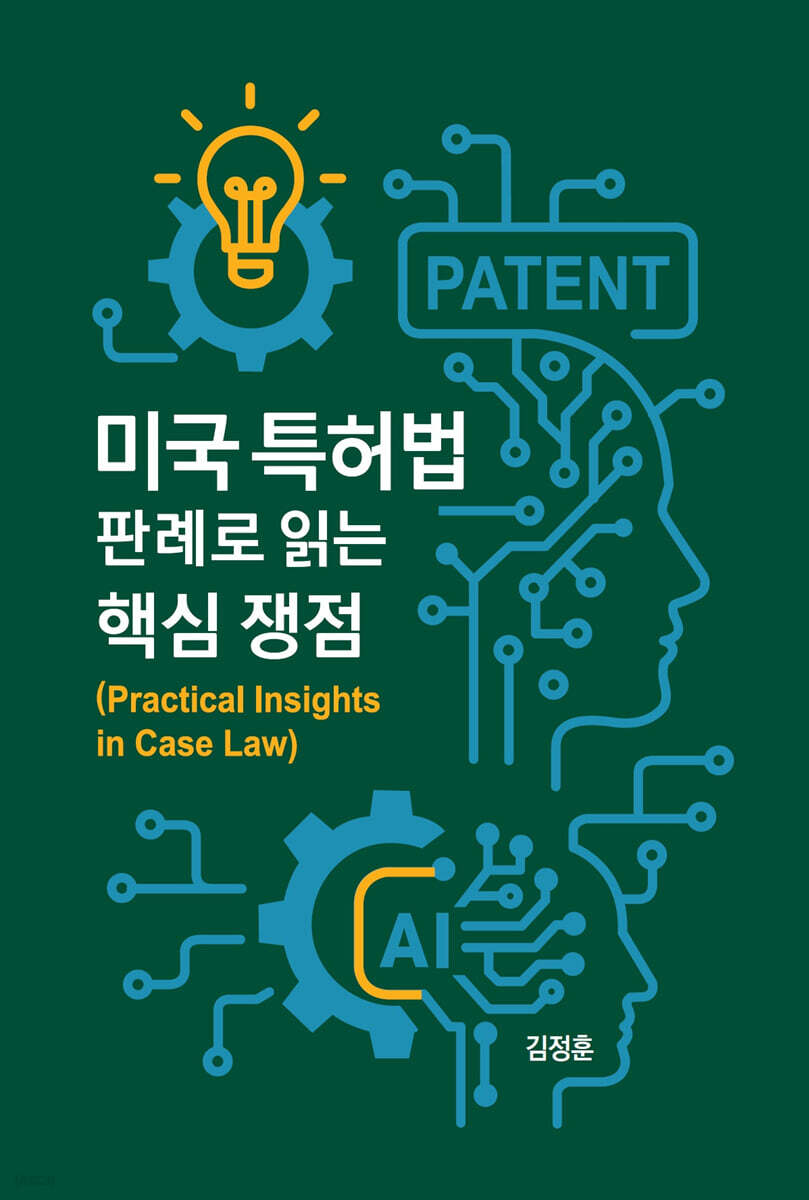
U.S. Patent Law: Key Issues Understood Through Case Law
 |
Description
Book Introduction
The United States has a dispute-centered institutional structure with frequent patent litigation.
Therefore, a company's patent officer must be able to write specifications and perform patent analysis based on an understanding of the dispute.
This allows companies to secure competitive patents, negotiate efficient licenses, and effectively respond to patent disputes.
Recent patent case law provides practical insights that address these practical needs.
This book aims to explain the key concepts and interpretations of U.S. patent law through federal court decisions.
Regarding the important provisions of the Patent Act, representative precedents (landmark cases) related to the main patent requirements for each provision were explained, focusing on recent cases.
In addition, some of the important precedents defining each requirement are included, even if they are not recent cases, and are organized around the key issues of the cases.
In addition, we selected major topics such as patent claim construction, doctrine of equivalents, design patents, patent applicants' duty of candor, claims for damages due to foreign sales, and patent law issues related to artificial intelligence (AI), and explained the key issues for each topic based on representative case law.
Patent case decisions not only feature inventions from various scientific and engineering fields, but also discuss a variety of legal issues, including the Constitution, contract law, and the Rules of Civil Procedure (FRCP), making it difficult to grasp and understand their contents.
Nonetheless, because the judge logically explains the core concepts of patent law based on the facts of the case, the judgment can be a more useful learning tool than any other material for understanding patent law.
Therefore, a company's patent officer must be able to write specifications and perform patent analysis based on an understanding of the dispute.
This allows companies to secure competitive patents, negotiate efficient licenses, and effectively respond to patent disputes.
Recent patent case law provides practical insights that address these practical needs.
This book aims to explain the key concepts and interpretations of U.S. patent law through federal court decisions.
Regarding the important provisions of the Patent Act, representative precedents (landmark cases) related to the main patent requirements for each provision were explained, focusing on recent cases.
In addition, some of the important precedents defining each requirement are included, even if they are not recent cases, and are organized around the key issues of the cases.
In addition, we selected major topics such as patent claim construction, doctrine of equivalents, design patents, patent applicants' duty of candor, claims for damages due to foreign sales, and patent law issues related to artificial intelligence (AI), and explained the key issues for each topic based on representative case law.
Patent case decisions not only feature inventions from various scientific and engineering fields, but also discuss a variety of legal issues, including the Constitution, contract law, and the Rules of Civil Procedure (FRCP), making it difficult to grasp and understand their contents.
Nonetheless, because the judge logically explains the core concepts of patent law based on the facts of the case, the judgment can be a more useful learning tool than any other material for understanding patent law.
- You can preview some of the book's contents.
Preview
index
(Part 1) Patentability Requirements
Jurisdiction in US Patent Infringement Litigation
Appellate Court Standard of Review
35 USC
§101 Patentable Inventions: Patentable Subject Matter; Abstract Idea; Inventorship; Obviousness-Type Double Patenting
35 USC
§102 Novelty: Novelty; Prior Art; Exclusion of Prior Art from Intervening Disclosure; Inherency; On-sale Bar
35 USC
§103 Non-Obvious Subject Matter: Graham Framework; Expansive and Flexible Approach; Prima Facie Case of Obviousness; Analogous Art; Level of Ordinary Skill; Motivation to Combine; Obvious to Try; Teach Away; Secondary Considerations
35 USC
§112 Specification (a): Written Description; Enablement
35 USC
§112 Specification (b): Claim Definiteness Requirement
(Part 2) In-depth Discussion (Selected Topics)
Claim Construction: Ordinary and Customary Meaning; Prosecution Disclaimer; Own Lexicographer Rule; Disavowal; Means-plus-Function Claim; Preamble
Doctrine of Equivalents: Prosecution History Estoppel; Reversal of Festo Presumption; Disclosure-Dedication Rule; Claim Vitiation; Ensnarement; Judgments Specifying Limited Exceptions to Patent Infringement; Whether Responding to a Limited Claim Limits Claims of Equivalent Infringement
Design Patent: Article of Manufacture; Ornamental Feature; Non-obviousness Test; Ordinary Observer Test; Design Patent Application Process Estoppel
Patent Applicant's Duty of Candor: 35 USC
§115 Inventor's Oath; Criteria for Judging Inequitable Conduct; Claiming Invalidity of Patent Based on Prior Art Submitted in an IDS
Claims for Damages in Foreign Sales: 35 USC
§271 Infringement of Patent (f)(2); Claim for damages for foreign lost profits
Artificial Intelligence: Inventorship of AI Software, Patent Eligibility of AI Inventions, Enablement Requirements for AI Inventions
Jurisdiction in US Patent Infringement Litigation
Appellate Court Standard of Review
35 USC
§101 Patentable Inventions: Patentable Subject Matter; Abstract Idea; Inventorship; Obviousness-Type Double Patenting
35 USC
§102 Novelty: Novelty; Prior Art; Exclusion of Prior Art from Intervening Disclosure; Inherency; On-sale Bar
35 USC
§103 Non-Obvious Subject Matter: Graham Framework; Expansive and Flexible Approach; Prima Facie Case of Obviousness; Analogous Art; Level of Ordinary Skill; Motivation to Combine; Obvious to Try; Teach Away; Secondary Considerations
35 USC
§112 Specification (a): Written Description; Enablement
35 USC
§112 Specification (b): Claim Definiteness Requirement
(Part 2) In-depth Discussion (Selected Topics)
Claim Construction: Ordinary and Customary Meaning; Prosecution Disclaimer; Own Lexicographer Rule; Disavowal; Means-plus-Function Claim; Preamble
Doctrine of Equivalents: Prosecution History Estoppel; Reversal of Festo Presumption; Disclosure-Dedication Rule; Claim Vitiation; Ensnarement; Judgments Specifying Limited Exceptions to Patent Infringement; Whether Responding to a Limited Claim Limits Claims of Equivalent Infringement
Design Patent: Article of Manufacture; Ornamental Feature; Non-obviousness Test; Ordinary Observer Test; Design Patent Application Process Estoppel
Patent Applicant's Duty of Candor: 35 USC
§115 Inventor's Oath; Criteria for Judging Inequitable Conduct; Claiming Invalidity of Patent Based on Prior Art Submitted in an IDS
Claims for Damages in Foreign Sales: 35 USC
§271 Infringement of Patent (f)(2); Claim for damages for foreign lost profits
Artificial Intelligence: Inventorship of AI Software, Patent Eligibility of AI Inventions, Enablement Requirements for AI Inventions
Into the book
It is not easy to grasp and understand the content of the judgment of a patent case because it not only features inventions from various scientific and engineering fields, but also discusses various legal issues such as the Constitution, contract law, and the Rules of Civil Procedure (FRCP) in addition to patent law.
Nonetheless, because the judge logically explains the core concepts of patent law based on the facts of the case, the judgment can be a more useful learning tool than any other material for understanding patent law.
--- p.3
An application estoppel occurs when (1) a claim is narrowed (amendment-based estoppel) or (2) an examiner's rejection is appealed (argument-based estoppel).
For estoppel by defense to be established, there must be a clear and unmistakable waiver in the filing history.
Conoco, Inc.
v. Energy & Envtl.
Int'l, LC, 460 F.3d 1349 (Fed.
Cir.
2006) If an applicant presents multiple grounds to distinguish his invention from the prior art, each claim may individually give rise to estoppel unless the prior art is overcome based on a combination of the various grounds.
An assertion that is clearly made to overcome a ground for rejection may give rise to estoppel regardless of whether the ground for rejection is overcome by the assertion and patentability is recognized.
The key question is whether the competitor reasonably believed that the applicant had abandoned the relevant subject matter. PODS, Inc.
v. Porta Stor, Inc., 484 F.3d 1359 (Fed.
Cir.
2007)
--- p.269
In design patents, the concepts of literal infringement and equivalent infringement are intertwined.
The provisions on infringement of design patents do not require literal identity, and impose liability on anyone who, without the permission of the patentee, (1) applies the patented design or a colorable imitation thereof to a manufactured article and sells it, or (2) sells or exposes for sale a manufactured article to which such design or a colorable imitation thereof has been applied.
35 USC
§289 The Gorham court ruled that a design patent infringement is determined when two designs are substantially the same and the similarity would confuse an ordinary observer, leading to a purchase by mistake and mistaking the product for another, when the ordinary observer, as a purchaser, would exercise the care normally exercised by the purchaser.
He pointed out that if the standard for determining infringement were to require the exact reproduction of all elements of a patented design, then infringement would not be possible due to the limitations of human creativity.
Gorham Mfg.
Co.
v. White, 81 US
511 (1871)
--- p.342
The CAFC has long recognized that abstract concepts are not made less abstract simply by confining the invention to a particular field or technological environment.
Intel.
Ventures I LLC v.
Capital One Bank (USA), 792 F.3d 1363 (Fed.
Cir.
2015) also confirmed that simply applying existing techniques to a new database does not convert them to patent eligibility. SAP Am., Inc.
v. InvestPic, LLC, 898 F.3d 1161 (Fed.
Cir.
2018) Ultimately, the claimed invention is not patent eligible simply because it uses known machine learning techniques to perform tasks previously performed by humans faster and more efficiently.
Nonetheless, because the judge logically explains the core concepts of patent law based on the facts of the case, the judgment can be a more useful learning tool than any other material for understanding patent law.
--- p.3
An application estoppel occurs when (1) a claim is narrowed (amendment-based estoppel) or (2) an examiner's rejection is appealed (argument-based estoppel).
For estoppel by defense to be established, there must be a clear and unmistakable waiver in the filing history.
Conoco, Inc.
v. Energy & Envtl.
Int'l, LC, 460 F.3d 1349 (Fed.
Cir.
2006) If an applicant presents multiple grounds to distinguish his invention from the prior art, each claim may individually give rise to estoppel unless the prior art is overcome based on a combination of the various grounds.
An assertion that is clearly made to overcome a ground for rejection may give rise to estoppel regardless of whether the ground for rejection is overcome by the assertion and patentability is recognized.
The key question is whether the competitor reasonably believed that the applicant had abandoned the relevant subject matter. PODS, Inc.
v. Porta Stor, Inc., 484 F.3d 1359 (Fed.
Cir.
2007)
--- p.269
In design patents, the concepts of literal infringement and equivalent infringement are intertwined.
The provisions on infringement of design patents do not require literal identity, and impose liability on anyone who, without the permission of the patentee, (1) applies the patented design or a colorable imitation thereof to a manufactured article and sells it, or (2) sells or exposes for sale a manufactured article to which such design or a colorable imitation thereof has been applied.
35 USC
§289 The Gorham court ruled that a design patent infringement is determined when two designs are substantially the same and the similarity would confuse an ordinary observer, leading to a purchase by mistake and mistaking the product for another, when the ordinary observer, as a purchaser, would exercise the care normally exercised by the purchaser.
He pointed out that if the standard for determining infringement were to require the exact reproduction of all elements of a patented design, then infringement would not be possible due to the limitations of human creativity.
Gorham Mfg.
Co.
v. White, 81 US
511 (1871)
--- p.342
The CAFC has long recognized that abstract concepts are not made less abstract simply by confining the invention to a particular field or technological environment.
Intel.
Ventures I LLC v.
Capital One Bank (USA), 792 F.3d 1363 (Fed.
Cir.
2015) also confirmed that simply applying existing techniques to a new database does not convert them to patent eligibility. SAP Am., Inc.
v. InvestPic, LLC, 898 F.3d 1161 (Fed.
Cir.
2018) Ultimately, the claimed invention is not patent eligible simply because it uses known machine learning techniques to perform tasks previously performed by humans faster and more efficiently.
--- p.394
GOODS SPECIFICS
- Date of issue: August 20, 2025
- Page count, weight, size: 407 pages | 120g | 152*225*19mm
- ISBN13: 9791199342101
- ISBN10: 1199342106
You may also like
카테고리
korean


korean

![GQ KOREA Mark (Monthly): December [2025]](http://librairie.coreenne.fr/cdn/shop/files/8ef265dbbfbf186523ed75ba7319009d.jpg?v=1765340328&width=3840)


