

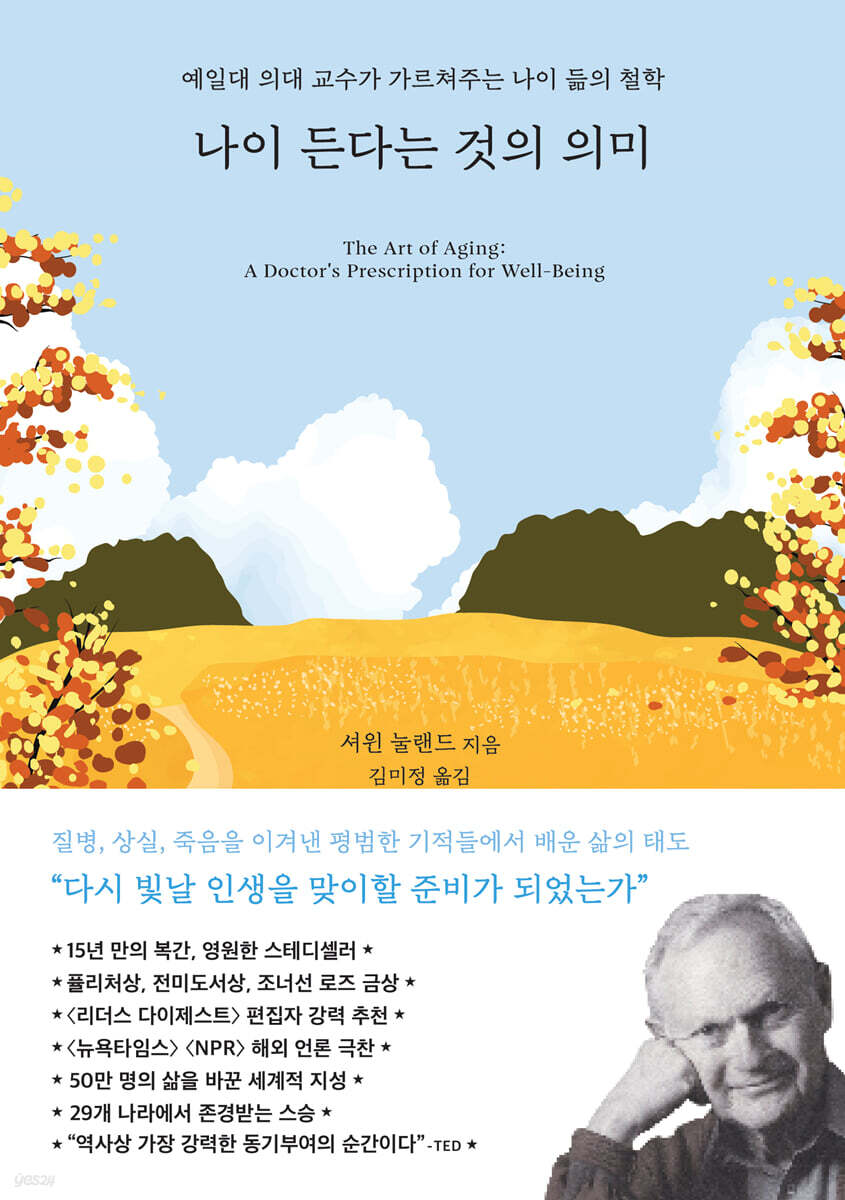
What it means to grow old
 |
Description
Book Introduction
★ Winner of the Pulitzer Prize, National Book Award, and Jonathan Rose Gold Medal
★ A world-renowned intellectual who changed the lives of 500,000 people in 29 countries.
★Rave reviews from international media outlets such as the New York Times and NPR
★Highly recommended by the Reader's Digest editors
★ Copyright exported to 7 countries including Germany, the Netherlands, and Taiwan
★“The most powerful motivational story in history” - TED
Sherwin Nuland, the physician and philosopher who sparked the euthanasia and well-dying craze in American society, has republished his book, "How We Age," 15 years later, with a new, deeper philosophy, titled "What It Means to Age." TED CEO Chris Anderson called Sherwin Nuland's story "the most powerful motivational moment in history," a story that infuses all those who age with a vibrant vitality.
The author is convinced that “getting older is a blessing.”
Not only do we see life with a better perspective than when we were younger, but medically speaking, our brains become wiser as time goes by.
This beautiful shift in perspective is what will keep readers coming back for more of this book.
In Korea, which has become a super-aged society, we face the challenge of ensuring a successful old age.
This timeless classic, filled with wisdom that applies across time, will teach us the secrets to living the rest of our lives more happily.
★ A world-renowned intellectual who changed the lives of 500,000 people in 29 countries.
★Rave reviews from international media outlets such as the New York Times and NPR
★Highly recommended by the Reader's Digest editors
★ Copyright exported to 7 countries including Germany, the Netherlands, and Taiwan
★“The most powerful motivational story in history” - TED
Sherwin Nuland, the physician and philosopher who sparked the euthanasia and well-dying craze in American society, has republished his book, "How We Age," 15 years later, with a new, deeper philosophy, titled "What It Means to Age." TED CEO Chris Anderson called Sherwin Nuland's story "the most powerful motivational moment in history," a story that infuses all those who age with a vibrant vitality.
The author is convinced that “getting older is a blessing.”
Not only do we see life with a better perspective than when we were younger, but medically speaking, our brains become wiser as time goes by.
This beautiful shift in perspective is what will keep readers coming back for more of this book.
In Korea, which has become a super-aged society, we face the challenge of ensuring a successful old age.
This timeless classic, filled with wisdom that applies across time, will teach us the secrets to living the rest of our lives more happily.
- You can preview some of the book's contents.
Preview
index
1.
Possibility | Age is a horizon that reveals new possibilities.
2.
Maturity | The tree of knowledge and experience continues to branch out.
3.
Attitude | How you live is more important than how long you live.
4.
Choice | As long as you're alive, you can make better choices.
5.
Courage | How Adversity Makes Us Stronger
6.
Relationships | As long as you love and are loved, there is a reason to live.
7.
Aging | Life is valuable because it is finite
8.
Change | Some Ways to Love the Changed Me
9.
Wisdom | How to Acquire Wisdom
10.
Creativity | Creativity is life's new passion.
Acknowledgements
Possibility | Age is a horizon that reveals new possibilities.
2.
Maturity | The tree of knowledge and experience continues to branch out.
3.
Attitude | How you live is more important than how long you live.
4.
Choice | As long as you're alive, you can make better choices.
5.
Courage | How Adversity Makes Us Stronger
6.
Relationships | As long as you love and are loved, there is a reason to live.
7.
Aging | Life is valuable because it is finite
8.
Change | Some Ways to Love the Changed Me
9.
Wisdom | How to Acquire Wisdom
10.
Creativity | Creativity is life's new passion.
Acknowledgements
Detailed image

Into the book
1.
We must establish a new, purified sense of purpose and learn how to escape from the trap.
The word 'attune' is pronounced similarly to 'atone'.
'Atone' is an abbreviation of 'at one', meaning 'in harmony', especially 'in harmony with oneself'.
To align oneself with a progressive perspective on life is to become one with time, present and future.
Through such attunement, we gain a new form of peace, one we have never known or expected.
--- 「1.
Possibility | Age is a horizon that shows new possibilities.
2.
As we mature, our communication with our ecological niche becomes increasingly refined, and the tree of knowledge and experience continues to branch out.
So, it becomes a vast structure that increases the number of reference points where newly incoming data can be established.
The older brain is a vast and expansive storehouse of information.
As time goes by and we continue to learn more, the entry points will expand and additional information will be inputted more broadly.
In this way, the mind perceives, learns, integrates, and uses information, making up for the loss of long-term capacity over time.
The brain may age, but the mind continues to grow.
If used well, the older brain becomes more useful and sometimes even wiser than before.
--- 「2.
From “Maturity | The tree of knowledge and experience continues to branch out”
3.
We are rewarded for this life when we realize that we have dedicated ourselves to something worthwhile.
We are rewarded for this life when we become aware of the good our actions have ignited.
We are rewarded for this life when we become aware of the people we have helped while we were in this world.
All of this is a form of love, and that is the greatest reward of all.
--- 「3.
Attitude | How to live is more important than how long to live.
4.
Whatever the adversity, in the afternoon of life, we must suppress our fiercely competitive impulses and instincts and make choices that will satisfy others.
Once you decide to do something, no matter how difficult it may seem, you must take action.
Over time, the behavior will become more and more familiar and eventually become an honorable habit.
As Miriam Gabler and Pete Barker did.
--- From "Choice | You Can Make Better Choices While You're Alive"
5.
Successfully improving our own lives doesn't simply mean that we move forward more easily with gentle encouragement or support from those who hold our hands firmly and keep us steady as we take uncertain steps.
Sometimes, instead of gently holding the hand of the person you love, you have to push hard.
When we feel like we can't do something and hold back, those who love us can push, pull, and sometimes criticize us harshly, while helping us make the right choices.
--- From "Courage | How Adversity Makes Us Stronger"
6.
We soon found ourselves discussing what it would take to continue to play a vital role within the confines of our families and society—to clarify purpose, provide value, and uphold dignity—as we age.
Young people owe a debt to their elders, and the elders owe a debt to the young people.
In this way, they live by acknowledging each other's value.
As always, this approach helps others in their lives.
And as always, there are relationships within it.
--- From "Relationships | As long as you love and are loved, there is a reason to live"
7.
Francis Bacon, the father of scientific methodology in the 17th century, wrote:
“If you want to master nature, you must obey her.” About 500 years ago, Montaigne foretold the prolongation of life for futurists who would come much later.
He gave his readers and descendants a prescient warning that humans should never interfere with the affairs of nature, because “nature knows her own affairs better than we do.”
--- From "Growing Old | Life is Valuable Because It is Finite"
8.
If some older people believe that wearing partial or full wigs will make them look a little younger, we don't laugh at that.
We can simply view such behavior as an expression of a desire to remain young.
Perhaps this wish will be the first step toward changing a long-held bad habit and purchasing a gym membership.
Vanity is like the raisins in a child's cereal, and pride is like the rich flavor that keeps the child eating the cereal.
--- 「8.
Change | Some Ways to Love the Changed Me
9.
Reflect, but be faithful to your decisions and actions.
Be idealistic, but keep your feet on the ground.
We must cultivate peace of mind, yet be sufficiently dissatisfied to fuel the engine of necessary reform.
Embrace cultural change, but understand that such change is only temporary.
Think beyond time, but live in the present.
Consider the values of society and the times, but do not be bound by them.
Appeal to others to show their best, but don't expect more than they are capable of delivering.
We must live in the reality of today while still holding onto the vision of a better tomorrow.
--- 「9.
Wisdom | How to Acquire Wisdom
10.
Carlyle said, “Our task is not to see what lies dimly in the distance, but to practice what lies clearly at hand.”
No matter how old we are, we must live actively in the present.
He sometimes argued that one must climb a mountain to gain the wisdom to see everything that unfolds before one's eyes.
While you can plan for your future hopes, you must focus on the present to approach the time that lies ahead.
“Immersing yourself in what you do during this time is the best guarantee for ultimate success.”
We must establish a new, purified sense of purpose and learn how to escape from the trap.
The word 'attune' is pronounced similarly to 'atone'.
'Atone' is an abbreviation of 'at one', meaning 'in harmony', especially 'in harmony with oneself'.
To align oneself with a progressive perspective on life is to become one with time, present and future.
Through such attunement, we gain a new form of peace, one we have never known or expected.
--- 「1.
Possibility | Age is a horizon that shows new possibilities.
2.
As we mature, our communication with our ecological niche becomes increasingly refined, and the tree of knowledge and experience continues to branch out.
So, it becomes a vast structure that increases the number of reference points where newly incoming data can be established.
The older brain is a vast and expansive storehouse of information.
As time goes by and we continue to learn more, the entry points will expand and additional information will be inputted more broadly.
In this way, the mind perceives, learns, integrates, and uses information, making up for the loss of long-term capacity over time.
The brain may age, but the mind continues to grow.
If used well, the older brain becomes more useful and sometimes even wiser than before.
--- 「2.
From “Maturity | The tree of knowledge and experience continues to branch out”
3.
We are rewarded for this life when we realize that we have dedicated ourselves to something worthwhile.
We are rewarded for this life when we become aware of the good our actions have ignited.
We are rewarded for this life when we become aware of the people we have helped while we were in this world.
All of this is a form of love, and that is the greatest reward of all.
--- 「3.
Attitude | How to live is more important than how long to live.
4.
Whatever the adversity, in the afternoon of life, we must suppress our fiercely competitive impulses and instincts and make choices that will satisfy others.
Once you decide to do something, no matter how difficult it may seem, you must take action.
Over time, the behavior will become more and more familiar and eventually become an honorable habit.
As Miriam Gabler and Pete Barker did.
--- From "Choice | You Can Make Better Choices While You're Alive"
5.
Successfully improving our own lives doesn't simply mean that we move forward more easily with gentle encouragement or support from those who hold our hands firmly and keep us steady as we take uncertain steps.
Sometimes, instead of gently holding the hand of the person you love, you have to push hard.
When we feel like we can't do something and hold back, those who love us can push, pull, and sometimes criticize us harshly, while helping us make the right choices.
--- From "Courage | How Adversity Makes Us Stronger"
6.
We soon found ourselves discussing what it would take to continue to play a vital role within the confines of our families and society—to clarify purpose, provide value, and uphold dignity—as we age.
Young people owe a debt to their elders, and the elders owe a debt to the young people.
In this way, they live by acknowledging each other's value.
As always, this approach helps others in their lives.
And as always, there are relationships within it.
--- From "Relationships | As long as you love and are loved, there is a reason to live"
7.
Francis Bacon, the father of scientific methodology in the 17th century, wrote:
“If you want to master nature, you must obey her.” About 500 years ago, Montaigne foretold the prolongation of life for futurists who would come much later.
He gave his readers and descendants a prescient warning that humans should never interfere with the affairs of nature, because “nature knows her own affairs better than we do.”
--- From "Growing Old | Life is Valuable Because It is Finite"
8.
If some older people believe that wearing partial or full wigs will make them look a little younger, we don't laugh at that.
We can simply view such behavior as an expression of a desire to remain young.
Perhaps this wish will be the first step toward changing a long-held bad habit and purchasing a gym membership.
Vanity is like the raisins in a child's cereal, and pride is like the rich flavor that keeps the child eating the cereal.
--- 「8.
Change | Some Ways to Love the Changed Me
9.
Reflect, but be faithful to your decisions and actions.
Be idealistic, but keep your feet on the ground.
We must cultivate peace of mind, yet be sufficiently dissatisfied to fuel the engine of necessary reform.
Embrace cultural change, but understand that such change is only temporary.
Think beyond time, but live in the present.
Consider the values of society and the times, but do not be bound by them.
Appeal to others to show their best, but don't expect more than they are capable of delivering.
We must live in the reality of today while still holding onto the vision of a better tomorrow.
--- 「9.
Wisdom | How to Acquire Wisdom
10.
Carlyle said, “Our task is not to see what lies dimly in the distance, but to practice what lies clearly at hand.”
No matter how old we are, we must live actively in the present.
He sometimes argued that one must climb a mountain to gain the wisdom to see everything that unfolds before one's eyes.
While you can plan for your future hopes, you must focus on the present to approach the time that lies ahead.
“Immersing yourself in what you do during this time is the best guarantee for ultimate success.”
--- 「10.
Creativity | Creativity is the new passion of life"
Creativity | Creativity is the new passion of life"
Publisher's Review
“Age is not an obstacle, but a horizon that indicates the direction of life.”
The Keys to Successful Aging, According to a Yale Medical School Professor
"The Meaning of Growing Old" is a book of life lessons from Sherwin Nuland, recipient of the Jonathan Rose Gold Medal, an award given to outstanding physicians and philosophers. It is a book filled with wisdom for successfully spending the afternoon of life that comes equally to everyone.
It's often thought that as we get older, our abilities decrease and our future disappears.
But for the author, age is paradoxically a 'good limit' and a 'horizon' that indicates an end.
Because each passing year reminds me of the preciousness of today, something I didn't realize in my youth due to the infinite possibilities.
The very fact that time is finite makes things we might have inadvertently overlooked—love, learning, family, work, health—more valuable. (p. 18) The author emphasizes that aging is a state, not a result, and that we can change the direction of our old age for the better through our choices.
The phrase "act your age" can be interpreted, if viewed slightly differently, as "soothe the arrogance of youth and live life with a prudent sense of reality." This reminds us that even as we age, we can continue to grow. (p. 23)
The author also explores what it means to grow old as a physician.
We usually calculate our lives in 10-year increments, and when the last morning of our 59th birthday comes, we feel upset as if we have become old. However, medical science has proven that humans are beings that change according to biochemical changes in the body and reactions that occur in the mind rather than artificial divisions of time.
So, while we must be sensitive to the changes in our mind and body, we must also be aware of this and not easily succumb to time.
Then, we will finally be free from the age-obsession that binds us, able to live as individuals with unique personalities true to our true selves, and liberated from the rigidity of our thinking. (p. 24)
“As long as you live, do not allow yourself the luxury of defeat.”
Life lessons learned from ordinary miracles that overcome illness, loss, loneliness, and death.
Can someone who has considered suicide find a reason to live again? What makes a cancer patient who has to care for a spouse happy? Where does the strength to live authentically while working after retirement come from? How do I form loving relationships that protect me from loneliness? How can I live a healthy life on my own?
The author embarks on an extraordinary journey to find the keys to the challenges of old age: illness, loss, retirement, loneliness, and death.
If we meet those who have practiced the art of aging well and learn how old age enriches life, we too can reduce our trial and error.
Dr. DeBakey (page 75), who says that the secret to staying healthy enough to perform surgeries until the age of 90 was the reciprocal 'love' he gave and received from patients; Miriam Gabler (page 105), who says that she can actively 'choose' happiness despite caring for her husband and battling her own illness; Pete Barker (page 123), who 'challenged' his favorite hobbies and a new job even after retirement; actress Patricia Neal (page 139), who overcame a stroke with 'courage'; Ruby Chatterjee (page 173), who attempted suicide but realized that 'friendship' is worth living for after becoming friends with the author; these stories of about 10 people who are living their old age with great wisdom serve as excellent textbooks for the vastness of life.
Of the several lessons we can learn from Ruby's story, the one most relevant to those of us who grow increasingly pessimistic as we age is this one:
“Never allow yourself the luxury of despair.” Of course, you can give up everything and live the way you want.
It's easy to give in to pessimism, so when dark clouds approach, the strong will to keep going and the courageous heart that keeps pushing forward are likely to be swept away.
But as Ruby agrees, the fear of growing older is worse than the reality of growing older itself (p. 215).
The author likens the process of finding lessons from those who have come before us and applying them to our lives to the process of sowing seeds and harvesting them.
If you learn from these life masters and arm yourself mentally, you will be able to enjoy a solid and abundant old age.
How to Live a Life of Over 100 Years
How to live a full life, even if it's just one day, rather than a meaningless long life
The term "slow aging" or "young forty" has become popular, and the main concern of all generations these days is how to live as long and as young as possible.
This topic, which is even more heated and pervasive than when it was first published in Korea in 2010, is a timely example of how we often view aging and aging negatively, dismissing them as something to be 'fixed.'
But is it truly right to live a long and meaningless life without proper reflection on the inevitable aging process? Quoting the philosopher Carlyle, the author emphasizes, "Our task is not to see what lies dimly in the distance, but to act upon what lies clearly at hand." (p. 327)
The author believes that the reason we can cherish this moment more is because of the limitations of age.
The author meets with the extreme immortalist Aubrey de Grey and engages in a heated debate to find an answer to this question.
And, mentioning the side effects of the desire to live hundreds of years in a young body, he emphasizes that what we truly need is not a meaningless longevity, but an attitude of living in the present to the best of our ability within the given limitations.
The author urges us to cultivate the strength to live our old age in our own way as a way to achieve this.
But it doesn't talk about financial preparation or thorough health checkups, as other books emphasize.
Instead, he emphasizes that we should prepare emotionally by accumulating knowledge and wisdom as if saving a pension for old age (p. 331). He says that the way to truly be free from age does not depend on hospitals filled with all kinds of medicines and treatments, but on mental armament that does not collapse in the face of illness and death (p. 332). These virtues include creativity that allows us to continue to taste victory through a sense of accomplishment; caritas, another form of love that benefits the lives of others; and self-understanding that embraces oneself.
After reading this book, those in their final days will find answers to enrich the remainder of their lives, and young people will gain a bright sense of anticipation for the future.
The Keys to Successful Aging, According to a Yale Medical School Professor
"The Meaning of Growing Old" is a book of life lessons from Sherwin Nuland, recipient of the Jonathan Rose Gold Medal, an award given to outstanding physicians and philosophers. It is a book filled with wisdom for successfully spending the afternoon of life that comes equally to everyone.
It's often thought that as we get older, our abilities decrease and our future disappears.
But for the author, age is paradoxically a 'good limit' and a 'horizon' that indicates an end.
Because each passing year reminds me of the preciousness of today, something I didn't realize in my youth due to the infinite possibilities.
The very fact that time is finite makes things we might have inadvertently overlooked—love, learning, family, work, health—more valuable. (p. 18) The author emphasizes that aging is a state, not a result, and that we can change the direction of our old age for the better through our choices.
The phrase "act your age" can be interpreted, if viewed slightly differently, as "soothe the arrogance of youth and live life with a prudent sense of reality." This reminds us that even as we age, we can continue to grow. (p. 23)
The author also explores what it means to grow old as a physician.
We usually calculate our lives in 10-year increments, and when the last morning of our 59th birthday comes, we feel upset as if we have become old. However, medical science has proven that humans are beings that change according to biochemical changes in the body and reactions that occur in the mind rather than artificial divisions of time.
So, while we must be sensitive to the changes in our mind and body, we must also be aware of this and not easily succumb to time.
Then, we will finally be free from the age-obsession that binds us, able to live as individuals with unique personalities true to our true selves, and liberated from the rigidity of our thinking. (p. 24)
“As long as you live, do not allow yourself the luxury of defeat.”
Life lessons learned from ordinary miracles that overcome illness, loss, loneliness, and death.
Can someone who has considered suicide find a reason to live again? What makes a cancer patient who has to care for a spouse happy? Where does the strength to live authentically while working after retirement come from? How do I form loving relationships that protect me from loneliness? How can I live a healthy life on my own?
The author embarks on an extraordinary journey to find the keys to the challenges of old age: illness, loss, retirement, loneliness, and death.
If we meet those who have practiced the art of aging well and learn how old age enriches life, we too can reduce our trial and error.
Dr. DeBakey (page 75), who says that the secret to staying healthy enough to perform surgeries until the age of 90 was the reciprocal 'love' he gave and received from patients; Miriam Gabler (page 105), who says that she can actively 'choose' happiness despite caring for her husband and battling her own illness; Pete Barker (page 123), who 'challenged' his favorite hobbies and a new job even after retirement; actress Patricia Neal (page 139), who overcame a stroke with 'courage'; Ruby Chatterjee (page 173), who attempted suicide but realized that 'friendship' is worth living for after becoming friends with the author; these stories of about 10 people who are living their old age with great wisdom serve as excellent textbooks for the vastness of life.
Of the several lessons we can learn from Ruby's story, the one most relevant to those of us who grow increasingly pessimistic as we age is this one:
“Never allow yourself the luxury of despair.” Of course, you can give up everything and live the way you want.
It's easy to give in to pessimism, so when dark clouds approach, the strong will to keep going and the courageous heart that keeps pushing forward are likely to be swept away.
But as Ruby agrees, the fear of growing older is worse than the reality of growing older itself (p. 215).
The author likens the process of finding lessons from those who have come before us and applying them to our lives to the process of sowing seeds and harvesting them.
If you learn from these life masters and arm yourself mentally, you will be able to enjoy a solid and abundant old age.
How to Live a Life of Over 100 Years
How to live a full life, even if it's just one day, rather than a meaningless long life
The term "slow aging" or "young forty" has become popular, and the main concern of all generations these days is how to live as long and as young as possible.
This topic, which is even more heated and pervasive than when it was first published in Korea in 2010, is a timely example of how we often view aging and aging negatively, dismissing them as something to be 'fixed.'
But is it truly right to live a long and meaningless life without proper reflection on the inevitable aging process? Quoting the philosopher Carlyle, the author emphasizes, "Our task is not to see what lies dimly in the distance, but to act upon what lies clearly at hand." (p. 327)
The author believes that the reason we can cherish this moment more is because of the limitations of age.
The author meets with the extreme immortalist Aubrey de Grey and engages in a heated debate to find an answer to this question.
And, mentioning the side effects of the desire to live hundreds of years in a young body, he emphasizes that what we truly need is not a meaningless longevity, but an attitude of living in the present to the best of our ability within the given limitations.
The author urges us to cultivate the strength to live our old age in our own way as a way to achieve this.
But it doesn't talk about financial preparation or thorough health checkups, as other books emphasize.
Instead, he emphasizes that we should prepare emotionally by accumulating knowledge and wisdom as if saving a pension for old age (p. 331). He says that the way to truly be free from age does not depend on hospitals filled with all kinds of medicines and treatments, but on mental armament that does not collapse in the face of illness and death (p. 332). These virtues include creativity that allows us to continue to taste victory through a sense of accomplishment; caritas, another form of love that benefits the lives of others; and self-understanding that embraces oneself.
After reading this book, those in their final days will find answers to enrich the remainder of their lives, and young people will gain a bright sense of anticipation for the future.
GOODS SPECIFICS
- Date of issue: September 20, 2025
- Page count, weight, size: 336 pages | 466g | 148*210*20mm
- ISBN13: 9791194880165
- ISBN10: 1194880169
You may also like
카테고리
korean


korean

![GQ KOREA Mark (Monthly): December [2025]](http://librairie.coreenne.fr/cdn/shop/files/8ef265dbbfbf186523ed75ba7319009d.jpg?v=1765340328&width=3840)


