

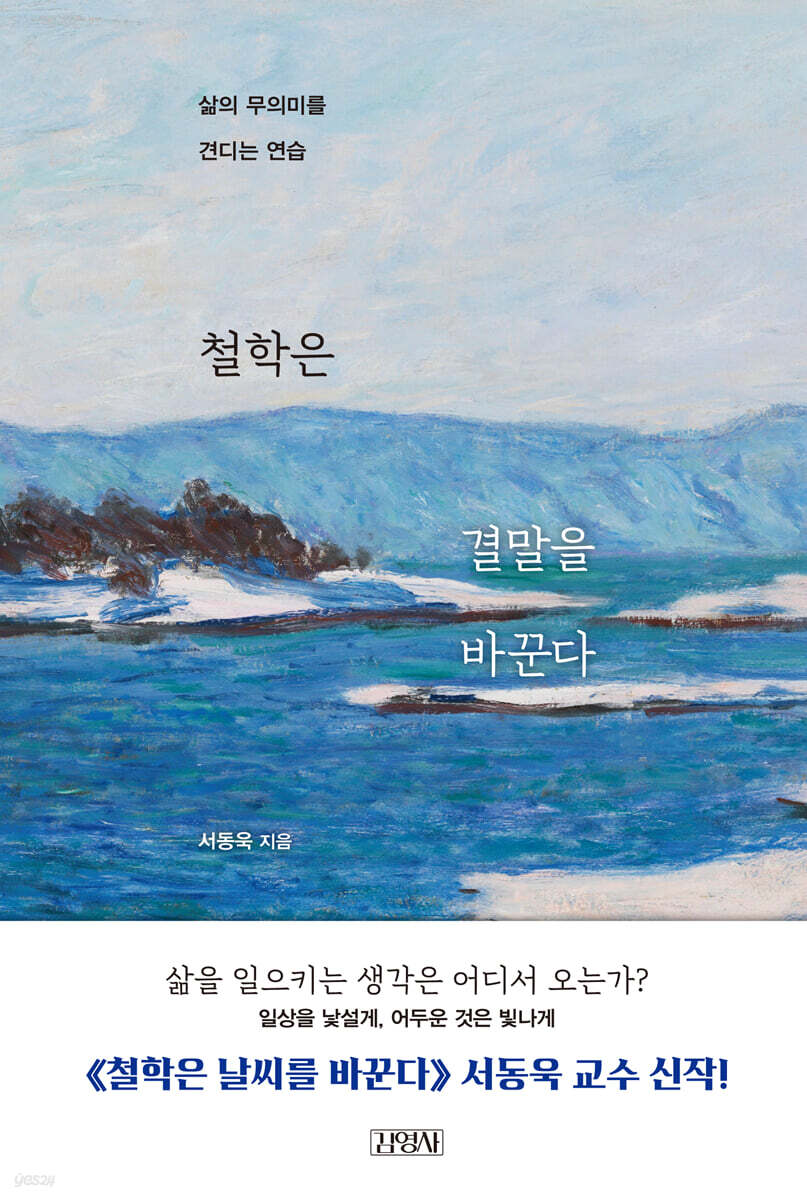
Philosophy changes the ending
 |
Description
Book Introduction
The Second Story of "Philosophy Changes the Weather"
Where do the thoughts that give rise to life come from?
Hesitating in front of a seemingly irreversible ending
The reason for the reversal that causes a precarious life
In “Philosophy Changes the Weather,” Professor Seo Dong-wook, who “gifted fresh weather” (Lee Dong-jin’s Phaeacia) to superficial lives that were unable to ask their own questions while searching for the “shortest path to answers,” gathers the power of thought again in his new work “Philosophy Changes the Ending.”
The author, who is Korea's leading researcher on Deleuze philosophy, a poet, and literary critic, still shines with his delicate gaze.
Can a life so helpless, crouched within a thin membrane called the answer, truly face a different phase?
Every story in this book has a different ending.
Things we thought we knew well, like our bodies, travel, love, family, and loneliness, become unfamiliar, and burdensome things, like shame, study, fear, and the end, change their appearances lightly.
It covers diverse thoughts that cross over philosophy, literature, art, and film, from common themes to topics that are rarely considered.
“When you have to observe life as if you were watching a movie in a theater, like popcorn you slowly put in your mouth,” it will give you the courage to move towards an ending at every crossroads in your daily life.
Where do the thoughts that give rise to life come from?
Hesitating in front of a seemingly irreversible ending
The reason for the reversal that causes a precarious life
In “Philosophy Changes the Weather,” Professor Seo Dong-wook, who “gifted fresh weather” (Lee Dong-jin’s Phaeacia) to superficial lives that were unable to ask their own questions while searching for the “shortest path to answers,” gathers the power of thought again in his new work “Philosophy Changes the Ending.”
The author, who is Korea's leading researcher on Deleuze philosophy, a poet, and literary critic, still shines with his delicate gaze.
Can a life so helpless, crouched within a thin membrane called the answer, truly face a different phase?
Every story in this book has a different ending.
Things we thought we knew well, like our bodies, travel, love, family, and loneliness, become unfamiliar, and burdensome things, like shame, study, fear, and the end, change their appearances lightly.
It covers diverse thoughts that cross over philosophy, literature, art, and film, from common themes to topics that are rarely considered.
“When you have to observe life as if you were watching a movie in a theater, like popcorn you slowly put in your mouth,” it will give you the courage to move towards an ending at every crossroads in your daily life.
- You can preview some of the book's contents.
Preview
index
Prologue: The Lever of Thought That Moves Life
Part 1: Jewels of Everyday Life
The Era of Mukbang: The Philosophy of Eating│Subtle Differences Create a New World│How Is Freedom Born│Shame, the Great Heart of Man│The Spirit of Epicurus│Loneliness│We Meet Others Through Our Bodies│Let's Overcome Boredom with Travel│Smell│Meaninglessness│Food in the Later Years
Part 2: Life's Study
Fear, the black magic that tames humans│What is there to gain from discussion│Scholars and politics│Wit│Academics as destroyers and creators│Oriental philosophy as training for life│Experience is the teacher of life│Love and jealousy│Is the family the enemy of the state│Plato and Carl Sagan's 'correct' universe│How does study change people?
Part 3: The Hidden Laws of the World
Philosophical nausea│The philosophy of inaction│How to understand the 'law of God'│The tragedy of humanists│Board games, a practice of democracy│Ramo's nephew, the non-mainstream is a mirror of society│The meaning of childbirth and the woman without a shadow│The part and the whole│Air war│The Fourth Industrial Revolution is a matter of judgment│God is dead, and so are humans
Part 4: The Way We Live
Similarity, the crab-turned-samurai│Imitation│The world of waiters│Pure art, participatory art, ugly art│In search of the golden chariot of Olympia│The philosophy of music│The art appreciator│The teacher before philosophy, the epic│Philosophy through geography│A joke about Spinoza's name│The flower of December, Christmas
Epilogue: Learning Through Pain
main
Part 1: Jewels of Everyday Life
The Era of Mukbang: The Philosophy of Eating│Subtle Differences Create a New World│How Is Freedom Born│Shame, the Great Heart of Man│The Spirit of Epicurus│Loneliness│We Meet Others Through Our Bodies│Let's Overcome Boredom with Travel│Smell│Meaninglessness│Food in the Later Years
Part 2: Life's Study
Fear, the black magic that tames humans│What is there to gain from discussion│Scholars and politics│Wit│Academics as destroyers and creators│Oriental philosophy as training for life│Experience is the teacher of life│Love and jealousy│Is the family the enemy of the state│Plato and Carl Sagan's 'correct' universe│How does study change people?
Part 3: The Hidden Laws of the World
Philosophical nausea│The philosophy of inaction│How to understand the 'law of God'│The tragedy of humanists│Board games, a practice of democracy│Ramo's nephew, the non-mainstream is a mirror of society│The meaning of childbirth and the woman without a shadow│The part and the whole│Air war│The Fourth Industrial Revolution is a matter of judgment│God is dead, and so are humans
Part 4: The Way We Live
Similarity, the crab-turned-samurai│Imitation│The world of waiters│Pure art, participatory art, ugly art│In search of the golden chariot of Olympia│The philosophy of music│The art appreciator│The teacher before philosophy, the epic│Philosophy through geography│A joke about Spinoza's name│The flower of December, Christmas
Epilogue: Learning Through Pain
main
Detailed image

Into the book
Everyone wants to stop for a moment in front of their own life, distance themselves from it, and ask about its meaning.
But that can't be done.
Because we ourselves are life itself, we cannot distance ourselves from life and find time to think from a distance.
When the waves of life crash, I am like seaweed washed up on the shore, unable to put strength in my back and just spinning around.
So what we need is an air pocket that can briefly confirm life in the churning water.
--- From the "Prologue"
The body is the relationship with the other and at the same time the gap with the other.
In fact, this gap is not opposed to the relationship with the other, but rather forms part of it.
Because of that gap, which sometimes creates misunderstandings about others and turns our most beloved ones into enigmas, we become 'those who can immerse themselves in others' as if we have found a problem to solve.
--- From "Chapter 1"
What matters to us is rather a single experience that has nothing in common with anything else.
Things like the experience of first love, which can only happen twice, or the experience of becoming a parent for the first time.
And these experiences are usually filled with errors and failures.
Human life is made up of one-time experiences that are not common to anything else, not of universal natural scientific experiences.
--- From Chapter 2
There was no one to advise Abraham whether what he heard was a real command from God or a hallucination; Abraham had to decide for himself.
How heavy a burden is this freedom of decision! Yet, God's law, God's command, comes to man only with this heavy freedom.
Because there is freedom, there is also responsibility for disobeying orders, responsibility for sin.
This is the image of a human being standing alone before the law of God.
--- From Chapter 3
Freedom and initiative alone cannot enable us to feel the pain of our suffering neighbors and begin to act for them.
The movement of the heart toward others does not begin with a free decision, as if planning one's own life, but rather finds its initial spark in the pain that pricks the heart.
My heart suffers because of the suffering of others, even if I don't want to.
Being consumed by the passion of being hurt.
God taught us how important this suffering was by becoming human.
So Christmas is the brightest day.
--- From Chapter 4
Were all the heavy worries that had been weighing on me ultimately not a way to die, but a way to survive? Pain is an honest alarm clock that only rings loudly in the midst of life, and life does nothing but strive to be true to itself.
I am a tambourine in a karaoke room that life shakes and tones.
Although we constantly complain and look at death, in the end, the place we stand is life.
But that can't be done.
Because we ourselves are life itself, we cannot distance ourselves from life and find time to think from a distance.
When the waves of life crash, I am like seaweed washed up on the shore, unable to put strength in my back and just spinning around.
So what we need is an air pocket that can briefly confirm life in the churning water.
--- From the "Prologue"
The body is the relationship with the other and at the same time the gap with the other.
In fact, this gap is not opposed to the relationship with the other, but rather forms part of it.
Because of that gap, which sometimes creates misunderstandings about others and turns our most beloved ones into enigmas, we become 'those who can immerse themselves in others' as if we have found a problem to solve.
--- From "Chapter 1"
What matters to us is rather a single experience that has nothing in common with anything else.
Things like the experience of first love, which can only happen twice, or the experience of becoming a parent for the first time.
And these experiences are usually filled with errors and failures.
Human life is made up of one-time experiences that are not common to anything else, not of universal natural scientific experiences.
--- From Chapter 2
There was no one to advise Abraham whether what he heard was a real command from God or a hallucination; Abraham had to decide for himself.
How heavy a burden is this freedom of decision! Yet, God's law, God's command, comes to man only with this heavy freedom.
Because there is freedom, there is also responsibility for disobeying orders, responsibility for sin.
This is the image of a human being standing alone before the law of God.
--- From Chapter 3
Freedom and initiative alone cannot enable us to feel the pain of our suffering neighbors and begin to act for them.
The movement of the heart toward others does not begin with a free decision, as if planning one's own life, but rather finds its initial spark in the pain that pricks the heart.
My heart suffers because of the suffering of others, even if I don't want to.
Being consumed by the passion of being hurt.
God taught us how important this suffering was by becoming human.
So Christmas is the brightest day.
--- From Chapter 4
Were all the heavy worries that had been weighing on me ultimately not a way to die, but a way to survive? Pain is an honest alarm clock that only rings loudly in the midst of life, and life does nothing but strive to be true to itself.
I am a tambourine in a karaoke room that life shakes and tones.
Although we constantly complain and look at death, in the end, the place we stand is life.
--- From "Epilogue"
Publisher's Review
Professor Seo Dong-wook's new work, "Cheolhak Changes the Weather"!
Between daily life and events, meaninglessness and meaning
In the midst of life that cannot be ignored
Moments of Possibility Captured by a Philosopher
The lives of Epicurus and Socrates, two ancient Greek philosophers who traveled in opposite directions throughout their lives, overlap as they face death.
Epicurus, a hedonist who did not believe in the immortality of the soul, changes the ending of his suffering by recalling a conversation he had with his friends about tranquility in the face of a terminal illness.
Socrates, who was sentenced to death, changes the ending of his own life by testifying to the immortality of the soul to his friends who visit him in prison.
The sequel to “Philosophy Changes the Weather,” which was praised as “a book of awakening that shakes life up and a model of philosophical essays” (critic Lee Dong-jin), “Philosophy Changes the Ending,” has been published.
In this book, Professor Seo Dong-wook, a 'philosopher who changes the weather', talks about the power of thoughts that change the ending.
From thoughts on emotions like shame, jealousy, and pleasure to perspectives on communities like childbirth, family, and democracy, it lifts the exhausted daily life by making the boring unfamiliar and the burdensome light.
The lever of thought is at hand.
In Part 1, we discover hidden gems in the everyday things that make up life.
For example, 'eating' is an act that goes beyond simply experiencing taste and penetrates the philosophy of existence, from the form of life to living together.
In 'Pleasure,' which is wary of being extravagant, we show how the hedonistic philosophy of Epicurus led to the philosophy of Marx, and discover the spirit of freedom and tranquility.
Part 2 talks about experiences that serve as lessons in life.
In the author's view, another word for the experience that makes a person grow is 'disappointment'.
As bitter as it may be, only experience can tell us what we are capable of and make us aware of our own limitations.
The statement in this book that “philosophy changes the ending” is neither metaphor nor optimism.
It is a declaration that we will change the direction of life that seems to be set through thought, and that philosophy can become a skill for living.
Like two philosophers who moved their rocky lives in the face of a precarious ending.
When life raises questions and forces us to answer them, we begin to philosophize in response to those questions.
So, fundamentally, philosophy is nothing other than ‘practice in living’, training in living.
Philosophy is not a practice of dying, of abandoning the chaos of life for the eternal knowledge that shines alone in the void, frozen in place.
Chapter 2 (page 144)
“There are subtle differences between different worlds.”
A precarious life, a thought blossoming on its edge
About small practices that change the ending of everyday life
Two roads diverged in the woods.
This famous line from Frost's poem "The Road Not Taken" is a metaphor for life, where one choice can lead to a completely different world.
This book says that 'one choice' is actually about the subtle differences.
Starting from Leibniz's theory of possible worlds, the author asks whether chance encounters actually make one of the innumerable possible worlds a reality.
So, the 'Messiah' we are waiting for may also come from 'subtle differences'.
This book overturns familiar logic with a subtle difference called 'thought'.
Part 3 explores the workings of the world behind the gritty details.
For example, nausea, although painful, is a symbol and a teaching that “my existence can be freed from the control of the subject called me at any time.”
Often, the ‘part’ is considered to be for the ‘whole’, but based on Deleuze’s concept of the ‘body without organs’, the author explores a new relationship of “the whole placed alongside the parts” and “the whole as the effect of the parts.”
This reasoning could be a breakthrough for democracy, which is facing a crisis today.
Part 4 is a story about discovering the way we live and the virtues we pursue in life in places that seem unrelated to 'making a living'.
The author reads the legend of the Japanese crab with the face of a samurai not as a mere absurd tale, but as a “string that connects people of the vanished world to those of the present,” embracing our lives.
I see exercise, like sports, as a culmination of virtues that can never be acquired at a desk: honesty, patience, temperance, courage, cooperation, and so on.
With this kind of reversal of perspective that discovers subtle differences, how about we too try to actualize the possible world within the “joy, transaction, and world that already exists”?
Small differences make the secular world a messianic world.
(…) Philosophy just stands there as a cold, inexorable structure, but that doesn't stop people from drawing inspiration from it.
The inspiration is that making a single world exist from all the possible worlds floating in our minds is possible through subtle differences and small practices.
Chapter 1 (Page 36)
“Even when we are alone, we are together.”
The unknown ending in every story
Typing and thinking outward
The clue to the reversal comes from the typist.
This book argues that it is possible for us to feel lonely and to sometimes feel like we are resting through 'eating shows' and 'eating alone' because we are with others.
The ‘body’ is not mine alone.
For the author, the body is “the gap that is ourselves,” thanks to which we are accepted by the world, perceive the world, and become “able to immerse ourselves in others.”
This book quotes Levinas's words, "To welcome the other is to question my freedom," and says that even 'freedom', which seems to be an individual's sole choice, is created by the other.
We want the ending of our lives to be like a movie.
This book suggests that we find the idea of a reversal in 'something other than myself' and rewrite the ending with the power of that idea.
When philosophy changes its conclusion, it is said that it is not completed through solitary thought, but through coexistence with others.
Spinoza appears frequently in this book, suggesting that philosophy is always a mongrel, and that its essence lies in the openness and freedom that protect the citizens of the world.
Can a life-shaking awakening become a daily occurrence? The final draft hasn't been written yet.
Where is freedom? Freedom lies in the possibility of giving or not giving what's in your pocket.
Before that there was no freedom, only arbitrariness.
Only with the appearance of the other does freedom as a possibility of sin come into being.
Chapter 1 (Page 44)
Between daily life and events, meaninglessness and meaning
In the midst of life that cannot be ignored
Moments of Possibility Captured by a Philosopher
The lives of Epicurus and Socrates, two ancient Greek philosophers who traveled in opposite directions throughout their lives, overlap as they face death.
Epicurus, a hedonist who did not believe in the immortality of the soul, changes the ending of his suffering by recalling a conversation he had with his friends about tranquility in the face of a terminal illness.
Socrates, who was sentenced to death, changes the ending of his own life by testifying to the immortality of the soul to his friends who visit him in prison.
The sequel to “Philosophy Changes the Weather,” which was praised as “a book of awakening that shakes life up and a model of philosophical essays” (critic Lee Dong-jin), “Philosophy Changes the Ending,” has been published.
In this book, Professor Seo Dong-wook, a 'philosopher who changes the weather', talks about the power of thoughts that change the ending.
From thoughts on emotions like shame, jealousy, and pleasure to perspectives on communities like childbirth, family, and democracy, it lifts the exhausted daily life by making the boring unfamiliar and the burdensome light.
The lever of thought is at hand.
In Part 1, we discover hidden gems in the everyday things that make up life.
For example, 'eating' is an act that goes beyond simply experiencing taste and penetrates the philosophy of existence, from the form of life to living together.
In 'Pleasure,' which is wary of being extravagant, we show how the hedonistic philosophy of Epicurus led to the philosophy of Marx, and discover the spirit of freedom and tranquility.
Part 2 talks about experiences that serve as lessons in life.
In the author's view, another word for the experience that makes a person grow is 'disappointment'.
As bitter as it may be, only experience can tell us what we are capable of and make us aware of our own limitations.
The statement in this book that “philosophy changes the ending” is neither metaphor nor optimism.
It is a declaration that we will change the direction of life that seems to be set through thought, and that philosophy can become a skill for living.
Like two philosophers who moved their rocky lives in the face of a precarious ending.
When life raises questions and forces us to answer them, we begin to philosophize in response to those questions.
So, fundamentally, philosophy is nothing other than ‘practice in living’, training in living.
Philosophy is not a practice of dying, of abandoning the chaos of life for the eternal knowledge that shines alone in the void, frozen in place.
Chapter 2 (page 144)
“There are subtle differences between different worlds.”
A precarious life, a thought blossoming on its edge
About small practices that change the ending of everyday life
Two roads diverged in the woods.
This famous line from Frost's poem "The Road Not Taken" is a metaphor for life, where one choice can lead to a completely different world.
This book says that 'one choice' is actually about the subtle differences.
Starting from Leibniz's theory of possible worlds, the author asks whether chance encounters actually make one of the innumerable possible worlds a reality.
So, the 'Messiah' we are waiting for may also come from 'subtle differences'.
This book overturns familiar logic with a subtle difference called 'thought'.
Part 3 explores the workings of the world behind the gritty details.
For example, nausea, although painful, is a symbol and a teaching that “my existence can be freed from the control of the subject called me at any time.”
Often, the ‘part’ is considered to be for the ‘whole’, but based on Deleuze’s concept of the ‘body without organs’, the author explores a new relationship of “the whole placed alongside the parts” and “the whole as the effect of the parts.”
This reasoning could be a breakthrough for democracy, which is facing a crisis today.
Part 4 is a story about discovering the way we live and the virtues we pursue in life in places that seem unrelated to 'making a living'.
The author reads the legend of the Japanese crab with the face of a samurai not as a mere absurd tale, but as a “string that connects people of the vanished world to those of the present,” embracing our lives.
I see exercise, like sports, as a culmination of virtues that can never be acquired at a desk: honesty, patience, temperance, courage, cooperation, and so on.
With this kind of reversal of perspective that discovers subtle differences, how about we too try to actualize the possible world within the “joy, transaction, and world that already exists”?
Small differences make the secular world a messianic world.
(…) Philosophy just stands there as a cold, inexorable structure, but that doesn't stop people from drawing inspiration from it.
The inspiration is that making a single world exist from all the possible worlds floating in our minds is possible through subtle differences and small practices.
Chapter 1 (Page 36)
“Even when we are alone, we are together.”
The unknown ending in every story
Typing and thinking outward
The clue to the reversal comes from the typist.
This book argues that it is possible for us to feel lonely and to sometimes feel like we are resting through 'eating shows' and 'eating alone' because we are with others.
The ‘body’ is not mine alone.
For the author, the body is “the gap that is ourselves,” thanks to which we are accepted by the world, perceive the world, and become “able to immerse ourselves in others.”
This book quotes Levinas's words, "To welcome the other is to question my freedom," and says that even 'freedom', which seems to be an individual's sole choice, is created by the other.
We want the ending of our lives to be like a movie.
This book suggests that we find the idea of a reversal in 'something other than myself' and rewrite the ending with the power of that idea.
When philosophy changes its conclusion, it is said that it is not completed through solitary thought, but through coexistence with others.
Spinoza appears frequently in this book, suggesting that philosophy is always a mongrel, and that its essence lies in the openness and freedom that protect the citizens of the world.
Can a life-shaking awakening become a daily occurrence? The final draft hasn't been written yet.
Where is freedom? Freedom lies in the possibility of giving or not giving what's in your pocket.
Before that there was no freedom, only arbitrariness.
Only with the appearance of the other does freedom as a possibility of sin come into being.
Chapter 1 (Page 44)
GOODS SPECIFICS
- Date of issue: October 30, 2025
- Page count, weight, size: 376 pages | 480g | 145*215*22mm
- ISBN13: 9791173323959
- ISBN10: 1173323953
You may also like
카테고리
korean


korean

![GQ KOREA Mark (Monthly): December [2025]](http://librairie.coreenne.fr/cdn/shop/files/8ef265dbbfbf186523ed75ba7319009d.jpg?v=1765340328&width=3840)


