

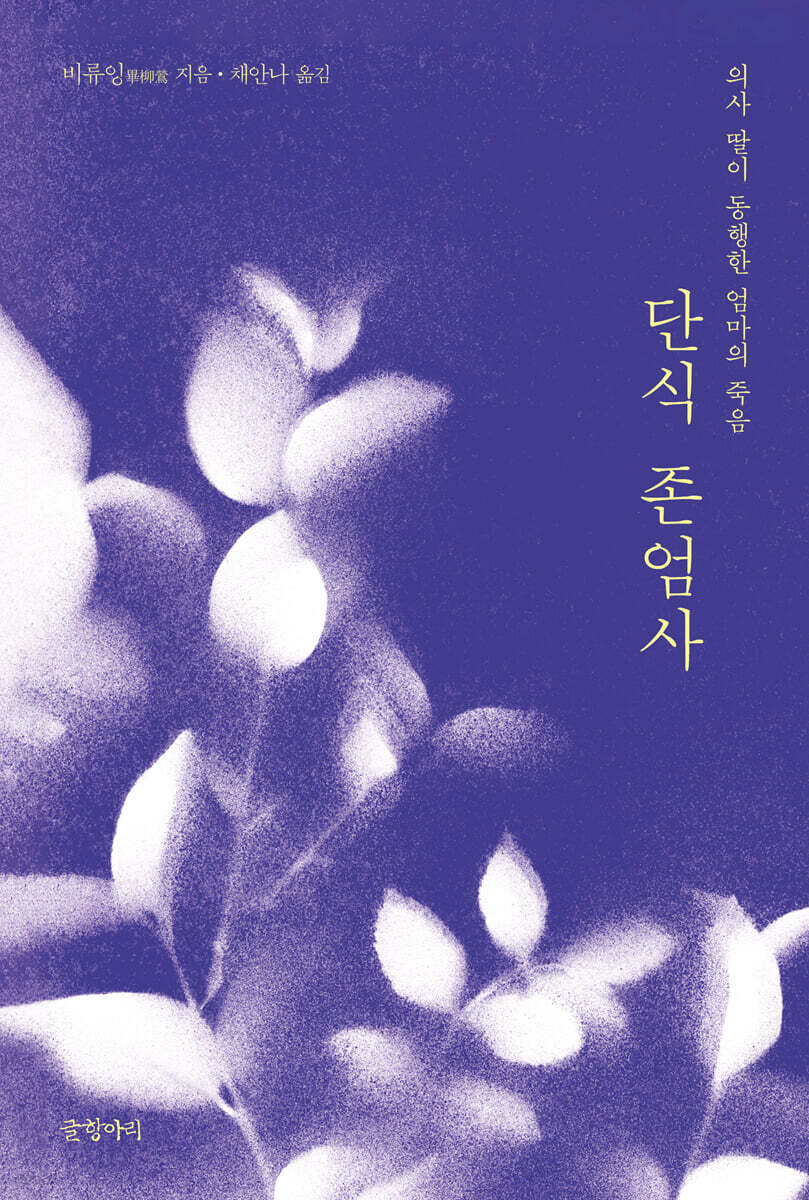
Fasting for euthanasia
 |
Description
Book Introduction
When life loses its meaning and only suffering remains
Do we have the right to choose death?
A rehabilitation doctor sees off his mother's death
Breaking free from the shackles of life-sustaining treatment
Advances in 21st-century medicine have not only extended life expectancy but also given new life to patients at risk from serious illnesses.
However, the number of people who are stuck with their sick bodies even after receiving treatment has also increased.
Either a treatment has not yet been developed, or it has reached some limit and is simply delayed in a life-sustaining state.
A life where you can't eat, walk, or speak on your own.
A life that cannot be endured without painkillers, and that ends up sinking not only oneself but also one's family.
A life lived in an inescapable hell, not with the hope that it can get better.
This book offers concrete and realistic alternatives to those living such lives and their families.
And ask:
Do we have the right to choose death? Or do we have the right to limit the choices of others?
Author Bi Liuying, a rehabilitation physician, shares her experiences working in the medical field, as well as the lives of family members and acquaintances who suffered from dementia, genetic diseases, and other painful conditions.
According to Taiwan's Ministry of the Interior statistics, the average life expectancy spent in an unhealthy state (bedridden, dependent on care from others) before death is 8.47 years.
If the patient is unable to express his or her intentions, all choices are left to the guardian, and even if the patient has expressed his or her intention to refuse life-sustaining treatment in advance, if the family ultimately opposes, the hospital cannot stop meaningless treatment to avoid medical disputes.
The inability to give up on someone because of too much love or because of a sense of duty can unintentionally push the patient into a more difficult situation.
Not only is it difficult for the patient who cannot move and is receiving nutrients through a tube and suffering from bedsores, but the pain of the family watching them from the side is also great.
Dr. Goodall from Australia and renowned Taiwanese broadcaster Mr. Fu Da-ren chose to go to Switzerland and undergo euthanasia as a way to end their lives with dignity.
This is not a common option as it is physically time-consuming and expensive along with rigorous screening.
No matter how much palliative care can alleviate a patient's suffering, there are clear limitations.
Dr. Irvin Yalom, who had studied the fear of death all his life, also could not accept his wife's death, and his wife Marilyn eventually died with the help of a doctor after relying on strong painkillers.
Do we have the right to choose death?
A rehabilitation doctor sees off his mother's death
Breaking free from the shackles of life-sustaining treatment
Advances in 21st-century medicine have not only extended life expectancy but also given new life to patients at risk from serious illnesses.
However, the number of people who are stuck with their sick bodies even after receiving treatment has also increased.
Either a treatment has not yet been developed, or it has reached some limit and is simply delayed in a life-sustaining state.
A life where you can't eat, walk, or speak on your own.
A life that cannot be endured without painkillers, and that ends up sinking not only oneself but also one's family.
A life lived in an inescapable hell, not with the hope that it can get better.
This book offers concrete and realistic alternatives to those living such lives and their families.
And ask:
Do we have the right to choose death? Or do we have the right to limit the choices of others?
Author Bi Liuying, a rehabilitation physician, shares her experiences working in the medical field, as well as the lives of family members and acquaintances who suffered from dementia, genetic diseases, and other painful conditions.
According to Taiwan's Ministry of the Interior statistics, the average life expectancy spent in an unhealthy state (bedridden, dependent on care from others) before death is 8.47 years.
If the patient is unable to express his or her intentions, all choices are left to the guardian, and even if the patient has expressed his or her intention to refuse life-sustaining treatment in advance, if the family ultimately opposes, the hospital cannot stop meaningless treatment to avoid medical disputes.
The inability to give up on someone because of too much love or because of a sense of duty can unintentionally push the patient into a more difficult situation.
Not only is it difficult for the patient who cannot move and is receiving nutrients through a tube and suffering from bedsores, but the pain of the family watching them from the side is also great.
Dr. Goodall from Australia and renowned Taiwanese broadcaster Mr. Fu Da-ren chose to go to Switzerland and undergo euthanasia as a way to end their lives with dignity.
This is not a common option as it is physically time-consuming and expensive along with rigorous screening.
No matter how much palliative care can alleviate a patient's suffering, there are clear limitations.
Dr. Irvin Yalom, who had studied the fear of death all his life, also could not accept his wife's death, and his wife Marilyn eventually died with the help of a doctor after relying on strong painkillers.
- You can preview some of the book's contents.
Preview
index
Introduction: The Distance from Euthanasia
Entering, thinking about death, facing death
Chapter 1: Genetic Testing for Cerebellar Ataxia
Chapter 2: The Poor Girl's Tears
Chapter 3: Loving Each Other, Traveling Hand in Hand
Chapter 4: Rehabilitation and Passionate Living
Chapter 5: Father's Eternal Rest, Mother's Freedom
Chapter 6: Days with a Caregiver
Chapter 7: Euthanasia of Your Own Choice
Chapter 8: Letting go is the greatest state of love.
Chapter 9: The Way of Fasting
Chapter 10: Funeral before death
Chapter 11 Three Funerals, Three Kinds of Love
Chapter 12: An Unexpected Journey Through Euthanasia
Chapter 13: Legislative History of the Right to Euthanasia
Chapter 14 Self-help Where Euthanasia Is Not Permitted
Postscript 1: Mother's Honorable Death, Reconciliation with Father
Review 2: The Most Valuable Lesson: My Mother's Transcendence in the Face of Death
Review 3: The Dilemma of Life and Death
Translator's Note
Entering, thinking about death, facing death
Chapter 1: Genetic Testing for Cerebellar Ataxia
Chapter 2: The Poor Girl's Tears
Chapter 3: Loving Each Other, Traveling Hand in Hand
Chapter 4: Rehabilitation and Passionate Living
Chapter 5: Father's Eternal Rest, Mother's Freedom
Chapter 6: Days with a Caregiver
Chapter 7: Euthanasia of Your Own Choice
Chapter 8: Letting go is the greatest state of love.
Chapter 9: The Way of Fasting
Chapter 10: Funeral before death
Chapter 11 Three Funerals, Three Kinds of Love
Chapter 12: An Unexpected Journey Through Euthanasia
Chapter 13: Legislative History of the Right to Euthanasia
Chapter 14 Self-help Where Euthanasia Is Not Permitted
Postscript 1: Mother's Honorable Death, Reconciliation with Father
Review 2: The Most Valuable Lesson: My Mother's Transcendence in the Face of Death
Review 3: The Dilemma of Life and Death
Translator's Note
Into the book
The world is constantly changing, and accidents can happen suddenly. When a person is unable to express themselves, their bewildered family members become divided.
Medical institutions, fearing lawsuits, make it their policy to save patients as much as possible, which often results in long-term bed rest for patients, and families often regret it later.
--- pp.9~10
From this time on, a miserable fate befell my uncle's family.
Five years after becoming a bedridden patient, my uncle took his own life by falling from the bed with his clothes wrapped around his neck.
My cousin died of suffocation with a plastic bag over his face 10 years after being diagnosed.
My cousin developed the disease in his 20s and spent 7 or 8 years in bed.
He died unable to speak or swallow food, with joint deformities and bedsores all over his body, leaving only his bones exposed.
He was forty-four years old.
--- pp.33~34
After my mother's illness, we felt we had to tell my father.
I hoped my father would treat my mother better because of that.
However, my father was so busy finding folk remedies for himself that he did not even ask about my mother's illness, hoping that she would be cured of her stroke.
My mother's illness progresses slowly, so it doesn't get worse right away.
My father was still a 'husband' who ordered my mother around without any care.
--- p.65
Patients don't die from not eating; they die because they can't digest and absorb food, facing imminent death! After repeated explanations and demonstrations of practical measures, the nursing home staff and families finally accepted Nakamura's approach of "doing nothing, convalescing, and dying naturally."
--- p.116
There is a saying that a long illness does not make a filial son.
It is admirable and makes me think deeply about whether the two elders poured everything into their husbands without any resentment because of social values or because of their marital love.
Are these sacrifices worth it? Is it fair to them? How much of a burden does it place on society if similar things happen to countless families every year?
--- p.131
My father-in-law passed away in his sleep at the age of 93 (12 years after he had been bedridden).
It was only after the funeral that my husband spoke.
“I have been in agony countless times in my heart for the past year.
"Is there any point in my father being alive like this? Is it filial piety to let him suffer? Or is it unfilial?"
--- p.133
Because we love, we had to let go and watch our mother suffer.
May my mother leave her old body and return to a healthy one.
And our mother's spirit lived even more vividly in our hearts because she was gone.
Medical institutions, fearing lawsuits, make it their policy to save patients as much as possible, which often results in long-term bed rest for patients, and families often regret it later.
--- pp.9~10
From this time on, a miserable fate befell my uncle's family.
Five years after becoming a bedridden patient, my uncle took his own life by falling from the bed with his clothes wrapped around his neck.
My cousin died of suffocation with a plastic bag over his face 10 years after being diagnosed.
My cousin developed the disease in his 20s and spent 7 or 8 years in bed.
He died unable to speak or swallow food, with joint deformities and bedsores all over his body, leaving only his bones exposed.
He was forty-four years old.
--- pp.33~34
After my mother's illness, we felt we had to tell my father.
I hoped my father would treat my mother better because of that.
However, my father was so busy finding folk remedies for himself that he did not even ask about my mother's illness, hoping that she would be cured of her stroke.
My mother's illness progresses slowly, so it doesn't get worse right away.
My father was still a 'husband' who ordered my mother around without any care.
--- p.65
Patients don't die from not eating; they die because they can't digest and absorb food, facing imminent death! After repeated explanations and demonstrations of practical measures, the nursing home staff and families finally accepted Nakamura's approach of "doing nothing, convalescing, and dying naturally."
--- p.116
There is a saying that a long illness does not make a filial son.
It is admirable and makes me think deeply about whether the two elders poured everything into their husbands without any resentment because of social values or because of their marital love.
Are these sacrifices worth it? Is it fair to them? How much of a burden does it place on society if similar things happen to countless families every year?
--- p.131
My father-in-law passed away in his sleep at the age of 93 (12 years after he had been bedridden).
It was only after the funeral that my husband spoke.
“I have been in agony countless times in my heart for the past year.
"Is there any point in my father being alive like this? Is it filial piety to let him suffer? Or is it unfilial?"
--- p.133
Because we love, we had to let go and watch our mother suffer.
May my mother leave her old body and return to a healthy one.
And our mother's spirit lived even more vividly in our hearts because she was gone.
--- p.136
Publisher's Review
Mother's death through hunger strike
The last lesson I left for my children
The author's mother, already in her middle age, discovered that she had a genetic disease called cerebellar ataxia, which ran in her family (her maternal uncle and cousins had died miserably because of it).
Since it was a disease that had a 1 in 2 chance of developing if one parent had it, the mother insisted that the three siblings also be tested, and the author and his younger sister were confirmed to not have inherited it through testing.
However, my younger brother insisted on not getting tested because he had no children and the disease had no cure.
Having witnessed the unfortunate fate of her relatives who had this disease, the mother entrusts her eldest daughter, a doctor, with her final days.
Thanks to her regular yoga practice, the onset of the disease was delayed and she was healthy enough not to need additional rehabilitation exercises. However, as the disease progressed, she lost her will to live and wanted to be free from the pain as soon as possible.
But since the passage of a euthanasia bill in Taiwan seemed a long way off, the mother and daughter discussed the idea of a dignified death through voluntary fasting, and the mother resolved to begin the process after her birthday the following year. The mother stopped fasting and gradually reduced her food intake.
The fasting method of dying with dignity by abstaining from grains was specifically proposed by Dr. Jinichi Nakamura as follows: 'abstaining from 5 grains for 7 days, abstaining from 10 grains for 7 days, abstaining from eating wild plants and fruits for 7 days, and abstaining from water for 7 days.'
They did not eat fish or meat, but ate porridge, boiled vegetables, and fruit as their staple foods. They also consumed oil and lotus root to reduce hunger and prevent bloating.
After 11 days of fasting, I stopped eating all solid foods, and two days later I stopped eating lotus root juice.
From the 18th day onwards, my mother's sleep time became longer, and on the 21st day, she passed away with a peaceful expression on her face.
My mother showed unwavering, strong will until the very end, and my family respected my mother's decision because they had always talked about death naturally and shared their thoughts with each other.
However, this does not mean that everything went smoothly.
The mother complained of physical pain during the fast, and the family members who watched her had to hold their chests.
Nevertheless, for the three siblings, this entire process was also a lesson given by their mother.
Half a century ago, it was common for people to die at home, but now about 80 percent of people die in hospitals or nursing homes.
Jinichi Nakamura recommended that people die naturally at home instead of being rushed to the hospital right before their death, receiving meaningless treatment, and even being treated by a "medical professional" who performs CPR, and he said that this would be the last legacy he could leave to the next generation.
The Dalai Lama views death positively, saying:
“Just as old, worn-out, and torn clothes need to be replaced, the same thing applies to the body when it becomes damaged.
Death is that simple, it is not a mysterious or dark thing.”
Also, in hospitals, it is often difficult to spend enough time with family members to say goodbye, but when a person dies naturally at home, there is ample time to sit down with family members and share their feelings.
In fact, the author's family held a funeral for his mother and reminisced about her life together, expressing their respect and gratitude for how wonderful a person she was and how hard she lived.
Through this, both the person leaving and the person being left behind can feel the deep affection between family members without regret.
How should the 'right to self-determination' be respected?
In the 1980s, when the author was working at National Taiwan University Hospital, the mother of Wang Xiaomin, who was in a vegetative state, raised the need for euthanasia laws, saying that she did not want her daughter to suffer any longer after caring for her daughter for 20 years without any improvement, and this sparked a social discussion.
In Taiwan, hospice palliative care was introduced, and the 'Palliative Care Ordinance' and the 'Patient Autonomy Act' were implemented.
This allows patients to express their wishes in advance so that they can escape the pain they are currently experiencing or so that they can do so in the future.
However, there are still many areas that need improvement in terms of the scope and timing of application.
Meanwhile, the medical and religious communities still voice opposition to the euthanasia law.
The first reason is that ending a patient's life is like eliminating the chance for them to get better.
In this regard, the author points out that since doctors are not gods, there are bound to be limitations in medical care.
Mr. Pudarun, who chose euthanasia in Switzerland, suffered from severe side effects due to pain that could not be relieved even with palliative care and a morphine allergy.
Second, there is the opinion that euthanasia violates medical ethics.
The author argues that even if euthanasia legislation is passed, individual doctors have the right to choose not to participate, and that the medical community has no right to urge all doctors not to participate.
Going forward, we must move toward greater respect for patients' "right to self-determination of death," and we must improve our thinking to consider helping patients achieve a peaceful death as part of medical care.
Additionally, there are concerns about the so-called 'landslide effect'.
If the euthanasia law is passed, it means that the socially vulnerable will be encouraged to choose death or that the person concerned will be pressured to make such a choice. However, if we refer to statistics from the United States and the Netherlands, we can see that concerns and reality are different.
Discussions about 'well-dying', or euthanasia, should no longer abstractly glorify death or reduce it to someone else's case.
This book primarily deals with the current state of Taiwanese society and its cases, but it also presents sharp topics of debate in Korean society, where issues such as an aging society, poverty among the elderly, and patients' right to self-determination are becoming increasingly important.
The last lesson I left for my children
The author's mother, already in her middle age, discovered that she had a genetic disease called cerebellar ataxia, which ran in her family (her maternal uncle and cousins had died miserably because of it).
Since it was a disease that had a 1 in 2 chance of developing if one parent had it, the mother insisted that the three siblings also be tested, and the author and his younger sister were confirmed to not have inherited it through testing.
However, my younger brother insisted on not getting tested because he had no children and the disease had no cure.
Having witnessed the unfortunate fate of her relatives who had this disease, the mother entrusts her eldest daughter, a doctor, with her final days.
Thanks to her regular yoga practice, the onset of the disease was delayed and she was healthy enough not to need additional rehabilitation exercises. However, as the disease progressed, she lost her will to live and wanted to be free from the pain as soon as possible.
But since the passage of a euthanasia bill in Taiwan seemed a long way off, the mother and daughter discussed the idea of a dignified death through voluntary fasting, and the mother resolved to begin the process after her birthday the following year. The mother stopped fasting and gradually reduced her food intake.
The fasting method of dying with dignity by abstaining from grains was specifically proposed by Dr. Jinichi Nakamura as follows: 'abstaining from 5 grains for 7 days, abstaining from 10 grains for 7 days, abstaining from eating wild plants and fruits for 7 days, and abstaining from water for 7 days.'
They did not eat fish or meat, but ate porridge, boiled vegetables, and fruit as their staple foods. They also consumed oil and lotus root to reduce hunger and prevent bloating.
After 11 days of fasting, I stopped eating all solid foods, and two days later I stopped eating lotus root juice.
From the 18th day onwards, my mother's sleep time became longer, and on the 21st day, she passed away with a peaceful expression on her face.
My mother showed unwavering, strong will until the very end, and my family respected my mother's decision because they had always talked about death naturally and shared their thoughts with each other.
However, this does not mean that everything went smoothly.
The mother complained of physical pain during the fast, and the family members who watched her had to hold their chests.
Nevertheless, for the three siblings, this entire process was also a lesson given by their mother.
Half a century ago, it was common for people to die at home, but now about 80 percent of people die in hospitals or nursing homes.
Jinichi Nakamura recommended that people die naturally at home instead of being rushed to the hospital right before their death, receiving meaningless treatment, and even being treated by a "medical professional" who performs CPR, and he said that this would be the last legacy he could leave to the next generation.
The Dalai Lama views death positively, saying:
“Just as old, worn-out, and torn clothes need to be replaced, the same thing applies to the body when it becomes damaged.
Death is that simple, it is not a mysterious or dark thing.”
Also, in hospitals, it is often difficult to spend enough time with family members to say goodbye, but when a person dies naturally at home, there is ample time to sit down with family members and share their feelings.
In fact, the author's family held a funeral for his mother and reminisced about her life together, expressing their respect and gratitude for how wonderful a person she was and how hard she lived.
Through this, both the person leaving and the person being left behind can feel the deep affection between family members without regret.
How should the 'right to self-determination' be respected?
In the 1980s, when the author was working at National Taiwan University Hospital, the mother of Wang Xiaomin, who was in a vegetative state, raised the need for euthanasia laws, saying that she did not want her daughter to suffer any longer after caring for her daughter for 20 years without any improvement, and this sparked a social discussion.
In Taiwan, hospice palliative care was introduced, and the 'Palliative Care Ordinance' and the 'Patient Autonomy Act' were implemented.
This allows patients to express their wishes in advance so that they can escape the pain they are currently experiencing or so that they can do so in the future.
However, there are still many areas that need improvement in terms of the scope and timing of application.
Meanwhile, the medical and religious communities still voice opposition to the euthanasia law.
The first reason is that ending a patient's life is like eliminating the chance for them to get better.
In this regard, the author points out that since doctors are not gods, there are bound to be limitations in medical care.
Mr. Pudarun, who chose euthanasia in Switzerland, suffered from severe side effects due to pain that could not be relieved even with palliative care and a morphine allergy.
Second, there is the opinion that euthanasia violates medical ethics.
The author argues that even if euthanasia legislation is passed, individual doctors have the right to choose not to participate, and that the medical community has no right to urge all doctors not to participate.
Going forward, we must move toward greater respect for patients' "right to self-determination of death," and we must improve our thinking to consider helping patients achieve a peaceful death as part of medical care.
Additionally, there are concerns about the so-called 'landslide effect'.
If the euthanasia law is passed, it means that the socially vulnerable will be encouraged to choose death or that the person concerned will be pressured to make such a choice. However, if we refer to statistics from the United States and the Netherlands, we can see that concerns and reality are different.
Discussions about 'well-dying', or euthanasia, should no longer abstractly glorify death or reduce it to someone else's case.
This book primarily deals with the current state of Taiwanese society and its cases, but it also presents sharp topics of debate in Korean society, where issues such as an aging society, poverty among the elderly, and patients' right to self-determination are becoming increasingly important.
GOODS SPECIFICS
- Date of issue: July 19, 2024
- Page count, weight, size: 268 pages | 135*200*15mm
- ISBN13: 9791169092753
- ISBN10: 1169092756
You may also like
카테고리
korean


korean

![ELLE 엘르 스페셜 에디션 A형 : 12월 [2025]](http://librairie.coreenne.fr/cdn/shop/files/b8e27a3de6c9538896439686c6b0e8fb.jpg?v=1766436872&width=3840)


