

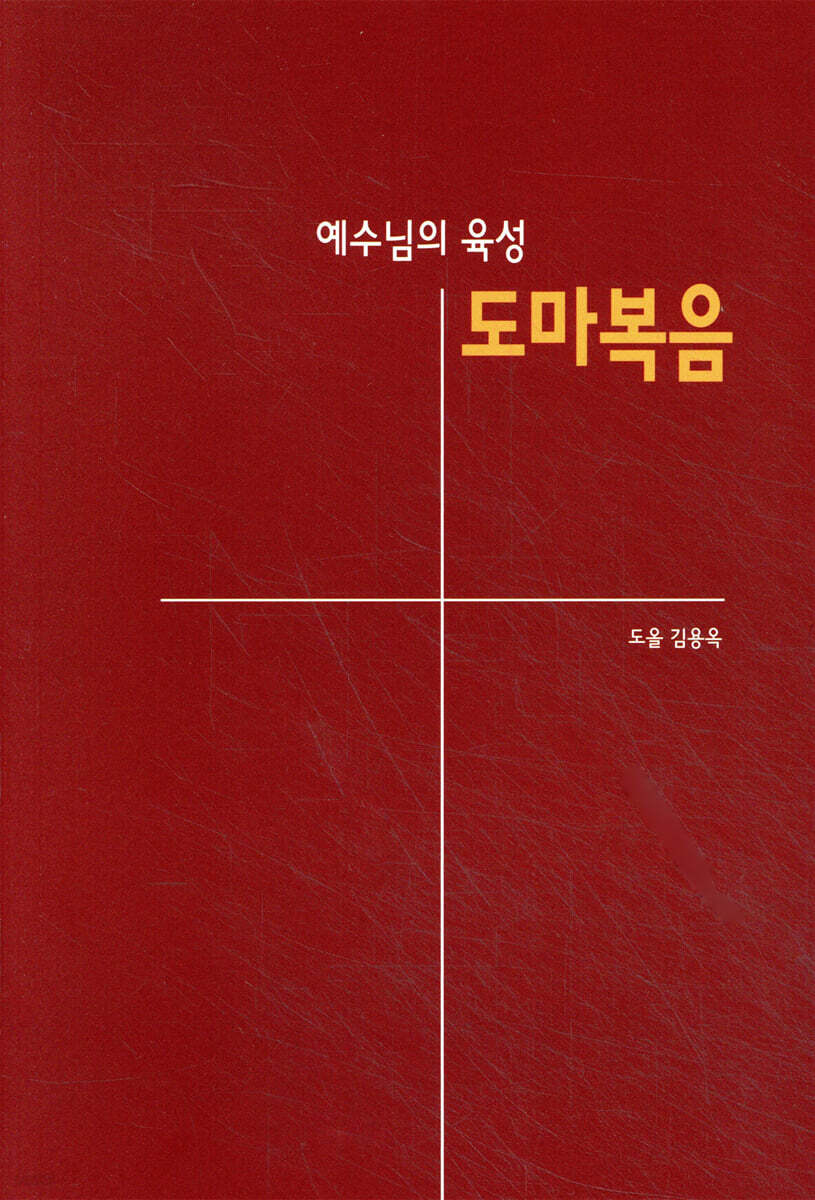
The Gospel of Thomas
 |
Description
Book Introduction
Those who are hungry for spirituality!
Here, listen to the vivid voice of Jesus!!
The Gospel of Thomas, a gospel of profound wisdom, is the original source for the four Gospels of the New Testament and provides a new dimension to understanding Christianity.
This book by Dool Kim Yong-ok explains the words of Jesus recorded in the Gospel of Thomas by mobilizing all possible sources, including the four Gospels and Paul's letters.
His study of the Gospel of Thomas is an avant-garde undertaking that surpasses the achievements of Western theological circles.
When I read this book by Dool, I feel like I can hear the voice of Jesus.
Again, the powerful charisma of Jesus, who boldly preaches the truth, is overwhelmingly felt.
And the wisdom of Jesus, which transcends time and space and enlightens humanity, contained in those words, conveys living meaning to us today through this book.
Readers will discover true religion in the new Jesus.
Here, listen to the vivid voice of Jesus!!
The Gospel of Thomas, a gospel of profound wisdom, is the original source for the four Gospels of the New Testament and provides a new dimension to understanding Christianity.
This book by Dool Kim Yong-ok explains the words of Jesus recorded in the Gospel of Thomas by mobilizing all possible sources, including the four Gospels and Paul's letters.
His study of the Gospel of Thomas is an avant-garde undertaking that surpasses the achievements of Western theological circles.
When I read this book by Dool, I feel like I can hear the voice of Jesus.
Again, the powerful charisma of Jesus, who boldly preaches the truth, is overwhelmingly felt.
And the wisdom of Jesus, which transcends time and space and enlightens humanity, contained in those words, conveys living meaning to us today through this book.
Readers will discover true religion in the new Jesus.
- You can preview some of the book's contents.
Preview
index
Preface 13
Shiui Gyeokmun (時宜檄文) 70
Yoon Seok-yeol's dismissal protects the Constitution… Constitutional Court urges against 'political bargaining'
Gospel according to Thomas 79
Chapter 80
Chapter 1, 87
… …
Chapter 114, 514
Appendix: The Gospel of Thomas, English and Korean Editions, 520
Shiui Gyeokmun (時宜檄文) 70
Yoon Seok-yeol's dismissal protects the Constitution… Constitutional Court urges against 'political bargaining'
Gospel according to Thomas 79
Chapter 80
Chapter 1, 87
… …
Chapter 114, 514
Appendix: The Gospel of Thomas, English and Korean Editions, 520
Into the book
The introduction of Christianity provided an opportunity for awakening to those who were concerned about the collapse of Confucian society.
--- p.14
Paul was a human being of the same age as Jesus, but he never met the living Jesus.
And in Paul's letters there is absolutely no information about the person of Jesus.
--- p.23
It can be said that the history of Christianity in our country is a trace of turning away from the historical Jesus and promoting the eschatological Jesus of which Paul speaks.
--- p.30
The community that existed within the consciousness of those who maintained the pure historical tradition of Jesus without being tainted by Paul's missionary work is broadly called the "Jesus Movement."
--- p.55
The Gospel of Thomas is a product of the Jesus movement and is the words inscribed in the pure Jesus community before Paul contaminated it.
--- p.64
35% of the content of the fragment from the Gospel of Thomas matches the content of the Q Gospel...
In the remaining 65%, there is not a single piece of content that has no connection with the existing synoptic gospels.
65
But Jesus is not someone who wants to go to heaven.
He is a person who wants to realize the order of heaven as the order of earth.
--- p.85
Jesus says:
The construction of a new self is painful.
But only when you suffer will you taste the wonders of heaven.
--- p.95
In fact, the discourse of the Gospel of Thomas can be found entirely within existing canonical literature.
Just the expression of the Gospel of Thomas is more...
It brings to mind a “vivid and lively Jesus.”
--- p.100
Jesus of Thomas does not proclaim that he alone is the only Son of God.
...
Jesus is a wise teacher who makes people realize that they are the sons of God by leading them to reflect on themselves.
--- p.105
The historical Jesus preferred the term “Father” to “God.”
--- p.161
John confines the Logos to Jesus alone.
But Jesus of Thomas allows such a possibility to all humans.
--- p.175
Gnosticism can also be defined as a creative misinterpretation of the Old Testament and Plato.
If we re-penetrate this marble, we will see the emergence of various religious movements in the latter half of the first century of Christianity.
--- p.214
Jesus on Thomas does not try to persuade others by borrowing God's authority.
The Jesus in the narratives of the four Gospels is a Jesus who has already passed through the filter of Pauline theology.
--- p271
The Holy Spirit is not some personified entity.
It is some abstract force that unites the resurrected historical Jesus with the Lord God in heaven.
--- p.14
Paul was a human being of the same age as Jesus, but he never met the living Jesus.
And in Paul's letters there is absolutely no information about the person of Jesus.
--- p.23
It can be said that the history of Christianity in our country is a trace of turning away from the historical Jesus and promoting the eschatological Jesus of which Paul speaks.
--- p.30
The community that existed within the consciousness of those who maintained the pure historical tradition of Jesus without being tainted by Paul's missionary work is broadly called the "Jesus Movement."
--- p.55
The Gospel of Thomas is a product of the Jesus movement and is the words inscribed in the pure Jesus community before Paul contaminated it.
--- p.64
35% of the content of the fragment from the Gospel of Thomas matches the content of the Q Gospel...
In the remaining 65%, there is not a single piece of content that has no connection with the existing synoptic gospels.
65
But Jesus is not someone who wants to go to heaven.
He is a person who wants to realize the order of heaven as the order of earth.
--- p.85
Jesus says:
The construction of a new self is painful.
But only when you suffer will you taste the wonders of heaven.
--- p.95
In fact, the discourse of the Gospel of Thomas can be found entirely within existing canonical literature.
Just the expression of the Gospel of Thomas is more...
It brings to mind a “vivid and lively Jesus.”
--- p.100
Jesus of Thomas does not proclaim that he alone is the only Son of God.
...
Jesus is a wise teacher who makes people realize that they are the sons of God by leading them to reflect on themselves.
--- p.105
The historical Jesus preferred the term “Father” to “God.”
--- p.161
John confines the Logos to Jesus alone.
But Jesus of Thomas allows such a possibility to all humans.
--- p.175
Gnosticism can also be defined as a creative misinterpretation of the Old Testament and Plato.
If we re-penetrate this marble, we will see the emergence of various religious movements in the latter half of the first century of Christianity.
--- p.214
Jesus on Thomas does not try to persuade others by borrowing God's authority.
The Jesus in the narratives of the four Gospels is a Jesus who has already passed through the filter of Pauline theology.
--- p271
The Holy Spirit is not some personified entity.
It is some abstract force that unites the resurrected historical Jesus with the Lord God in heaven.
--- p.275
Publisher's Review
The voice of Jesus resonates anew in the Gospel of Thomas,
Reviving the lost heart of Christianity!!
The Gospel of Thomas was kept in an underground jar for 16 centuries, but was finally revealed to the world in December 1945.
This document has been recognized by leading scholars from all walks of life as the most vivid document conveying the truth about the historical Jesus.
Author Dool defines this document as the verbal material that forms the formative part of the four Gospels, and conducts a fierce literary and editorial critique of it.
The Gospel of Thomas overturns our thinking.
The kingdom of God, that is, heaven, is a kingdom on this earth.
“Country” is not a spatial concept, but “rule” (basileia).
The rule of heaven is a “new order.”
Now a new country has come to our land.
We are trying to get rid of the old order and create a country where everyone pursues love, reconciliation, and understanding.
What is most important in these times (kairos) is a new understanding of the gospel (good news).
The miraculous discovery of the Gospel of Thomas, which had been dormant for 1,600 years,
Finally we meet the living words of Jesus!!
The miraculous discovery of the Coptic Gospel of Thomas on the cliffs of Gebel al-Tarif in the Arabian Desert, on the upper reaches of the Nile River, in December 1945 was hailed as an event that marked a new era in Christian theology.
From the late 19th century to the early 20th century, German theological circles persistently pushed the hypothesis that there was a sayings gospel that was a collection of fragments of “Jesus said” that preceded the current four gospels (narrative gospel), and surprisingly, this hypothesis was confirmed as a physical reality.
The Gospel of Thomas is a record of the words of “the living Jesus” spoken by Thomas.
This gospel consists of only 114 sayings of Jesus, and the important thing is that the content of these saying fragments is not separate from the current gospel, but contains almost all the same content as the current gospel.
However, when comparing the Gospel of Thomas with the current four gospels, it becomes clear that the Gospel of Thomas is a more original source.
The Gospel of Thomas precedes the Synoptic Gospels!!
The words of Jesus written on the tomb are the original form of Jesus' words!!
We call the three gospels of Matthew, Mark, and Luke, which are said to have been written from the same perspective as the four gospels, the synoptic gospels.
Of these synoptic gospels, the Gospel of Mark was the first to be written, estimated to have been written around AD 70-75.
However, the Gospel of Thomas was written a generation earlier, around AD 50 (great theologians such as Koester, Robinson, Crossan, and Patterson support this theory).
So, with the advent of the Gospel of Thomas, we can now see the original form of Jesus' words and clearly see how the writers of the Synoptic Gospels transformed those words within the context of the concerns of the early church.
“Living Jesus” is not “dead Jesus.”
He has no thoughts of his own death, resurrection, or second coming.
As a living human being, I only talk to living humans about “life.”
The living Jesus is not the protagonist of the Passion drama.
The ceiling of the Gothic cathedral is not high,
Jesus' moral standards were high!!
The Jesus that the Gospel of Thomas tells us is very sensible, profound, and healthy.
There is no mythological embellishment whatsoever, no reliance on miracles or transcendent beings.
The Jesus of the Gospel of Thomas embodies the Asian values of the Asian continent.
It suggests the possibility of East-West communication.
The historical Jesus was a human being who grew up and thought in a culture completely different from the Western civilization we know today.
In the Gospel of Thomas, Jesus appears as a fierce practitioner.
There is not a single scene of performing miracles.
He is overflowing with the charisma of an abstract, transcendent practitioner who constantly wanders as a teacher of wisdom.
There, the divinity of Jesus is demonstrated.
Divinity is revealed in Jesus' human life.
Anyone who denies the humanity of Jesus is a Christian heretic.
The humanity of Jesus is depicted in the Gospel of Thomas in very sophisticated language and with a very refined appearance.
Christianity has not survived to this day because of its belief in a transcendent being.
Because Jesus, the first event, presented to humanity a lofty moral standard that no other religion could offer.
It was not the ceilings of Gothic cathedrals that were high, but the standards of Jesus' moral practice that were high.
A monumental commentary on the Gospel of Thomas, Dool's new edition!!
Mobilizing all wisdom discourses from the East and the West!!
This book, “The Gospel of Thomas: The Voice of Jesus,” is a new edition of the three-volume “The Gospel of Thomas: A Korean Translation and Notes” published in 2007, which was newly revised and compiled into one volume by author Dool after 18 years.
This book focuses particularly on deeply explaining the meaning of the words recorded in the Gospel of Thomas.
The dense editing of this volume enhances the commentary on the Gospel text itself, allowing the entire content of the Gospel of Thomas to naturally permeate the reader's mind.
Dool Kim Yong-ok explains the Gospel of Thomas by mobilizing all possible sources related to the Gospel of Thomas.
First, the four New Testament Gospels (Matthew, Mark, Luke, John) and Paul's letters related to the passages in the Gospel of Thomas are all quoted and provided with detailed annotations so that readers can easily understand them by comparing them with each other.
And, in an open manner, we present to readers all materials that enable them to correctly portray the historical Jesus, including materials from the Mesopotamian civilization of the time, Old Testament materials from the Bible, early Buddhist materials such as the Suttanipata, and materials from Confucianism and Taoism.
Now, the Korean church is shedding its complacency,
We must be born again through the enlightenment of Jesus in the Gospel of Thomas!!
Christianity can no longer insist on the eschatological kerygma of the early church, namely the Christology and resurrection doctrine presented by Paul, as its starting point.
To survive in the coming age of complex and multifaceted information, we need to upgrade Christian doctrine by comprehensively understanding the true nature of the Jesus Movement, the original form of Christianity.
In all future theological debates, the Gospel of Thomas has become a crucial “function” that cannot be excluded.
After reading this book on the Gospel of Thomas, we must change our existing ideas about Jesus.
Jesus intended to create the kingdom of heaven on earth, and he created it.
The living Jesus lived on this earth, and the life of that Jesus was heaven.
Reviving the lost heart of Christianity!!
The Gospel of Thomas was kept in an underground jar for 16 centuries, but was finally revealed to the world in December 1945.
This document has been recognized by leading scholars from all walks of life as the most vivid document conveying the truth about the historical Jesus.
Author Dool defines this document as the verbal material that forms the formative part of the four Gospels, and conducts a fierce literary and editorial critique of it.
The Gospel of Thomas overturns our thinking.
The kingdom of God, that is, heaven, is a kingdom on this earth.
“Country” is not a spatial concept, but “rule” (basileia).
The rule of heaven is a “new order.”
Now a new country has come to our land.
We are trying to get rid of the old order and create a country where everyone pursues love, reconciliation, and understanding.
What is most important in these times (kairos) is a new understanding of the gospel (good news).
The miraculous discovery of the Gospel of Thomas, which had been dormant for 1,600 years,
Finally we meet the living words of Jesus!!
The miraculous discovery of the Coptic Gospel of Thomas on the cliffs of Gebel al-Tarif in the Arabian Desert, on the upper reaches of the Nile River, in December 1945 was hailed as an event that marked a new era in Christian theology.
From the late 19th century to the early 20th century, German theological circles persistently pushed the hypothesis that there was a sayings gospel that was a collection of fragments of “Jesus said” that preceded the current four gospels (narrative gospel), and surprisingly, this hypothesis was confirmed as a physical reality.
The Gospel of Thomas is a record of the words of “the living Jesus” spoken by Thomas.
This gospel consists of only 114 sayings of Jesus, and the important thing is that the content of these saying fragments is not separate from the current gospel, but contains almost all the same content as the current gospel.
However, when comparing the Gospel of Thomas with the current four gospels, it becomes clear that the Gospel of Thomas is a more original source.
The Gospel of Thomas precedes the Synoptic Gospels!!
The words of Jesus written on the tomb are the original form of Jesus' words!!
We call the three gospels of Matthew, Mark, and Luke, which are said to have been written from the same perspective as the four gospels, the synoptic gospels.
Of these synoptic gospels, the Gospel of Mark was the first to be written, estimated to have been written around AD 70-75.
However, the Gospel of Thomas was written a generation earlier, around AD 50 (great theologians such as Koester, Robinson, Crossan, and Patterson support this theory).
So, with the advent of the Gospel of Thomas, we can now see the original form of Jesus' words and clearly see how the writers of the Synoptic Gospels transformed those words within the context of the concerns of the early church.
“Living Jesus” is not “dead Jesus.”
He has no thoughts of his own death, resurrection, or second coming.
As a living human being, I only talk to living humans about “life.”
The living Jesus is not the protagonist of the Passion drama.
The ceiling of the Gothic cathedral is not high,
Jesus' moral standards were high!!
The Jesus that the Gospel of Thomas tells us is very sensible, profound, and healthy.
There is no mythological embellishment whatsoever, no reliance on miracles or transcendent beings.
The Jesus of the Gospel of Thomas embodies the Asian values of the Asian continent.
It suggests the possibility of East-West communication.
The historical Jesus was a human being who grew up and thought in a culture completely different from the Western civilization we know today.
In the Gospel of Thomas, Jesus appears as a fierce practitioner.
There is not a single scene of performing miracles.
He is overflowing with the charisma of an abstract, transcendent practitioner who constantly wanders as a teacher of wisdom.
There, the divinity of Jesus is demonstrated.
Divinity is revealed in Jesus' human life.
Anyone who denies the humanity of Jesus is a Christian heretic.
The humanity of Jesus is depicted in the Gospel of Thomas in very sophisticated language and with a very refined appearance.
Christianity has not survived to this day because of its belief in a transcendent being.
Because Jesus, the first event, presented to humanity a lofty moral standard that no other religion could offer.
It was not the ceilings of Gothic cathedrals that were high, but the standards of Jesus' moral practice that were high.
A monumental commentary on the Gospel of Thomas, Dool's new edition!!
Mobilizing all wisdom discourses from the East and the West!!
This book, “The Gospel of Thomas: The Voice of Jesus,” is a new edition of the three-volume “The Gospel of Thomas: A Korean Translation and Notes” published in 2007, which was newly revised and compiled into one volume by author Dool after 18 years.
This book focuses particularly on deeply explaining the meaning of the words recorded in the Gospel of Thomas.
The dense editing of this volume enhances the commentary on the Gospel text itself, allowing the entire content of the Gospel of Thomas to naturally permeate the reader's mind.
Dool Kim Yong-ok explains the Gospel of Thomas by mobilizing all possible sources related to the Gospel of Thomas.
First, the four New Testament Gospels (Matthew, Mark, Luke, John) and Paul's letters related to the passages in the Gospel of Thomas are all quoted and provided with detailed annotations so that readers can easily understand them by comparing them with each other.
And, in an open manner, we present to readers all materials that enable them to correctly portray the historical Jesus, including materials from the Mesopotamian civilization of the time, Old Testament materials from the Bible, early Buddhist materials such as the Suttanipata, and materials from Confucianism and Taoism.
Now, the Korean church is shedding its complacency,
We must be born again through the enlightenment of Jesus in the Gospel of Thomas!!
Christianity can no longer insist on the eschatological kerygma of the early church, namely the Christology and resurrection doctrine presented by Paul, as its starting point.
To survive in the coming age of complex and multifaceted information, we need to upgrade Christian doctrine by comprehensively understanding the true nature of the Jesus Movement, the original form of Christianity.
In all future theological debates, the Gospel of Thomas has become a crucial “function” that cannot be excluded.
After reading this book on the Gospel of Thomas, we must change our existing ideas about Jesus.
Jesus intended to create the kingdom of heaven on earth, and he created it.
The living Jesus lived on this earth, and the life of that Jesus was heaven.
GOODS SPECIFICS
- Date of issue: June 13, 2025
- Page count, weight, size: 544 pages | 634g | 153*224*26mm
- ISBN13: 9788982641657
- ISBN10: 8982641653
You may also like
카테고리
korean


korean

![ELLE 엘르 스페셜 에디션 A형 : 12월 [2025]](http://librairie.coreenne.fr/cdn/shop/files/b8e27a3de6c9538896439686c6b0e8fb.jpg?v=1766436872&width=3840)


