

That you will rule me until I die
 |
Description
Book Introduction
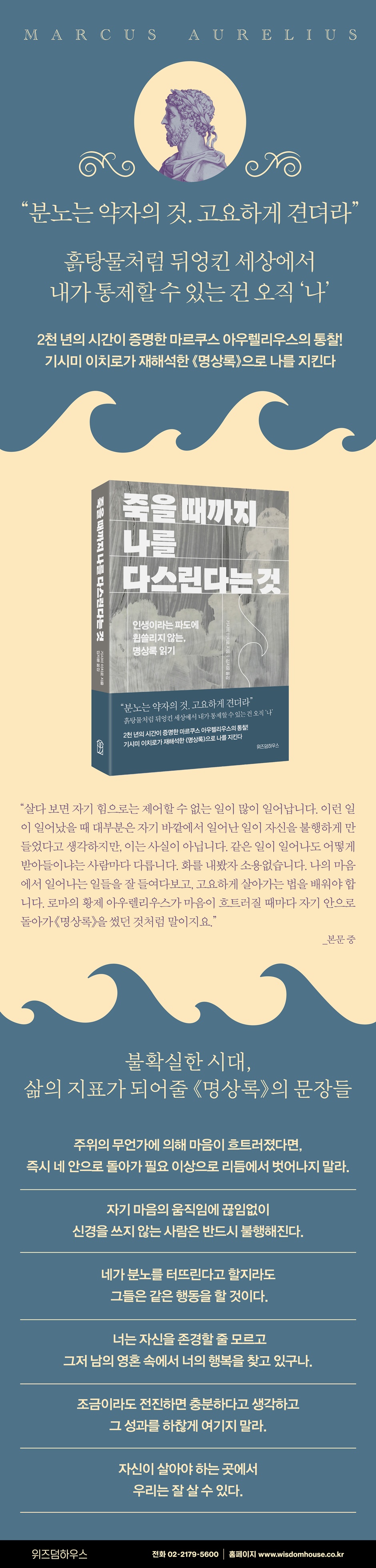
“Anger is for the weak.
“Endure calmly”
The insight of Marcus Aurelius, proven over two thousand years!
Protecting Myself with Kishimi Ichiro's Reinterpretation of "Meditations"
Ichiro Kishimi first encountered Meditations during his graduate school days while caring for his mother who suddenly collapsed from a cerebral infarction. He also realized the meaning of life again through the diary of Marcus Aurelius, who had long faced life and death on the battlefield and had to look into his inner self and discipline himself. “Disciplining Myself Until Death” contains sentences from “Meditations” personally selected by Ichiro Kishimi and reinterpreted stories.
This book gives strength to those who are trying to find their own way of life without losing their composure in a world that is like war.
“Endure calmly”
The insight of Marcus Aurelius, proven over two thousand years!
Protecting Myself with Kishimi Ichiro's Reinterpretation of "Meditations"
Ichiro Kishimi first encountered Meditations during his graduate school days while caring for his mother who suddenly collapsed from a cerebral infarction. He also realized the meaning of life again through the diary of Marcus Aurelius, who had long faced life and death on the battlefield and had to look into his inner self and discipline himself. “Disciplining Myself Until Death” contains sentences from “Meditations” personally selected by Ichiro Kishimi and reinterpreted stories.
This book gives strength to those who are trying to find their own way of life without losing their composure in a world that is like war.
- You can preview some of the book's contents.
Preview
index
Entering
Chapter 1: Aurelius and the Meditations
A Person Called Aurelius│A Record for Oneself│The Appellation 'You'│Seeing Oneself as Oneself
Chapter 2: Philosophy Protects Me
Even small progress is enough│How to live well in the place where I must live│Knowing how to give up│The only thing that protects us is philosophy
Chapter 3: Looking at Yourself
Looking into Your Own Heart│An Impregnable Mental Fortress
Chapter 4: How to Face Emotions
The power of composure│It's useless to get angry│Live with dignity│Don't get angry, teach│Expect nothing in return│When others evaluate me│Do not expect anything from others
Chapter 5: Living in harmony with nature
The reason we exist│Living as a human being│Looking at ourselves and coexisting with others
Chapter 6: How to Live in Complex Human Relationships
The Other Who Blocks My Way│I Only Focus on What I Can Do│I Think I'm One of Those People│Anyone Can Make Mistakes│We Were Born to Cooperate│Why Cooperate
Chapter 7: What is outside does not make people unhappy.
Disaster comes from within me│Judging correctly│No bad thing happens to good people
Chapter 8: How to Face Difficulties
There is no hardship that cannot be endured. I must choose how to face adversity. Endure it nobly.
Chapter 9: Do not insist on good and evil
Good and evil are indiscriminate│Be indifferent│Know the good and evil of this era│Living a miserable life│Others are also indiscriminate│Are life and death indiscriminate?
Chapter 10: Accepting Fate
Is everything fate? Accept it joyfully. Is what happens good?
Chapter 11: On Death
No one is immortal│A brief pause for a new beginning│Do not neglect death│Are you afraid of change│I am only doing my duty│I live thinking it is a bonus│A peaceful death│There is value in being alive
Chapter 12: Living in the Here and Now
Everything is fleeting│To be forgotten│We can only live for the present│Life is fleeting│Live today as if it were your last│Start now
Chapter 13 Beyond the Meditations
Confirming what is within your power│Existential and historical dichotomies│There is something you can do│You must not forget yourself
References
Chapter 1: Aurelius and the Meditations
A Person Called Aurelius│A Record for Oneself│The Appellation 'You'│Seeing Oneself as Oneself
Chapter 2: Philosophy Protects Me
Even small progress is enough│How to live well in the place where I must live│Knowing how to give up│The only thing that protects us is philosophy
Chapter 3: Looking at Yourself
Looking into Your Own Heart│An Impregnable Mental Fortress
Chapter 4: How to Face Emotions
The power of composure│It's useless to get angry│Live with dignity│Don't get angry, teach│Expect nothing in return│When others evaluate me│Do not expect anything from others
Chapter 5: Living in harmony with nature
The reason we exist│Living as a human being│Looking at ourselves and coexisting with others
Chapter 6: How to Live in Complex Human Relationships
The Other Who Blocks My Way│I Only Focus on What I Can Do│I Think I'm One of Those People│Anyone Can Make Mistakes│We Were Born to Cooperate│Why Cooperate
Chapter 7: What is outside does not make people unhappy.
Disaster comes from within me│Judging correctly│No bad thing happens to good people
Chapter 8: How to Face Difficulties
There is no hardship that cannot be endured. I must choose how to face adversity. Endure it nobly.
Chapter 9: Do not insist on good and evil
Good and evil are indiscriminate│Be indifferent│Know the good and evil of this era│Living a miserable life│Others are also indiscriminate│Are life and death indiscriminate?
Chapter 10: Accepting Fate
Is everything fate? Accept it joyfully. Is what happens good?
Chapter 11: On Death
No one is immortal│A brief pause for a new beginning│Do not neglect death│Are you afraid of change│I am only doing my duty│I live thinking it is a bonus│A peaceful death│There is value in being alive
Chapter 12: Living in the Here and Now
Everything is fleeting│To be forgotten│We can only live for the present│Life is fleeting│Live today as if it were your last│Start now
Chapter 13 Beyond the Meditations
Confirming what is within your power│Existential and historical dichotomies│There is something you can do│You must not forget yourself
References
Detailed image
Into the book
Soon after, my mother passed away and I returned to graduate school, but the life I had thought was on track disappeared, and I felt derailed.
In short, it is giving up on ‘success’.
I was prepared for the prospect of becoming a university professor and a life without money, but I still harbored the ambition to become a professor. But even that desire completely vanished.
Philosophy helped me overcome my mother's death and decide to live a different life from before.
--- From "Entering"
Even if you want to quit your job to make a living, realistically it might be as difficult as Aurelius's.
But if you're just suffering, you can't live your life.
Life is too short to endure living a lifestyle that doesn't fit your purpose.
But if you say that quitting your job because things are difficult now will solve the problem, that's not true.
It cannot be said that Aurelius' life as emperor was only miserable.
Aurelius does not seem to have considered either living as an emperor or living as a philosopher to be false.
He said:
We can live well where we need to live (May 16)
--- From "Chapter 2 Philosophy Protects Me"
'Dig inside you.
If you keep digging, there will always be a spring of goodness that will gush forth (7·59)
There is no one who does not wish to be happy.
It means that there is no choice but to not wish for happiness or to wish for unhappiness.
But why can't I be happy?
Because they don't know what is good and what is happiness for them.
To know that, you must use your reason properly.
To do that, you must dig inside yourself and find the ‘fountain of goodness.’
--- From "Chapter 3: Looking at Yourself"
There are countless injustices and unreasonable incidents happening in the world.
We feel indignation and anger because we have to live in such a situation.
Sometimes, under the assumption that the irrational is natural, we must turn our eyes inward and strive to achieve peace.
With this in mind, you should always consider whether there is anything you can do.
This is also what is meant by the phrase 'not selling'.
If you try to avoid external influences by digging inward, you may not be able to find peace of mind, let alone a sense of comfort.
'Few people are unhappy because they don't care what's going on in other people's minds.
But a person who is not constantly mindful of the movements of his own mind will inevitably become unhappy (2·8)
--- From "Chapter 3: Looking at Yourself"
Be like a rock that is constantly being hit by waves.
The rock stands solemnly, and the foam sleeps around it (4·49) '
Whatever someone does or says to me, I just think of it as a foam from a wave crashing against the rock called 'me'.
If you stand solemnly, even when you hear envy, jealousy, or baseless criticism or condemnation, the waves will eventually subside and become quiet.
Aurelius believed that anger was not something to be suppressed or controlled.
I believe that we can become free from anger when we truly realize that anger is 'unhelpful' and not good.
The fortress and the rock may have been metaphors that came to mind as he pictured himself free from passion.
--- From "Chapter 4: How to Face Emotions"
The past is no longer there because it is 'already alive'.
The future is 'uncertain' in the sense that no one knows what will happen.
No matter how much you try to imagine what will happen tomorrow, it will never happen exactly as planned.
People have no choice but to live in the 'present moment'.
Look into the abyss of eternity behind you.
And look at another infinity ahead.
In this infinity, what difference is there between a three-day-old baby and an old man who has lived for three generations? (4·50)
In short, it is giving up on ‘success’.
I was prepared for the prospect of becoming a university professor and a life without money, but I still harbored the ambition to become a professor. But even that desire completely vanished.
Philosophy helped me overcome my mother's death and decide to live a different life from before.
--- From "Entering"
Even if you want to quit your job to make a living, realistically it might be as difficult as Aurelius's.
But if you're just suffering, you can't live your life.
Life is too short to endure living a lifestyle that doesn't fit your purpose.
But if you say that quitting your job because things are difficult now will solve the problem, that's not true.
It cannot be said that Aurelius' life as emperor was only miserable.
Aurelius does not seem to have considered either living as an emperor or living as a philosopher to be false.
He said:
We can live well where we need to live (May 16)
--- From "Chapter 2 Philosophy Protects Me"
'Dig inside you.
If you keep digging, there will always be a spring of goodness that will gush forth (7·59)
There is no one who does not wish to be happy.
It means that there is no choice but to not wish for happiness or to wish for unhappiness.
But why can't I be happy?
Because they don't know what is good and what is happiness for them.
To know that, you must use your reason properly.
To do that, you must dig inside yourself and find the ‘fountain of goodness.’
--- From "Chapter 3: Looking at Yourself"
There are countless injustices and unreasonable incidents happening in the world.
We feel indignation and anger because we have to live in such a situation.
Sometimes, under the assumption that the irrational is natural, we must turn our eyes inward and strive to achieve peace.
With this in mind, you should always consider whether there is anything you can do.
This is also what is meant by the phrase 'not selling'.
If you try to avoid external influences by digging inward, you may not be able to find peace of mind, let alone a sense of comfort.
'Few people are unhappy because they don't care what's going on in other people's minds.
But a person who is not constantly mindful of the movements of his own mind will inevitably become unhappy (2·8)
--- From "Chapter 3: Looking at Yourself"
Be like a rock that is constantly being hit by waves.
The rock stands solemnly, and the foam sleeps around it (4·49) '
Whatever someone does or says to me, I just think of it as a foam from a wave crashing against the rock called 'me'.
If you stand solemnly, even when you hear envy, jealousy, or baseless criticism or condemnation, the waves will eventually subside and become quiet.
Aurelius believed that anger was not something to be suppressed or controlled.
I believe that we can become free from anger when we truly realize that anger is 'unhelpful' and not good.
The fortress and the rock may have been metaphors that came to mind as he pictured himself free from passion.
--- From "Chapter 4: How to Face Emotions"
The past is no longer there because it is 'already alive'.
The future is 'uncertain' in the sense that no one knows what will happen.
No matter how much you try to imagine what will happen tomorrow, it will never happen exactly as planned.
People have no choice but to live in the 'present moment'.
Look into the abyss of eternity behind you.
And look at another infinity ahead.
In this infinity, what difference is there between a three-day-old baby and an old man who has lived for three generations? (4·50)
--- From "Chapter 12 Living Here and Now"
Publisher's Review
“What is happiness to humans? How should we live?”
In times like these, we need philosophy.
Ichiro Kishimi, a writer and philosopher who is widely loved for his book "The Courage to be Disliked," has been consistently working to integrate "Meditations" with modern psychology and self-development to help individuals' lives.
Its origins date back to when Ichiro Kishimi was a graduate student.
He had to continue caring for his mother, who suddenly collapsed from a cerebral infarction. As he watched her on the brink of death, he thought, "What meaning does this kind of life have for a human being?" and began to question things he had previously considered valuable, such as money and fame.
Every time, I would open the 'diary' that Marcus Aurelius had written on the battlefield.
『Meditations』 is a book written on the battlefield by Marcus Aurelius, the 16th Roman emperor and philosopher, and is not simply a historical record of battles.
This book is a personal diary, a way to calm one's mind as one faces the uncertain days of not knowing when one might die, and a trace of the struggles of an emperor who constantly seeks to answer the questions life raises in the complex and multifaceted fate of leading a great empire.
It contains the figure of Marcus Aurelius, who, despite the glamorous nature of being an emperor and the realization of the transience of worldly affairs, silently carried out his daily duties.
Through the diary of a lonely hero who believed in philosophy and loved humanity more than power, one can encounter profound insights into life, making it the most read book by past U.S. presidents and a must-read for prestigious universities such as Harvard University and Oxford University.
『Ruling Myself Until I Die』 is a book in which Ichiro Kishimi, a leading expert in psychology, directly translated the original text and expressed it in his own words, expressing the content of Marcus Aurelius's reflections on life and death while digging deep into his inner self without wavering even on the fierce battlefield. He also selected sentences from 『Meditations』 that we should reflect on and included them in the book.
At the time when Ichiro Kishimi was researching this book, philosophy was considered a discipline that was of no use in making money.
But what he needed was reflection on life and resilience, not practical skills.
I live in the present with a heart strengthened by the insights passed down from people two thousand years ago, so in a way, I have acquired the 'skill' of life.
Life is about asking questions and finding answers.
A journey of philosophical questions and answers completed through "Meditations"
Starting with an introduction to the person Marcus Aurelius and the meaning of Meditations, it goes on to explain the philosophical method that is the 'art of life' that we need now. Since Meditations is an inner record, it emphasizes the equanimity that governs oneself until death without being swayed by one's surroundings.
In particular, it talks about how to have the courage to look inside yourself and face your honest feelings.
Marcus Aurelius always tried to go into his own mind whenever something disturbed him.
We long for happiness, but why is it so hard to get it?
Are other people interfering with my happiness?
But in fact, other people are not the real cause.
When you become emotional and know what is going on inside you, you will not be confused.
If you can free yourself from passions like anger and hatred, you will be able to remain unshaken no matter what people around you say.
And while you can't avoid hardship, you can choose how you face it, so he said, 'Hold on nobly.'
This means that you should accept the emotions as they are, but you should not lose yourself by being swayed by them.
Live in the present
When Aurelius said, "Live as if you could disappear from this world at any moment," he meant to do your best right now, in your current position.
I can't do anything about what's already happened.
There is nothing more foolish than worrying about something that has not happened and being consumed by anxiety so much that you can't do anything.
I just have to do what I can here and now.
This is the age-old wisdom that says we should live our lives with a generous heart, without becoming overly serious, but without losing our sense of seriousness, no matter what hardships we face.
In times like these, we need philosophy.
Ichiro Kishimi, a writer and philosopher who is widely loved for his book "The Courage to be Disliked," has been consistently working to integrate "Meditations" with modern psychology and self-development to help individuals' lives.
Its origins date back to when Ichiro Kishimi was a graduate student.
He had to continue caring for his mother, who suddenly collapsed from a cerebral infarction. As he watched her on the brink of death, he thought, "What meaning does this kind of life have for a human being?" and began to question things he had previously considered valuable, such as money and fame.
Every time, I would open the 'diary' that Marcus Aurelius had written on the battlefield.
『Meditations』 is a book written on the battlefield by Marcus Aurelius, the 16th Roman emperor and philosopher, and is not simply a historical record of battles.
This book is a personal diary, a way to calm one's mind as one faces the uncertain days of not knowing when one might die, and a trace of the struggles of an emperor who constantly seeks to answer the questions life raises in the complex and multifaceted fate of leading a great empire.
It contains the figure of Marcus Aurelius, who, despite the glamorous nature of being an emperor and the realization of the transience of worldly affairs, silently carried out his daily duties.
Through the diary of a lonely hero who believed in philosophy and loved humanity more than power, one can encounter profound insights into life, making it the most read book by past U.S. presidents and a must-read for prestigious universities such as Harvard University and Oxford University.
『Ruling Myself Until I Die』 is a book in which Ichiro Kishimi, a leading expert in psychology, directly translated the original text and expressed it in his own words, expressing the content of Marcus Aurelius's reflections on life and death while digging deep into his inner self without wavering even on the fierce battlefield. He also selected sentences from 『Meditations』 that we should reflect on and included them in the book.
At the time when Ichiro Kishimi was researching this book, philosophy was considered a discipline that was of no use in making money.
But what he needed was reflection on life and resilience, not practical skills.
I live in the present with a heart strengthened by the insights passed down from people two thousand years ago, so in a way, I have acquired the 'skill' of life.
Life is about asking questions and finding answers.
A journey of philosophical questions and answers completed through "Meditations"
Starting with an introduction to the person Marcus Aurelius and the meaning of Meditations, it goes on to explain the philosophical method that is the 'art of life' that we need now. Since Meditations is an inner record, it emphasizes the equanimity that governs oneself until death without being swayed by one's surroundings.
In particular, it talks about how to have the courage to look inside yourself and face your honest feelings.
Marcus Aurelius always tried to go into his own mind whenever something disturbed him.
We long for happiness, but why is it so hard to get it?
Are other people interfering with my happiness?
But in fact, other people are not the real cause.
When you become emotional and know what is going on inside you, you will not be confused.
If you can free yourself from passions like anger and hatred, you will be able to remain unshaken no matter what people around you say.
And while you can't avoid hardship, you can choose how you face it, so he said, 'Hold on nobly.'
This means that you should accept the emotions as they are, but you should not lose yourself by being swayed by them.
Live in the present
When Aurelius said, "Live as if you could disappear from this world at any moment," he meant to do your best right now, in your current position.
I can't do anything about what's already happened.
There is nothing more foolish than worrying about something that has not happened and being consumed by anxiety so much that you can't do anything.
I just have to do what I can here and now.
This is the age-old wisdom that says we should live our lives with a generous heart, without becoming overly serious, but without losing our sense of seriousness, no matter what hardships we face.
GOODS SPECIFICS
- Date of issue: September 25, 2024
- Page count, weight, size: 312 pages | 402g | 130*190*20mm
- ISBN13: 9791171712762
- ISBN10: 1171712766
You may also like
카테고리
korean


korean

![GQ KOREA Mark (Monthly): December [2025]](http://librairie.coreenne.fr/cdn/shop/files/8ef265dbbfbf186523ed75ba7319009d.jpg?v=1765340328&width=3840)


