

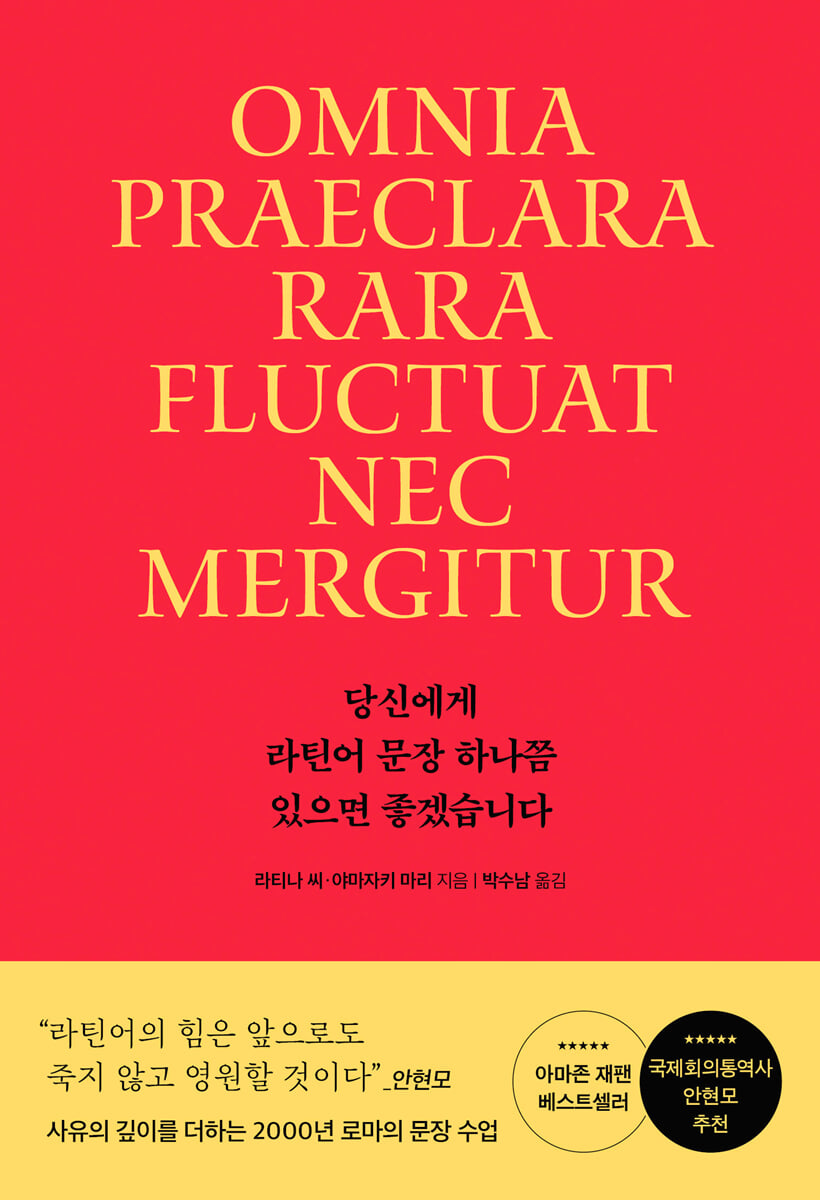
I wish you had a Latin phrase or two.
 |
Description
Book Introduction
"The power of Latin will never die, it will endure forever." - Highly recommended by international conference interpreter Hyunmo Ahn
A 2000-year Roman heraldry class that adds depth to your thinking
★ Amazon Japan Bestseller
★ Includes 65 key sentences from classical Latin literature
Carpe diem (Seize the day), the famous line that made the movie “Dead Poets Society” a masterpiece; Fortis Fortuna Adiuvat (Fortune favors the brave) engraved on the back of the main character of the movie series “John Wick”; Amor Fati (Love your fate) which is a phrase from a trot melody but penetrates the essence of Nietzsche’s philosophy; and even Ad Astra per Aspera (Against adversity, to the stars), the title of NASA’s Apollo 1 Memorial Exhibition.
Why does a Latin proverb, rather than any other language, serve as a pervasive motif throughout the work, eliciting a nod of sympathy and understanding from people around the world? It's likely because it embodies the essence of human thought, a philosophy that has endured the vicissitudes of two thousand years, constantly being validated and preserved by humanity.
This book, "I Wish You Had a Latin Phrase," contains 65 famous quotes from among the countless Latin phrases that have deeply shaped Western civilization and influenced great philosophers throughout history, and that truly resonate with us living in the modern era. These were carefully selected by Latina, a young Latin scholar who has widely spread the beauty of Latin and the mysteries of its etymology through social media, and Mari Yamazaki, who has received various cultural awards and medals in Japan and Italy for her Roman-themed manga, including "Thermae Romae" and "Pliny the Great." These carefully selected quotes reflect a deep affection for Latin.
From Horace, who maintained his composure amidst chaos, to Virgil, with his unique lyricism, to Caesar, who carved out a life with unwavering determination, the Latin sentences left behind by the sages of ancient Rome, and the stories of the ancient Romans amidst the turbulent times that permeate them, unfold for us an unprecedented intellectual journey.
Reading Latin proverbs, which are like abridged records of human observation, allows us to grasp the social nature of human beings very objectively.
This is because, beneath the layers of time, people in the past also experienced similar things and had similar concerns as we do today.
The more I understand the sentences that contain the results of all these reflections, the more I reflect on my arrogance and self-deception as a human being, become more humble, and at the same time, realize the happiness and joy of life itself, gaining the strength to live tomorrow.
Let's discover the world of Latin through the weighty sentences that humanity has preserved for centuries and the authors' meticulous and warm commentary.
One of those sentences will surely be engraved deep in your heart and become a compass that will stay with you for the rest of your life.
A 2000-year Roman heraldry class that adds depth to your thinking
★ Amazon Japan Bestseller
★ Includes 65 key sentences from classical Latin literature
Carpe diem (Seize the day), the famous line that made the movie “Dead Poets Society” a masterpiece; Fortis Fortuna Adiuvat (Fortune favors the brave) engraved on the back of the main character of the movie series “John Wick”; Amor Fati (Love your fate) which is a phrase from a trot melody but penetrates the essence of Nietzsche’s philosophy; and even Ad Astra per Aspera (Against adversity, to the stars), the title of NASA’s Apollo 1 Memorial Exhibition.
Why does a Latin proverb, rather than any other language, serve as a pervasive motif throughout the work, eliciting a nod of sympathy and understanding from people around the world? It's likely because it embodies the essence of human thought, a philosophy that has endured the vicissitudes of two thousand years, constantly being validated and preserved by humanity.
This book, "I Wish You Had a Latin Phrase," contains 65 famous quotes from among the countless Latin phrases that have deeply shaped Western civilization and influenced great philosophers throughout history, and that truly resonate with us living in the modern era. These were carefully selected by Latina, a young Latin scholar who has widely spread the beauty of Latin and the mysteries of its etymology through social media, and Mari Yamazaki, who has received various cultural awards and medals in Japan and Italy for her Roman-themed manga, including "Thermae Romae" and "Pliny the Great." These carefully selected quotes reflect a deep affection for Latin.
From Horace, who maintained his composure amidst chaos, to Virgil, with his unique lyricism, to Caesar, who carved out a life with unwavering determination, the Latin sentences left behind by the sages of ancient Rome, and the stories of the ancient Romans amidst the turbulent times that permeate them, unfold for us an unprecedented intellectual journey.
Reading Latin proverbs, which are like abridged records of human observation, allows us to grasp the social nature of human beings very objectively.
This is because, beneath the layers of time, people in the past also experienced similar things and had similar concerns as we do today.
The more I understand the sentences that contain the results of all these reflections, the more I reflect on my arrogance and self-deception as a human being, become more humble, and at the same time, realize the happiness and joy of life itself, gaining the strength to live tomorrow.
Let's discover the world of Latin through the weighty sentences that humanity has preserved for centuries and the authors' meticulous and warm commentary.
One of those sentences will surely be engraved deep in your heart and become a compass that will stay with you for the rest of your life.
- You can preview some of the book's contents.
Preview
index
To begin with, all answers lead to Rome.
Chapter 1: When You Need Unconventional Comfort
How to end hesitation
If you want to become the master of your emotions
Moderation is the best choice
Techniques to Stop Anxiety
To maintain the dignity of an adult
How to Give Meaning to Life
The gift of hard times
Chapter 2 When Facing a New Challenge
Practice believing in myself
There are no bad experiences in the world.
You have to be crazy to be crazy
Chapter 3: When I Want to Love Without Losing Myself
Why Love Is Difficult
The mind that overwhelms everything
Love and Surrender
A special way to gain favor
Chapter 4: When Life Isn't as Simple as You Think
Accepting the breakup
Life Lessons Learned from Animals
What Alcohol Teaches Us
Finding meaningful connections
Life is a play
Chapter 5: When You Want to Become a Better Person
How to use your time properly
Living and living
A life without comparison
The conditions of a true adult
Chapter 6: When to Steady a Wavering Heart
It seems contradictory, but it's true
How to maintain mental balance
The power of bold choices
Chapter 7: When You Want to Hold on to Hope Even in Turmoil
How to End a War
The wisdom to recognize differences
Smart social distancing
An eye that distinguishes between truth and lies
Traps in a peaceful everyday life
Happiness hidden in the ordinary
Seeing the future through the past
In conclusion: Latin is not an old language, but an old comfort.
Chapter 1: When You Need Unconventional Comfort
How to end hesitation
If you want to become the master of your emotions
Moderation is the best choice
Techniques to Stop Anxiety
To maintain the dignity of an adult
How to Give Meaning to Life
The gift of hard times
Chapter 2 When Facing a New Challenge
Practice believing in myself
There are no bad experiences in the world.
You have to be crazy to be crazy
Chapter 3: When I Want to Love Without Losing Myself
Why Love Is Difficult
The mind that overwhelms everything
Love and Surrender
A special way to gain favor
Chapter 4: When Life Isn't as Simple as You Think
Accepting the breakup
Life Lessons Learned from Animals
What Alcohol Teaches Us
Finding meaningful connections
Life is a play
Chapter 5: When You Want to Become a Better Person
How to use your time properly
Living and living
A life without comparison
The conditions of a true adult
Chapter 6: When to Steady a Wavering Heart
It seems contradictory, but it's true
How to maintain mental balance
The power of bold choices
Chapter 7: When You Want to Hold on to Hope Even in Turmoil
How to End a War
The wisdom to recognize differences
Smart social distancing
An eye that distinguishes between truth and lies
Traps in a peaceful everyday life
Happiness hidden in the ordinary
Seeing the future through the past
In conclusion: Latin is not an old language, but an old comfort.
Detailed image
.jpg)
Into the book
The numerous Latin proverbs that Ms. Latina and I introduce in this book also convey the fact that human thoughts and lives are not very different in any era.
Beneath the layers of time, people in the past also experienced similar things and had similar concerns as we do today.
The wisdom of the ancients, who persevered without giving up in the face of any hardship or trial, remains precious and has been passed down through the ages.
The fact that Italians still use Latin proverbs naturally in their daily lives is proof of this.
--- p.9~10
The last sentence from Horace that I would like to introduce is carpe diem, seize the day.
Like aurea mediocritas, meaning the golden mean, Horace's maxims are often characterized by surprising combinations of words.
The combination of ‘gold’ and ‘moderate’ is also not a common one.
If you read Horace's poetry, you will find that these unique expressions appear frequently.
Carpe diem is one of them, which literally means 'take each day as it comes'.
--- p.41
varium et mutabile semper femina is a phrase from Virgil's Aeneid.
The Aeneid is a 12-volume epic poem about the founding of the Roman Empire that follows the journey of the Trojan hero Aeneas after the fall of Troy.
More specifically, it is a line from a line of advice given to Aeneas by a character in his dream.
Aeneas falls in love with Dido, the queen of Carthage.
Aeneas was destined to head to a new land, Italy, but he found it difficult to make up his mind to cross over.
At that time, the person who appeared in my dream advised me to hurry and go to Italy, saying this.
--- p.111~112
First, I would like to talk about the sentence abiit ad plures, which means to go to more people.
There are probably more people who have already died than there are people alive in the world today.
So this means that he went to heaven, or in other words, he died.
There is an old English expression, "go to the silent majority."
The silent majority are the many people who do not speak, that is, 'those who are dead and have no more words.'
It has the same meaning as this Latin phrase.
The meaning is conveyed even without speaking directly.
The way of expression is interesting.
--- p.125
The first sentence we will cover is inter arma silent leges.
This is what Cicero said at trial, defending a man named Milo who had committed murder.
If we look at the original context, it is as follows:
“If someone tries to kill you, you protect yourself even if it means killing them.
This is a given.
So, if it is self-defense, it is okay to kill the opponent regardless of the law.” However, it is now widely known as an interpretation that ‘during war, the law is ignored and anything can happen.’
The phrase about self-defense is being used to criticize war.
--- p.193
The phrase "quis custodiet ipsos custodes? Who will guard the guards?" appears in a poem by the ancient Roman satirist Juvenal.
His representative work is a collection of satirical poems consisting of 16 pieces.
But the context in which this sentence appears is a bit surprising.
It's about a man who is worried about how to stop his cheating wife from cheating on him.
No matter how much you protect someone, your wife will seduce even that person.
It's interesting that the phrase about adultery is now cited when institutions that exist to maintain social order and public order abuse their power.
Beneath the layers of time, people in the past also experienced similar things and had similar concerns as we do today.
The wisdom of the ancients, who persevered without giving up in the face of any hardship or trial, remains precious and has been passed down through the ages.
The fact that Italians still use Latin proverbs naturally in their daily lives is proof of this.
--- p.9~10
The last sentence from Horace that I would like to introduce is carpe diem, seize the day.
Like aurea mediocritas, meaning the golden mean, Horace's maxims are often characterized by surprising combinations of words.
The combination of ‘gold’ and ‘moderate’ is also not a common one.
If you read Horace's poetry, you will find that these unique expressions appear frequently.
Carpe diem is one of them, which literally means 'take each day as it comes'.
--- p.41
varium et mutabile semper femina is a phrase from Virgil's Aeneid.
The Aeneid is a 12-volume epic poem about the founding of the Roman Empire that follows the journey of the Trojan hero Aeneas after the fall of Troy.
More specifically, it is a line from a line of advice given to Aeneas by a character in his dream.
Aeneas falls in love with Dido, the queen of Carthage.
Aeneas was destined to head to a new land, Italy, but he found it difficult to make up his mind to cross over.
At that time, the person who appeared in my dream advised me to hurry and go to Italy, saying this.
--- p.111~112
First, I would like to talk about the sentence abiit ad plures, which means to go to more people.
There are probably more people who have already died than there are people alive in the world today.
So this means that he went to heaven, or in other words, he died.
There is an old English expression, "go to the silent majority."
The silent majority are the many people who do not speak, that is, 'those who are dead and have no more words.'
It has the same meaning as this Latin phrase.
The meaning is conveyed even without speaking directly.
The way of expression is interesting.
--- p.125
The first sentence we will cover is inter arma silent leges.
This is what Cicero said at trial, defending a man named Milo who had committed murder.
If we look at the original context, it is as follows:
“If someone tries to kill you, you protect yourself even if it means killing them.
This is a given.
So, if it is self-defense, it is okay to kill the opponent regardless of the law.” However, it is now widely known as an interpretation that ‘during war, the law is ignored and anything can happen.’
The phrase about self-defense is being used to criticize war.
--- p.193
The phrase "quis custodiet ipsos custodes? Who will guard the guards?" appears in a poem by the ancient Roman satirist Juvenal.
His representative work is a collection of satirical poems consisting of 16 pieces.
But the context in which this sentence appears is a bit surprising.
It's about a man who is worried about how to stop his cheating wife from cheating on him.
No matter how much you protect someone, your wife will seduce even that person.
It's interesting that the phrase about adultery is now cited when institutions that exist to maintain social order and public order abuse their power.
--- p.213
Publisher's Review
“The oldest sentence is,
“It is the newest comfort”
How Latin inspires us and gives us direction in life
Is there a phrase you use often, a sentence you always hold close to your heart? It's easy to dismiss it as trivial, but I urge you to seriously examine it.
This is because it becomes life itself.
Words become thoughts, thoughts become beliefs, and those beliefs lead to the choices and direction of life.
In other words, a single sentence that resides in our mind eventually becomes our life.
For those who want to set new course in life or have yet to find a single phrase that represents them, the two authors recommend Latin proverbs that will serve as anchors of wisdom that will remain constant in any situation.
The reason why the proverbs carefully selected by the two authors are particularly good to use as 'life sentences' is that, above all, these words were born during one of the most turbulent times in ancient history, when the Roman social system was changing from a republic to an empire.
In this age of uncertainty and chaos, the words of writers as they confront various emotions are filled with indescribable comfort and insight.
I've curated a total of 7 chapters by situation so that you can unfold them at each important moment in your life, so you don't have to read them in order.
If you need some unconventional consolation, I recommend omnia praeclara rara (Everything that is splendid is rare). For those who want to love without losing themselves, I recommend omnia vincit amor (Love conquers all). For those who want to be better, I recommend esse quam videri (Be rather than appear).
In this way, the life sentences proposed by the two authors go beyond mere mottos to aim for, and help us find the answer to the question of a 'good life.'
An attitude that acknowledges and accepts differences regardless of whether you win or lose, an attitude that uses painful situations as an opportunity to move forward, and a heart that believes in yourself and jumps into the world.
That's probably why you should have a Latin phrase or two.
“All answers lead to Rome.”
A single Latin collection for a dignified and cultured life
Have you ever heard the Latin adage, "quis custodiet ipsos custodes?" (Who will watch the watchmen?)? This is often cited when institutions meant to maintain social order and public order abuse their power.
It is a sharp sentence that sounds an alarm, but there is a surprising truth behind the birth of this word: it was a phrase about adultery.
This is a phrase from a poem by the ancient Roman satirist Juvenal, written in a poem in which a man is wondering how to stop his cheating wife from cheating on him.
The context is that no matter how much you protect someone, your wife will seduce even that person.
This doesn't end with a brief introduction to these proverbs, but rather offers a comprehensive look at the behind-the-scenes stories, as well as the history and culture of ancient Rome and the implications of Latin literature. This adds to the intellectual enjoyment and helps broaden the scope of thought.
The everyday examples presented by the two authors in a conversational format also help us see the world from various angles and have a pleasant intellectual experience.
There is a phonetic transcription included that can be read and memorized even without any knowledge of the language, so don't worry if you are unfamiliar with Latin.
As I meet the ancient Roman sages who labeled the emotions I had yet to name and offered a dense comfort that transcended time and space, I will soon discover the inherent charm of Latin and a deeper sense of self.
“It is the newest comfort”
How Latin inspires us and gives us direction in life
Is there a phrase you use often, a sentence you always hold close to your heart? It's easy to dismiss it as trivial, but I urge you to seriously examine it.
This is because it becomes life itself.
Words become thoughts, thoughts become beliefs, and those beliefs lead to the choices and direction of life.
In other words, a single sentence that resides in our mind eventually becomes our life.
For those who want to set new course in life or have yet to find a single phrase that represents them, the two authors recommend Latin proverbs that will serve as anchors of wisdom that will remain constant in any situation.
The reason why the proverbs carefully selected by the two authors are particularly good to use as 'life sentences' is that, above all, these words were born during one of the most turbulent times in ancient history, when the Roman social system was changing from a republic to an empire.
In this age of uncertainty and chaos, the words of writers as they confront various emotions are filled with indescribable comfort and insight.
I've curated a total of 7 chapters by situation so that you can unfold them at each important moment in your life, so you don't have to read them in order.
If you need some unconventional consolation, I recommend omnia praeclara rara (Everything that is splendid is rare). For those who want to love without losing themselves, I recommend omnia vincit amor (Love conquers all). For those who want to be better, I recommend esse quam videri (Be rather than appear).
In this way, the life sentences proposed by the two authors go beyond mere mottos to aim for, and help us find the answer to the question of a 'good life.'
An attitude that acknowledges and accepts differences regardless of whether you win or lose, an attitude that uses painful situations as an opportunity to move forward, and a heart that believes in yourself and jumps into the world.
That's probably why you should have a Latin phrase or two.
“All answers lead to Rome.”
A single Latin collection for a dignified and cultured life
Have you ever heard the Latin adage, "quis custodiet ipsos custodes?" (Who will watch the watchmen?)? This is often cited when institutions meant to maintain social order and public order abuse their power.
It is a sharp sentence that sounds an alarm, but there is a surprising truth behind the birth of this word: it was a phrase about adultery.
This is a phrase from a poem by the ancient Roman satirist Juvenal, written in a poem in which a man is wondering how to stop his cheating wife from cheating on him.
The context is that no matter how much you protect someone, your wife will seduce even that person.
This doesn't end with a brief introduction to these proverbs, but rather offers a comprehensive look at the behind-the-scenes stories, as well as the history and culture of ancient Rome and the implications of Latin literature. This adds to the intellectual enjoyment and helps broaden the scope of thought.
The everyday examples presented by the two authors in a conversational format also help us see the world from various angles and have a pleasant intellectual experience.
There is a phonetic transcription included that can be read and memorized even without any knowledge of the language, so don't worry if you are unfamiliar with Latin.
As I meet the ancient Roman sages who labeled the emotions I had yet to name and offered a dense comfort that transcended time and space, I will soon discover the inherent charm of Latin and a deeper sense of self.
GOODS SPECIFICS
- Date of issue: October 29, 2025
- Page count, weight, size: 232 pages | 302g | 130*190*14mm
- ISBN13: 9791199247895
- ISBN10: 1199247898
You may also like
카테고리
korean


korean

![GQ KOREA Mark (Monthly): December [2025]](http://librairie.coreenne.fr/cdn/shop/files/8ef265dbbfbf186523ed75ba7319009d.jpg?v=1765340328&width=3840)


