

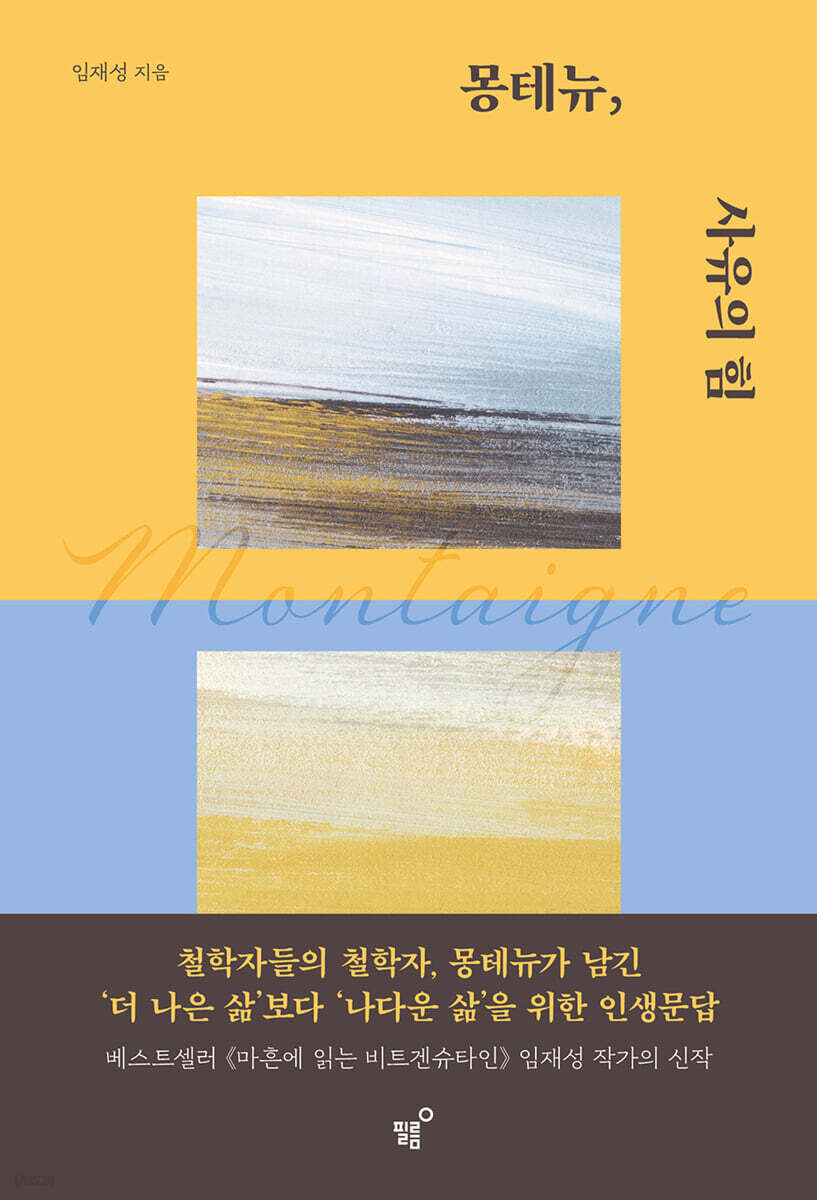
Montaigne, The Power of Thought
 |
Description
Book Introduction
The philosopher of philosophers who have had the greatest influence on humanity in history,
Better than the 'better life' left by Michel de Montaigne
Life Q&A for Living Your Own Life
“In the midst of the whirlwind of life,
“Solid reasoning begins only with ‘me.’”
Michel de Montaigne (1533-1592), a French philosopher of the Renaissance era, left his judicial post at the age of thirty-eight and set up his own study in the Château de Montaigne. There, he stayed, escaping the pace of the world and filling his time with thought, silence, reading, and writing, quieting the external noise and listening to his inner voice.
His thinking was not a philosophy to persuade anyone, but an inner technique to protect oneself and live one's life.
The book that was born that way is 『Essais』.
"Essays" are records that must be read to live today, traces of persistent thinking to understand oneself, and a technique for maintaining one's inner center even in the midst of wavering.
Montaigne does not present a grand philosophical system or a complete theory.
He reflected on his daily life, wrote down the questions that arose in his mind, and explored the essence of existence by recording the inherent anxieties, losses, and contradictions of human nature while controlling his wavering mind with thought.
His thinking has deeply inspired and influenced numerous philosophers and thinkers, including Pascal, Descartes, Nietzsche, Emerson, and Schopenhauer.
Nietzsche said, “It was only after reading Montaigne that I began to understand human thought,” and Emerson said, “Montaigne is my friend and mentor.
“He is half of my spirit,” he confessed.
"Montaigne, The Power of Thought" is a book about the power of thought that allows me to live my life as myself even in the midst of uncertainty, by reconnecting Montaigne's profound questions to us today.
This book begins by questioning existence, the starting point of thought. It talks about how to protect one's inner self even in a life swayed by the world's standards and those of others, how to transform one's perception and become flexible through thought in the face of change, and how to hold on to life firmly by thinking about and reflecting on death.
The 'Thoughts of the Day' section, located throughout each chapter, encourages deep conversations with oneself through time for reflection and questioning, while pondering Montaigne's sentences.
If you're losing yourself amidst change and uncertainty, if you want to design your own life, not by others' standards, if you want to enrich your life through philosophical thought and reflection, if you ultimately want to live a "life true to yourself" rather than a "better life," this book will resonate deeply as a life guide that illuminates your own path to thought.
Better than the 'better life' left by Michel de Montaigne
Life Q&A for Living Your Own Life
“In the midst of the whirlwind of life,
“Solid reasoning begins only with ‘me.’”
Michel de Montaigne (1533-1592), a French philosopher of the Renaissance era, left his judicial post at the age of thirty-eight and set up his own study in the Château de Montaigne. There, he stayed, escaping the pace of the world and filling his time with thought, silence, reading, and writing, quieting the external noise and listening to his inner voice.
His thinking was not a philosophy to persuade anyone, but an inner technique to protect oneself and live one's life.
The book that was born that way is 『Essais』.
"Essays" are records that must be read to live today, traces of persistent thinking to understand oneself, and a technique for maintaining one's inner center even in the midst of wavering.
Montaigne does not present a grand philosophical system or a complete theory.
He reflected on his daily life, wrote down the questions that arose in his mind, and explored the essence of existence by recording the inherent anxieties, losses, and contradictions of human nature while controlling his wavering mind with thought.
His thinking has deeply inspired and influenced numerous philosophers and thinkers, including Pascal, Descartes, Nietzsche, Emerson, and Schopenhauer.
Nietzsche said, “It was only after reading Montaigne that I began to understand human thought,” and Emerson said, “Montaigne is my friend and mentor.
“He is half of my spirit,” he confessed.
"Montaigne, The Power of Thought" is a book about the power of thought that allows me to live my life as myself even in the midst of uncertainty, by reconnecting Montaigne's profound questions to us today.
This book begins by questioning existence, the starting point of thought. It talks about how to protect one's inner self even in a life swayed by the world's standards and those of others, how to transform one's perception and become flexible through thought in the face of change, and how to hold on to life firmly by thinking about and reflecting on death.
The 'Thoughts of the Day' section, located throughout each chapter, encourages deep conversations with oneself through time for reflection and questioning, while pondering Montaigne's sentences.
If you're losing yourself amidst change and uncertainty, if you want to design your own life, not by others' standards, if you want to enrich your life through philosophical thought and reflection, if you ultimately want to live a "life true to yourself" rather than a "better life," this book will resonate deeply as a life guide that illuminates your own path to thought.
- You can preview some of the book's contents.
Preview
index
prolog
Chapter 1.
My life begins the moment I ask about existence.
Before doing anything, let's first ask about 'existence'.
I can only be sure of who I am today.
He who knows how to see me will not lose his way.
I am always changing, mixing, and shaking
You have to step back from the noise of life to find yourself.
My unwillingness to change imprisons me.
The shadow of my desire has another's face.
Chapter 2.
Even if the world shakes, I protect myself.
I face situations I can't control with composure.
How to protect myself from being swayed by anger
I control my emotions quietly but firmly.
The power of repetition that protects me even in the midst of shaking
Those who endure silently become quietly strong.
Even when the world shakes, I hold on to my will.
Every time I waver, I hold myself together with words.
Chapter 3.
The moment you stop thinking, life loses direction.
Knowledge begins with the awareness that you don't know.
Assertion stops thinking
The study, a room of reflection that refines me
I learn about life from old books.
Conversation is an exercise in thinking that expands my mind.
When faced with an unfamiliar world, reason awakens again.
Knowledge without reason has no impact on my life.
Chapter 4.
If you change the direction of your mind, the shaking will stop.
We are always there and rarely here
The problem wasn't the thing, it was me looking at it.
Pain stays within me only as long as I allow it to.
Shame freezes the heart and breeds resentment.
I didn't fall apart because there was that one person.
I look at myself by my own standards.
A decision made after deep deliberation is unwavering.
Chapter 5.
The more we face death, the clearer life becomes.
No one knows until the last day comes
The eyes that look upon death illuminate life more clearly.
Learning to die is rewriting life.
Illness helped me come to terms with death.
The density of life is more important than its length.
Death will determine the meaning of a lifetime of study.
Live today so you can leave at any time
Chapter 1.
My life begins the moment I ask about existence.
Before doing anything, let's first ask about 'existence'.
I can only be sure of who I am today.
He who knows how to see me will not lose his way.
I am always changing, mixing, and shaking
You have to step back from the noise of life to find yourself.
My unwillingness to change imprisons me.
The shadow of my desire has another's face.
Chapter 2.
Even if the world shakes, I protect myself.
I face situations I can't control with composure.
How to protect myself from being swayed by anger
I control my emotions quietly but firmly.
The power of repetition that protects me even in the midst of shaking
Those who endure silently become quietly strong.
Even when the world shakes, I hold on to my will.
Every time I waver, I hold myself together with words.
Chapter 3.
The moment you stop thinking, life loses direction.
Knowledge begins with the awareness that you don't know.
Assertion stops thinking
The study, a room of reflection that refines me
I learn about life from old books.
Conversation is an exercise in thinking that expands my mind.
When faced with an unfamiliar world, reason awakens again.
Knowledge without reason has no impact on my life.
Chapter 4.
If you change the direction of your mind, the shaking will stop.
We are always there and rarely here
The problem wasn't the thing, it was me looking at it.
Pain stays within me only as long as I allow it to.
Shame freezes the heart and breeds resentment.
I didn't fall apart because there was that one person.
I look at myself by my own standards.
A decision made after deep deliberation is unwavering.
Chapter 5.
The more we face death, the clearer life becomes.
No one knows until the last day comes
The eyes that look upon death illuminate life more clearly.
Learning to die is rewriting life.
Illness helped me come to terms with death.
The density of life is more important than its length.
Death will determine the meaning of a lifetime of study.
Live today so you can leave at any time
Detailed image

Into the book
We are so busy with our lives that we too often forget ourselves.
To us, Montaigne says this:
“Look inside yourself.
Want to know who you are?
If your mind and will are scattered and exhausted, bring them back in.
“You are wasting yourself now.”
Looking within begins with stopping.
Take a step back and look at me.
Now, I ask myself whether this life is truly in line with my intentions.
Montaigne reflected on himself every day.
What I found inside was vanity, anxiety, and a fragile self swayed by moods.
Real life begins with that recognition.
Accepting myself as I am is the first step to increasing the density of my life.
---From "Before doing anything, let's first ask about 'existence'"
Montaigne believed that humans are not fixed beings, but constantly changing beings.
He criticized the attitude of humans who are often obsessed with their own tendencies and temperaments and mistakenly believe that they are themselves.
We often say, “This is just the way I am,” and we set boundaries and confine ourselves.
But such stereotypes are not reality, but merely repeated self-assurances.
(…) What am I like now?
Is this really the person I want to be? Or is this the person I've created to avoid past habits, the expectations of others, and failure? Saying, "This is just how I am," preserves familiarity, but blocks a new me.
Now is the best time to change.
---From "The unwillingness to change imprisons me"
There are things in life that I cannot change no matter how hard I try.
Like an unexpected event, an unexpected relationship shake-up, or an unprepared break-up.
In moments like that, it becomes more important to refine myself than to try to hold on to the world.
If you can't control the outside, at least correct your internal attitude.
That is the most realistic way to protect myself in this turbulent world.
(…) Living life wisely does not mean trying to do everything my way, but rather humbly recognizing where the flow of my life is flowing.
Accepting the things I cannot change as they are, but keeping my center within them.
That is the attitude of a person who does not crumble even in the face of a shaky world.
---From "I face uncontrollable situations calmly"
The truth of life is often not found at the end of words, but in the margins of silence.
Pausing to ask, that one step of reservation, sometimes speaks more than words.
Don't settle and stay still.
Reason quietly takes root in that place.
(…) As we live, we cannot know everything clearly and we cannot fully understand everyone.
So sometimes, let's live with reservations instead of judgments, with questions instead of certainties.
A person who postpones conclusions, leaves questions, and leaves room for margins.
---From "Decisions Stop Thinking"
We sometimes make impulsive choices and are easily swayed by those choices.
The more complicated our minds become, the more we want to make quick decisions, and impatience hinders deep reflection.
But truly strong resolutions always come from deep, quiet inner thought.
A decision made after long thought, sufficient reflection, and calming of mind is not shaken by external influences.
Only when the direction of our hearts reaches the center can we move forward without wavering.
If you have to make a decision now, you don't have to rush it today.
A decision made after enduring a quiet time and convincing yourself will never be shaken.
And that is the most solid teaching that Montaigne left us.
---From "A decision made after deep consideration is unwavering"
Our lives are still being written.
Yet we jump to conclusions too easily.
They define a person's life in a few scenes and hastily add meaning to their own life, which is not yet over.
So, Montaigne's thoughts are a quiet comfort to us who live in the present.
Because our current failures are not everything in life, and it means that we can still write new sentences.
No life can be judged until it ends, and any pain will eventually pass.
Even if I am wavering now, it will not become a mark on my life.
Because we are beings who can choose how we write our last sentence.
To us, Montaigne says this:
“Look inside yourself.
Want to know who you are?
If your mind and will are scattered and exhausted, bring them back in.
“You are wasting yourself now.”
Looking within begins with stopping.
Take a step back and look at me.
Now, I ask myself whether this life is truly in line with my intentions.
Montaigne reflected on himself every day.
What I found inside was vanity, anxiety, and a fragile self swayed by moods.
Real life begins with that recognition.
Accepting myself as I am is the first step to increasing the density of my life.
---From "Before doing anything, let's first ask about 'existence'"
Montaigne believed that humans are not fixed beings, but constantly changing beings.
He criticized the attitude of humans who are often obsessed with their own tendencies and temperaments and mistakenly believe that they are themselves.
We often say, “This is just the way I am,” and we set boundaries and confine ourselves.
But such stereotypes are not reality, but merely repeated self-assurances.
(…) What am I like now?
Is this really the person I want to be? Or is this the person I've created to avoid past habits, the expectations of others, and failure? Saying, "This is just how I am," preserves familiarity, but blocks a new me.
Now is the best time to change.
---From "The unwillingness to change imprisons me"
There are things in life that I cannot change no matter how hard I try.
Like an unexpected event, an unexpected relationship shake-up, or an unprepared break-up.
In moments like that, it becomes more important to refine myself than to try to hold on to the world.
If you can't control the outside, at least correct your internal attitude.
That is the most realistic way to protect myself in this turbulent world.
(…) Living life wisely does not mean trying to do everything my way, but rather humbly recognizing where the flow of my life is flowing.
Accepting the things I cannot change as they are, but keeping my center within them.
That is the attitude of a person who does not crumble even in the face of a shaky world.
---From "I face uncontrollable situations calmly"
The truth of life is often not found at the end of words, but in the margins of silence.
Pausing to ask, that one step of reservation, sometimes speaks more than words.
Don't settle and stay still.
Reason quietly takes root in that place.
(…) As we live, we cannot know everything clearly and we cannot fully understand everyone.
So sometimes, let's live with reservations instead of judgments, with questions instead of certainties.
A person who postpones conclusions, leaves questions, and leaves room for margins.
---From "Decisions Stop Thinking"
We sometimes make impulsive choices and are easily swayed by those choices.
The more complicated our minds become, the more we want to make quick decisions, and impatience hinders deep reflection.
But truly strong resolutions always come from deep, quiet inner thought.
A decision made after long thought, sufficient reflection, and calming of mind is not shaken by external influences.
Only when the direction of our hearts reaches the center can we move forward without wavering.
If you have to make a decision now, you don't have to rush it today.
A decision made after enduring a quiet time and convincing yourself will never be shaken.
And that is the most solid teaching that Montaigne left us.
---From "A decision made after deep consideration is unwavering"
Our lives are still being written.
Yet we jump to conclusions too easily.
They define a person's life in a few scenes and hastily add meaning to their own life, which is not yet over.
So, Montaigne's thoughts are a quiet comfort to us who live in the present.
Because our current failures are not everything in life, and it means that we can still write new sentences.
No life can be judged until it ends, and any pain will eventually pass.
Even if I am wavering now, it will not become a mark on my life.
Because we are beings who can choose how we write our last sentence.
---From "No one knows until the last day comes"
Publisher's Review
In these turbulent times, Montaigne poses a question to us.
“Is what I want now truly mine?
Or is it a shadow created by the gaze and expectations of others?”
Life often feels like a complex maze.
If you keep running forward without looking back, the question 'Where am I headed now?' will suddenly cross your mind.
Everyone moves toward something at their own pace, but they live their days as if they are being pushed around without knowing where they stand or where they are going.
When life feels uncertain, the first thing to do is to take a good look at yourself.
Montaigne maintained the center of his life by examining himself daily and honestly recording his insecurities and flaws.
Montaigne chose to live a life of self-reflection, putting aside social success and fame.
He faced the fact that desires often stem from the gaze and expectations of others, and emphasized that true desires must be cultivated from within.
"Montaigne, The Power of Thought" asks whether the desires that drive our lives today truly originate from within ourselves, and guides us to dispel the shadows created by others' expectations through genuine thought and listen to our inner voice.
In front of the countless questions life faces
Wisdom and insight to live unwaveringly
“Even if the world shakes, my center remains within me.”
We are faced with countless stimuli every day.
A single word from someone, an unexpected situation, can shake up the mood of the day, and sometimes even trivial things can make your heart ache.
We often look for the cause outside ourselves, but Montaigne said, “Everything has its own weight and measure, but the moment it enters us, we give it a meaning in the way we understand it.”
That is, most problems often stem from the way and attitude of the person who accepts them rather than from the problem itself.
Ultimately, any problem or situation produces different results depending on how I perceive, interpret, and resolve it.
The world will continue to change, and in the midst of that change, we will stumble and be shaken many times.
However, if there is a strong center of gravity within us, we can fully live a life that is truly our own.
In the sentences left behind by time
Learn the depth of thought
Philosophy doesn't give you the right answers.
It leaves us with just one weighty question, which soon leads us back to ourselves.
《Montaigne, The Power of Thought》 contains the most essential questions about life that we need in the present age.
Reason is time for me.
The power that sustains life does not lie in fancy logic or perfect theories, but in the 'habit of thinking' of asking and answering questions to oneself every day.
What we need is an attitude of slowing down and regaining our sense of sincerity.
In this day and age, where we live bombarded by countless information and stimuli, the power of true thought is what makes life more alive and allows us to center ourselves before making essential choices.
This is precisely why we are reading Montaigne again today.
The power of reason is what fosters the courage to face one's imperfect self without hiding it.
If you want to stay centered in these turbulent times, you must be able to think for yourself.
This book will be a profound life guide that will lead you to that very essential question.
“Is what I want now truly mine?
Or is it a shadow created by the gaze and expectations of others?”
Life often feels like a complex maze.
If you keep running forward without looking back, the question 'Where am I headed now?' will suddenly cross your mind.
Everyone moves toward something at their own pace, but they live their days as if they are being pushed around without knowing where they stand or where they are going.
When life feels uncertain, the first thing to do is to take a good look at yourself.
Montaigne maintained the center of his life by examining himself daily and honestly recording his insecurities and flaws.
Montaigne chose to live a life of self-reflection, putting aside social success and fame.
He faced the fact that desires often stem from the gaze and expectations of others, and emphasized that true desires must be cultivated from within.
"Montaigne, The Power of Thought" asks whether the desires that drive our lives today truly originate from within ourselves, and guides us to dispel the shadows created by others' expectations through genuine thought and listen to our inner voice.
In front of the countless questions life faces
Wisdom and insight to live unwaveringly
“Even if the world shakes, my center remains within me.”
We are faced with countless stimuli every day.
A single word from someone, an unexpected situation, can shake up the mood of the day, and sometimes even trivial things can make your heart ache.
We often look for the cause outside ourselves, but Montaigne said, “Everything has its own weight and measure, but the moment it enters us, we give it a meaning in the way we understand it.”
That is, most problems often stem from the way and attitude of the person who accepts them rather than from the problem itself.
Ultimately, any problem or situation produces different results depending on how I perceive, interpret, and resolve it.
The world will continue to change, and in the midst of that change, we will stumble and be shaken many times.
However, if there is a strong center of gravity within us, we can fully live a life that is truly our own.
In the sentences left behind by time
Learn the depth of thought
Philosophy doesn't give you the right answers.
It leaves us with just one weighty question, which soon leads us back to ourselves.
《Montaigne, The Power of Thought》 contains the most essential questions about life that we need in the present age.
Reason is time for me.
The power that sustains life does not lie in fancy logic or perfect theories, but in the 'habit of thinking' of asking and answering questions to oneself every day.
What we need is an attitude of slowing down and regaining our sense of sincerity.
In this day and age, where we live bombarded by countless information and stimuli, the power of true thought is what makes life more alive and allows us to center ourselves before making essential choices.
This is precisely why we are reading Montaigne again today.
The power of reason is what fosters the courage to face one's imperfect self without hiding it.
If you want to stay centered in these turbulent times, you must be able to think for yourself.
This book will be a profound life guide that will lead you to that very essential question.
GOODS SPECIFICS
- Date of issue: August 27, 2025
- Page count, weight, size: 272 pages | 304g | 128*188*20mm
- ISBN13: 9791193262689
- ISBN10: 1193262682
You may also like
카테고리
korean


korean

![GQ KOREA Mark (Monthly): December [2025]](http://librairie.coreenne.fr/cdn/shop/files/8ef265dbbfbf186523ed75ba7319009d.jpg?v=1765340328&width=3840)


