

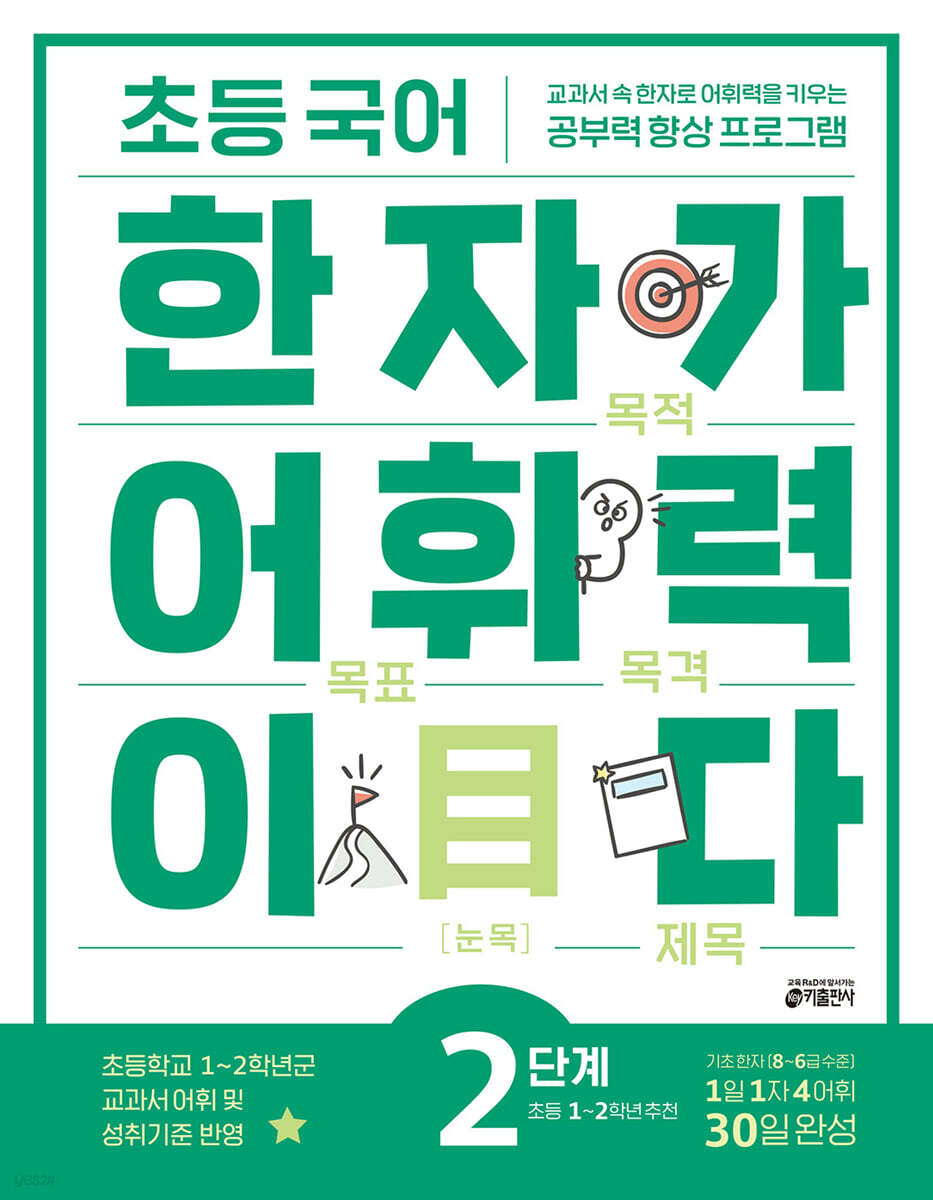
Elementary Korean Chinese Character Vocabulary Level 2: Recommended for 1st and 2nd graders
 |
Description
Book Introduction
『Elementary Korean Chinese Characters are Vocabulary』 is a textbook vocabulary book for 1st and 2nd grade elementary school students using basic Chinese characters (level 8-6). By realizing for yourself that the letters common to vocabulary are Chinese characters and knowing the meaning of those Chinese characters, you can develop the ability to infer the meaning of words you encounter in long texts. By learning one Chinese character a day, you can learn the four words hidden in that character, and finally develop the ability to find the words you learned in long texts. |
- You can preview some of the book's contents.
Preview
index
This book
Unit 1 Science
Lesson 1 Self-confidence / Self-confidence / Bicycle / Car
Lesson 2 Travel / Fashion / Airplane / Behavior
3. Stone Magnets / Gems / Petroleum / Stonemasonry
Lesson 4: Center / Center / Aerial / Focus
Lesson 5: Words of Wisdom / Prophecy / Advice
6. Bar is really / exactly / honestly / on time
7. Uncomfortable / Unlawful / Unhappy / Insufficient
Check your vocabulary 1
Unit 2 Social Studies
1. Talent / Wit / Genius / Gifted
Lesson 2: Craftsmanship / Factory / Construction Site / Artificial
3. People / Peasants / Folk Songs / Folklore
Lesson 4 Market City Market / City / Downtown / Citizen
Lesson 5: Establishment National / Assembly / Independence / Position
Lesson 6 East East Sea / West Sea / South Sea / North Sea
Lesson 7 Square Room Cushion / Four Sides / Province / Dialect
Check your vocabulary 2
Unit 3 Daily Life
Lesson 1 Departure / Attendance / Going to work / Entering and exiting
2nd month May / every month / years / salary
Lesson 3: Going out / Eating out / Coats / Outdoors
Lesson 4: Old and Antique Objects / Scrap Metal / Old Wood / Used
Lesson 5 Hand washing / Clapping / Handshake / Manual
Lesson 6 Foot / Foot Bath / Satisfaction / Insufficiency
Lesson 7 Blue Grape / Jeans / Denim Skirt / Youth
Lesson 8: Iron and Gold Safe / Deposit / Donation / Piggy Bank
Check your vocabulary 3
Unit 4 School Life
1. Year Year Last year / Next year / Every year / Grade
2. First come first served / first served / first goal / first come first served
Lesson 3: Raw Life / Ecology / Creatures / Fish
Lesson 4: Letters, Numbers, Characters, Chinese Characters, Thousand Character Classic
Lesson 5 Sounds High notes / Pronunciation / Music / Notes
Lesson 6: Divide into 6 parts / parts / classification / separation
Lesson 7 Light Colored Pencils / Colored Paper / Coloring / White
Lesson 8 Eye and Neck Witnessing / Goal / Objective / Title
Check your vocabulary 4
* Book in Book (answer sheet)
* Chinese character index
* View all Chinese characters
Unit 1 Science
Lesson 1 Self-confidence / Self-confidence / Bicycle / Car
Lesson 2 Travel / Fashion / Airplane / Behavior
3. Stone Magnets / Gems / Petroleum / Stonemasonry
Lesson 4: Center / Center / Aerial / Focus
Lesson 5: Words of Wisdom / Prophecy / Advice
6. Bar is really / exactly / honestly / on time
7. Uncomfortable / Unlawful / Unhappy / Insufficient
Check your vocabulary 1
Unit 2 Social Studies
1. Talent / Wit / Genius / Gifted
Lesson 2: Craftsmanship / Factory / Construction Site / Artificial
3. People / Peasants / Folk Songs / Folklore
Lesson 4 Market City Market / City / Downtown / Citizen
Lesson 5: Establishment National / Assembly / Independence / Position
Lesson 6 East East Sea / West Sea / South Sea / North Sea
Lesson 7 Square Room Cushion / Four Sides / Province / Dialect
Check your vocabulary 2
Unit 3 Daily Life
Lesson 1 Departure / Attendance / Going to work / Entering and exiting
2nd month May / every month / years / salary
Lesson 3: Going out / Eating out / Coats / Outdoors
Lesson 4: Old and Antique Objects / Scrap Metal / Old Wood / Used
Lesson 5 Hand washing / Clapping / Handshake / Manual
Lesson 6 Foot / Foot Bath / Satisfaction / Insufficiency
Lesson 7 Blue Grape / Jeans / Denim Skirt / Youth
Lesson 8: Iron and Gold Safe / Deposit / Donation / Piggy Bank
Check your vocabulary 3
Unit 4 School Life
1. Year Year Last year / Next year / Every year / Grade
2. First come first served / first served / first goal / first come first served
Lesson 3: Raw Life / Ecology / Creatures / Fish
Lesson 4: Letters, Numbers, Characters, Chinese Characters, Thousand Character Classic
Lesson 5 Sounds High notes / Pronunciation / Music / Notes
Lesson 6: Divide into 6 parts / parts / classification / separation
Lesson 7 Light Colored Pencils / Colored Paper / Coloring / White
Lesson 8 Eye and Neck Witnessing / Goal / Objective / Title
Check your vocabulary 4
* Book in Book (answer sheet)
* Chinese character index
* View all Chinese characters
Detailed image

Publisher's Review
Chinese characters, the key to vocabulary and study skills! How should I get started?
Say goodbye to Hanja for Hanja! Here's a Hanja textbook to improve your vocabulary!
I have compiled vocabulary for elementary school 1st and 2nd grade textbooks using basic Chinese characters (level 8-6).
If you start with familiar words and follow them step by step,
Now, even when you encounter unfamiliar vocabulary, you can guess its meaning on your own.
① Easy and fun way to study Chinese characters without burdening children!
Start with familiar vocabulary that your child already knows.
First of all, this is not a Chinese character textbook that teaches you to write and memorize the suggested Chinese characters.
By realizing for yourself that the letters in common in vocabulary are Chinese characters and knowing the meaning of those Chinese characters,
Develop the ability to infer the meaning of words encountered in long texts.
② Closely linked to the textbook! Complete in 30 days with '1 letter, 4 vocabulary words per day'!
Learn one Chinese character a day and learn the four vocabulary words hidden in that character.
Finally, find the vocabulary you learned in the long text.
▶ Chinese characters: Classify basic Chinese characters of level 8-6 into an order that children can easily understand.
▶ Vocabulary: Textbook vocabulary for 1st and 2nd grade elementary school students and everyday vocabulary familiar to children at that level
▶ Long article: A life story of a friend of the same age written on the topic of the achievement standards of the elementary school curriculum for grades 1 and 2
③ Learning Korean etymology to develop your inferential skills!
Improve your vocabulary, which is the foundation for all school subjects, through Chinese characters.
If you know Chinese characters, the meaning of vocabulary you already know becomes clearer.
Children can guess the meaning of new vocabulary by inferring it on their own.
By starting the process of building vocabulary with Chinese characters, you will establish a more solid and solid foundation.
By learning Chinese characters, which are the origin of many Korean words, you can study vocabulary by rote memorization.
Develop a real vocabulary that allows children to infer meaning on their own.
▶ Learners who are just starting to study Chinese characters!
▶ Learners who find studying Chinese characters difficult and boring and feel burdened!
▶ Learners who want to study Chinese characters to improve their reading comprehension, not for the purpose of learning Chinese characters!
▶ Learners who want to learn vocabulary in conjunction with elementary school textbooks!
▶ Learners who have too many unfamiliar words!
What Chinese characters do you learn?
Basic Chinese characters (levels 8-6) are classified according to specially designed selection criteria.
It is an order that is easy for children to accept, not a gradual order.
1.
Easy Chinese characters with few strokes
2.
Many Chinese characters in vocabulary of textbooks for 1st and 2nd grade elementary school students
3.
Chinese characters closely related to the daily lives of first and second grade elementary school students
What vocabulary do you learn?
It starts with words that your child has likely heard at least once at home or school.
You will know that there are Chinese characters hidden in words you already know, and if you didn't know, you can guess the meaning through the Chinese characters.
1.
Textbook vocabulary for 1st and 2nd grade elementary school students
2.
Vocabulary closely related to the daily lives of first and second grade elementary school students
Follow along step by step and get a sense of accomplishment!
In the first and second level textbooks for beginners to learn Chinese characters, only the shape, meaning, and sound of the Chinese characters are presented so that children do not feel burdened by learning.
The principles of Chinese characters are also explained through interesting illustrations.
The National Institute of the Korean Language's [Standard Korean Dictionary] definitions have been edited to fit children's needs.
Linking the curriculum to the achievement standards for 1st and 2nd grade elementary school students
All fingerprints are about the lives of peers, and the content matches the '1st and 2nd grade elementary school achievement standards' that children learn at school.
In texts on familiar topics, recall the meaning of the Chinese characters hidden in the words.
Help your child learn to infer without giving up when they encounter unfamiliar words.
Say goodbye to Hanja for Hanja! Here's a Hanja textbook to improve your vocabulary!
I have compiled vocabulary for elementary school 1st and 2nd grade textbooks using basic Chinese characters (level 8-6).
If you start with familiar words and follow them step by step,
Now, even when you encounter unfamiliar vocabulary, you can guess its meaning on your own.
① Easy and fun way to study Chinese characters without burdening children!
Start with familiar vocabulary that your child already knows.
First of all, this is not a Chinese character textbook that teaches you to write and memorize the suggested Chinese characters.
By realizing for yourself that the letters in common in vocabulary are Chinese characters and knowing the meaning of those Chinese characters,
Develop the ability to infer the meaning of words encountered in long texts.
② Closely linked to the textbook! Complete in 30 days with '1 letter, 4 vocabulary words per day'!
Learn one Chinese character a day and learn the four vocabulary words hidden in that character.
Finally, find the vocabulary you learned in the long text.
▶ Chinese characters: Classify basic Chinese characters of level 8-6 into an order that children can easily understand.
▶ Vocabulary: Textbook vocabulary for 1st and 2nd grade elementary school students and everyday vocabulary familiar to children at that level
▶ Long article: A life story of a friend of the same age written on the topic of the achievement standards of the elementary school curriculum for grades 1 and 2
③ Learning Korean etymology to develop your inferential skills!
Improve your vocabulary, which is the foundation for all school subjects, through Chinese characters.
If you know Chinese characters, the meaning of vocabulary you already know becomes clearer.
Children can guess the meaning of new vocabulary by inferring it on their own.
By starting the process of building vocabulary with Chinese characters, you will establish a more solid and solid foundation.
By learning Chinese characters, which are the origin of many Korean words, you can study vocabulary by rote memorization.
Develop a real vocabulary that allows children to infer meaning on their own.
▶ Learners who are just starting to study Chinese characters!
▶ Learners who find studying Chinese characters difficult and boring and feel burdened!
▶ Learners who want to study Chinese characters to improve their reading comprehension, not for the purpose of learning Chinese characters!
▶ Learners who want to learn vocabulary in conjunction with elementary school textbooks!
▶ Learners who have too many unfamiliar words!
What Chinese characters do you learn?
Basic Chinese characters (levels 8-6) are classified according to specially designed selection criteria.
It is an order that is easy for children to accept, not a gradual order.
1.
Easy Chinese characters with few strokes
2.
Many Chinese characters in vocabulary of textbooks for 1st and 2nd grade elementary school students
3.
Chinese characters closely related to the daily lives of first and second grade elementary school students
What vocabulary do you learn?
It starts with words that your child has likely heard at least once at home or school.
You will know that there are Chinese characters hidden in words you already know, and if you didn't know, you can guess the meaning through the Chinese characters.
1.
Textbook vocabulary for 1st and 2nd grade elementary school students
2.
Vocabulary closely related to the daily lives of first and second grade elementary school students
Follow along step by step and get a sense of accomplishment!
In the first and second level textbooks for beginners to learn Chinese characters, only the shape, meaning, and sound of the Chinese characters are presented so that children do not feel burdened by learning.
The principles of Chinese characters are also explained through interesting illustrations.
The National Institute of the Korean Language's [Standard Korean Dictionary] definitions have been edited to fit children's needs.
Linking the curriculum to the achievement standards for 1st and 2nd grade elementary school students
All fingerprints are about the lives of peers, and the content matches the '1st and 2nd grade elementary school achievement standards' that children learn at school.
In texts on familiar topics, recall the meaning of the Chinese characters hidden in the words.
Help your child learn to infer without giving up when they encounter unfamiliar words.
GOODS SPECIFICS
- Date of issue: July 31, 2020
- Page count, weight, size: 176 pages | 579g | 210*270*11mm
- ISBN13: 9791165260316
- ISBN10: 116526031X
- Reference book grade: Elementary school common
- Reference book usage semester: Common semester
- Reference book difficulty level: Easy Reference book difficulty level guide
- KC Certification: Certification Type: Conformity Confirmation
You may also like
카테고리
korean


korean

![GQ KOREA Mark (Monthly): December [2025]](http://librairie.coreenne.fr/cdn/shop/files/8ef265dbbfbf186523ed75ba7319009d.jpg?v=1765340328&width=3840)


