

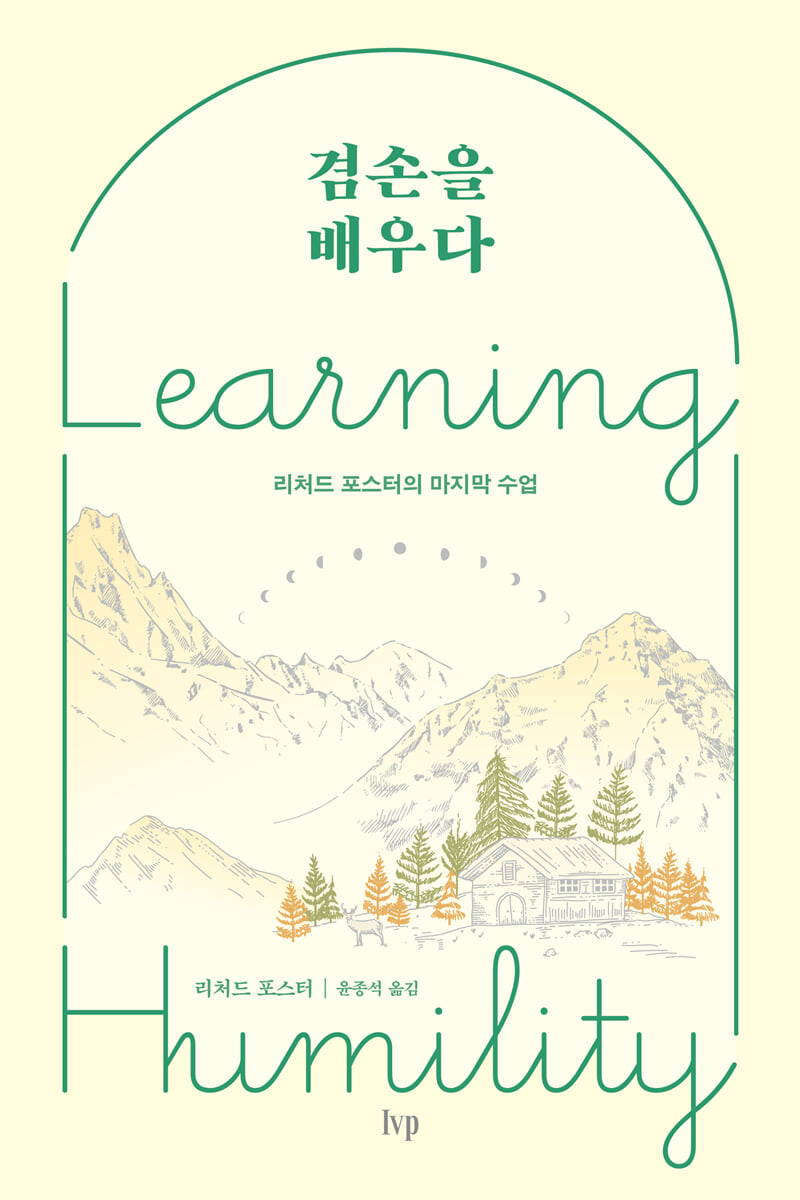
Learn humility
 |
Description
Book Introduction
The final lesson from world-renowned spiritual mentor Richard Foster.
“What is humility?”
A year-long journey to find humility, a value that is disappearing in our time!
★★★Recommended by Kim Ki-seok (Senior Pastor, Cheongpa Church) and Lee Jong-tae (Director of the Seoul Women's University Chaplaincy Office)★★★
This book is a year-long spiritual pilgrimage to discover the meaning and value of humility.
Richard Foster finds that many people today are losing the important value of humility by becoming narcissistic and selfish, prioritizing self-satisfaction above all else.
Not only are you unable to see yourself as you are, you have also lost interest in others.
Accordingly, Foster realizes that humility is the most fundamental virtue in human life and meditates on humility in the form of a diary every week.
It presents insights from a wide range of sources, from Jesus, the living example of humility, to Bernard of Clairvaux, Thomas à Kempis, Julian of Norwich, Andrew Murray, and personal friends.
Moreover, by sharing his own experiences of learning and practicing humility in the 'small corners' of life, he provides deep and rich wisdom on how we can live humble lives in today's culture.
“What is humility?”
A year-long journey to find humility, a value that is disappearing in our time!
★★★Recommended by Kim Ki-seok (Senior Pastor, Cheongpa Church) and Lee Jong-tae (Director of the Seoul Women's University Chaplaincy Office)★★★
This book is a year-long spiritual pilgrimage to discover the meaning and value of humility.
Richard Foster finds that many people today are losing the important value of humility by becoming narcissistic and selfish, prioritizing self-satisfaction above all else.
Not only are you unable to see yourself as you are, you have also lost interest in others.
Accordingly, Foster realizes that humility is the most fundamental virtue in human life and meditates on humility in the form of a diary every week.
It presents insights from a wide range of sources, from Jesus, the living example of humility, to Bernard of Clairvaux, Thomas à Kempis, Julian of Norwich, Andrew Murray, and personal friends.
Moreover, by sharing his own experiences of learning and practicing humility in the 'small corners' of life, he provides deep and rich wisdom on how we can live humble lives in today's culture.
- You can preview some of the book's contents.
Preview
index
Introduction
Part 1: Three Cold and Dark Months (Winter - Waniyedu)
1.
The month when the earth hardens
2.
The Moon When Trees Break in the Cold - Humility
3.
The month of sore eyes - patience
Part 2: Three Months of Rebirth and Growth (Spring - Wedu)
4.
The Moon When the Duck Returns - Respect
5.
The month of body growth - honor
6.
The Moon with Green Leaves - Love
Part 3: Three Warm Months (Summer - Blockedu)
7.
The month of ripening fruit - sacrifice
8.
The Moon That Turns Black - The Truth
9.
Harvest Moon - Compassion
Part 4: Four Months of Change (Autumn - Phdanyedu)
10.
The moon dyed with brown leaves - courage
11.
The Moon with Leaves Falling in the Wind - Perseverance
12.
The month when deer are in estrus - Aryang
13.
The Moon Where Deer Antlers Fall - Wisdom
Conclusion
Acknowledgements
More books to read
main
Part 1: Three Cold and Dark Months (Winter - Waniyedu)
1.
The month when the earth hardens
2.
The Moon When Trees Break in the Cold - Humility
3.
The month of sore eyes - patience
Part 2: Three Months of Rebirth and Growth (Spring - Wedu)
4.
The Moon When the Duck Returns - Respect
5.
The month of body growth - honor
6.
The Moon with Green Leaves - Love
Part 3: Three Warm Months (Summer - Blockedu)
7.
The month of ripening fruit - sacrifice
8.
The Moon That Turns Black - The Truth
9.
Harvest Moon - Compassion
Part 4: Four Months of Change (Autumn - Phdanyedu)
10.
The moon dyed with brown leaves - courage
11.
The Moon with Leaves Falling in the Wind - Perseverance
12.
The month when deer are in estrus - Aryang
13.
The Moon Where Deer Antlers Fall - Wisdom
Conclusion
Acknowledgements
More books to read
main
Detailed image

Into the book
Since I've already used the Lakota calendar as the framework for this diary, I think it would be beneficial to also think about the tribe's cultural ideals.
The Twelve Virtues of the Lakota provide a good framework for reflection throughout the year.
The virtues we will examine, one each month for the next twelve months, are as follows:
Humility, patience, respect, honor, love, sacrifice, truth, compassion, courage, perseverance, tolerance, wisdom.
--- From "Chapter 1: The Moon That Hardens the Earth"
Tonight I think of Bruce and the humility that seems to permeate him.
There are a lot of people in his field who seem arrogant and completely absorbed in themselves.
But surprisingly, he served others, especially his students, with love from a state of complete self-forgetfulness.
Knowing him has enriched my life infinitely.
--- From "Chapter 2: The Moon When Trees Break in the Cold_Humility"
In my opinion, one of the surest signs of humility is complete freedom from all desire for domination and control.
Humility is neither the desire nor the need to impose anything on anyone.
A demanding attitude goes against a humble mind.
Humility puts others at ease by being friendly.
There seems to be a cheerfulness that is almost unconscious in the humble.
Perhaps this is because there is no human reputation to protect, and no need to build a reputation to win people's admiration.
--- From "Chapter 3: The Moon That Hurts the Eyes_Patience"
Of course, the 'humility' of flowers has a different meaning for us, who struggle with extreme pride and harmful self-deception.
But isn't it clear that flowers bear some resemblance to the attributes of their creator? So, isn't there also, somehow, a sense of God's profound humility embedded within these beautiful wildflowers? Without the slightest hint of arrogance or pride, I gaze intently at the clusters of flowers, radiating radiant light and beauty.
The flowers are just there for everyone to see.
How can such beauty be described in human words?
In all the glory of the flowers blooming in the valley, I learn a little of the beauty of humility.
--- From "Chapter 4 The Moon the Duck Returns_Respect"
We cannot achieve humility by our own strength.
We do not reach God through our actions; He comes to us first.
We cannot take the initiative from him.
Ultimately, humility is a gift from God.
But we too can prepare to receive humility as a grace.
We just need to align our will with God.
If what I say about humility being a gift from God is true, then it becomes possible to be certain that humility is indeed powerful.
Humility is strong enough to break even the shackles of pride.
--- From "Chapter 5: The Month of Growing Body_Honor"
Humility is a pure, unsullied virtue.
First, we must know what humility is; second, we must cherish humility; third, we must faithfully emulate humility; and fourth, we must constantly experience humility in our character.
Training like this requires a loving community.
Other people, such as spiritual leaders, friends in the faith, and wise elders, must help us develop the right perspective and discernment.
For humility to mature, we need a community of people who know how to guide other souls with love.
That's what I need most.
--- From "Chapter 6: The Moon When Blue Leaves Sprout_Love"
How did Paul learn humility so deeply? Did he see an example of humility as he stood witnessing Stephen's death? Many of the disciples of Jesus, whom he persecuted, clearly showed him a life of humble service.
Rather, I believe Paul learned the fundamentals of humility when he had a dramatic encounter with the resurrected Christ (so intense that he fell from his donkey and lost his sight for a time) and experienced conversion alongside Ananias, who called him “Brother Saul.”
More importantly, he spent three years in the Arabian Desert.
There he would have been learning directly from his teacher, Jesus, who is God.
It is clear that Paul learned well what a humble life looks like in the closet of his heart.
I too would like to learn the supreme value of a humble heart.
--- From "Chapter 11: The Moon with Leaves Falling in the Wind_Perseverance"
I often pray like that when I drink my morning coffee.
There are times when we are led by the inspiration of the Holy Spirit and stay in one part of our heart, mind, imagination, or soul for a long time.
Sometimes He teaches me or guides me, and sometimes He makes a confession on my part.
Above all, there is a calm and intimate friendship.
Even when my mind seems to wander far from the purity I seek, I strive to continue praying like this.
Sometimes this little prayer follows me all day long.
Purify, renew, sanctify, and enlarge.
The Twelve Virtues of the Lakota provide a good framework for reflection throughout the year.
The virtues we will examine, one each month for the next twelve months, are as follows:
Humility, patience, respect, honor, love, sacrifice, truth, compassion, courage, perseverance, tolerance, wisdom.
--- From "Chapter 1: The Moon That Hardens the Earth"
Tonight I think of Bruce and the humility that seems to permeate him.
There are a lot of people in his field who seem arrogant and completely absorbed in themselves.
But surprisingly, he served others, especially his students, with love from a state of complete self-forgetfulness.
Knowing him has enriched my life infinitely.
--- From "Chapter 2: The Moon When Trees Break in the Cold_Humility"
In my opinion, one of the surest signs of humility is complete freedom from all desire for domination and control.
Humility is neither the desire nor the need to impose anything on anyone.
A demanding attitude goes against a humble mind.
Humility puts others at ease by being friendly.
There seems to be a cheerfulness that is almost unconscious in the humble.
Perhaps this is because there is no human reputation to protect, and no need to build a reputation to win people's admiration.
--- From "Chapter 3: The Moon That Hurts the Eyes_Patience"
Of course, the 'humility' of flowers has a different meaning for us, who struggle with extreme pride and harmful self-deception.
But isn't it clear that flowers bear some resemblance to the attributes of their creator? So, isn't there also, somehow, a sense of God's profound humility embedded within these beautiful wildflowers? Without the slightest hint of arrogance or pride, I gaze intently at the clusters of flowers, radiating radiant light and beauty.
The flowers are just there for everyone to see.
How can such beauty be described in human words?
In all the glory of the flowers blooming in the valley, I learn a little of the beauty of humility.
--- From "Chapter 4 The Moon the Duck Returns_Respect"
We cannot achieve humility by our own strength.
We do not reach God through our actions; He comes to us first.
We cannot take the initiative from him.
Ultimately, humility is a gift from God.
But we too can prepare to receive humility as a grace.
We just need to align our will with God.
If what I say about humility being a gift from God is true, then it becomes possible to be certain that humility is indeed powerful.
Humility is strong enough to break even the shackles of pride.
--- From "Chapter 5: The Month of Growing Body_Honor"
Humility is a pure, unsullied virtue.
First, we must know what humility is; second, we must cherish humility; third, we must faithfully emulate humility; and fourth, we must constantly experience humility in our character.
Training like this requires a loving community.
Other people, such as spiritual leaders, friends in the faith, and wise elders, must help us develop the right perspective and discernment.
For humility to mature, we need a community of people who know how to guide other souls with love.
That's what I need most.
--- From "Chapter 6: The Moon When Blue Leaves Sprout_Love"
How did Paul learn humility so deeply? Did he see an example of humility as he stood witnessing Stephen's death? Many of the disciples of Jesus, whom he persecuted, clearly showed him a life of humble service.
Rather, I believe Paul learned the fundamentals of humility when he had a dramatic encounter with the resurrected Christ (so intense that he fell from his donkey and lost his sight for a time) and experienced conversion alongside Ananias, who called him “Brother Saul.”
More importantly, he spent three years in the Arabian Desert.
There he would have been learning directly from his teacher, Jesus, who is God.
It is clear that Paul learned well what a humble life looks like in the closet of his heart.
I too would like to learn the supreme value of a humble heart.
--- From "Chapter 11: The Moon with Leaves Falling in the Wind_Perseverance"
I often pray like that when I drink my morning coffee.
There are times when we are led by the inspiration of the Holy Spirit and stay in one part of our heart, mind, imagination, or soul for a long time.
Sometimes He teaches me or guides me, and sometimes He makes a confession on my part.
Above all, there is a calm and intimate friendship.
Even when my mind seems to wander far from the purity I seek, I strive to continue praying like this.
Sometimes this little prayer follows me all day long.
Purify, renew, sanctify, and enlarge.
--- From "Chapter 12: The Month When the Deer Are in Heat_Aryang"
Publisher's Review
What is humility?
The English word humility comes from the Latin word humilitas, meaning 'grounded, earthly.'
The English word humus still means 'earth, soil'.
So humility brings us back to the dirt.
Humility is neither thinking of oneself as higher than one really is nor as lower than one really is.
There is no arrogance or pride, no self-deprecation or feeling inferior.
It only accurately evaluates your actual self.
See your own strengths and abilities as they are.
Of course, I also see weaknesses and flaws.
Jesus completely changed our perspective on humility.
In Greece and the Hellenistic world, 'humility' ('tapeinos' in Greek) was not valued or desired.
Almost without exception, humility was used in a contemptuous sense meaning 'insignificant, mean, lowly.'
But the life and teachings of Jesus completely changed our perspective on humility.
He said, “The greatest among you will be your servant.
“For whoever exalts himself will be humbled, and whoever humbles himself will be exalted,” he declares (Matthew 23:11-12).
Also, the authors of the New Testament, including Paul, used 'tapheinos', and all of them had a positive meaning.
Early Christian scholars accepted this completely different meaning and classified humility as a virtue.
In contrast to the pagan view of the time, humility was sometimes called “the Savior’s thoughtful and noble gift.”
Humility runs counter to our contemporary culture
The Christian testimony that humility is a precious central virtue is as counterintuitive to today's culture as it was in the first century.
Modern culture views humility as negatively as the ancient world.
They regard humility as helpless self-abandonment and do not encourage a humble life.
They value self-love, self-display, and narcissism over humility.
Even among Christians who follow Jesus, it has become difficult to find examples of humility being practiced in their lives.
Grow in the grace of humility
Richard Foster opens his diary to reveal a year-long spiritual journey in which he sought to cultivate this fundamental, countercultural Christian virtue.
He focuses on the Lakota, a Native American tribe that is closest to humility (the earth, nature).
Using the Lakota calendar as a framework, I meditate on humility in a weekly diary format.
We explore the essence of humility by examining each of the twelve important virtues of the tribe: humility, patience, respect, honor, love, sacrifice, truth, compassion, courage, perseverance, tolerance, and wisdom.
It also presents insights from a wide range of sources, including Jesus, the living example of humility, as well as Benedict, Bernard, Thomas à Kempis, Julian of Norwich, Andrew Murray, and the author's own personal friends.
Rather than trying to teach humility to readers, the poster calmly shows the process of learning humility in one's own life, struggling, grappling, seeking, confessing, and practicing it.
This process is internal, but its ripple effects are outward, making us notice people we previously ignored and caring for people in newer, deeper ways.
It means being able to genuinely rejoice in the success of others and also to empathize with their pain and sorrow.
As he concludes his year-long journey, he challenges his readers to continually grow in the grace of humility through these processes.
As I walk the path of humility, guided by a seasoned mentor, I will become more authentic and more comfortable with others.
I hope that through this book, you will fully realize the virtue of humility that saves yourself and your community, and enjoy and savor it more abundantly.
■ Main Readers
ㆍ Those who want to find and learn the meaning of humility
Christians who are concerned about the maturity of their faith and character
ㆍ Pastors, seminarians, and church leaders who assist in disciple training and serve
Readers who have read Richard Foster's books
The English word humility comes from the Latin word humilitas, meaning 'grounded, earthly.'
The English word humus still means 'earth, soil'.
So humility brings us back to the dirt.
Humility is neither thinking of oneself as higher than one really is nor as lower than one really is.
There is no arrogance or pride, no self-deprecation or feeling inferior.
It only accurately evaluates your actual self.
See your own strengths and abilities as they are.
Of course, I also see weaknesses and flaws.
Jesus completely changed our perspective on humility.
In Greece and the Hellenistic world, 'humility' ('tapeinos' in Greek) was not valued or desired.
Almost without exception, humility was used in a contemptuous sense meaning 'insignificant, mean, lowly.'
But the life and teachings of Jesus completely changed our perspective on humility.
He said, “The greatest among you will be your servant.
“For whoever exalts himself will be humbled, and whoever humbles himself will be exalted,” he declares (Matthew 23:11-12).
Also, the authors of the New Testament, including Paul, used 'tapheinos', and all of them had a positive meaning.
Early Christian scholars accepted this completely different meaning and classified humility as a virtue.
In contrast to the pagan view of the time, humility was sometimes called “the Savior’s thoughtful and noble gift.”
Humility runs counter to our contemporary culture
The Christian testimony that humility is a precious central virtue is as counterintuitive to today's culture as it was in the first century.
Modern culture views humility as negatively as the ancient world.
They regard humility as helpless self-abandonment and do not encourage a humble life.
They value self-love, self-display, and narcissism over humility.
Even among Christians who follow Jesus, it has become difficult to find examples of humility being practiced in their lives.
Grow in the grace of humility
Richard Foster opens his diary to reveal a year-long spiritual journey in which he sought to cultivate this fundamental, countercultural Christian virtue.
He focuses on the Lakota, a Native American tribe that is closest to humility (the earth, nature).
Using the Lakota calendar as a framework, I meditate on humility in a weekly diary format.
We explore the essence of humility by examining each of the twelve important virtues of the tribe: humility, patience, respect, honor, love, sacrifice, truth, compassion, courage, perseverance, tolerance, and wisdom.
It also presents insights from a wide range of sources, including Jesus, the living example of humility, as well as Benedict, Bernard, Thomas à Kempis, Julian of Norwich, Andrew Murray, and the author's own personal friends.
Rather than trying to teach humility to readers, the poster calmly shows the process of learning humility in one's own life, struggling, grappling, seeking, confessing, and practicing it.
This process is internal, but its ripple effects are outward, making us notice people we previously ignored and caring for people in newer, deeper ways.
It means being able to genuinely rejoice in the success of others and also to empathize with their pain and sorrow.
As he concludes his year-long journey, he challenges his readers to continually grow in the grace of humility through these processes.
As I walk the path of humility, guided by a seasoned mentor, I will become more authentic and more comfortable with others.
I hope that through this book, you will fully realize the virtue of humility that saves yourself and your community, and enjoy and savor it more abundantly.
■ Main Readers
ㆍ Those who want to find and learn the meaning of humility
Christians who are concerned about the maturity of their faith and character
ㆍ Pastors, seminarians, and church leaders who assist in disciple training and serve
Readers who have read Richard Foster's books
GOODS SPECIFICS
- Date of issue: October 31, 2025
- Page count, weight, size: 248 pages | 268g | 140*210*11mm
- ISBN13: 9788932823829
- ISBN10: 8932823820
You may also like
카테고리
korean


korean

![GQ KOREA Mark (Monthly): December [2025]](http://librairie.coreenne.fr/cdn/shop/files/8ef265dbbfbf186523ed75ba7319009d.jpg?v=1765340328&width=3840)


