

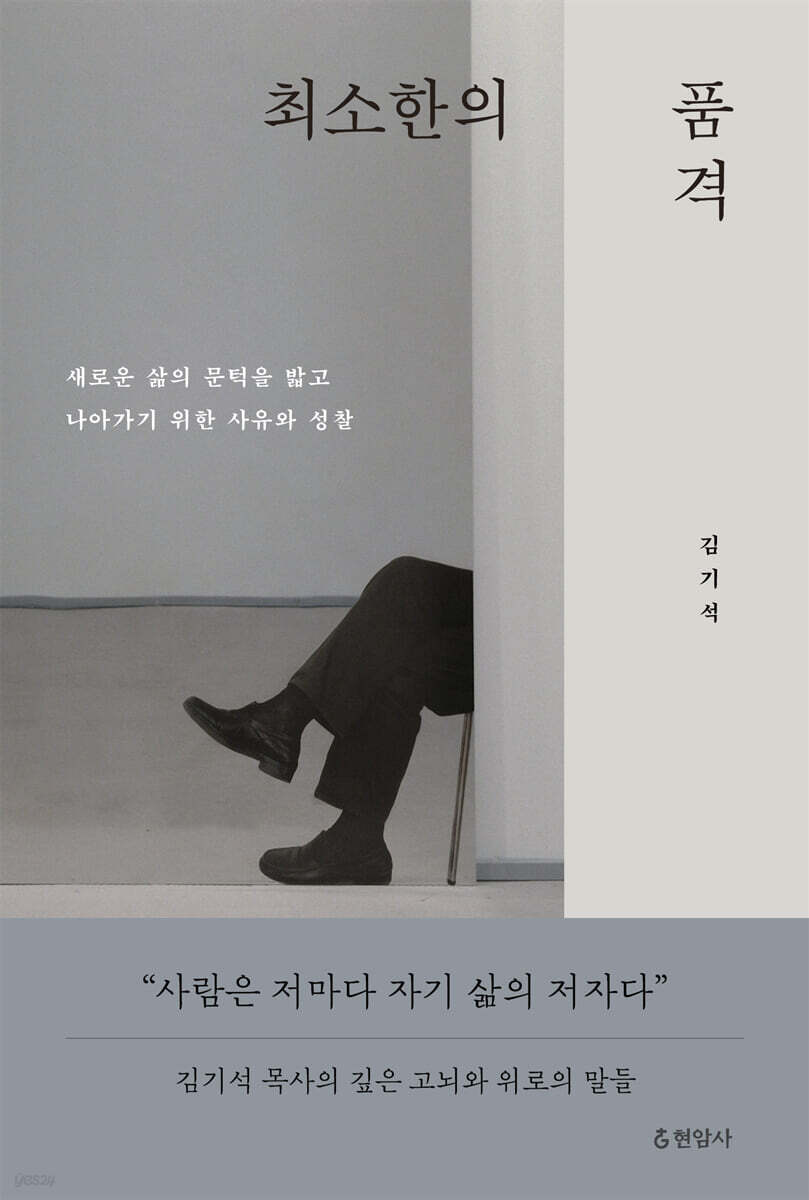
Minimum dignity
 |
Description
Book Introduction
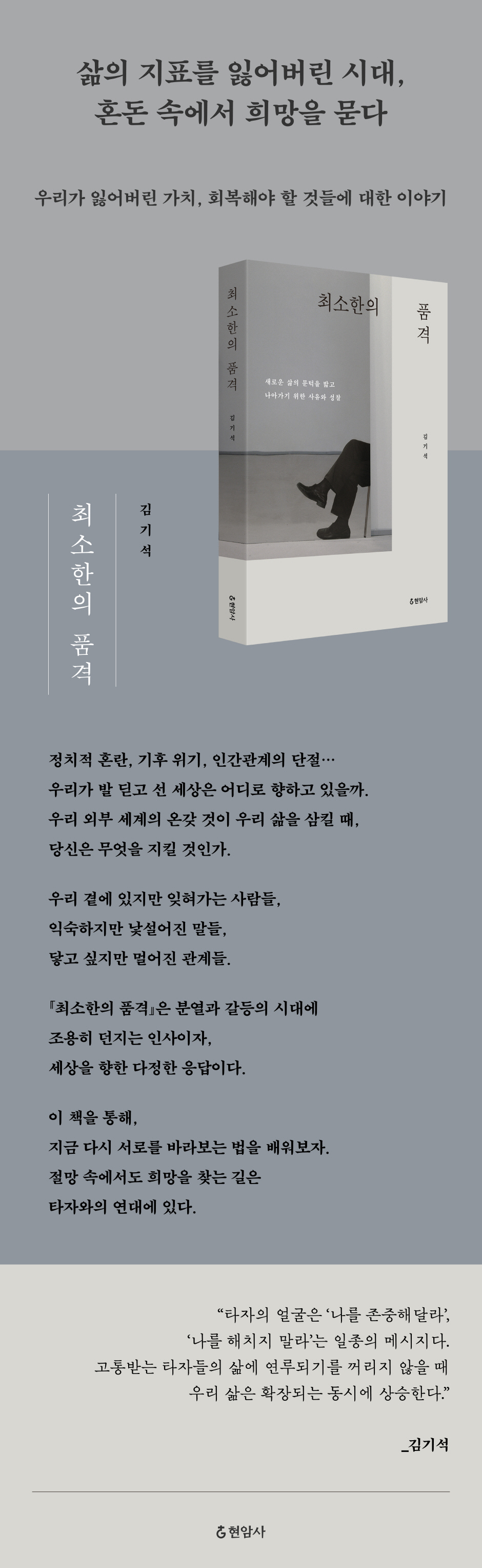
An era that has lost the sense of direction in life,
Asking for hope in the midst of chaos
Pastor Kim Ki-seok's profound reflection, "Minimum Dignity"
A story about the values we have lost and the things we need to recover.
"Minimum Dignity" is a collection of 63 columns published in the Kyunghyang Shinmun, Kookmin Ilbo, and Monthly Essay from 2021 to January 2025, organized by topic.
The author of this book, Pastor Kim Ki-seok, deeply reflects on the multi-layered crises facing modern society and explores the possibilities of humanity and hope within them.
In today's world, where economic insecurity, climate crisis, and social conflict pile up, threatening the lives of individuals and communities, social boundaries are becoming more rigid, and the socially vulnerable are experiencing extreme alienation and exclusion.
Pastor Kim Ki-seok emphasizes that in a society where exclusion and hostility are rampant, what we need to create is not more walls, but "spaces of hospitality."
We also look back on moments in history that created hope and encourage us to find new possibilities.
It also provides profound insights into how politics and religion shape human life and community.
In particular, he cautions against dichotomous thinking between good and evil, and emphasizes that embracing diverse values and differences is the essence of democracy and faith.
Pastor Kim Ki-seok's writings organically unravel the corruption and conflict of human desire and irresponsible language, human finitude, and the decline of human values from philosophical, social, and practical perspectives, revealing profound insights.
Traces of having read countless books, freely moving between Eastern and Western classics, including poetry and literature, and various humanities knowledge, are clearly evident throughout the writing, adding to the reader's intellectual fulfillment.
Moreover, Pastor Kim Ki-seok's sharp insight, which is firmly grounded in the harsh realities of life rather than an abstract ideal world, serves as an example as a scholar and adult of the times, and resonates deeply with those who read his writing.
His compelling words, which make us rethink humanity, should remind us of the ethical responsibility and importance of solidarity.
Asking for hope in the midst of chaos
Pastor Kim Ki-seok's profound reflection, "Minimum Dignity"
A story about the values we have lost and the things we need to recover.
"Minimum Dignity" is a collection of 63 columns published in the Kyunghyang Shinmun, Kookmin Ilbo, and Monthly Essay from 2021 to January 2025, organized by topic.
The author of this book, Pastor Kim Ki-seok, deeply reflects on the multi-layered crises facing modern society and explores the possibilities of humanity and hope within them.
In today's world, where economic insecurity, climate crisis, and social conflict pile up, threatening the lives of individuals and communities, social boundaries are becoming more rigid, and the socially vulnerable are experiencing extreme alienation and exclusion.
Pastor Kim Ki-seok emphasizes that in a society where exclusion and hostility are rampant, what we need to create is not more walls, but "spaces of hospitality."
We also look back on moments in history that created hope and encourage us to find new possibilities.
It also provides profound insights into how politics and religion shape human life and community.
In particular, he cautions against dichotomous thinking between good and evil, and emphasizes that embracing diverse values and differences is the essence of democracy and faith.
Pastor Kim Ki-seok's writings organically unravel the corruption and conflict of human desire and irresponsible language, human finitude, and the decline of human values from philosophical, social, and practical perspectives, revealing profound insights.
Traces of having read countless books, freely moving between Eastern and Western classics, including poetry and literature, and various humanities knowledge, are clearly evident throughout the writing, adding to the reader's intellectual fulfillment.
Moreover, Pastor Kim Ki-seok's sharp insight, which is firmly grounded in the harsh realities of life rather than an abstract ideal world, serves as an example as a scholar and adult of the times, and resonates deeply with those who read his writing.
His compelling words, which make us rethink humanity, should remind us of the ethical responsibility and importance of solidarity.
- You can preview some of the book's contents.
Preview
index
Introduction
Part 1: Losing the Guide to Life
1.
When we increase ‘earth literacy’
2.
We don't support
3.
Lives engulfed in flames and reduced to ashes
4.
The collapse begins from within
5.
Hostile gaze toward strangers
6.
The roar of desires colliding
7.
compartments between people
8.
Things I couldn't bring myself to say
9.
Wherever the water flows
10.
When you lose your sense of unease
11.
What is a human being?
12.
War is the eradication of hope
13.
Things You Should Really Be Afraid Of
14.
A flash of light falls upon us
15.
People who resist cheerfully
16.
Courage to escape from hell
17.
We stand before a choice
Part 2: A Bleak and Chaotic Battlefield
1.
People who have lost their expressions
2.
Awareness of deficiency
3.
The trap of self-confidence
4.
Words whose substance is unknown
5.
A place where violence passed by
6.
Humility that has disappeared
7.
A story calls a story
8.
A being with limitations
9.
The desire to be different from others
10.
Hardship, resentment, anxiety
11.
ruler-centered thinking
12.
flat mind
13.
A daily life filled with boredom and helplessness
14.
Between excess and deficiency
15.
The fate of anxiety
16.
Loneliness is having nowhere to put your heart.
17.
Shake off learned helplessness
18.
When words are misused
19.
When trust in each other breaks down
20.
The pain that creates cracks in everyday life
21.
Busyness, a sign of social status
22.
Knowing the name
Part 3: The Power of Refilling
1.
Reading, a holistic human experience
2.
The direction history should take
3.
Beyond abstract love
4.
The uncertain 'Four Seasons'
5.
Life as a dance performed in a circular shape
6.
The one who built a pillar in my heart
7.
Beyond conventional realism
8.
It's okay to be shaken sometimes
9.
Repository of social capital
10.
dignified language
11.
The courage to start a new life
12.
Life is a miracle
13.
Time for purification
14.
Respect and consideration for others
15.
People who make places beautiful through hospitality
16.
What we need to live together
17.
The beginning of learning is looking forward
18.
The possibility of a new life
19.
Each person is the author of his or her own life.
20.
Melt away hatred and disgust
21.
Every human being is a beginning
22.
Those who live their lives are holy.
23.
Space for coexistence with others
24.
People who create a new ecosystem
Part 1: Losing the Guide to Life
1.
When we increase ‘earth literacy’
2.
We don't support
3.
Lives engulfed in flames and reduced to ashes
4.
The collapse begins from within
5.
Hostile gaze toward strangers
6.
The roar of desires colliding
7.
compartments between people
8.
Things I couldn't bring myself to say
9.
Wherever the water flows
10.
When you lose your sense of unease
11.
What is a human being?
12.
War is the eradication of hope
13.
Things You Should Really Be Afraid Of
14.
A flash of light falls upon us
15.
People who resist cheerfully
16.
Courage to escape from hell
17.
We stand before a choice
Part 2: A Bleak and Chaotic Battlefield
1.
People who have lost their expressions
2.
Awareness of deficiency
3.
The trap of self-confidence
4.
Words whose substance is unknown
5.
A place where violence passed by
6.
Humility that has disappeared
7.
A story calls a story
8.
A being with limitations
9.
The desire to be different from others
10.
Hardship, resentment, anxiety
11.
ruler-centered thinking
12.
flat mind
13.
A daily life filled with boredom and helplessness
14.
Between excess and deficiency
15.
The fate of anxiety
16.
Loneliness is having nowhere to put your heart.
17.
Shake off learned helplessness
18.
When words are misused
19.
When trust in each other breaks down
20.
The pain that creates cracks in everyday life
21.
Busyness, a sign of social status
22.
Knowing the name
Part 3: The Power of Refilling
1.
Reading, a holistic human experience
2.
The direction history should take
3.
Beyond abstract love
4.
The uncertain 'Four Seasons'
5.
Life as a dance performed in a circular shape
6.
The one who built a pillar in my heart
7.
Beyond conventional realism
8.
It's okay to be shaken sometimes
9.
Repository of social capital
10.
dignified language
11.
The courage to start a new life
12.
Life is a miracle
13.
Time for purification
14.
Respect and consideration for others
15.
People who make places beautiful through hospitality
16.
What we need to live together
17.
The beginning of learning is looking forward
18.
The possibility of a new life
19.
Each person is the author of his or her own life.
20.
Melt away hatred and disgust
21.
Every human being is a beginning
22.
Those who live their lives are holy.
23.
Space for coexistence with others
24.
People who create a new ecosystem
Detailed image
Into the book
Unfortunately, global literacy among modern people, especially urban dwellers, is very low.
Because we have lost the integrated ability to view our lives within the mystery of the universe.
The moment you lose your sense of awe, the world turns into a market bottom.
A society where profit swallows all values like a black hole is dangerous.
What we desperately need now is a higher perspective from which to view our lives.
--- 「Part 1, 1.
From “When Raising ‘Earth Literacy’”
The world tries to silence those who died unjustly and their families.
There are those who say, "Be quiet!" "Wait!" "That's enough, what more do you want?" and act as if the incident is over with a few pennies in compensation.
Wouldn't true mourning for those who suffered this absurd tragedy involve reforming social systems and fostering a culture of respect for life to prevent such incidents from recurring? Those who refuse to back down despite ridicule and insult, those who resist oblivion and wage a struggle for memory, will never be defeated.
As long as there are those who try to revive fading memories, justice will not be destroyed.
Coincidentally, the date Luther sent his letter to the clergy from Birmingham Prison was April 16th.
--- 「Part 1, 2.
From "We do not support"
The world we live in constantly creates boundaries and divides people, preventing them from communicating with each other.
As we adapt to a world filled with hostility, our souls are consumed by fear, terror, and anger.
The space for gratitude, joy, and praise is becoming increasingly narrow.
--- 「Part 1, 6.
From "The Deafening Noise Created by the Collision of Desires"
Even if we don't expect Plato's philosopher kings, I hope that people with liberal arts education will become representatives of the people.
This is an era in which we need people who possess deep insight into the complex and diverse realities of human existence, who listen attentively to the voices of the marginalized, and who possess a clear position on the direction history should take.
He must also be someone who faces the various crises of our time and constantly strives to acquire the practical wisdom to overcome them.
His thinking must be flexible, and respect for humanity must be at the very core of his being.
If people who seek to justify their existence by belittling others, and people who use their bluster to silence others, enter the stage of history, history is bound to regress.
--- 「Part 1, 13.
From "Things You Should Really Be Afraid Of"
A hallmark of an enlightened mind is the recognition that it has limitations in its perception and action.
Hesitation is not a trait of the weak, but should be the basic attitude of all who seek the truth.
Absolute certainty that does not allow even the slightest doubt is dangerous.
The more self-confident people are, the more they are reluctant to accept change.
They are as dangerous as a train with broken brakes.
Life ceases to grow when there is no room for newness to intrude.
Violence thrives on rigidity that cannot tolerate differences.
Tolerating differences does not mean weakening one's own identity.
--- 「Part 2, 8.
From "Limited Beings"
Consumer society thrives on creating dissatisfaction and anxiety.
Dissatisfaction arises from a sense of comparison with others.
The moment you harbor the desire to be different from others, you are not allowed to rest.
Because the moment you take a breather, you become obsessed with the idea that you might be overtaken by a competitor.
There can be no conflict between those who internalize competition and live in it.
As the possibility of peaceful coexistence diminishes, reality turns into an invisible battlefield.
--- 「Part 2, 9.
From “The desire to be different from others”
Humanity, riding on the chariot of desire, is living in Cassandra's time.
The religion of consumerism is taking hold of people's souls.
Capitalism, which is maintained through the expanded reproduction of desire, constantly creates symbols of scarcity to tempt people.
People cannot tolerate the time difference between desire and satisfaction.
The moment you hold in your hand the symbol of happiness you worked so hard to obtain, another deficiency becomes apparent.
Happiness is on hold and only a tiring routine remains.
That's how a fatigue society arrives.
--- 「Part 2, 10.
Among “hardship, resentment, and anxiety”
The pain of the victims does not subside with the passage of time.
Their pain is becoming more vivid because of those who try to deny or nullify the very incident that clearly occurred.
It is shocking that their existence is being denied, but it is even more heartbreaking that the government, which should be on their side, seems to be viewing them as an obstacle to historical progress.
This perception of history is not only unjust, but also extremely dangerous.
--- 「Part 2, 11.
From “Ruler-centered thinking”
The world is in an uproar because of words that judge right and wrong.
The words that cross between people have long since lost their homes.
Words cannot connect people and cannot guarantee the truth at face value.
Because words serve someone's interests.
--- 「Part 2, 12.
From "Flat Mind"
Everyone cries out that the weight of life they carry is heavy.
Boredom and helplessness color our daily lives, blinding us to the eternity embedded in time.
Of course, everything in the world is destined to decline, but there is no reason to accept that with sadness.
It is a habit of the weak to yearn for another life while unfairly ignoring the everyday and ordinary things.
The poet Gu Sang expressed that as the veil of ignorance that had been covering the eyes of the soul was lifted, one came to realize that everything surrounding oneself was a single message.
Miracles are not something that exists separately, but are a reality that appears to those who open their eyes.
Those who open their eyes and see the mystery of life in everyday life are bound to experience the joy of being liberated from the slavery of tiresome desires.
--- 「Part 2, 13.
From “Daily Life Filled with Boredom and Helplessness”
There is a saying that a name is a portent.
The moment we hear the name, our body and mind react simultaneously.
When I hear the name of my favorite food, my heart warms and my mouth waters.
The moment I hear the name of a food I dislike, I frown.
There are people who, the moment their name is called, bring a longing to them like a mist and a smile to their lips, while there are people who, the moment they hear their name, fill their hearts with discomfort and their body stiffens.
A name is a symbol for distinction.
To know a name is to open one's eyes to individuality.
--- 「Part 2, 22.
From "Knowing the Name"
There are people in the world who are dedicated to broadening the horizons of the human spirit.
In the 20th century, a century of war, there are people like Albert Schweitzer, who presented a new life ethic through the simple truth that “all life wants to live,” and Mahatma Gandhi, who, despite experiencing the harsh violence of the empire, presented a path for both the oppressor and the oppressed to be liberated through non-violent resistance.
But even if their names are not widely known, those who willingly put themselves in danger to save precious lives should also be considered beings who have elevated the human spirit.
All suffering does not result in spiritual nobility.
The sublimity of the human spirit is always expressed through extraordinary suffering.
Extraordinary suffering is not passive suffering that we have no choice but to endure, but suffering that we actively choose to endure.
There are people who jump into the turbulent waters to turn back the flow of history that swallows up the weak.
--- 「Part 3, 2.
From “The Direction History Should Aim For”
Arabic numerals organize people into lines and hierarchies.
Becoming an adult doesn't free you from Arabic numerals.
People are visually ranked by their annual salary, the engine displacement of their car, and the size of their home.
Those who stare intently at the stock market board sigh or exclaim at the sight of the flashing numbers.
Arabic numerals either make people feel proud or intimidated.
Arabic numerals are powerful.
But there are many things that Arabic numerals cannot do.
Isn't it impossible to quantify human qualities, beauty, empathy, responsibility, friendship, love, etc.?
--- 「Part 3, 5.
From “Life as a Dance in a Round Shape”
To build intimate relationships, you must first create space to welcome others.
But at some point, the house that used to be so welcoming to neighbors became an extremely private space, and even when I finally met friends, I felt embarrassed.
Indirect encounters through social networking services are more familiar than face-to-face encounters.
In that space, you can express empathy with the other person's posts by saying things like "Like," "Cheer up," or "I'm sad," but you are not deeply involved in their reality.
Because a safe distance is secured.
The meaning of life is a gift given when we respond to the needs of others.
--- 「Part 3, 9.
From “The Repository of Social Capital”
But things changed quite a bit when words became power.
Language is sometimes used like a blade or a whip.
Dictators are people who speak alone.
Those around him are only allowed to write down his words or repeat them like parrots.
No other words are allowed.
The words of politicians who only care about the opinions of those in power are despicable.
Words that should serve truth and freedom are more often used to create lies, division, and confusion.
This phenomenon is not limited to the political world.
Words that should be the foundation of trust in all sectors of our society are not fulfilling their role.
--- 「Part 3, 10.
From “Language of Dignity”
When you feel overwhelmed by the weight of life and don't know what to do, you need to find a place to go.
Of course, that place could be a specific space, a person, or a community.
If there is a place where we can just be ourselves, even without saying anything, or by his side, we can overcome the hardships of life.
Some people soothe their worries by tending to their gardens, while others calm their minds by hoeing in the fields.
(...) There are people all over the world who make places beautiful through hospitality.
Thanks to those who bring forth the springs of hospitality from the sea of hostility, we gain the strength to live again.
--- 「Part 3, 15.
Among those who make places beautiful through hospitality
The ancient Greek philosopher Isocrates said, “True persuasion does not come from plausible words.
“It comes from the character that is conveyed through words and makes those thoughts straight,” he said.
Perhaps the reason people have difficulty trusting politicians is because they lack character in their seemingly unorthodox words and actions. Arendt said that politics is "acting together to explore and preserve forms of togetherness."
The most important thing for living together is mutual recognition and respect.
Is the politics of coexistence just a dream? --- 「Part 3, 16.
From “What We Need to Live Together”
Pastor Kim Heung-ho, who explains the profound meaning of the Bible through Eastern and Western philosophy, says that a teacher is someone who “does nothing but helps people grow.”
A teacher is someone who has a clear attitude toward life, someone who has conquered himself, and someone who has become a mountain himself.
“If there is a mountain, people climb it alone.
“That being does nothing, yet it makes others rise by itself.” A master is one who does everything by being.
If not meeting a teacher is a tragedy in life, then it is a tragedy.
Life becomes impoverished when we don't meet people to look up to and emulate.
--- 「Part 3, 17.
From “The Beginning of Learning is Looking”
Each person is the author of his own life.
No one can live for us.
Just as fingerprints are all different, our perspectives and attitudes toward the world are bound to be different.
I shouldn't judge people by my standards.
The appearance of a mountain varies depending on where you stand.
When you change your viewing position, the mountain appears in a different form.
We only know in part.
Humans strive for holistic knowledge, but their attempts always end in failure.
Lao Tzu said in Chapter 14 of the Tao Te Ching, “What you see but cannot see is called ‘flatness.’”
Something that cannot be heard even when heard is called 'faint'.
Something that cannot be caught when caught is called 'very small'.
There is no way to do these three things.
So he teaches that “these are mixed together to form one.”
The world is full of unknown things.
The proverb, “You can know the depth of ten feet of water, but you cannot know the heart of a person one foot deep” clearly reveals the complexity of human beings.
Understanding and accepting that complexity is maturity.
Because we have lost the integrated ability to view our lives within the mystery of the universe.
The moment you lose your sense of awe, the world turns into a market bottom.
A society where profit swallows all values like a black hole is dangerous.
What we desperately need now is a higher perspective from which to view our lives.
--- 「Part 1, 1.
From “When Raising ‘Earth Literacy’”
The world tries to silence those who died unjustly and their families.
There are those who say, "Be quiet!" "Wait!" "That's enough, what more do you want?" and act as if the incident is over with a few pennies in compensation.
Wouldn't true mourning for those who suffered this absurd tragedy involve reforming social systems and fostering a culture of respect for life to prevent such incidents from recurring? Those who refuse to back down despite ridicule and insult, those who resist oblivion and wage a struggle for memory, will never be defeated.
As long as there are those who try to revive fading memories, justice will not be destroyed.
Coincidentally, the date Luther sent his letter to the clergy from Birmingham Prison was April 16th.
--- 「Part 1, 2.
From "We do not support"
The world we live in constantly creates boundaries and divides people, preventing them from communicating with each other.
As we adapt to a world filled with hostility, our souls are consumed by fear, terror, and anger.
The space for gratitude, joy, and praise is becoming increasingly narrow.
--- 「Part 1, 6.
From "The Deafening Noise Created by the Collision of Desires"
Even if we don't expect Plato's philosopher kings, I hope that people with liberal arts education will become representatives of the people.
This is an era in which we need people who possess deep insight into the complex and diverse realities of human existence, who listen attentively to the voices of the marginalized, and who possess a clear position on the direction history should take.
He must also be someone who faces the various crises of our time and constantly strives to acquire the practical wisdom to overcome them.
His thinking must be flexible, and respect for humanity must be at the very core of his being.
If people who seek to justify their existence by belittling others, and people who use their bluster to silence others, enter the stage of history, history is bound to regress.
--- 「Part 1, 13.
From "Things You Should Really Be Afraid Of"
A hallmark of an enlightened mind is the recognition that it has limitations in its perception and action.
Hesitation is not a trait of the weak, but should be the basic attitude of all who seek the truth.
Absolute certainty that does not allow even the slightest doubt is dangerous.
The more self-confident people are, the more they are reluctant to accept change.
They are as dangerous as a train with broken brakes.
Life ceases to grow when there is no room for newness to intrude.
Violence thrives on rigidity that cannot tolerate differences.
Tolerating differences does not mean weakening one's own identity.
--- 「Part 2, 8.
From "Limited Beings"
Consumer society thrives on creating dissatisfaction and anxiety.
Dissatisfaction arises from a sense of comparison with others.
The moment you harbor the desire to be different from others, you are not allowed to rest.
Because the moment you take a breather, you become obsessed with the idea that you might be overtaken by a competitor.
There can be no conflict between those who internalize competition and live in it.
As the possibility of peaceful coexistence diminishes, reality turns into an invisible battlefield.
--- 「Part 2, 9.
From “The desire to be different from others”
Humanity, riding on the chariot of desire, is living in Cassandra's time.
The religion of consumerism is taking hold of people's souls.
Capitalism, which is maintained through the expanded reproduction of desire, constantly creates symbols of scarcity to tempt people.
People cannot tolerate the time difference between desire and satisfaction.
The moment you hold in your hand the symbol of happiness you worked so hard to obtain, another deficiency becomes apparent.
Happiness is on hold and only a tiring routine remains.
That's how a fatigue society arrives.
--- 「Part 2, 10.
Among “hardship, resentment, and anxiety”
The pain of the victims does not subside with the passage of time.
Their pain is becoming more vivid because of those who try to deny or nullify the very incident that clearly occurred.
It is shocking that their existence is being denied, but it is even more heartbreaking that the government, which should be on their side, seems to be viewing them as an obstacle to historical progress.
This perception of history is not only unjust, but also extremely dangerous.
--- 「Part 2, 11.
From “Ruler-centered thinking”
The world is in an uproar because of words that judge right and wrong.
The words that cross between people have long since lost their homes.
Words cannot connect people and cannot guarantee the truth at face value.
Because words serve someone's interests.
--- 「Part 2, 12.
From "Flat Mind"
Everyone cries out that the weight of life they carry is heavy.
Boredom and helplessness color our daily lives, blinding us to the eternity embedded in time.
Of course, everything in the world is destined to decline, but there is no reason to accept that with sadness.
It is a habit of the weak to yearn for another life while unfairly ignoring the everyday and ordinary things.
The poet Gu Sang expressed that as the veil of ignorance that had been covering the eyes of the soul was lifted, one came to realize that everything surrounding oneself was a single message.
Miracles are not something that exists separately, but are a reality that appears to those who open their eyes.
Those who open their eyes and see the mystery of life in everyday life are bound to experience the joy of being liberated from the slavery of tiresome desires.
--- 「Part 2, 13.
From “Daily Life Filled with Boredom and Helplessness”
There is a saying that a name is a portent.
The moment we hear the name, our body and mind react simultaneously.
When I hear the name of my favorite food, my heart warms and my mouth waters.
The moment I hear the name of a food I dislike, I frown.
There are people who, the moment their name is called, bring a longing to them like a mist and a smile to their lips, while there are people who, the moment they hear their name, fill their hearts with discomfort and their body stiffens.
A name is a symbol for distinction.
To know a name is to open one's eyes to individuality.
--- 「Part 2, 22.
From "Knowing the Name"
There are people in the world who are dedicated to broadening the horizons of the human spirit.
In the 20th century, a century of war, there are people like Albert Schweitzer, who presented a new life ethic through the simple truth that “all life wants to live,” and Mahatma Gandhi, who, despite experiencing the harsh violence of the empire, presented a path for both the oppressor and the oppressed to be liberated through non-violent resistance.
But even if their names are not widely known, those who willingly put themselves in danger to save precious lives should also be considered beings who have elevated the human spirit.
All suffering does not result in spiritual nobility.
The sublimity of the human spirit is always expressed through extraordinary suffering.
Extraordinary suffering is not passive suffering that we have no choice but to endure, but suffering that we actively choose to endure.
There are people who jump into the turbulent waters to turn back the flow of history that swallows up the weak.
--- 「Part 3, 2.
From “The Direction History Should Aim For”
Arabic numerals organize people into lines and hierarchies.
Becoming an adult doesn't free you from Arabic numerals.
People are visually ranked by their annual salary, the engine displacement of their car, and the size of their home.
Those who stare intently at the stock market board sigh or exclaim at the sight of the flashing numbers.
Arabic numerals either make people feel proud or intimidated.
Arabic numerals are powerful.
But there are many things that Arabic numerals cannot do.
Isn't it impossible to quantify human qualities, beauty, empathy, responsibility, friendship, love, etc.?
--- 「Part 3, 5.
From “Life as a Dance in a Round Shape”
To build intimate relationships, you must first create space to welcome others.
But at some point, the house that used to be so welcoming to neighbors became an extremely private space, and even when I finally met friends, I felt embarrassed.
Indirect encounters through social networking services are more familiar than face-to-face encounters.
In that space, you can express empathy with the other person's posts by saying things like "Like," "Cheer up," or "I'm sad," but you are not deeply involved in their reality.
Because a safe distance is secured.
The meaning of life is a gift given when we respond to the needs of others.
--- 「Part 3, 9.
From “The Repository of Social Capital”
But things changed quite a bit when words became power.
Language is sometimes used like a blade or a whip.
Dictators are people who speak alone.
Those around him are only allowed to write down his words or repeat them like parrots.
No other words are allowed.
The words of politicians who only care about the opinions of those in power are despicable.
Words that should serve truth and freedom are more often used to create lies, division, and confusion.
This phenomenon is not limited to the political world.
Words that should be the foundation of trust in all sectors of our society are not fulfilling their role.
--- 「Part 3, 10.
From “Language of Dignity”
When you feel overwhelmed by the weight of life and don't know what to do, you need to find a place to go.
Of course, that place could be a specific space, a person, or a community.
If there is a place where we can just be ourselves, even without saying anything, or by his side, we can overcome the hardships of life.
Some people soothe their worries by tending to their gardens, while others calm their minds by hoeing in the fields.
(...) There are people all over the world who make places beautiful through hospitality.
Thanks to those who bring forth the springs of hospitality from the sea of hostility, we gain the strength to live again.
--- 「Part 3, 15.
Among those who make places beautiful through hospitality
The ancient Greek philosopher Isocrates said, “True persuasion does not come from plausible words.
“It comes from the character that is conveyed through words and makes those thoughts straight,” he said.
Perhaps the reason people have difficulty trusting politicians is because they lack character in their seemingly unorthodox words and actions. Arendt said that politics is "acting together to explore and preserve forms of togetherness."
The most important thing for living together is mutual recognition and respect.
Is the politics of coexistence just a dream? --- 「Part 3, 16.
From “What We Need to Live Together”
Pastor Kim Heung-ho, who explains the profound meaning of the Bible through Eastern and Western philosophy, says that a teacher is someone who “does nothing but helps people grow.”
A teacher is someone who has a clear attitude toward life, someone who has conquered himself, and someone who has become a mountain himself.
“If there is a mountain, people climb it alone.
“That being does nothing, yet it makes others rise by itself.” A master is one who does everything by being.
If not meeting a teacher is a tragedy in life, then it is a tragedy.
Life becomes impoverished when we don't meet people to look up to and emulate.
--- 「Part 3, 17.
From “The Beginning of Learning is Looking”
Each person is the author of his own life.
No one can live for us.
Just as fingerprints are all different, our perspectives and attitudes toward the world are bound to be different.
I shouldn't judge people by my standards.
The appearance of a mountain varies depending on where you stand.
When you change your viewing position, the mountain appears in a different form.
We only know in part.
Humans strive for holistic knowledge, but their attempts always end in failure.
Lao Tzu said in Chapter 14 of the Tao Te Ching, “What you see but cannot see is called ‘flatness.’”
Something that cannot be heard even when heard is called 'faint'.
Something that cannot be caught when caught is called 'very small'.
There is no way to do these three things.
So he teaches that “these are mixed together to form one.”
The world is full of unknown things.
The proverb, “You can know the depth of ten feet of water, but you cannot know the heart of a person one foot deep” clearly reveals the complexity of human beings.
Understanding and accepting that complexity is maturity.
--- 「Part 3, 19.
From “Everyone is the author of their own life”
From “Everyone is the author of their own life”
Publisher's Review
Blind hatred and loathing,
In an era where the language of division has become commonplace
Heavy questions for us who have lost our sense of direction in life.
The infinite illusion of finite beings
- Survival, competition, and the responsibilities we forget
Looking back at history, there has never been a time without crises, but the current situation feels particularly urgent.
With the economic slowdown and supply chain instability, prices are skyrocketing, and with the advent of an era of high interest rates, the foundations of ordinary people's lives are shaking.
We live witnessing too often the tragedies of human helplessness, such as the Sewol ferry disaster, the Fukushima nuclear power plant explosion, the Russia-Ukraine war, the Israel-Hamas war, earthquakes and tsunamis, and passenger plane crashes.
In Korea, the conflict between the two major political parties, the incompetence of a leader who has abandoned his duty, and the cries of angry citizens are intertwined, creating chaos throughout society.
Amidst the political turmoil, the climate crisis is no longer a prediction but a reality.
The scale of disasters is growing every year due to the climate crisis, which has emerged as an inconvenient truth since the late 20th century.
Signs that the Earth is suffering have long been evident, but people have neglected to connect this to their own survival.
This indifference is rooted in the optimism that humanity has overcome crises, and because of that optimism, the planet is rapidly being destroyed.
Humans are finite beings.
Although I am a guest staying on this land for a short time, I am caught up in conflicting emotions within the constraints of time and space.
We are driven by a desire to take root in a limited space, yet infinitely expand the horizons of life.
Finding this balance is the essence of life, but city dwellers accept alienation from place as their fate.
We dream of a comfortable living space, but reality pushes us away, and houses and land become tools for speculation.
Those obsessed with wealth are consumed by the flames of desire and always feel a sense of lack. In an effort to fill this void, they view others as competitors and destroy the space for coexistence without feeling any guilt.
George Steiner said we must come to the painful realization that we are “guests on a damaged planet.”
As guests, we should leave the place we stayed in even more beautiful when we leave, but we run through the fields of desire, taking advantage of the future generations' share.
Taking someone's place away is a terrifying thing that pushes them to the edge of despair.
The violence of the word 'wait'
- Justice deferred, those forced into silence
In any era, what plagues those dedicated to social change is not the misunderstanding of the wicked, but the shallow perception of the good.
When the National Coalition for the Elimination of Discrimination against Persons with Disabilities (NCPD) held protests every morning, the party leader condemned it as an uncivilized act that used Seoul citizens as bait.
People with disabilities have long been treated as if they do not exist in our society, but when they began to speak out, many expressed discomfort.
Even during the Sewol ferry disaster, during the Jeonjangyeon protests, and even in the current chaotic political climate, those in power keep repeating the words, “Wait.”
Those who live enjoying what they have to enjoy regard those who disrupt the status quo as subversive and criticize them for hastening the resolution of things that will naturally come to pass in due time.
But Martin Luther King was adamant that delaying justice is obstructing it.
He said, “‘Wait!’ usually means ‘No!’” and that “the biggest obstacle to improving the status of black people is not the ‘White Citizens’ Council’ or the ‘KKK,’ but moderate white people who are more obsessed with maintaining ‘order’ than with justice.”
Protests are acts that shake up peaceful daily life, create a gap, and clearly reveal those who were considered invisible.
In a world that seeks to silence those who have been unjustly deported and their families, those who build walls either treat those beyond the walls as non-existent or as a threat to their comfortable lives.
Refugees, migrant workers, people with disabilities, North Korean defectors, those living in emotional isolation, and those who have lost their homes to repeated large-scale disasters and industrial accidents.
The coldness of a society that is uncomfortable with their existence pushes them further to the edge of a cliff.
The world becomes a dangerous place when we cast hostile glances at strangers and rob them of their mental comfort.
In a world where boundaries are constantly drawn and communication is blocked, only the language of show, stimulation, and hate abounds.
Humanistic qualities and refinement have disappeared, and instead of respect for people, only self-promotional words are rampant.
The gap between desire and reality widens with no sign of narrowing, and longing and resentment creep into the gap, filling the streets with cynicism and hostility.
The political arena is awash with provocative and sharp language, and those who have lost their sense of dignity and history are a source of confusion for our eyes and ears.
Sharp words, like weapons, roam the world, leaving wounds on those who pass by without a second thought. As these wounds accumulate, the peace of mind and resilience diminish, and people become unable to tolerate even the slightest differences.
ㆍNow is the time to re-weave the pattern of life.
- The language of respect and faith in humanity that must be restored in an age of regression.
Living things are soft, dead things are hard.
A living tree sways in the wind, but a dead tree does not sway.
Shaking is embracing change, and the bewilderment that comes from encountering an unfamiliar world opens up new possibilities.
When we remain in tension with the world of conflict, our horizons of perception broaden and our mental flexibility increases.
If we try to settle for the familiar world, we will regress.
Self-renewal occurs when we stand on the edge and embrace change.
Life doesn't flow by itself.
To avoid being swayed by depression and realize the joy of life, we must gather the wisdom to unravel the complexly tangled threads.
As life has become a marketplace and the sense of mystery has disappeared, we must restore and replenish the lost values of awe, compassion, mercy, reflection, and hospitality.
When language becomes corrupt, the world falls into chaos.
In these chaotic times, those with a liberal education who understand the nature of humanity, listen to the voices of the marginalized, and have a position on the direction of history must represent our cause.
We need leaders who can face the crises of our times, pursue practical wisdom, have flexible thinking, and have a deep-rooted respect for humanity.
When people who belittle others or shout at others to silence them come onto the stage, history regresses.
Leaving the tangled web of reality, which is difficult to unravel even with a collective effort, to the arrogant, ignorant, and heartless is like jumping into a fire carrying a bundle of embers.
Now is a time of transition.
Now more than ever, it is time to reweave the pattern of life.
Those who live their lives are holy.
“Is there any hope in the world?
Some ask in a gloomy voice.
In order not to be eliminated according to the grammar of desire
As I ran, I became out of breath,
At some point, I was completely consumed by loneliness and loss,
That doesn't mean we can stop
It is a kind of scream that bursts out in despair.
Those who seek hope somewhere outside themselves
I can't help but feel discouraged.
Hope is something you create yourself.
Humanity is a new beginning.
It's a time when the wheel of history seems to be turning backwards.
Not permeated by sorrow
“Those who live their lives with dignity are holy.”
- Kim Ki-seok
In an era where the language of division has become commonplace
Heavy questions for us who have lost our sense of direction in life.
The infinite illusion of finite beings
- Survival, competition, and the responsibilities we forget
Looking back at history, there has never been a time without crises, but the current situation feels particularly urgent.
With the economic slowdown and supply chain instability, prices are skyrocketing, and with the advent of an era of high interest rates, the foundations of ordinary people's lives are shaking.
We live witnessing too often the tragedies of human helplessness, such as the Sewol ferry disaster, the Fukushima nuclear power plant explosion, the Russia-Ukraine war, the Israel-Hamas war, earthquakes and tsunamis, and passenger plane crashes.
In Korea, the conflict between the two major political parties, the incompetence of a leader who has abandoned his duty, and the cries of angry citizens are intertwined, creating chaos throughout society.
Amidst the political turmoil, the climate crisis is no longer a prediction but a reality.
The scale of disasters is growing every year due to the climate crisis, which has emerged as an inconvenient truth since the late 20th century.
Signs that the Earth is suffering have long been evident, but people have neglected to connect this to their own survival.
This indifference is rooted in the optimism that humanity has overcome crises, and because of that optimism, the planet is rapidly being destroyed.
Humans are finite beings.
Although I am a guest staying on this land for a short time, I am caught up in conflicting emotions within the constraints of time and space.
We are driven by a desire to take root in a limited space, yet infinitely expand the horizons of life.
Finding this balance is the essence of life, but city dwellers accept alienation from place as their fate.
We dream of a comfortable living space, but reality pushes us away, and houses and land become tools for speculation.
Those obsessed with wealth are consumed by the flames of desire and always feel a sense of lack. In an effort to fill this void, they view others as competitors and destroy the space for coexistence without feeling any guilt.
George Steiner said we must come to the painful realization that we are “guests on a damaged planet.”
As guests, we should leave the place we stayed in even more beautiful when we leave, but we run through the fields of desire, taking advantage of the future generations' share.
Taking someone's place away is a terrifying thing that pushes them to the edge of despair.
The violence of the word 'wait'
- Justice deferred, those forced into silence
In any era, what plagues those dedicated to social change is not the misunderstanding of the wicked, but the shallow perception of the good.
When the National Coalition for the Elimination of Discrimination against Persons with Disabilities (NCPD) held protests every morning, the party leader condemned it as an uncivilized act that used Seoul citizens as bait.
People with disabilities have long been treated as if they do not exist in our society, but when they began to speak out, many expressed discomfort.
Even during the Sewol ferry disaster, during the Jeonjangyeon protests, and even in the current chaotic political climate, those in power keep repeating the words, “Wait.”
Those who live enjoying what they have to enjoy regard those who disrupt the status quo as subversive and criticize them for hastening the resolution of things that will naturally come to pass in due time.
But Martin Luther King was adamant that delaying justice is obstructing it.
He said, “‘Wait!’ usually means ‘No!’” and that “the biggest obstacle to improving the status of black people is not the ‘White Citizens’ Council’ or the ‘KKK,’ but moderate white people who are more obsessed with maintaining ‘order’ than with justice.”
Protests are acts that shake up peaceful daily life, create a gap, and clearly reveal those who were considered invisible.
In a world that seeks to silence those who have been unjustly deported and their families, those who build walls either treat those beyond the walls as non-existent or as a threat to their comfortable lives.
Refugees, migrant workers, people with disabilities, North Korean defectors, those living in emotional isolation, and those who have lost their homes to repeated large-scale disasters and industrial accidents.
The coldness of a society that is uncomfortable with their existence pushes them further to the edge of a cliff.
The world becomes a dangerous place when we cast hostile glances at strangers and rob them of their mental comfort.
In a world where boundaries are constantly drawn and communication is blocked, only the language of show, stimulation, and hate abounds.
Humanistic qualities and refinement have disappeared, and instead of respect for people, only self-promotional words are rampant.
The gap between desire and reality widens with no sign of narrowing, and longing and resentment creep into the gap, filling the streets with cynicism and hostility.
The political arena is awash with provocative and sharp language, and those who have lost their sense of dignity and history are a source of confusion for our eyes and ears.
Sharp words, like weapons, roam the world, leaving wounds on those who pass by without a second thought. As these wounds accumulate, the peace of mind and resilience diminish, and people become unable to tolerate even the slightest differences.
ㆍNow is the time to re-weave the pattern of life.
- The language of respect and faith in humanity that must be restored in an age of regression.
Living things are soft, dead things are hard.
A living tree sways in the wind, but a dead tree does not sway.
Shaking is embracing change, and the bewilderment that comes from encountering an unfamiliar world opens up new possibilities.
When we remain in tension with the world of conflict, our horizons of perception broaden and our mental flexibility increases.
If we try to settle for the familiar world, we will regress.
Self-renewal occurs when we stand on the edge and embrace change.
Life doesn't flow by itself.
To avoid being swayed by depression and realize the joy of life, we must gather the wisdom to unravel the complexly tangled threads.
As life has become a marketplace and the sense of mystery has disappeared, we must restore and replenish the lost values of awe, compassion, mercy, reflection, and hospitality.
When language becomes corrupt, the world falls into chaos.
In these chaotic times, those with a liberal education who understand the nature of humanity, listen to the voices of the marginalized, and have a position on the direction of history must represent our cause.
We need leaders who can face the crises of our times, pursue practical wisdom, have flexible thinking, and have a deep-rooted respect for humanity.
When people who belittle others or shout at others to silence them come onto the stage, history regresses.
Leaving the tangled web of reality, which is difficult to unravel even with a collective effort, to the arrogant, ignorant, and heartless is like jumping into a fire carrying a bundle of embers.
Now is a time of transition.
Now more than ever, it is time to reweave the pattern of life.
Those who live their lives are holy.
“Is there any hope in the world?
Some ask in a gloomy voice.
In order not to be eliminated according to the grammar of desire
As I ran, I became out of breath,
At some point, I was completely consumed by loneliness and loss,
That doesn't mean we can stop
It is a kind of scream that bursts out in despair.
Those who seek hope somewhere outside themselves
I can't help but feel discouraged.
Hope is something you create yourself.
Humanity is a new beginning.
It's a time when the wheel of history seems to be turning backwards.
Not permeated by sorrow
“Those who live their lives with dignity are holy.”
- Kim Ki-seok
GOODS SPECIFICS
- Date of issue: March 27, 2025
- Page count, weight, size: 308 pages | 448g | 135*200*18mm
- ISBN13: 9788932324159
You may also like
카테고리
korean


korean

![GQ KOREA Mark (Monthly): December [2025]](http://librairie.coreenne.fr/cdn/shop/files/8ef265dbbfbf186523ed75ba7319009d.jpg?v=1765340328&width=3840)


