

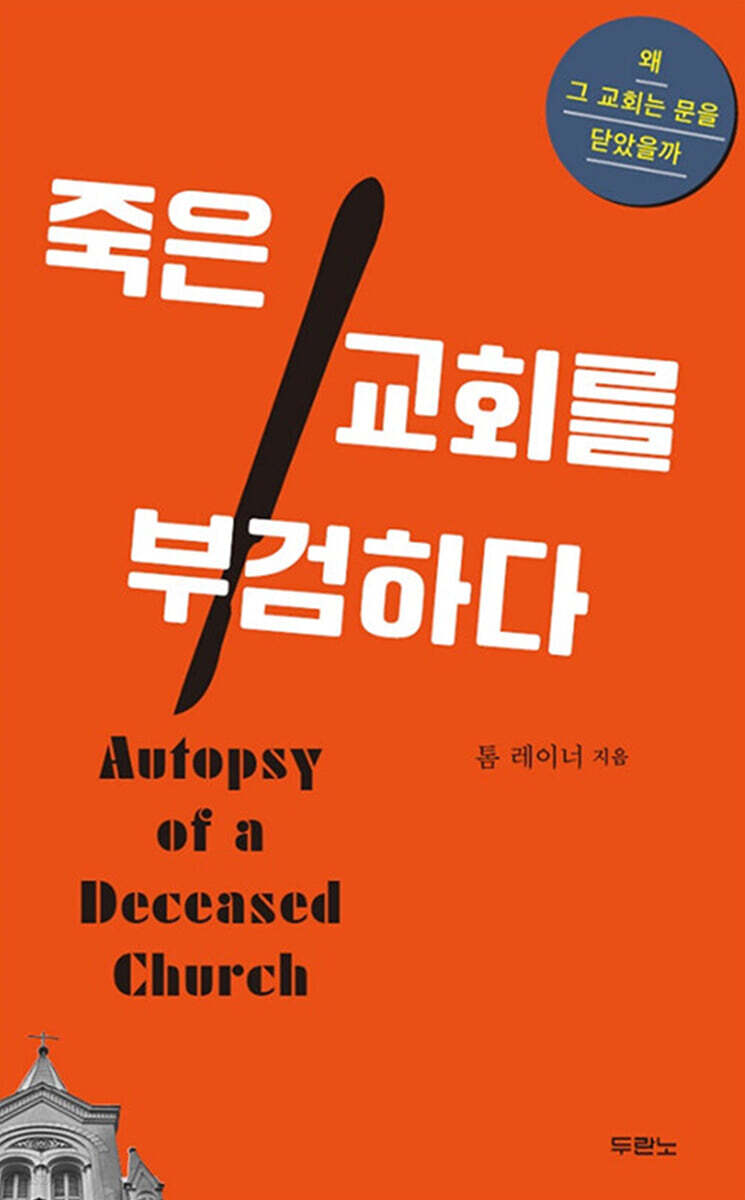
Autopsy of the Dead Church
 |
Description
Book Introduction
No one wants the church to die. Yet, too many churches are dying. Dr. Tom Rainer, a pastoral consulting expert, has been helping churches grow for over 25 years, diagnosing them and providing prescriptions accordingly. In particular, he observed numerous churches closing their doors and performed autopsies on dead churches to find out the cause. As a result, he discovered common problems in dead churches. But it's not all gloomy. Because in those problems, a way to maintain the vitality of the church was discovered. This book is a must-read for everyone, whether you're in a vibrant or dying church, a pastor or a layperson. |
- You can preview some of the book's contents.
Preview
index
Prologue: In search of the reasons for the death of countless churches
Part 1: Characteristics of Dead Churches
Disappearing Churches
1.
Sign 1: Gradual decline
It declined so slowly that no one noticed.
2.
Sign 2 Past Glory
He stubbornly refused any change.
3.
Sign 3: Abandoning the community
It was their own church
4.
Sign 4 Greed
The budget was used only internally
5.
Sign 5: Forgetting the Great Commandment
At some point, obedience to the Great Commission disappeared.
6.
Sign 6: A Church Driven by Taste
Always filled with saints for me and myself
7.
Sign 7 Frequent replacement of pastors
Pastors minimize conflicts with their congregation.
I chose the safe path
8.
Sign 8: Absence of Prayer Life
The church rarely prayed together.
9.
Sign 9: Lost Vision
The church has lost its purpose and mission.
10.
Sign 10 Conflict Surrounding Church Facilities
Instead of being good stewards, he was obsessed with church facilities.
Part 2: 12 Ways to Keep Your Church Vitality
There is still hope and solutions.
1.
Four Solutions for Churches Showing Symptoms of Disease
Without a thorough change
Hope cannot become reality.
2.
Four Solutions for Very Sick Churches
If you truly want to recover,
Acknowledge the seriousness of the situation and pray.
3.
Four Solutions for Dying Churches
For the glory of God
Have the courage and strength to let go of your church.
Acknowledgements
main
Part 1: Characteristics of Dead Churches
Disappearing Churches
1.
Sign 1: Gradual decline
It declined so slowly that no one noticed.
2.
Sign 2 Past Glory
He stubbornly refused any change.
3.
Sign 3: Abandoning the community
It was their own church
4.
Sign 4 Greed
The budget was used only internally
5.
Sign 5: Forgetting the Great Commandment
At some point, obedience to the Great Commission disappeared.
6.
Sign 6: A Church Driven by Taste
Always filled with saints for me and myself
7.
Sign 7 Frequent replacement of pastors
Pastors minimize conflicts with their congregation.
I chose the safe path
8.
Sign 8: Absence of Prayer Life
The church rarely prayed together.
9.
Sign 9: Lost Vision
The church has lost its purpose and mission.
10.
Sign 10 Conflict Surrounding Church Facilities
Instead of being good stewards, he was obsessed with church facilities.
Part 2: 12 Ways to Keep Your Church Vitality
There is still hope and solutions.
1.
Four Solutions for Churches Showing Symptoms of Disease
Without a thorough change
Hope cannot become reality.
2.
Four Solutions for Very Sick Churches
If you truly want to recover,
Acknowledge the seriousness of the situation and pray.
3.
Four Solutions for Dying Churches
For the glory of God
Have the courage and strength to let go of your church.
Acknowledgements
main
Detailed image
Into the book
Living in the 'good old days'
The most common finding from autopsies is that the dead churches had long lived in the past, viewing it as their golden age.
Those churches were clinging to the past in desperation and fear.
Whenever internal or external factors tried to change the past, the churches reacted with anger and stubbornness.
“We will die before we change.” And those churches died.
Listen carefully.
Those churches were not holding on to the truth of the Bible.
Those churches did not hold to clear Christian ethics.
Those churches did not fight for major doctrines, minor doctrines, or even minor doctrines.
No, those churches didn't fight for doctrine at all.
Those churches fought and clung to the past.
We fought for the good old days, the way things were always done, the way we hoped they would continue today.
Of course, there were prophets in those churches who presented dissenting opinions.
They warned people that if their church did not change, it would die.
But the defenders of the past did not listen.
They resisted fiercely.
Eventually the prophets left, and death drew nearer and nearer.
---From Chapter 2
****
Why endure the pain of an autopsy?
Why have I dragged you into the painful task of determining why the churches are dead? Because we need to know.
An autopsy on a human is performed to find out why the person died.
An autopsy can provide bereaved families with the information they need to prevent their loved ones from following the same path.
Sometimes forensic scientists perform autopsies to determine how a murder or accident occurred.
Information is always useful.
Sometimes information brings definition.
That doesn't mean autopsies are fun.
I will show you the autopsies of 14 churches.
However, we will not be presenting reports for each church.
Because it is unnecessary.
Instead, I'm going to summarize what I've discovered about these dead churches.
I am deeply grateful to those who confessed everything to me honestly and to those who performed the autopsy with me.
They were members of a church that was once alive but is now dead.
They all endured the pain of the autopsy with me.
The denominations of those churches are diverse.
There are also churches that do not belong to any denomination.
The regions are also diverse.
The demographics of the area also vary greatly.
But in one important respect the churches were very similar.
In other words, those churches followed the path to death.
Jesus told Peter that the church would not die.
“And I tell you that you are Peter, and on this rock I will build my church, and the gates of Hades will not overcome it” (Matthew 16:18).
In reality, the church will not die.
But many local churches have died, and are dying even at this moment.
Although this is a painful process, I sincerely hope that this autopsy will be helpful to church leaders and laity today.
In the United States alone, 100,000 churches are showing signs of death.
I earnestly pray that God will give us the courage to make the changes necessary to breathe new life into the churches.
The most common finding from autopsies is that the dead churches had long lived in the past, viewing it as their golden age.
Those churches were clinging to the past in desperation and fear.
Whenever internal or external factors tried to change the past, the churches reacted with anger and stubbornness.
“We will die before we change.” And those churches died.
Listen carefully.
Those churches were not holding on to the truth of the Bible.
Those churches did not hold to clear Christian ethics.
Those churches did not fight for major doctrines, minor doctrines, or even minor doctrines.
No, those churches didn't fight for doctrine at all.
Those churches fought and clung to the past.
We fought for the good old days, the way things were always done, the way we hoped they would continue today.
Of course, there were prophets in those churches who presented dissenting opinions.
They warned people that if their church did not change, it would die.
But the defenders of the past did not listen.
They resisted fiercely.
Eventually the prophets left, and death drew nearer and nearer.
---From Chapter 2
****
Why endure the pain of an autopsy?
Why have I dragged you into the painful task of determining why the churches are dead? Because we need to know.
An autopsy on a human is performed to find out why the person died.
An autopsy can provide bereaved families with the information they need to prevent their loved ones from following the same path.
Sometimes forensic scientists perform autopsies to determine how a murder or accident occurred.
Information is always useful.
Sometimes information brings definition.
That doesn't mean autopsies are fun.
I will show you the autopsies of 14 churches.
However, we will not be presenting reports for each church.
Because it is unnecessary.
Instead, I'm going to summarize what I've discovered about these dead churches.
I am deeply grateful to those who confessed everything to me honestly and to those who performed the autopsy with me.
They were members of a church that was once alive but is now dead.
They all endured the pain of the autopsy with me.
The denominations of those churches are diverse.
There are also churches that do not belong to any denomination.
The regions are also diverse.
The demographics of the area also vary greatly.
But in one important respect the churches were very similar.
In other words, those churches followed the path to death.
Jesus told Peter that the church would not die.
“And I tell you that you are Peter, and on this rock I will build my church, and the gates of Hades will not overcome it” (Matthew 16:18).
In reality, the church will not die.
But many local churches have died, and are dying even at this moment.
Although this is a painful process, I sincerely hope that this autopsy will be helpful to church leaders and laity today.
In the United States alone, 100,000 churches are showing signs of death.
I earnestly pray that God will give us the courage to make the changes necessary to breathe new life into the churches.
---From the "Prologue"
Publisher's Review
A Pastoral Consultant's Church Diagnosis 1
Disappearing Churches, Reviving Churches
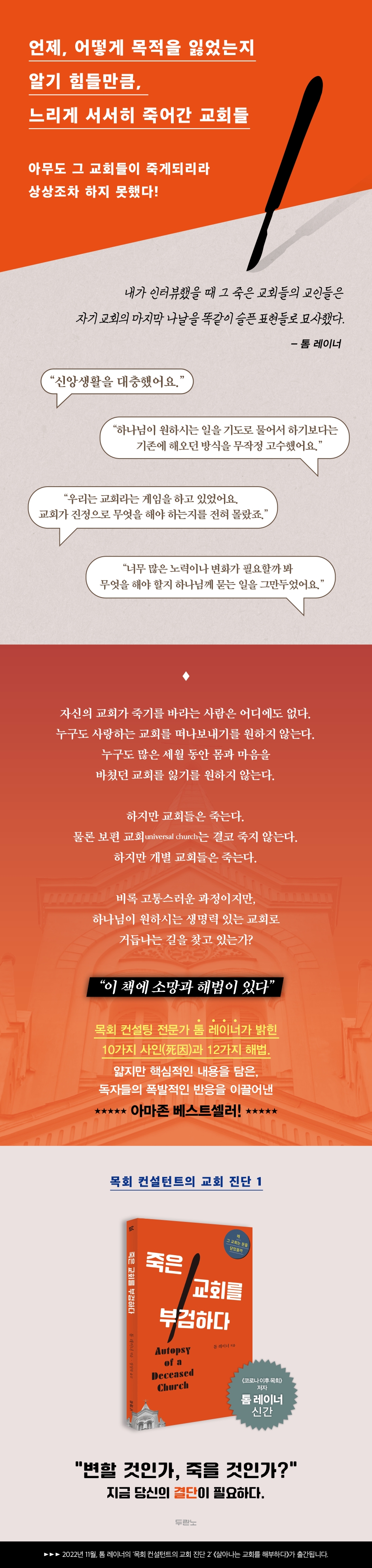
“So many churches are dying.
“In the United States alone, 100,000 churches are showing signs of death.”
No one wants their church to die.
No one wants to leave the church they love.
No one wants to lose the church to which they have devoted their hearts and souls for many years.
But churches die.
Of course, the universal church never dies.
But individual churches die.
Although it is a painful process,
To a vibrant church that God desires
Is there a need for a path for those seeking rebirth?
Let's hear the diagnosis and solutions from a pastoral consulting expert.
He autopsied 14 dead churches among the numerous churches,
We are revealing the signs of those churches and proposing solutions.
No one wants the church to die.
Yet, too many churches are dying.
Dr. Tom Rainer, a pastoral consulting expert, has been helping churches grow for over 25 years, diagnosing them and providing prescriptions accordingly.
In particular, he observed numerous churches closing their doors and performed autopsies on dead churches to find out the cause.
As a result, he discovered common problems in dead churches.
But it's not all gloomy.
Because in those problems, a way to maintain the vitality of the church was discovered.
This book is a must-read for everyone, whether you're in a vibrant or dying church, a pastor or a layperson.
A church that was probably born with a grand vision.
But the church died because it no longer had a vision.
There is still hope and a solution.
I earnestly pray that God will give us the courage to make the changes necessary to breathe new life into the churches.
Our church can be revived again.
But we have this challenge.
“Will you change or die?” Your decision is needed now.
Disappearing Churches, Reviving Churches
“So many churches are dying.
“In the United States alone, 100,000 churches are showing signs of death.”
No one wants their church to die.
No one wants to leave the church they love.
No one wants to lose the church to which they have devoted their hearts and souls for many years.
But churches die.
Of course, the universal church never dies.
But individual churches die.
Although it is a painful process,
To a vibrant church that God desires
Is there a need for a path for those seeking rebirth?
Let's hear the diagnosis and solutions from a pastoral consulting expert.
He autopsied 14 dead churches among the numerous churches,
We are revealing the signs of those churches and proposing solutions.
No one wants the church to die.
Yet, too many churches are dying.
Dr. Tom Rainer, a pastoral consulting expert, has been helping churches grow for over 25 years, diagnosing them and providing prescriptions accordingly.
In particular, he observed numerous churches closing their doors and performed autopsies on dead churches to find out the cause.
As a result, he discovered common problems in dead churches.
But it's not all gloomy.
Because in those problems, a way to maintain the vitality of the church was discovered.
This book is a must-read for everyone, whether you're in a vibrant or dying church, a pastor or a layperson.
A church that was probably born with a grand vision.
But the church died because it no longer had a vision.
There is still hope and a solution.
I earnestly pray that God will give us the courage to make the changes necessary to breathe new life into the churches.
Our church can be revived again.
But we have this challenge.
“Will you change or die?” Your decision is needed now.
GOODS SPECIFICS
- Publication date: October 19, 2022
- Page count, weight, size: 156 pages | 156g | 112*180*5mm
- ISBN13: 9788953143319
- ISBN10: 8953143314
You may also like
카테고리
korean


korean

![GQ KOREA Mark (Monthly): December [2025]](http://librairie.coreenne.fr/cdn/shop/files/8ef265dbbfbf186523ed75ba7319009d.jpg?v=1765340328&width=3840)


