

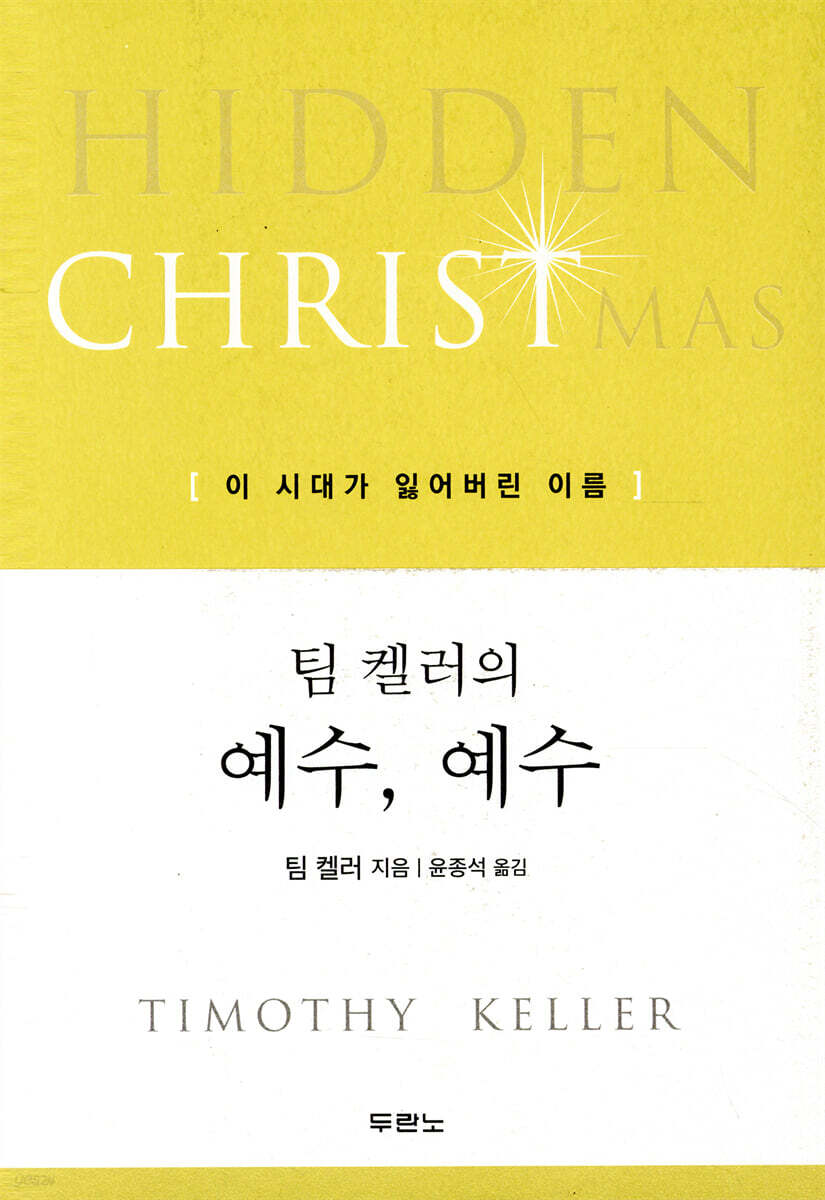
Tim Keller's Jesus, Jesus
 |
Description
Book Introduction
The Mystery of God's Decrease in Size I can't understand a 'God like Jesus' The world is either indifferent to him or has chosen to distort him. The whole world is groping in the dark. I thought it was a light and chased it around, but the darkness only grew thicker. Tim Keller, who deeply conveys the Christian gospel in the language of this day and age, has now shaken off the old, worn-out layers that have piled up on the global Christmas festival and revealed the treasure hidden within the world's wrapping paper. Even long-time churchgoers and non-believers believe they know the story of Jesus' birth well. Every year, when Christmas comes around, every church is decorated with baby Jesus lying in a manger, and songs about the birth of Jesus, shepherds, angels, and the world resonate throughout the streets and through the media. But how many of us have actually examined the sharp double-edged sword of this true story? |
- You can preview some of the book's contents.
Preview
index
prolog.
In search of a person hidden in the noisy festival
The truth this era ignores
Part 1.
One day, God came to us in person.
Jesus, the light of the blind world
1.
As things stand now, there is no way out of the darkness.
Jesus, the lifeline of a crying life
2.
He gathers flawed lives around the 'table of grace'
Jesus, God who became one of us
3.
He became like you so that you would not be left alone.
Jesus, the King who descended to the lowest place
4.
The 'King Herod' running wild inside me must step down.
My whole life is soaked in the life of Jesus
Part 2.
The One who created us in the first place is creating us again.
Jesus gives us the grace to believe
5.
The journey of faith requires His guidance.
Jesus gives us 'eyes to see'
6.
Fear loses its power as we see the gospel clearly.
Jesus, giving us 'unwavering peace'
7.
A sword that pierces the heart, a strife for true peace
Jesus gives himself
8.
The name Jesus has been restored, and now it cannot be hidden.
main
Acknowledgements
In search of a person hidden in the noisy festival
The truth this era ignores
Part 1.
One day, God came to us in person.
Jesus, the light of the blind world
1.
As things stand now, there is no way out of the darkness.
Jesus, the lifeline of a crying life
2.
He gathers flawed lives around the 'table of grace'
Jesus, God who became one of us
3.
He became like you so that you would not be left alone.
Jesus, the King who descended to the lowest place
4.
The 'King Herod' running wild inside me must step down.
My whole life is soaked in the life of Jesus
Part 2.
The One who created us in the first place is creating us again.
Jesus gives us the grace to believe
5.
The journey of faith requires His guidance.
Jesus gives us 'eyes to see'
6.
Fear loses its power as we see the gospel clearly.
Jesus, giving us 'unwavering peace'
7.
A sword that pierces the heart, a strife for true peace
Jesus gives himself
8.
The name Jesus has been restored, and now it cannot be hidden.
main
Acknowledgements
Into the book
The trend of emphasizing light in the darkness originated from the Christian belief that the world's hope comes from outside the world.
Moreover, the act of giving gifts is a natural response to Jesus, who gave his life.
Jesus left all his glory and came as a human being.
The concern for our neighbors in difficult circumstances reminds us that the Son of God was born into a poor family, not into the upper class.
The Lord of the universe has become one with the least and most marginalized of humanity.
All of these are heartwarming topics, but they are actually a double-edged sword.
Jesus came as light because we are so spiritually blind that we cannot find our way on our own.
He became human and died because we are so morally corrupt that we cannot be forgiven in any other way.
Since Jesus gave himself to us, we too must give ourselves completely to him.
Therefore, we are not our own.
(Like God) Christmas is more wonderful and more deadly than we think.
--- pp.
12-13
Christianity does not subscribe to the optimistic view that 'if we try our best, we can solve the problem.'
Of course, I do not agree with the pessimism that only sees a dystopian future.
The Christian message is that the problem is so serious that we cannot heal or save ourselves.
The world is very dark, but there is still hope.
“On those who live in the land of the shadow of death a light has dawned” (Isaiah 9:2).
As you can see, it does not say that light rose from the world, but that light shined on the world.
The light came from outside.
There is light outside this world, and Jesus brought that light to save us.
No, to be more precise, He is that light (see John 8:12).
--- p.
27
Where can we find the strength to be so courageous? Look to Jesus.
It takes courage for you to be with Him, but it takes infinitely more courage for Him to be with you.
Christianity is the only religion in which courage is an attribute of God.
There is no god in any other religion that requires courage.
As Packer points out, Jesus had to wrestle in the Garden of Gethsemane and face an agonizing death to save us.
He became a frail human being who could not help but die, and suffered suffering, betrayal, and death.
He endured all these things for you and considered it worthwhile.
Behold Him who faces the darkness for you.
Then you too will be able to face any darkness.
--- pp.
98-99
As we see in her, the response of faith is a holistic experience that includes even the intellect.
Modern people tend to adopt an arrogant attitude when reading old documents.
As if people in the past had lower IQs than we do now.
We assume that people at that time were superstitious and gullible, so they blindly believed anything they heard.
But just because it was 2,000 years ago doesn't mean that people were any less intelligent.
If an angel appeared to you and spoke to you, you would react the same way Mary did.
You and I have been culturally trained not to believe in the supernatural.
As we have seen, Mary, being Jewish, was culturally raised not to believe in the idea that God could become human.
So the barrier that prevented her from believing the angel's message was just as high as the barrier before you, only different in type.
Yet, evidence and experience combined to break down that barrier, and Mary eventually believed.
The principles of faith remain the same today.
She had doubts and questions, and she used her reason to ask questions.
We must do the same today if we are to believe.
--- pp.
132-133
Ultimately, faith always transcends intellectual agreement and duty and encompasses the entire self, including knowledge, emotion, and will.
Why does it take so long to have faith, and why is the process of believing so different for each person? It's because true faith isn't something we decide to exercise on our own.
This process is not under your control.
As we saw in the previous chapter, we deeply resent the notion that we are not the masters of our own lives.
But we do not have the ability to believe in Jesus on our own.
Over the years I have never known a single person who came to faith simply by deciding to create faith and then putting that plan into action.
No, God must open our hearts and break down our prejudices and negativity.
Therefore, one sign of true Christian faith is the recognition that some external power has pointed you in the eye, reached out, and dealt directly with you.
Because of that ability, you can see the incredible, realize that it is true, and rejoice and give yourself.
He who created you in the beginning is creating you again (see Titus 3:4-7).
We can never find Him unless He comes and reveals Himself to us, as He did to Mary.
--- pp.
139-140
Here again Mary stands before us as the model of all who love Jesus.
If you love Jesus and invite Him into your life, a sword will pierce your heart.
There will be inner conflicts, and at times confusion and great pain will follow.
You might get something wrong.
You can fight him or you can fight yourself.
… (omitted)… After believing in Christ, many fights end or are almost over.
The struggle to prove oneself, the struggle to discover one's identity, the struggle to find a meaning in life that will enable one to endure even hardships, the struggle to find true satisfaction—all these struggles are resolved.
But believing in Christ triggers a whole new level of struggle.
So, Ryle said that the standard for knowing a true Christian is not only the new peace, but also the new conflict.
--- pp.
190-191
The Christian life begins not with noble acts and accomplishments, but with extremely simple and ordinary actions.
It is a matter of humility.
Then, as time goes by, life and joy grow within us, and this too grows through practices that are ordinary, almost boring.
These include daily obedience, reading the Bible and praying, attending worship services, serving our brothers and sisters in Christ and our neighbors, and relying on Jesus in times of trouble.
As our faith grows little by little, the foundation of our lives moves closer and closer to the groundwater of joy.
Don't be confined by the ordinary path of joy.
Hidden within that ordinariness lies the extraordinary richness of the gospel.
Do not commit the mistakes the world has always made.
Moreover, the act of giving gifts is a natural response to Jesus, who gave his life.
Jesus left all his glory and came as a human being.
The concern for our neighbors in difficult circumstances reminds us that the Son of God was born into a poor family, not into the upper class.
The Lord of the universe has become one with the least and most marginalized of humanity.
All of these are heartwarming topics, but they are actually a double-edged sword.
Jesus came as light because we are so spiritually blind that we cannot find our way on our own.
He became human and died because we are so morally corrupt that we cannot be forgiven in any other way.
Since Jesus gave himself to us, we too must give ourselves completely to him.
Therefore, we are not our own.
(Like God) Christmas is more wonderful and more deadly than we think.
--- pp.
12-13
Christianity does not subscribe to the optimistic view that 'if we try our best, we can solve the problem.'
Of course, I do not agree with the pessimism that only sees a dystopian future.
The Christian message is that the problem is so serious that we cannot heal or save ourselves.
The world is very dark, but there is still hope.
“On those who live in the land of the shadow of death a light has dawned” (Isaiah 9:2).
As you can see, it does not say that light rose from the world, but that light shined on the world.
The light came from outside.
There is light outside this world, and Jesus brought that light to save us.
No, to be more precise, He is that light (see John 8:12).
--- p.
27
Where can we find the strength to be so courageous? Look to Jesus.
It takes courage for you to be with Him, but it takes infinitely more courage for Him to be with you.
Christianity is the only religion in which courage is an attribute of God.
There is no god in any other religion that requires courage.
As Packer points out, Jesus had to wrestle in the Garden of Gethsemane and face an agonizing death to save us.
He became a frail human being who could not help but die, and suffered suffering, betrayal, and death.
He endured all these things for you and considered it worthwhile.
Behold Him who faces the darkness for you.
Then you too will be able to face any darkness.
--- pp.
98-99
As we see in her, the response of faith is a holistic experience that includes even the intellect.
Modern people tend to adopt an arrogant attitude when reading old documents.
As if people in the past had lower IQs than we do now.
We assume that people at that time were superstitious and gullible, so they blindly believed anything they heard.
But just because it was 2,000 years ago doesn't mean that people were any less intelligent.
If an angel appeared to you and spoke to you, you would react the same way Mary did.
You and I have been culturally trained not to believe in the supernatural.
As we have seen, Mary, being Jewish, was culturally raised not to believe in the idea that God could become human.
So the barrier that prevented her from believing the angel's message was just as high as the barrier before you, only different in type.
Yet, evidence and experience combined to break down that barrier, and Mary eventually believed.
The principles of faith remain the same today.
She had doubts and questions, and she used her reason to ask questions.
We must do the same today if we are to believe.
--- pp.
132-133
Ultimately, faith always transcends intellectual agreement and duty and encompasses the entire self, including knowledge, emotion, and will.
Why does it take so long to have faith, and why is the process of believing so different for each person? It's because true faith isn't something we decide to exercise on our own.
This process is not under your control.
As we saw in the previous chapter, we deeply resent the notion that we are not the masters of our own lives.
But we do not have the ability to believe in Jesus on our own.
Over the years I have never known a single person who came to faith simply by deciding to create faith and then putting that plan into action.
No, God must open our hearts and break down our prejudices and negativity.
Therefore, one sign of true Christian faith is the recognition that some external power has pointed you in the eye, reached out, and dealt directly with you.
Because of that ability, you can see the incredible, realize that it is true, and rejoice and give yourself.
He who created you in the beginning is creating you again (see Titus 3:4-7).
We can never find Him unless He comes and reveals Himself to us, as He did to Mary.
--- pp.
139-140
Here again Mary stands before us as the model of all who love Jesus.
If you love Jesus and invite Him into your life, a sword will pierce your heart.
There will be inner conflicts, and at times confusion and great pain will follow.
You might get something wrong.
You can fight him or you can fight yourself.
… (omitted)… After believing in Christ, many fights end or are almost over.
The struggle to prove oneself, the struggle to discover one's identity, the struggle to find a meaning in life that will enable one to endure even hardships, the struggle to find true satisfaction—all these struggles are resolved.
But believing in Christ triggers a whole new level of struggle.
So, Ryle said that the standard for knowing a true Christian is not only the new peace, but also the new conflict.
--- pp.
190-191
The Christian life begins not with noble acts and accomplishments, but with extremely simple and ordinary actions.
It is a matter of humility.
Then, as time goes by, life and joy grow within us, and this too grows through practices that are ordinary, almost boring.
These include daily obedience, reading the Bible and praying, attending worship services, serving our brothers and sisters in Christ and our neighbors, and relying on Jesus in times of trouble.
As our faith grows little by little, the foundation of our lives moves closer and closer to the groundwater of joy.
Don't be confined by the ordinary path of joy.
Hidden within that ordinariness lies the extraordinary richness of the gospel.
Do not commit the mistakes the world has always made.
--- p.
214
214
Publisher's Review
The precious name buried in the tumultuous reality, Christ Jesus
Retracing the historical truth of his arrival in this land
Tim Keller explains his reason for writing this book in the introduction, saying, “The Christmas season is the only time of year when secular society and the church have anything in common, and that understanding Christmas correctly allows us to understand the gospel of Jesus, the foundation of Christianity.”
In this book, Tim Keller explores some of the Bible verses that have become famous because they appear every Christmas.
Part 1 focuses on the Gospel of Matthew and seeks out Christ Jesus, the gift God gave us but which has been lost in this age.
Also, in Part 2, we are guided on the path to no longer rejecting Him but accepting Him, focusing on the Gospel of Luke.
Who is this book for?
As this book announces the 'beginning of the gospel', it is also a great evangelistic gift that can open the door to conversation with non-believers.
It also awakens believers who say they celebrate Jesus' birthday on Christmas, but in reality, like non-believers, spend the day expecting the wrong things, and helps them recover the excitement and thrill of the incarnation and salvation, not the church holidays or public holidays.
God came into the world we live in, breaking through the gap between ideal and reality, between eternity and time.
Jesus, who came as promised, will come again on the last day as promised.
Through this book, we will rediscover the name of Jesus, who came to this earth to find us, and make a new resolution about how we should live until He returns to this earth.
Retracing the historical truth of his arrival in this land
Tim Keller explains his reason for writing this book in the introduction, saying, “The Christmas season is the only time of year when secular society and the church have anything in common, and that understanding Christmas correctly allows us to understand the gospel of Jesus, the foundation of Christianity.”
In this book, Tim Keller explores some of the Bible verses that have become famous because they appear every Christmas.
Part 1 focuses on the Gospel of Matthew and seeks out Christ Jesus, the gift God gave us but which has been lost in this age.
Also, in Part 2, we are guided on the path to no longer rejecting Him but accepting Him, focusing on the Gospel of Luke.
Who is this book for?
As this book announces the 'beginning of the gospel', it is also a great evangelistic gift that can open the door to conversation with non-believers.
It also awakens believers who say they celebrate Jesus' birthday on Christmas, but in reality, like non-believers, spend the day expecting the wrong things, and helps them recover the excitement and thrill of the incarnation and salvation, not the church holidays or public holidays.
God came into the world we live in, breaking through the gap between ideal and reality, between eternity and time.
Jesus, who came as promised, will come again on the last day as promised.
Through this book, we will rediscover the name of Jesus, who came to this earth to find us, and make a new resolution about how we should live until He returns to this earth.
GOODS SPECIFICS
- Publication date: November 20, 2017
- Page count, weight, size: 224 pages | 233g | 125*180*14mm
- ISBN13: 9788953129948
- ISBN10: 895312994X
You may also like
카테고리
korean


korean

![GQ KOREA Mark (Monthly): December [2025]](http://librairie.coreenne.fr/cdn/shop/files/8ef265dbbfbf186523ed75ba7319009d.jpg?v=1765340328&width=3840)


