

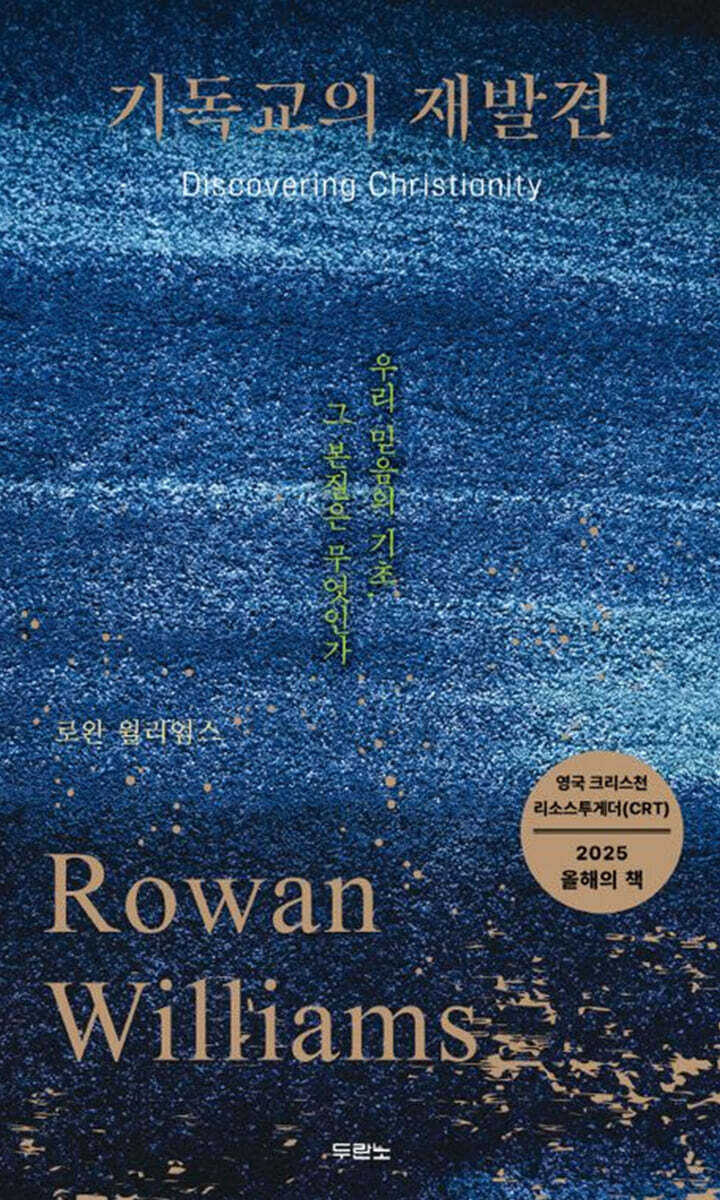
Rediscovery of Christianity
 |
Description
Book Introduction
Those who still have difficulty believing despite their long religious life,
Today, God, the world, and myself
For all who want to understand correctly
Theology and doctrine, church life and sacraments, tradition and reason are all connected to our lives, yet we wander, not knowing where to begin understanding Christianity or what to hold onto.
In this book, Rowan Williams guides us toward a living faith in a complex and confusing world.
This book covers everything from what faith is, what Christianity is, and the essence of the church, the Bible, tradition, and reason, helping us realize the center of life that we have been missing.
Let us return to the place where God's life and love flow! Knowing true Christianity can renew our hearts.
This book is not simply a theological book.
It is a guide that invites us to experience God in our lives, connect with one another, and live in love and grace.
Today, God, the world, and myself
For all who want to understand correctly
Theology and doctrine, church life and sacraments, tradition and reason are all connected to our lives, yet we wander, not knowing where to begin understanding Christianity or what to hold onto.
In this book, Rowan Williams guides us toward a living faith in a complex and confusing world.
This book covers everything from what faith is, what Christianity is, and the essence of the church, the Bible, tradition, and reason, helping us realize the center of life that we have been missing.
Let us return to the place where God's life and love flow! Knowing true Christianity can renew our hearts.
This book is not simply a theological book.
It is a guide that invites us to experience God in our lives, connect with one another, and live in love and grace.
- You can preview some of the book's contents.
Preview
index
Recommendation
1.
What is faith?
2.
What is Christianity?
3.
What is theology?
4.
Why the Church Is Important
5.
Why the Bible is Important
6.
Why Traditions Matter
7.
Why Reason Matters
8.
Why the Gospel Matters to the World and Our Lives
Questions for small group and individual reflection
1.
What is faith?
2.
What is Christianity?
3.
What is theology?
4.
Why the Church Is Important
5.
Why the Bible is Important
6.
Why Traditions Matter
7.
Why Reason Matters
8.
Why the Gospel Matters to the World and Our Lives
Questions for small group and individual reflection
Into the book
I would like to begin the discussion of this chapter by considering an aspect of human awareness that is plagued by constant bewilderment and frustration.
This self-consciousness stems from the idea that what we see now may not be the whole story, and that our individual perceptions may not be the measure of all truth.
Our everyday perceptions of the world around us are often tinged with deep joy or sadness.
Sometimes we feel an inexplicable urge to express deep gratitude, even when we are not sure who or what that gratitude should be directed to.
And we often find ourselves feeling overwhelmed by emotions that we find difficult to express in words or don't know how to deal with.
These experiences may, of course, be quite different from the strange uncle mentioned above, but essentially the same idea underlies both phenomena.
What if this world isn't as flat and docile as we imagine? What if our own perceptions of things (including the idea that our personal needs and desires are paramount) aren't the measure of all things? Our religious feelings and perceptions are rooted in this very sense of human limitation, or (if I may so express it) our vulnerability.
And it also underpins the sense that we humans are not necessarily the center of the world or in control of everything.
It is not as if we were some kind of lighthouse, illuminating all things with a single, uniform light centered on ourselves, our hearts, or our minds, and able to see into the entire realm of reality.
So what if we are not at the center of all things, but merely part of a vast and rich web of intertwined perspectives and energies, constantly influencing each other?
To this question, we can choose one of two answers:
One of them is actually a sound choice, and the other is not so good.
And not so good choices lead to unhealthy religions, while good choices lead us to the path of faith.
Here, harmful religion ultimately arises from the misuse of religious language and narratives in ways that make us believe that we are at the center of all things, the masters of all things, and capable of overcoming human limitations.
At this point, we come to believe that we can grasp the infallible and absolute truth and that we can embrace a perspective that views all things equally and fairly.
Soon, you will realize that you have already figured out the true nature of the world and therefore have no need to learn anything more.
This attitude not only becomes the basis for harmful religions, but also for harmful atheistic beliefs.
This is especially true when a system of thought calls itself 'atheistic', yet still clings to some (bad) religious notion, as if it could provide complete answers to human beings' questions and overcome all the limitations that threaten their power.
The most fundamental problem with such bad religions, what makes them harmful, is that their teachings make us
The problem is that it makes us ignore and turn away from the true reality of the world.
So what would a "healthy" response be? In my view, one of the touchstones of true faith, as opposed to the "bad" religions discussed above, is whether it allows us to stop ignoring the realities of this world.
Our faith becomes most fully alive when it opens our eyes to a world larger than we ever imagined.
(Of course, at this time, the world can be a more frightening and surprising place than you think.)
The true measure of faith is how much it reveals to us, and how much it allows us to stop denying, resisting, or ignoring the various realities of the world.
I know someone who has handled the demanding job of senior psychiatrist at Broadmore Hospital remarkably well over the past twenty-six years.
He is also an avid Shakespearean, and one of his favorite lines from the play The Tempest is the question posed by Prospero, the exiled Duke of Milan living on a remote island, to his daughter Miranda:
“What seest thou else?”
He confessed that it was that very question that gave him the strength to endure his arduous medical practice.
When confronted with patients in dark and miserable situations, with intense anxiety and trapped in their own fantasies, he had to constantly ask himself:
'Is there anything else I can see? What am I supposed to see here?'
In his view, it was the influence of religious faith that helped us see beyond the surface of given things.
It was a force that made us realize that the true nature of this world cannot be grasped through the eyes of just one human being, or even through the vision of all mankind.
This was the force that awakened us to the fact that the world before us possessed truly strange and unfamiliar dimensions and unfathomable depths.
In this respect, religious faith has characteristics that overlap considerably with art and creative scientific activities.
As you know, creative scientific inquiry begins with the conviction that there is something in this world that has not yet been discovered.
It is time to face up to something that I and all of us have been ignoring.
Likewise, artistic activities (consisting of poetry, sculpture, painting, and drama) are also rooted in the following feeling.
'The true nature of the world is far greater and broader than what anyone can grasp through a single image at any given moment.' In other words, religious faith is a process that awakens our vision and passion.
It awakens our vision, allowing us to learn to perceive things we previously overlooked.
Furthermore, it helps us look beyond the surface of things and understand the depth of this world that we cannot fully fathom with our own strength.
And that faith awakens our passion, leading us to grow 'humanly', so that we can fully reveal our human worth without being crushed by fear of the unfamiliar aspects of the world.
This self-consciousness stems from the idea that what we see now may not be the whole story, and that our individual perceptions may not be the measure of all truth.
Our everyday perceptions of the world around us are often tinged with deep joy or sadness.
Sometimes we feel an inexplicable urge to express deep gratitude, even when we are not sure who or what that gratitude should be directed to.
And we often find ourselves feeling overwhelmed by emotions that we find difficult to express in words or don't know how to deal with.
These experiences may, of course, be quite different from the strange uncle mentioned above, but essentially the same idea underlies both phenomena.
What if this world isn't as flat and docile as we imagine? What if our own perceptions of things (including the idea that our personal needs and desires are paramount) aren't the measure of all things? Our religious feelings and perceptions are rooted in this very sense of human limitation, or (if I may so express it) our vulnerability.
And it also underpins the sense that we humans are not necessarily the center of the world or in control of everything.
It is not as if we were some kind of lighthouse, illuminating all things with a single, uniform light centered on ourselves, our hearts, or our minds, and able to see into the entire realm of reality.
So what if we are not at the center of all things, but merely part of a vast and rich web of intertwined perspectives and energies, constantly influencing each other?
To this question, we can choose one of two answers:
One of them is actually a sound choice, and the other is not so good.
And not so good choices lead to unhealthy religions, while good choices lead us to the path of faith.
Here, harmful religion ultimately arises from the misuse of religious language and narratives in ways that make us believe that we are at the center of all things, the masters of all things, and capable of overcoming human limitations.
At this point, we come to believe that we can grasp the infallible and absolute truth and that we can embrace a perspective that views all things equally and fairly.
Soon, you will realize that you have already figured out the true nature of the world and therefore have no need to learn anything more.
This attitude not only becomes the basis for harmful religions, but also for harmful atheistic beliefs.
This is especially true when a system of thought calls itself 'atheistic', yet still clings to some (bad) religious notion, as if it could provide complete answers to human beings' questions and overcome all the limitations that threaten their power.
The most fundamental problem with such bad religions, what makes them harmful, is that their teachings make us
The problem is that it makes us ignore and turn away from the true reality of the world.
So what would a "healthy" response be? In my view, one of the touchstones of true faith, as opposed to the "bad" religions discussed above, is whether it allows us to stop ignoring the realities of this world.
Our faith becomes most fully alive when it opens our eyes to a world larger than we ever imagined.
(Of course, at this time, the world can be a more frightening and surprising place than you think.)
The true measure of faith is how much it reveals to us, and how much it allows us to stop denying, resisting, or ignoring the various realities of the world.
I know someone who has handled the demanding job of senior psychiatrist at Broadmore Hospital remarkably well over the past twenty-six years.
He is also an avid Shakespearean, and one of his favorite lines from the play The Tempest is the question posed by Prospero, the exiled Duke of Milan living on a remote island, to his daughter Miranda:
“What seest thou else?”
He confessed that it was that very question that gave him the strength to endure his arduous medical practice.
When confronted with patients in dark and miserable situations, with intense anxiety and trapped in their own fantasies, he had to constantly ask himself:
'Is there anything else I can see? What am I supposed to see here?'
In his view, it was the influence of religious faith that helped us see beyond the surface of given things.
It was a force that made us realize that the true nature of this world cannot be grasped through the eyes of just one human being, or even through the vision of all mankind.
This was the force that awakened us to the fact that the world before us possessed truly strange and unfamiliar dimensions and unfathomable depths.
In this respect, religious faith has characteristics that overlap considerably with art and creative scientific activities.
As you know, creative scientific inquiry begins with the conviction that there is something in this world that has not yet been discovered.
It is time to face up to something that I and all of us have been ignoring.
Likewise, artistic activities (consisting of poetry, sculpture, painting, and drama) are also rooted in the following feeling.
'The true nature of the world is far greater and broader than what anyone can grasp through a single image at any given moment.' In other words, religious faith is a process that awakens our vision and passion.
It awakens our vision, allowing us to learn to perceive things we previously overlooked.
Furthermore, it helps us look beyond the surface of things and understand the depth of this world that we cannot fully fathom with our own strength.
And that faith awakens our passion, leading us to grow 'humanly', so that we can fully reveal our human worth without being crushed by fear of the unfamiliar aspects of the world.
--- From the text
Publisher's Review
World-renowned theologian Rowan Williams guides you through the deepest questions of life and faith.
Book of the Year 2025, selected by Christian Resources Together (CRT) in the UK!
A life in disarray, a dry heart, a wavering faith…
Discover true Christianity in the world
An invitation to a journey of living out God's will
What is faith?
What is Christianity?
What is theology?
Why the Church Is Important
Why the Bible is Important
Why Traditions Matter
Why Reason Matters
This book asks:
Why are faith, church, Bible, tradition, and reason important?
And answer.
All of this is what makes our lives alive.
Faith shakes a life that sees only what is visible, the church sustains life, the Bible illuminates the way, tradition and reason guard the path, and theology opens the depths of all questions.
Join Rowan Williams as we respond to God's mysterious invitation to reflect deeply on the world around us and ourselves, and immerse ourselves in the beauty and mystery of the Christianity we believe in.
Book of the Year 2025, selected by Christian Resources Together (CRT) in the UK!
A life in disarray, a dry heart, a wavering faith…
Discover true Christianity in the world
An invitation to a journey of living out God's will
What is faith?
What is Christianity?
What is theology?
Why the Church Is Important
Why the Bible is Important
Why Traditions Matter
Why Reason Matters
This book asks:
Why are faith, church, Bible, tradition, and reason important?
And answer.
All of this is what makes our lives alive.
Faith shakes a life that sees only what is visible, the church sustains life, the Bible illuminates the way, tradition and reason guard the path, and theology opens the depths of all questions.
Join Rowan Williams as we respond to God's mysterious invitation to reflect deeply on the world around us and ourselves, and immerse ourselves in the beauty and mystery of the Christianity we believe in.
GOODS SPECIFICS
- Date of issue: October 29, 2025
- Page count, weight, size: 156 pages | 182g | 120*200*10mm
- ISBN13: 9788953151949
- ISBN10: 8953151945
You may also like
카테고리
korean


korean

![GQ KOREA Mark (Monthly): December [2025]](http://librairie.coreenne.fr/cdn/shop/files/8ef265dbbfbf186523ed75ba7319009d.jpg?v=1765340328&width=3840)


