

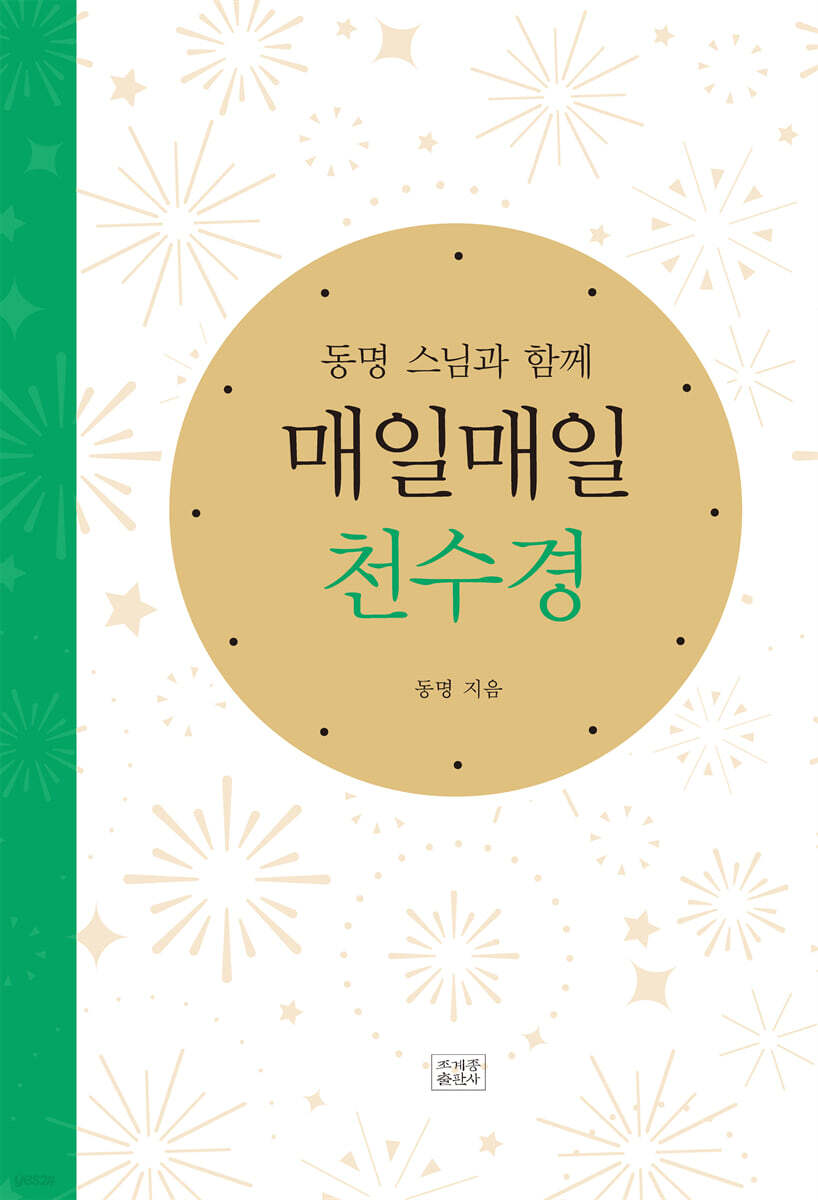
Every day, Cheon Soo-gyeong
 |
Description
Book Introduction
A well-made textbook essential for new life!
Study your mind every day with the Thousand Hands Sutra!
Monk Dongmyeong, the director of Bulkwang Education Center, has published "Every Day Thousand Hands Sutra," which guides Korean Buddhists to practice the core of Buddha's teachings through daily practice through the "Thousand Hands Sutra," the most familiar text to Korean Buddhists, and to build up proper practice.
This book was personally bound and used by Monk Dongmyeong for study with his followers for several years. Its content is both easy to understand and profound, so he received requests to make it available to a wider range of Buddhists, and so it has been officially published.
There are a variety of books on the market that cover the Thousand Hands Sutra, including commentaries, scriptures, and solo versions.
This is probably proof that the Thousand Hands Sutra is the most familiar and popular scripture among Korean Buddhists.
However, 『Everyday Thousand Hands Sutra』 is different from other ‘commentary books.’
Although it calmly explains the contents of the Thousand Hands Sutra from the perspective of Buddhists, it does not stop at being a simple commentary, but focuses on finding the secret to happiness and methods of mind study that the Thousand Hands Sutra suggests.
Monk Dongmyeong hopes that Buddhists will not only recite and copy the Thousand-Hand Sutra, but also study its profound meaning and ponder its meaning every day, pray, study, and practice it. He titled this book “Every Day Thousand-Hand Sutra.”
How about starting a study of the mind with this book, which requires daily practice to change your daily life, change your habits, and ultimately, change your life?
Study your mind every day with the Thousand Hands Sutra!
Monk Dongmyeong, the director of Bulkwang Education Center, has published "Every Day Thousand Hands Sutra," which guides Korean Buddhists to practice the core of Buddha's teachings through daily practice through the "Thousand Hands Sutra," the most familiar text to Korean Buddhists, and to build up proper practice.
This book was personally bound and used by Monk Dongmyeong for study with his followers for several years. Its content is both easy to understand and profound, so he received requests to make it available to a wider range of Buddhists, and so it has been officially published.
There are a variety of books on the market that cover the Thousand Hands Sutra, including commentaries, scriptures, and solo versions.
This is probably proof that the Thousand Hands Sutra is the most familiar and popular scripture among Korean Buddhists.
However, 『Everyday Thousand Hands Sutra』 is different from other ‘commentary books.’
Although it calmly explains the contents of the Thousand Hands Sutra from the perspective of Buddhists, it does not stop at being a simple commentary, but focuses on finding the secret to happiness and methods of mind study that the Thousand Hands Sutra suggests.
Monk Dongmyeong hopes that Buddhists will not only recite and copy the Thousand-Hand Sutra, but also study its profound meaning and ponder its meaning every day, pray, study, and practice it. He titled this book “Every Day Thousand-Hand Sutra.”
How about starting a study of the mind with this book, which requires daily practice to change your daily life, change your habits, and ultimately, change your life?
- You can preview some of the book's contents.
Preview
index
Preface: The Thousand-Hand Sutra contains a study of the mind.
Chapter 1 Koreans Controlled Their Minds with the Thousand Hands Sutra - What Kind of Sutra Is the Thousand Hands Sutra?
What kind of scripture is the Thousand Hands Sutra?
Structure of the Thousand-Hand Mirror
Thousand-Armed Sutra and Avalokitesvara Bodhisattva
Historical characteristics of Cheonsu-gyeong
Structural features of the Cheonsu-gyeong
Chapter 2: The Need for Praise Practice - The Sutra of the Opening and the Dharani
A heart of admiration purifies the world.
Opening a petition for the Dharani
Jeongguupjineon and mind study
Chapter 3: Let's Take Refuge in the Buddha and Let Our Minds Go _ Aspiration and Refuge
Ten origins
Six Vows for Beings Who Have Fallen into Evil
Taking refuge in the many Bodhisattvas and Amitabha Buddha
Return to the faith and study the mind
Chapter 4: Letting Go of the Mind by Relying on the Dharani - The Great Dharani, Made of Mysterious and Subtle Words
The many stories of the creation of the Simmyeojanggudaedharani
Dharani chanting and mind study
Chapter 5: Letting Go of the Mind through Repentance - Do-Ryang-Chan, Sa-Bang-Chan, and Repentance
Praise makes elephants dance
Repentance makes elephants dance
Praise and mind study
Repentance and mind study
Chapter 6: Letting Go of the Mind by Relying on the Mantra of Junje _Junje Mantra
Ask for the semi-temple mantra
The 'path-clearing' mantra for reciting the Junje Mantra
The storehouse of all virtues, the Junje Mantra
Prayer and study of the mind
Chapter 7 Letting go of the mind by widely sharing - The total number of people and the three refuges
Ten vows toward Buddha
Four Great Vows
The conclusion of the Thousand-Hand Sutra, the Three Refuges
Diversion and mindfulness
Chapter 8: The Bonus Mantras for Letting Go That Haven't Been Done Yet - Jeongsamup Mantra, Gaedan Mantra, Geondan Mantra, Jeongbeopgye Mantra
Mantra to clear the three karmas
The mantra that opens the Dharma Hall
Mantra for establishing a Buddhist altar
Mantra that purifies the world
The beginning of prayer is loving yourself.
Chapter 9: Conclusion: The Secret to Happiness Is in the Thousand-Hand Sutra
The secret to happiness is in the Thousand Hands Sutra.
The 'Laws of the Mind' for Success in Modern Society
Appendix 1: Korean Thousand-Hand Sutra - Standard Version of the Jogye Order of Korean Buddhism
Appendix 2: Korean version of the Thousand-Hand Sutra - translated by Monk Gwangdeok
Appendix 3: Chinese Thousand-Hand Sutra
Chapter 1 Koreans Controlled Their Minds with the Thousand Hands Sutra - What Kind of Sutra Is the Thousand Hands Sutra?
What kind of scripture is the Thousand Hands Sutra?
Structure of the Thousand-Hand Mirror
Thousand-Armed Sutra and Avalokitesvara Bodhisattva
Historical characteristics of Cheonsu-gyeong
Structural features of the Cheonsu-gyeong
Chapter 2: The Need for Praise Practice - The Sutra of the Opening and the Dharani
A heart of admiration purifies the world.
Opening a petition for the Dharani
Jeongguupjineon and mind study
Chapter 3: Let's Take Refuge in the Buddha and Let Our Minds Go _ Aspiration and Refuge
Ten origins
Six Vows for Beings Who Have Fallen into Evil
Taking refuge in the many Bodhisattvas and Amitabha Buddha
Return to the faith and study the mind
Chapter 4: Letting Go of the Mind by Relying on the Dharani - The Great Dharani, Made of Mysterious and Subtle Words
The many stories of the creation of the Simmyeojanggudaedharani
Dharani chanting and mind study
Chapter 5: Letting Go of the Mind through Repentance - Do-Ryang-Chan, Sa-Bang-Chan, and Repentance
Praise makes elephants dance
Repentance makes elephants dance
Praise and mind study
Repentance and mind study
Chapter 6: Letting Go of the Mind by Relying on the Mantra of Junje _Junje Mantra
Ask for the semi-temple mantra
The 'path-clearing' mantra for reciting the Junje Mantra
The storehouse of all virtues, the Junje Mantra
Prayer and study of the mind
Chapter 7 Letting go of the mind by widely sharing - The total number of people and the three refuges
Ten vows toward Buddha
Four Great Vows
The conclusion of the Thousand-Hand Sutra, the Three Refuges
Diversion and mindfulness
Chapter 8: The Bonus Mantras for Letting Go That Haven't Been Done Yet - Jeongsamup Mantra, Gaedan Mantra, Geondan Mantra, Jeongbeopgye Mantra
Mantra to clear the three karmas
The mantra that opens the Dharma Hall
Mantra for establishing a Buddhist altar
Mantra that purifies the world
The beginning of prayer is loving yourself.
Chapter 9: Conclusion: The Secret to Happiness Is in the Thousand-Hand Sutra
The secret to happiness is in the Thousand Hands Sutra.
The 'Laws of the Mind' for Success in Modern Society
Appendix 1: Korean Thousand-Hand Sutra - Standard Version of the Jogye Order of Korean Buddhism
Appendix 2: Korean version of the Thousand-Hand Sutra - translated by Monk Gwangdeok
Appendix 3: Chinese Thousand-Hand Sutra
Into the book
The Thousand-Hand Sutra is a sutra about meeting Avalokitesvara Bodhisattva, who is like a mother to us, and in addition, it is a sutra about repenting our daily lives, a sutra about praying for a righteous life and attaining Buddhahood, and a sutra about pledging to take refuge in the Triple Gem.
In short, it is a Mahayana sutra that is a good blend of our origins, our vows, our own strength and the strength of others.
We will confirm that in the Thousand Hands Sutra, there is a path that we Buddhists must follow, a path to success, and a path to happiness.
Above all, let's explore what kind of mindset we should have in our lives, how to create a mind that is strong yet flexible, fast yet relaxed, challenging yet stable.
--- p.9 From the “Preface”
The Thousand-Hand Sutra, which is currently being recited, is a sutra that was established over a long history, unlike other sutras.
In this way, it could be said that the history of Buddhism is contained in the Thousand Hand Sutra.
The historical characteristics of Cheonsu Gyeong are as follows:
First, the Thousand Hands Sutra is a comprehensive collection of Buddhist history.
While the Cheonsu Gyeong contains elements of Buddhism's original self-cultivation, it is also deeply imbued with Mahayana Buddhism's belief in other-power, and the mantras of esoteric Buddhism also play a significant role.
In this way, it can be said that the Thousand Hands Sutra evenly covers the path that Buddhism has taken throughout history.
Second, the Thousand Hands Sutra is a scripture that demonstrates Buddhism's inclusive attitude, which even teaches the gods of other religions to be Buddhist guardian deities.
--- p.29 From “Historical Characteristics of the Thousand-Hand Sutra”
We need to note that the Thousand-Hand Sutra begins with the Jeongguup Mantra.
This is because it tells us that the karma created by words is very heavy.
Instead of doing evil with your words, try to do good with your words.
Soft and warm words, words that praise others, and honest words are all words that create good deeds.
Words that build good karma will also become words that clear away old karma.
--- p.37 From “A Heart of Admiration Purifies the World”
Keep in mind that success in life lies in clearing away karma. While striving not to create karma, you must also work hard to clear away karma you have already created.
The important thing is to become aware of your own body, feelings, and mind.
It's about being clear about what I'm talking about.
If I always speak with a clear awareness of what I am saying, I can avoid creating evil deeds with my mouth.
--- p.62 From “Jeongguupjineon and Mind Study”
To become a monk, first of all, you must do it; second, you must not despise yourself despite it; and third, you must have true faith and respect for the object, and complete surrender.
What better way to cultivate the mind than to be humble while doing something, yet instead honor that which is worthy of respect? There is no better way to let go of yourself.
What should we do if our prayers to the objects of our faith—Buddhas, Bodhisattvas, or deities—don't come true? If our prayers fail even once, we often think, "This Buddha or Bodhisattva has no power!" or "Praying to him is useless!" Those who do so will find it difficult to achieve their wishes.
Those who simply focus on praying and are grateful for whatever outcome comes will not be unhappy even if things don't go as planned.
--- p.81 From “Reflection and Mind Study”
What do I desperately need right now? Pray for that need.
Avalokitesvara Bodhisattva appears to the person praying in an appropriate form.
To those who are sick, Avalokitesvara Bodhisattva will appear as a doctor or nurse, to those who need academics, as a scholar, professor, or teacher, to those who need to move quickly, as a driver, and to those who need a friend, as a friend.
Now, let’s go find Avalokitesvara Bodhisattva and pray.
Try reciting the Simmyojanggudaedharani with all your heart.
--- p.105 From “The many stories of the creation of the Simmyojanggudaedharani”
One day, I discovered something very important in the first sentence of the Heart Sutra.
It was said that the Bodhisattva Avalokitesvara, who is synonymous with altruism, started by loving himself before carrying out his Bodhisattva path.
In the above sentence, the subject who overcomes all suffering is none other than Avalokitesvara Bodhisattva.
It was a moment when even Avalokitesvara Bodhisattva confirmed that it was important to relieve his own suffering.
At this point, I clearly realized that the starting point of true prayer is to truly love oneself.
How should I live? If I had to answer this question in just one sentence, I'd say, "You must truly love yourself."
In short, it is a Mahayana sutra that is a good blend of our origins, our vows, our own strength and the strength of others.
We will confirm that in the Thousand Hands Sutra, there is a path that we Buddhists must follow, a path to success, and a path to happiness.
Above all, let's explore what kind of mindset we should have in our lives, how to create a mind that is strong yet flexible, fast yet relaxed, challenging yet stable.
--- p.9 From the “Preface”
The Thousand-Hand Sutra, which is currently being recited, is a sutra that was established over a long history, unlike other sutras.
In this way, it could be said that the history of Buddhism is contained in the Thousand Hand Sutra.
The historical characteristics of Cheonsu Gyeong are as follows:
First, the Thousand Hands Sutra is a comprehensive collection of Buddhist history.
While the Cheonsu Gyeong contains elements of Buddhism's original self-cultivation, it is also deeply imbued with Mahayana Buddhism's belief in other-power, and the mantras of esoteric Buddhism also play a significant role.
In this way, it can be said that the Thousand Hands Sutra evenly covers the path that Buddhism has taken throughout history.
Second, the Thousand Hands Sutra is a scripture that demonstrates Buddhism's inclusive attitude, which even teaches the gods of other religions to be Buddhist guardian deities.
--- p.29 From “Historical Characteristics of the Thousand-Hand Sutra”
We need to note that the Thousand-Hand Sutra begins with the Jeongguup Mantra.
This is because it tells us that the karma created by words is very heavy.
Instead of doing evil with your words, try to do good with your words.
Soft and warm words, words that praise others, and honest words are all words that create good deeds.
Words that build good karma will also become words that clear away old karma.
--- p.37 From “A Heart of Admiration Purifies the World”
Keep in mind that success in life lies in clearing away karma. While striving not to create karma, you must also work hard to clear away karma you have already created.
The important thing is to become aware of your own body, feelings, and mind.
It's about being clear about what I'm talking about.
If I always speak with a clear awareness of what I am saying, I can avoid creating evil deeds with my mouth.
--- p.62 From “Jeongguupjineon and Mind Study”
To become a monk, first of all, you must do it; second, you must not despise yourself despite it; and third, you must have true faith and respect for the object, and complete surrender.
What better way to cultivate the mind than to be humble while doing something, yet instead honor that which is worthy of respect? There is no better way to let go of yourself.
What should we do if our prayers to the objects of our faith—Buddhas, Bodhisattvas, or deities—don't come true? If our prayers fail even once, we often think, "This Buddha or Bodhisattva has no power!" or "Praying to him is useless!" Those who do so will find it difficult to achieve their wishes.
Those who simply focus on praying and are grateful for whatever outcome comes will not be unhappy even if things don't go as planned.
--- p.81 From “Reflection and Mind Study”
What do I desperately need right now? Pray for that need.
Avalokitesvara Bodhisattva appears to the person praying in an appropriate form.
To those who are sick, Avalokitesvara Bodhisattva will appear as a doctor or nurse, to those who need academics, as a scholar, professor, or teacher, to those who need to move quickly, as a driver, and to those who need a friend, as a friend.
Now, let’s go find Avalokitesvara Bodhisattva and pray.
Try reciting the Simmyojanggudaedharani with all your heart.
--- p.105 From “The many stories of the creation of the Simmyojanggudaedharani”
One day, I discovered something very important in the first sentence of the Heart Sutra.
It was said that the Bodhisattva Avalokitesvara, who is synonymous with altruism, started by loving himself before carrying out his Bodhisattva path.
In the above sentence, the subject who overcomes all suffering is none other than Avalokitesvara Bodhisattva.
It was a moment when even Avalokitesvara Bodhisattva confirmed that it was important to relieve his own suffering.
At this point, I clearly realized that the starting point of true prayer is to truly love oneself.
How should I live? If I had to answer this question in just one sentence, I'd say, "You must truly love yourself."
--- p.184 From “The Beginning of Prayer is Loving Oneself”
Publisher's Review
A thousand-handed sutra that contains precepts, sutras, chanting, meditation, and bodhisattva practices!
A practice method that is completed once a day, every day, with the Thousand Hands Sutra!
The Cheonsu Gyeong is a scripture with a unique structure that combines the esoteric Buddhist dharani, the "Shinmyojanggudaedharani," with shamanistic meaning, and ritual texts for prayer and worship. It is the most famous scripture in Korea and occupies an important position that is always included in Buddhist rituals.
'Dharani' refers to the longest of the 'mantras', which are true words that express the truth. This ritual text not only has mystical powers, but also contains all the basic virtues that Buddhists must know and practice.
This is why Monk Dongmyeong asserts that 'there is a path in the Thousand Hands Sutra that Buddhists must follow, a path to success, and a path to happiness.'
In addition, the Thousand Hands Sutra includes all five training methods of the Jogye Order of Korean Buddhism: precepts, meditation, chanting, meditation, and bodhisattva practices. Therefore, if you properly practice the Thousand Hands Sutra, you are practicing all of the Buddhist training methods.
If you recite the Thousand-Hand Sutra once a day, every day, with a sincere heart, ponder the meaning contained in the mantra, and study according to its teachings, you will at some point be able to reach the core of the Buddha's teachings.
‘Ten ways to be happy’ contained in the Thousand Character Classic!
The standard version of the Jongdan and the translation of the "Korean Thousand-Hand Sutra" by Great Monk Gwangdeok
Included in the appendix of the "Chinese Thousand Character Classic"!
Monk Dongmyeong begins by examining the historical and structural characteristics of the Thousand-Hand Sutra (Chapter 1, 'Koreans Controlled Their Minds with the Thousand-Hand Sutra'), then examines the meaning contained in the Thousand-Hand Sutra from the 'Jeongguup Mantra' to the 'Jeongbeopgye Mantra' (Chapters 2-8). In Chapter 9, 'Conclusion - The Secret to Happiness Is in the Thousand-Hand Sutra', he presents 'ten ways to become happy' that we can practice every day based on the Thousand-Hand Sutra.
It is a well-organized list of attitudes and actions that Buddhists should keep in mind and practice every day, such as ‘Speak positively,’ ‘Take refuge in Buddha and Bodhisattva,’ ‘Make clear aspirations and make earnest wishes,’ ‘Praise with a grateful heart,’ ‘Repent,’ and ‘Cultivate meditation.’
Lastly, for your convenience when practicing daily, we have included both the Korean version of the Thousand-Hand Sutra and the Chinese version of the Standard Version of the Jogye Order and the version translated by Great Monk Gwangdeok, so that you can choose the one you want and recite it every day.
A practice method that is completed once a day, every day, with the Thousand Hands Sutra!
The Cheonsu Gyeong is a scripture with a unique structure that combines the esoteric Buddhist dharani, the "Shinmyojanggudaedharani," with shamanistic meaning, and ritual texts for prayer and worship. It is the most famous scripture in Korea and occupies an important position that is always included in Buddhist rituals.
'Dharani' refers to the longest of the 'mantras', which are true words that express the truth. This ritual text not only has mystical powers, but also contains all the basic virtues that Buddhists must know and practice.
This is why Monk Dongmyeong asserts that 'there is a path in the Thousand Hands Sutra that Buddhists must follow, a path to success, and a path to happiness.'
In addition, the Thousand Hands Sutra includes all five training methods of the Jogye Order of Korean Buddhism: precepts, meditation, chanting, meditation, and bodhisattva practices. Therefore, if you properly practice the Thousand Hands Sutra, you are practicing all of the Buddhist training methods.
If you recite the Thousand-Hand Sutra once a day, every day, with a sincere heart, ponder the meaning contained in the mantra, and study according to its teachings, you will at some point be able to reach the core of the Buddha's teachings.
‘Ten ways to be happy’ contained in the Thousand Character Classic!
The standard version of the Jongdan and the translation of the "Korean Thousand-Hand Sutra" by Great Monk Gwangdeok
Included in the appendix of the "Chinese Thousand Character Classic"!
Monk Dongmyeong begins by examining the historical and structural characteristics of the Thousand-Hand Sutra (Chapter 1, 'Koreans Controlled Their Minds with the Thousand-Hand Sutra'), then examines the meaning contained in the Thousand-Hand Sutra from the 'Jeongguup Mantra' to the 'Jeongbeopgye Mantra' (Chapters 2-8). In Chapter 9, 'Conclusion - The Secret to Happiness Is in the Thousand-Hand Sutra', he presents 'ten ways to become happy' that we can practice every day based on the Thousand-Hand Sutra.
It is a well-organized list of attitudes and actions that Buddhists should keep in mind and practice every day, such as ‘Speak positively,’ ‘Take refuge in Buddha and Bodhisattva,’ ‘Make clear aspirations and make earnest wishes,’ ‘Praise with a grateful heart,’ ‘Repent,’ and ‘Cultivate meditation.’
Lastly, for your convenience when practicing daily, we have included both the Korean version of the Thousand-Hand Sutra and the Chinese version of the Standard Version of the Jogye Order and the version translated by Great Monk Gwangdeok, so that you can choose the one you want and recite it every day.
GOODS SPECIFICS
- Date of issue: October 31, 2025
- Page count, weight, size: 244 pages | 150*220*14mm
- ISBN13: 9791155802618
You may also like
카테고리
korean


korean

![GQ KOREA Mark (Monthly): December [2025]](http://librairie.coreenne.fr/cdn/shop/files/8ef265dbbfbf186523ed75ba7319009d.jpg?v=1765340328&width=3840)


