

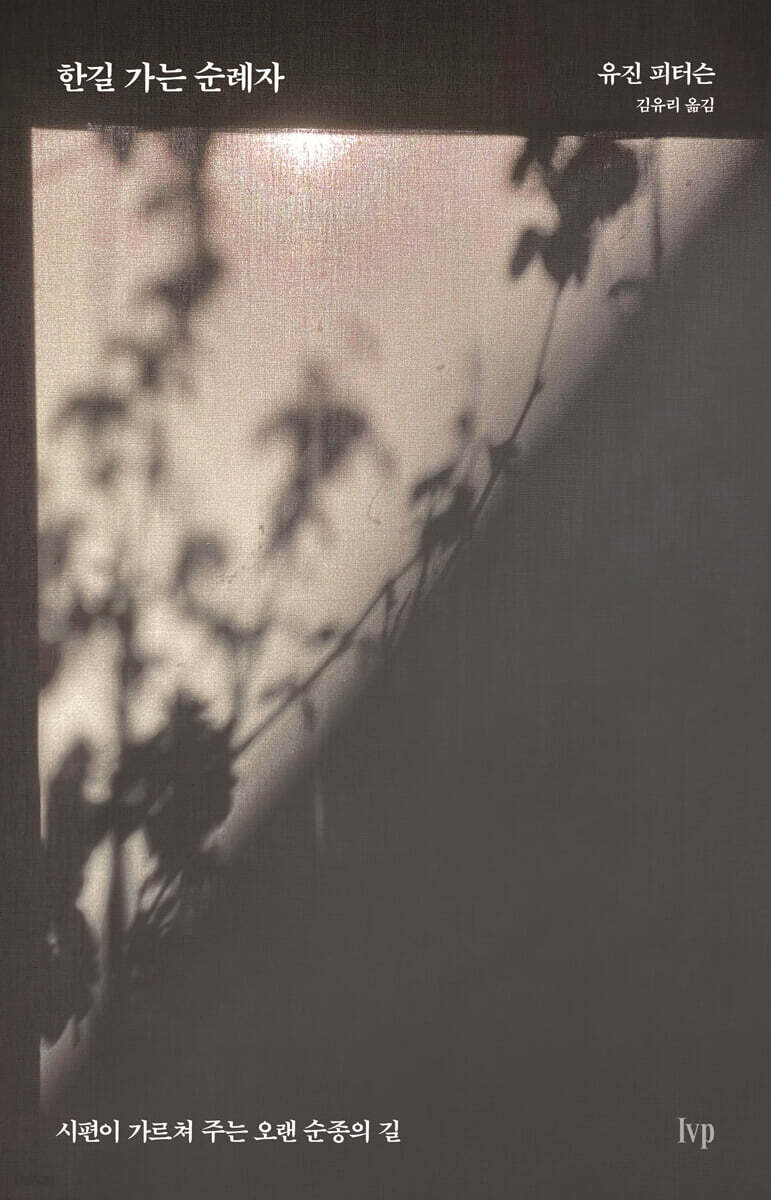
A pilgrim on a journey
 |
Description
Book Introduction
In this complex and busy world
Recover the lost rhythm of spirituality!
Eugene Peterson's Pilgrim Spirituality in the Language of the Psalms
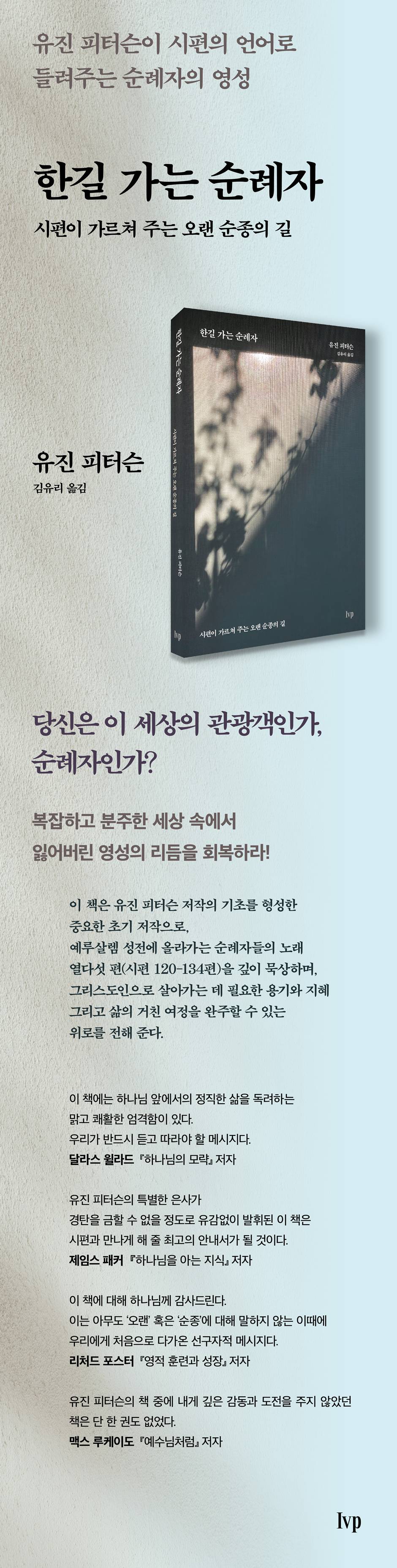
An important early work that formed the foundation of Eugene Peterson's writings, it helps to develop a pilgrim's spirituality by praying along to the Psalms.
Eugene Peterson encourages us to have the spirituality of "pilgrims," following only the path of Christ, rather than "tourists," who wander here and there in search of a spirituality that suits their needs and preferences.
Through deep meditation on the fifteen songs of pilgrims ascending to the Temple in Jerusalem (Psalms 120-134), we receive the courage and wisdom needed to live as Christians in this world, as well as the comfort needed to complete life's arduous journey.
For those of us who have entered the path of faith, there is no better song than 'The Song Sung on the Path'.
*This book is a revised edition of "A Pilgrim's Journey" with a new cover and editing, and the Bible text translated by Eugene Peterson.
Recover the lost rhythm of spirituality!
Eugene Peterson's Pilgrim Spirituality in the Language of the Psalms
An important early work that formed the foundation of Eugene Peterson's writings, it helps to develop a pilgrim's spirituality by praying along to the Psalms.
Eugene Peterson encourages us to have the spirituality of "pilgrims," following only the path of Christ, rather than "tourists," who wander here and there in search of a spirituality that suits their needs and preferences.
Through deep meditation on the fifteen songs of pilgrims ascending to the Temple in Jerusalem (Psalms 120-134), we receive the courage and wisdom needed to live as Christians in this world, as well as the comfort needed to complete life's arduous journey.
For those of us who have entered the path of faith, there is no better song than 'The Song Sung on the Path'.
*This book is a revised edition of "A Pilgrim's Journey" with a new cover and editing, and the Bible text translated by Eugene Peterson.
- You can preview some of the book's contents.
Preview
index
Preface to the 20th Anniversary Edition
Chapter 1 Disciple - “How will you race with horses in the future?”
Chapter 2: Repentance - "My Sickness, Stuck in Gedal"
Chapter 3: Providence - "God will protect you from all evil."
Chapter 4 Worship - “Let’s go to the house of God!”
Chapter 5: Serving - "We wait breathlessly, without taking our eyes off you for even a moment."
Chapter 6 Help - “Out of their snares.
“I gained freedom like a bird”
Chapter 7 Safety - “God surrounds his people.
Until now, and forever”
Chapter 8 Joy - "We burst into laughter"
Chapter 9 - "If God Had Not Built It"
Chapter 10: Happiness - "Enjoy your blessings to the fullest! Enjoy happiness to the fullest!"
Chapter 11: Patience - "They've been tormenting me since I was a child, but they've never been able to bring me down."
Chapter 12: Hope - "I pray to God and wait for His word and His work."
Chapter 13: Humility - "I didn't meddle in other people's business, nor did I dream grandiose, vain dreams."
Chapter 14: Obedience - "Remember the promise he made to God."
Chapter 15 Community - “It is like precious oil poured on the head, running down his hair and beard, and down the collar of his priestly garments.”
Chapter 16: Praise God with Lifted Hands to the Sanctuary
Epilogue
main
Chapter 1 Disciple - “How will you race with horses in the future?”
Chapter 2: Repentance - "My Sickness, Stuck in Gedal"
Chapter 3: Providence - "God will protect you from all evil."
Chapter 4 Worship - “Let’s go to the house of God!”
Chapter 5: Serving - "We wait breathlessly, without taking our eyes off you for even a moment."
Chapter 6 Help - “Out of their snares.
“I gained freedom like a bird”
Chapter 7 Safety - “God surrounds his people.
Until now, and forever”
Chapter 8 Joy - "We burst into laughter"
Chapter 9 - "If God Had Not Built It"
Chapter 10: Happiness - "Enjoy your blessings to the fullest! Enjoy happiness to the fullest!"
Chapter 11: Patience - "They've been tormenting me since I was a child, but they've never been able to bring me down."
Chapter 12: Hope - "I pray to God and wait for His word and His work."
Chapter 13: Humility - "I didn't meddle in other people's business, nor did I dream grandiose, vain dreams."
Chapter 14: Obedience - "Remember the promise he made to God."
Chapter 15 Community - “It is like precious oil poured on the head, running down his hair and beard, and down the collar of his priestly garments.”
Chapter 16: Praise God with Lifted Hands to the Sanctuary
Epilogue
main
Detailed image
Into the book
What I realized was that the beautiful, harmonious, and rhythmic language of the Psalms was so far removed from the messy, complex, and chaotic daily lives of those living in modern society.
But when our Hebrew ancestors first prayed and wrote down these psalms, they too lived in a daily life that was in every way as hectic, complex, and chaotic as what we experience today.
--- From the "Preface to the 20th Anniversary Edition"
I don't know about other cultures or the past, but the biggest obstacle for pastors in Western culture today in leading believers to the path of faith is the nature of this world, which Gore Vidal analyzed as "modern people's tendency to pursue immediacy and the one-time-only."
It's urgent without you.
Even the believers I meet while leading worship services, counseling, visiting, praying, preaching, and studying the Bible ask for tips on how to write an instant credit card (that lasts forever).
I'm not relaxed enough to wait for the results.
I want to live like a tourist but have a high credit score.
But pastors are not tour guides.
I have no interest in introducing anecdotes about unknown holy sites.
The Christian life cannot mature with the attitude of a tourist.
--- From "Chapter 1 Discipleship"
No literary genre confronts the harsh realities of life more realistically and honestly than the Bible.
There has never been even a faint hint that religious life would exempt us from adversity.
The Bible promises that God will protect us from all evil influences even in adversity.
The recognition that faith encounters adversity is pervasive throughout the Bible.
The sixth petition of the Lord's Prayer is, "And lead us not into temptation, but deliver us from evil."
This prayer is answered daily, or even several times a day, in the lives of those who walk the path of faith.
--- From "Chapter 3 Providence"
What is at stake in my life is living as a Christian.
Every day my faith is on the line.
I have never seen God.
In a world where almost everything is weighed, defined, measured, and subjected to psychological analysis and scientific control, we insist on living with a God we have never met, never heard, or even explored at the center of our lives.
It's already an adventure in itself.
--- From "Chapter 6 Help"
Patience is not a state of resignation where one unconditionally endures all the circumstances they encounter on their path, remaining in the same state as time passes, or treating oneself as a piece of dirt on people's shoes or a mat to be brushed away.
It's not about desperately holding on, it's about moving from ability to ability.
You won't find any signs of weariness or boredom in Isaiah, nor any signs of dryness in Jesus or Paul.
Patience is spirited and vibrant.
--- From "Chapter 11 Patience"
God bowed down among us, made himself like us, and gave himself to us.
He was far away and did not send us any diplomatic documents.
He came among us and bowed down.
This attitude is the characteristic of God.
By discovering and realizing this fact, we come to regard what we know about God as good news—that God has graciously and mercifully given himself.
But when our Hebrew ancestors first prayed and wrote down these psalms, they too lived in a daily life that was in every way as hectic, complex, and chaotic as what we experience today.
--- From the "Preface to the 20th Anniversary Edition"
I don't know about other cultures or the past, but the biggest obstacle for pastors in Western culture today in leading believers to the path of faith is the nature of this world, which Gore Vidal analyzed as "modern people's tendency to pursue immediacy and the one-time-only."
It's urgent without you.
Even the believers I meet while leading worship services, counseling, visiting, praying, preaching, and studying the Bible ask for tips on how to write an instant credit card (that lasts forever).
I'm not relaxed enough to wait for the results.
I want to live like a tourist but have a high credit score.
But pastors are not tour guides.
I have no interest in introducing anecdotes about unknown holy sites.
The Christian life cannot mature with the attitude of a tourist.
--- From "Chapter 1 Discipleship"
No literary genre confronts the harsh realities of life more realistically and honestly than the Bible.
There has never been even a faint hint that religious life would exempt us from adversity.
The Bible promises that God will protect us from all evil influences even in adversity.
The recognition that faith encounters adversity is pervasive throughout the Bible.
The sixth petition of the Lord's Prayer is, "And lead us not into temptation, but deliver us from evil."
This prayer is answered daily, or even several times a day, in the lives of those who walk the path of faith.
--- From "Chapter 3 Providence"
What is at stake in my life is living as a Christian.
Every day my faith is on the line.
I have never seen God.
In a world where almost everything is weighed, defined, measured, and subjected to psychological analysis and scientific control, we insist on living with a God we have never met, never heard, or even explored at the center of our lives.
It's already an adventure in itself.
--- From "Chapter 6 Help"
Patience is not a state of resignation where one unconditionally endures all the circumstances they encounter on their path, remaining in the same state as time passes, or treating oneself as a piece of dirt on people's shoes or a mat to be brushed away.
It's not about desperately holding on, it's about moving from ability to ability.
You won't find any signs of weariness or boredom in Isaiah, nor any signs of dryness in Jesus or Paul.
Patience is spirited and vibrant.
--- From "Chapter 11 Patience"
God bowed down among us, made himself like us, and gave himself to us.
He was far away and did not send us any diplomatic documents.
He came among us and bowed down.
This attitude is the characteristic of God.
By discovering and realizing this fact, we come to regard what we know about God as good news—that God has graciously and mercifully given himself.
--- From "Chapter 16 Praise"
Publisher's Review
Faith is not an event
It is a long obedience in one direction.
Today, Christians often understand faith only as a short, intense experience.
We know from long experience that while events like retreats and gatherings can provide temporary enthusiasm, that enthusiasm quickly fades and our daily faith can easily crumble.
Eugene Peterson points out this distortion of faith in his early masterpiece, A Pilgrim's Journey, which sets the direction for his later works, and helps us recover the path of discipleship that the Bible speaks of.
Peterson focuses on fifteen psalms, the "Songs of Ascents" (Psalms 120-134), to show that the Christian life is not a fleeting flame but a lifelong pilgrimage.
Hebrew pilgrims sang these fifteen songs as they ascended to Jerusalem for each festival.
Jerusalem was a place of 'ascent' geographically, as it was located on the highest point in Palestine, and at the same time, it was a place of 'ascent' in the sense that one could exalt and look up to God and approach the temple.
That is, they lived out the fundamental reality of being God's people in their daily lives, and as pilgrims they went to the temple and focused their hearts on God.
This is the embodiment of the image of Christian devotion.
The pilgrim's path that Peterson suggests is not a short-term religious training.
It refers to a life of looking to God who does not change even when the world constantly tries to shake us.
He sharply criticizes the reality that worships speed and achievement and even turns faith into an object of consumption.
But it doesn't stop at criticism.
When the Psalms become the language of prayer for Christians, they say they can find peace and joy in God without being shaken by the noise of the world.
Don't focus on the shaky world
Fix your eyes on the unchanging God
The pilgrimage path that Peterson speaks of is not unfamiliar.
It is made up of familiar and ordinary words such as repentance, worship, service, and patience.
But what's remarkable is that Peterson delves deeply into the true meaning of these familiar words, revealing the difference between a "tourist" and a "pilgrim" of faith.
Tourists consume religion, but pilgrims seek the essence of discipleship.
We come to God through repentance, saying “no” to the world’s lies and “yes” to God’s truth.
Worship with the congregation deepens our thirst for God and enables us to seek Him in our daily lives.
The Christian life is always precarious, but our safety does not depend on our feelings, but on who God is.
Therefore, we do not endure the life of faith with lethargy or self-denial, but serve, work, and obey with spirited and vibrant perseverance.
In our time, various types of 'spirituality' come and go, then fade, and new trends emerge.
However, Peterson asserts that only a union of Scripture and prayer, which requires diligent concentration, is the true Christian path that will bear fruit.
Peterson's words give hope to us who often become busy and listless in this turbulent world.
It helps us to leave the visible world and walk the invisible path of pilgrimage.
It invites us to remain rooted in the unchanging love of God, rather than being swept away by the waves of spirituality that respond to a turbulent world.
This book will serve as a solid compass for all who wish to remain faithful in this rapidly changing era.
Features of this book
-An important early work that forms the foundation of Eugene Peterson's writings.
Restoring the essence of discipleship as "long-term obedience," not short-term faith training.
-Read and meditate on Psalms 120-134 in Eugene Peterson's translation.
- A spiritual guide that reinterprets the key words of faith and connects your entire life to prayer.
Target audience
- A believer who wants to recapture 'long-standing obedience' amidst the busyness of life
-Christians who seek to connect prayer and life through the Psalms
-Christians who want to learn concrete and practical spirituality
- A pastor who teaches discipleship and spiritual training in the field
It is a long obedience in one direction.
Today, Christians often understand faith only as a short, intense experience.
We know from long experience that while events like retreats and gatherings can provide temporary enthusiasm, that enthusiasm quickly fades and our daily faith can easily crumble.
Eugene Peterson points out this distortion of faith in his early masterpiece, A Pilgrim's Journey, which sets the direction for his later works, and helps us recover the path of discipleship that the Bible speaks of.
Peterson focuses on fifteen psalms, the "Songs of Ascents" (Psalms 120-134), to show that the Christian life is not a fleeting flame but a lifelong pilgrimage.
Hebrew pilgrims sang these fifteen songs as they ascended to Jerusalem for each festival.
Jerusalem was a place of 'ascent' geographically, as it was located on the highest point in Palestine, and at the same time, it was a place of 'ascent' in the sense that one could exalt and look up to God and approach the temple.
That is, they lived out the fundamental reality of being God's people in their daily lives, and as pilgrims they went to the temple and focused their hearts on God.
This is the embodiment of the image of Christian devotion.
The pilgrim's path that Peterson suggests is not a short-term religious training.
It refers to a life of looking to God who does not change even when the world constantly tries to shake us.
He sharply criticizes the reality that worships speed and achievement and even turns faith into an object of consumption.
But it doesn't stop at criticism.
When the Psalms become the language of prayer for Christians, they say they can find peace and joy in God without being shaken by the noise of the world.
Don't focus on the shaky world
Fix your eyes on the unchanging God
The pilgrimage path that Peterson speaks of is not unfamiliar.
It is made up of familiar and ordinary words such as repentance, worship, service, and patience.
But what's remarkable is that Peterson delves deeply into the true meaning of these familiar words, revealing the difference between a "tourist" and a "pilgrim" of faith.
Tourists consume religion, but pilgrims seek the essence of discipleship.
We come to God through repentance, saying “no” to the world’s lies and “yes” to God’s truth.
Worship with the congregation deepens our thirst for God and enables us to seek Him in our daily lives.
The Christian life is always precarious, but our safety does not depend on our feelings, but on who God is.
Therefore, we do not endure the life of faith with lethargy or self-denial, but serve, work, and obey with spirited and vibrant perseverance.
In our time, various types of 'spirituality' come and go, then fade, and new trends emerge.
However, Peterson asserts that only a union of Scripture and prayer, which requires diligent concentration, is the true Christian path that will bear fruit.
Peterson's words give hope to us who often become busy and listless in this turbulent world.
It helps us to leave the visible world and walk the invisible path of pilgrimage.
It invites us to remain rooted in the unchanging love of God, rather than being swept away by the waves of spirituality that respond to a turbulent world.
This book will serve as a solid compass for all who wish to remain faithful in this rapidly changing era.
Features of this book
-An important early work that forms the foundation of Eugene Peterson's writings.
Restoring the essence of discipleship as "long-term obedience," not short-term faith training.
-Read and meditate on Psalms 120-134 in Eugene Peterson's translation.
- A spiritual guide that reinterprets the key words of faith and connects your entire life to prayer.
Target audience
- A believer who wants to recapture 'long-standing obedience' amidst the busyness of life
-Christians who seek to connect prayer and life through the Psalms
-Christians who want to learn concrete and practical spirituality
- A pastor who teaches discipleship and spiritual training in the field
GOODS SPECIFICS
- Date of issue: September 15, 2025
- Page count, weight, size: 280 pages | 354g | 135*210*19mm
- ISBN13: 9788932823621
- ISBN10: 8932823626
You may also like
카테고리
korean


korean

![GQ KOREA Mark (Monthly): December [2025]](http://librairie.coreenne.fr/cdn/shop/files/8ef265dbbfbf186523ed75ba7319009d.jpg?v=1765340328&width=3840)


