

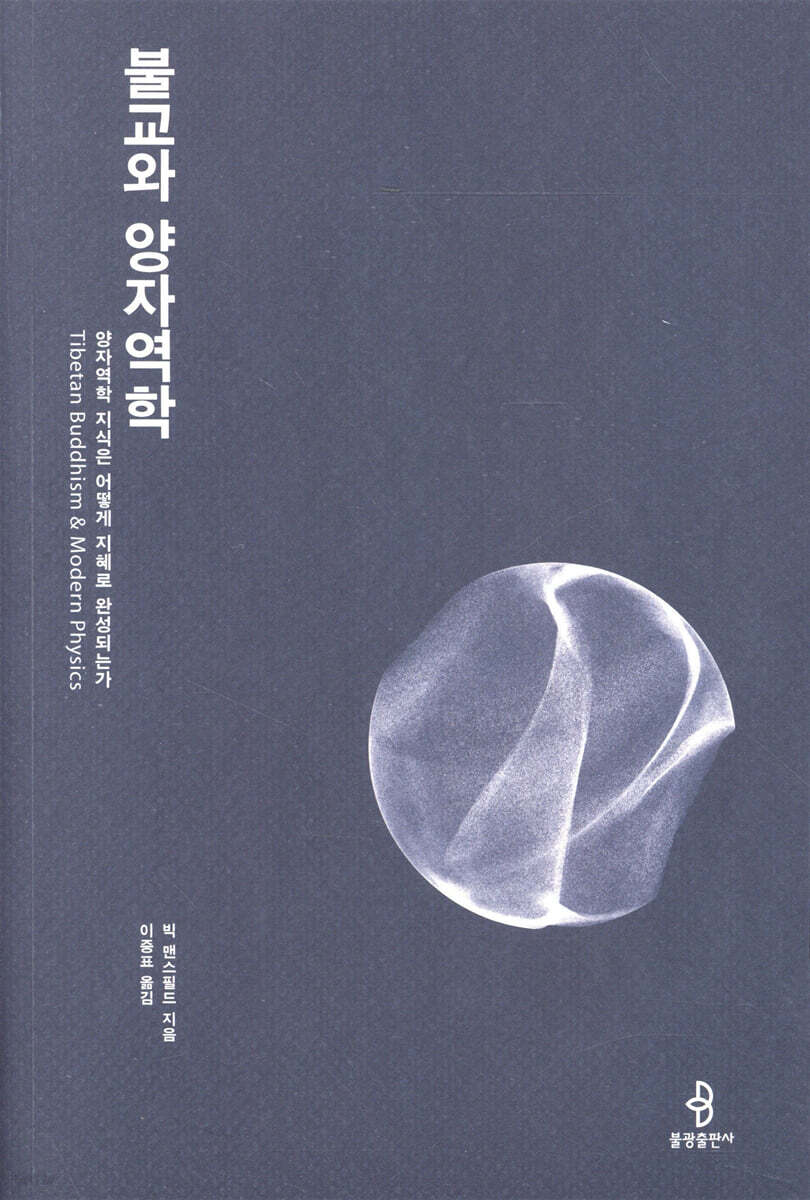
Buddhism and quantum mechanics
 |
Description
Book Introduction
Quantum mechanics, the greatest theory in the history of physics
The core idea of Buddhism, emptiness, is consistent with ‘no-self’!
Quantum mechanics meets Buddhism
How Science and Religion Should Be Transformed into Wisdom for Life
A book that is logically analyzed!
A religion that deals with the world of transcendent beliefs.
Science that proves world phenomena through repeated experiments using logical thinking.
In this way, religion and science appear to be in conflict and opposition just by looking at their underlying ways of thinking.
But the author has drawn surprising parallels between religion and science, two fields that seem utterly incompatible.
It is the point of agreement between the world view of quantum mechanics, which is called the cutting edge of modern science, and the world view of emptiness in Buddhist Madhyamaka philosophy.
These two say that nothing exists with its own independent identity or self-nature, and that since everything in the world is interconnected, nothing exists independently.
This book fuses these surprising commonalities into one, grounded in scientific evidence and detailed Buddhist doctrine.
This shows that scientific and religious knowledge can be transformed into wisdom, and that wisdom can only lead to compassion and love.
“Quantum mechanics is without a doubt the greatest theory in the history of physics in terms of precision and mathematical accuracy.
“Surprisingly, the Buddhist theory of emptiness closely resembles quantum mechanics not only in its broad outlines but also in its finer details.” (_Vic Mansfield)
The core idea of Buddhism, emptiness, is consistent with ‘no-self’!
Quantum mechanics meets Buddhism
How Science and Religion Should Be Transformed into Wisdom for Life
A book that is logically analyzed!
A religion that deals with the world of transcendent beliefs.
Science that proves world phenomena through repeated experiments using logical thinking.
In this way, religion and science appear to be in conflict and opposition just by looking at their underlying ways of thinking.
But the author has drawn surprising parallels between religion and science, two fields that seem utterly incompatible.
It is the point of agreement between the world view of quantum mechanics, which is called the cutting edge of modern science, and the world view of emptiness in Buddhist Madhyamaka philosophy.
These two say that nothing exists with its own independent identity or self-nature, and that since everything in the world is interconnected, nothing exists independently.
This book fuses these surprising commonalities into one, grounded in scientific evidence and detailed Buddhist doctrine.
This shows that scientific and religious knowledge can be transformed into wisdom, and that wisdom can only lead to compassion and love.
“Quantum mechanics is without a doubt the greatest theory in the history of physics in terms of precision and mathematical accuracy.
“Surprisingly, the Buddhist theory of emptiness closely resembles quantum mechanics not only in its broad outlines but also in its finer details.” (_Vic Mansfield)
- You can preview some of the book's contents.
Preview
index
Preface by His Holiness the Dalai Lama
Acknowledgements
Translator's Note
1 What are Buddhism and Science?
2 Quantum Mechanics and Mercy
3. Introduction to the concept of emptiness in the Middle Way
4 Physics of Peace
5 Quantum Mechanics Challenges Buddhism
6 Relativity and the Arrow of Time
7 Aiming for the unity of love and knowledge
index
Acknowledgements
Translator's Note
1 What are Buddhism and Science?
2 Quantum Mechanics and Mercy
3. Introduction to the concept of emptiness in the Middle Way
4 Physics of Peace
5 Quantum Mechanics Challenges Buddhism
6 Relativity and the Arrow of Time
7 Aiming for the unity of love and knowledge
index
Detailed image

Into the book
I want to show how the modern physics view of nature is precisely and meticulously connected to Madhyamaka philosophy, and how it leads to compassionate actions that foster a deeper concern for others and our environment.
Wisdom (knowledge) cannot but ultimately become mercy (love).
--- p.34
The belief that humans have a special relationship with the universe is almost undeniable.
Human life is merely a somewhat comical consequence of random events that occurred during the first three minutes of the Big Bang, and so humans were, in a sense, created from the beginning.
--- p.50
Many people think of science and Buddhism as complementary studies.
The complementarity we see between waves and particles in quantum mechanics, or between yin and yang in Taoism, may help us understand the relationship between science and Buddhism.
--- p.52
I am by no means convinced that quantum mechanics in any way proves the truths of Buddhism.
Rather, it examines the similarity of their respective attitudes toward indistinguishability, the proof of similarity through mutual exchange, and its consequences.
--- p.70
Continuity without independent self-identity or self-nature is a core principle of Madhyamaka and quantum mechanics.
--- p.73
I was struck by the idea that the immense diversity and difference we see all around us arise from a sea of indistinguishable particles, without any independent identity or self.
--- p.75
From the Big Bang until the end of the universe, there will never be another person exactly like you.
For this reason, each individual's path to enlightenment cannot but be unique.
This is why it becomes important to know a guru or lama who can give us unique guidance on our life's journey.
--- p.76
Yes, that's right.
You are clearly different from me in a number of important ways.
But we can never be distinguished in that we all long for happiness and freedom from suffering.
--- p.76~77
The most fundamental philosophical perspective of Tibetan Buddhism is the Madhyamaka view of emptiness.
--- p.101
Perhaps most surprising is that the non-locality and the Madhyamaka idea are deeply aligned with the nature of existence, not only in their general outlines but also in their minute details.
--- p.102
If something exists independently, it does not depend on anything outside itself.
It is important to understand precisely what it means to be independent.
Objects that exist independently, whether they are pillars, stones, or people, cannot change or develop.
Because there is nothing outside of them that can influence their nature.
So they cannot change.
--- p.109
Madhyamaka philosophy tells us that when we are most angry, we should identify the strong sense of self, the 'I' that seems to exist very vividly, something that is so angry.
--- p.112
Although the concept of construction may feel like a denial of our most precious sense of self, this absence of our original being becomes the foundation for a spiritual and psychological transformation that allows us to transition from darkness to light.
--- p.114
To understand clearly that the ball is a negation that it does not assert is to know that there is no new principle that can replace the false property of independent existence.
--- p.114~115
Dependent arising is a synonym for emptiness, emphasizing that the nature of all people and things is interdependent in a deep relationship.
The ball and the smoke are like the front and back of a hand, with impermanence spreading out from both sides.
--- p.115
Once we understand how it works within ourselves, we can see it working within others, and a strong feeling of compassion arises for all those who suffer in the process of projecting an independent existence so naturally.
In this way, our personal experience becomes universal, and emptiness gives rise to compassion.
In other words, deep knowledge of reality gives rise to universal compassion.
--- p.122~123
I'm always trying to validate my ego, to prove to myself and others how important, talented, and wonderful I am.
Of course, this isn't just me.
We all strive to be 'someone', someone with real meaning and value.
This 'someone complex' is not only a detrimental aspect of the human condition, but also a 'bar' that imprisons us in the prison of the ego.
--- p.125~126
In other words, you cannot think of quantum properties that are unaffected by experimental equipment.
--- p.146
Quantum mechanics is unprecedented in its range of applications and the precision of its predictions.
It has never failed experimental tests, and a vast variety of excellent experiments confirm its predictions with exquisite precision.
In terms of scope, precision, and mathematical accuracy (criteria important to physicists), it is without a doubt the best theory in the history of physics.
--- p.149
The principle of emptiness, whether derived from traditional Madhyamaka arguments or from an understanding of quantum mechanics, resonates deeply with the ancient South African spirit of Ubuntu: “I am because you are.”
My true existence requires your existence.
There is no such thing as an isolated or independent entity, whether a particle or a person.
We are not so much self-existing individuals as we are expressions of our interconnectedness with other people, communities, and the larger environment.
So in the end, when you are sick, I am sick, and when you are happy, I am happy.
--- p.178
I really wanted to logically derive mercy from the ball.
As a conclusion that follows from the understanding that there is no original existence in physics, I wanted to know how that could be logically derived.
I probably thought of this approach because I've been doing theoretical physics for many years.
The ball clearly suggests the need for mercy.
And as we discussed at the end of the previous chapter, understanding how people get caught up in the process of projecting their true being puts us on the path to universal compassion.
--- p.179~180
It should be remembered that standard quantum mechanics is by far the best theory in the history of physics.
Nothing can even compare.
Of course, as with all theories in physics, there is room for change and improvement.
Nevertheless, the important theory of probability amplitudes and wave functions, which have been evolving in Hilbert space since before measurement, has remained unshaken for over 80 years since quantum mechanics first obtained its current mathematical formulation.
--- p.222~223
The Dalai Lama said, “Buddhists believe in reincarnation.
But let's say that one day, through various studies, science comes to the clear conclusion that reincarnation does not exist.
If this is conclusively proven, Buddhists should gladly accept it.
He said, “This is a universal Buddhist thought.”
--- p.229
Emptiness, that is, the absence of independent existence, guarantees continuous change by its very nature.
The impermanence that directly expresses the sphere is the law of the universe.
Wisdom (knowledge) cannot but ultimately become mercy (love).
--- p.34
The belief that humans have a special relationship with the universe is almost undeniable.
Human life is merely a somewhat comical consequence of random events that occurred during the first three minutes of the Big Bang, and so humans were, in a sense, created from the beginning.
--- p.50
Many people think of science and Buddhism as complementary studies.
The complementarity we see between waves and particles in quantum mechanics, or between yin and yang in Taoism, may help us understand the relationship between science and Buddhism.
--- p.52
I am by no means convinced that quantum mechanics in any way proves the truths of Buddhism.
Rather, it examines the similarity of their respective attitudes toward indistinguishability, the proof of similarity through mutual exchange, and its consequences.
--- p.70
Continuity without independent self-identity or self-nature is a core principle of Madhyamaka and quantum mechanics.
--- p.73
I was struck by the idea that the immense diversity and difference we see all around us arise from a sea of indistinguishable particles, without any independent identity or self.
--- p.75
From the Big Bang until the end of the universe, there will never be another person exactly like you.
For this reason, each individual's path to enlightenment cannot but be unique.
This is why it becomes important to know a guru or lama who can give us unique guidance on our life's journey.
--- p.76
Yes, that's right.
You are clearly different from me in a number of important ways.
But we can never be distinguished in that we all long for happiness and freedom from suffering.
--- p.76~77
The most fundamental philosophical perspective of Tibetan Buddhism is the Madhyamaka view of emptiness.
--- p.101
Perhaps most surprising is that the non-locality and the Madhyamaka idea are deeply aligned with the nature of existence, not only in their general outlines but also in their minute details.
--- p.102
If something exists independently, it does not depend on anything outside itself.
It is important to understand precisely what it means to be independent.
Objects that exist independently, whether they are pillars, stones, or people, cannot change or develop.
Because there is nothing outside of them that can influence their nature.
So they cannot change.
--- p.109
Madhyamaka philosophy tells us that when we are most angry, we should identify the strong sense of self, the 'I' that seems to exist very vividly, something that is so angry.
--- p.112
Although the concept of construction may feel like a denial of our most precious sense of self, this absence of our original being becomes the foundation for a spiritual and psychological transformation that allows us to transition from darkness to light.
--- p.114
To understand clearly that the ball is a negation that it does not assert is to know that there is no new principle that can replace the false property of independent existence.
--- p.114~115
Dependent arising is a synonym for emptiness, emphasizing that the nature of all people and things is interdependent in a deep relationship.
The ball and the smoke are like the front and back of a hand, with impermanence spreading out from both sides.
--- p.115
Once we understand how it works within ourselves, we can see it working within others, and a strong feeling of compassion arises for all those who suffer in the process of projecting an independent existence so naturally.
In this way, our personal experience becomes universal, and emptiness gives rise to compassion.
In other words, deep knowledge of reality gives rise to universal compassion.
--- p.122~123
I'm always trying to validate my ego, to prove to myself and others how important, talented, and wonderful I am.
Of course, this isn't just me.
We all strive to be 'someone', someone with real meaning and value.
This 'someone complex' is not only a detrimental aspect of the human condition, but also a 'bar' that imprisons us in the prison of the ego.
--- p.125~126
In other words, you cannot think of quantum properties that are unaffected by experimental equipment.
--- p.146
Quantum mechanics is unprecedented in its range of applications and the precision of its predictions.
It has never failed experimental tests, and a vast variety of excellent experiments confirm its predictions with exquisite precision.
In terms of scope, precision, and mathematical accuracy (criteria important to physicists), it is without a doubt the best theory in the history of physics.
--- p.149
The principle of emptiness, whether derived from traditional Madhyamaka arguments or from an understanding of quantum mechanics, resonates deeply with the ancient South African spirit of Ubuntu: “I am because you are.”
My true existence requires your existence.
There is no such thing as an isolated or independent entity, whether a particle or a person.
We are not so much self-existing individuals as we are expressions of our interconnectedness with other people, communities, and the larger environment.
So in the end, when you are sick, I am sick, and when you are happy, I am happy.
--- p.178
I really wanted to logically derive mercy from the ball.
As a conclusion that follows from the understanding that there is no original existence in physics, I wanted to know how that could be logically derived.
I probably thought of this approach because I've been doing theoretical physics for many years.
The ball clearly suggests the need for mercy.
And as we discussed at the end of the previous chapter, understanding how people get caught up in the process of projecting their true being puts us on the path to universal compassion.
--- p.179~180
It should be remembered that standard quantum mechanics is by far the best theory in the history of physics.
Nothing can even compare.
Of course, as with all theories in physics, there is room for change and improvement.
Nevertheless, the important theory of probability amplitudes and wave functions, which have been evolving in Hilbert space since before measurement, has remained unshaken for over 80 years since quantum mechanics first obtained its current mathematical formulation.
--- p.222~223
The Dalai Lama said, “Buddhists believe in reincarnation.
But let's say that one day, through various studies, science comes to the clear conclusion that reincarnation does not exist.
If this is conclusively proven, Buddhists should gladly accept it.
He said, “This is a universal Buddhist thought.”
--- p.229
Emptiness, that is, the absence of independent existence, guarantees continuous change by its very nature.
The impermanence that directly expresses the sphere is the law of the universe.
--- p.272
Publisher's Review
The meeting of quantum mechanics, the pinnacle of modern physics, and Buddhism.
A corresponding but entirely different approach to truth
Quantum mechanics has had a tremendous impact on our daily lives.
This is because various cutting-edge devices such as semiconductors, computers, and smartphones have been developed or advanced based on the research results of quantum mechanics.
Although it is a highly specialized field and difficult, and the general public is not even aware of it, it is no exaggeration to say that we already live in the world of quantum mechanics.
Quantum mechanics is a scientific field that studies the invisible microscopic world of molecules, atoms, electrons, and other elementary particles.
We try to break matter down into pieces until we reach a point where it cannot be broken down any further.
And we put effort into predicting and controlling the movement of those tiny particles.
However, no matter how much we observe and experiment with matter using the most advanced equipment, we have not yet discovered an ultimate entity that cannot be broken down any further.
Scientists have been greatly shocked by the fact that, through the study of quantum mechanics up to now, in the world of atoms that make up matter, particles persist without their own nature, and that within that persistence, they cannot find any independently existing essence.
Moreover, it turns out that these tiny microscopic worlds are interdependent, and in this sense, all matter is connected like a dense net.
This fact tells us that the countless things that can be touched and seen, as well as the physical body that constitutes 'me', have no self-nature, are merely continual, and are formed of insubstantial atoms that are interdependent.
To put it in extreme terms, we can conclude that nothing has substance.
Until further research proves new facts, this worldview of quantum mechanics remains solid.
From its inception some 2,600 years ago, Buddhism considered all objective and subjective phenomena to have no independent or original existence.
This is expressed as “no self-nature” and is called ‘emptiness’ for short.
Even the word 'emptiness' is an illusion, but Buddhism has denied things like nature and ultimate reality to the extent that it has to use 'emptiness' as a means to express the absence of self-nature.
Since ‘I’ am not a real entity, there can be no ‘thing that is mine’.
When I, who am not real, become attached to something, I experience suffering, and suffering causes me constant pain.
Buddhism is a religion that breaks this cycle of suffering.
Therefore, when studying Buddhist doctrine and practicing it, we must first accept this process of 'emptiness'.
There is no way Buddha was a scientist, nor was there any advanced experimental equipment at the time.
The Buddha saw through the non-existence of this world through only advanced mental practice.
And this is very much in line with the worldview of quantum mechanics, a cutting-edge scientific field of the 21st century.
Conclusions of quantum mechanics and Buddhism,
There is no such thing as an independent being.
It is important to understand precisely what it means to be independent.
Let's think about it.
Anything that exists independently cannot change.
Because it is independent in itself, it does not depend on anything external, and nothing else can affect it.
The idea of an independent being, which we habitually believe to be the 'foundation of reality', is a contradiction.
There is no such thing as an independent entity, and there never will be.
What emptiness denies is also this ‘foundation of reality.’
Only by clearly identifying the independent entity that is mistakenly considered the foundation of reality can we properly understand emptiness.
Otherwise, the ball could easily be misunderstood as claiming that nothing exists.
Buddhism does not deny things and people as unconditionally intangible beings.
In Buddhism, the term 'emptiness' serves as a standard for our perception of the outside world.
If you have seen through the external world that it is made up of insubstantial things, now observe the insubstantiality of the thoughts within your mind.
If you gradually understand and accept the ball in this way, you will also be able to easily accept the worldview of quantum mechanics.
Once we understand that entities are not independent and cannot be independent, it becomes easier to understand interdependence.
The answer to the question of how intangible things can maintain their form is interdependence.
In Buddhism, this is called dependent origination.
All things are connected and dependent on each other.
Because we depend on it, we can continue.
So, what exists is impermanent and empty.
How scientific knowledge becomes wisdom
Does wisdom transform into compassion?
As science and technology advance, humanity's problems grow proportionally.
However, the solution to that problem can only be found in science and technology.
Scientific knowledge has the power to solve problems.
Unfortunately, however, due to the logic of capitalism, there is little interest in the application of humanitarian science.
We allow massive inequalities to exist and tolerate the constant discharge of pollutants.
This is unfortunate not only for humans but also for the entire planet.
What on earth is knowledge?
Despite having created such a precise scientific world, humanity only intends to use that science to satisfy its greed.
Even now, we must awaken to the interconnectedness of this world and have compassion for all life.
We must use scientific knowledge to benefit all living things and the environment.
Otherwise, the future that awaits us is bleak.
The desires, greed, and all the negative emotions that lurk within us have no substance.
We must recognize that such a dark mind is empty.
We must realize that nothing can satisfy our insubstantial greed.
Only when we accept that fact can we see that the whole world is connected and interdependent.
Let's look at ourselves, who depend on so many things to maintain our current form.
If one of them disappears, we will disappear in succession.
When this shift in perception takes place, compassion will naturally arise in your heart.
This mindset guides science to be used in the right direction.
In this way, the worldview of quantum mechanics and the understanding of 'non-self' as spoken of by Buddhism become the foundation for the mental and psychological change that can transform from darkness to light.
Therefore, scientific knowledge can soon become mercy.
A corresponding but entirely different approach to truth
Quantum mechanics has had a tremendous impact on our daily lives.
This is because various cutting-edge devices such as semiconductors, computers, and smartphones have been developed or advanced based on the research results of quantum mechanics.
Although it is a highly specialized field and difficult, and the general public is not even aware of it, it is no exaggeration to say that we already live in the world of quantum mechanics.
Quantum mechanics is a scientific field that studies the invisible microscopic world of molecules, atoms, electrons, and other elementary particles.
We try to break matter down into pieces until we reach a point where it cannot be broken down any further.
And we put effort into predicting and controlling the movement of those tiny particles.
However, no matter how much we observe and experiment with matter using the most advanced equipment, we have not yet discovered an ultimate entity that cannot be broken down any further.
Scientists have been greatly shocked by the fact that, through the study of quantum mechanics up to now, in the world of atoms that make up matter, particles persist without their own nature, and that within that persistence, they cannot find any independently existing essence.
Moreover, it turns out that these tiny microscopic worlds are interdependent, and in this sense, all matter is connected like a dense net.
This fact tells us that the countless things that can be touched and seen, as well as the physical body that constitutes 'me', have no self-nature, are merely continual, and are formed of insubstantial atoms that are interdependent.
To put it in extreme terms, we can conclude that nothing has substance.
Until further research proves new facts, this worldview of quantum mechanics remains solid.
From its inception some 2,600 years ago, Buddhism considered all objective and subjective phenomena to have no independent or original existence.
This is expressed as “no self-nature” and is called ‘emptiness’ for short.
Even the word 'emptiness' is an illusion, but Buddhism has denied things like nature and ultimate reality to the extent that it has to use 'emptiness' as a means to express the absence of self-nature.
Since ‘I’ am not a real entity, there can be no ‘thing that is mine’.
When I, who am not real, become attached to something, I experience suffering, and suffering causes me constant pain.
Buddhism is a religion that breaks this cycle of suffering.
Therefore, when studying Buddhist doctrine and practicing it, we must first accept this process of 'emptiness'.
There is no way Buddha was a scientist, nor was there any advanced experimental equipment at the time.
The Buddha saw through the non-existence of this world through only advanced mental practice.
And this is very much in line with the worldview of quantum mechanics, a cutting-edge scientific field of the 21st century.
Conclusions of quantum mechanics and Buddhism,
There is no such thing as an independent being.
It is important to understand precisely what it means to be independent.
Let's think about it.
Anything that exists independently cannot change.
Because it is independent in itself, it does not depend on anything external, and nothing else can affect it.
The idea of an independent being, which we habitually believe to be the 'foundation of reality', is a contradiction.
There is no such thing as an independent entity, and there never will be.
What emptiness denies is also this ‘foundation of reality.’
Only by clearly identifying the independent entity that is mistakenly considered the foundation of reality can we properly understand emptiness.
Otherwise, the ball could easily be misunderstood as claiming that nothing exists.
Buddhism does not deny things and people as unconditionally intangible beings.
In Buddhism, the term 'emptiness' serves as a standard for our perception of the outside world.
If you have seen through the external world that it is made up of insubstantial things, now observe the insubstantiality of the thoughts within your mind.
If you gradually understand and accept the ball in this way, you will also be able to easily accept the worldview of quantum mechanics.
Once we understand that entities are not independent and cannot be independent, it becomes easier to understand interdependence.
The answer to the question of how intangible things can maintain their form is interdependence.
In Buddhism, this is called dependent origination.
All things are connected and dependent on each other.
Because we depend on it, we can continue.
So, what exists is impermanent and empty.
How scientific knowledge becomes wisdom
Does wisdom transform into compassion?
As science and technology advance, humanity's problems grow proportionally.
However, the solution to that problem can only be found in science and technology.
Scientific knowledge has the power to solve problems.
Unfortunately, however, due to the logic of capitalism, there is little interest in the application of humanitarian science.
We allow massive inequalities to exist and tolerate the constant discharge of pollutants.
This is unfortunate not only for humans but also for the entire planet.
What on earth is knowledge?
Despite having created such a precise scientific world, humanity only intends to use that science to satisfy its greed.
Even now, we must awaken to the interconnectedness of this world and have compassion for all life.
We must use scientific knowledge to benefit all living things and the environment.
Otherwise, the future that awaits us is bleak.
The desires, greed, and all the negative emotions that lurk within us have no substance.
We must recognize that such a dark mind is empty.
We must realize that nothing can satisfy our insubstantial greed.
Only when we accept that fact can we see that the whole world is connected and interdependent.
Let's look at ourselves, who depend on so many things to maintain our current form.
If one of them disappears, we will disappear in succession.
When this shift in perception takes place, compassion will naturally arise in your heart.
This mindset guides science to be used in the right direction.
In this way, the worldview of quantum mechanics and the understanding of 'non-self' as spoken of by Buddhism become the foundation for the mental and psychological change that can transform from darkness to light.
Therefore, scientific knowledge can soon become mercy.
Translator's Note
In today's world, where science dominates humanity, this book contains the earnest desire of a physicist who believes that humanity can only find happiness by finding the right path within science, and who found that path in Buddhism, which shares the same philosophy as science.
- Translator's Note: Lee Jung-pyo (Professor Emeritus of Philosophy, Chonnam National University)
In today's world, where science dominates humanity, this book contains the earnest desire of a physicist who believes that humanity can only find happiness by finding the right path within science, and who found that path in Buddhism, which shares the same philosophy as science.
- Lee Jung-pyo (Professor Emeritus of Philosophy, Chonnam National University)
In today's world, where science dominates humanity, this book contains the earnest desire of a physicist who believes that humanity can only find happiness by finding the right path within science, and who found that path in Buddhism, which shares the same philosophy as science.
- Translator's Note: Lee Jung-pyo (Professor Emeritus of Philosophy, Chonnam National University)
In today's world, where science dominates humanity, this book contains the earnest desire of a physicist who believes that humanity can only find happiness by finding the right path within science, and who found that path in Buddhism, which shares the same philosophy as science.
- Lee Jung-pyo (Professor Emeritus of Philosophy, Chonnam National University)
GOODS SPECIFICS
- Date of issue: January 22, 2021
- Page count, weight, size: 312 pages | 486g | 152*225*30mm
- ISBN13: 9788974798857
- ISBN10: 8974798859
You may also like
카테고리
korean


korean

![GQ KOREA Mark (Monthly): December [2025]](http://librairie.coreenne.fr/cdn/shop/files/8ef265dbbfbf186523ed75ba7319009d.jpg?v=1765340328&width=3840)


