

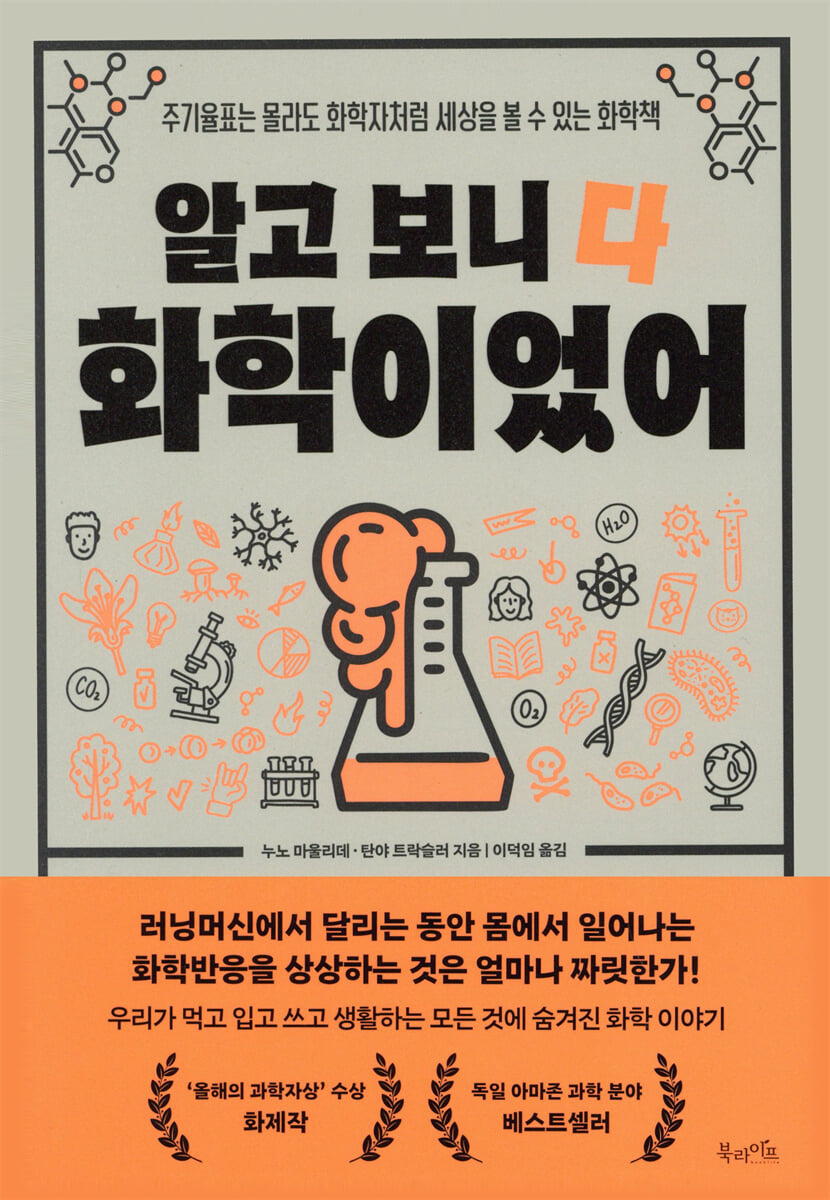
Turns out it was all chemistry
 |
Description
Book Introduction
German Amazon Science Bestseller This year's Scientist of the Year Award winner Have you ever imagined a world without chemistry? A fascinating story of chemistry that moved our daily lives and changed the world. “There are beginners who get nervous just hearing the word ‘chemistry’ “This is a book for anyone who wants to be infected by the passion of a scientist.” -APA News What do you eat for breakfast? You probably start your day with a simple meal. Water and sugar, protein and fat, ester and aldehyde, and alcohol. A little riboflavin, calcium, magnesium... in other words, eating an apple. Apples are made up of chemicals, from the skin to the seeds. If you eat the same amount of any chemical in the lab, it will have the same effect on your body as if you were eating an apple. In other words, food contains nothing but chemicals! From the food that satisfies the simplest individual needs to the global climate and environmental issues, nothing is free from chemicals. This book was co-written by two authors who received the Austrian Scientist of the Year Award and the Science Journalism of the Year Award. The two authors offer a fascinating look at how chemistry drives our daily lives and how the world is influenced by chemistry. From everyday chemistry like how to avoid crying while chopping onions to the great chemistry that changed human history, the world of chemistry is introduced through seven keywords: food, human body, medicine, fertilizer, plastic, gas, and climate. Historically, chemistry has transformed our lives to such an extent that it is impossible to imagine a world without it. Artificial fertilizers solved the food shortage, the development of medicines extended life expectancy, and the discovery of plastics made life easier and more affluent. Solutions to the climate change and waste problems that humanity will face in the future can also be found in chemistry. When we look at the world through a chemical lens, we see that everything around us is made of and sustained by chemistry. |
- You can preview some of the book's contents.
Preview
index
prolog
Chapter 1: Food and Chemistry: A Feast of Chemicals on the Table
People who fear spices more than alcohol
Earth, water, air, fire, and atoms that make up matter
Raw materials for the human body obtained from food: carbohydrates, proteins, and fats
Top 3 Crispy and Mouthwatering Harmful Substances
Whiskey is needed to create banana flavor.
Chapter 2: The Human Body and Chemistry: Chemistry That Saves Me, Chemistry That Kills Me
A human made of less material than a smartphone
Save your life by washing your hands
The culprit in the death case was artificial nails
Chapter 3: Medicine and Chemistry: A Journey to Alleviate Human Suffering
The birth of penicillin, the mold that saved countless lives
Preventive cocktail instead of vaccination
The superstar of drug developers, tree bark
Nature's Mystery of Creating the Best Medicine
Emergence of powerful antibiotic-resistant bacteria
The work of a chemist: creating order in chaos
Chapter 4: Fertilizers and Chemistry: The Heroes Who Feed the World
Nitrogen, which is responsible for the life and death of living things
Deadly side effects of excess nitrogen
Factors driving the explosive growth of forests
Chapter 5: Plastics and Chemistry: A Sudden Appearance of Our Daily Companions
Accidental discovery of the solid white substance polyethylene
Patent disputes surrounding plastics
A disaster caused by an immortal being
Chapter 6: Gas and Chemistry: From Ice Planets to Fire Planets
Earth fluctuates between cold and hot water
Carbon dioxide's hot counterattack
The terrifying power of 2 degrees Celsius
Chapter 7: Climate and Chemistry: Nature's Hidden Key to Environmental Salvation
Artificial leaves: the energy resource that will lead future industries
solar-powered cars
chemical recycling of plastics
Ammonia synthesis and root nodule bacteria
In search of a game changer
Chapter 8: The Beauty of Chemistry: A Melody That Clearly Sums Up the World
In search of economical and elegant chemical reactions
Cool reactions and uncool reactions
Uncertainty and conspiracy theories surrounding chemistry
Acknowledgements
References
annotation
Chapter 1: Food and Chemistry: A Feast of Chemicals on the Table
People who fear spices more than alcohol
Earth, water, air, fire, and atoms that make up matter
Raw materials for the human body obtained from food: carbohydrates, proteins, and fats
Top 3 Crispy and Mouthwatering Harmful Substances
Whiskey is needed to create banana flavor.
Chapter 2: The Human Body and Chemistry: Chemistry That Saves Me, Chemistry That Kills Me
A human made of less material than a smartphone
Save your life by washing your hands
The culprit in the death case was artificial nails
Chapter 3: Medicine and Chemistry: A Journey to Alleviate Human Suffering
The birth of penicillin, the mold that saved countless lives
Preventive cocktail instead of vaccination
The superstar of drug developers, tree bark
Nature's Mystery of Creating the Best Medicine
Emergence of powerful antibiotic-resistant bacteria
The work of a chemist: creating order in chaos
Chapter 4: Fertilizers and Chemistry: The Heroes Who Feed the World
Nitrogen, which is responsible for the life and death of living things
Deadly side effects of excess nitrogen
Factors driving the explosive growth of forests
Chapter 5: Plastics and Chemistry: A Sudden Appearance of Our Daily Companions
Accidental discovery of the solid white substance polyethylene
Patent disputes surrounding plastics
A disaster caused by an immortal being
Chapter 6: Gas and Chemistry: From Ice Planets to Fire Planets
Earth fluctuates between cold and hot water
Carbon dioxide's hot counterattack
The terrifying power of 2 degrees Celsius
Chapter 7: Climate and Chemistry: Nature's Hidden Key to Environmental Salvation
Artificial leaves: the energy resource that will lead future industries
solar-powered cars
chemical recycling of plastics
Ammonia synthesis and root nodule bacteria
In search of a game changer
Chapter 8: The Beauty of Chemistry: A Melody That Clearly Sums Up the World
In search of economical and elegant chemical reactions
Cool reactions and uncool reactions
Uncertainty and conspiracy theories surrounding chemistry
Acknowledgements
References
annotation
Detailed image

Into the book
On my way to college during rush hour, I meet many people rushing to work.
Before starting their day, people drink hot liquids made of thousands of different ingredients.
The most important ingredient in this chemical cocktail is an alkaloid from the xanthine family, namely caffeine.
As the passenger sitting across from me on the subway sips his coffee, I think about how fundamentally chemistry influences the simplest desires and habits we experience in life, the actions we repeat.
--- From “Chapter 1 Food and Chemistry”
Banana scent is a combination of more than 30 elements.
The most prominent of these is isoamyl acetate.
This compound, made up of carbon, hydrogen, and oxygen, is a natural substance found in bananas, but can also be easily made in a laboratory.
All you need is isoamyl alcohol and concentrated acetic acid, which are found in whiskey or brandy.
However, this is not an appropriate experiment to do at home.
What a waste of whiskey! It's much easier to make isoamyl acetate in the lab than to extract the molecule from a banana, and the two substances are exactly the same.
--- From "You need whiskey to make banana flavor"
It's surprisingly easy to trick your brain with smell.
If a bathroom smells good, people will use it even if it is very dirty.
Of course, there are risk factors.
This is because our sense of smell detects bad odors and sends us a warning to avoid dangerous bacteria.
But I think this project is a good example of the power of chemistry.
If we use chemistry to analyze the components that create the foul odor in excrement and then use chemistry to find countermeasures, the brain will eventually be fooled.
--- From "Saving Lives by Washing Hands"
In the early 19th century, malaria posed a challenge to British troops stationed in India.
As a preventative measure against malaria, soldiers were given a drink containing quinine, called "tonic water."
Despite its high sugar content, it was bitter, so the British had a hard time convincing their soldiers to drink it.
Then a solution was discovered.
Soldiers started mixing gin with tonic water.
It was the birth of gin and tonic.
--- From "Preventive Cocktails Instead of Vaccines"
Batrachotoxin is one of the substances known to be highly toxic and is found only in the skin of frogs.
Just one microgram is enough to kill an adult.
The molecular structures of natural substances have evolved over millions of years.
However, the reason why such a structure was created has not been clearly identified.
Why do deep-sea sponges produce chemicals that can be used as anticancer agents? Why do poppy seeds produce juice that alleviates human suffering? It's all a coincidence, you might say.
And coincidences happen all the time.
--- From "Nature's Mystery of Creating the Best Medicine"
Ammonia synthesis is used for two extremely different purposes.
The Haber-Bosch process continues to play a significant role in ensuring food for the world's growing population.
Meanwhile, this method was also used to make explosives used in World War I.
If ammonia synthesis had not been possible, the German army would have run out of ammunition by mid-1915.
Before starting their day, people drink hot liquids made of thousands of different ingredients.
The most important ingredient in this chemical cocktail is an alkaloid from the xanthine family, namely caffeine.
As the passenger sitting across from me on the subway sips his coffee, I think about how fundamentally chemistry influences the simplest desires and habits we experience in life, the actions we repeat.
--- From “Chapter 1 Food and Chemistry”
Banana scent is a combination of more than 30 elements.
The most prominent of these is isoamyl acetate.
This compound, made up of carbon, hydrogen, and oxygen, is a natural substance found in bananas, but can also be easily made in a laboratory.
All you need is isoamyl alcohol and concentrated acetic acid, which are found in whiskey or brandy.
However, this is not an appropriate experiment to do at home.
What a waste of whiskey! It's much easier to make isoamyl acetate in the lab than to extract the molecule from a banana, and the two substances are exactly the same.
--- From "You need whiskey to make banana flavor"
It's surprisingly easy to trick your brain with smell.
If a bathroom smells good, people will use it even if it is very dirty.
Of course, there are risk factors.
This is because our sense of smell detects bad odors and sends us a warning to avoid dangerous bacteria.
But I think this project is a good example of the power of chemistry.
If we use chemistry to analyze the components that create the foul odor in excrement and then use chemistry to find countermeasures, the brain will eventually be fooled.
--- From "Saving Lives by Washing Hands"
In the early 19th century, malaria posed a challenge to British troops stationed in India.
As a preventative measure against malaria, soldiers were given a drink containing quinine, called "tonic water."
Despite its high sugar content, it was bitter, so the British had a hard time convincing their soldiers to drink it.
Then a solution was discovered.
Soldiers started mixing gin with tonic water.
It was the birth of gin and tonic.
--- From "Preventive Cocktails Instead of Vaccines"
Batrachotoxin is one of the substances known to be highly toxic and is found only in the skin of frogs.
Just one microgram is enough to kill an adult.
The molecular structures of natural substances have evolved over millions of years.
However, the reason why such a structure was created has not been clearly identified.
Why do deep-sea sponges produce chemicals that can be used as anticancer agents? Why do poppy seeds produce juice that alleviates human suffering? It's all a coincidence, you might say.
And coincidences happen all the time.
--- From "Nature's Mystery of Creating the Best Medicine"
Ammonia synthesis is used for two extremely different purposes.
The Haber-Bosch process continues to play a significant role in ensuring food for the world's growing population.
Meanwhile, this method was also used to make explosives used in World War I.
If ammonia synthesis had not been possible, the German army would have run out of ammunition by mid-1915.
--- From Chapter 4 Fertilizers and Chemistry
Publisher's Review
Can smells trick the brain?
Everyday chemistry occurring in our bodies and around us
“It’s a whole bunch of chemicals!” You might be shocked to see the list of chemicals on a food ingredient list, but it’s true.
All living things in the world, including food and humans, are lumps of chemicals.
Chemical substances secretly cause chemical reactions in our bodies and surroundings at every moment.
The reason why tears flow when you cut an onion, why your hair becomes frizzy, and why you use a dirty bathroom when it smells good are all due to chemical reactions.
The fun of reading this book lies in discovering the chemical events that occur unseen around us.
As you read the book, even those who wrinkled their noses at the mention of the word chemistry will find themselves looking at the world with the same interest as a chemist.
What is the identity of the hero who fed the world?
Chemistry that has enabled human survival and the development of civilization
Without advances in chemical research, most of the 8.1 billion people would have died long ago.
Chemistry's greatest contribution to humanity is undoubtedly the development of medicines and artificial fertilizers.
Penicillin, discovered accidentally from mold growing on a plate, was developed into an antibiotic that saved countless lives from bacterial infections.
Salicylic acid, produced from willow bark, was developed into aspirin and has been relieving people's pain for centuries.
The development of ammonia synthesis made mass production of artificial fertilizer possible and saved the world's population from food shortages.
In this way, chemistry has always been at the center of human survival and the development of civilization, past and present.
On the other hand, chemistry is also at the center of the crisis that is pushing humanity into.
The book explores how chemistry can be used to address the environmental pollution and climate crises humanity will face in the future.
The most serious problem is global warming.
Carbon dioxide produced when burning coal, oil, and natural gas, the main energy sources, is continuously raising the Earth's temperature.
How can we avoid living on a boiling Earth in the coming future? The book presents forward-looking approaches, from eco-friendly methods like burning car fuel to producing water instead of carbon dioxide, to the possibility of chemically recycling plastics.
From serendipitous and dramatic discoveries to absurd incidents
The real fun of chemistry, told by a chemistry storyteller!
This book vividly and humorously explains the unique properties of chemicals, focusing on situations in which chemical reactions occur.
It covers molecules and the periodic table in just the bare minimum necessary to establish basic concepts, and then reveals the colorful fun hidden in chemistry through anecdotes about chemical research and inventions.
Polyethylene, a plastic that is always mentioned when talking about chemistry, was like a revolution in chemical research.
The story of the accidental and dramatic discovery of polyethylene, the patent dispute surrounding it, and the wealth and fame enjoyed by the ultimate winner is far more interesting and entertaining than the molecular structure of polyethylene.
The episode about soap, a wondrous invention of chemistry, is absurd in itself.
It's hard to believe that the invention of soap involved medical professionals who considered handwashing a waste of time.
As you read these endless stories about chemistry, you realize that what you know so far is only a very small part of chemistry.
Let's break free from the periodic table of chemistry and discover the true fun of chemistry.
Everyday chemistry occurring in our bodies and around us
“It’s a whole bunch of chemicals!” You might be shocked to see the list of chemicals on a food ingredient list, but it’s true.
All living things in the world, including food and humans, are lumps of chemicals.
Chemical substances secretly cause chemical reactions in our bodies and surroundings at every moment.
The reason why tears flow when you cut an onion, why your hair becomes frizzy, and why you use a dirty bathroom when it smells good are all due to chemical reactions.
The fun of reading this book lies in discovering the chemical events that occur unseen around us.
As you read the book, even those who wrinkled their noses at the mention of the word chemistry will find themselves looking at the world with the same interest as a chemist.
What is the identity of the hero who fed the world?
Chemistry that has enabled human survival and the development of civilization
Without advances in chemical research, most of the 8.1 billion people would have died long ago.
Chemistry's greatest contribution to humanity is undoubtedly the development of medicines and artificial fertilizers.
Penicillin, discovered accidentally from mold growing on a plate, was developed into an antibiotic that saved countless lives from bacterial infections.
Salicylic acid, produced from willow bark, was developed into aspirin and has been relieving people's pain for centuries.
The development of ammonia synthesis made mass production of artificial fertilizer possible and saved the world's population from food shortages.
In this way, chemistry has always been at the center of human survival and the development of civilization, past and present.
On the other hand, chemistry is also at the center of the crisis that is pushing humanity into.
The book explores how chemistry can be used to address the environmental pollution and climate crises humanity will face in the future.
The most serious problem is global warming.
Carbon dioxide produced when burning coal, oil, and natural gas, the main energy sources, is continuously raising the Earth's temperature.
How can we avoid living on a boiling Earth in the coming future? The book presents forward-looking approaches, from eco-friendly methods like burning car fuel to producing water instead of carbon dioxide, to the possibility of chemically recycling plastics.
From serendipitous and dramatic discoveries to absurd incidents
The real fun of chemistry, told by a chemistry storyteller!
This book vividly and humorously explains the unique properties of chemicals, focusing on situations in which chemical reactions occur.
It covers molecules and the periodic table in just the bare minimum necessary to establish basic concepts, and then reveals the colorful fun hidden in chemistry through anecdotes about chemical research and inventions.
Polyethylene, a plastic that is always mentioned when talking about chemistry, was like a revolution in chemical research.
The story of the accidental and dramatic discovery of polyethylene, the patent dispute surrounding it, and the wealth and fame enjoyed by the ultimate winner is far more interesting and entertaining than the molecular structure of polyethylene.
The episode about soap, a wondrous invention of chemistry, is absurd in itself.
It's hard to believe that the invention of soap involved medical professionals who considered handwashing a waste of time.
As you read these endless stories about chemistry, you realize that what you know so far is only a very small part of chemistry.
Let's break free from the periodic table of chemistry and discover the true fun of chemistry.
GOODS SPECIFICS
- Date of issue: June 25, 2024
- Page count, weight, size: 216 pages | 145*210*20mm
- ISBN13: 9791191013658
- ISBN10: 1191013650
You may also like
카테고리
korean


korean

![ELLE 엘르 스페셜 에디션 A형 : 12월 [2025]](http://librairie.coreenne.fr/cdn/shop/files/b8e27a3de6c9538896439686c6b0e8fb.jpg?v=1766436872&width=3840)


