

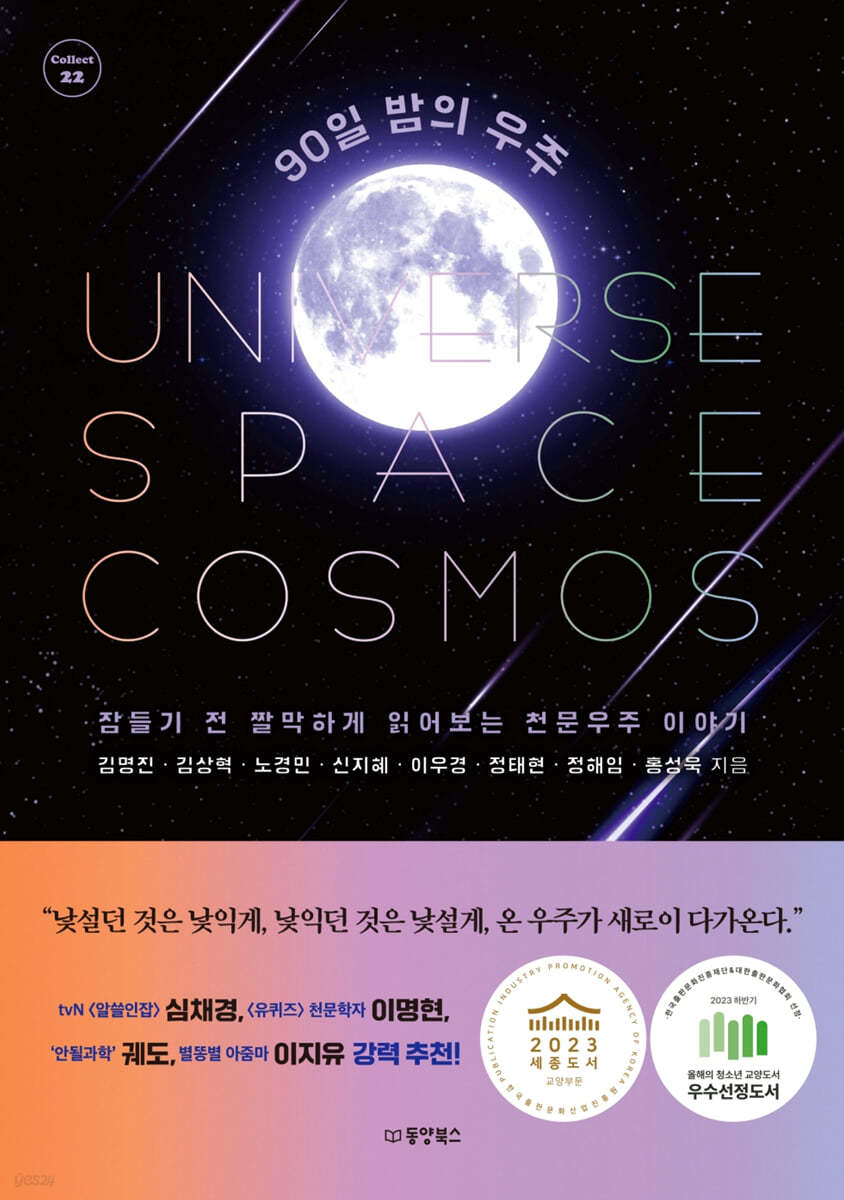
90 Nights of the Universe
 |
Description
Book Introduction
- A word from MD
- [A Night Sky Space Journey with an Astronomer] Eight astronomers from Korea Astronomy and Space Science Institute, Korea's leading astronomical and space research institute, have joined forces.
Stars, galaxies, solar systems, space exploration, exoplanets, and even time travel! Realistic yet scientifically-inspired space stories and vivid photographs invite readers on a journey through the night sky.
- Hyunjae Ahn, PD of Natural Sciences
A space trip to the night sky at the end of the day
Amazing and realistic stories from eight astronomers
The Story of Universe -Universe, Space, Cosmos-
“The unfamiliar becomes familiar, the familiar becomes unfamiliar, and the whole universe approaches us in a new way.”
Astronomers Sim Chae-kyung and Lee Myeong-hyeon, from YouTube's "Unsuccessful Science," strongly recommend science writer Lee Ji-yu!
The '90 Nights' series that will enrich your nights.
This time, I captured the 'universe' of the night sky.
Let's embark on a 90-night space journey, following the stories of space told by eight astronomers from Korea Astronomy and Space Science Institute, Korea's leading astronomical and space research institute.
The vivid color photographs printed on high-quality art paper are enough to feel the wonders of the mysterious universe in themselves, and the realistic and scientific history introduced by astronomers on stars, galaxies, solar systems, space exploration, exoplanets, time travel, and paleoastronomy delivers a new message to us who live for a moment on 'Earth', a small dot in the vast universe.
Books viewed through card news can be found at Uju Toon (@uju_toon).
Amazing and realistic stories from eight astronomers
The Story of Universe -Universe, Space, Cosmos-
“The unfamiliar becomes familiar, the familiar becomes unfamiliar, and the whole universe approaches us in a new way.”
Astronomers Sim Chae-kyung and Lee Myeong-hyeon, from YouTube's "Unsuccessful Science," strongly recommend science writer Lee Ji-yu!
The '90 Nights' series that will enrich your nights.
This time, I captured the 'universe' of the night sky.
Let's embark on a 90-night space journey, following the stories of space told by eight astronomers from Korea Astronomy and Space Science Institute, Korea's leading astronomical and space research institute.
The vivid color photographs printed on high-quality art paper are enough to feel the wonders of the mysterious universe in themselves, and the realistic and scientific history introduced by astronomers on stars, galaxies, solar systems, space exploration, exoplanets, time travel, and paleoastronomy delivers a new message to us who live for a moment on 'Earth', a small dot in the vast universe.
Books viewed through card news can be found at Uju Toon (@uju_toon).
- You can preview some of the book's contents.
Preview
index
preface
UNIVERSE Universe: The story of the universe above your head
Day 01 The Lights Out Ceiling #Universe #EvolutionoftheWorldview
Day 02 The treasure trove of all celestial bodies #Galaxy #OurMilkyWhale
Day 03 You can't see the whole forest from inside the forest #Milkyway #SkyConstruction
Day 04 Star is a star★ #Self-burning #star
Day 05: The Home of Stars Seen Through Binoculars #Nebula #StarCluster #Pleiades
Day 06 The Moon, Our Friend #Moon #FullMoon #LunarEclipse
Day 07 The night when the planets shine #Planet #Mercury, Venus, Earth, Mars, Mok, Sat, Cheonhae
Day 08 If a star with a tail appears #Comet #NEOWISE
Day 09 Fireworks of Cosmic Dust Particles #ShootingStar #MeteorRain #MeteorStorm
Day 10: A lottery ticket? A rock? A fossil! #Meteorite #JinjuMeteorite #SolarSystemFossil
Day 11 Another Eye to the Universe #telescope #electromagnetic waves #James Webb #gravitational waves
Day 12 Another Eye on the Universe #telescope #electromagnetic waves #James Webb #gravitational waves
Day 13: What if you could see the night sky through radio waves? #Radio #BodeGalaxyGroup
Day 14 Big replaces small #biggest #telescope
Day 15: The Universe in Your Camera #Astrophotography #AstrophotographyContest
Day 16 Look closely and record in numbers (how pretty it is) #Observation #Astronomy #Photometry
Day 17 Midday Diamond Ring #SolarEclipse #TotalEclipse
Day 18 The Earth's Rhythm Created by Tilts #Season #Rotation #Revolution
Day 19 A record of time based on celestial periodic phenomena #Almanac #Solar calendar
Day 20: Beautiful Aurora Interfering with GPS? #Aurora #SpaceWeather #GPS
Day 21 Blue Light Surrounding the Earth #Airglow #Ionosphere
Day 22 Fun things to see in the night sky #Constellation #MyConstellation
Day 23 Constellations that capture our sky #KoreaConstellation #NohInSeong
Day 24: World Heritage, Celestial Train Map #Astronomy #3Won28Su
Day 25: What's Your Name? #Naming #ExoplanetNaming #AsteroidNaming
Day 26 Turn off the lights and turn on the stars #light #lightpollution #lightpollution
Day 27 Let's go stargazing #KoreanAstronomicalObservatory #Sobaeksan #Bohyeonsan
Day 28: The oldest existing observatory #GyeongjuCheomseongdae #RoyalObservatory
Day 29: You don't need alien help to see the stars! #World'sFirstObservatory #ArchaeologicalRelic #ResearchObservatory
Day 30 Astronomical instruments encountered in Istanbul #AstronomyMuseum #Astrolabe
Day 31: Observe the skies of Joseon #Gan's #Sogan's #StandardObservationSystem
Day 32 A vessel containing the sky #Angbuilgu #Sundial
SPACE Space: Space Exploration and New Space
Day 33: Pale Blue Dot; Earth as Seen by Voyager #Earth #Voyager #SpaceExploration
Day 34 Solar System Insider #Asteroid #Looks Like a Star #Not a Star
Day 35 Red Earth #Mars #Mars #Rover
Day 36 Fly Me to the Moon #Apollo #Artemis #MoontoMars
Day 37 Return to Space #SpaceShuttle #NewSpace
Day 38: A giant artificial object launched into space #International Space Station #Astronaut
Day 39: Can rockets be recycled? #Falcon9 #RecyclableRocket #Starship
Day 40: The Great Voyage to Space #MoonExploration #ReasonsForGoingToTheMoon
Day 41: Navigation into Space #MoonLight #SpaceTravel
Day 42: Finding Your Way Through Space! #Orbit #InterstellarSuperhighway
Day 43: Nothing happens on April 13, 2029 #Apophis #SafeAsteroid #SpaceEvent
Day 44: Who's Throwing Rocks at My Target? #crashexperiment #spacetrafficaccident #naturallab
Day 45: The Space Defense Force Protecting Earth #SpaceGuard #SpaceDefenseForce #EarthDefenseForce
Day 46 I wanted to see the universe clearly, even if it meant doing so.
Day 47 #Hubble #JamesWebbSpaceTelescope
Day 48 K-GPS, Look Only at Me #KPS #Korean #SatelliteNavigationSystem
Day 49: GPS Takes Its Next Step #GPS #007ShootDown
Day 50 Motion Capture for Earth #GNSS #Avatar #EarthPeace
Day 51: Spaceship Graveyard, Point Nemo #Nemo #NotAFish #EarthReentry
Day 52 Don't Forget Me #SatelliteLife #SpaceDebris
Day 53 Today's Space Weather #solarburst #spacestorm #ionosphericdisruption
Day 54 Corona Mystery #Corona #SolarWind
Day 55: This vacation in space? #SpaceTravel #SpaceTransportationEra
Day 56: The Future of Earth #GlobalWarming #CarbonNeutrality #SpaceSolarPower
Day 57: Space Age Concerns #SpaceInternet #Starlink #SpaceJunk
Day 58 Let's explore, discover and expand for humanity #SpaceAgency #WhatsNASA
Day 59: How did you find Earth? #ExoplanetFinding #ProximaB
COSMOS: The Universe and Astronomers in Theory
Day 60: The Expansion and Attraction of the Universe #BigBang #UniverseInflation
Day 61: The World Tree Across a Billion Light Years #CosmicLargeStructure #HundredsofMillionsofLightYears
Day 62: Astronomically, our hometown is… … #nuclearsynthesis #supernova
Day 63 Let's all go around the sun together #SolarSystem #GoingroundGoinground
Day 64: Imaginary Black Star #BlackHole #GeneralRelativity #EventHorizon
Day 65: Seeing the Black Hole's Shadow! #EHT #EventHorizonTelescope
Day 66 Black Holes and WiFi #Failed #Observation #WIFI
Day 67 The universe's strongest wave field you've never felt, gravitational waves #blackhole #collision #adogen
Day 68 All Things Connected by a Gravitational Network #gravity #relationships
Day 69 The Darkness of the Universe #DayandNight #LightandDarkness
Day 70: The Darkness That Rules the Universe, Not So Bad #DarkMatter #DarkEnergy
Day 71 Why won't a broken television fix itself? #time #direction #pastandfuture
Day 72: A One-Way Ticket to the Future #TimeTravel #Tachyon #Wormhole #Relativity
Day 73: King Sejong's Advanced Clock #Ilseongjeongsi's #StarClock #TimeCorrection
Day 74: The Challenge of Timekeeping in Modern Europe #Polyot #PendulumClock
Day 75: Fusing Eastern and Western Mechanical Clock Technology #SpaceModel #MoonPhase #Archline
Day 76 In search of timelessness #clock #reference system #how does time change
Day 77 I'm happy because it's 3D space #space #3D #gravity
Day 78 The 'Astronomical' Scale of the Universe #TheSizeoftheUniverse #Unfathomable #Enormity
Day 79: Evolution of a Virtual Universe Implemented with Computer Algorithms #Simulation #Supercomputer
Day 80 You're Not Reading This Book Right Now #multiverse #inflation #quantummechanics
Day 81: Stories of Human Life and the Universe #SFComics #SFMovies
Day 82: The Infinite Ideas of Earthlings #SF #ScienceFiction #Imagination
Plus Episode: Space and Astronomers
Day 83: The universe in 10,000 won #science banknote #armillary sphere
Day 84: Astronomical Observatory in the Old Palace #Donggwoldo #Gyeongbokgungdo
Day 85: A Fight with Yourself and Solidarity with Others, Aiming for the Universe #GraduateStudent #Cooperation #JointResearch
Day 86 Astronomers go on an expedition beyond Earth today too #AstronomersOnTheGoToWork #Astronomy #DetailedField
Day 87 Amateur Astronomers Are Not Amateurs #AmateurAstronomers #Stargazing
Day 88 Oreo Cookie Eaters #IAU #InternationalAstronomicalUnion
Day 89 Our nights are more beautiful than your days #ObservatoryNight #AstronomerNight #MidnightSnack
Day 90: Want to participate in astronomical research with just one click? #Everyone's #NightSky #CitizenScience
UNIVERSE Universe: The story of the universe above your head
Day 01 The Lights Out Ceiling #Universe #EvolutionoftheWorldview
Day 02 The treasure trove of all celestial bodies #Galaxy #OurMilkyWhale
Day 03 You can't see the whole forest from inside the forest #Milkyway #SkyConstruction
Day 04 Star is a star★ #Self-burning #star
Day 05: The Home of Stars Seen Through Binoculars #Nebula #StarCluster #Pleiades
Day 06 The Moon, Our Friend #Moon #FullMoon #LunarEclipse
Day 07 The night when the planets shine #Planet #Mercury, Venus, Earth, Mars, Mok, Sat, Cheonhae
Day 08 If a star with a tail appears #Comet #NEOWISE
Day 09 Fireworks of Cosmic Dust Particles #ShootingStar #MeteorRain #MeteorStorm
Day 10: A lottery ticket? A rock? A fossil! #Meteorite #JinjuMeteorite #SolarSystemFossil
Day 11 Another Eye to the Universe #telescope #electromagnetic waves #James Webb #gravitational waves
Day 12 Another Eye on the Universe #telescope #electromagnetic waves #James Webb #gravitational waves
Day 13: What if you could see the night sky through radio waves? #Radio #BodeGalaxyGroup
Day 14 Big replaces small #biggest #telescope
Day 15: The Universe in Your Camera #Astrophotography #AstrophotographyContest
Day 16 Look closely and record in numbers (how pretty it is) #Observation #Astronomy #Photometry
Day 17 Midday Diamond Ring #SolarEclipse #TotalEclipse
Day 18 The Earth's Rhythm Created by Tilts #Season #Rotation #Revolution
Day 19 A record of time based on celestial periodic phenomena #Almanac #Solar calendar
Day 20: Beautiful Aurora Interfering with GPS? #Aurora #SpaceWeather #GPS
Day 21 Blue Light Surrounding the Earth #Airglow #Ionosphere
Day 22 Fun things to see in the night sky #Constellation #MyConstellation
Day 23 Constellations that capture our sky #KoreaConstellation #NohInSeong
Day 24: World Heritage, Celestial Train Map #Astronomy #3Won28Su
Day 25: What's Your Name? #Naming #ExoplanetNaming #AsteroidNaming
Day 26 Turn off the lights and turn on the stars #light #lightpollution #lightpollution
Day 27 Let's go stargazing #KoreanAstronomicalObservatory #Sobaeksan #Bohyeonsan
Day 28: The oldest existing observatory #GyeongjuCheomseongdae #RoyalObservatory
Day 29: You don't need alien help to see the stars! #World'sFirstObservatory #ArchaeologicalRelic #ResearchObservatory
Day 30 Astronomical instruments encountered in Istanbul #AstronomyMuseum #Astrolabe
Day 31: Observe the skies of Joseon #Gan's #Sogan's #StandardObservationSystem
Day 32 A vessel containing the sky #Angbuilgu #Sundial
SPACE Space: Space Exploration and New Space
Day 33: Pale Blue Dot; Earth as Seen by Voyager #Earth #Voyager #SpaceExploration
Day 34 Solar System Insider #Asteroid #Looks Like a Star #Not a Star
Day 35 Red Earth #Mars #Mars #Rover
Day 36 Fly Me to the Moon #Apollo #Artemis #MoontoMars
Day 37 Return to Space #SpaceShuttle #NewSpace
Day 38: A giant artificial object launched into space #International Space Station #Astronaut
Day 39: Can rockets be recycled? #Falcon9 #RecyclableRocket #Starship
Day 40: The Great Voyage to Space #MoonExploration #ReasonsForGoingToTheMoon
Day 41: Navigation into Space #MoonLight #SpaceTravel
Day 42: Finding Your Way Through Space! #Orbit #InterstellarSuperhighway
Day 43: Nothing happens on April 13, 2029 #Apophis #SafeAsteroid #SpaceEvent
Day 44: Who's Throwing Rocks at My Target? #crashexperiment #spacetrafficaccident #naturallab
Day 45: The Space Defense Force Protecting Earth #SpaceGuard #SpaceDefenseForce #EarthDefenseForce
Day 46 I wanted to see the universe clearly, even if it meant doing so.
Day 47 #Hubble #JamesWebbSpaceTelescope
Day 48 K-GPS, Look Only at Me #KPS #Korean #SatelliteNavigationSystem
Day 49: GPS Takes Its Next Step #GPS #007ShootDown
Day 50 Motion Capture for Earth #GNSS #Avatar #EarthPeace
Day 51: Spaceship Graveyard, Point Nemo #Nemo #NotAFish #EarthReentry
Day 52 Don't Forget Me #SatelliteLife #SpaceDebris
Day 53 Today's Space Weather #solarburst #spacestorm #ionosphericdisruption
Day 54 Corona Mystery #Corona #SolarWind
Day 55: This vacation in space? #SpaceTravel #SpaceTransportationEra
Day 56: The Future of Earth #GlobalWarming #CarbonNeutrality #SpaceSolarPower
Day 57: Space Age Concerns #SpaceInternet #Starlink #SpaceJunk
Day 58 Let's explore, discover and expand for humanity #SpaceAgency #WhatsNASA
Day 59: How did you find Earth? #ExoplanetFinding #ProximaB
COSMOS: The Universe and Astronomers in Theory
Day 60: The Expansion and Attraction of the Universe #BigBang #UniverseInflation
Day 61: The World Tree Across a Billion Light Years #CosmicLargeStructure #HundredsofMillionsofLightYears
Day 62: Astronomically, our hometown is… … #nuclearsynthesis #supernova
Day 63 Let's all go around the sun together #SolarSystem #GoingroundGoinground
Day 64: Imaginary Black Star #BlackHole #GeneralRelativity #EventHorizon
Day 65: Seeing the Black Hole's Shadow! #EHT #EventHorizonTelescope
Day 66 Black Holes and WiFi #Failed #Observation #WIFI
Day 67 The universe's strongest wave field you've never felt, gravitational waves #blackhole #collision #adogen
Day 68 All Things Connected by a Gravitational Network #gravity #relationships
Day 69 The Darkness of the Universe #DayandNight #LightandDarkness
Day 70: The Darkness That Rules the Universe, Not So Bad #DarkMatter #DarkEnergy
Day 71 Why won't a broken television fix itself? #time #direction #pastandfuture
Day 72: A One-Way Ticket to the Future #TimeTravel #Tachyon #Wormhole #Relativity
Day 73: King Sejong's Advanced Clock #Ilseongjeongsi's #StarClock #TimeCorrection
Day 74: The Challenge of Timekeeping in Modern Europe #Polyot #PendulumClock
Day 75: Fusing Eastern and Western Mechanical Clock Technology #SpaceModel #MoonPhase #Archline
Day 76 In search of timelessness #clock #reference system #how does time change
Day 77 I'm happy because it's 3D space #space #3D #gravity
Day 78 The 'Astronomical' Scale of the Universe #TheSizeoftheUniverse #Unfathomable #Enormity
Day 79: Evolution of a Virtual Universe Implemented with Computer Algorithms #Simulation #Supercomputer
Day 80 You're Not Reading This Book Right Now #multiverse #inflation #quantummechanics
Day 81: Stories of Human Life and the Universe #SFComics #SFMovies
Day 82: The Infinite Ideas of Earthlings #SF #ScienceFiction #Imagination
Plus Episode: Space and Astronomers
Day 83: The universe in 10,000 won #science banknote #armillary sphere
Day 84: Astronomical Observatory in the Old Palace #Donggwoldo #Gyeongbokgungdo
Day 85: A Fight with Yourself and Solidarity with Others, Aiming for the Universe #GraduateStudent #Cooperation #JointResearch
Day 86 Astronomers go on an expedition beyond Earth today too #AstronomersOnTheGoToWork #Astronomy #DetailedField
Day 87 Amateur Astronomers Are Not Amateurs #AmateurAstronomers #Stargazing
Day 88 Oreo Cookie Eaters #IAU #InternationalAstronomicalUnion
Day 89 Our nights are more beautiful than your days #ObservatoryNight #AstronomerNight #MidnightSnack
Day 90: Want to participate in astronomical research with just one click? #Everyone's #NightSky #CitizenScience
Detailed image

Into the book
The universe in which we live and breathe, someone must unlock its secrets.
I think astronomers do that work on behalf of humanity.
So, I always have a heart that supports astronomers' research and wants to spread the word about their passion.
I believe that you, too, will soon find yourself empathizing with this book.
--- From "p.11, Preface"
The exploration of space is about answering the great questions: where did we come from, what are we, and where are we going?
Galaxies are like lights to help us understand the universe.
That's why astronomers studying galaxies are trying to collect more information about galaxies, not missing even the faint light of the galaxies.
--- From "p.33, The Treasure of All Celestial Bodies"
Well, now we should call only those things that burn by themselves and hydrogen stars.
So, it would be difficult to use the word 'Earth' anymore.
Because the Earth doesn't burn itself or use hydrogen as fuel.
So, is the sun, the brightest star, a giant celestial body filled with hydrogen gas?
The temperature and pressure at the center are extremely high.
Therefore, it is a star because it is a celestial body that glows by burning hydrogen inside itself.
The sun is the closest star to us and the only star in our solar system, and it is a precious being that burns itself to provide light and heat to our solar system.
--- From "p.42, Star is a Star★"
Although humanity is expanding its horizons by sending probes to the moon and Mars with advanced scientific technology, we must not forget that we are still small creatures that adapt and survive within the rhythm created by the changing seasons.
Today, tomorrow, and every day, we experience the Earth's day, night, and seasons.
--- From "The Earth's Rhythm Created by Tilts" (pp. 113-114)
The principle of Angbuilgu is simple.
There is a pointed stylus on the inside of the sphere to create a shadow of the sun, and the altitude to which the stylus points is the sundial's observation latitude, i.e. the altitude of the North Pole.
The shadows cast by the sun are formed on a checkerboard pattern on the inside of the sphere.
This represents the visual line and the seasonal line, with the vertical line being the visual line and the horizontal line being the seasonal line.
As you can see here, the Angbuilgu is a scientific sundial that tells not only the time but also the season (date).
--- From "p.184, A Vessel Containing the Sky"
Fifty years after the first moon landing, the United States has restarted its project to send humans to the moon.
Named Artemis.
It is the name of the goddess of the moon and sister of the sun god Apollo in Greek mythology.
As some of you may have guessed from the name, the Artemis program will send the first 'female' astronaut to the moon.
And in addition to sending landers, we will also build lunar stations that orbit the moon and create lunar bases for astronauts to stay and carry out missions.
--- From "p.218, Fly Me to the Moon"
Of the over 30,000 near-Earth objects discovered so far, not one has a greater than 5 percent chance of colliding with Earth in the next 100 years.
All of them have a probability of less than 1 percent, except for an 8-meter-wide asteroid called '2017 WT28', which has a 1.1 percent chance of impact in 2104.
Of all the asteroids or comets discovered to date, we can safely assume that not a single one will hit Earth until at least the time our children and grandchildren are born.
--- From "p.263~264, Space Defense Force Protecting the Earth"
Virgin Galactic opened the door to space travel.
It is a space company founded by Richard Branson, who created the Virgin Group, famous for Virgin Records and Virgin Atlantic Airlines, for the purpose of space tourism.
Virgin Galactic's approach to space travel is unique.
First, a specially constructed aircraft, a modified Boeing 747, will lift a small passenger plane, the VSS Unity, into the stratosphere and then release it.
The detached VSS Unity ascended vertically to an altitude of approximately 86 kilometers, giving passengers a near-weightless experience in space.
--- From "p.313~314, This vacation in space?"
All the atoms that make up the human body can be seen as having been created in the Big Bang, the core of a star, or a supernova explosion.
Various atoms that were floating around as cosmic dust came together on Earth when the solar system was formed and ended up in our bodies today.
In this way, each of the trillions of atoms in our bodies has its own story.
It has become established in our bodies through countless encounters and separations with various molecules.
If atoms had memories, what adventures would they tell us?
--- From “p.358, If we were to describe our hometown in astronomical terms… … ”
According to Einstein's theory of relativity, the size of the universe continues to grow over time.
And the rate at which the universe grows depends on what makes up the universe.
But the current universe
Of the constituents, only 5 percent are substances we are familiar with, such as atoms, electrons, and molecules.
The remaining 95 percent is made up of something we don't know much about, and astronomers call it "darkness."
So, it would not be an exaggeration to say that darkness dominates the history of the universe!
--- From "p.395, The Not-Bad Darkness That Rules the Universe"
A surefire way to get to any future point in time is already well known.
It's simple! When moving close to the speed of light (300,000 kilometers per second), the distance traveled appears shorter to a moving person, and time appears to pass much more slowly to a stationary person moving close to the speed of light.
So if someone were to move at close to the speed of light for 10 seconds, then in the outside world, more than 10 seconds could have passed, or if they were really fast, more than a year.
Then that person can go to the future.
--- From "p.405, One-Way Ticket to the Future"
Astronomy has a very broad spectrum.
Although our research subjects and methods differ, we share the same goal of understanding the vagueness of the universe through the knowledge system called science.
Astronomers continue to venture beyond Earth today to scientifically answer fundamental questions about where we came from, what we are, and where we are going.
I think astronomers do that work on behalf of humanity.
So, I always have a heart that supports astronomers' research and wants to spread the word about their passion.
I believe that you, too, will soon find yourself empathizing with this book.
--- From "p.11, Preface"
The exploration of space is about answering the great questions: where did we come from, what are we, and where are we going?
Galaxies are like lights to help us understand the universe.
That's why astronomers studying galaxies are trying to collect more information about galaxies, not missing even the faint light of the galaxies.
--- From "p.33, The Treasure of All Celestial Bodies"
Well, now we should call only those things that burn by themselves and hydrogen stars.
So, it would be difficult to use the word 'Earth' anymore.
Because the Earth doesn't burn itself or use hydrogen as fuel.
So, is the sun, the brightest star, a giant celestial body filled with hydrogen gas?
The temperature and pressure at the center are extremely high.
Therefore, it is a star because it is a celestial body that glows by burning hydrogen inside itself.
The sun is the closest star to us and the only star in our solar system, and it is a precious being that burns itself to provide light and heat to our solar system.
--- From "p.42, Star is a Star★"
Although humanity is expanding its horizons by sending probes to the moon and Mars with advanced scientific technology, we must not forget that we are still small creatures that adapt and survive within the rhythm created by the changing seasons.
Today, tomorrow, and every day, we experience the Earth's day, night, and seasons.
--- From "The Earth's Rhythm Created by Tilts" (pp. 113-114)
The principle of Angbuilgu is simple.
There is a pointed stylus on the inside of the sphere to create a shadow of the sun, and the altitude to which the stylus points is the sundial's observation latitude, i.e. the altitude of the North Pole.
The shadows cast by the sun are formed on a checkerboard pattern on the inside of the sphere.
This represents the visual line and the seasonal line, with the vertical line being the visual line and the horizontal line being the seasonal line.
As you can see here, the Angbuilgu is a scientific sundial that tells not only the time but also the season (date).
--- From "p.184, A Vessel Containing the Sky"
Fifty years after the first moon landing, the United States has restarted its project to send humans to the moon.
Named Artemis.
It is the name of the goddess of the moon and sister of the sun god Apollo in Greek mythology.
As some of you may have guessed from the name, the Artemis program will send the first 'female' astronaut to the moon.
And in addition to sending landers, we will also build lunar stations that orbit the moon and create lunar bases for astronauts to stay and carry out missions.
--- From "p.218, Fly Me to the Moon"
Of the over 30,000 near-Earth objects discovered so far, not one has a greater than 5 percent chance of colliding with Earth in the next 100 years.
All of them have a probability of less than 1 percent, except for an 8-meter-wide asteroid called '2017 WT28', which has a 1.1 percent chance of impact in 2104.
Of all the asteroids or comets discovered to date, we can safely assume that not a single one will hit Earth until at least the time our children and grandchildren are born.
--- From "p.263~264, Space Defense Force Protecting the Earth"
Virgin Galactic opened the door to space travel.
It is a space company founded by Richard Branson, who created the Virgin Group, famous for Virgin Records and Virgin Atlantic Airlines, for the purpose of space tourism.
Virgin Galactic's approach to space travel is unique.
First, a specially constructed aircraft, a modified Boeing 747, will lift a small passenger plane, the VSS Unity, into the stratosphere and then release it.
The detached VSS Unity ascended vertically to an altitude of approximately 86 kilometers, giving passengers a near-weightless experience in space.
--- From "p.313~314, This vacation in space?"
All the atoms that make up the human body can be seen as having been created in the Big Bang, the core of a star, or a supernova explosion.
Various atoms that were floating around as cosmic dust came together on Earth when the solar system was formed and ended up in our bodies today.
In this way, each of the trillions of atoms in our bodies has its own story.
It has become established in our bodies through countless encounters and separations with various molecules.
If atoms had memories, what adventures would they tell us?
--- From “p.358, If we were to describe our hometown in astronomical terms… … ”
According to Einstein's theory of relativity, the size of the universe continues to grow over time.
And the rate at which the universe grows depends on what makes up the universe.
But the current universe
Of the constituents, only 5 percent are substances we are familiar with, such as atoms, electrons, and molecules.
The remaining 95 percent is made up of something we don't know much about, and astronomers call it "darkness."
So, it would not be an exaggeration to say that darkness dominates the history of the universe!
--- From "p.395, The Not-Bad Darkness That Rules the Universe"
A surefire way to get to any future point in time is already well known.
It's simple! When moving close to the speed of light (300,000 kilometers per second), the distance traveled appears shorter to a moving person, and time appears to pass much more slowly to a stationary person moving close to the speed of light.
So if someone were to move at close to the speed of light for 10 seconds, then in the outside world, more than 10 seconds could have passed, or if they were really fast, more than a year.
Then that person can go to the future.
--- From "p.405, One-Way Ticket to the Future"
Astronomy has a very broad spectrum.
Although our research subjects and methods differ, we share the same goal of understanding the vagueness of the universe through the knowledge system called science.
Astronomers continue to venture beyond Earth today to scientifically answer fundamental questions about where we came from, what we are, and where we are going.
--- From "p.476, Astronomers go on an expedition outside the Earth today"
Publisher's Review
“From now on, with eight astronomers
“We’re going on a 90-day space journey through the night sky!”
As the world heads into space, what's happening there? Where does space begin and end, and how many stories lie hidden within? It's probably more than you can imagine.
In "90 Nights of the Universe," eight astronomy experts from the Korea Astronomy and Space Science Institute, Korea's leading astronomy and space research institute, introduce one wondrous aspect of the universe each day.
Not only is it filled with mysterious space knowledge, but it also contains the latest news, firsthand observations, and experiences from research sites closely related to space, as well as the passion and joys and sorrows of scientists.
Three universes, same yet different
UNIVERSE, SPACE, COSMOS
In this one book!
This book consists of three chapters: “Universe,” “Space,” and “Cosmos.”
In this book, eight co-authored astronomy and space experts introduce the romantic and mysterious stories of the night sky, such as the birth of stars, the evolution of galaxies, observation of the aurora, and the planets of the solar system (Universe); the history of Voyager's space exploration, asteroid, Mars, and moon exploration, and news of the rapidly developing space industry, such as space travel and space navigation GPS that are becoming a reality (Space); and scientific knowledge beyond the universe, such as the large-scale structure of the universe, black holes, time travel, and exoplanets (Cosmos), in an interesting and thrilling way.
We also provide tips on recommended videos and books that will help you feel closer to space, and we have placed vivid space photos taken by space telescopes (HST, JWST) and astronomical photographers throughout to make reading more realistic.
Astronomy, space exploration, space theory, etc.
Satisfy your intellectual curiosity about space
A single, comprehensive, must-read book on space culture
There are many introductory books on the market about space culture, but 90 Nights in Space is a great book for everyone, regardless of age or gender, to read every day, especially for adults who don't know much about space or teenagers who are interested in astronomy.
It's full of mysterious space stories accessible to the general reader, content that will satisfy intellectual curiosity about the universe both near and far, and knowledge that will help build scientific literacy.
Difficult space science theories and technical terms are explained in an easy-to-understand manner, and analogies and quotations are used appropriately.
As you read, you'll discover that the authors, each a leading expert in their respective fields, have worked hard to explain the universe in an easy and fun way.
Also, since it covers a new topic every day, if you find long texts burdensome to read or are hesitant to read large and difficult astronomy books, I recommend this book as a light start.
The ultimate goal of telling a story about 'space' is
Living on Earth, a small dot in the vast universe
Getting to know 'us' who interact closely with the universe
What does the universe look like to astronomers? As we follow astronomers as they ask questions and seek answers about the universe, we discover that we are part of it, living beings dependent on its breathtakingly exquisite principles.
In this book, the authors present what humanity has discovered so far and what remains to be discovered, ultimately leading us to realize that understanding humanity's past, present, and future is paramount.
It also exposes us to the immense 'astronomical' scale of the universe, which holds 95% of its secrets and less than 5% of which has yet to be solved.
A dark night to face as I close the book.
We know that tomorrow will be brighter day again.
But the moment you realize that this is all due to the principles of the universe, rotation and revolution, everything around you looks different.
We come to realize anew that we exist as a part of a vast world called the universe.
I hope that through this book, many readers will experience a new sense of the universe, a universe that was too close to be recognized, or too far to even think about.
After all, the story of space is the story of the present we live in.
“We’re going on a 90-day space journey through the night sky!”
As the world heads into space, what's happening there? Where does space begin and end, and how many stories lie hidden within? It's probably more than you can imagine.
In "90 Nights of the Universe," eight astronomy experts from the Korea Astronomy and Space Science Institute, Korea's leading astronomy and space research institute, introduce one wondrous aspect of the universe each day.
Not only is it filled with mysterious space knowledge, but it also contains the latest news, firsthand observations, and experiences from research sites closely related to space, as well as the passion and joys and sorrows of scientists.
Three universes, same yet different
UNIVERSE, SPACE, COSMOS
In this one book!
This book consists of three chapters: “Universe,” “Space,” and “Cosmos.”
In this book, eight co-authored astronomy and space experts introduce the romantic and mysterious stories of the night sky, such as the birth of stars, the evolution of galaxies, observation of the aurora, and the planets of the solar system (Universe); the history of Voyager's space exploration, asteroid, Mars, and moon exploration, and news of the rapidly developing space industry, such as space travel and space navigation GPS that are becoming a reality (Space); and scientific knowledge beyond the universe, such as the large-scale structure of the universe, black holes, time travel, and exoplanets (Cosmos), in an interesting and thrilling way.
We also provide tips on recommended videos and books that will help you feel closer to space, and we have placed vivid space photos taken by space telescopes (HST, JWST) and astronomical photographers throughout to make reading more realistic.
Astronomy, space exploration, space theory, etc.
Satisfy your intellectual curiosity about space
A single, comprehensive, must-read book on space culture
There are many introductory books on the market about space culture, but 90 Nights in Space is a great book for everyone, regardless of age or gender, to read every day, especially for adults who don't know much about space or teenagers who are interested in astronomy.
It's full of mysterious space stories accessible to the general reader, content that will satisfy intellectual curiosity about the universe both near and far, and knowledge that will help build scientific literacy.
Difficult space science theories and technical terms are explained in an easy-to-understand manner, and analogies and quotations are used appropriately.
As you read, you'll discover that the authors, each a leading expert in their respective fields, have worked hard to explain the universe in an easy and fun way.
Also, since it covers a new topic every day, if you find long texts burdensome to read or are hesitant to read large and difficult astronomy books, I recommend this book as a light start.
The ultimate goal of telling a story about 'space' is
Living on Earth, a small dot in the vast universe
Getting to know 'us' who interact closely with the universe
What does the universe look like to astronomers? As we follow astronomers as they ask questions and seek answers about the universe, we discover that we are part of it, living beings dependent on its breathtakingly exquisite principles.
In this book, the authors present what humanity has discovered so far and what remains to be discovered, ultimately leading us to realize that understanding humanity's past, present, and future is paramount.
It also exposes us to the immense 'astronomical' scale of the universe, which holds 95% of its secrets and less than 5% of which has yet to be solved.
A dark night to face as I close the book.
We know that tomorrow will be brighter day again.
But the moment you realize that this is all due to the principles of the universe, rotation and revolution, everything around you looks different.
We come to realize anew that we exist as a part of a vast world called the universe.
I hope that through this book, many readers will experience a new sense of the universe, a universe that was too close to be recognized, or too far to even think about.
After all, the story of space is the story of the present we live in.
GOODS SPECIFICS
- Date of issue: May 19, 2023
- Page count, weight, size: 498 pages | 148*210*30mm
- ISBN13: 9791157689200
- ISBN10: 1157689205
You may also like
카테고리
korean


korean

![ELLE 엘르 스페셜 에디션 A형 : 12월 [2025]](http://librairie.coreenne.fr/cdn/shop/files/b8e27a3de6c9538896439686c6b0e8fb.jpg?v=1766436872&width=3840)


