

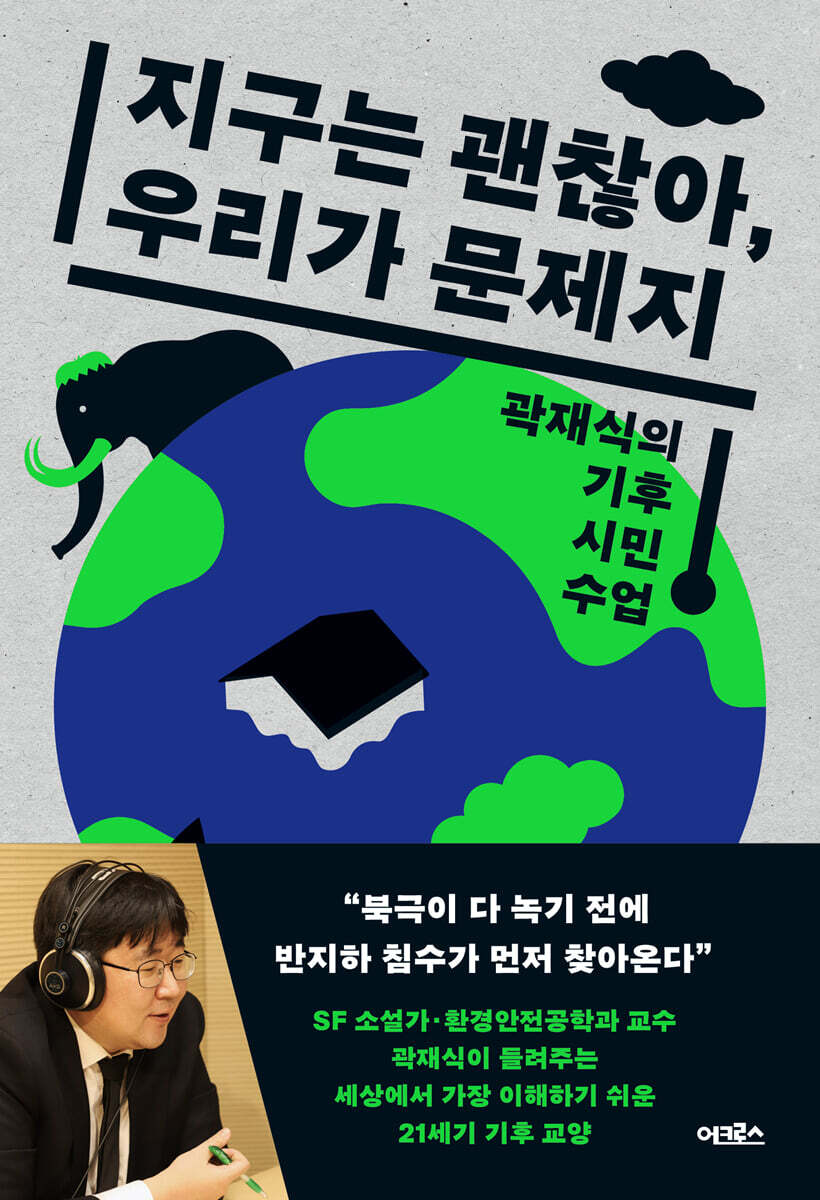
The Earth is okay, we are the problem
 |
Description
Book Introduction
"Before the Arctic melts completely, sub-basement flooding will come first." SF novelist and environmental safety engineering professor Kwak Jae-sik tells us The world's most accessible 21st-century climate literacy "The Earth is Okay, We're the Problem" is a story about climate change told by an author renowned for his storytelling that makes difficult science accessible and fun. In this book, the author draws on a variety of stories, including science fiction and classical tales, to provide easy-to-understand common sense and information we need to know in the age of climate change, from misconceptions about climate change to innovations at the forefront of crisis response technology. If you just roll around and follow the story as if you were reading an interesting story, you will soon come to understand the issue of climate change from a broader perspective. Additionally, as an environmental engineer, the author, who has personally experienced the debate, improvement, and frustration surrounding climate change, offers concrete and realistic insights. In a warming world, this is the 21st-century climate education that is needed by 'climate citizens' who take action for ourselves and our neighbors. |
- You can preview some of the book's contents.
Preview
index
Part 1: Climate Change Basics
Chapter 1: Why is the Earth getting hotter? - The causes of climate change.
Martian Warning
It all starts with the greenhouse effect
Five greenhouse gases we need to remember
Chapter 2: What the History of Climate Change Tells Us
The Legend of the Great Flood: A Scientific Perspective
The Ice Age: The Secret of the Mammoth That Fell into the Sea
Five Mass Extinctions and the Future of Humanity
Chapter 3: Making Those Who Don't Believe in Climate Change Believe
Eunice Newton Foote, a series of discoveries
The chemist who understood everything about climate change 120 years ago
How to find the truth by gathering different opinions
Chapter 4: International Studies on Climate Change in Ten Scenes
Why We Need to Look at Climate Change Internationally
Earth Summit and COP
Greta Thunberg and Severn Suzuki
IPCC and the Kyoto Protocol
Carbon Emissions Trading and the Tragedy of the Commons
Green Climate Fund and the Paris Agreement
Part 2: Climate Change Future Class
Chapter 5: If all electricity could be generated without carbon dioxide emissions
Old Future, Hydroelectric Power
The world brought by the sun and wind
Other renewable energies
Chapter 6 If many things could be moved by electricity
Why Electrification Matters
The era of electric vehicles, awaited for 200 years
How Batteries Changed the World
Electric Vehicles Today and Tomorrow
Chapter 7: If hydrogen could be used as fuel
Can hydrogen cars catch up with electric cars?
Introducing Hydrogen, a friendly but demanding friend.
How far has hydrogen production technology come?
Imagining a Hydrogen Economy
Can Korea Lead the Hydrogen Economy?
Chapter 8 If we could eliminate carbon dioxide
The best defense is a good offense.
Challenges Facing Carbon Absorption
Can't we make money from carbon dioxide?
Trees: A Billion-Year-Old Carbon Dioxide Utilization Technology
Part 3: Citizens' Class on Climate Change
Chapter 9: Climate Change Response for Today
The year that seemed closest to the end, 1670
Today's basement flooding, not tomorrow's apocalypse
If you look into it, it's all a climate issue
Strategies for the Low
Chapter 10: What Should We Do?
The missing story in the plastic debate
Climate Action Calculator. Carbon Footprint
Democratic Society, Climate Citizens' Work
Chapter 1: Why is the Earth getting hotter? - The causes of climate change.
Martian Warning
It all starts with the greenhouse effect
Five greenhouse gases we need to remember
Chapter 2: What the History of Climate Change Tells Us
The Legend of the Great Flood: A Scientific Perspective
The Ice Age: The Secret of the Mammoth That Fell into the Sea
Five Mass Extinctions and the Future of Humanity
Chapter 3: Making Those Who Don't Believe in Climate Change Believe
Eunice Newton Foote, a series of discoveries
The chemist who understood everything about climate change 120 years ago
How to find the truth by gathering different opinions
Chapter 4: International Studies on Climate Change in Ten Scenes
Why We Need to Look at Climate Change Internationally
Earth Summit and COP
Greta Thunberg and Severn Suzuki
IPCC and the Kyoto Protocol
Carbon Emissions Trading and the Tragedy of the Commons
Green Climate Fund and the Paris Agreement
Part 2: Climate Change Future Class
Chapter 5: If all electricity could be generated without carbon dioxide emissions
Old Future, Hydroelectric Power
The world brought by the sun and wind
Other renewable energies
Chapter 6 If many things could be moved by electricity
Why Electrification Matters
The era of electric vehicles, awaited for 200 years
How Batteries Changed the World
Electric Vehicles Today and Tomorrow
Chapter 7: If hydrogen could be used as fuel
Can hydrogen cars catch up with electric cars?
Introducing Hydrogen, a friendly but demanding friend.
How far has hydrogen production technology come?
Imagining a Hydrogen Economy
Can Korea Lead the Hydrogen Economy?
Chapter 8 If we could eliminate carbon dioxide
The best defense is a good offense.
Challenges Facing Carbon Absorption
Can't we make money from carbon dioxide?
Trees: A Billion-Year-Old Carbon Dioxide Utilization Technology
Part 3: Citizens' Class on Climate Change
Chapter 9: Climate Change Response for Today
The year that seemed closest to the end, 1670
Today's basement flooding, not tomorrow's apocalypse
If you look into it, it's all a climate issue
Strategies for the Low
Chapter 10: What Should We Do?
The missing story in the plastic debate
Climate Action Calculator. Carbon Footprint
Democratic Society, Climate Citizens' Work
Detailed image

Into the book
Despite his many accomplishments as a scholar, Teller gained notoriety as he grew older.
Communists naturally hated him for being anti-communist, people who tried to warn about the dangers of nuclear energy hated him, people who wanted to reduce weapons for world peace hated him, and there were even fellow scientists who hated him because of his estrangement from Oppenheimer and other fellow scientists.
Thanks to his eccentric nature, he also had a word to say about climate change.
He gives a speech expressing his strong opinion on climate change over 60 years ago, when most people had no interest in the issue.
---From "The Martian's Warning"
The important thing is that the great problem of whether the gas will raise the temperature of the Earth or not, or even whether it will become a scary planet like Venus, is actually whether the shape of the moving material is symmetrical or not.
The point is that it all depends on a simple fact.
Stories like this one illustrate how a seemingly trivial scientific finding can connect to a larger problem that spans many fields.
---From "Everything Starts with the Greenhouse Effect"
I don't think it's right to treat the issue of climate change like the legend of the Great Flood.
Climate change is not destroying the planet, but rather primarily harming the poor through droughts, floods, heat waves, and cold spells.
We must address climate change to reduce the number of victims of climate-related disasters and accidents, not to avoid the final moment when an angry Earth punishes humanity, or to piously apologize to the clouds and wind.
---From "The Legend of the Great Flood Read Through Science"
Many people who saw Thunberg were reminded of Severn Suzuki from 20 years ago.
In many ways, Greta Thunberg and Severn Suzuki are similar.
Not only did he present his thoughts as a representative of the next generation, pointing out the mistakes of the current generation, but he also agreed that he was a teenager.
Since a similar thing happened twice, some people reacted with indifference.
“I’ve also heard people say that the current generation that Greta Thunberg points out as the next generation is actually the generation that Severn Suzuki grew up to be and became adults.”
However, I do not think it is right to disparage the activities of these two people in that way.
Focusing on the differences between Suzuki and Greta Thunberg makes it clearer what has changed.
---From "Greta Thunberg and Severn Suzuki"
At that time, electric vehicles did not receive as much attention as they do now.
There were also major technical hurdles that were difficult to overcome.
The biggest problem was that electricity was difficult to store.
For electric vehicles to be useful, they need to charge quickly and run for a long time on a single charge.
However, it has been difficult to develop a battery that can charge that much electricity.
If I thought it charged well, it was too expensive, and if I thought it was reasonably priced, it was too heavy.
Many people have tried to solve this problem, but no clear breakthrough has been in sight for decades.
There seemed to be no hope of solving the battery problem.
Then, a light started to appear from a strange direction.
The direction the light was shining was towards rock and roll and computer games.
---From "The Era of Electric Vehicles, Waiting for 200 Years"
As the impacts of climate change are clearly anticipated, we must make efforts to adapt and prepare for them.
We must find a way to prevent floods by building dams, and a way to endure droughts by building reservoirs.
So we need to prepare to reduce the number of victims.
These efforts will not reverse climate change.
It is not often mentioned because it is not connected to companies that are receiving a lot of investment in new businesses such as electric vehicles, hydrogen vehicles, solar power plants, and wind power plants.
Because it is a less popular topic.
But climate change adaptation technologies can save the lives of people who will be affected by climate change right now.
Communists naturally hated him for being anti-communist, people who tried to warn about the dangers of nuclear energy hated him, people who wanted to reduce weapons for world peace hated him, and there were even fellow scientists who hated him because of his estrangement from Oppenheimer and other fellow scientists.
Thanks to his eccentric nature, he also had a word to say about climate change.
He gives a speech expressing his strong opinion on climate change over 60 years ago, when most people had no interest in the issue.
---From "The Martian's Warning"
The important thing is that the great problem of whether the gas will raise the temperature of the Earth or not, or even whether it will become a scary planet like Venus, is actually whether the shape of the moving material is symmetrical or not.
The point is that it all depends on a simple fact.
Stories like this one illustrate how a seemingly trivial scientific finding can connect to a larger problem that spans many fields.
---From "Everything Starts with the Greenhouse Effect"
I don't think it's right to treat the issue of climate change like the legend of the Great Flood.
Climate change is not destroying the planet, but rather primarily harming the poor through droughts, floods, heat waves, and cold spells.
We must address climate change to reduce the number of victims of climate-related disasters and accidents, not to avoid the final moment when an angry Earth punishes humanity, or to piously apologize to the clouds and wind.
---From "The Legend of the Great Flood Read Through Science"
Many people who saw Thunberg were reminded of Severn Suzuki from 20 years ago.
In many ways, Greta Thunberg and Severn Suzuki are similar.
Not only did he present his thoughts as a representative of the next generation, pointing out the mistakes of the current generation, but he also agreed that he was a teenager.
Since a similar thing happened twice, some people reacted with indifference.
“I’ve also heard people say that the current generation that Greta Thunberg points out as the next generation is actually the generation that Severn Suzuki grew up to be and became adults.”
However, I do not think it is right to disparage the activities of these two people in that way.
Focusing on the differences between Suzuki and Greta Thunberg makes it clearer what has changed.
---From "Greta Thunberg and Severn Suzuki"
At that time, electric vehicles did not receive as much attention as they do now.
There were also major technical hurdles that were difficult to overcome.
The biggest problem was that electricity was difficult to store.
For electric vehicles to be useful, they need to charge quickly and run for a long time on a single charge.
However, it has been difficult to develop a battery that can charge that much electricity.
If I thought it charged well, it was too expensive, and if I thought it was reasonably priced, it was too heavy.
Many people have tried to solve this problem, but no clear breakthrough has been in sight for decades.
There seemed to be no hope of solving the battery problem.
Then, a light started to appear from a strange direction.
The direction the light was shining was towards rock and roll and computer games.
---From "The Era of Electric Vehicles, Waiting for 200 Years"
As the impacts of climate change are clearly anticipated, we must make efforts to adapt and prepare for them.
We must find a way to prevent floods by building dams, and a way to endure droughts by building reservoirs.
So we need to prepare to reduce the number of victims.
These efforts will not reverse climate change.
It is not often mentioned because it is not connected to companies that are receiving a lot of investment in new businesses such as electric vehicles, hydrogen vehicles, solar power plants, and wind power plants.
Because it is a less popular topic.
But climate change adaptation technologies can save the lives of people who will be affected by climate change right now.
---From "Today's Basement Flooding, Not Tomorrow's End"
Publisher's Review
From the Joseon Dynasty's Baebawi legend to science fiction set on Venus,
Climate classes that increase absorption through stories
“Once you understand something that is difficult to understand, you can develop your own thoughts based on that understanding, and once you have your own thoughts, you can act on them.
I believe this point is crucial for issues like climate change, which require the cooperation of many people, so I wanted to write a book that would be easy to understand.
“There are stories about climate change that are not widely explained because they are difficult, complex, or involve vested interests. I have tried to explain such stories within the framework of a story that is as interesting and easy as possible.” - From the introduction
The author, a novelist and environmental engineer, has garnered attention for his nonfiction works that combine science fiction imagination with extensive scientific knowledge.
In this book, the author finds a subtle intersection between science and story.
The eccentricities of chemist Edward Teller, who warned against using oil at a Petroleum Institute event, lead to the discovery of climate change, and the novel, which imagines a hot Venusian jungle, ends with the discovery of the greenhouse effect.
Reading the Joseon Dynasty folktale of Baebawi Rock, about a ship tied high up in a mountain, confronts us with long-standing human fears surrounding climate change, and how those fears have led to climate change denial.
This book, with its fascinating stories that follow one another, helps us understand the issue of climate change from a broader perspective.
From misconceptions about climate change to crisis response technologies that make imagination a reality,
Everything People Need to Know About Living in a 0.04% Carbon Dioxide World
“If we assume that the human race appeared on Earth approximately 100,000 years ago, then 99.998 percent of Earth’s history has been unrelated to human life.
So, if we really look at the planet as a whole, what we need to do to address climate change is far from saving a dying planet or saving the planet from corruption.
Rather, I think it is closer to the survival of our species, which emerged recently in Earth's history and has barely managed to adapt.” - From 'The Ice Age, the Secret of the Mammoths That Fell into the Sea'
The book goes through everything we need to know about living in the age of climate change, from the causes and history of climate change to the future of crisis response technology and what we can do as individuals.
In it, readers are sometimes confronted with the complex realities of what they once assumed was common sense surrounding climate change.
For example, replacing plastic with paper or aluminum may not be beneficial.
This is because the production, transportation, and manufacturing processes of materials generate much more carbon dioxide.
Even in climate issues, we find that the logic of capitalism and the powerful permeates more areas than we might think.
Above all, as an environmental engineer, you can encounter specific and realistic insights from the author who has personally experienced the debate, improvement, and frustration surrounding climate change.
How did electric vehicles, once a classic, become mainstream? Is there a technology that can simply remove the increasing carbon dioxide in the air? What are the obstacles to increasing the efficiency of alternative energy sources? Rather than raising the alarm about the severity of the climate crisis, these stories focus on how we got to this point and what we have done, are doing, and can do to overcome the current situation.
Climate change isn't tomorrow's apocalypse; it's the immediate sacrifice of society's vulnerable.
A Guide for Climate Citizens Who Understand and Take Action
“Climate change is a more urgent and realistic question about how we and our neighbors will survive in the future.
There has been a lot of talk about how it is important to take small steps ourselves to prevent climate change.
I would like to see a world where we work harder to figure out what practices are important right now, and where we work harder to educate people about them.
When we think of disasters caused by climate change, rather than just seeing cute polar bears panicking, we think of sudden torrential downpours.
One could say that this means that we should first consider how we can protect people living in semi-basement rooms in cities where water flows backwards.” - From ‘Democratic Society, Climate Citizens’ Work’
The author emphasizes that climate change does not first manifest itself as a devastating flood that wipes out the world, but rather as a way to sacrifice the vulnerable in society.
“Many neighbors can be lost from a shock much smaller than a mass extinction, and human life is about trying to prevent that.”
Therefore, the author suggests that rather than repeating pessimism or vaguely taking actions that seem beneficial to nature, we should act based on an understanding of what is and is not beneficial to solving the immediate climate problem.
A clear example is the fact that someone who uses a paper cup every day has a smaller impact on the climate than someone who practices zero waste but travels abroad once a year.
The explanation is that we need to calculate and judge how much our practices actually reduce carbon dioxide, and we need to demand that governments and society provide more accurate and rich information.
Furthermore, the author reminds us that no field today is unrelated to climate change.
The article explores a range of issues that warrant reconsideration from a broader perspective, including the possibility that installing air conditioning and heating systems for those most vulnerable to climate change may actually be part of climate action, and the need to improve the working conditions of related industries to ensure more accurate weather forecasts.
In a warming world, this is 21st-century climate education necessary for "climate citizens" who understand and take action on climate change issues for themselves and their neighbors.
Climate classes that increase absorption through stories
“Once you understand something that is difficult to understand, you can develop your own thoughts based on that understanding, and once you have your own thoughts, you can act on them.
I believe this point is crucial for issues like climate change, which require the cooperation of many people, so I wanted to write a book that would be easy to understand.
“There are stories about climate change that are not widely explained because they are difficult, complex, or involve vested interests. I have tried to explain such stories within the framework of a story that is as interesting and easy as possible.” - From the introduction
The author, a novelist and environmental engineer, has garnered attention for his nonfiction works that combine science fiction imagination with extensive scientific knowledge.
In this book, the author finds a subtle intersection between science and story.
The eccentricities of chemist Edward Teller, who warned against using oil at a Petroleum Institute event, lead to the discovery of climate change, and the novel, which imagines a hot Venusian jungle, ends with the discovery of the greenhouse effect.
Reading the Joseon Dynasty folktale of Baebawi Rock, about a ship tied high up in a mountain, confronts us with long-standing human fears surrounding climate change, and how those fears have led to climate change denial.
This book, with its fascinating stories that follow one another, helps us understand the issue of climate change from a broader perspective.
From misconceptions about climate change to crisis response technologies that make imagination a reality,
Everything People Need to Know About Living in a 0.04% Carbon Dioxide World
“If we assume that the human race appeared on Earth approximately 100,000 years ago, then 99.998 percent of Earth’s history has been unrelated to human life.
So, if we really look at the planet as a whole, what we need to do to address climate change is far from saving a dying planet or saving the planet from corruption.
Rather, I think it is closer to the survival of our species, which emerged recently in Earth's history and has barely managed to adapt.” - From 'The Ice Age, the Secret of the Mammoths That Fell into the Sea'
The book goes through everything we need to know about living in the age of climate change, from the causes and history of climate change to the future of crisis response technology and what we can do as individuals.
In it, readers are sometimes confronted with the complex realities of what they once assumed was common sense surrounding climate change.
For example, replacing plastic with paper or aluminum may not be beneficial.
This is because the production, transportation, and manufacturing processes of materials generate much more carbon dioxide.
Even in climate issues, we find that the logic of capitalism and the powerful permeates more areas than we might think.
Above all, as an environmental engineer, you can encounter specific and realistic insights from the author who has personally experienced the debate, improvement, and frustration surrounding climate change.
How did electric vehicles, once a classic, become mainstream? Is there a technology that can simply remove the increasing carbon dioxide in the air? What are the obstacles to increasing the efficiency of alternative energy sources? Rather than raising the alarm about the severity of the climate crisis, these stories focus on how we got to this point and what we have done, are doing, and can do to overcome the current situation.
Climate change isn't tomorrow's apocalypse; it's the immediate sacrifice of society's vulnerable.
A Guide for Climate Citizens Who Understand and Take Action
“Climate change is a more urgent and realistic question about how we and our neighbors will survive in the future.
There has been a lot of talk about how it is important to take small steps ourselves to prevent climate change.
I would like to see a world where we work harder to figure out what practices are important right now, and where we work harder to educate people about them.
When we think of disasters caused by climate change, rather than just seeing cute polar bears panicking, we think of sudden torrential downpours.
One could say that this means that we should first consider how we can protect people living in semi-basement rooms in cities where water flows backwards.” - From ‘Democratic Society, Climate Citizens’ Work’
The author emphasizes that climate change does not first manifest itself as a devastating flood that wipes out the world, but rather as a way to sacrifice the vulnerable in society.
“Many neighbors can be lost from a shock much smaller than a mass extinction, and human life is about trying to prevent that.”
Therefore, the author suggests that rather than repeating pessimism or vaguely taking actions that seem beneficial to nature, we should act based on an understanding of what is and is not beneficial to solving the immediate climate problem.
A clear example is the fact that someone who uses a paper cup every day has a smaller impact on the climate than someone who practices zero waste but travels abroad once a year.
The explanation is that we need to calculate and judge how much our practices actually reduce carbon dioxide, and we need to demand that governments and society provide more accurate and rich information.
Furthermore, the author reminds us that no field today is unrelated to climate change.
The article explores a range of issues that warrant reconsideration from a broader perspective, including the possibility that installing air conditioning and heating systems for those most vulnerable to climate change may actually be part of climate action, and the need to improve the working conditions of related industries to ensure more accurate weather forecasts.
In a warming world, this is 21st-century climate education necessary for "climate citizens" who understand and take action on climate change issues for themselves and their neighbors.
GOODS SPECIFICS
- Publication date: February 18, 2022
- Page count, weight, size: 448 pages | 602g | 147*215*30mm
- ISBN13: 9791167740342
- ISBN10: 1167740343
You may also like
카테고리
korean


korean

![ELLE 엘르 스페셜 에디션 A형 : 12월 [2025]](http://librairie.coreenne.fr/cdn/shop/files/b8e27a3de6c9538896439686c6b0e8fb.jpg?v=1766436872&width=3840)


