

Designing the future with an engineering eye
 |
Description
Book Introduction
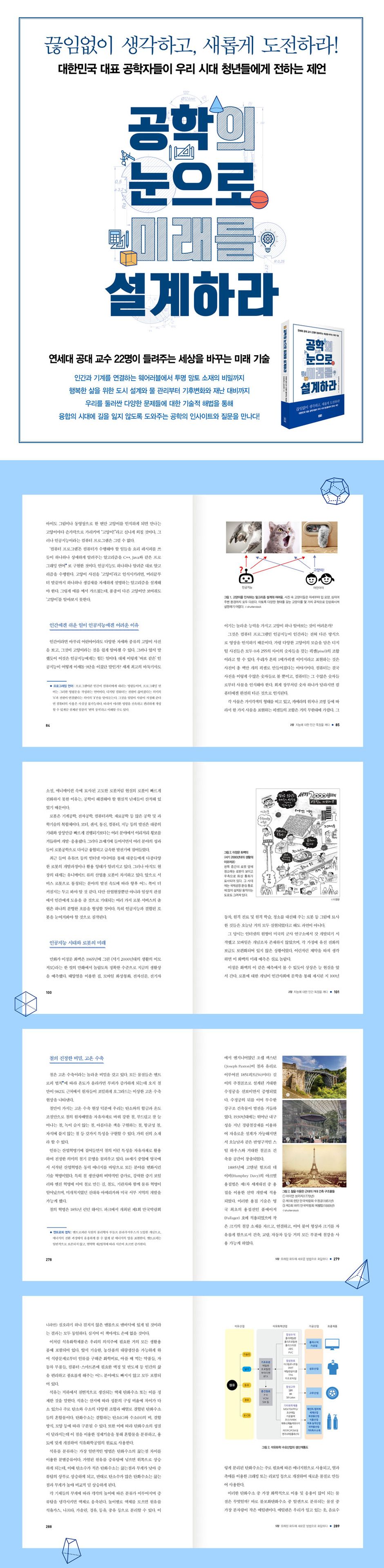
A book offering insight into how to cope with the future. While we emphasize the importance of understanding and learning engineering, there is a severe lack of introductory books that cover this topic in an easy and fun way. Additionally, most related books are limited to introductory and theoretical stories. This book covers specialized techniques in each field, but it also approaches the subject in a way that non-majors or those just entering the engineering field can understand it in an interesting way by connecting it to their daily lives. In particular, rather than simply classifying the various fields of engineering by major, they are grouped together with keywords such as 'connection', 'intelligence', 'innovation', 'new perspective', and 'consideration', allowing readers to experience the subject of engineering from a multi-layered perspective. This book presents engineers as curious explorers, problem solvers who create a better world, and eloquent speakers filled with conviction. Readers will be able to vividly experience what is happening in the field of engineering and how certain parts of society are changing. To adapt to a society that changes every day and create value in life by integrating various information and technologies, one must understand and utilize engineering as the foundation of one's life. Just as engineering thinking lacking an understanding of humanity is problematic, humanistic thinking lacking an understanding of engineering will also be inevitably half-baked in the coming era of the Fourth Industrial Revolution. The question of 'how to cope with the future' depends on the fusion of engineering understanding and humanistic insight. This book will serve as a helpful guide, providing insight not only to students interested in engineering and preparing for a career, but also to young people who wish to broaden their perspective on the world and plan their future with a multi-faceted perspective, as well as to the general public curious about future technologies. |
- You can preview some of the book's contents.
Preview
index
Opening Remarks: Towards a Future of Sharing and Convergence _ Hong Dae-sik
Prologue: Continuing the Challenge of Engineering with a New Generation _ Han Kyung-hee
Chapter 1: Breaking Down Barriers with Innovation in Connectivity
Fast and Secure Connections: The Future of the Mobile Revolution _ Hong Dae-sik
Humans and Machines Communicate Directly Beyond Barriers _ Jong-Hyeon Ahn
A world of accurate and rapid treatment: Smart Healthcare _ Jeong Hyeong-il
Controlling 'disasters' with the Internet of Things _ Jeongsangseom
Chapter 2: Breaking the Human Monopoly on Intelligence
Understanding Artificial Intelligence: A Fool Smarter Than Humans _ Kim Seon-ju
Imagining a Future of Humans Collaborating with Robots _ Yang Hyun-suk
How will the automobile, a symbol of the industrial age, evolve? _ Jeon Gwang-min
Living spaces have human-friendly intelligence _ Kim Tae-yeon
Chapter 3: Going back to basics and changing things from the roots
The Future of VR: Imagine It and See It _ Lee Sang-hoon
The triumph of materials that deceive human senses: the transparent cloak _ Kim Kyung-sik
Biotechnology that leaped out of the movies _ Kim Eung-bin
Ordinary household items are reborn with cutting-edge materials _ Sim Woo-young
How to Harvest Solar Energy Perfectly _ Jong-hyuk Park
Chapter 4: Think Again and Ask Another Question
Revealing What Computers Can Do _ Han Yo-seop
What is the price of the ecosystem we live in? _ Kang Ho-jeong
The process of finding answers to questions, architecture _ Choi Moon-kyu
The Future of Industry Created by New Technology _ Lee Young-hoon
Chapter 5: Responding to Old Questions in New Ways
The Evolution of Iron Is Not Yet Over _ Min Dong-jun
The Art of Chemical Processes, Sharing the Blessings of Chemistry with More People _ Moon Il, Lee Gwang-hee
Creating a smart city as a space for walking people _ Now
Hyperconnected Society: Seeking Innovation in Urban Water Management _ Park Jun-hong
How to Prepare for the Fourth Industrial Revolution _ Park Hee-jun
Prologue: Continuing the Challenge of Engineering with a New Generation _ Han Kyung-hee
Chapter 1: Breaking Down Barriers with Innovation in Connectivity
Fast and Secure Connections: The Future of the Mobile Revolution _ Hong Dae-sik
Humans and Machines Communicate Directly Beyond Barriers _ Jong-Hyeon Ahn
A world of accurate and rapid treatment: Smart Healthcare _ Jeong Hyeong-il
Controlling 'disasters' with the Internet of Things _ Jeongsangseom
Chapter 2: Breaking the Human Monopoly on Intelligence
Understanding Artificial Intelligence: A Fool Smarter Than Humans _ Kim Seon-ju
Imagining a Future of Humans Collaborating with Robots _ Yang Hyun-suk
How will the automobile, a symbol of the industrial age, evolve? _ Jeon Gwang-min
Living spaces have human-friendly intelligence _ Kim Tae-yeon
Chapter 3: Going back to basics and changing things from the roots
The Future of VR: Imagine It and See It _ Lee Sang-hoon
The triumph of materials that deceive human senses: the transparent cloak _ Kim Kyung-sik
Biotechnology that leaped out of the movies _ Kim Eung-bin
Ordinary household items are reborn with cutting-edge materials _ Sim Woo-young
How to Harvest Solar Energy Perfectly _ Jong-hyuk Park
Chapter 4: Think Again and Ask Another Question
Revealing What Computers Can Do _ Han Yo-seop
What is the price of the ecosystem we live in? _ Kang Ho-jeong
The process of finding answers to questions, architecture _ Choi Moon-kyu
The Future of Industry Created by New Technology _ Lee Young-hoon
Chapter 5: Responding to Old Questions in New Ways
The Evolution of Iron Is Not Yet Over _ Min Dong-jun
The Art of Chemical Processes, Sharing the Blessings of Chemistry with More People _ Moon Il, Lee Gwang-hee
Creating a smart city as a space for walking people _ Now
Hyperconnected Society: Seeking Innovation in Urban Water Management _ Park Jun-hong
How to Prepare for the Fourth Industrial Revolution _ Park Hee-jun
Detailed image
Into the book
Towards a future where we share and converge
It is never easy to create something new by transcending the boundaries of existing majors and the walls of universities, collaborating with industries, regions, and institutions around the world.
This seems to be due not simply to limitations in technology and knowledge, but rather to differences in cultural and social norms and values.
However, it is important to note that many of the social, technological, and economic problems facing the world today and that we must address are inherently interconnected.
Even if we look at popular fields of the Fourth Industrial Revolution, such as big data, artificial intelligence, and blockchain, we can see how complexly intertwined the problems are.
It is important for engineering to define and solve these types of problems in a way that society can understand and accept.
Through "Designing the Future Through the Eyes of Engineering," we hope to understand and share how engineering is a field that develops by combining diverse knowledge and values, and what problems and questions it faces.
Hong Dae-sik? Dean of Yonsei University College of Engineering --- From the "Introduction"
Continuing the Challenge of Engineering with a New Generation
The authors of this book wrote with the hope that readers would understand what engineering is interested in in their respective fields, what areas it addresses and how it approaches them, how it responds to the questions posed by society, and what the future challenges of each field are.
So, I hope you don't get discouraged simply because you had bad grades in math and science in middle and high school, and don't give up on engineering because your grades say it's not the right path for you. Likewise, I hope you understand that good grades in math and science don't guarantee you'll be good at engineering.
I hope that young students will become more adventurous, believing that their futures are not determined by a single large company or stable job.
I hope you can experience the big difference between solving math problems and solving engineering problems.
I hope you understand that there are many different fields under the umbrella of engineering, and that each field influences and develops with the other.
That's why I want you to understand that engineering is not something simple and rigid, but rather something complex, flexible, and inherently creative.
And the reason for this is that engineering is interested in solving societal problems, and therefore, I hope that you will recognize and work with us that engineering faces endless challenges that must be solved, just as many as the many tasks that society faces.
Han Kyung-hee, Professor, Center for Innovation in Engineering Education, Yonsei University --- From "Prologue"
Humans and machines communicate directly, overcoming barriers.
Let's imagine.
A wardrobe that helps us choose clothes for the weather on our way to work in the morning and reports on our daily schedule, a refrigerator that notifies housewives of the ingredients they need and automatically orders them, and home robots that not only clean the house but also feed our pets will all make our lives more convenient.
Remember the incident where pesticides were detected in eggs, causing a major social issue? Even in this case, IoT technology could easily solve the problem.
By installing sensors on the chickens in each laying farm, consumers can check the health of the chickens and the freshness of the eggs produced in real time through their smartphones, allowing them to purchase eggs with confidence.
Thanks to electronics that allow electrons to flow infinitely freely between chips that have been reduced to infinitesimally small sizes.
Jong-Hyeon Ahn | Professor, Department of Electrical and Electronic Engineering
Understanding AI: The Fool Smarter Than Humans
Any human, even a child, can easily recognize that it is a cat when looking at pictures of cats in various poses and types.
But as I said before, this is a difficult task for artificial intelligence.
How on earth did such a "stupid" AI defeat 9-dan player Lee Sedol? Is it so incredible that it can even beat the world's best Go player, yet it's so hard to recognize a cat?
This is because artificial intelligence, a computer program, perceives images in a completely different way than humans do.
For example, digital photos of various cats can all be said to be a combination of pixels with numbers between 0 and 255.
When we commonly refer to a 1 megapixel image, we mean that the photo is made up of a total of one million pixels.
In the end, the computer just sees the photo as a bunch of numbers, and the computer has to recognize the object from those numbers.
Just like an accounting ledger, if one number changes, the computer sees it as something completely different.
Kim Seon-ju | Professor of Computer Science
How will the automobile, a symbol of the industrial age, evolve?
Humanity's desire for mobility, awakened and fulfilled by automobiles, will never disappear, and automobiles will not be easily replaced.
The technical structure of automobiles will change, and the way they are driven and owned will have to change, but their fundamental status will be difficult to change.
Therefore, we must find opportunities in change.
The winners of the future will be those who first identify opportunities for innovation that will fulfill people's needs and desires for automobiles in this new environment.
For example, future vehicle ownership will likely shift from the current model of each individual owning, managing, and operating their own vehicle to one of shared ownership. (Omitted)
New innovations inevitably create demand for new people and technologies.
Who will innovate in battery production, which is currently hindering the widespread adoption of electric vehicles? Self-driving technology, new engine technology,
We need people armed with new ideas and experiences to develop new materials for powertrains, bodies, and interiors, and new designs to meet the changing needs of consumers.
It is hard to imagine that the roads on which cars move will be the same as they are now.
From materials to operating methods, everything will change to the level of a mulberry field and a blue sea. Who will be able to achieve this?
Jeon Kwang-min | Professor of Mechanical Engineering
The triumph of materials that deceive human senses: the invisibility cloak
Nature uses the sophisticated art of nanotechnology to present us with a variety of 'seeing experiences'.
Let's take a look around for a moment.
There won't be a single thing that looks the same.
This means that light is reflected differently from each object.
Why does light reflect so differently from different objects? It's because each object's "surface condition" is different.
Imagine throwing a tennis ball at a wall.
You can see that the ball bounces differently depending on whether the wall is smooth or rough.
It would be different if the wall had deep grooves dug like a maze.
The microscopic structures and materials of the surfaces of all things in the world, whether man-made or natural, are different.
That is, every time light hits it, it has to bounce off in a thousand different ways.
Even the wings of blue butterflies appear blue to us because they actually contain structures that are hundreds of nanometers in size, or one-thousandth the width of a human hair.
This is where visible light with a wavelength of a few hundred nanometers interacts with nanostructures of similar size to create the colors we see in our eyes.
Kim Kyung-sik | Professor, Department of Mechanical Engineering
Biotechnology that jumped out of the movies
The 1997 film [Gattaca] depicts a terrifying future society where everything is evaluated based on genes.
Here, humans born naturally are branded as having inferior genes compared to those born with the help of cutting-edge genetic engineering technology, and suffer enormous social disadvantages.
In a word, it is a ‘genetically discriminatory society.’
Unlike most science fiction films that deal with stories set in the distant future, [Gattaca] begins with the phrase "The not-too-distant future."
I note this point.
Considering that the film was released in 1997, it seems that the future could be our present.
In fact, on May 21, 2008, then-US President George W. Bush signed the Genetic Information Non-discrimination Act (GINA), which passed both the House and Senate with almost unanimous consent.
A law has been enacted to prepare for situations like those in the movie.
So, has the story in the movie really become reality for us?
Kim Eung-bin, Professor of Systems Biology
Architecture, the process of finding answers to questions
Why are the sizes of rooms in a house different? The idea behind this is the importance of space created long ago.
It contains the perception of size.
The idea is that the master bedroom is where the parents live, so it should be bigger than other rooms, or that the older brother should have a bigger room than the younger brother.
At first, some people might have been skeptical, but as time goes by, it becomes taken for granted and no one questions about this.
The shape of the room is also like that.
Have you ever lived in a circular or diamond-shaped room? Why don't we build them? I've even wondered if it's a conspiracy by furniture companies that make square furniture.
(Omitted) The world we live in has long been created based on people's ideas about how they should live.
Driving on the right side of the road is like that, and a 10-minute break every 50 minutes of class is like that.
I believe that architecture is where these ideas are most concretely evident.
The buildings we live in every day are the embodiment of human thought in solid concrete.
So if you look at them with curiosity, you can see how different they can look.
Curiosity can lead to taller buildings or lighter ones.
It can also create more democratic and humane relationships.
We tend to be more interested in 'making' because the building is solid, but at the base of it is 'thinking'.
What we see is actually thoughts.
Choi Moon-kyu | Professor of Architectural Engineering
The evolution of iron is not over yet.
Stars breathe together inside our bodies.
That's about 4 to 5 grams of iron.
Because iron flows through our blood vessels, we can breathe oxygen and sustain life.
If we can't breathe like this, we'll die in less than a minute.
Iron is ‘life itself.’
(syncopation)
The Earth was able to become a home for life because of iron.
Iron becomes a heavy core, and the friction generated by the rotating mantle creates the dynamic and beautiful Earth ecosystem we experience, such as continental drift, ocean convection, and volcanoes.
Without iron, the Earth would be a cold, rocky planet with no life.
Just like Mars… … .
The heavy iron core forms magnetic fields at the North and South Poles through rotation and revolution, creating an ionosphere in the Earth's atmosphere, which protects the Earth's ecosystem from harmful cosmic radiation from the sun and space.
From red blood rich in oxygen to the aurora that beautifully decorates the Arctic winter night, human life is literally a beautiful and wondrous cosmic masterpiece created by iron.
Min Dong-jun | Professor, Department of Materials Science and Engineering
It is never easy to create something new by transcending the boundaries of existing majors and the walls of universities, collaborating with industries, regions, and institutions around the world.
This seems to be due not simply to limitations in technology and knowledge, but rather to differences in cultural and social norms and values.
However, it is important to note that many of the social, technological, and economic problems facing the world today and that we must address are inherently interconnected.
Even if we look at popular fields of the Fourth Industrial Revolution, such as big data, artificial intelligence, and blockchain, we can see how complexly intertwined the problems are.
It is important for engineering to define and solve these types of problems in a way that society can understand and accept.
Through "Designing the Future Through the Eyes of Engineering," we hope to understand and share how engineering is a field that develops by combining diverse knowledge and values, and what problems and questions it faces.
Hong Dae-sik? Dean of Yonsei University College of Engineering --- From the "Introduction"
Continuing the Challenge of Engineering with a New Generation
The authors of this book wrote with the hope that readers would understand what engineering is interested in in their respective fields, what areas it addresses and how it approaches them, how it responds to the questions posed by society, and what the future challenges of each field are.
So, I hope you don't get discouraged simply because you had bad grades in math and science in middle and high school, and don't give up on engineering because your grades say it's not the right path for you. Likewise, I hope you understand that good grades in math and science don't guarantee you'll be good at engineering.
I hope that young students will become more adventurous, believing that their futures are not determined by a single large company or stable job.
I hope you can experience the big difference between solving math problems and solving engineering problems.
I hope you understand that there are many different fields under the umbrella of engineering, and that each field influences and develops with the other.
That's why I want you to understand that engineering is not something simple and rigid, but rather something complex, flexible, and inherently creative.
And the reason for this is that engineering is interested in solving societal problems, and therefore, I hope that you will recognize and work with us that engineering faces endless challenges that must be solved, just as many as the many tasks that society faces.
Han Kyung-hee, Professor, Center for Innovation in Engineering Education, Yonsei University --- From "Prologue"
Humans and machines communicate directly, overcoming barriers.
Let's imagine.
A wardrobe that helps us choose clothes for the weather on our way to work in the morning and reports on our daily schedule, a refrigerator that notifies housewives of the ingredients they need and automatically orders them, and home robots that not only clean the house but also feed our pets will all make our lives more convenient.
Remember the incident where pesticides were detected in eggs, causing a major social issue? Even in this case, IoT technology could easily solve the problem.
By installing sensors on the chickens in each laying farm, consumers can check the health of the chickens and the freshness of the eggs produced in real time through their smartphones, allowing them to purchase eggs with confidence.
Thanks to electronics that allow electrons to flow infinitely freely between chips that have been reduced to infinitesimally small sizes.
Jong-Hyeon Ahn | Professor, Department of Electrical and Electronic Engineering
Understanding AI: The Fool Smarter Than Humans
Any human, even a child, can easily recognize that it is a cat when looking at pictures of cats in various poses and types.
But as I said before, this is a difficult task for artificial intelligence.
How on earth did such a "stupid" AI defeat 9-dan player Lee Sedol? Is it so incredible that it can even beat the world's best Go player, yet it's so hard to recognize a cat?
This is because artificial intelligence, a computer program, perceives images in a completely different way than humans do.
For example, digital photos of various cats can all be said to be a combination of pixels with numbers between 0 and 255.
When we commonly refer to a 1 megapixel image, we mean that the photo is made up of a total of one million pixels.
In the end, the computer just sees the photo as a bunch of numbers, and the computer has to recognize the object from those numbers.
Just like an accounting ledger, if one number changes, the computer sees it as something completely different.
Kim Seon-ju | Professor of Computer Science
How will the automobile, a symbol of the industrial age, evolve?
Humanity's desire for mobility, awakened and fulfilled by automobiles, will never disappear, and automobiles will not be easily replaced.
The technical structure of automobiles will change, and the way they are driven and owned will have to change, but their fundamental status will be difficult to change.
Therefore, we must find opportunities in change.
The winners of the future will be those who first identify opportunities for innovation that will fulfill people's needs and desires for automobiles in this new environment.
For example, future vehicle ownership will likely shift from the current model of each individual owning, managing, and operating their own vehicle to one of shared ownership. (Omitted)
New innovations inevitably create demand for new people and technologies.
Who will innovate in battery production, which is currently hindering the widespread adoption of electric vehicles? Self-driving technology, new engine technology,
We need people armed with new ideas and experiences to develop new materials for powertrains, bodies, and interiors, and new designs to meet the changing needs of consumers.
It is hard to imagine that the roads on which cars move will be the same as they are now.
From materials to operating methods, everything will change to the level of a mulberry field and a blue sea. Who will be able to achieve this?
Jeon Kwang-min | Professor of Mechanical Engineering
The triumph of materials that deceive human senses: the invisibility cloak
Nature uses the sophisticated art of nanotechnology to present us with a variety of 'seeing experiences'.
Let's take a look around for a moment.
There won't be a single thing that looks the same.
This means that light is reflected differently from each object.
Why does light reflect so differently from different objects? It's because each object's "surface condition" is different.
Imagine throwing a tennis ball at a wall.
You can see that the ball bounces differently depending on whether the wall is smooth or rough.
It would be different if the wall had deep grooves dug like a maze.
The microscopic structures and materials of the surfaces of all things in the world, whether man-made or natural, are different.
That is, every time light hits it, it has to bounce off in a thousand different ways.
Even the wings of blue butterflies appear blue to us because they actually contain structures that are hundreds of nanometers in size, or one-thousandth the width of a human hair.
This is where visible light with a wavelength of a few hundred nanometers interacts with nanostructures of similar size to create the colors we see in our eyes.
Kim Kyung-sik | Professor, Department of Mechanical Engineering
Biotechnology that jumped out of the movies
The 1997 film [Gattaca] depicts a terrifying future society where everything is evaluated based on genes.
Here, humans born naturally are branded as having inferior genes compared to those born with the help of cutting-edge genetic engineering technology, and suffer enormous social disadvantages.
In a word, it is a ‘genetically discriminatory society.’
Unlike most science fiction films that deal with stories set in the distant future, [Gattaca] begins with the phrase "The not-too-distant future."
I note this point.
Considering that the film was released in 1997, it seems that the future could be our present.
In fact, on May 21, 2008, then-US President George W. Bush signed the Genetic Information Non-discrimination Act (GINA), which passed both the House and Senate with almost unanimous consent.
A law has been enacted to prepare for situations like those in the movie.
So, has the story in the movie really become reality for us?
Kim Eung-bin, Professor of Systems Biology
Architecture, the process of finding answers to questions
Why are the sizes of rooms in a house different? The idea behind this is the importance of space created long ago.
It contains the perception of size.
The idea is that the master bedroom is where the parents live, so it should be bigger than other rooms, or that the older brother should have a bigger room than the younger brother.
At first, some people might have been skeptical, but as time goes by, it becomes taken for granted and no one questions about this.
The shape of the room is also like that.
Have you ever lived in a circular or diamond-shaped room? Why don't we build them? I've even wondered if it's a conspiracy by furniture companies that make square furniture.
(Omitted) The world we live in has long been created based on people's ideas about how they should live.
Driving on the right side of the road is like that, and a 10-minute break every 50 minutes of class is like that.
I believe that architecture is where these ideas are most concretely evident.
The buildings we live in every day are the embodiment of human thought in solid concrete.
So if you look at them with curiosity, you can see how different they can look.
Curiosity can lead to taller buildings or lighter ones.
It can also create more democratic and humane relationships.
We tend to be more interested in 'making' because the building is solid, but at the base of it is 'thinking'.
What we see is actually thoughts.
Choi Moon-kyu | Professor of Architectural Engineering
The evolution of iron is not over yet.
Stars breathe together inside our bodies.
That's about 4 to 5 grams of iron.
Because iron flows through our blood vessels, we can breathe oxygen and sustain life.
If we can't breathe like this, we'll die in less than a minute.
Iron is ‘life itself.’
(syncopation)
The Earth was able to become a home for life because of iron.
Iron becomes a heavy core, and the friction generated by the rotating mantle creates the dynamic and beautiful Earth ecosystem we experience, such as continental drift, ocean convection, and volcanoes.
Without iron, the Earth would be a cold, rocky planet with no life.
Just like Mars… … .
The heavy iron core forms magnetic fields at the North and South Poles through rotation and revolution, creating an ionosphere in the Earth's atmosphere, which protects the Earth's ecosystem from harmful cosmic radiation from the sun and space.
From red blood rich in oxygen to the aurora that beautifully decorates the Arctic winter night, human life is literally a beautiful and wondrous cosmic masterpiece created by iron.
Min Dong-jun | Professor, Department of Materials Science and Engineering
--- From the text
Publisher's Review
Through technological solutions to various problems surrounding us and ourselves.
Discover engineering insights and questions to help you stay on track in the age of convergence!
A must-read for everyone, from engineering beginners to the general public living in the era of the Fourth Industrial Revolution.
From wearable electronic devices that attach to the skin and directly connect people and machines, to microneedle patches that provide painless treatment anytime, anywhere without going to the hospital, to invisibility cloaks made using nanotechnology, and to urban designs that revive stagnant streets.
Engineering is at the heart of the technologies that change the world we live in and the future.
The operation and change of the world are based on the foundation of engineering, and it has a deep influence on our lives.
'Engineering' is a discipline that presents technological solutions to various social problems and represents the era of convergence.
Although engineering has contributed significantly to industrial development, and understanding of technology is paramount in the era of the Fourth Industrial Revolution, engineering has been considered the exclusive domain of those majoring in the "humanities and science and engineering" categories.
Or they simply chase after the glamorous fantasy of high-tech fields with good employment prospects.
But now, regardless of major, everyone needs an 'engineering eye' and 'engineering mindset.'
??Designing the Future with an Engineering Eye?? is a book that brings together the thoughts of professors from Yonsei University's College of Engineering on 'the future of engineering technologies that will change the world and our tomorrow.'
Twenty-two professors from 11 majors, ranging from electrical and electronic engineering to computer science and industrial engineering, explained what engineering is interested in in their respective fields, how they respond to questions posed by society, and what future challenges each field faces, using various future technologies.
The book is also enjoyable to read, featuring the honest thoughts and perspectives of leading Korean engineers, who are actively working in industry and education and are recognized worldwide, sharing their respective fields of expertise.
In particular, this book outlines the Fourth Industrial Revolution, which aims for 'connection' between humans and things and between things and 'fusion' that crosses the boundaries between academia and industry based on artificial intelligence and big data, and explains how engineering leads and supports it.
From the mobile revolution that has ushered in the now-familiar 5G era to the development of robots as ubiquitous as computers, from living spaces imbued with human-friendly intelligence to the transformation of everyday objects into cutting-edge materials, we can see behind the scenes at various technologies that are transforming imagination into reality.
This book consists of a total of five chapters.
Chapter 1 examines how barriers between domains are disappearing and being reorganized through innovation in connectivity.
Chapter 2 introduces recent issues centered on the subject of intelligence in the fields of artificial intelligence, machinery, and architecture.
Chapter 3 covers more fundamental topics related to scientific knowledge and technological innovation.
You can learn about recent technological trends and interests related to human cognitive abilities, metamaterials, genes, materials, and energy.
Chapter 4 shifts the question to give a new perspective to concepts that have been familiar so far, such as architecture, computers, ecosystems, and new technologies.
Looking at it.
Finally, Chapter 5 covers chemical processes and changes in urban water management, areas that have long been explored but for which new solutions are actively being sought.
As the book concludes, it also addresses the social and ethical consensus we must not overlook as we navigate future technologically driven engineering and technological advancements.
Discover engineering insights and questions to help you stay on track in the age of convergence!
A must-read for everyone, from engineering beginners to the general public living in the era of the Fourth Industrial Revolution.
From wearable electronic devices that attach to the skin and directly connect people and machines, to microneedle patches that provide painless treatment anytime, anywhere without going to the hospital, to invisibility cloaks made using nanotechnology, and to urban designs that revive stagnant streets.
Engineering is at the heart of the technologies that change the world we live in and the future.
The operation and change of the world are based on the foundation of engineering, and it has a deep influence on our lives.
'Engineering' is a discipline that presents technological solutions to various social problems and represents the era of convergence.
Although engineering has contributed significantly to industrial development, and understanding of technology is paramount in the era of the Fourth Industrial Revolution, engineering has been considered the exclusive domain of those majoring in the "humanities and science and engineering" categories.
Or they simply chase after the glamorous fantasy of high-tech fields with good employment prospects.
But now, regardless of major, everyone needs an 'engineering eye' and 'engineering mindset.'
??Designing the Future with an Engineering Eye?? is a book that brings together the thoughts of professors from Yonsei University's College of Engineering on 'the future of engineering technologies that will change the world and our tomorrow.'
Twenty-two professors from 11 majors, ranging from electrical and electronic engineering to computer science and industrial engineering, explained what engineering is interested in in their respective fields, how they respond to questions posed by society, and what future challenges each field faces, using various future technologies.
The book is also enjoyable to read, featuring the honest thoughts and perspectives of leading Korean engineers, who are actively working in industry and education and are recognized worldwide, sharing their respective fields of expertise.
In particular, this book outlines the Fourth Industrial Revolution, which aims for 'connection' between humans and things and between things and 'fusion' that crosses the boundaries between academia and industry based on artificial intelligence and big data, and explains how engineering leads and supports it.
From the mobile revolution that has ushered in the now-familiar 5G era to the development of robots as ubiquitous as computers, from living spaces imbued with human-friendly intelligence to the transformation of everyday objects into cutting-edge materials, we can see behind the scenes at various technologies that are transforming imagination into reality.
This book consists of a total of five chapters.
Chapter 1 examines how barriers between domains are disappearing and being reorganized through innovation in connectivity.
Chapter 2 introduces recent issues centered on the subject of intelligence in the fields of artificial intelligence, machinery, and architecture.
Chapter 3 covers more fundamental topics related to scientific knowledge and technological innovation.
You can learn about recent technological trends and interests related to human cognitive abilities, metamaterials, genes, materials, and energy.
Chapter 4 shifts the question to give a new perspective to concepts that have been familiar so far, such as architecture, computers, ecosystems, and new technologies.
Looking at it.
Finally, Chapter 5 covers chemical processes and changes in urban water management, areas that have long been explored but for which new solutions are actively being sought.
As the book concludes, it also addresses the social and ethical consensus we must not overlook as we navigate future technologically driven engineering and technological advancements.
GOODS SPECIFICS
- Date of publication: March 22, 2019
- Page count, weight, size: 348 pages | 511g | 152*225*21mm
- ISBN13: 9788965746799
- ISBN10: 8965746795
You may also like
카테고리
korean


korean

![ELLE 엘르 스페셜 에디션 A형 : 12월 [2025]](http://librairie.coreenne.fr/cdn/shop/files/b8e27a3de6c9538896439686c6b0e8fb.jpg?v=1766436872&width=3840)


