

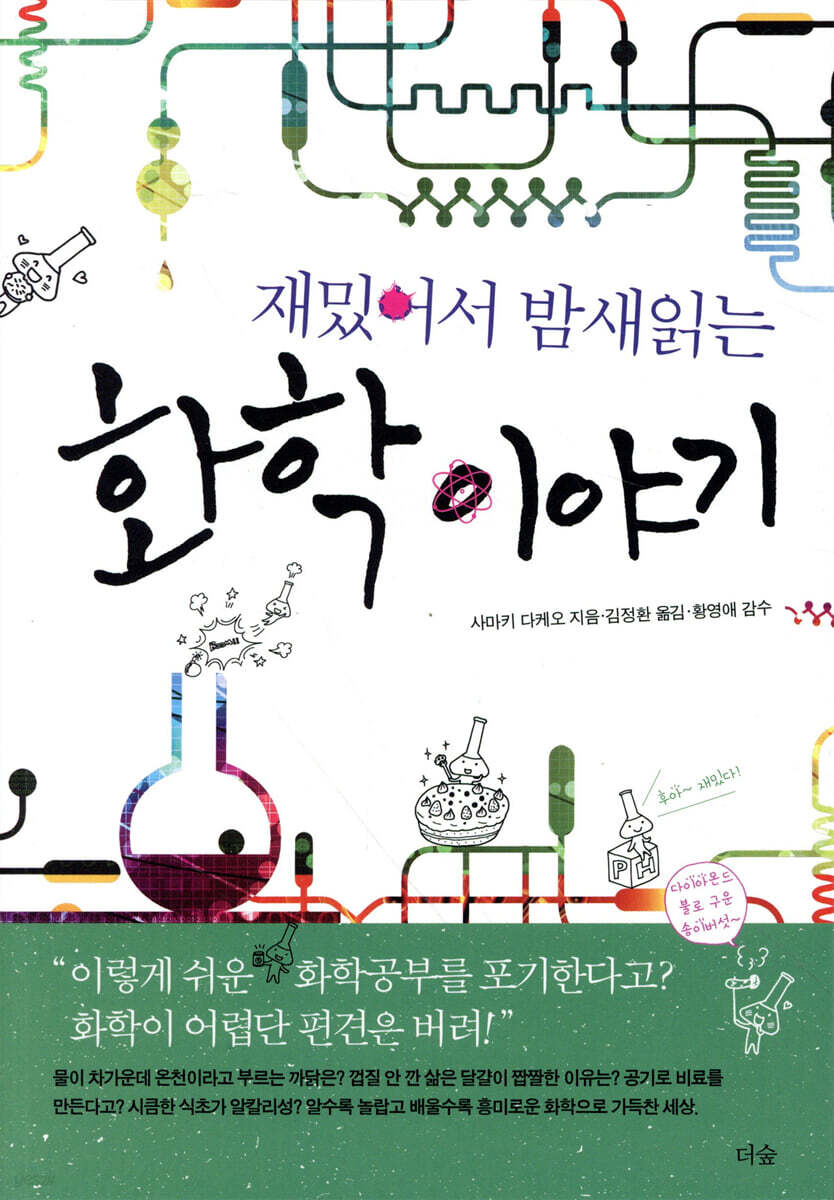
A chemistry story that's so fun you'll read it all night
 |
Description
Book Introduction
2013 Hanuri Reading Olympiad Selected Book, 2014 School Library Journal Recommended Book
Fun chemistry lessons through interesting stories
Many students find chemistry so difficult that they feel lost as to where to start.
The terms that appear in chemistry textbooks are unfamiliar, and the chemical reaction equations are also difficult to read, so it is bound to be burdensome.
However, if we approach chemistry in an easy way based on various materials that we frequently encounter in our daily lives, chemistry is no longer a difficult subject.
From now on, let's approach chemistry with a lighter and more enjoyable mind.
The author felt sorry for students who were not interested in chemistry, which has many fun elements.
Thus, for over 30 years, I have taught students in classrooms and on podiums, trying to convey to them how fascinating and exciting chemistry is, and how much fun it is to discover the secrets of nature, which are full of mysteries.
This book stimulates students' curiosity by colorfully presenting chemical properties and changes that can be commonly observed around us.
Moreover, since it includes not only basic knowledge about chemistry but also thrilling chemical stories, you will be actively curious enough to want to try various chemical experiments yourself.
You will discover an endless number of everyday materials, including what causes plastic bottles and dry ice to explode, how to roast pine mushrooms with diamonds, and what chemical changes lead to the creation of dalgona.
By going beyond simply acquiring knowledge and engaging in various experiments and engaging in interesting chemical stories, you can deeply experience the wonders of chemistry that you couldn't experience in school.
Fun chemistry lessons through interesting stories
Many students find chemistry so difficult that they feel lost as to where to start.
The terms that appear in chemistry textbooks are unfamiliar, and the chemical reaction equations are also difficult to read, so it is bound to be burdensome.
However, if we approach chemistry in an easy way based on various materials that we frequently encounter in our daily lives, chemistry is no longer a difficult subject.
From now on, let's approach chemistry with a lighter and more enjoyable mind.
The author felt sorry for students who were not interested in chemistry, which has many fun elements.
Thus, for over 30 years, I have taught students in classrooms and on podiums, trying to convey to them how fascinating and exciting chemistry is, and how much fun it is to discover the secrets of nature, which are full of mysteries.
This book stimulates students' curiosity by colorfully presenting chemical properties and changes that can be commonly observed around us.
Moreover, since it includes not only basic knowledge about chemistry but also thrilling chemical stories, you will be actively curious enough to want to try various chemical experiments yourself.
You will discover an endless number of everyday materials, including what causes plastic bottles and dry ice to explode, how to roast pine mushrooms with diamonds, and what chemical changes lead to the creation of dalgona.
By going beyond simply acquiring knowledge and engaging in various experiments and engaging in interesting chemical stories, you can deeply experience the wonders of chemistry that you couldn't experience in school.
- You can preview some of the book's contents.
Preview
index
Reviewer's note
preface
Chapter 1: A Dangerous and Thrilling Chemistry Story
What is the difference between a plastic bottle of cola and a bottle of mineral water? / Chemistry is an explosion / Why gas explosions occur / Why did Nobel invent dynamite? / Three conditions necessary for a substance to burn / Can you roast pine mushrooms with diamond fire? / Carbon monoxide, the gas of death
Chapter 2: A fun chemistry story that will make you want to stay up all night reading.
Representative poisons: cyanide and arsenic / How much water should you drink a day? / What happens if you inhale soy sauce all at once? / Vipers and octopuses with terrifying biological toxins / The sad life of Jewish chemist Haber, who developed poison gas / Does drinking cola really dissolve teeth and bones? / The truth and lies surrounding 'hot springs' and 'bathing' / Are alkaline foods really good for your body?
Chapter 3: Chemistry that makes you want to experiment without even realizing it
Does electricity flow through silver paper? / What color is calcium? / What are the silver granules used to decorate cakes? / Is ash the only thing left when a substance is burned? / What is an acid? What is an alkali? / Why does the color change when you add lemon to black tea? / How do the seeds of canned tangerines separate? / 'Egg bouncy balls' with the peel dissolved in vinegar / Let's make 'slime' with laundry glue / The chemical principles hidden in Dalgona? / How far does rubber transform? / Why does ice float on water while other solids sink?
Conclusion
preface
Chapter 1: A Dangerous and Thrilling Chemistry Story
What is the difference between a plastic bottle of cola and a bottle of mineral water? / Chemistry is an explosion / Why gas explosions occur / Why did Nobel invent dynamite? / Three conditions necessary for a substance to burn / Can you roast pine mushrooms with diamond fire? / Carbon monoxide, the gas of death
Chapter 2: A fun chemistry story that will make you want to stay up all night reading.
Representative poisons: cyanide and arsenic / How much water should you drink a day? / What happens if you inhale soy sauce all at once? / Vipers and octopuses with terrifying biological toxins / The sad life of Jewish chemist Haber, who developed poison gas / Does drinking cola really dissolve teeth and bones? / The truth and lies surrounding 'hot springs' and 'bathing' / Are alkaline foods really good for your body?
Chapter 3: Chemistry that makes you want to experiment without even realizing it
Does electricity flow through silver paper? / What color is calcium? / What are the silver granules used to decorate cakes? / Is ash the only thing left when a substance is burned? / What is an acid? What is an alkali? / Why does the color change when you add lemon to black tea? / How do the seeds of canned tangerines separate? / 'Egg bouncy balls' with the peel dissolved in vinegar / Let's make 'slime' with laundry glue / The chemical principles hidden in Dalgona? / How far does rubber transform? / Why does ice float on water while other solids sink?
Conclusion
Detailed image
.jpg)
Into the book
Ischemic heart disease is a disease that occurs when the flow of coronary arteries that carry oxygen and nutrients to the heart becomes poor or when the heart muscle is deprived of oxygen.
Representative ischemic heart diseases include angina and myocardial infarction. When an angina attack occurs or is about to occur, using a sublingual tablet containing nitroglycerin is effective.
It is said that an employee of a nitroglycerin manufacturing plant who suffered from angina discovered its effectiveness when he noticed that the attacks did not occur at the plant.
The reason nitroglycerin is effective in treating angina attacks is because the nitric oxide produced when it is broken down in the body has a blood vessel dilating effect.
The American who discovered this mechanism was Robert F.
Furchgott et al. received the 1998 Nobel Prize in Physiology or Medicine.
Of course, nitroglycerin tablets are processed with additives to prevent them from exploding, so there is no danger in being near someone who has them.
---"Nitroglycerin, the main ingredient in dynamite, saves the heart."
If you eat boiled eggs sold at stores in stations, they are surprisingly salty.
I wondered, 'How did they salt it? Did they poke a hole somewhere and then boil it in salt water?' and looked closely at the shell, but there were no holes.
How on earth do you salt an egg without breaking the shell?
In fact, eggs have tiny holes that cannot be seen with the naked eye.
Eggs are alive and breathe.
So there is a hole for the gas to come in and out.
As eggs age, they become lighter or rotten because moisture evaporates through the pores or bacteria or mold enters.
The hole is called a 'gi-gong'.
Going a little further in, there is a semi-permeable membrane called the ovarian membrane.
If the salt can pass through the pores of the shell and the membrane, the flavor will seep into the egg.
---"How to salt boiled eggs"
Although pickled plums and lemons are sour, they are called 'alkaline foods'.
However, if you examine the acidity and alkalinity of both plums and lemons using litmus paper, they clearly show 'acidity'.
Looking at it that way, it seems that the fact that it is an alkaline food does not mean that the food itself is alkaline.
In fact, if the ash produced by burning food is alkaline, it is called an alkaline food.
If the ashes remaining after burning are acidic, it becomes an acidic food.
The reason plums and lemons are sour is because of an organic acid called citric acid. Citric acid is composed of carbon, hydrogen, and oxygen, so when burned, it turns into carbon dioxide and water.
Meanwhile, the reason why the ash produced by burning is alkaline is because it contains a lot of potassium, which creates an alkaline substance called potassium carbonate.
Other alkaline foods include vegetables, fruits, beans, and milk.
These foods contain a lot of alkaline elements such as calcium and magnesium in addition to potassium.
Meanwhile, when sulfuric acid or phosphorus is burned, it becomes sulfur dioxide (sulfurous acid gas) or phosphorus tetraoxide (phosphoric acid when dissolved in water).
Therefore, foods that contain a lot of sulfur or phosphorus as elements are acidic foods.
For example, grains such as rice and wheat, meat, fish, and eggs are acidic foods.
Representative ischemic heart diseases include angina and myocardial infarction. When an angina attack occurs or is about to occur, using a sublingual tablet containing nitroglycerin is effective.
It is said that an employee of a nitroglycerin manufacturing plant who suffered from angina discovered its effectiveness when he noticed that the attacks did not occur at the plant.
The reason nitroglycerin is effective in treating angina attacks is because the nitric oxide produced when it is broken down in the body has a blood vessel dilating effect.
The American who discovered this mechanism was Robert F.
Furchgott et al. received the 1998 Nobel Prize in Physiology or Medicine.
Of course, nitroglycerin tablets are processed with additives to prevent them from exploding, so there is no danger in being near someone who has them.
---"Nitroglycerin, the main ingredient in dynamite, saves the heart."
If you eat boiled eggs sold at stores in stations, they are surprisingly salty.
I wondered, 'How did they salt it? Did they poke a hole somewhere and then boil it in salt water?' and looked closely at the shell, but there were no holes.
How on earth do you salt an egg without breaking the shell?
In fact, eggs have tiny holes that cannot be seen with the naked eye.
Eggs are alive and breathe.
So there is a hole for the gas to come in and out.
As eggs age, they become lighter or rotten because moisture evaporates through the pores or bacteria or mold enters.
The hole is called a 'gi-gong'.
Going a little further in, there is a semi-permeable membrane called the ovarian membrane.
If the salt can pass through the pores of the shell and the membrane, the flavor will seep into the egg.
---"How to salt boiled eggs"
Although pickled plums and lemons are sour, they are called 'alkaline foods'.
However, if you examine the acidity and alkalinity of both plums and lemons using litmus paper, they clearly show 'acidity'.
Looking at it that way, it seems that the fact that it is an alkaline food does not mean that the food itself is alkaline.
In fact, if the ash produced by burning food is alkaline, it is called an alkaline food.
If the ashes remaining after burning are acidic, it becomes an acidic food.
The reason plums and lemons are sour is because of an organic acid called citric acid. Citric acid is composed of carbon, hydrogen, and oxygen, so when burned, it turns into carbon dioxide and water.
Meanwhile, the reason why the ash produced by burning is alkaline is because it contains a lot of potassium, which creates an alkaline substance called potassium carbonate.
Other alkaline foods include vegetables, fruits, beans, and milk.
These foods contain a lot of alkaline elements such as calcium and magnesium in addition to potassium.
Meanwhile, when sulfuric acid or phosphorus is burned, it becomes sulfur dioxide (sulfurous acid gas) or phosphorus tetraoxide (phosphoric acid when dissolved in water).
Therefore, foods that contain a lot of sulfur or phosphorus as elements are acidic foods.
For example, grains such as rice and wheat, meat, fish, and eggs are acidic foods.
---「How to distinguish between acidity and alkalinity」
Publisher's Review
"Chemistry is fun! That's the only reason I wrote this book."
Having taught 'fun chemistry' through various experiments and research for 30 years,
The Joy of Studying Chemistry, According to a Renowned Science Education Expert
Most students consider chemistry to be the most difficult subject and are unsure of how to study it.
The chemical terms are unfamiliar, and the chemical reaction formulas are unfamiliar, making them difficult.
Moreover, since basic concepts are not easily understood, interest in chemistry begins to wane.
For middle and high school students who are becoming distant from chemistry, a book has been published that helps them learn science in a more approachable and enjoyable way, using various materials encountered in everyday life.
"Chemistry is fun! That's the only reason I wrote this book," the author declares in the preface. Having spent over 30 years observing students who lacked interest in chemistry in classrooms and lecture halls, the author wanted to convey how fascinating and fascinating chemistry is, and furthermore, how moving science, which uncovers the secrets of nature, full of mystery and drama, is.
So, he compiled the interesting chemical knowledge he discovered through various experiments and daily life into this one book.
This book is full of materials that we encounter in our daily lives and in the laboratory, such as how commonly seen plastic bottles and dry ice have chemical properties that lead to explosions, how pine mushrooms can be roasted using diamonds, and what chemical changes are involved in the completion of our favorite sweet, dalgona.
The author says that after reading this book, you will be so curious that you will want to try various chemical experiments yourself, and you will have endless questions about all the phenomena in your daily life.
I am also confident that the essential and fundamental knowledge of chemistry acquired in this way will broaden your perspective on the new world.
Based on basic chemistry knowledge, this book combines various scientific experiments and thrilling chemistry stories to help you discover new facts you didn't learn in school and experience the joy of studying chemistry you never knew existed.
The author's hope that students who have been too far removed from science studies can experience the moving and enriching nature of science is evident throughout the book, including examples of interesting chemistry experiments and stories from his own experiences.
Play with chemistry, study chemistry!
The basic concepts of chemistry that were abstract and unrealistic,
Have fun learning through various phenomena and experiments in everyday life!
The basic concepts of chemistry are abstract and not easy to grasp in your head.
This is why studying chemistry feels particularly difficult.
This book covers phenomena easily observed in everyday life and basic chemistry experiments found in textbooks, inviting readers into the world of chemistry in a more fun and accessible way.
This will be a great opportunity to broaden your interest beyond chemistry to basic science, as you will be able to learn new facts about chemistry while also experiencing the joy of learning.
It explains abstract chemical concepts in an easy-to-understand way and conveys the chemical phenomena hidden within them, such as the fact that nitroglycerin, which boasts terrifying explosive power when processed into dynamite, can save patients with myocardial infarction or angina, that salt permeates through invisible tiny pores and membranes, making hard-boiled eggs salty, and the process of processing substances contained in the air to make fertilizer.
Additionally, the witty illustrations and characters hidden throughout the book help make chemistry more approachable.
Chemistry is not just a subject useful in the classroom; it is also closely related to our lives!
A world full of chemistry that is surprising the more you know and interesting the more you learn.
The author argues in this book that the science we learn in school fails to stimulate our curiosity to examine the events and phenomena that abound around us through the eyes of science.
The scientific eye mentioned here refers to looking at the phenomena of the world with scientific knowledge.
He pointed out that the current science education is nothing more than a collection of fragments of facts, concepts, and laws of natural science, and thus, classes are inevitably focused on memorization, and that when teaching chemistry, we do not talk about the “fun of chemistry or the deep relationship between chemistry and our lives,” and he revealed his thoughts on how chemistry should be taught as follows.
“I believe that we must teach the intellectual pleasure of chemistry, the study of the properties and changes of matter, and the fact that the theories and experiments of chemistry are broadly connected to our lives and society.”
For example, when learning about chemical changes, try an experiment to make dalgona using the decomposition of sodium bicarbonate.
Through these experiments, we have consciously tried to convey that chemistry is not just a discipline useful only in the classroom, but is a discipline closely related to our daily lives.”
This book also contains a message that we should strive and think hard to overcome the limitations of science education, and it will stimulate interest in chemistry among teachers who are considering new directions for science education, middle and high school students who find chemistry difficult, and parents whose children find chemistry difficult. As an introductory book to chemistry, it will be difficult to find a better book.
Having taught 'fun chemistry' through various experiments and research for 30 years,
The Joy of Studying Chemistry, According to a Renowned Science Education Expert
Most students consider chemistry to be the most difficult subject and are unsure of how to study it.
The chemical terms are unfamiliar, and the chemical reaction formulas are unfamiliar, making them difficult.
Moreover, since basic concepts are not easily understood, interest in chemistry begins to wane.
For middle and high school students who are becoming distant from chemistry, a book has been published that helps them learn science in a more approachable and enjoyable way, using various materials encountered in everyday life.
"Chemistry is fun! That's the only reason I wrote this book," the author declares in the preface. Having spent over 30 years observing students who lacked interest in chemistry in classrooms and lecture halls, the author wanted to convey how fascinating and fascinating chemistry is, and furthermore, how moving science, which uncovers the secrets of nature, full of mystery and drama, is.
So, he compiled the interesting chemical knowledge he discovered through various experiments and daily life into this one book.
This book is full of materials that we encounter in our daily lives and in the laboratory, such as how commonly seen plastic bottles and dry ice have chemical properties that lead to explosions, how pine mushrooms can be roasted using diamonds, and what chemical changes are involved in the completion of our favorite sweet, dalgona.
The author says that after reading this book, you will be so curious that you will want to try various chemical experiments yourself, and you will have endless questions about all the phenomena in your daily life.
I am also confident that the essential and fundamental knowledge of chemistry acquired in this way will broaden your perspective on the new world.
Based on basic chemistry knowledge, this book combines various scientific experiments and thrilling chemistry stories to help you discover new facts you didn't learn in school and experience the joy of studying chemistry you never knew existed.
The author's hope that students who have been too far removed from science studies can experience the moving and enriching nature of science is evident throughout the book, including examples of interesting chemistry experiments and stories from his own experiences.
Play with chemistry, study chemistry!
The basic concepts of chemistry that were abstract and unrealistic,
Have fun learning through various phenomena and experiments in everyday life!
The basic concepts of chemistry are abstract and not easy to grasp in your head.
This is why studying chemistry feels particularly difficult.
This book covers phenomena easily observed in everyday life and basic chemistry experiments found in textbooks, inviting readers into the world of chemistry in a more fun and accessible way.
This will be a great opportunity to broaden your interest beyond chemistry to basic science, as you will be able to learn new facts about chemistry while also experiencing the joy of learning.
It explains abstract chemical concepts in an easy-to-understand way and conveys the chemical phenomena hidden within them, such as the fact that nitroglycerin, which boasts terrifying explosive power when processed into dynamite, can save patients with myocardial infarction or angina, that salt permeates through invisible tiny pores and membranes, making hard-boiled eggs salty, and the process of processing substances contained in the air to make fertilizer.
Additionally, the witty illustrations and characters hidden throughout the book help make chemistry more approachable.
Chemistry is not just a subject useful in the classroom; it is also closely related to our lives!
A world full of chemistry that is surprising the more you know and interesting the more you learn.
The author argues in this book that the science we learn in school fails to stimulate our curiosity to examine the events and phenomena that abound around us through the eyes of science.
The scientific eye mentioned here refers to looking at the phenomena of the world with scientific knowledge.
He pointed out that the current science education is nothing more than a collection of fragments of facts, concepts, and laws of natural science, and thus, classes are inevitably focused on memorization, and that when teaching chemistry, we do not talk about the “fun of chemistry or the deep relationship between chemistry and our lives,” and he revealed his thoughts on how chemistry should be taught as follows.
“I believe that we must teach the intellectual pleasure of chemistry, the study of the properties and changes of matter, and the fact that the theories and experiments of chemistry are broadly connected to our lives and society.”
For example, when learning about chemical changes, try an experiment to make dalgona using the decomposition of sodium bicarbonate.
Through these experiments, we have consciously tried to convey that chemistry is not just a discipline useful only in the classroom, but is a discipline closely related to our daily lives.”
This book also contains a message that we should strive and think hard to overcome the limitations of science education, and it will stimulate interest in chemistry among teachers who are considering new directions for science education, middle and high school students who find chemistry difficult, and parents whose children find chemistry difficult. As an introductory book to chemistry, it will be difficult to find a better book.
GOODS SPECIFICS
- Date of issue: February 4, 2013
- Page count, weight, size: 204 pages | 320g | 145*210*20mm
- ISBN13: 9788994418513
- ISBN10: 8994418512
You may also like
카테고리
korean


korean

![ELLE 엘르 스페셜 에디션 A형 : 12월 [2025]](http://librairie.coreenne.fr/cdn/shop/files/b8e27a3de6c9538896439686c6b0e8fb.jpg?v=1766436872&width=3840)


