

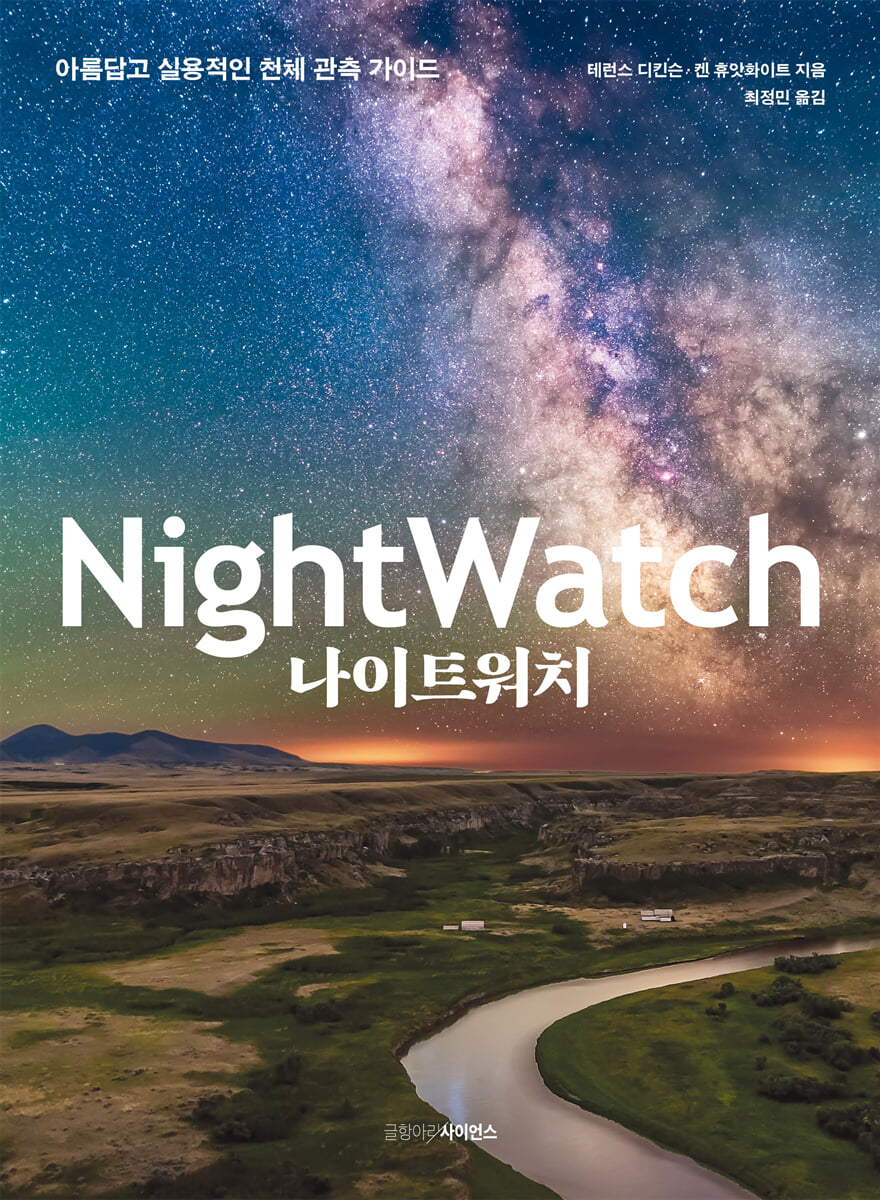
Night Watch
 |
Description
Book Introduction
The bible of astronomical observations, revised four times over 40 years
Finally landing in Korea!
The ultimate stargazing guide for beginners and experts alike.
Orbit, Space Dust Highly Recommended
It is rare for a book to be loved for nearly half a century.
The same goes for things called 'classics' in certain fields, and the fact that there are many people who study from the original text because there is no translated version.
"Nightwatch" is a book that exemplifies all of those rare cases.
The first edition was published in 1983 and has been continuously revised for over 40 years, receiving support from fans.
This translation, presented for the first time in Korea, is a translation of the 5th edition, and all information is updated to be usable until 2035.
What makes it so special? Before delving into the book's content or structure, let's take a look at the authors' biographies.
The lead author, Terence Dickinson, has been devoted to astronomy for 75 years since witnessing a meteor at the age of five.
Co-author Ken Hewitt-White has also been a fan of astronomy for over 50 years.
Alan Dyer, who took many of the photographs in the book, has seen a whopping 16 total solar eclipses.
A phenomenon that occurs only once a year, lasting only a few minutes, and is only visible within an area on average 100 miles (160 kilometers) wide!
This book was revised by authors who have been passionate about astronomical observation since before the advent of the Internet, and includes know-how on operating a computerized telescope.
It contains the past, present, and future of astronomical observations, and is filled with an even greater affection.
If you continue a hobby for several decades, it becomes history.
Explore the night sky with the authors, historians of astronomical observation.
Finally landing in Korea!
The ultimate stargazing guide for beginners and experts alike.
Orbit, Space Dust Highly Recommended
It is rare for a book to be loved for nearly half a century.
The same goes for things called 'classics' in certain fields, and the fact that there are many people who study from the original text because there is no translated version.
"Nightwatch" is a book that exemplifies all of those rare cases.
The first edition was published in 1983 and has been continuously revised for over 40 years, receiving support from fans.
This translation, presented for the first time in Korea, is a translation of the 5th edition, and all information is updated to be usable until 2035.
What makes it so special? Before delving into the book's content or structure, let's take a look at the authors' biographies.
The lead author, Terence Dickinson, has been devoted to astronomy for 75 years since witnessing a meteor at the age of five.
Co-author Ken Hewitt-White has also been a fan of astronomy for over 50 years.
Alan Dyer, who took many of the photographs in the book, has seen a whopping 16 total solar eclipses.
A phenomenon that occurs only once a year, lasting only a few minutes, and is only visible within an area on average 100 miles (160 kilometers) wide!
This book was revised by authors who have been passionate about astronomical observation since before the advent of the Internet, and includes know-how on operating a computerized telescope.
It contains the past, present, and future of astronomical observations, and is filled with an even greater affection.
If you continue a hobby for several decades, it becomes history.
Explore the night sky with the authors, historians of astronomical observation.
- You can preview some of the book's contents.
Preview
index
Chapter 1: Backyard Astronomy
Night Seekers | A Starry World
Chapter 2: The Universe in 11 Steps
Chapter 3: The Movement of Celestial Bodies
Sky Movement | Circumpolar Constellation | Finding the Southern Star | Useful Polar Star | Measuring the Sky | Big Dipper Signpost | Constellation and Star Names | Some Constellation and Star Name Guides
Chapter 4: The Four Seasons
All Sky Map | Spring Sky | Summer Sky | Fall Sky | Winter Sky
Chapter 5: Astronomical Observation Equipment
Choosing Binoculars | The World of Astronomical Telescopes | Types of Astronomical Telescopes | Mounting Issues | Making the Decision | Recommendations | Telescopes in the Computer Age | Beyond the Basics
Chapter 6: Exploring Deep Space
Binary or double stars | Variable stars | Novas and supernovas | Open clusters | Pleiades | Globular clusters | Nebulae | Star birth in the Orion Nebula | Planetary nebulae | Galaxies | Andromeda | Telescope experience | Recording | Deep-sky star map
Chapter 7: Planets
Mercury | Venus | Mars | Asteroid Belt | Jupiter | Saturn | More Distant Planets | Planet Observation Reference Table 2023–2035
Chapter 8: The Moon and the Sun
Observing the Moon | Observing the Sun
Chapter 9: Solar and Lunar Eclipses
solar eclipse | lunar eclipse
Chapter 10: Comets, Meteors, and Auroras
Comet | Meteor | Aurora
Chapter 11: Photographing the Night Sky
Step 1: Smartphone filming | Step 2: Camera on a tripod | Step 3: Camera on a tracker | Step 4: Camera on a telescope
Chapter 12: The Wonders of the Southern Sky
Southern Hemisphere Sky Map | Top 10 Celestial Objects in the Southern Hemisphere
Night Seekers | A Starry World
Chapter 2: The Universe in 11 Steps
Chapter 3: The Movement of Celestial Bodies
Sky Movement | Circumpolar Constellation | Finding the Southern Star | Useful Polar Star | Measuring the Sky | Big Dipper Signpost | Constellation and Star Names | Some Constellation and Star Name Guides
Chapter 4: The Four Seasons
All Sky Map | Spring Sky | Summer Sky | Fall Sky | Winter Sky
Chapter 5: Astronomical Observation Equipment
Choosing Binoculars | The World of Astronomical Telescopes | Types of Astronomical Telescopes | Mounting Issues | Making the Decision | Recommendations | Telescopes in the Computer Age | Beyond the Basics
Chapter 6: Exploring Deep Space
Binary or double stars | Variable stars | Novas and supernovas | Open clusters | Pleiades | Globular clusters | Nebulae | Star birth in the Orion Nebula | Planetary nebulae | Galaxies | Andromeda | Telescope experience | Recording | Deep-sky star map
Chapter 7: Planets
Mercury | Venus | Mars | Asteroid Belt | Jupiter | Saturn | More Distant Planets | Planet Observation Reference Table 2023–2035
Chapter 8: The Moon and the Sun
Observing the Moon | Observing the Sun
Chapter 9: Solar and Lunar Eclipses
solar eclipse | lunar eclipse
Chapter 10: Comets, Meteors, and Auroras
Comet | Meteor | Aurora
Chapter 11: Photographing the Night Sky
Step 1: Smartphone filming | Step 2: Camera on a tripod | Step 3: Camera on a tracker | Step 4: Camera on a telescope
Chapter 12: The Wonders of the Southern Sky
Southern Hemisphere Sky Map | Top 10 Celestial Objects in the Southern Hemisphere
Detailed image

Into the book
Astronomy, as an intellectual discipline seeking to understand the vast distances and sizes of celestial bodies, is fascinating in itself.
But what makes 'backyard astronomy' such an addictive pastime is the opportunity to stand under the stars and planets on a dark night.
For me, it is a matter of communing with the vast nature.
I learned about distant stars and galaxies.
There is a star that is 250 times larger than our sun.
Over there, in the distance, at a point where I can even cover it with my fingernail, there are 500 galaxies like our own Milky Way.
And here, just beyond the Milky Way Gap, lies the nucleus of our own galaxy.' When we recall these facts, a vivid panorama of stars unfolds before our eyes.
All of this can be seen and appreciated with the naked eye.
And some become 'night seekers', experts at capturing the subtle differences in celestial objects.
This experience is both humbling and exciting.
--- p.18
I'm often asked if, when I go outside and look at the stars, the vastness of the universe makes me feel insignificant.
Many people even ask if it makes them depressed.
Contrary to that question, I feel a deep sense of peace when I am under a starry night sky.
The universe is not an incomprehensible mystery, but a wonderful world to explore.
Humans may not understand all the complex workings of the universe, but we do know enough to recognize our place in it.
At least physically.
For that reason alone, we are not so insignificant.
--- p.31~32
A starry night, despite its beauty, can seem like a chaotic mess of shining dots.
It takes time to classify stars.
Among the curious stargazers who have learned to distinguish individual stars, some go out with a star map and give up in frustration after an hour or two.
The problem usually lies with the star map rather than the observer.
Although not widely used today, impractical star maps with mythical figures and monsters drawn on star patterns still circulate.
Even modern star maps and star charts are often too small or too densely packed with dots and lines for use on your first day of astronomical observation.
--- p.47
Almost all stargazers come to dislike the general city sky light, and even one or two partial lights that fall directly into their eyes.
Streetlights are usually the problem, but porch lamps and 'security lights' that are on from dusk until dawn are also often problematic.
Most people don't want to spend time outside at night, so they rarely notice the glare that outdoor lighting creates.
This happens when poorly designed or improperly installed built-in lighting emits light in all directions instead of focusing it downward.
Night lights rarely need to shine horizontally or upwards.
That's pure waste of energy, light pollution.
--- p.93
Backyard astronomers are a special breed.
They enjoy the moments spent under the stars.
They fall in love with a universe that grows and develops on its own, just as meaningful relationships between humans do.
Of course, it's a one-sided relationship that's harder to define, but I've come to think that feeling is closest to becoming one with nature.
Spending a night under the stars leaves me with a sweet feeling of humility, wonder, and discovery.
The universe is beautiful.
Both visually and spiritually.
--- p.147
I vividly remember the final transition from the old Mars to the new Mars.
It was a warm summer evening in July 1976 when the Viking 1 lander touched down on Mars.
I was in Mission Control at the Jet Propulsion Laboratory in Pasadena, California, with about 200 scientists and an equal number of journalists and science fiction writers.
We were all anxiously awaiting the first surface photos from Mars.
As each photo appeared on the television monitor, a line slowly revealed a landscape of sand dunes strewn with rocks.
“From this moment on, you won’t have to imagine what Mars looks like,” said science fiction writer Ray Bradbury quietly, standing next to me.
--- p.207
And then there are the so-called 'supermoons', a term coined by astrologers (not astronomers).
The moon moves around the Earth in an elliptical orbit, coming closest to the Earth once a month.
This is called perigee.
The full moon that occurs around the same time as the closest perigee of the year is nicknamed the "super moon."
It is true that some perigees are closer than others.
But the 'super moon' is just a fuss.
Many people claim that the moon appears larger even though it is only 7 percent larger than usual, which is imperceptible.
--- p.238
A total solar eclipse is visible from a given location on Earth only once every 360 years, on average.
It is more reasonable to go to a restaurant rather than wait for it to come to you.
Some Japanese food enthusiasts have successfully observed Japanese food more than 25 times.
I've traveled to see total solar eclipses four times, but only twice have the eclipses occurred in cloudless skies: the 1979 total eclipse and the February 1998 Caribbean eclipse.
About 30,000 enthusiasts traveled to the Caribbean to see the eclipse, most from the decks of cruise ships that lined the path of the totality like floating hotels.
--- p.251
Some people might quickly purchase all the equipment they need to attempt long-exposure photographs of the Andromeda Galaxy or the Orion Nebula, following the recommendations in this chapter.
Please don't do that.
People who try to do too much too quickly often end up disappointed with the results.
They ask for help in online communities or even sell their equipment on second-hand sites.
Learning astrophotography requires taking one step at a time.
First, learn the basics and then develop based on them.
The key to this chapter is to start simple and work your way up to higher levels.
--- p.281
Recently, many astronomers have quietly lamented the fact that the Earth was born 'upside down'.
They want our planet to flip over so that the northern hemisphere faces south and the southern hemisphere faces north.
Then the richest part of the night sky will be above the heads of most of the people on Earth.
All the splendor of our galaxy will be revealed, instead of hiding near or below the southern horizon as it is now in most northern skies.
But what makes 'backyard astronomy' such an addictive pastime is the opportunity to stand under the stars and planets on a dark night.
For me, it is a matter of communing with the vast nature.
I learned about distant stars and galaxies.
There is a star that is 250 times larger than our sun.
Over there, in the distance, at a point where I can even cover it with my fingernail, there are 500 galaxies like our own Milky Way.
And here, just beyond the Milky Way Gap, lies the nucleus of our own galaxy.' When we recall these facts, a vivid panorama of stars unfolds before our eyes.
All of this can be seen and appreciated with the naked eye.
And some become 'night seekers', experts at capturing the subtle differences in celestial objects.
This experience is both humbling and exciting.
--- p.18
I'm often asked if, when I go outside and look at the stars, the vastness of the universe makes me feel insignificant.
Many people even ask if it makes them depressed.
Contrary to that question, I feel a deep sense of peace when I am under a starry night sky.
The universe is not an incomprehensible mystery, but a wonderful world to explore.
Humans may not understand all the complex workings of the universe, but we do know enough to recognize our place in it.
At least physically.
For that reason alone, we are not so insignificant.
--- p.31~32
A starry night, despite its beauty, can seem like a chaotic mess of shining dots.
It takes time to classify stars.
Among the curious stargazers who have learned to distinguish individual stars, some go out with a star map and give up in frustration after an hour or two.
The problem usually lies with the star map rather than the observer.
Although not widely used today, impractical star maps with mythical figures and monsters drawn on star patterns still circulate.
Even modern star maps and star charts are often too small or too densely packed with dots and lines for use on your first day of astronomical observation.
--- p.47
Almost all stargazers come to dislike the general city sky light, and even one or two partial lights that fall directly into their eyes.
Streetlights are usually the problem, but porch lamps and 'security lights' that are on from dusk until dawn are also often problematic.
Most people don't want to spend time outside at night, so they rarely notice the glare that outdoor lighting creates.
This happens when poorly designed or improperly installed built-in lighting emits light in all directions instead of focusing it downward.
Night lights rarely need to shine horizontally or upwards.
That's pure waste of energy, light pollution.
--- p.93
Backyard astronomers are a special breed.
They enjoy the moments spent under the stars.
They fall in love with a universe that grows and develops on its own, just as meaningful relationships between humans do.
Of course, it's a one-sided relationship that's harder to define, but I've come to think that feeling is closest to becoming one with nature.
Spending a night under the stars leaves me with a sweet feeling of humility, wonder, and discovery.
The universe is beautiful.
Both visually and spiritually.
--- p.147
I vividly remember the final transition from the old Mars to the new Mars.
It was a warm summer evening in July 1976 when the Viking 1 lander touched down on Mars.
I was in Mission Control at the Jet Propulsion Laboratory in Pasadena, California, with about 200 scientists and an equal number of journalists and science fiction writers.
We were all anxiously awaiting the first surface photos from Mars.
As each photo appeared on the television monitor, a line slowly revealed a landscape of sand dunes strewn with rocks.
“From this moment on, you won’t have to imagine what Mars looks like,” said science fiction writer Ray Bradbury quietly, standing next to me.
--- p.207
And then there are the so-called 'supermoons', a term coined by astrologers (not astronomers).
The moon moves around the Earth in an elliptical orbit, coming closest to the Earth once a month.
This is called perigee.
The full moon that occurs around the same time as the closest perigee of the year is nicknamed the "super moon."
It is true that some perigees are closer than others.
But the 'super moon' is just a fuss.
Many people claim that the moon appears larger even though it is only 7 percent larger than usual, which is imperceptible.
--- p.238
A total solar eclipse is visible from a given location on Earth only once every 360 years, on average.
It is more reasonable to go to a restaurant rather than wait for it to come to you.
Some Japanese food enthusiasts have successfully observed Japanese food more than 25 times.
I've traveled to see total solar eclipses four times, but only twice have the eclipses occurred in cloudless skies: the 1979 total eclipse and the February 1998 Caribbean eclipse.
About 30,000 enthusiasts traveled to the Caribbean to see the eclipse, most from the decks of cruise ships that lined the path of the totality like floating hotels.
--- p.251
Some people might quickly purchase all the equipment they need to attempt long-exposure photographs of the Andromeda Galaxy or the Orion Nebula, following the recommendations in this chapter.
Please don't do that.
People who try to do too much too quickly often end up disappointed with the results.
They ask for help in online communities or even sell their equipment on second-hand sites.
Learning astrophotography requires taking one step at a time.
First, learn the basics and then develop based on them.
The key to this chapter is to start simple and work your way up to higher levels.
--- p.281
Recently, many astronomers have quietly lamented the fact that the Earth was born 'upside down'.
They want our planet to flip over so that the northern hemisphere faces south and the southern hemisphere faces north.
Then the richest part of the night sky will be above the heads of most of the people on Earth.
All the splendor of our galaxy will be revealed, instead of hiding near or below the southern horizon as it is now in most northern skies.
--- p.301
Publisher's Review
From ANSI observations to GoTo telescopes
From constellations to nebulae and galaxies
A must-have for both beginners and experts
The Ultimate Stargazing Guide
★Orbit, Space Dust Highly Recommended★
It is rare for a book to be loved for nearly half a century.
The same goes for things called 'classics' in certain fields, and the fact that there are many people who study from the original text because there is no translated version.
"Nightwatch" is a book that exemplifies all of those rare cases.
The first edition was published in 1983 and has been continuously revised for over 40 years, receiving support from fans.
This translation, presented for the first time in Korea, is a translation of the 5th edition, and all information is updated to be usable until 2035.
What makes it so special? Before delving into the book's content or structure, let's take a look at the authors' biographies.
The lead author, Terence Dickinson, has been devoted to astronomy for 75 years since witnessing a meteor at the age of five.
Co-author Ken Hewitt-White has also been a fan of astronomy for over 50 years.
Alan Dyer, who took many of the photographs in the book, has seen a whopping 16 total solar eclipses.
A phenomenon that occurs only once a year, lasting only a few minutes, and is only visible within an area on average 100 miles (160 kilometers) wide!
This book was revised by authors who have been passionate about astronomical observation since before the advent of the Internet, and includes know-how on operating a computerized telescope.
It contains the past, present, and future of astronomical observations, and is filled with an even greater affection.
If you continue a hobby for several decades, it becomes history.
Explore the night sky with the authors, historians of astronomical observation.
A telescope is not essential
Enjoy the night sky with your naked eyes
"Nightwatch" is a must-read for anyone who loves space.
Unlike most books that begin by explaining the different types of telescopes as if they were essential for observing the night sky, this book is structured so that the level of difficulty changes around the turning point of “buying equipment.”
First, we will explain celestial bodies that can be observed with the naked eye without any equipment.
Next, we will cover how to choose binoculars and telescopes, and lastly, how to use those equipment for observation.
If you are a beginner without a telescope, you can start reading from Chapter 1. If you are an experienced observer with a fair amount of experience using a telescope, you can start reading from Chapter 6.
You might scoff and say, 'How many celestial bodies can we see with the naked eye?'
However, there are quite a few bright stars in the night sky that we can see with just our two eyes.
The seven stars of the Big Dipper that shine brightly all year round, the Orion constellation that rises to the center of the sky in winter… … .
All of these serve as landmarks placed in very distant places to help you find the stars.
For example, the line extending from the Big Dipper leads to bright stars such as Castor, Pollux, Capella, Deneb, Vega, Regulus, Arcturus, and Spica.
Each of these stars forms another constellation, so they also serve as constellation landmarks.
The book adds a variety of materials so that even beginners can utilize them.
I marked each line from each star that makes up the Big Dipper and Orion to the other stars, and I even drew a method for estimating the distance between them using a few fingers and the shape of the hands.
The coolest one is definitely the 'Seasonal Constellation Map'.
As the authors lament, there is no such thing as a 'useless map with mythical figures and monsters drawn on a star pattern.'
Instead, they chose to feature a realistic image of the night sky on the left side and a drawing of constellations on the right.
When you first try to find a constellation, it's easy to get lost because the dots and lines on the map are different from the actual shapes of the stars.
The maps in this book are much easier to use because they can be compared to actual night sky images.
Again, I want to emphasize that all of this can be done with just two eyes.
Beyond the eyepiece to Andromeda
Space travel from Earth
If you've followed along this far, it's time to consider purchasing some gear.
If you've become accustomed to finding bright stars visible to the naked eye and find yourself increasingly drawn to seeing more distant celestial bodies, consider purchasing binoculars instead of a telescope.
The authors go into great detail about the ideal binoculars, from aperture and weight to what kind of coating is best for the lenses.
With just a pair of binoculars, you can explore the night sky for years.
But as the authors say, “almost everyone who is captivated by the mystery of the starry night soon finds themselves yearning for a telescope.”
What you need to be careful of at this time is the 'junk telescope'.
So-called 'beginner's telescopes' are cheap and cheap to buy and are luring beginners.
These are telescopes whose lenses are out of focus, whose mounts are weak and wobbly, and whose accessories are toy-like.
To prevent such mishaps, the book also contains all the information you need to purchase a telescope.
Where will you mainly observe, what celestial bodies will you mainly observe, whether you have access to a vehicle, what is your budget… … .
By following the authors' advice, you will be able to find the product that best suits any situation.
With the help of equipment, we can travel further into space.
Deep sky, the universe beyond the solar system, which is difficult to see with the naked eye, has also become a space that can be explored.
Unique stars like binaries, variable stars, supernovae, and novae are just the beginning.
Clusters of stars look like scattered gemstone dust, and nebulae made of gas and dust make for stunning laptop wallpapers.
You can even see the universe beyond our galaxy!
For observers willing to venture further afield, the authors have prepared another gift.
This is a 20-point deep-sky map created by selecting areas that are good for observation in the central-northern latitudes.
Like the seasonal constellation map, this map is also very practical.
This is because essential information for observation is marked in blue, and additional information is marked in red.
For outdoor observation, it is recommended to use a red light flashlight, which is less damaging to night vision.
This map is optimized for this flashlight, allowing the red light to highlight essential information (blue) while hiding additional information (red).
If being able to go further into space is one advantage, being able to see the nearby universe in greater detail is another.
With a telescope (or binoculars), you can observe the surface of celestial bodies that are invisible to the naked eye.
Jupiter's swirling Great Red Spot, Saturn's rings torn apart by the Cassini Division, the intricate patterns on the lunar surface… … .
Solar and lunar eclipses, comets, and meteors, all of which stargazers look forward to, also become clearer through the eyepiece.
The authors explain where and when to find each planet, what features it has on its surface, and even when and where total solar eclipses occur.
When I look at such unique scenery, I often want to preserve it in a form that I can look at again.
For those people, this book also covers space photography in detail.
From level 1, which can be done with just a smartphone in your pocket, to level 4, which requires a telescope and a camera, these are also explained by difficulty level, so if you're interested, give them a try.
*
Beyond its rich structure, outstanding practicality, and the fact that the information has been updated through multiple revisions, the authors' appeal lies in its comprehensive structure.
Even if you try to keep practical information tightly packed, you can't stop your personal affections from spilling out.
Instead of describing his favorite celestial body, he introduces a nickname he created.
When discussing celestial observations in the Southern Hemisphere, we rank celestial bodies from 1st to 10th, and we are constantly envious of those who have good eyesight and can see many stars with the naked eye.
I gave up taking pictures before the first solar eclipse.
It's because I don't want to miss even a single moment of this once-in-a-lifetime spectacle.
A pure wonder at nature, a passion that has remained undiminished for over half a century.
When we look at such authors, the common pessimism that 'humans are insignificant compared to the universe' quickly evaporates.
If you truly want to marvel at the sparkle of the night sky, pick up "Night Watch."
With this book, even the word "astronomical" will evoke excitement rather than helplessness.
From constellations to nebulae and galaxies
A must-have for both beginners and experts
The Ultimate Stargazing Guide
★Orbit, Space Dust Highly Recommended★
It is rare for a book to be loved for nearly half a century.
The same goes for things called 'classics' in certain fields, and the fact that there are many people who study from the original text because there is no translated version.
"Nightwatch" is a book that exemplifies all of those rare cases.
The first edition was published in 1983 and has been continuously revised for over 40 years, receiving support from fans.
This translation, presented for the first time in Korea, is a translation of the 5th edition, and all information is updated to be usable until 2035.
What makes it so special? Before delving into the book's content or structure, let's take a look at the authors' biographies.
The lead author, Terence Dickinson, has been devoted to astronomy for 75 years since witnessing a meteor at the age of five.
Co-author Ken Hewitt-White has also been a fan of astronomy for over 50 years.
Alan Dyer, who took many of the photographs in the book, has seen a whopping 16 total solar eclipses.
A phenomenon that occurs only once a year, lasting only a few minutes, and is only visible within an area on average 100 miles (160 kilometers) wide!
This book was revised by authors who have been passionate about astronomical observation since before the advent of the Internet, and includes know-how on operating a computerized telescope.
It contains the past, present, and future of astronomical observations, and is filled with an even greater affection.
If you continue a hobby for several decades, it becomes history.
Explore the night sky with the authors, historians of astronomical observation.
A telescope is not essential
Enjoy the night sky with your naked eyes
"Nightwatch" is a must-read for anyone who loves space.
Unlike most books that begin by explaining the different types of telescopes as if they were essential for observing the night sky, this book is structured so that the level of difficulty changes around the turning point of “buying equipment.”
First, we will explain celestial bodies that can be observed with the naked eye without any equipment.
Next, we will cover how to choose binoculars and telescopes, and lastly, how to use those equipment for observation.
If you are a beginner without a telescope, you can start reading from Chapter 1. If you are an experienced observer with a fair amount of experience using a telescope, you can start reading from Chapter 6.
You might scoff and say, 'How many celestial bodies can we see with the naked eye?'
However, there are quite a few bright stars in the night sky that we can see with just our two eyes.
The seven stars of the Big Dipper that shine brightly all year round, the Orion constellation that rises to the center of the sky in winter… … .
All of these serve as landmarks placed in very distant places to help you find the stars.
For example, the line extending from the Big Dipper leads to bright stars such as Castor, Pollux, Capella, Deneb, Vega, Regulus, Arcturus, and Spica.
Each of these stars forms another constellation, so they also serve as constellation landmarks.
The book adds a variety of materials so that even beginners can utilize them.
I marked each line from each star that makes up the Big Dipper and Orion to the other stars, and I even drew a method for estimating the distance between them using a few fingers and the shape of the hands.
The coolest one is definitely the 'Seasonal Constellation Map'.
As the authors lament, there is no such thing as a 'useless map with mythical figures and monsters drawn on a star pattern.'
Instead, they chose to feature a realistic image of the night sky on the left side and a drawing of constellations on the right.
When you first try to find a constellation, it's easy to get lost because the dots and lines on the map are different from the actual shapes of the stars.
The maps in this book are much easier to use because they can be compared to actual night sky images.
Again, I want to emphasize that all of this can be done with just two eyes.
Beyond the eyepiece to Andromeda
Space travel from Earth
If you've followed along this far, it's time to consider purchasing some gear.
If you've become accustomed to finding bright stars visible to the naked eye and find yourself increasingly drawn to seeing more distant celestial bodies, consider purchasing binoculars instead of a telescope.
The authors go into great detail about the ideal binoculars, from aperture and weight to what kind of coating is best for the lenses.
With just a pair of binoculars, you can explore the night sky for years.
But as the authors say, “almost everyone who is captivated by the mystery of the starry night soon finds themselves yearning for a telescope.”
What you need to be careful of at this time is the 'junk telescope'.
So-called 'beginner's telescopes' are cheap and cheap to buy and are luring beginners.
These are telescopes whose lenses are out of focus, whose mounts are weak and wobbly, and whose accessories are toy-like.
To prevent such mishaps, the book also contains all the information you need to purchase a telescope.
Where will you mainly observe, what celestial bodies will you mainly observe, whether you have access to a vehicle, what is your budget… … .
By following the authors' advice, you will be able to find the product that best suits any situation.
With the help of equipment, we can travel further into space.
Deep sky, the universe beyond the solar system, which is difficult to see with the naked eye, has also become a space that can be explored.
Unique stars like binaries, variable stars, supernovae, and novae are just the beginning.
Clusters of stars look like scattered gemstone dust, and nebulae made of gas and dust make for stunning laptop wallpapers.
You can even see the universe beyond our galaxy!
For observers willing to venture further afield, the authors have prepared another gift.
This is a 20-point deep-sky map created by selecting areas that are good for observation in the central-northern latitudes.
Like the seasonal constellation map, this map is also very practical.
This is because essential information for observation is marked in blue, and additional information is marked in red.
For outdoor observation, it is recommended to use a red light flashlight, which is less damaging to night vision.
This map is optimized for this flashlight, allowing the red light to highlight essential information (blue) while hiding additional information (red).
If being able to go further into space is one advantage, being able to see the nearby universe in greater detail is another.
With a telescope (or binoculars), you can observe the surface of celestial bodies that are invisible to the naked eye.
Jupiter's swirling Great Red Spot, Saturn's rings torn apart by the Cassini Division, the intricate patterns on the lunar surface… … .
Solar and lunar eclipses, comets, and meteors, all of which stargazers look forward to, also become clearer through the eyepiece.
The authors explain where and when to find each planet, what features it has on its surface, and even when and where total solar eclipses occur.
When I look at such unique scenery, I often want to preserve it in a form that I can look at again.
For those people, this book also covers space photography in detail.
From level 1, which can be done with just a smartphone in your pocket, to level 4, which requires a telescope and a camera, these are also explained by difficulty level, so if you're interested, give them a try.
*
Beyond its rich structure, outstanding practicality, and the fact that the information has been updated through multiple revisions, the authors' appeal lies in its comprehensive structure.
Even if you try to keep practical information tightly packed, you can't stop your personal affections from spilling out.
Instead of describing his favorite celestial body, he introduces a nickname he created.
When discussing celestial observations in the Southern Hemisphere, we rank celestial bodies from 1st to 10th, and we are constantly envious of those who have good eyesight and can see many stars with the naked eye.
I gave up taking pictures before the first solar eclipse.
It's because I don't want to miss even a single moment of this once-in-a-lifetime spectacle.
A pure wonder at nature, a passion that has remained undiminished for over half a century.
When we look at such authors, the common pessimism that 'humans are insignificant compared to the universe' quickly evaporates.
If you truly want to marvel at the sparkle of the night sky, pick up "Night Watch."
With this book, even the word "astronomical" will evoke excitement rather than helplessness.
GOODS SPECIFICS
- Date of issue: November 11, 2025
- Format: Hardcover book binding method guide
- Page count, weight, size: 332 pages | 1,014g | 196*264*21mm
- ISBN13: 9791169094153
You may also like
카테고리
korean


korean

![ELLE 엘르 스페셜 에디션 A형 : 12월 [2025]](http://librairie.coreenne.fr/cdn/shop/files/b8e27a3de6c9538896439686c6b0e8fb.jpg?v=1766436872&width=3840)


