

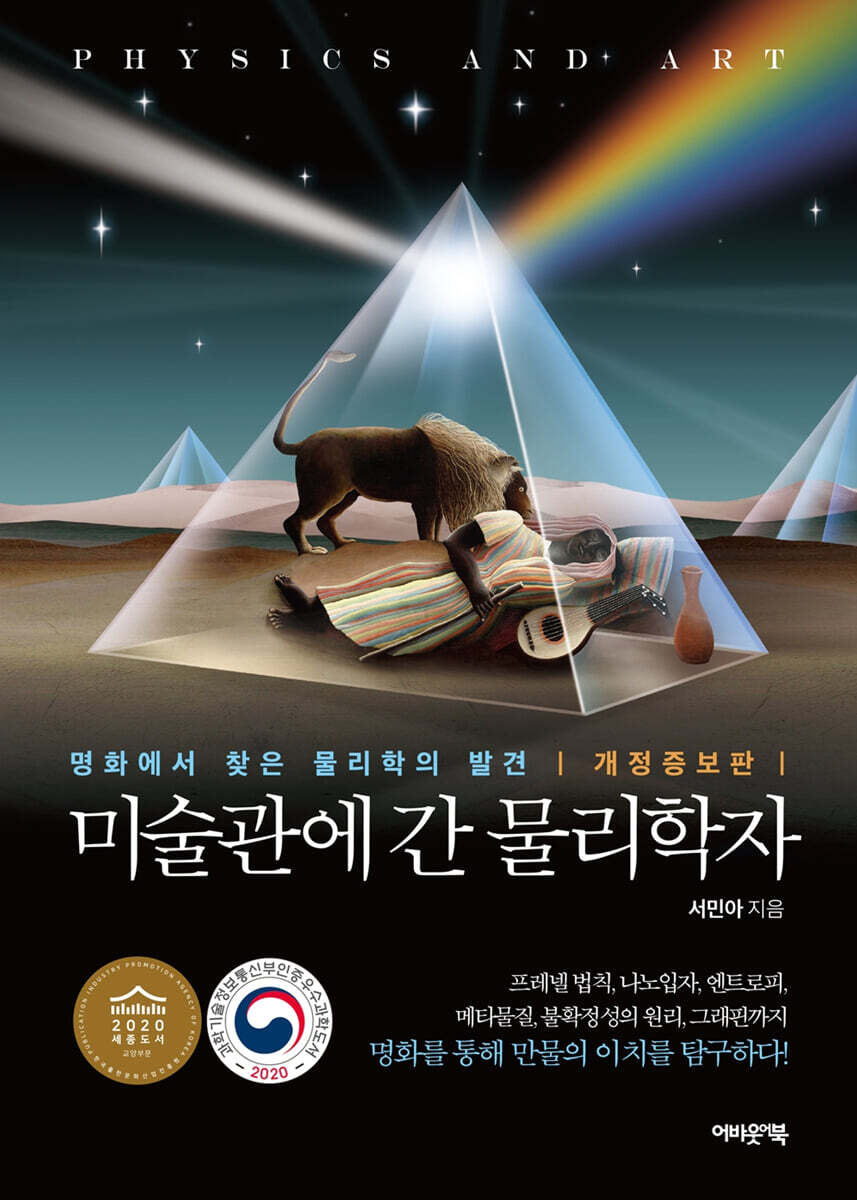
A physicist goes to an art museum
 |
Description
Book Introduction
A Physicist Who Went to the Museum: Recommended by Academics and Loved by Readers
A revised and expanded edition has been published, covering topics ranging from 'light' to 'artificial intelligence'!
Physics is the study of the principles of all things.
How do clouds form, how do we perceive the shape and color of objects, what process does sound go through to transmit, how can we stand on the constantly rotating Earth without falling… … .
Physicists are people who ask and answer questions about the nature of nature and the universe.
And the path of a scientist and the path of an artist are not different in that they each delve deeply into the 'essence of all things' in their own language.
Since the Renaissance, the muse of artists has been 'physics'.
Beginning in the 17th century, art and physics developed in parallel, following similar trajectories.
This book traces the development of art and physics through mutual inspiration.
The stained glass window that Chagall left behind in St. Stephen's Church is imbued with the science of quantum dots and nanoparticles, and da Vinci's [Mona Lisa] is imbued with the science of terahertz waves, also known as 'dream electromagnetic waves.'
Magritte's [The Treachery of Images] touches on the idea of quantum mechanics, and Mondrian's [Composition in Red, Blue and Yellow] contains science that explains the low-dimensional material world such as graphene.
This book becomes a 'prism', showing the colorful colors of physics that are revealed only when passing through a work of art.
Since its first publication in 2020, The Physicist at the Museum has received support from academia, education, and countless readers.
It has been honored with being selected as an excellent science book by the Ministry of Science and ICT, a Sejong book by the Korea Publication Industry Promotion Agency, and a recommended book by the Seoul National University Science Gifted Education Center, and has established itself as a steady seller in the science field for a long time.
This revised and expanded edition illuminates a broader range of topics through works of art, from "light," a long-standing subject of physics exploration, to "artificial intelligence," which is fundamentally shaking not only the scientific community but also individual lives.
Through [Annunciation], we unravel the secrets of the rainbow created by the refraction, dispersion, and reflection of light, and through [Ghent Altarpiece], our paintings [10-panel folding screen of the Haehak Peninsula], and [Cityscape (Taepyeongseongsido)], we illuminate the 'microscopic stitching' devised by scientists to satisfy the conflicting desires of seeing trees and forests at the same time.
The life of a star and the cosmic drama of galactic collisions are illuminated through the [Starry Night] paintings by Millet, Munch, and Van Gogh, respectively.
It also addresses the impact that artificial intelligence has had on the intersection of art and science.
In 2020, the image [Space Opera Theater], generated by inputting only a few keywords into an artificial intelligence program, won first place at a prestigious art exhibition, sparking heated debate.
The 2024 Nobel Prize in Physics will be awarded to John J.
Hopfield and Jeffrey E.
Back to Hinton.
Through works such as [Space Opera Theater], which is at the center of controversy, [Arirang Pass] by modern Korean painter Lee In-seong, and [Hunting Painting] from Goguryeo's Tomb of Dancers, we look back on the future society that artificial intelligence will create and the meaning of human creativity.
A revised and expanded edition has been published, covering topics ranging from 'light' to 'artificial intelligence'!
Physics is the study of the principles of all things.
How do clouds form, how do we perceive the shape and color of objects, what process does sound go through to transmit, how can we stand on the constantly rotating Earth without falling… … .
Physicists are people who ask and answer questions about the nature of nature and the universe.
And the path of a scientist and the path of an artist are not different in that they each delve deeply into the 'essence of all things' in their own language.
Since the Renaissance, the muse of artists has been 'physics'.
Beginning in the 17th century, art and physics developed in parallel, following similar trajectories.
This book traces the development of art and physics through mutual inspiration.
The stained glass window that Chagall left behind in St. Stephen's Church is imbued with the science of quantum dots and nanoparticles, and da Vinci's [Mona Lisa] is imbued with the science of terahertz waves, also known as 'dream electromagnetic waves.'
Magritte's [The Treachery of Images] touches on the idea of quantum mechanics, and Mondrian's [Composition in Red, Blue and Yellow] contains science that explains the low-dimensional material world such as graphene.
This book becomes a 'prism', showing the colorful colors of physics that are revealed only when passing through a work of art.
Since its first publication in 2020, The Physicist at the Museum has received support from academia, education, and countless readers.
It has been honored with being selected as an excellent science book by the Ministry of Science and ICT, a Sejong book by the Korea Publication Industry Promotion Agency, and a recommended book by the Seoul National University Science Gifted Education Center, and has established itself as a steady seller in the science field for a long time.
This revised and expanded edition illuminates a broader range of topics through works of art, from "light," a long-standing subject of physics exploration, to "artificial intelligence," which is fundamentally shaking not only the scientific community but also individual lives.
Through [Annunciation], we unravel the secrets of the rainbow created by the refraction, dispersion, and reflection of light, and through [Ghent Altarpiece], our paintings [10-panel folding screen of the Haehak Peninsula], and [Cityscape (Taepyeongseongsido)], we illuminate the 'microscopic stitching' devised by scientists to satisfy the conflicting desires of seeing trees and forests at the same time.
The life of a star and the cosmic drama of galactic collisions are illuminated through the [Starry Night] paintings by Millet, Munch, and Van Gogh, respectively.
It also addresses the impact that artificial intelligence has had on the intersection of art and science.
In 2020, the image [Space Opera Theater], generated by inputting only a few keywords into an artificial intelligence program, won first place at a prestigious art exhibition, sparking heated debate.
The 2024 Nobel Prize in Physics will be awarded to John J.
Hopfield and Jeffrey E.
Back to Hinton.
Through works such as [Space Opera Theater], which is at the center of controversy, [Arirang Pass] by modern Korean painter Lee In-seong, and [Hunting Painting] from Goguryeo's Tomb of Dancers, we look back on the future society that artificial intelligence will create and the meaning of human creativity.
- You can preview some of the book's contents.
Preview
index
Preface to the Revised Edition _ An Art Museum Opened at the End of a Wave of Light
Preface _ Physics has been the greatest muse to inspire artists!
Chapter 1.
Paintings drawn with light and colored with physics
ㆍWhat happened to the sun at that time?
: Pieter Bruegel, Winter Landscape with Birdtrap | The Little Ice Age
ㆍWas it the waves that were shaking, or was it their hearts?
: Auguste Renoir, "La Grenouillere" · Claude Monet, "La Grenouillere" | Waves and Interference
The blue skies of Santa Fe that brought O'Keeffe back to life
: Georgia O'Keeffe, "White Clouds and the Red Hills of Mount Federal" | Rayleigh and Mie Scattering
The light that drew God, drawing the future of humanity
Marc Chagall, Stained Glass, St. Stephen's Church | The Science of Quantum Dots and Nanoparticles
ㆍWaltz with atoms! “Shall we dance?”
: Auguste Renoir, "Ball at the Moulin de la Galette" | Phonons and the Physics of Photons
A painter who wanted to portray the expression of the sky
: John Constable, "The Hay Wagon" | Cloud Formation and the Cloud Chamber
ㆍUntil I draw myself as nothing
: Rembrandt van Rijn, Rembrandt the Laughing | Rays of Light According to Direction
ㆍSomething that exists in Western painting but not in Eastern painting
Shin Yun-bok, "Dano Wind" | Light and Shadow
The secret to the sense of space felt on a flat canvas
Johannes Vermeer, The Milkmaid | Perspective and the Camera Obscura
ㆍRainbow, Drawing the Mystery of Light
Jan van Eyck, "Stage" | Natural Art Created by Refraction, Reflection, and Dispersion
Chapter 2.
A painting depicting the muse called 'science'
ㆍHow far away should I look to see it most beautifully?
Georges Seurat, A Sunday Afternoon on the Island of La Grande Jatte | The Nature of Light and the Science of Seeing
ㆍImmortal moments captured on canvas
: Claude Monet, Haystacks, End of Summer at Giverny | Fresnel's Law
ㆍColor of love
Marc Chagall, "I and the Village" | Young-Helmholtz's Tricolor Theory
ㆍDraw what cannot be seen
Wassily Kandinsky, Yellow, Red, Blue | Sound and Gravitational Waves
ㆍLife forms swimming in a small universe
Gustav Klimt, Adele Bloch-Bauer I | The Limits of Light's Wavelength and Brownian Motion
ㆍA color that cohesively bonds more strongly as it repels
Vincent van Gogh, The Yellow House | Complementary Color Contrast
ㆍThe desire to see both the trees and the forest
Jan van Eyck, The Ghent Altarpiece | Part and Whole
The dream of a 'Sunday painter'
Henri Rousseau, The Sleeping Gypsy | Electromagnetic Induction
Chapter 3.
A picture drawn by Schrödinger's cat
ㆍTranquility in a universe filled with chaos
: Jackson Pollock, Autumn Rhythm (No.
30)〉 | Entropy and the Third Law of Thermodynamics
If I could stop the flow of time
Salvador Dali, The Exploding Head of Raphael | Nuclear Physics
When imagination meets science
: René Magritte, Decalcomania | Metamaterials
A mysterious glimpse into the universe
Pablo Picasso, Les Demoiselles d'Avignon | Quantum Mechanics and the Quantum Cheshire Cat
ㆍHe who wishes to be born must destroy a world.
Vladimir Kush, Sunrise on the Beach | The Uncertainty Principle and Schrödinger's Cat
Dancing atoms
Henri Matisse, "Dance II" | Atomic Model, Pitch and Wave
ㆍLow-dimensional world
: Piet Mondrian, Composition in Red, Blue, and Yellow | Lower-Dimensional Matter and Carbon Allotropes
The Science of Starry Nights
Jean-François Millet, The Starry Night | The Life of Stars and Galactic Collisions
Chapter 4.
Time in pictures turned back to physics
ㆍCan you be confident that you know everything about the Mona Lisa?
Leonardo da Vinci, Mona Lisa | Wavelengths and Penetration Depth of Light
The Great Forgery Scandal That Fooled Even the Nazis
Johannes Vermeer, "Woman Reading a Letter" | Terahertz Wave Analysis
ㆍThe woman hidden in the painting that appeared when the light was shined on her
: Vincent van Gogh, "At the Café, Agostina Segatori at Le Tinbourin" | Non-destructive testing using various light sources
We will continue to love the art museum.
Jason Allen, Space Opera Theater | Seeing the Paintings in a World Ruled by AI
Solving the mystery in the picture
Vincent van Gogh, "Sunflowers" | Analyzing the Painting Using Cutting-Edge Technology
ㆍThe one who turns back the time of the picture
Leonardo da Vinci, The Last Supper | Art Restoration
Browse works
Preface _ Physics has been the greatest muse to inspire artists!
Chapter 1.
Paintings drawn with light and colored with physics
ㆍWhat happened to the sun at that time?
: Pieter Bruegel, Winter Landscape with Birdtrap | The Little Ice Age
ㆍWas it the waves that were shaking, or was it their hearts?
: Auguste Renoir, "La Grenouillere" · Claude Monet, "La Grenouillere" | Waves and Interference
The blue skies of Santa Fe that brought O'Keeffe back to life
: Georgia O'Keeffe, "White Clouds and the Red Hills of Mount Federal" | Rayleigh and Mie Scattering
The light that drew God, drawing the future of humanity
Marc Chagall, Stained Glass, St. Stephen's Church | The Science of Quantum Dots and Nanoparticles
ㆍWaltz with atoms! “Shall we dance?”
: Auguste Renoir, "Ball at the Moulin de la Galette" | Phonons and the Physics of Photons
A painter who wanted to portray the expression of the sky
: John Constable, "The Hay Wagon" | Cloud Formation and the Cloud Chamber
ㆍUntil I draw myself as nothing
: Rembrandt van Rijn, Rembrandt the Laughing | Rays of Light According to Direction
ㆍSomething that exists in Western painting but not in Eastern painting
Shin Yun-bok, "Dano Wind" | Light and Shadow
The secret to the sense of space felt on a flat canvas
Johannes Vermeer, The Milkmaid | Perspective and the Camera Obscura
ㆍRainbow, Drawing the Mystery of Light
Jan van Eyck, "Stage" | Natural Art Created by Refraction, Reflection, and Dispersion
Chapter 2.
A painting depicting the muse called 'science'
ㆍHow far away should I look to see it most beautifully?
Georges Seurat, A Sunday Afternoon on the Island of La Grande Jatte | The Nature of Light and the Science of Seeing
ㆍImmortal moments captured on canvas
: Claude Monet, Haystacks, End of Summer at Giverny | Fresnel's Law
ㆍColor of love
Marc Chagall, "I and the Village" | Young-Helmholtz's Tricolor Theory
ㆍDraw what cannot be seen
Wassily Kandinsky, Yellow, Red, Blue | Sound and Gravitational Waves
ㆍLife forms swimming in a small universe
Gustav Klimt, Adele Bloch-Bauer I | The Limits of Light's Wavelength and Brownian Motion
ㆍA color that cohesively bonds more strongly as it repels
Vincent van Gogh, The Yellow House | Complementary Color Contrast
ㆍThe desire to see both the trees and the forest
Jan van Eyck, The Ghent Altarpiece | Part and Whole
The dream of a 'Sunday painter'
Henri Rousseau, The Sleeping Gypsy | Electromagnetic Induction
Chapter 3.
A picture drawn by Schrödinger's cat
ㆍTranquility in a universe filled with chaos
: Jackson Pollock, Autumn Rhythm (No.
30)〉 | Entropy and the Third Law of Thermodynamics
If I could stop the flow of time
Salvador Dali, The Exploding Head of Raphael | Nuclear Physics
When imagination meets science
: René Magritte, Decalcomania | Metamaterials
A mysterious glimpse into the universe
Pablo Picasso, Les Demoiselles d'Avignon | Quantum Mechanics and the Quantum Cheshire Cat
ㆍHe who wishes to be born must destroy a world.
Vladimir Kush, Sunrise on the Beach | The Uncertainty Principle and Schrödinger's Cat
Dancing atoms
Henri Matisse, "Dance II" | Atomic Model, Pitch and Wave
ㆍLow-dimensional world
: Piet Mondrian, Composition in Red, Blue, and Yellow | Lower-Dimensional Matter and Carbon Allotropes
The Science of Starry Nights
Jean-François Millet, The Starry Night | The Life of Stars and Galactic Collisions
Chapter 4.
Time in pictures turned back to physics
ㆍCan you be confident that you know everything about the Mona Lisa?
Leonardo da Vinci, Mona Lisa | Wavelengths and Penetration Depth of Light
The Great Forgery Scandal That Fooled Even the Nazis
Johannes Vermeer, "Woman Reading a Letter" | Terahertz Wave Analysis
ㆍThe woman hidden in the painting that appeared when the light was shined on her
: Vincent van Gogh, "At the Café, Agostina Segatori at Le Tinbourin" | Non-destructive testing using various light sources
We will continue to love the art museum.
Jason Allen, Space Opera Theater | Seeing the Paintings in a World Ruled by AI
Solving the mystery in the picture
Vincent van Gogh, "Sunflowers" | Analyzing the Painting Using Cutting-Edge Technology
ㆍThe one who turns back the time of the picture
Leonardo da Vinci, The Last Supper | Art Restoration
Browse works
Detailed image
Publisher's Review
◎ Physics has been the greatest muse of inspiration for artists!
Physics is the study of the principles of all things.
How do clouds form, how do we perceive the shape and color of objects, what process does sound go through to transmit, how can we stand on the constantly rotating Earth without falling… … .
Physicists are people who ask and answer questions about the nature of nature and the universe.
And the paths of scientists and artists are not very different in that they each delve into the 'essence of all things' in their own language.
The muse of Renaissance artists was the 'humanities'.
Drawing on literature, history, philosophy, and theology, masters like da Vinci, Michelangelo, and Raphael left behind immortal works.
However, after the Renaissance, the muse of artists shifted to 'physics'.
Beginning in the 17th century, art and physics developed in parallel, following similar trajectories.
Modern physics stands on two axes: the theory of relativity and quantum mechanics.
As Hesse said, “He who wants to be born must destroy a world.” Modern physics, which emerged in the early 20th century, completely shook the system of classical physics and opened up a new worldview.
Its starting point was the fundamental question, “Is light a particle or a wave?”
In the 17th century, Huygens of the Netherlands viewed light as a wave, and Newton of England viewed light as a stream of small particles.
This debate continued for centuries, and eventually, in the 20th century, quantum mechanics revealed that light is both a wave and a particle (p. 320).
Just as the debate surrounding the nature of light has advanced science, numerous currents of thought have emerged in the art world regarding how to interpret and express light.
Interestingly, the period when light began to be seriously explored in art was in the 17th century in the Netherlands, when Huygens sparked the light debate in physics.
Rembrandt (page 100) and Vermeer (page 129) brought light, which was merely a source of illumination, into the subject of their paintings, and this soon became the style that defined their identity.
Impressionist painters, aided by optics, understood that the color of an object is ultimately a result of 'reflection and transmission of light.'
They took their canvases outdoors and began to capture nature as it changed with the light.
The art world was shaken by the successive appearance of various movements such as Neo-Impressionism, Cubism, Fauvism, Surrealism, and Op Art in a short period of time.
This is in line with the flow of modern physics, in which numerous new theories have been proposed, refuted, and developed in an attempt to elucidate the nature of light (pp. 326-325).
◎ A flower born from the fusion of reason and emotion, blooming on canvas!
“Some people say they see poetry in my paintings, but I only see science.”
These are the words of the neo-impressionist painter Seurat.
He broke the stereotype that paintings must be drawn with lines, and created pointillism through persistent research into optics and physics.
To complete one painting, “A Sunday Afternoon on the Island of La Grande Jatte,” he created about 40 sketches and 20 drawings over two years.
The tiny dots that filled the canvas were the result of physical calculations and experiments (p. 177).
Jackson Pollock painted with his whole body, dripping and splashing paint.
The flow of paint was a product of chance and overlap, which brings to mind the 'uncertainty principle', a core concept in quantum mechanics.
This principle, which states that it is impossible to know both the position and velocity of a particle precisely at the same time, means that even if the initial conditions are known, the future state cannot be perfectly predicted.
Just as the law of entropy states that disorder flows in the direction of increasing, Pollock's paintings most truthfully reproduce nature in disorder (p. 274).
Van Gogh sold only one painting during his lifetime.
An artist who painted as if he was breathing but could not sell his work was destined to be poor.
Because he didn't have enough money to buy paper, he drew on the back of his paintings. Because he didn't have enough money to buy a model, he used himself as a model and drew a self-portrait in front of a mirror.
Segatori, Van Gogh's lover, became a model and stood in front of the poor Van Gogh.
The painting that was born in this way is “Agostina Segatori at Le Tinbourin, in the Café.”
As optical technology advances, light of various wavelengths, such as X-rays, infrared rays, and terahertz waves, is being used to analyze works of art.
When the Van Gogh Museum X-rayed this painting, they were astonished to discover that the face of another woman had appeared in the underpainting! Poor Van Gogh had reused the canvas.
A painting that was almost buried forever was revived thanks to light (page 392).
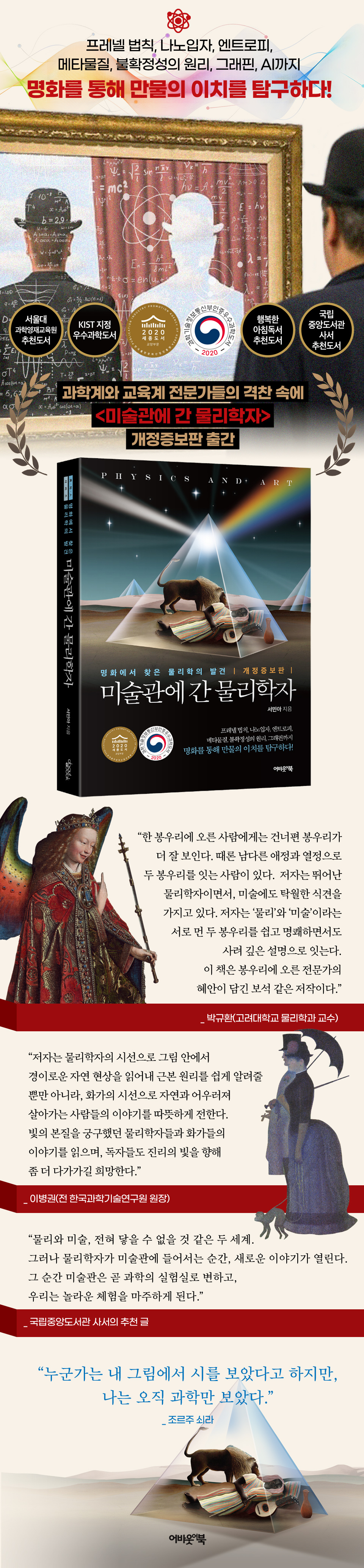
◎ Recommended by academics and loved by readers, "The Physicist Who Went to the Art Museum"
A revised and expanded edition has been published, covering topics ranging from 'light' to 'artificial intelligence'!
Since its first publication in 2020, The Physicist at the Museum has received support from academia, education, and countless readers.
It has been honored with being selected as an excellent science book by the Ministry of Science and ICT, a Sejong book by the Korea Publication Industry Promotion Agency, and a recommended book by the Seoul National University Science Gifted Education Center, and has established itself as a steady seller in the science field for a long time.
This revised and expanded edition illuminates a broader range of topics through works of art, from "light," a long-standing subject of physics exploration, to "artificial intelligence," which is fundamentally shaking not only the scientific community but also individual lives.
Through the Annunciation, the secret of the rainbow created by the refraction, dispersion, and reflection of light is revealed (p. 146), and through the Ghent Altarpiece, our paintings, the 10-panel folding screen of the Haehak Peninsula, and the Cityscape (Taepyeongseongsido), the 'microscopic sewing' devised by scientists to satisfy the conflicting desires of seeing trees and forests at the same time is illuminated (p. 248).
The life of stars and the cosmic drama of galactic collisions are illuminated through the Starry Nights by Millet, Munch, and Van Gogh (p. 352).
It also addresses the impact that artificial intelligence has had on the intersection of art and science.
In 2020, the image "Space Opera Theater," generated by inputting only a few keywords into an artificial intelligence program, won first place at a prestigious art exhibition, sparking heated debate.
The 2024 Nobel Prize in Physics will be awarded to John J.
Hopfield and Jeffrey E.
Back to Hinton.
Through the controversial “Space Opera Theater,” “Arirang Pass” by modern Korean painter Lee In-seong, and “Hunting Painting” from Goguryeo’s Tomb of the Dancers, we look back on the future society that artificial intelligence will create and the meaning of human creativity (p. 402).
‘Waves’, which originated from physics exploring the nature of light, became an art form that moved people’s hearts when it reached the painter.
This book unravels modern physics through works conceived through the interaction between physics and art.
When we look at the picture through the eyes of a physicist, we will experience a whole new emotion.
Physics is the study of the principles of all things.
How do clouds form, how do we perceive the shape and color of objects, what process does sound go through to transmit, how can we stand on the constantly rotating Earth without falling… … .
Physicists are people who ask and answer questions about the nature of nature and the universe.
And the paths of scientists and artists are not very different in that they each delve into the 'essence of all things' in their own language.
The muse of Renaissance artists was the 'humanities'.
Drawing on literature, history, philosophy, and theology, masters like da Vinci, Michelangelo, and Raphael left behind immortal works.
However, after the Renaissance, the muse of artists shifted to 'physics'.
Beginning in the 17th century, art and physics developed in parallel, following similar trajectories.
Modern physics stands on two axes: the theory of relativity and quantum mechanics.
As Hesse said, “He who wants to be born must destroy a world.” Modern physics, which emerged in the early 20th century, completely shook the system of classical physics and opened up a new worldview.
Its starting point was the fundamental question, “Is light a particle or a wave?”
In the 17th century, Huygens of the Netherlands viewed light as a wave, and Newton of England viewed light as a stream of small particles.
This debate continued for centuries, and eventually, in the 20th century, quantum mechanics revealed that light is both a wave and a particle (p. 320).
Just as the debate surrounding the nature of light has advanced science, numerous currents of thought have emerged in the art world regarding how to interpret and express light.
Interestingly, the period when light began to be seriously explored in art was in the 17th century in the Netherlands, when Huygens sparked the light debate in physics.
Rembrandt (page 100) and Vermeer (page 129) brought light, which was merely a source of illumination, into the subject of their paintings, and this soon became the style that defined their identity.
Impressionist painters, aided by optics, understood that the color of an object is ultimately a result of 'reflection and transmission of light.'
They took their canvases outdoors and began to capture nature as it changed with the light.
The art world was shaken by the successive appearance of various movements such as Neo-Impressionism, Cubism, Fauvism, Surrealism, and Op Art in a short period of time.
This is in line with the flow of modern physics, in which numerous new theories have been proposed, refuted, and developed in an attempt to elucidate the nature of light (pp. 326-325).
◎ A flower born from the fusion of reason and emotion, blooming on canvas!
“Some people say they see poetry in my paintings, but I only see science.”
These are the words of the neo-impressionist painter Seurat.
He broke the stereotype that paintings must be drawn with lines, and created pointillism through persistent research into optics and physics.
To complete one painting, “A Sunday Afternoon on the Island of La Grande Jatte,” he created about 40 sketches and 20 drawings over two years.
The tiny dots that filled the canvas were the result of physical calculations and experiments (p. 177).
Jackson Pollock painted with his whole body, dripping and splashing paint.
The flow of paint was a product of chance and overlap, which brings to mind the 'uncertainty principle', a core concept in quantum mechanics.
This principle, which states that it is impossible to know both the position and velocity of a particle precisely at the same time, means that even if the initial conditions are known, the future state cannot be perfectly predicted.
Just as the law of entropy states that disorder flows in the direction of increasing, Pollock's paintings most truthfully reproduce nature in disorder (p. 274).
Van Gogh sold only one painting during his lifetime.
An artist who painted as if he was breathing but could not sell his work was destined to be poor.
Because he didn't have enough money to buy paper, he drew on the back of his paintings. Because he didn't have enough money to buy a model, he used himself as a model and drew a self-portrait in front of a mirror.
Segatori, Van Gogh's lover, became a model and stood in front of the poor Van Gogh.
The painting that was born in this way is “Agostina Segatori at Le Tinbourin, in the Café.”
As optical technology advances, light of various wavelengths, such as X-rays, infrared rays, and terahertz waves, is being used to analyze works of art.
When the Van Gogh Museum X-rayed this painting, they were astonished to discover that the face of another woman had appeared in the underpainting! Poor Van Gogh had reused the canvas.
A painting that was almost buried forever was revived thanks to light (page 392).
◎ Recommended by academics and loved by readers, "The Physicist Who Went to the Art Museum"
A revised and expanded edition has been published, covering topics ranging from 'light' to 'artificial intelligence'!
Since its first publication in 2020, The Physicist at the Museum has received support from academia, education, and countless readers.
It has been honored with being selected as an excellent science book by the Ministry of Science and ICT, a Sejong book by the Korea Publication Industry Promotion Agency, and a recommended book by the Seoul National University Science Gifted Education Center, and has established itself as a steady seller in the science field for a long time.
This revised and expanded edition illuminates a broader range of topics through works of art, from "light," a long-standing subject of physics exploration, to "artificial intelligence," which is fundamentally shaking not only the scientific community but also individual lives.
Through the Annunciation, the secret of the rainbow created by the refraction, dispersion, and reflection of light is revealed (p. 146), and through the Ghent Altarpiece, our paintings, the 10-panel folding screen of the Haehak Peninsula, and the Cityscape (Taepyeongseongsido), the 'microscopic sewing' devised by scientists to satisfy the conflicting desires of seeing trees and forests at the same time is illuminated (p. 248).
The life of stars and the cosmic drama of galactic collisions are illuminated through the Starry Nights by Millet, Munch, and Van Gogh (p. 352).
It also addresses the impact that artificial intelligence has had on the intersection of art and science.
In 2020, the image "Space Opera Theater," generated by inputting only a few keywords into an artificial intelligence program, won first place at a prestigious art exhibition, sparking heated debate.
The 2024 Nobel Prize in Physics will be awarded to John J.
Hopfield and Jeffrey E.
Back to Hinton.
Through the controversial “Space Opera Theater,” “Arirang Pass” by modern Korean painter Lee In-seong, and “Hunting Painting” from Goguryeo’s Tomb of the Dancers, we look back on the future society that artificial intelligence will create and the meaning of human creativity (p. 402).
‘Waves’, which originated from physics exploring the nature of light, became an art form that moved people’s hearts when it reached the painter.
This book unravels modern physics through works conceived through the interaction between physics and art.
When we look at the picture through the eyes of a physicist, we will experience a whole new emotion.
GOODS SPECIFICS
- Date of issue: October 10, 2025
- Page count, weight, size: 446 pages | 150*210*30mm
- ISBN13: 9791192229706
- ISBN10: 1192229703
You may also like
카테고리
korean


korean

![GQ KOREA Mark (Monthly): December [2025]](http://librairie.coreenne.fr/cdn/shop/files/8ef265dbbfbf186523ed75ba7319009d.jpg?v=1765340328&width=3840)


