

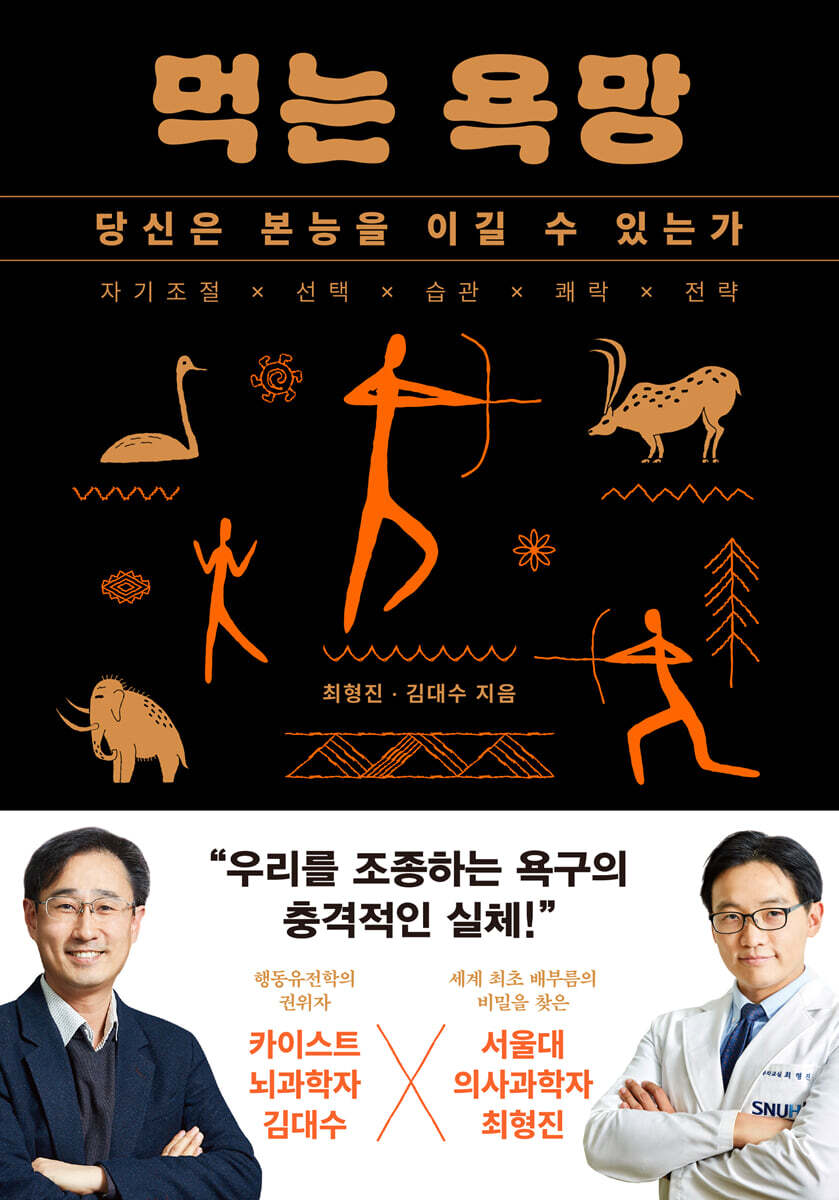
desire to eat
 |
Description
Book Introduction
- A word from MD
-
If you keep eating like this, you'll dieThe world's leading cause of death is heart disease, and the second leading cause is stroke.
It is related to obesity.
The incidence of diabetes is also increasing.
It's evidence that you're eating badly.
Most people know.
The fact that we are eating too much for nothing.
So why do diets keep failing?
Exploring a career in neuroscience and medicine.
July 29, 2025. Humanities PD Son Min-gyu
“The two faces of danger and blessing,
“The shocking truth about the desires that control us!”
Understand the cool-headed basis of neuroscience
Learn practical medical methods!
The world's first secret to fullness discovered
Choi Hyeong-jin, a physician-scientist at Seoul National University
×
An authority on behavioral genetics
KAIST neuroscientist Kim Dae-soo
★ Hot topic of appearance on "You Quiz on the Block" ★
Professor Choi Hyung-jin, a Seoul National University physician-scientist who discovered the secret to fullness for the first time in the world, and Professor Kim Dae-soo, a KAIST neuroscientist and authority on behavioral genetics, uncover the shocking truth about the desire to eat, which is the greatest human desire and has two faces: danger and blessing.
The hottest issue in the world right now, including Wigobi, Saxenda, and Zebbound, is 'How can we control the human desire to eat?'
Two leading figures, a physician-scientist and a neuroscientist, take us on a bold and surprising journey of exploration into this desire that influences every aspect of our daily lives, and even propose practical solutions.
We face the desire to eat every day.
However, they do not know the danger of how much the desire that fills their mouths with pleasure can lead a person to great ruin and ultimately death, and they are even less aware of the greatness of how that desire created the foundation of the ecosystem called human society.
This book delves into the true nature of our inexplicable desire to eat, providing a sobering understanding of the neuroscientific basis for our inexplicable desires and practical medical knowledge.
When we take a closer look at our desire to eat—our daily struggles between choices and habits, between unbearable cravings and moderation—we can approach life in a completely different way.
“The shocking truth about the desires that control us!”
Understand the cool-headed basis of neuroscience
Learn practical medical methods!
The world's first secret to fullness discovered
Choi Hyeong-jin, a physician-scientist at Seoul National University
×
An authority on behavioral genetics
KAIST neuroscientist Kim Dae-soo
★ Hot topic of appearance on "You Quiz on the Block" ★
Professor Choi Hyung-jin, a Seoul National University physician-scientist who discovered the secret to fullness for the first time in the world, and Professor Kim Dae-soo, a KAIST neuroscientist and authority on behavioral genetics, uncover the shocking truth about the desire to eat, which is the greatest human desire and has two faces: danger and blessing.
The hottest issue in the world right now, including Wigobi, Saxenda, and Zebbound, is 'How can we control the human desire to eat?'
Two leading figures, a physician-scientist and a neuroscientist, take us on a bold and surprising journey of exploration into this desire that influences every aspect of our daily lives, and even propose practical solutions.
We face the desire to eat every day.
However, they do not know the danger of how much the desire that fills their mouths with pleasure can lead a person to great ruin and ultimately death, and they are even less aware of the greatness of how that desire created the foundation of the ecosystem called human society.
This book delves into the true nature of our inexplicable desire to eat, providing a sobering understanding of the neuroscientific basis for our inexplicable desires and practical medical knowledge.
When we take a closer look at our desire to eat—our daily struggles between choices and habits, between unbearable cravings and moderation—we can approach life in a completely different way.
- You can preview some of the book's contents.
Preview
index
introduction
The Brain-Driven Energy Revolution: Dae-soo Kim
Manufactured Pleasure Threatens Everyday Life: Choi Hyung-jin
Part 1.
Why do you eat?
Someone's Manipulating Your Taste Right Now: Choi Hyung-jin
High-Level Hunting Strategy: The Birth of the Meta Hunter: Kim Dae-soo
Part 2.
The illusion that eating is a matter of personal decision
The Powerful Brain's Desire to Control Me: Kim Dae-soo
We're Being Deprived of the Happiness of Eating Without Realizing It: Choi Hyeong-jin
Part 3.
We can make better choices
How to Avoid Being Fooled by Subtle and Subtle Pleasures: Choi Hyung-jin
In an unavoidable competitive society, what is your hunting strategy? : Kim Dae-soo
Part 4.
The Dilemma of Habit and Addiction
The Successful Science of Moderation: The Brain Science of Overcoming Habits and Addictions: Kim Dae-su
Anxiety Makes You More Obsessed: Choi Hyeong-jin
Part 5.
The Impact of Obesity on Our Lives
Is Obesity Shameful?: Choi Hyeong-jin
Brain Science to Overcome Obesity: Kim Dae-soo
Part 6.
Dangerous desires shake up work and life.
Becoming a Charming Hunter: Kim Dae-soo
People who eat because they're depressed, eat because they're sad, eat because they're feeling good: Choi Hyeong-jin
Part 7.
A massive tectonic shift that changes the course of life
An Innovative Obesity Treatment That Aids Self-Regulation: Choi Hyung-jin
We must pursue humanity by sharing energy: Kim Dae-su
The Brain-Driven Energy Revolution: Dae-soo Kim
Manufactured Pleasure Threatens Everyday Life: Choi Hyung-jin
Part 1.
Why do you eat?
Someone's Manipulating Your Taste Right Now: Choi Hyung-jin
High-Level Hunting Strategy: The Birth of the Meta Hunter: Kim Dae-soo
Part 2.
The illusion that eating is a matter of personal decision
The Powerful Brain's Desire to Control Me: Kim Dae-soo
We're Being Deprived of the Happiness of Eating Without Realizing It: Choi Hyeong-jin
Part 3.
We can make better choices
How to Avoid Being Fooled by Subtle and Subtle Pleasures: Choi Hyung-jin
In an unavoidable competitive society, what is your hunting strategy? : Kim Dae-soo
Part 4.
The Dilemma of Habit and Addiction
The Successful Science of Moderation: The Brain Science of Overcoming Habits and Addictions: Kim Dae-su
Anxiety Makes You More Obsessed: Choi Hyeong-jin
Part 5.
The Impact of Obesity on Our Lives
Is Obesity Shameful?: Choi Hyeong-jin
Brain Science to Overcome Obesity: Kim Dae-soo
Part 6.
Dangerous desires shake up work and life.
Becoming a Charming Hunter: Kim Dae-soo
People who eat because they're depressed, eat because they're sad, eat because they're feeling good: Choi Hyeong-jin
Part 7.
A massive tectonic shift that changes the course of life
An Innovative Obesity Treatment That Aids Self-Regulation: Choi Hyung-jin
We must pursue humanity by sharing energy: Kim Dae-su
Detailed image

Into the book
Humans are great energy hunters.
Humans utilize their developed brains to generate greater energy benefits than other animals.
The human brain was built for adaptation, but it performed that task so faithfully that it obtained more energy from nature than it needed.
Civilization was built on energy that was more than enough to last, and civilization increased the population and created a society that did not have to find its own food.
People who deliberately abstained from eating emerged, and the first society in the universe was established where the saying that life is not all about eating was considered a famous saying.
--- p.6
I have lived a life of being prescribed the same diabetes medication over and over again every three months.
Nothing has changed.
Unable to overcome their desires, people continued to suffer, knew they would suffer but could not stop, and died.
I could make money, but I couldn't save them from death.
A fundamental solution was needed.
I decided to quit being a doctor.
I could not stand by and watch my children and grandchildren live lives driven by false pleasures and desires, just like the people of this generation.
I thought I had to save people from their polluted desires.
If we can uncover the secret of this desire, we can enjoy the freedom of liberation from the diseases created by capitalism: obesity, diabetes, and cardiovascular disease.
--- p.14~15
Modern society is forcing each of us into a cycle of addiction that we know is bad but cannot break free from.
In the midst of the many operating principles of modern society based on addiction, addiction becomes stronger and we become weaker.
The weaker you become, the more you become dependent on your own power drinks, power snacks, and power foods.
The food industry is increasingly powerful and insidiously invading our lives because it can make more money by making us more dependent.
--- p.34
People who desire energy can reflect on themselves and design a better life strategy of their own.
Although we have inherited from our ancestors the constant pursuit of energy, we can choose how we live our lives.
You can't avoid the waves that come your way, but you can choose where to ride them.
--- p.56
Sugar itself is not inherently pleasurable, but mutations that made sugar feel painful did not survive, while mutations that made sugar feel pleasurable survived.
Conversely, mutants who felt pleasure from the dust did not survive, while mutants who felt pain from the dust survived.
Mutations that feel pleasure in things that are advantageous to survival and reproduction have been increasingly selected and accumulated.
--- p.112
From a neuroscientific perspective, following visible prey is an instinct, and suppressing that instinct is the only way to prevent chasing behavior.
But it is not easy to suppress instinct.
This is because instincts are unconscious and react regardless of my will.
Watching pornography creates sexual desire, watching mukbang creates appetite, and watching luxury goods creates material desire. These are instincts created by the brain.
Instincts cannot be suppressed; we can only delay the actions that pursue them.
We need the aesthetics of waiting, of not following our hunting instincts and of delaying the process of watching the herds of gazelles and wildebeests slowly move away.
--- p.139
It is easy to think that obesity is caused by an abundance of food.
But the reality is the opposite.
Food insecurity, which is caused by food insecurity and instability, further contributes to obesity.
Numerous studies have shown that people with severe obesity are not those who are wealthy and have abundant food.
Severe obesity is occurring among people who are poor and cannot secure stable access to adequate food.
--- p.168~169
To become healthy, it is important to regain your identity as a hunter.
When we don't overload ourselves with news and exercise, our bodies, which are natural hunters, work to maintain optimal condition.
Our body's cells and genes survive by making bold investments to create the best possible body, even when energy is scarce.
A hungry hunter is healthy.
Because you have to be healthy to hunt prey and survive.
--- p.215
What should we do with the powerful appetite that comes with depressed mood? Even if we shake off these feelings and cravings for a while, they often return, slowly rising from the dark recesses of our hearts.
It's so hard to shake off until you've finally eaten more than you've endured.
Is there no way to overcome this powerful desire that drags me down deep underground?
--- p.247
Our research team identified which part of the brain GLP-1 acts on and through what psychological mechanism it suppresses appetite, and published a paper in the world-renowned scientific journal Science in 2024.
The title of the paper is 'GLP-1 increases preingestive satiation via hypothalamic circuits in mice and humans', and it clarified the mechanism by which the anti-obesity drug GLP-1, a gut hormone analogue, induces fullness simply by recognizing food, and specifically which part of the brain and which type of cell it acts on to cause this effect.
This is the most important study our research team has ever conducted.
Humans utilize their developed brains to generate greater energy benefits than other animals.
The human brain was built for adaptation, but it performed that task so faithfully that it obtained more energy from nature than it needed.
Civilization was built on energy that was more than enough to last, and civilization increased the population and created a society that did not have to find its own food.
People who deliberately abstained from eating emerged, and the first society in the universe was established where the saying that life is not all about eating was considered a famous saying.
--- p.6
I have lived a life of being prescribed the same diabetes medication over and over again every three months.
Nothing has changed.
Unable to overcome their desires, people continued to suffer, knew they would suffer but could not stop, and died.
I could make money, but I couldn't save them from death.
A fundamental solution was needed.
I decided to quit being a doctor.
I could not stand by and watch my children and grandchildren live lives driven by false pleasures and desires, just like the people of this generation.
I thought I had to save people from their polluted desires.
If we can uncover the secret of this desire, we can enjoy the freedom of liberation from the diseases created by capitalism: obesity, diabetes, and cardiovascular disease.
--- p.14~15
Modern society is forcing each of us into a cycle of addiction that we know is bad but cannot break free from.
In the midst of the many operating principles of modern society based on addiction, addiction becomes stronger and we become weaker.
The weaker you become, the more you become dependent on your own power drinks, power snacks, and power foods.
The food industry is increasingly powerful and insidiously invading our lives because it can make more money by making us more dependent.
--- p.34
People who desire energy can reflect on themselves and design a better life strategy of their own.
Although we have inherited from our ancestors the constant pursuit of energy, we can choose how we live our lives.
You can't avoid the waves that come your way, but you can choose where to ride them.
--- p.56
Sugar itself is not inherently pleasurable, but mutations that made sugar feel painful did not survive, while mutations that made sugar feel pleasurable survived.
Conversely, mutants who felt pleasure from the dust did not survive, while mutants who felt pain from the dust survived.
Mutations that feel pleasure in things that are advantageous to survival and reproduction have been increasingly selected and accumulated.
--- p.112
From a neuroscientific perspective, following visible prey is an instinct, and suppressing that instinct is the only way to prevent chasing behavior.
But it is not easy to suppress instinct.
This is because instincts are unconscious and react regardless of my will.
Watching pornography creates sexual desire, watching mukbang creates appetite, and watching luxury goods creates material desire. These are instincts created by the brain.
Instincts cannot be suppressed; we can only delay the actions that pursue them.
We need the aesthetics of waiting, of not following our hunting instincts and of delaying the process of watching the herds of gazelles and wildebeests slowly move away.
--- p.139
It is easy to think that obesity is caused by an abundance of food.
But the reality is the opposite.
Food insecurity, which is caused by food insecurity and instability, further contributes to obesity.
Numerous studies have shown that people with severe obesity are not those who are wealthy and have abundant food.
Severe obesity is occurring among people who are poor and cannot secure stable access to adequate food.
--- p.168~169
To become healthy, it is important to regain your identity as a hunter.
When we don't overload ourselves with news and exercise, our bodies, which are natural hunters, work to maintain optimal condition.
Our body's cells and genes survive by making bold investments to create the best possible body, even when energy is scarce.
A hungry hunter is healthy.
Because you have to be healthy to hunt prey and survive.
--- p.215
What should we do with the powerful appetite that comes with depressed mood? Even if we shake off these feelings and cravings for a while, they often return, slowly rising from the dark recesses of our hearts.
It's so hard to shake off until you've finally eaten more than you've endured.
Is there no way to overcome this powerful desire that drags me down deep underground?
--- p.247
Our research team identified which part of the brain GLP-1 acts on and through what psychological mechanism it suppresses appetite, and published a paper in the world-renowned scientific journal Science in 2024.
The title of the paper is 'GLP-1 increases preingestive satiation via hypothalamic circuits in mice and humans', and it clarified the mechanism by which the anti-obesity drug GLP-1, a gut hormone analogue, induces fullness simply by recognizing food, and specifically which part of the brain and which type of cell it acts on to cause this effect.
This is the most important study our research team has ever conducted.
--- p.264
Publisher's Review
From human evolution to the latest science such as Wigobi and Saxenda
All About the Desire to Eat
“In our busy daily lives, the desire to eat
A Guide to Recovery for Modern People Driven by Insanity
Why is the desire to eat so important? Because so many stimuli and foods have come to dominate every aspect of our daily lives.
What we eat affects every aspect of our lives, including our relationships, upbringing, lifestyle, work performance, medical costs, and the wealth gap.
Humans evolved to pursue pleasure, and modern society tempts us, forcing each of us into a cycle of addiction that we know is bad but cannot break.
Understanding how the brain interprets and regulates these desires that shape our lives, and what role they have played in human evolution and development, will unlock many of life's secrets.
Here, the country's top medical scientists and neuroscientists met.
Armed with medical evidence and solutions, as well as neuroscientific knowledge and insights, we help you see life from a completely different perspective.
Addicted to the pleasure and craving of eating, they constantly put deadly poison into their mouths, swallow it, and die, leading them to their own death.
Even though I know I'll die if I keep eating, I can't stop.
I've lived a life where I've been prescribed the same diabetes medication over and over again every three months.
Nothing has changed.
Unable to overcome their desires, people continued to suffer, knew they would suffer but could not stop, and died.
I could make money, but I couldn't save them from death.
A fundamental solution was needed.
I decided to quit being a doctor.
_Choi Hyeong-jin
During his 13 years of dedicated medical practice, Professor Choi Hyeong-jin encountered countless patients with serious problems such as myocardial infarction, blood sugar control, and diabetes, but who could not control their cravings for food.
Even though the same diabetes medication was prescribed repeatedly, patients were lured by false pleasure and cravings.
To fundamentally solve this problem, I quit my job as a doctor and have been dedicated to basic science research for the past 10 years.
As a result, he has been making important scientific achievements, such as being the first in the world to identify the mechanism by which the hypothalamus of the brain reacts with an anti-obesity drug to suppress appetite, which was published in Science in 2024, and being selected as one of the 100 Next Generation Leaders in 2024.
In this book, Professor Choi Hyeong-jin vividly presents his experiences and research achievements, and includes medical knowledge and practical methods based on the cases and results of patients who have overcome suffering.
This fascinating case study delves into the fundamental reasons why we say, "I shouldn't do it, I should endure it," but still break down, and why we eat and drink and act on desires even though we clearly know that it is harmful to our bodies.
It helps us look at our unbearable desires objectively and ultimately shows us how to break free from them.
Neuroscientist Professor Dae-soo Kim reveals that the human desire to eat has been recorded in our genes over millions of years of human history, and that this desire has manifested itself in various ways, serving as a core energy source that has built a vast civilization and shaped human society.
Humans utilize their developed brains to generate greater energy benefits than other animals.
The human brain was built for adaptation, but it performed that task so faithfully that it obtained more energy from nature than it needed.
Civilization was built on energy that was more than enough to last, and civilization increased the population and created a society that did not have to find its own food.
People who deliberately abstained from eating emerged, and the first society in the universe was established where the saying that life isn't all about eating was considered a famous saying.
_Kim Dae-soo
Why does our brain constantly lure us into inescapable desires? Professor Dae-soo Kim, an authority on behavioral genetics, explores the history of humankind, from prehistoric times to space science, from a geneticist's perspective. He vividly reveals how this dangerous yet alluring desire has driven the development of human society.
This unique pursuit, unseen in any other animal, is explored through philosophy, literature, art, and thousands of years of history, helping us understand it at a glance.
It also reveals the surprising secret of how humans, who have no need to hunt for food but instead have projected the ecological principle of eating and being eaten onto their work, relationships, power, and social status.
Professor Kim Dae-soo defines humans as highly developed hunters, "metahunters," and explains how humans, as top predators in the ecosystem, have built their desire to eat and be eaten into human society, and what strategies each of us should adopt in such a human society.
This book provides us, who are driven by the desire to eat in our busy daily lives, with a cool-headed, neuroscientific perspective on 'what is happening in our bodies right now' and medical advice on 'how we can make choices for a better life.'
As you follow this book, you will discover solutions to create a balance for a better life.
While using instinct
The fate of humanity that must fight
“Are your control abilities okay?”
The two scholars tell the story in an exciting way.
Neuroscientists and physicianscientists each present their own perspectives on a single topic.
For example, in Part 3, under the theme of “What is a Good Choice?”, pseudoscientist Professor Choi Hyeong-jin explores what leads us to false pleasure and provides methods to avoid falling into false desires.
Here, neuroscientist Professor Dae-soo Kim explains how the relationship between eating and being eaten is realized in human society, and advises on how to wisely utilize our instincts when designing life strategies.
Part 6 talks about 'the desire to eat that shakes up our work and life.'
Professor Kim Dae-soo explores ways for humans, now top predators in the ecosystem, to evolve into attractive hunters while still pursuing humanity, while Professor Choi Hyeong-jin explains why we develop the habit of solving work-related stress and interpersonal conflicts through eating, and advises on how to deal with this attitude of eating because of our mood.
Recently, there has been a lot of social and personal interest in appetite suppressants such as Vigovi, Saxenda, and Zebbound.
Professor Choi Hyung-jin, a medical scientist, was the first in the world to discover that the GLP-1 obesity treatment acts on the hypothalamus of the brain to induce a feeling of fullness and suppress appetite simply by recognizing food.
In "Eating Desire," Professor Choi Hyeong-jin provides detailed information on the mechanisms, side effects, social influence, and personal utilization methods of GLP-1 hormone-based appetite suppressants, which are causing a huge tectonic shift.
Our research team identified which part of the brain GLP-1 acts on and through what psychological mechanism it suppresses appetite, and published a paper in the world-renowned scientific journal Science in 2024.
(…) The mechanism by which the GLP-1 anti-obesity drug, a gut hormone analog, induces satiety simply by recognizing food has been elucidated, and specifically which part of the brain and which type of cells it acts on to induce this effect.
This is the most important study our research team has ever conducted.
_Choi Hyeong-jin
Professor Choi Hyeong-jin reveals the struggles, process, and achievements that led to the research results recently published in Science and recognized as important scientific achievements, and emphasizes the direction in which society and individuals should respond and move forward.
In particular, thanks to the very powerful and effective anti-obesity drugs, humans can be saved from the deathly desire surrounding appetite, but not all problems have been solved, and the point that we must take this opportunity to fundamentally reform our lifestyles reminds us of our destiny, which we must confront while utilizing our human instincts.
Our reflections on our destiny shine even brighter when combined with Professor Kim Dae-soo's reflections.
Humans have become advanced hunters who can obtain prey without having to hunt directly, and have established an ecosystem of eating and being eaten in the form of human society.
With energy to spare, they were finally able to break free from the shackles of survival and reproduction and gain the right to live freely.
Are humans free now? (…) Humans have the ability to achieve freedom, but they do not know how to use it.
_Kim Dae-soo
Professor Kim Dae-soo, who had been pondering countless questions such as, 'How are the origins of life, the origins of civilization, and the origins of religion and philosophy closely connected to the human desire to eat?' one day, he had a great realization while having a meal with his 86-year-old mother.
After my father passed away, it was none other than food that reawakened my mother's brain, who was suffering from severe dementia. This made me realize 'what is the true freedom that the brain seeks?'
Professor Kim Dae-soo demonstrates throughout the book that the discourse on freedom and happiness is not limited to excellence and competence, but is also connected to the everyday science of eating and drinking that humans engage in every day.
The two scholars' bold exploration is a scientific and medical insight into desire, a human reflection on what it means to live by consuming energy, and a biological inquiry into what it means to sustain life within a vast ecosystem and millions of years of human history.
Through the writings of these two scholars, we will be able to look at our daily but often unaware desire to eat from a different perspective and embrace life with a broader perspective.
This book will reveal solid principles and methods for how to effectively utilize and sometimes wisely combat the instincts of humans, animals designed to pursue pleasure for survival and reproduction.
It is time to properly understand the desires that influence our daily choices.
Only then can we personally live freer and healthier lives, and furthermore, our society can develop in a healthier direction.
This book will serve as a compass that will help us reexamine our lives from the ground up and innovatively change our way of life.
All About the Desire to Eat
“In our busy daily lives, the desire to eat
A Guide to Recovery for Modern People Driven by Insanity
Why is the desire to eat so important? Because so many stimuli and foods have come to dominate every aspect of our daily lives.
What we eat affects every aspect of our lives, including our relationships, upbringing, lifestyle, work performance, medical costs, and the wealth gap.
Humans evolved to pursue pleasure, and modern society tempts us, forcing each of us into a cycle of addiction that we know is bad but cannot break.
Understanding how the brain interprets and regulates these desires that shape our lives, and what role they have played in human evolution and development, will unlock many of life's secrets.
Here, the country's top medical scientists and neuroscientists met.
Armed with medical evidence and solutions, as well as neuroscientific knowledge and insights, we help you see life from a completely different perspective.
Addicted to the pleasure and craving of eating, they constantly put deadly poison into their mouths, swallow it, and die, leading them to their own death.
Even though I know I'll die if I keep eating, I can't stop.
I've lived a life where I've been prescribed the same diabetes medication over and over again every three months.
Nothing has changed.
Unable to overcome their desires, people continued to suffer, knew they would suffer but could not stop, and died.
I could make money, but I couldn't save them from death.
A fundamental solution was needed.
I decided to quit being a doctor.
_Choi Hyeong-jin
During his 13 years of dedicated medical practice, Professor Choi Hyeong-jin encountered countless patients with serious problems such as myocardial infarction, blood sugar control, and diabetes, but who could not control their cravings for food.
Even though the same diabetes medication was prescribed repeatedly, patients were lured by false pleasure and cravings.
To fundamentally solve this problem, I quit my job as a doctor and have been dedicated to basic science research for the past 10 years.
As a result, he has been making important scientific achievements, such as being the first in the world to identify the mechanism by which the hypothalamus of the brain reacts with an anti-obesity drug to suppress appetite, which was published in Science in 2024, and being selected as one of the 100 Next Generation Leaders in 2024.
In this book, Professor Choi Hyeong-jin vividly presents his experiences and research achievements, and includes medical knowledge and practical methods based on the cases and results of patients who have overcome suffering.
This fascinating case study delves into the fundamental reasons why we say, "I shouldn't do it, I should endure it," but still break down, and why we eat and drink and act on desires even though we clearly know that it is harmful to our bodies.
It helps us look at our unbearable desires objectively and ultimately shows us how to break free from them.
Neuroscientist Professor Dae-soo Kim reveals that the human desire to eat has been recorded in our genes over millions of years of human history, and that this desire has manifested itself in various ways, serving as a core energy source that has built a vast civilization and shaped human society.
Humans utilize their developed brains to generate greater energy benefits than other animals.
The human brain was built for adaptation, but it performed that task so faithfully that it obtained more energy from nature than it needed.
Civilization was built on energy that was more than enough to last, and civilization increased the population and created a society that did not have to find its own food.
People who deliberately abstained from eating emerged, and the first society in the universe was established where the saying that life isn't all about eating was considered a famous saying.
_Kim Dae-soo
Why does our brain constantly lure us into inescapable desires? Professor Dae-soo Kim, an authority on behavioral genetics, explores the history of humankind, from prehistoric times to space science, from a geneticist's perspective. He vividly reveals how this dangerous yet alluring desire has driven the development of human society.
This unique pursuit, unseen in any other animal, is explored through philosophy, literature, art, and thousands of years of history, helping us understand it at a glance.
It also reveals the surprising secret of how humans, who have no need to hunt for food but instead have projected the ecological principle of eating and being eaten onto their work, relationships, power, and social status.
Professor Kim Dae-soo defines humans as highly developed hunters, "metahunters," and explains how humans, as top predators in the ecosystem, have built their desire to eat and be eaten into human society, and what strategies each of us should adopt in such a human society.
This book provides us, who are driven by the desire to eat in our busy daily lives, with a cool-headed, neuroscientific perspective on 'what is happening in our bodies right now' and medical advice on 'how we can make choices for a better life.'
As you follow this book, you will discover solutions to create a balance for a better life.
While using instinct
The fate of humanity that must fight
“Are your control abilities okay?”
The two scholars tell the story in an exciting way.
Neuroscientists and physicianscientists each present their own perspectives on a single topic.
For example, in Part 3, under the theme of “What is a Good Choice?”, pseudoscientist Professor Choi Hyeong-jin explores what leads us to false pleasure and provides methods to avoid falling into false desires.
Here, neuroscientist Professor Dae-soo Kim explains how the relationship between eating and being eaten is realized in human society, and advises on how to wisely utilize our instincts when designing life strategies.
Part 6 talks about 'the desire to eat that shakes up our work and life.'
Professor Kim Dae-soo explores ways for humans, now top predators in the ecosystem, to evolve into attractive hunters while still pursuing humanity, while Professor Choi Hyeong-jin explains why we develop the habit of solving work-related stress and interpersonal conflicts through eating, and advises on how to deal with this attitude of eating because of our mood.
Recently, there has been a lot of social and personal interest in appetite suppressants such as Vigovi, Saxenda, and Zebbound.
Professor Choi Hyung-jin, a medical scientist, was the first in the world to discover that the GLP-1 obesity treatment acts on the hypothalamus of the brain to induce a feeling of fullness and suppress appetite simply by recognizing food.
In "Eating Desire," Professor Choi Hyeong-jin provides detailed information on the mechanisms, side effects, social influence, and personal utilization methods of GLP-1 hormone-based appetite suppressants, which are causing a huge tectonic shift.
Our research team identified which part of the brain GLP-1 acts on and through what psychological mechanism it suppresses appetite, and published a paper in the world-renowned scientific journal Science in 2024.
(…) The mechanism by which the GLP-1 anti-obesity drug, a gut hormone analog, induces satiety simply by recognizing food has been elucidated, and specifically which part of the brain and which type of cells it acts on to induce this effect.
This is the most important study our research team has ever conducted.
_Choi Hyeong-jin
Professor Choi Hyeong-jin reveals the struggles, process, and achievements that led to the research results recently published in Science and recognized as important scientific achievements, and emphasizes the direction in which society and individuals should respond and move forward.
In particular, thanks to the very powerful and effective anti-obesity drugs, humans can be saved from the deathly desire surrounding appetite, but not all problems have been solved, and the point that we must take this opportunity to fundamentally reform our lifestyles reminds us of our destiny, which we must confront while utilizing our human instincts.
Our reflections on our destiny shine even brighter when combined with Professor Kim Dae-soo's reflections.
Humans have become advanced hunters who can obtain prey without having to hunt directly, and have established an ecosystem of eating and being eaten in the form of human society.
With energy to spare, they were finally able to break free from the shackles of survival and reproduction and gain the right to live freely.
Are humans free now? (…) Humans have the ability to achieve freedom, but they do not know how to use it.
_Kim Dae-soo
Professor Kim Dae-soo, who had been pondering countless questions such as, 'How are the origins of life, the origins of civilization, and the origins of religion and philosophy closely connected to the human desire to eat?' one day, he had a great realization while having a meal with his 86-year-old mother.
After my father passed away, it was none other than food that reawakened my mother's brain, who was suffering from severe dementia. This made me realize 'what is the true freedom that the brain seeks?'
Professor Kim Dae-soo demonstrates throughout the book that the discourse on freedom and happiness is not limited to excellence and competence, but is also connected to the everyday science of eating and drinking that humans engage in every day.
The two scholars' bold exploration is a scientific and medical insight into desire, a human reflection on what it means to live by consuming energy, and a biological inquiry into what it means to sustain life within a vast ecosystem and millions of years of human history.
Through the writings of these two scholars, we will be able to look at our daily but often unaware desire to eat from a different perspective and embrace life with a broader perspective.
This book will reveal solid principles and methods for how to effectively utilize and sometimes wisely combat the instincts of humans, animals designed to pursue pleasure for survival and reproduction.
It is time to properly understand the desires that influence our daily choices.
Only then can we personally live freer and healthier lives, and furthermore, our society can develop in a healthier direction.
This book will serve as a compass that will help us reexamine our lives from the ground up and innovatively change our way of life.
GOODS SPECIFICS
- Date of issue: July 28, 2025
- Page count, weight, size: 300 pages | 440g | 150*215*20mm
- ISBN13: 9791198731975
- ISBN10: 1198731974
You may also like
카테고리
korean


korean

![GQ KOREA Mark (Monthly): December [2025]](http://librairie.coreenne.fr/cdn/shop/files/8ef265dbbfbf186523ed75ba7319009d.jpg?v=1765340328&width=3840)


