

Elemental Story
 |
Description
Book Introduction
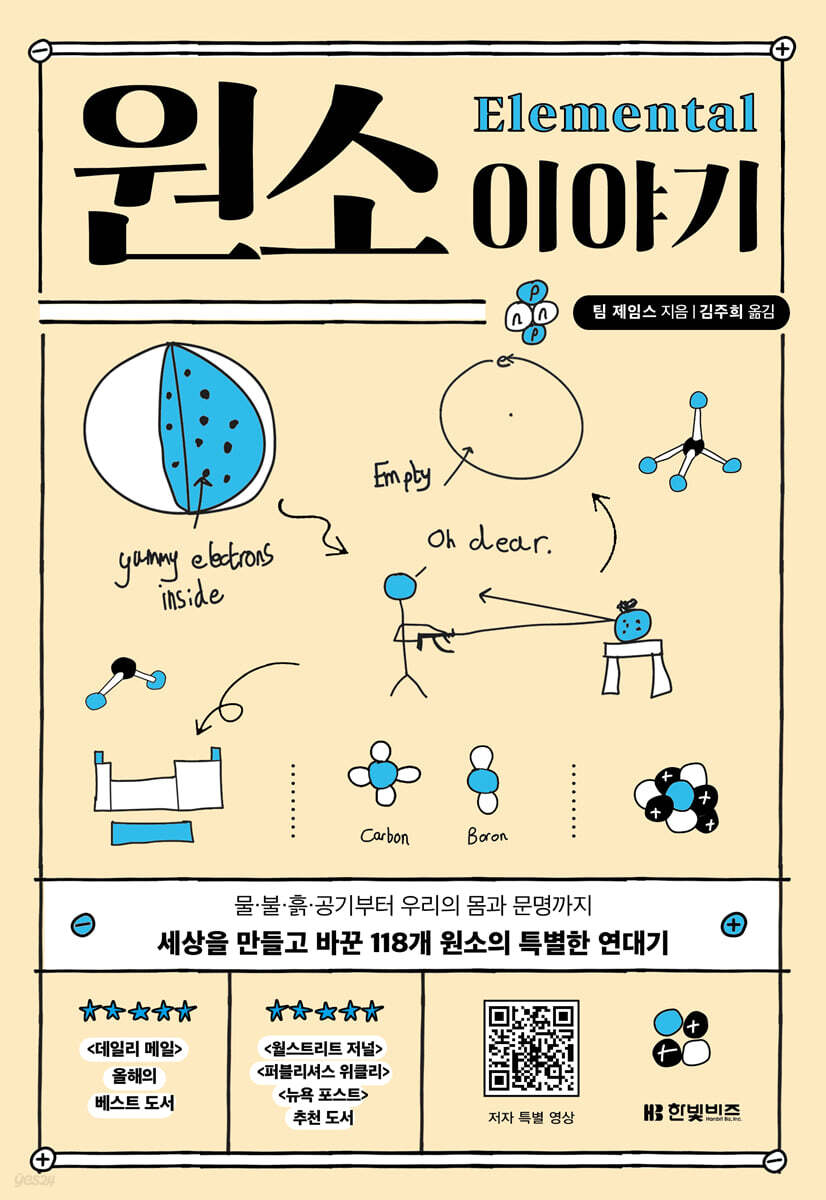
If you're curious about how the world works, look at the periodic table of elements! How the world works, explained from a chemical perspective [Daily Mail] Best Books of the Year Since the emergence of mankind in the 4.5 billion-year history of Earth, there have been continuous transformations and developments, including the agricultural revolution, the industrial revolution, the information revolution, and today's fourth industrial revolution. As a result, the Earth we live on today is becoming increasingly complex. But from a chemical perspective, the human world doesn't seem that complex. Just like the stars in the universe that were born after the Big Bang, we are nothing more than matter made of the elements that are the source of all things. The food we eat, the clothes we wear, the tools we use, even the air we breathe and our bodies are all just chemicals made up of a few of 118 elements. The 2016 periodic table was completed in its current form, containing 118 elements. Depending on how and how much of these elements are mixed, they can become tools that save human lives or weapons that take millions of lives. Even though they are minerals made of carbon, they can be the most expensive gem on Earth, like diamonds, or they can be very cheap writing instruments, like graphite. By understanding the properties of the elements in the periodic table, we can fundamentally understand how the world is structured and operates. As a British science teacher, author Tim James is dedicated to popularizing science through a variety of media, including broadcasts, lectures, newspapers and magazines, YouTube, and Instagram. He explained the principles of this world scientifically and very easily and funnily through the periodic table of elements, which we often find difficult and avoid, in “The Story of the Elements.” The British Daily Mail selected it as one of the best books of the year, and leading media outlets such as the Wall Street Journal, the New York Post, and Publisher's Weekly also praised it, saying that it provides both knowledge and entertainment. The author explains the milestones of Earth and human history through 118 elements, from the birth of the universe and stars, the discovery of fire, the invention of the internal combustion engine, and the current semiconductor industry, along with countless scientists who have tried to identify elements, from Democritus, who first proposed the atomic theory, to American chemist Glenn Seaborg, who completed today's periodic table. As you turn each page, you will experience the mystical intellectual experience of watching the world's countless colorful shapes weave together on the loom of the periodic table of elements. |
- You can preview some of the book's contents.
Preview
index
Preface: How to Cook Reality
Chapter 1: Geniuses who jumped into elemental hunting
Chapter 2: The Indivisible Source
Chapter 3: Evolution of the Atomic Model
Chapter 4 Where do atoms come from?
Chapter 5: The Prelude to the Periodic Table
Chapter 6: The Periodic Table Solved by Quantum Mechanics
Chapter 7: If you're anxious, you'll explode.
Chapter 8: The Alchemist's Dream Come True
Chapter 9 Metallic Elements and Electricity
Chapter 10: Acids, Nonmetals, and Light
Chapter 11: Everything that Makes Up Life is on the Periodic Table
Chapter 12: Elements That Changed the World
supplement
Acknowledgements
main
Chapter 1: Geniuses who jumped into elemental hunting
Chapter 2: The Indivisible Source
Chapter 3: Evolution of the Atomic Model
Chapter 4 Where do atoms come from?
Chapter 5: The Prelude to the Periodic Table
Chapter 6: The Periodic Table Solved by Quantum Mechanics
Chapter 7: If you're anxious, you'll explode.
Chapter 8: The Alchemist's Dream Come True
Chapter 9 Metallic Elements and Electricity
Chapter 10: Acids, Nonmetals, and Light
Chapter 11: Everything that Makes Up Life is on the Periodic Table
Chapter 12: Elements That Changed the World
supplement
Acknowledgements
main
Detailed image
Into the book
Aristotle later borrowed Democritus' ideas to prove the existence of God.
Atoms that are constantly moving and collide with each other and bounce off fly through the air.
These atomic movements are explained by collisions with other atoms that occurred in the past.
The movement of that other atom can also be explained and traced back to a collision with another atom that occurred earlier.
Causes lead to effects, and every effect has a cause that precedes it.
If we go back very far in the past, there will be an initial movement that caused all events but did not itself attribute the cause.
These 'causeless causes' deviate from the general laws of nature, but can still influence nature.
This is another word for God.
---From "Chapter 2: The Indivisible Source"
Thomson used the term atom when he published the results of his experiments.
This was notorious for being easily misunderstood.
What we call atoms is neither an indivisible substance nor the smallest particle in the world.
It's just a stable structure that doesn't like to be separated.
According to Thomson's findings, the indivisible particle is the electron.
The electrons were stuck in a lump of dough with an opposite charge.
But science advances not when hypotheses are proven correct, but when they are disproved.
Thomson's plum pudding model was also torn to pieces by his disciple Ernest Rutherford.
---From "Chapter 3: Evolution of the Atomic Model"
We spend the first nine months of our lives growing up in our mother's womb through the food she consumes.
Those food atoms came from Earth, which was made from the remains of a long-dead star.
All the atoms in our bodies, except hydrogen, were born in the centers of stars and are made of stellar matter, as Carl Sagan once observed.
The stars that decorate the night sky are not transcendent beings made of ether, as Aristotle believed.
Those stars are made of the same stuff as us.
They are our distant relatives, and we will return to them after we die.
When the Earth is engulfed in fire and ends, the atoms that make us up will spread out into space.
And it will become part of another planet or another living being.
The ancient people who worshipped the stars chose their gods wisely.
---From "Chapter 4: Where Do Atoms Come From?"
There are only seven notes that are primarily used in Western music theory.
If you start from a certain note and raise the pitch according to the scale, the first note and the eighth note are the same note with only a difference in pitch.
The second and ninth notes have the same relationship.
A set of these seven notes is an octave.
As you increase the pitch, the sound rises in a spiral until it reaches a level that the human ear can no longer hear.
John Newlands applied the same logic to the table of elements.
He argued that there were seven categories that were repeated until the next higher group was reached.
The first seven elements will form the first row, and the 8th element will belong to the first category of the second row, which has similar properties to the 1st element.
Newlands called the seven vertical rows of the table of elements a 'group' and the eight horizontal rows a 'period'.
The word 'cycle' implies that something repeats regularly.
The idea that elements have 'periodic' properties was first proposed by John Newlands.
---From "Chapter 5: The Prelude to the Periodic Table"
Schrödinger created countless uncomfortable situations for those around him during his lifetime.
As a result, I was asked to step down from my position by many universities and institutions.
This was not due to academic achievements.
He left a great legacy in the scientific community.
The reason Schrödinger received such a request was because he was living in a three-way relationship with his wife Annemarie and his girlfriend Hilde.
---From "Chapter 6: The Periodic Table Solved by Quantum Mechanics"
When someone dies, it is taboo to speak ill of them, so we only say good things about the dead.
But this was not the case when Alfred Nobel's death was announced on April 13, 1888.
A French newspaper reportedly published an article under the headline “The Merchant of Death is Dead” with the following content: “Dr. Alfred Nobel, who became rich by discovering a way to kill more people faster than ever before, died yesterday.”
Many people were unhappy with the newspaper's tribute to the great scientist in that way.
Among those who thought so was Alfred Nobel himself.
He was able to read his own obituary because he didn't actually die.
This happened when a newspaper published an article containing strong criticism of the two brothers after the death of Alfred's older brother, Ludwig Nobel.
---From "Chapter 7: If you're anxious, you'll explode"
Now we have reached element 118, and the periodic table is complete.
Can humanity go further? To be honest, I'm not sure.
With the advent of oganesson, the seventh electron shell is now full, but an eighth or ninth electron shell may also exist.
Seaborg predicted that the periodic table would stop at element 126.
126 is the magic number, and beyond that, no matter how many neutrons you add, the repulsion between protons becomes too strong.
The empty position 126 is temporarily called Unbihexium.
---From "Chapter 8: The Alchemist's Dream Comes True"
At that time, a fierce debate was taking place in the United States over how to supply electricity.
Edison had invested a huge amount of money in the battery-based electricity business.
So, he had to find fault with the magnet-based power generation method promoted by his competitor, George Westinghouse.
Edison's solution was simple but chilling.
It was the most horrifying marketing strategy in history.
Edison thought that if he ran his newly designed electric chair on Westinghouse's electricity, people would associate the competitor's electricity with death.
Edison tested the electric chair on stray animals.
Records show that he killed dogs, cats, birds, horses, and a circus elephant named Topsy (Edison even filmed Topsy's death).
---From "Chapter 9 Metallic Elements and Electricity"
The first person to widely use chlorine was the German chemist Fritz Haber.
He introduced chlorine as a chemical weapon during World War I.
In 1915, Haber supervised the installation of metal containers along a seven-kilometer stretch of the Western Front.
As the wind blew in the desired direction, he ordered the lid of the container to be opened.
Chlorine is a dense green gas that spreads along the ground like a liquid.
Thousands of soldiers were suffocated and blinded when goats, carried by the wind toward the British, filled their trenches.
According to Hermann Luecke's testimony, a party was held on May 1, 1915, to commemorate the simple but effective goat attack on Haber.
A few hours after the party, Haber's wife, Clara, took Haber's pistol.
And then he shot himself in the chest in the garden, and died moments later in his son's arms.
She was a famous pacifist.
---From "Chapter 12 Elements That Changed the World"
Naming an element is an honor given to the person who isolated that element.
Unfortunately, if you give your child a name that others don't like, arguments can arise.
In 1875, French chemist Paul-Émile Lecoq named the newly discovered element gallium, derived from the Latin word for France, Gallia.
But soon after, he was suspected of doing something a little cunning.
The Latin word Gallus means rooster, and in French the rooster is Le Corre, the scientist's own name.
Le Coq cleverly named the elements and left his mark on them for a long time.
Atoms that are constantly moving and collide with each other and bounce off fly through the air.
These atomic movements are explained by collisions with other atoms that occurred in the past.
The movement of that other atom can also be explained and traced back to a collision with another atom that occurred earlier.
Causes lead to effects, and every effect has a cause that precedes it.
If we go back very far in the past, there will be an initial movement that caused all events but did not itself attribute the cause.
These 'causeless causes' deviate from the general laws of nature, but can still influence nature.
This is another word for God.
---From "Chapter 2: The Indivisible Source"
Thomson used the term atom when he published the results of his experiments.
This was notorious for being easily misunderstood.
What we call atoms is neither an indivisible substance nor the smallest particle in the world.
It's just a stable structure that doesn't like to be separated.
According to Thomson's findings, the indivisible particle is the electron.
The electrons were stuck in a lump of dough with an opposite charge.
But science advances not when hypotheses are proven correct, but when they are disproved.
Thomson's plum pudding model was also torn to pieces by his disciple Ernest Rutherford.
---From "Chapter 3: Evolution of the Atomic Model"
We spend the first nine months of our lives growing up in our mother's womb through the food she consumes.
Those food atoms came from Earth, which was made from the remains of a long-dead star.
All the atoms in our bodies, except hydrogen, were born in the centers of stars and are made of stellar matter, as Carl Sagan once observed.
The stars that decorate the night sky are not transcendent beings made of ether, as Aristotle believed.
Those stars are made of the same stuff as us.
They are our distant relatives, and we will return to them after we die.
When the Earth is engulfed in fire and ends, the atoms that make us up will spread out into space.
And it will become part of another planet or another living being.
The ancient people who worshipped the stars chose their gods wisely.
---From "Chapter 4: Where Do Atoms Come From?"
There are only seven notes that are primarily used in Western music theory.
If you start from a certain note and raise the pitch according to the scale, the first note and the eighth note are the same note with only a difference in pitch.
The second and ninth notes have the same relationship.
A set of these seven notes is an octave.
As you increase the pitch, the sound rises in a spiral until it reaches a level that the human ear can no longer hear.
John Newlands applied the same logic to the table of elements.
He argued that there were seven categories that were repeated until the next higher group was reached.
The first seven elements will form the first row, and the 8th element will belong to the first category of the second row, which has similar properties to the 1st element.
Newlands called the seven vertical rows of the table of elements a 'group' and the eight horizontal rows a 'period'.
The word 'cycle' implies that something repeats regularly.
The idea that elements have 'periodic' properties was first proposed by John Newlands.
---From "Chapter 5: The Prelude to the Periodic Table"
Schrödinger created countless uncomfortable situations for those around him during his lifetime.
As a result, I was asked to step down from my position by many universities and institutions.
This was not due to academic achievements.
He left a great legacy in the scientific community.
The reason Schrödinger received such a request was because he was living in a three-way relationship with his wife Annemarie and his girlfriend Hilde.
---From "Chapter 6: The Periodic Table Solved by Quantum Mechanics"
When someone dies, it is taboo to speak ill of them, so we only say good things about the dead.
But this was not the case when Alfred Nobel's death was announced on April 13, 1888.
A French newspaper reportedly published an article under the headline “The Merchant of Death is Dead” with the following content: “Dr. Alfred Nobel, who became rich by discovering a way to kill more people faster than ever before, died yesterday.”
Many people were unhappy with the newspaper's tribute to the great scientist in that way.
Among those who thought so was Alfred Nobel himself.
He was able to read his own obituary because he didn't actually die.
This happened when a newspaper published an article containing strong criticism of the two brothers after the death of Alfred's older brother, Ludwig Nobel.
---From "Chapter 7: If you're anxious, you'll explode"
Now we have reached element 118, and the periodic table is complete.
Can humanity go further? To be honest, I'm not sure.
With the advent of oganesson, the seventh electron shell is now full, but an eighth or ninth electron shell may also exist.
Seaborg predicted that the periodic table would stop at element 126.
126 is the magic number, and beyond that, no matter how many neutrons you add, the repulsion between protons becomes too strong.
The empty position 126 is temporarily called Unbihexium.
---From "Chapter 8: The Alchemist's Dream Comes True"
At that time, a fierce debate was taking place in the United States over how to supply electricity.
Edison had invested a huge amount of money in the battery-based electricity business.
So, he had to find fault with the magnet-based power generation method promoted by his competitor, George Westinghouse.
Edison's solution was simple but chilling.
It was the most horrifying marketing strategy in history.
Edison thought that if he ran his newly designed electric chair on Westinghouse's electricity, people would associate the competitor's electricity with death.
Edison tested the electric chair on stray animals.
Records show that he killed dogs, cats, birds, horses, and a circus elephant named Topsy (Edison even filmed Topsy's death).
---From "Chapter 9 Metallic Elements and Electricity"
The first person to widely use chlorine was the German chemist Fritz Haber.
He introduced chlorine as a chemical weapon during World War I.
In 1915, Haber supervised the installation of metal containers along a seven-kilometer stretch of the Western Front.
As the wind blew in the desired direction, he ordered the lid of the container to be opened.
Chlorine is a dense green gas that spreads along the ground like a liquid.
Thousands of soldiers were suffocated and blinded when goats, carried by the wind toward the British, filled their trenches.
According to Hermann Luecke's testimony, a party was held on May 1, 1915, to commemorate the simple but effective goat attack on Haber.
A few hours after the party, Haber's wife, Clara, took Haber's pistol.
And then he shot himself in the chest in the garden, and died moments later in his son's arms.
She was a famous pacifist.
---From "Chapter 12 Elements That Changed the World"
Naming an element is an honor given to the person who isolated that element.
Unfortunately, if you give your child a name that others don't like, arguments can arise.
In 1875, French chemist Paul-Émile Lecoq named the newly discovered element gallium, derived from the Latin word for France, Gallia.
But soon after, he was suspected of doing something a little cunning.
The Latin word Gallus means rooster, and in French the rooster is Le Corre, the scientist's own name.
Le Coq cleverly named the elements and left his mark on them for a long time.
---From the "Appendix"
Publisher's Review
We are what we eat!
Everything that makes up life is on the periodic table.
The food a pregnant woman eats during her nine months is broken down into atoms to form the fetus.
Calcium (atomic number 20) in milk builds bones, nitrogen (atomic number 7), a component of potatoes, makes up the skin, and sodium (atomic number 11) in salt makes up the brain.
In short, 'we are what we eat'.
This isn't just a story about animals.
Plants absorb sunlight using magnesium, element number 12 on the periodic table, and obtain nitrogen, an important nutrient for growth, from the soil using vanadium, element number 23, and molybdenum, element number 42.
The same goes for water and salt, which we cannot sustain life without.
As we all know, water is made up of two hydrogen atoms and one oxygen atom, and salt is a compound made up of chlorine and sodium.
Regardless of the biological system, all the elements that make up life are on the periodic table, and the secrets of this mysterious composition are also found in the periodic table.
So how were the elements discovered, and how was the periodic table, with each element arranged in its proper order, completed?
The story of the struggles of geniuses who set out to hunt for elements.
From Democritus to Mendeleev and Glenn Seaborg
Democritus, an ancient Greek philosopher who lived in the 5th century BC.
He believed that all things were made of small, indivisible units that combined to form the world we live in.
The word meaning 'indivisible' in Greek is the atom, which we already know.
However, it was more than 2,000 years later that mankind scientifically explained this atomic theory.
In the late 17th century, Hennig Brandt of Germany discovered phosphorus, element number 15, by heating and purifying urine.
Then, Antoine Lavoisier of France discovered that air is a mixture of nitrogen and oxygen and that water is a compound of hydrogen and oxygen.
After that, scientists are said to have discarded the ancient theory of the four elements (water, fire, air, and earth) and started burning or melting everything they could find to obtain the real elements.
Brandt's discovery was a momentous moment in chemistry, as it revealed that elements were not some imaginary substance far away, but were right around us.
Also, at this time, chemistry, which had been dismissed as alchemy and superstition, entered the realm of rational science.
As these discovered elements were piled up, it was revealed that each element had periodic properties.
The history of the periodic table of elements begins with the three-element theory of German chemist Johann Döbereiner.
It was then established through John Newlands' octave theory and then by the Russian genius chemist Dmitry Mendeleev.
Mendeleev is called the father of the periodic table because he arranged the elements in order of atomic weight, which is the basis of the modern periodic table, and he also left blank spaces, claiming that elements would one day be discovered to fill those blanks.
And Mendeleev's prediction came true as modern chemists, including American Glenn Seaborg, filled in the blanks.
In addition, reading the stories of scientists like Joseph Thomson, Ernest Rutherford, and Erwin Schrödinger who struggled to uncover the secrets of atoms, we can see that the history of chemistry follows the same path as the history of the development of human civilization.
Which element changed the world?
118 Stories from the Periodic Table
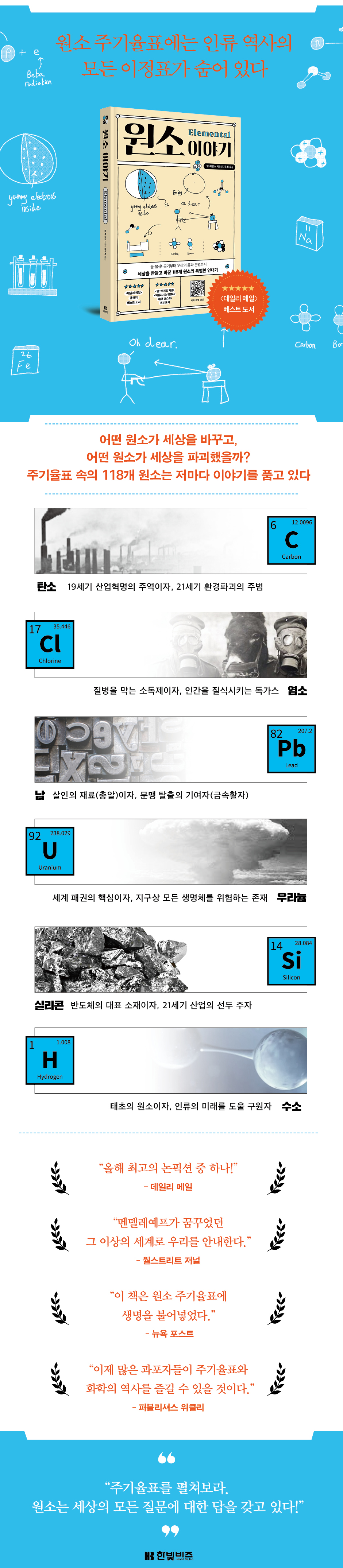
What element has played the most crucial role in human culture, politics, and technology? Which element has been crucial to the development of human civilization? Which element has shaped the world, and which element has subtly transformed our daily lives? Which element has wreaked havoc on the Earth's environment, and which element has had the most profound impact on human experimentation?
Take a look around your room now.
Ninety percent of visible objects are probably made of carbon.
Carbon gave humans the ability to refine metals and, in the 19th century, led to the invention of combustion engines that burned carbon as fuel.
But ironically, it is now becoming the main culprit in disrupting the balance of the Earth's climate.
The element that has most significantly changed the course of human history, whether positively or negatively, is carbon.
The periodic table is full of stories about elements with colorful stories, just like carbon.
Tin allowed us to can food to preserve it for longer, and the mere 17 tons of gold buried on Earth have inspired conquests and battles throughout human history.
Lead, used as a material for bullets, brought suffering to mankind, but Gutenberg's metal movable type helped countless people escape illiteracy.
Depending on how it is used, chlorine can be used as a disinfectant that prevents disease or as a toxic gas that suffocates people.
Uranium, named after the planet Uranus, has become the core of world power today, and silicon, a key material for semiconductors, changed the name of Santa Clara Valley, south of San Francisco, to Silicon Valley.
In this way, the stories related to the elements are our own stories.
Now is the time to rediscover the periodic table, which we have been avoiding for so long.
There, the incalculable history before we were born, and the future that will continue to unfold after we die, will be tightly woven into the warp and weft of history.
Everything that makes up life is on the periodic table.
The food a pregnant woman eats during her nine months is broken down into atoms to form the fetus.
Calcium (atomic number 20) in milk builds bones, nitrogen (atomic number 7), a component of potatoes, makes up the skin, and sodium (atomic number 11) in salt makes up the brain.
In short, 'we are what we eat'.
This isn't just a story about animals.
Plants absorb sunlight using magnesium, element number 12 on the periodic table, and obtain nitrogen, an important nutrient for growth, from the soil using vanadium, element number 23, and molybdenum, element number 42.
The same goes for water and salt, which we cannot sustain life without.
As we all know, water is made up of two hydrogen atoms and one oxygen atom, and salt is a compound made up of chlorine and sodium.
Regardless of the biological system, all the elements that make up life are on the periodic table, and the secrets of this mysterious composition are also found in the periodic table.
So how were the elements discovered, and how was the periodic table, with each element arranged in its proper order, completed?
The story of the struggles of geniuses who set out to hunt for elements.
From Democritus to Mendeleev and Glenn Seaborg
Democritus, an ancient Greek philosopher who lived in the 5th century BC.
He believed that all things were made of small, indivisible units that combined to form the world we live in.
The word meaning 'indivisible' in Greek is the atom, which we already know.
However, it was more than 2,000 years later that mankind scientifically explained this atomic theory.
In the late 17th century, Hennig Brandt of Germany discovered phosphorus, element number 15, by heating and purifying urine.
Then, Antoine Lavoisier of France discovered that air is a mixture of nitrogen and oxygen and that water is a compound of hydrogen and oxygen.
After that, scientists are said to have discarded the ancient theory of the four elements (water, fire, air, and earth) and started burning or melting everything they could find to obtain the real elements.
Brandt's discovery was a momentous moment in chemistry, as it revealed that elements were not some imaginary substance far away, but were right around us.
Also, at this time, chemistry, which had been dismissed as alchemy and superstition, entered the realm of rational science.
As these discovered elements were piled up, it was revealed that each element had periodic properties.
The history of the periodic table of elements begins with the three-element theory of German chemist Johann Döbereiner.
It was then established through John Newlands' octave theory and then by the Russian genius chemist Dmitry Mendeleev.
Mendeleev is called the father of the periodic table because he arranged the elements in order of atomic weight, which is the basis of the modern periodic table, and he also left blank spaces, claiming that elements would one day be discovered to fill those blanks.
And Mendeleev's prediction came true as modern chemists, including American Glenn Seaborg, filled in the blanks.
In addition, reading the stories of scientists like Joseph Thomson, Ernest Rutherford, and Erwin Schrödinger who struggled to uncover the secrets of atoms, we can see that the history of chemistry follows the same path as the history of the development of human civilization.
Which element changed the world?
118 Stories from the Periodic Table
What element has played the most crucial role in human culture, politics, and technology? Which element has been crucial to the development of human civilization? Which element has shaped the world, and which element has subtly transformed our daily lives? Which element has wreaked havoc on the Earth's environment, and which element has had the most profound impact on human experimentation?
Take a look around your room now.
Ninety percent of visible objects are probably made of carbon.
Carbon gave humans the ability to refine metals and, in the 19th century, led to the invention of combustion engines that burned carbon as fuel.
But ironically, it is now becoming the main culprit in disrupting the balance of the Earth's climate.
The element that has most significantly changed the course of human history, whether positively or negatively, is carbon.
The periodic table is full of stories about elements with colorful stories, just like carbon.
Tin allowed us to can food to preserve it for longer, and the mere 17 tons of gold buried on Earth have inspired conquests and battles throughout human history.
Lead, used as a material for bullets, brought suffering to mankind, but Gutenberg's metal movable type helped countless people escape illiteracy.
Depending on how it is used, chlorine can be used as a disinfectant that prevents disease or as a toxic gas that suffocates people.
Uranium, named after the planet Uranus, has become the core of world power today, and silicon, a key material for semiconductors, changed the name of Santa Clara Valley, south of San Francisco, to Silicon Valley.
In this way, the stories related to the elements are our own stories.
Now is the time to rediscover the periodic table, which we have been avoiding for so long.
There, the incalculable history before we were born, and the future that will continue to unfold after we die, will be tightly woven into the warp and weft of history.
GOODS SPECIFICS
- Date of issue: July 5, 2022
- Page count, weight, size: 276 pages | 424g | 148*215*18mm
- ISBN13: 9791157845903
- ISBN10: 1157845908
You may also like
카테고리
korean


korean

![GQ KOREA Mark (Monthly): December [2025]](http://librairie.coreenne.fr/cdn/shop/files/8ef265dbbfbf186523ed75ba7319009d.jpg?v=1765340328&width=3840)


