

A life-changing encounter
 |
Description
Book Introduction
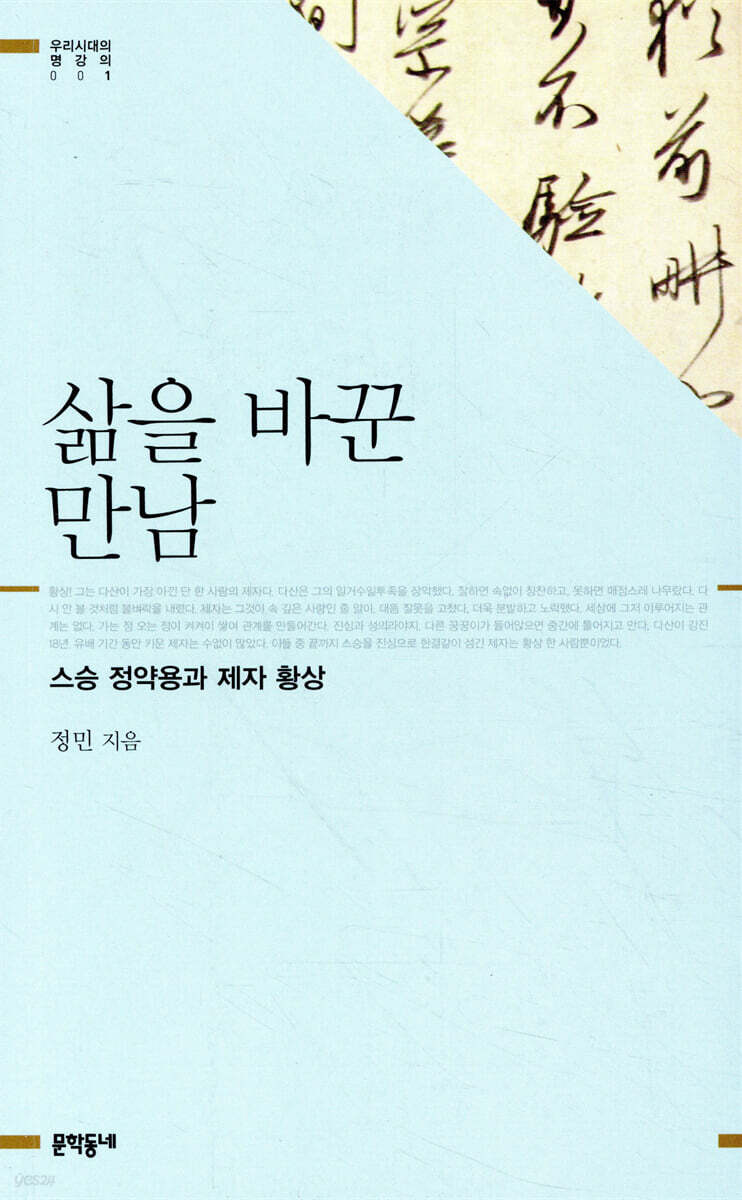
Professor Jeong Min of Hanyang University, who has long admired the fragrance of Dasan and studied his footsteps, has summarized the faithful teacher-student relationship that continued between Dasan Jeong Yak-yong and his disciple Hwang Sang.
"The Encounter That Changed My Life" focuses on this fateful encounter that completely changed my life in these times when it is difficult to find a true teacher or a true disciple.
During the Sinyu Persecution, Jeong Yak-yong was exiled to Gangjin, Jeollanam-do. He opened a small school in an inn outside the Dongmun Gate where he was staying, and there he met the young Hwang Sang.
Hwang Sang, the son of a country magistrate, devoted himself to studying throughout his life, keeping in mind his teacher Jeong Yak-yong's "Three Precepts of Diligence": "Be diligent, diligent, and diligent."
Even after his teacher was exiled and returned to Seoul in 1818, he settled deep in the mountains, farmed, and never put down his brush. In his later years, he built a small house and devoted himself solely to his studies.
He not only engraved his teacher's teachings in his body and mind, but he also had such an honest heart that, despite his old age, he would repeatedly walk a thousand miles from Gangjin to Namyangju, Gyeonggi Province, in the middle of winter, with his feet wrapped in snow.
His heart was reflected in his writings, and he was recognized for his writing skills as he interacted with the most prominent figures in the capital at the time.
In particular, it is said that Chusa Kim Jeong-hui admired his poetry.
Professor Jeong Min, the author of this book, says he was deeply impressed by the beautiful exchange between Hwang Sang and Dasan, and that the writings Hwang Sang left behind touched his heart.
Although it started with a small piece called "Samgeun-gye," it traces their footsteps through a vast amount of data and literature, and unfolds before us a world of profound scholarship with refined sentences that strike the heart without any unnecessary details.
In these days when no one talks about 'masters', the author sheds light on the life of Hwang Sang, who believed in one person and followed his teachings throughout his life, and Dasan's attitude as a teacher, who accepted that person's heart and tried to teach his disciples the right teachings.
The meeting of these two people, who are of equal standing and who are truly united by faith, awakens the hearts of readers anew.
"The Encounter That Changed My Life" focuses on this fateful encounter that completely changed my life in these times when it is difficult to find a true teacher or a true disciple.
During the Sinyu Persecution, Jeong Yak-yong was exiled to Gangjin, Jeollanam-do. He opened a small school in an inn outside the Dongmun Gate where he was staying, and there he met the young Hwang Sang.
Hwang Sang, the son of a country magistrate, devoted himself to studying throughout his life, keeping in mind his teacher Jeong Yak-yong's "Three Precepts of Diligence": "Be diligent, diligent, and diligent."
Even after his teacher was exiled and returned to Seoul in 1818, he settled deep in the mountains, farmed, and never put down his brush. In his later years, he built a small house and devoted himself solely to his studies.
He not only engraved his teacher's teachings in his body and mind, but he also had such an honest heart that, despite his old age, he would repeatedly walk a thousand miles from Gangjin to Namyangju, Gyeonggi Province, in the middle of winter, with his feet wrapped in snow.
His heart was reflected in his writings, and he was recognized for his writing skills as he interacted with the most prominent figures in the capital at the time.
In particular, it is said that Chusa Kim Jeong-hui admired his poetry.
Professor Jeong Min, the author of this book, says he was deeply impressed by the beautiful exchange between Hwang Sang and Dasan, and that the writings Hwang Sang left behind touched his heart.
Although it started with a small piece called "Samgeun-gye," it traces their footsteps through a vast amount of data and literature, and unfolds before us a world of profound scholarship with refined sentences that strike the heart without any unnecessary details.
In these days when no one talks about 'masters', the author sheds light on the life of Hwang Sang, who believed in one person and followed his teachings throughout his life, and Dasan's attitude as a teacher, who accepted that person's heart and tried to teach his disciples the right teachings.
The meeting of these two people, who are of equal standing and who are truly united by faith, awakens the hearts of readers anew.
- You can preview some of the book's contents.
Preview
index
Ah! Gwagol Samcheon | The inn outside the east gate | Words carved for 60 years | Sa-ui-jae and the disciple of the town | How should I open Munsim Hye-du? | This poem should not be shown to others | A song that breaks the cycle of learning | Thoughts at dawn | Motivational learning and praise education | 20 years of study are in vain | The desire to cultivate a vegetable garden | The couple grew up separately | Current affairs will be smooth from now on | I stalled for time | A study room in the middle of winter | A poetry contest | A tour of Durun Mountain | Being Dasan's son | What is precious is understanding the heart | Your son is my grandson | A dream of living a dream | I will say this much | What is Yu-in's life like? | How to capture spring | A quiet forest house | Remodeling work | Indulging in flowers | I will not beg | What is precious to people is trust | Hong-im's mother and daughter | Conflict with Kang-jin's disciples | I am very sick | Reunion and farewell after 18 years | Circumstances | I cannot oppose this person | The first monk of Iljiam | The teacher I saw in a dream | Spring returns to the old tree | A time of triumph | A sad reunion | The ladder is removed and the bridge is broken | I will decorate Ilsoksanbang | A luxurious life | There was such a person
Publisher's Review
Some encounters are fate!
Dasan Jeong Yak-yong, the all-round intellectual of the Joseon Dynasty, and the only person who lived his entire life following his teachings, Hwang Sang
The lives of Jeong Yak-yong and his disciple Hwang Sang have been reconstructed in three dimensions, thanks to over a decade of research.
The writings of Professor Jeong Min of Hanyang University, which were serialized every Monday under the title “An Encounter That Changed Life” in the “Famous Lectures of Our Time” corner of the Naver Munhakdongne Cafe (http://cafe.naver.com/mhdn) from January 3 to November 21, 2011, have been published as a book of the same name.
Since Professor Jeong Min introduced the fateful meeting between his teacher Jeong Yak-yong and his disciple Hwang Sang in [You Have to Be Crazy to Be Crazy], which won the overwhelming support of South Korean humanities readers in 2004, he has been searching for any source of information on Jeong Yak-yong and Hwang Sang for over ten years.
In this way, we have managed to persuade the collectors we met with great difficulty to discover new materials, and as a result of our efforts, we have published [Dasan Jeong Yak-yong's Knowledge Management Method], [Dasan's Sayings in Cheongsang], [Rewriting Joseon's Tea Culture], and [Rediscovery of Dasan], revealing the life and academic achievements of Dasan Jeong Yak-yong and its cultural and historical significance from various angles.
[An Encounter That Changed My Life: Master Jeong Yak-yong and His Student Hwang Sang] is the culmination of the author's long-term efforts.
The period that Dasan Jeong Yak-yong was exiled to Gangjin was 18 years, from 1801 to 1818.
During this period, he produced numerous works that rank among the greatest intellectual achievements of the late Joseon Dynasty.
In addition, in Gangjin, which was a remote area of power during the Joseon Dynasty, he interacted with monks such as Aam Hyejang and Choui Uisun, and led a new intellectual trend while also nurturing his disciples through his own unique teaching methods.
Among those disciples is the emperor.
The humanities, which begin with an interest in humanity, may end up focusing not on abstract humanity but on a specific human being.
In the path of Chinese literature, where we must uncover erased traces and dusty materials hidden away, never to be seen, the task of three-dimensionally restoring a person's life through the network of relationships he or she formed and reviving the forgotten meaning of that life shines even brighter because it is difficult.
Professor Jeongmin encounters the fateful encounter that changed the lives of his teacher Jeong Yak-yong and his disciple Hwang Sang. He then explores the inner workings of Jeong Yak-yong and traces the lost traces to restore the brilliant life of Hwang Sang.
Now, the beautiful meeting between Master Jeong Yak-yong and his disciple Hwang Sang will awaken the minds and touch the hearts of readers.
“Be diligent, diligent, and diligent.”
The lament that 'there are students but no disciples' is growing louder.
These days, words like respect and love are meaningless and true teachers and true students are rare.
Professor Jeong Min revives the profound meaning of the sincere and sincere relationship between Dasan Jeong Yak-yong (丁若鏞, 1762-1836) and his disciple Hwang Sang (黃裳, 1788-1870) from 200 years ago.
Dasan Jeong Yak-yong, a scholar and civil servant in the late Joseon Dynasty, was the greatest scholar of Joseon with many disciples and students.
Even he had a disciple whom he could never forget in his life.
During the Sinyu Persecution, Jeong Yak-yong was exiled to Gangjin, Jeollanam-do, and suffered indescribable pain without a proper place to stay. He opened a small school in an inn outside the Dongmun Gate where he was staying at the time, and in 1802, he met the fifteen-year-old Hwang Sang there.
Hwang Sang, the son of a country official, devoted his life to studying, keeping in mind the teachings of Dasan Jeong Yak-yong's "Three Precepts of Diligence": "Be diligent, diligent, and diligent." He never abandoned his teacher's teachings to study wholeheartedly until the very end.
In 1818, after his teacher was released from prison and returned to Seoul, he gave up his job as a government official to make a living and settled deep in the mountains of Baekjeok-dong, where he farmed and continued to study cursive script and poetry. In his later years, he built a small house called Ilsoksanbang (a house the size of a grain of millet) and devoted himself solely to his studies.
While everyone else was studying to become successful, only the emperor practiced the life of a hermit (a person who hides in a quiet place to avoid the chaotic world) that his teacher had always taught him.
“My teacher, Master Dasan, was exiled to Gangjin and stayed there for twenty years.
During those long years, he was so absorbed in writing every day that his ankle bone that touched the floor was punctured three times.
When I was fifteen, my father always said to me, “Be diligent, be diligent, and be diligent” as he taught me the three principles of diligence.
“I also obtained this through diligent effort.
“You too, do this.” Even today, 60 years later, the teachings that He taught me through His actions and words are still vivid in my eyes and ringing in my ears as if they were yesterday.
How could I abandon such profound and profound teachings before the coffin lid is closed?
If I don't study, I'll be dead that day.
"Don't you ever say that again." --- p.13
To engrave the teacher's words in one's heart and engrave them into one's bones
When Dasan returned to Seoul after 18 years of exile in Gangjin, many of his disciples began to hang around his house.
It was because of the desire to achieve success by gaining the power of fertility.
In the end, Lee Cheong (Lee Hak-rae), who had contributed greatly to writing numerous books during Dasan's reign, became disappointed in Dasan for not helping him with the civil service examination and entered the school of Chusa Kim Jeong-hui. Even the students who had cared for and served their teacher thought that it was not beneficial to them, so they turned around and found fault with their teacher, and did not even greet him when he came up to Seoul.
When everyone was like this, the one disciple who silently followed the master's will was the emperor.
He followed the truth that studying for success ends in failure and lived a hermit's life for 18 years without going to the capital. In 1836, on his way to the capital for Dasan's second wedding, he said goodbye to his teacher in tears. Even after Dasan's death, he always kept his teacher's words in mind and did not live in vain.
This led to a beautiful and strong friendship between Dasan's sons, Jeong Hak-yeon and Jeong Hak-yu, and later the two families formed the 'Jeong Hwang-gye (丁黃契)' to continue their relationship between the two families.
Despite his old age, the emperor's honest heart, which included walking a thousand miles from Gangjin to Namyangju, Gyeonggi Province, in the middle of winter, with his feet wrapped in snow, to visit his teacher's grave, is fully reflected in his writings.
Hwang Sang, who endured Dasan's strict and demanding education and was recognized for his talent, became known for his writing skills while associating with the famous scholars of the time, such as the Chusa Kim Jeong-hui brothers and Lee Jae Kwon Don-in, through the introduction of Dasan's eldest son, Jeong Hak-yeon.
In particular, Chusa Kim Jeong-hui admired his poetry so much that he stopped by Gangjin on his way back to Seoul after returning home from Jeju and visited Ilsoksanbang.
In a time when social distinctions were strict, the emotion of a country official's son meeting Lee Jae Kwon Don-in, who had served as Prime Minister, is conveyed to readers as well.
“When I was in Jeju Island, a person showed me a poem, and I could tell without even asking that he was Dasan’s great-grandfather.
When I asked his name, he said his name was Hwang.
… I heard that not only was Hwangmo’s poetry close to that of the Han and Tang dynasties, but his personality was also worthy of being called a great scholar of his time. Even though he was a hermit of old, he could not be more outstanding.
So, as soon as I got to land, I went to see him, and he said he had gone up to Seoul, so I looked at him sadly and came back.
Now that I'm back in Seoul, I hear he's already returned to his hometown.
“It’s like the mismatch between swallows and geese, so I can only click my tongue and feel sorry.” --- p.424
There are daffodils on the table.
The roots were just beginning to sprout on the surface.
Hanging on the wall was a clock I had never seen before.
It was full of strange things.
The emperor was so intimidated that he was at a loss.
A great man of the nation, a former Prime Minister, personally invited the son of a local official from a distant countryside and offered him warm words. I couldn't believe it.
Unlike when he met Chusa Jeonghakyeon, he responded to the question with a much more respectful attitude.
Their conversation began with a story about daffodils, then moved on to concerns about the country, and ended with a conversation about poetry.
The emperor, following Kwon Don-in's orders, composed a poem titled "Proceed to the Muryangsu Pavilion and Bowed."
--- p.481
One encounter changes your fate forever
The author says that if Hwang Sang had not met Dasan, his life would have been 180 degrees different.
What is the encounter that changes fate?
Master Dasan gave consistent teachings, and his disciple Hwangsang accepted them with a consistent attitude.
Dasan is great, but his disciples are also great.
Because there was a king, fertility could shine even brighter.
The author says that he was deeply impressed by the emperor and his fertility, and that the writings he left behind touched his heart.
The emperor, who spent his entire life trying to uphold the teachings of his strict and stern teacher, was also called a 'man of tears.'
It all started with a chance encounter with Dasan's small piece of writing titled "Samgeun-gye," but the inspiration I received from it led to extensive research and literature study, which led me to restore the forgotten Hwang Sang and the beautiful relationship he shared with his teacher in refined sentences without any unnecessary details.
Despite its 600-page length and potentially daunting subject matter, the vivid descriptions, narratives, and clear interpretations that unfold before your eyes with each turn of the page offer readers a world of profound academic enjoyment and emotion, allowing them to savor the "delicious encounter" between Hwang Sang, Dasan, and author Jeong Min.
When I asked around to find the owner of the calligraphy collection related to the emperor and encountered the vivid ink marks, I was unable to contain my excitement.
I saw several volumes of handwritten books given to the emperor by Dasan, Jeong Hak-yeon, and the Chusa brothers.
The writing was enchanting and the content was tear-jerking.
As the materials came out and I compared them with the contents of the anthology, the blank spaces that I had not been able to figure out were filled in one by one.
I guess it's my job to organize the beginning and end of the beautiful meeting between Dasan and Hwangsang.
What can I do? He walked into me without me even asking.
…The life of the emperor examined in this book is moving in itself.
How could such a person exist? Even from the perspective of the time, not just today, it was the same.
The harmonious melody created by the son of an unknown country official and his wonderful teacher still captivated many people at the time.
The story of a boy with a scruffy head whose life is completely changed by a short piece of writing from his teacher is a magnificent drama.
--- From 'Opening the Text'
The face of Jeong Yak-yong, the master and the human Jeong Yak-yong
Jeong Yak-yong, a scholar who excelled in both literature and classics, was a pioneering intellectual of the 18th century who inherited and synthesized the Silhak of Yu Hyeong-won and Lee Ik.
During the Sinyu Persecution, he suffered all kinds of hardships, including the deaths and exile of his family members. Even after being exiled to Gangjin, he was separated from his family and endured lonely and difficult days with no place to rest his heart or body.
He suffered from epilepsy and suffered from stroke and paralysis.
There was no news of Hae-bae, and there was no place to stay until they settled down at Dasan Chodang.
It has been a long-standing habit of Dasan to do his best in the space he is currently in, no matter what happens.
He transplanted bamboo to the vegetable patch outside Lee Hak-rae's Sarangchae, where he might stay for a long time.
I wanted to surround it with the slender, green bamboo that grows all year round as a fence.
The neighbor clicked his tongue and said, "That kind of bamboo is strong and can be thrown away in the valley, so why bother transplanting it to the vegetable patch?"
How could they know? I wanted to surround myself with a few bamboo trees, to compose myself, to steady my spirit as it crumbled and crumbled.
--- p.297
But he wasn't lying there.
He taught and raised children while struggling with a broken heart and a sick body, and also built up his own academic knowledge.
Dasan's representative works, such as [Mokminsimseo] and [Gyeongseyubyo], which we are all familiar with, were all written during his exile in Gangjin.
However, behind this image of Dasan as a scholar, we can also catch a glimpse of his truly human side.
Dasan was not only a benevolent teacher.
When it was good, it was infinitely kind, but when it was harsh, it was like a cold winter wind.
Even when he was sick with malaria, he did not put down his brush and continued to study, and he wrote a poem to praise the emperor, saying, “You are much younger than these two, but even when you have malaria, you do not lie down and do not put down your book.
(His stubbornness is no less than that of the sages, so he is truly admirable.) After getting married, he harshly scolds his disciple who has become lazy in his studies and urges the couple to sleep in separate rooms (“I have loved you very much, so I have been sad and sighing in my heart for a long time.
Truly, you must be able to raise your mind and change your intentions so that your husband and wife can live separately.
If you cannot concentrate your mind and focus on studying, not only will you not be able to write well, but you will also become sick and not be able to live long.” (p. 138)
Also, when Hwang In-dam, the emperor's father, died leaving a will telling the emperor not to complete the funeral procedures, he scolded the confused emperor through several short letters (“Are you comfortable in your bedroom every day? Are you comfortable eating two meals a day? The crime of going against ethics, breaking loyalty, forgetting your parents, and abandoning the dead is severe under the law.”
Do you want to live in heaven and earth? You are twenty years old.
You should be the one to take charge of housework.
If that is not possible, you should not eat breakfast or dinner and only seek death once.
If you don't do this immediately and eat comfortably to your heart's content, I will never meet a person like this again.
“I will only say this much.” (p. 274).
When the disciple who had been to the capital for the first time in 18 years returned to his hometown, he packed a gift and left his last writing, even though his consciousness was fading away, thinking that this separation would be his farewell (“Inside the package were a small booklet [of Gyu Jang Jeon Un], a Chinese ink and brush, a fan, and a pipe.”
The two strings of coins were tied separately.
This was Dasan's meticulousness.
He even set aside extra travel expenses for his disciple, in case he went hungry on his long journey.
“The emperor swallowed his tears as he thought of his teacher who had written with difficulty even while in a state of unconsciousness in order to give it to his incompetent disciple.”
Send Huang Zizhong to the prince
One Case of Gyujang Jeonun [Gyujang Jeonun]
A Chinese brush
A single piece of Chinese ink
A fan
A cigarette holder
Two nyang of travel expenses
Meanwhile, this book shows Dasan's rational and practical side as a Silhak scholar through his confession of wanting to cultivate a vegetable field, his claim that the Thousand Character Classic should not be taught while teaching [Ahakpyeon], and his story of saving money little by little and owning eighteen majigi of land while in exile in Gangjin.
He also warmly emphasizes the "Geokmulchiji study method" for his young sons who live far away, and emphasizes that they should study "as if they were tapping a messy document to straighten its four corners." This is a heartwarming sight.
The first question started out somewhat odd and small.
It shows the process of developing small questions into systematic knowledge through examples.
Dasan called this 'the study of observing things'.
Geokmul means to straighten things, that is, to organize disorderly things.
The act of tapping a tangled document to straighten its four corners is called gyek.
When you organize it like this, the meaning that was not clearly visible before becomes clearly visible.
The study of correcting things and reaching knowledge is called Geukmulchiji.
--- p.231
Nowadays, no one talks about the teacher.
Professor Jeongmin laments the current situation where all relationships are defined by gains and losses, and seeks to shed light on the character of Hwang Sang, who believed in one person and devoted his life to following his teachings, and the mindset of Dasan, a teacher who understood his heart and tried to teach his disciples the right way.
Their meeting, which was held with respect and sternness, yet was made with sincerity and trust, awakens the hearts of readers like a wind that penetrates through midwinter clothes.
Dasan Jeong Yak-yong, the all-round intellectual of the Joseon Dynasty, and the only person who lived his entire life following his teachings, Hwang Sang
The lives of Jeong Yak-yong and his disciple Hwang Sang have been reconstructed in three dimensions, thanks to over a decade of research.
The writings of Professor Jeong Min of Hanyang University, which were serialized every Monday under the title “An Encounter That Changed Life” in the “Famous Lectures of Our Time” corner of the Naver Munhakdongne Cafe (http://cafe.naver.com/mhdn) from January 3 to November 21, 2011, have been published as a book of the same name.
Since Professor Jeong Min introduced the fateful meeting between his teacher Jeong Yak-yong and his disciple Hwang Sang in [You Have to Be Crazy to Be Crazy], which won the overwhelming support of South Korean humanities readers in 2004, he has been searching for any source of information on Jeong Yak-yong and Hwang Sang for over ten years.
In this way, we have managed to persuade the collectors we met with great difficulty to discover new materials, and as a result of our efforts, we have published [Dasan Jeong Yak-yong's Knowledge Management Method], [Dasan's Sayings in Cheongsang], [Rewriting Joseon's Tea Culture], and [Rediscovery of Dasan], revealing the life and academic achievements of Dasan Jeong Yak-yong and its cultural and historical significance from various angles.
[An Encounter That Changed My Life: Master Jeong Yak-yong and His Student Hwang Sang] is the culmination of the author's long-term efforts.
The period that Dasan Jeong Yak-yong was exiled to Gangjin was 18 years, from 1801 to 1818.
During this period, he produced numerous works that rank among the greatest intellectual achievements of the late Joseon Dynasty.
In addition, in Gangjin, which was a remote area of power during the Joseon Dynasty, he interacted with monks such as Aam Hyejang and Choui Uisun, and led a new intellectual trend while also nurturing his disciples through his own unique teaching methods.
Among those disciples is the emperor.
The humanities, which begin with an interest in humanity, may end up focusing not on abstract humanity but on a specific human being.
In the path of Chinese literature, where we must uncover erased traces and dusty materials hidden away, never to be seen, the task of three-dimensionally restoring a person's life through the network of relationships he or she formed and reviving the forgotten meaning of that life shines even brighter because it is difficult.
Professor Jeongmin encounters the fateful encounter that changed the lives of his teacher Jeong Yak-yong and his disciple Hwang Sang. He then explores the inner workings of Jeong Yak-yong and traces the lost traces to restore the brilliant life of Hwang Sang.
Now, the beautiful meeting between Master Jeong Yak-yong and his disciple Hwang Sang will awaken the minds and touch the hearts of readers.
“Be diligent, diligent, and diligent.”
The lament that 'there are students but no disciples' is growing louder.
These days, words like respect and love are meaningless and true teachers and true students are rare.
Professor Jeong Min revives the profound meaning of the sincere and sincere relationship between Dasan Jeong Yak-yong (丁若鏞, 1762-1836) and his disciple Hwang Sang (黃裳, 1788-1870) from 200 years ago.
Dasan Jeong Yak-yong, a scholar and civil servant in the late Joseon Dynasty, was the greatest scholar of Joseon with many disciples and students.
Even he had a disciple whom he could never forget in his life.
During the Sinyu Persecution, Jeong Yak-yong was exiled to Gangjin, Jeollanam-do, and suffered indescribable pain without a proper place to stay. He opened a small school in an inn outside the Dongmun Gate where he was staying at the time, and in 1802, he met the fifteen-year-old Hwang Sang there.
Hwang Sang, the son of a country official, devoted his life to studying, keeping in mind the teachings of Dasan Jeong Yak-yong's "Three Precepts of Diligence": "Be diligent, diligent, and diligent." He never abandoned his teacher's teachings to study wholeheartedly until the very end.
In 1818, after his teacher was released from prison and returned to Seoul, he gave up his job as a government official to make a living and settled deep in the mountains of Baekjeok-dong, where he farmed and continued to study cursive script and poetry. In his later years, he built a small house called Ilsoksanbang (a house the size of a grain of millet) and devoted himself solely to his studies.
While everyone else was studying to become successful, only the emperor practiced the life of a hermit (a person who hides in a quiet place to avoid the chaotic world) that his teacher had always taught him.
“My teacher, Master Dasan, was exiled to Gangjin and stayed there for twenty years.
During those long years, he was so absorbed in writing every day that his ankle bone that touched the floor was punctured three times.
When I was fifteen, my father always said to me, “Be diligent, be diligent, and be diligent” as he taught me the three principles of diligence.
“I also obtained this through diligent effort.
“You too, do this.” Even today, 60 years later, the teachings that He taught me through His actions and words are still vivid in my eyes and ringing in my ears as if they were yesterday.
How could I abandon such profound and profound teachings before the coffin lid is closed?
If I don't study, I'll be dead that day.
"Don't you ever say that again." --- p.13
To engrave the teacher's words in one's heart and engrave them into one's bones
When Dasan returned to Seoul after 18 years of exile in Gangjin, many of his disciples began to hang around his house.
It was because of the desire to achieve success by gaining the power of fertility.
In the end, Lee Cheong (Lee Hak-rae), who had contributed greatly to writing numerous books during Dasan's reign, became disappointed in Dasan for not helping him with the civil service examination and entered the school of Chusa Kim Jeong-hui. Even the students who had cared for and served their teacher thought that it was not beneficial to them, so they turned around and found fault with their teacher, and did not even greet him when he came up to Seoul.
When everyone was like this, the one disciple who silently followed the master's will was the emperor.
He followed the truth that studying for success ends in failure and lived a hermit's life for 18 years without going to the capital. In 1836, on his way to the capital for Dasan's second wedding, he said goodbye to his teacher in tears. Even after Dasan's death, he always kept his teacher's words in mind and did not live in vain.
This led to a beautiful and strong friendship between Dasan's sons, Jeong Hak-yeon and Jeong Hak-yu, and later the two families formed the 'Jeong Hwang-gye (丁黃契)' to continue their relationship between the two families.
Despite his old age, the emperor's honest heart, which included walking a thousand miles from Gangjin to Namyangju, Gyeonggi Province, in the middle of winter, with his feet wrapped in snow, to visit his teacher's grave, is fully reflected in his writings.
Hwang Sang, who endured Dasan's strict and demanding education and was recognized for his talent, became known for his writing skills while associating with the famous scholars of the time, such as the Chusa Kim Jeong-hui brothers and Lee Jae Kwon Don-in, through the introduction of Dasan's eldest son, Jeong Hak-yeon.
In particular, Chusa Kim Jeong-hui admired his poetry so much that he stopped by Gangjin on his way back to Seoul after returning home from Jeju and visited Ilsoksanbang.
In a time when social distinctions were strict, the emotion of a country official's son meeting Lee Jae Kwon Don-in, who had served as Prime Minister, is conveyed to readers as well.
“When I was in Jeju Island, a person showed me a poem, and I could tell without even asking that he was Dasan’s great-grandfather.
When I asked his name, he said his name was Hwang.
… I heard that not only was Hwangmo’s poetry close to that of the Han and Tang dynasties, but his personality was also worthy of being called a great scholar of his time. Even though he was a hermit of old, he could not be more outstanding.
So, as soon as I got to land, I went to see him, and he said he had gone up to Seoul, so I looked at him sadly and came back.
Now that I'm back in Seoul, I hear he's already returned to his hometown.
“It’s like the mismatch between swallows and geese, so I can only click my tongue and feel sorry.” --- p.424
There are daffodils on the table.
The roots were just beginning to sprout on the surface.
Hanging on the wall was a clock I had never seen before.
It was full of strange things.
The emperor was so intimidated that he was at a loss.
A great man of the nation, a former Prime Minister, personally invited the son of a local official from a distant countryside and offered him warm words. I couldn't believe it.
Unlike when he met Chusa Jeonghakyeon, he responded to the question with a much more respectful attitude.
Their conversation began with a story about daffodils, then moved on to concerns about the country, and ended with a conversation about poetry.
The emperor, following Kwon Don-in's orders, composed a poem titled "Proceed to the Muryangsu Pavilion and Bowed."
--- p.481
One encounter changes your fate forever
The author says that if Hwang Sang had not met Dasan, his life would have been 180 degrees different.
What is the encounter that changes fate?
Master Dasan gave consistent teachings, and his disciple Hwangsang accepted them with a consistent attitude.
Dasan is great, but his disciples are also great.
Because there was a king, fertility could shine even brighter.
The author says that he was deeply impressed by the emperor and his fertility, and that the writings he left behind touched his heart.
The emperor, who spent his entire life trying to uphold the teachings of his strict and stern teacher, was also called a 'man of tears.'
It all started with a chance encounter with Dasan's small piece of writing titled "Samgeun-gye," but the inspiration I received from it led to extensive research and literature study, which led me to restore the forgotten Hwang Sang and the beautiful relationship he shared with his teacher in refined sentences without any unnecessary details.
Despite its 600-page length and potentially daunting subject matter, the vivid descriptions, narratives, and clear interpretations that unfold before your eyes with each turn of the page offer readers a world of profound academic enjoyment and emotion, allowing them to savor the "delicious encounter" between Hwang Sang, Dasan, and author Jeong Min.
When I asked around to find the owner of the calligraphy collection related to the emperor and encountered the vivid ink marks, I was unable to contain my excitement.
I saw several volumes of handwritten books given to the emperor by Dasan, Jeong Hak-yeon, and the Chusa brothers.
The writing was enchanting and the content was tear-jerking.
As the materials came out and I compared them with the contents of the anthology, the blank spaces that I had not been able to figure out were filled in one by one.
I guess it's my job to organize the beginning and end of the beautiful meeting between Dasan and Hwangsang.
What can I do? He walked into me without me even asking.
…The life of the emperor examined in this book is moving in itself.
How could such a person exist? Even from the perspective of the time, not just today, it was the same.
The harmonious melody created by the son of an unknown country official and his wonderful teacher still captivated many people at the time.
The story of a boy with a scruffy head whose life is completely changed by a short piece of writing from his teacher is a magnificent drama.
--- From 'Opening the Text'
The face of Jeong Yak-yong, the master and the human Jeong Yak-yong
Jeong Yak-yong, a scholar who excelled in both literature and classics, was a pioneering intellectual of the 18th century who inherited and synthesized the Silhak of Yu Hyeong-won and Lee Ik.
During the Sinyu Persecution, he suffered all kinds of hardships, including the deaths and exile of his family members. Even after being exiled to Gangjin, he was separated from his family and endured lonely and difficult days with no place to rest his heart or body.
He suffered from epilepsy and suffered from stroke and paralysis.
There was no news of Hae-bae, and there was no place to stay until they settled down at Dasan Chodang.
It has been a long-standing habit of Dasan to do his best in the space he is currently in, no matter what happens.
He transplanted bamboo to the vegetable patch outside Lee Hak-rae's Sarangchae, where he might stay for a long time.
I wanted to surround it with the slender, green bamboo that grows all year round as a fence.
The neighbor clicked his tongue and said, "That kind of bamboo is strong and can be thrown away in the valley, so why bother transplanting it to the vegetable patch?"
How could they know? I wanted to surround myself with a few bamboo trees, to compose myself, to steady my spirit as it crumbled and crumbled.
--- p.297
But he wasn't lying there.
He taught and raised children while struggling with a broken heart and a sick body, and also built up his own academic knowledge.
Dasan's representative works, such as [Mokminsimseo] and [Gyeongseyubyo], which we are all familiar with, were all written during his exile in Gangjin.
However, behind this image of Dasan as a scholar, we can also catch a glimpse of his truly human side.
Dasan was not only a benevolent teacher.
When it was good, it was infinitely kind, but when it was harsh, it was like a cold winter wind.
Even when he was sick with malaria, he did not put down his brush and continued to study, and he wrote a poem to praise the emperor, saying, “You are much younger than these two, but even when you have malaria, you do not lie down and do not put down your book.
(His stubbornness is no less than that of the sages, so he is truly admirable.) After getting married, he harshly scolds his disciple who has become lazy in his studies and urges the couple to sleep in separate rooms (“I have loved you very much, so I have been sad and sighing in my heart for a long time.
Truly, you must be able to raise your mind and change your intentions so that your husband and wife can live separately.
If you cannot concentrate your mind and focus on studying, not only will you not be able to write well, but you will also become sick and not be able to live long.” (p. 138)
Also, when Hwang In-dam, the emperor's father, died leaving a will telling the emperor not to complete the funeral procedures, he scolded the confused emperor through several short letters (“Are you comfortable in your bedroom every day? Are you comfortable eating two meals a day? The crime of going against ethics, breaking loyalty, forgetting your parents, and abandoning the dead is severe under the law.”
Do you want to live in heaven and earth? You are twenty years old.
You should be the one to take charge of housework.
If that is not possible, you should not eat breakfast or dinner and only seek death once.
If you don't do this immediately and eat comfortably to your heart's content, I will never meet a person like this again.
“I will only say this much.” (p. 274).
When the disciple who had been to the capital for the first time in 18 years returned to his hometown, he packed a gift and left his last writing, even though his consciousness was fading away, thinking that this separation would be his farewell (“Inside the package were a small booklet [of Gyu Jang Jeon Un], a Chinese ink and brush, a fan, and a pipe.”
The two strings of coins were tied separately.
This was Dasan's meticulousness.
He even set aside extra travel expenses for his disciple, in case he went hungry on his long journey.
“The emperor swallowed his tears as he thought of his teacher who had written with difficulty even while in a state of unconsciousness in order to give it to his incompetent disciple.”
Send Huang Zizhong to the prince
One Case of Gyujang Jeonun [Gyujang Jeonun]
A Chinese brush
A single piece of Chinese ink
A fan
A cigarette holder
Two nyang of travel expenses
Meanwhile, this book shows Dasan's rational and practical side as a Silhak scholar through his confession of wanting to cultivate a vegetable field, his claim that the Thousand Character Classic should not be taught while teaching [Ahakpyeon], and his story of saving money little by little and owning eighteen majigi of land while in exile in Gangjin.
He also warmly emphasizes the "Geokmulchiji study method" for his young sons who live far away, and emphasizes that they should study "as if they were tapping a messy document to straighten its four corners." This is a heartwarming sight.
The first question started out somewhat odd and small.
It shows the process of developing small questions into systematic knowledge through examples.
Dasan called this 'the study of observing things'.
Geokmul means to straighten things, that is, to organize disorderly things.
The act of tapping a tangled document to straighten its four corners is called gyek.
When you organize it like this, the meaning that was not clearly visible before becomes clearly visible.
The study of correcting things and reaching knowledge is called Geukmulchiji.
--- p.231
Nowadays, no one talks about the teacher.
Professor Jeongmin laments the current situation where all relationships are defined by gains and losses, and seeks to shed light on the character of Hwang Sang, who believed in one person and devoted his life to following his teachings, and the mindset of Dasan, a teacher who understood his heart and tried to teach his disciples the right way.
Their meeting, which was held with respect and sternness, yet was made with sincerity and trust, awakens the hearts of readers like a wind that penetrates through midwinter clothes.
GOODS SPECIFICS
- Date of issue: December 7, 2011
- Page count, weight, size: 592 pages | 940g | 140*224*35mm
- ISBN13: 9788954616751
- ISBN10: 8954616755
You may also like
카테고리
korean


korean

![GQ KOREA Mark (Monthly): December [2025]](http://librairie.coreenne.fr/cdn/shop/files/8ef265dbbfbf186523ed75ba7319009d.jpg?v=1765340328&width=3840)


