

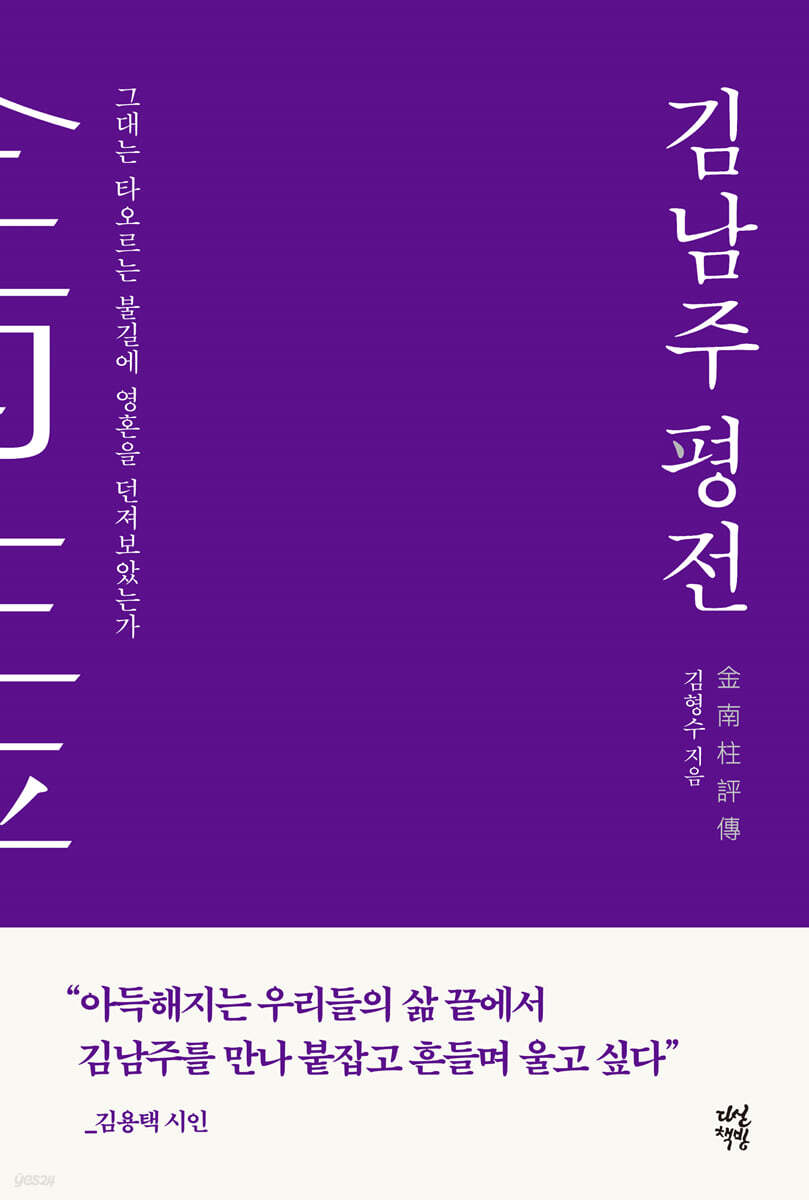
Kim Nam-joo biography
 |
Description
Book Introduction
“At the end of our lives that are becoming distant,
“I want to meet Kim Nam-joo, hold her, shake her, and cry.” ―Poet Kim Yong-taek
Poet Kim Nam-joo, who called himself a ‘warrior.’
He suffered nearly 10 years in prison for the 'Namminjeon Incident', which was recorded as the biggest public security incident in the late Yushin period, and while he was in prison, he wrote 360 of the 510 poems he wrote throughout his life, and he stands as a passionate symbol in the history of Korean literature and democratization.
The trajectory of his life is vividly brought to life in 『Kim Nam-ju Biography - Have You Thrown Your Soul into the Burning Flames』, and its meaning is explored.
Author Kim Hyeong-su, a poet and novelist, traces the temporal and geographical changes of poet Kim Nam-ju from her hometown of Haenam, through Gwangju, the city of the student movement, and finally to Seoul, revealing the spiritual archetype that supported Kim Nam-ju.
It also vividly reveals the footsteps of Kim Nam-ju, a pure soul who dedicated herself to the country and the people rather than her own safety, including the intimate process of publishing the first anti-Yushin underground newspaper, 'Hamseong', and the secret publication of poems written in prison on milk cartons and aluminum foil, which were then published as a collection of prison poems.
“I want to meet Kim Nam-joo, hold her, shake her, and cry.” ―Poet Kim Yong-taek
Poet Kim Nam-joo, who called himself a ‘warrior.’
He suffered nearly 10 years in prison for the 'Namminjeon Incident', which was recorded as the biggest public security incident in the late Yushin period, and while he was in prison, he wrote 360 of the 510 poems he wrote throughout his life, and he stands as a passionate symbol in the history of Korean literature and democratization.
The trajectory of his life is vividly brought to life in 『Kim Nam-ju Biography - Have You Thrown Your Soul into the Burning Flames』, and its meaning is explored.
Author Kim Hyeong-su, a poet and novelist, traces the temporal and geographical changes of poet Kim Nam-ju from her hometown of Haenam, through Gwangju, the city of the student movement, and finally to Seoul, revealing the spiritual archetype that supported Kim Nam-ju.
It also vividly reveals the footsteps of Kim Nam-ju, a pure soul who dedicated herself to the country and the people rather than her own safety, including the intimate process of publishing the first anti-Yushin underground newspaper, 'Hamseong', and the secret publication of poems written in prison on milk cartons and aluminum foil, which were then published as a collection of prison poems.
- You can preview some of the book's contents.
Preview
index
When publishing a book
Previous story
Chapter 1 I am a liberated person
Chapter 2: The Sound of Drums Shaking the Barley Fields
Chapter 3: The Penniless in Gwangju
Chapter 4 Like that green pine tree, like a greener bamboo
Chapter 5 The Waves Go
Chapter 6: After Leaving the Kafka Bookstore
Chapter 7 Warrior
Chapter 8: Mudeungsan Mountain rolled up its hem and covered the sky.
Chapter 9: Finally, do the stars close their eyes?
The story left behind
Photographic materials
Kim Nam-joo's chronology
References
Previous story
Chapter 1 I am a liberated person
Chapter 2: The Sound of Drums Shaking the Barley Fields
Chapter 3: The Penniless in Gwangju
Chapter 4 Like that green pine tree, like a greener bamboo
Chapter 5 The Waves Go
Chapter 6: After Leaving the Kafka Bookstore
Chapter 7 Warrior
Chapter 8: Mudeungsan Mountain rolled up its hem and covered the sky.
Chapter 9: Finally, do the stars close their eyes?
The story left behind
Photographic materials
Kim Nam-joo's chronology
References
Detailed image
.jpg)
Into the book
I sometimes indulge in the absurd fantasy of how different Kim Nam-joo's life would have been if she hadn't spent her youth in Gwangju.
He was a boy who had a knack for enduring silence from an early age.
The inner calm he exuded in the shade gave his neighbors a sense of security, but his eyes were always flickering with a spark.
It gives the impression of a charcoal fire burning endlessly and quietly on Mt. Mudeung.
What is the true nature of the flame? What is the spiritual archetype of this infinitely humble yet infinitely fierce individual who suppresses all the emotions that fuel human desires, yet responds resolutely and unhesitatingly to the insults inflicted on the compassion and dignity of the marginalized? When I begin to discuss this topic, Mt. Mudeung comes to mind.
--- p.98
How could they deliver a devastating blow to Park Chung-hee? The two men were at a loss for a solution.
After much thought, I went to see my senior, Park Seok-mu, but he also didn't have a clear answer.
Senior Park, on the other hand, brought up the story of how he had produced and distributed a leaflet called 'Nokduji' a year ago, and then suddenly got excited and started talking about General Nokdu all night long.
(…) Kim Nam-joo and Lee Kang were determined to resist by any means necessary, so they needed time to reflect on history, and the most appropriate action for that seemed to be to walk through the Donghak Peasant Revolution battlefields.
--- p.164
People breathe closely and feel a sense of intimacy with the poet's figure by touching the cold paper, the psychological medium containing the poet's body heat.
But that is not an act of fighting the meanness of a violent world.
Kim Nam-joo was always on guard, knowing that such behavior could lead her into a world of self-deception.
So he has tried his best not to break away from the world he faces, which is none other than his own father, and so his strong willpower has consciously put poetry aside.
But people were completely oblivious to the fact that this was a cautious attitude towards poetry.
How arrogant is Kim Nam-joo's arrogance in looking down on the romantic sentiments and literary tastes of his time?
--- pp.229~230
Considering that the 20th century was a time of decline for monarchies and empires, the development of democracy, even if nominally, and the rise of numerous ideologies and military dictatorships, Kim Nam-ju's poetry is undoubtedly a deeply historical and spiritual legacy that penetrated the very heart of that era.
It will be a rare monument, particularly one that has assimilated the legacy of resistance poetry that emerged from the vast expanse of the Earth, while transforming the unique linguistic structure of its own land into a most tangible poetic achievement.
And we cannot fail to note that this took place in the worst place in South Korea: the special ward of Gwangju Prison.
It's amazing.
--- pp.446~447
Any art can only reach its highest level when the artist can forget ideology and technical habits and substitute reality itself for his own existence.
For this to be possible, the poet's language must first spring from the heart of the times, and for it to have the power to call countless people to the square of history, the poet's position must be close to the scene of a violent explosion, a time of political civil war.
Throughout the 20th century, 150 million souls were murdered in wars and on the direct orders of state leaders.
Kim Nam-joo's poetry crawled through the midst of that fierce battlefield, and with the "white-hot" spirit it acquired, it proved to its time that it had reached the pinnacle of contemporary sensuality.
He was a boy who had a knack for enduring silence from an early age.
The inner calm he exuded in the shade gave his neighbors a sense of security, but his eyes were always flickering with a spark.
It gives the impression of a charcoal fire burning endlessly and quietly on Mt. Mudeung.
What is the true nature of the flame? What is the spiritual archetype of this infinitely humble yet infinitely fierce individual who suppresses all the emotions that fuel human desires, yet responds resolutely and unhesitatingly to the insults inflicted on the compassion and dignity of the marginalized? When I begin to discuss this topic, Mt. Mudeung comes to mind.
--- p.98
How could they deliver a devastating blow to Park Chung-hee? The two men were at a loss for a solution.
After much thought, I went to see my senior, Park Seok-mu, but he also didn't have a clear answer.
Senior Park, on the other hand, brought up the story of how he had produced and distributed a leaflet called 'Nokduji' a year ago, and then suddenly got excited and started talking about General Nokdu all night long.
(…) Kim Nam-joo and Lee Kang were determined to resist by any means necessary, so they needed time to reflect on history, and the most appropriate action for that seemed to be to walk through the Donghak Peasant Revolution battlefields.
--- p.164
People breathe closely and feel a sense of intimacy with the poet's figure by touching the cold paper, the psychological medium containing the poet's body heat.
But that is not an act of fighting the meanness of a violent world.
Kim Nam-joo was always on guard, knowing that such behavior could lead her into a world of self-deception.
So he has tried his best not to break away from the world he faces, which is none other than his own father, and so his strong willpower has consciously put poetry aside.
But people were completely oblivious to the fact that this was a cautious attitude towards poetry.
How arrogant is Kim Nam-joo's arrogance in looking down on the romantic sentiments and literary tastes of his time?
--- pp.229~230
Considering that the 20th century was a time of decline for monarchies and empires, the development of democracy, even if nominally, and the rise of numerous ideologies and military dictatorships, Kim Nam-ju's poetry is undoubtedly a deeply historical and spiritual legacy that penetrated the very heart of that era.
It will be a rare monument, particularly one that has assimilated the legacy of resistance poetry that emerged from the vast expanse of the Earth, while transforming the unique linguistic structure of its own land into a most tangible poetic achievement.
And we cannot fail to note that this took place in the worst place in South Korea: the special ward of Gwangju Prison.
It's amazing.
--- pp.446~447
Any art can only reach its highest level when the artist can forget ideology and technical habits and substitute reality itself for his own existence.
For this to be possible, the poet's language must first spring from the heart of the times, and for it to have the power to call countless people to the square of history, the poet's position must be close to the scene of a violent explosion, a time of political civil war.
Throughout the 20th century, 150 million souls were murdered in wars and on the direct orders of state leaders.
Kim Nam-joo's poetry crawled through the midst of that fierce battlefield, and with the "white-hot" spirit it acquired, it proved to its time that it had reached the pinnacle of contemporary sensuality.
--- p.541
Publisher's Review
“Have you thrown your soul into the burning flames?”
A pure soul who shouts freedom when fighting for all people
Kim Nam-ju's life philosophy and legacy revisited through the insights of author Kim Hyung-soo.
A biography of Kim Nam-ju (1945-1994), a pure poet who dedicated his entire life to the freedom and equality of the people and loved his era more than anyone else, has been published.
Author Kim Hyeong-su, a junior of poet Kim Nam-ju and a cradle of the democratization movement, devoted a long time to restoring Kim Nam-ju’s life, “as someone indebted to his poetry,” “to testify that the soul of Kim Nam-ju visited this seemingly humble world.”
Even 30 years after the military dictatorship disappeared, the reason we must revisit Kim Nam-ju's fiery life and literary legacy is because, according to author Kim Hyeong-su, the Republic of Korea still needs souls like "candlelight."
Compiled from anecdotes experienced by the poet, published prose, and interviews with close acquaintances, 『Kim Nam-ju Biography』 vividly depicts not only the first half of his life, which served as the foundation for Kim Nam-ju's literature, but also the second half, when he fought for the flag of freedom through popular literature in the fiercest of life situations.
This work, which organically connects the fragments of scattered literary and historical events to illustrate how Kim Nam-ju's life, literature, and struggle for democracy were inevitably connected, can be considered the most concise yet of any work charting the poet's life and legacy.
Remembering Kim Nam-joo is about the 'illusory future'
It's a means of not missing the narrative of resistance.
As his poetry is an indispensable part of discussing Kim Nam-ju's life, the author unfolds his narrative focusing on the poems that left a significant mark on Korean poetry history among the works he left behind.
Through works such as “Ashes,” which became a hot topic in intellectual circles as well as the democratization movement circles as soon as he debuted in the literary world by submitting to “Creation and Criticism,” “Servant and Master,” which reveals the rural society that was Kim Nam-ju’s foundation and class sentiment as a problem to be solved, and “Song,” which revealed Kim Nam-ju’s unique identity as the creator of the anti-Yushin underground newspaper “Hamseong” while attending college and became the lyrics of the famous song “Jukchangga” sung at the democratization movement in the 1980s, this book thoroughly examines literary and political themes raised throughout modern Korean history and the poet’s life.
From the time he first became known as a poet in 1974 until his death in 1994, Kim Nam-joo's poetry was a product of a revolution that threw itself into the world and created enormous power.
The author reveals the path by which his poetic world, which was multifaceted yet unified and became the cry of the people, was born, and, with the hope that Kim Nam-ju's life will be passed down to future generations as a great legacy of the times, he sought to redefine the achievements of the poet, who was the center of the democratization movement of his time, from a present-day perspective.
The poet's pure struggle to unite poetry and revolution while resisting violence against humanity still holds power and inspires us to dream of a better world.
And the poet's conscience, which burned himself to illuminate the light of the democratic spirit, will be revived in the biography of Kim Nam-ju and serve as an example to the current candlelight generation.
When Kim Nam-joo's poetry and life are not preserved as a single piece of history, but still live in our hearts and can be sung as songs, we will be able to illuminate the path to true freedom and equality that we seek.
A pure soul who shouts freedom when fighting for all people
Kim Nam-ju's life philosophy and legacy revisited through the insights of author Kim Hyung-soo.
A biography of Kim Nam-ju (1945-1994), a pure poet who dedicated his entire life to the freedom and equality of the people and loved his era more than anyone else, has been published.
Author Kim Hyeong-su, a junior of poet Kim Nam-ju and a cradle of the democratization movement, devoted a long time to restoring Kim Nam-ju’s life, “as someone indebted to his poetry,” “to testify that the soul of Kim Nam-ju visited this seemingly humble world.”
Even 30 years after the military dictatorship disappeared, the reason we must revisit Kim Nam-ju's fiery life and literary legacy is because, according to author Kim Hyeong-su, the Republic of Korea still needs souls like "candlelight."
Compiled from anecdotes experienced by the poet, published prose, and interviews with close acquaintances, 『Kim Nam-ju Biography』 vividly depicts not only the first half of his life, which served as the foundation for Kim Nam-ju's literature, but also the second half, when he fought for the flag of freedom through popular literature in the fiercest of life situations.
This work, which organically connects the fragments of scattered literary and historical events to illustrate how Kim Nam-ju's life, literature, and struggle for democracy were inevitably connected, can be considered the most concise yet of any work charting the poet's life and legacy.
Remembering Kim Nam-joo is about the 'illusory future'
It's a means of not missing the narrative of resistance.
As his poetry is an indispensable part of discussing Kim Nam-ju's life, the author unfolds his narrative focusing on the poems that left a significant mark on Korean poetry history among the works he left behind.
Through works such as “Ashes,” which became a hot topic in intellectual circles as well as the democratization movement circles as soon as he debuted in the literary world by submitting to “Creation and Criticism,” “Servant and Master,” which reveals the rural society that was Kim Nam-ju’s foundation and class sentiment as a problem to be solved, and “Song,” which revealed Kim Nam-ju’s unique identity as the creator of the anti-Yushin underground newspaper “Hamseong” while attending college and became the lyrics of the famous song “Jukchangga” sung at the democratization movement in the 1980s, this book thoroughly examines literary and political themes raised throughout modern Korean history and the poet’s life.
From the time he first became known as a poet in 1974 until his death in 1994, Kim Nam-joo's poetry was a product of a revolution that threw itself into the world and created enormous power.
The author reveals the path by which his poetic world, which was multifaceted yet unified and became the cry of the people, was born, and, with the hope that Kim Nam-ju's life will be passed down to future generations as a great legacy of the times, he sought to redefine the achievements of the poet, who was the center of the democratization movement of his time, from a present-day perspective.
The poet's pure struggle to unite poetry and revolution while resisting violence against humanity still holds power and inspires us to dream of a better world.
And the poet's conscience, which burned himself to illuminate the light of the democratic spirit, will be revived in the biography of Kim Nam-ju and serve as an example to the current candlelight generation.
When Kim Nam-joo's poetry and life are not preserved as a single piece of history, but still live in our hearts and can be sung as songs, we will be able to illuminate the path to true freedom and equality that we seek.
GOODS SPECIFICS
- Publication date: December 16, 2022
- Page count, weight, size: 564 pages | 642g | 145*215*28mm
- ISBN13: 9791130695587
- ISBN10: 1130695581
You may also like
카테고리
korean


korean

![GQ KOREA Mark (Monthly): December [2025]](http://librairie.coreenne.fr/cdn/shop/files/8ef265dbbfbf186523ed75ba7319009d.jpg?v=1765340328&width=3840)


