

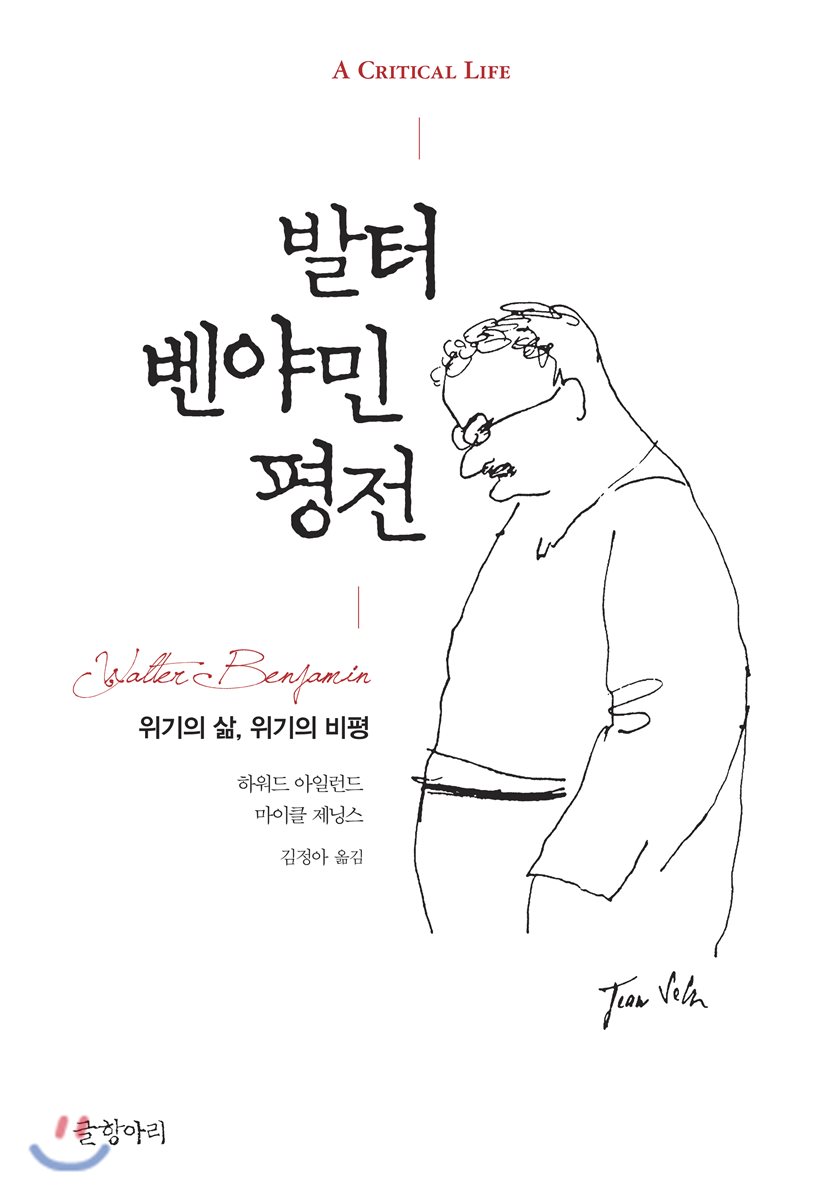
Walter Benjamin Biography
 |
Description
Book Introduction
The most comprehensive and definitive edition of Benjamin's biography!
Several books have been published on Walter Benjamin, who stands out among the many difficult figures in 20th-century intellectual history.
These secondary sources, when dealing with Benjamin, do not have a single unanimous agreement on their content and stance, showing that Benjamin was a multifaceted and multi-layered figure who could not be converged upon.
The authors of this biography, standing on the shoulders of thousands of previous researchers, could not help but feel a sense of regret about the shortcomings of their previous books.
This is because, regardless of whether it is electricity or criticism, it shows a tendency to be selective, that is, to set one topic and exclude the rest.
As a result, Benjamin's portrait was drawn in a biased way, and there were also ways to mythologize or misrepresent him.
This biography by Ireland and Jennings, the most authoritative Benjamin scholars in the English-speaking world, aims to complete a comprehensive overview of Benjamin.
To this end, we have adopted a rigorous chronological approach, focusing on the everyday life that was the hidden stage of Benjamin's work and attempting to illuminate the academic and historical context of his remaining works.
This approach allows us to illuminate the historicity of each stage of Benjamin's life and work, while also ensuring the credibility of the scholarly trajectory of Benjamin as understood by biographers.
This book, for example, traces the aspects of Benjamin's childhood that do not disappear as a personal trace of an individual but remain as a critical object of experience and memory, while also containing ample biographical elements that provide a compassionate look at his life.
What runs through the entire book is an objective approach to his life, at the same time a yardstick of compassion and understanding, while at the same time thoroughly examining an individual's life from a scholarly and critical perspective.
That is, each paragraph and each page quotes and condenses his theses and essays, and adds critical descriptions of them, so it has the character of a biography of life as well as a book review or critical essay on the text.
Benjamin did not consider 'readability' to be an important criterion in the writing of intellectuals.
But as a secondary source, this book aims to paint a clearer portrait of Benjamin's indecipherable obscurity.
Of course, this is by no means an attempt to solve the enigma that is Benjamin or to dissolve his contradictory aspects into one.
However, I wanted to explain a little more about the causes, background, and meaning of his incomprehensibility so that we can understand it more clearly.
This gives scholarly depth to this biography.
Several books have been published on Walter Benjamin, who stands out among the many difficult figures in 20th-century intellectual history.
These secondary sources, when dealing with Benjamin, do not have a single unanimous agreement on their content and stance, showing that Benjamin was a multifaceted and multi-layered figure who could not be converged upon.
The authors of this biography, standing on the shoulders of thousands of previous researchers, could not help but feel a sense of regret about the shortcomings of their previous books.
This is because, regardless of whether it is electricity or criticism, it shows a tendency to be selective, that is, to set one topic and exclude the rest.
As a result, Benjamin's portrait was drawn in a biased way, and there were also ways to mythologize or misrepresent him.
This biography by Ireland and Jennings, the most authoritative Benjamin scholars in the English-speaking world, aims to complete a comprehensive overview of Benjamin.
To this end, we have adopted a rigorous chronological approach, focusing on the everyday life that was the hidden stage of Benjamin's work and attempting to illuminate the academic and historical context of his remaining works.
This approach allows us to illuminate the historicity of each stage of Benjamin's life and work, while also ensuring the credibility of the scholarly trajectory of Benjamin as understood by biographers.
This book, for example, traces the aspects of Benjamin's childhood that do not disappear as a personal trace of an individual but remain as a critical object of experience and memory, while also containing ample biographical elements that provide a compassionate look at his life.
What runs through the entire book is an objective approach to his life, at the same time a yardstick of compassion and understanding, while at the same time thoroughly examining an individual's life from a scholarly and critical perspective.
That is, each paragraph and each page quotes and condenses his theses and essays, and adds critical descriptions of them, so it has the character of a biography of life as well as a book review or critical essay on the text.
Benjamin did not consider 'readability' to be an important criterion in the writing of intellectuals.
But as a secondary source, this book aims to paint a clearer portrait of Benjamin's indecipherable obscurity.
Of course, this is by no means an attempt to solve the enigma that is Benjamin or to dissolve his contradictory aspects into one.
However, I wanted to explain a little more about the causes, background, and meaning of his incomprehensibility so that we can understand it more clearly.
This gives scholarly depth to this biography.
- You can preview some of the book's contents.
Preview
index
introduction
Chapter 1: Childhood in Berlin: 1892–1912
Chapter 2: The Metaphysics of Youth: Berlin and Freiburg, 1912–1914
Chapter 3: The Concept of Criticism: Berlin, Munich, and Bern, 1915–1919
Chapter 4: Affinity: Berlin, Heidelberg, 1920–1922
Chapter 5: Academic Nomads: Frankfurt, Berlin, Italy, 1923–1926
Chapter 6: Intellectuals of the Weimar Era: Berlin and Moscow, 1925–1928
Chapter 7: The Destructive Personality: Berlin, Paris, and Ibiza, 1929–1932
Chapter 8: Exile: Paris, Ibiza, 1933–1934
Chapter 9: Parisian Roads, Parisian Writings: Paris, Sanremo, Skowsbostrand, 1935–1937
Chapter 10: Baudelaire and the Parisian Streets: Paris, Sanremo, and Skowsbostrand, 1938–1940
Chapter 11: The Angel of History: Paris, Nevers, Marseille, and Porte Bourg, 1939–1940
Epilogue
Translator's Note
References
Search
Chapter 1: Childhood in Berlin: 1892–1912
Chapter 2: The Metaphysics of Youth: Berlin and Freiburg, 1912–1914
Chapter 3: The Concept of Criticism: Berlin, Munich, and Bern, 1915–1919
Chapter 4: Affinity: Berlin, Heidelberg, 1920–1922
Chapter 5: Academic Nomads: Frankfurt, Berlin, Italy, 1923–1926
Chapter 6: Intellectuals of the Weimar Era: Berlin and Moscow, 1925–1928
Chapter 7: The Destructive Personality: Berlin, Paris, and Ibiza, 1929–1932
Chapter 8: Exile: Paris, Ibiza, 1933–1934
Chapter 9: Parisian Roads, Parisian Writings: Paris, Sanremo, Skowsbostrand, 1935–1937
Chapter 10: Baudelaire and the Parisian Streets: Paris, Sanremo, and Skowsbostrand, 1938–1940
Chapter 11: The Angel of History: Paris, Nevers, Marseille, and Porte Bourg, 1939–1940
Epilogue
Translator's Note
References
Search
Publisher's Review
The artist of life, a life combined with criticism
This book, which takes a chronological approach, begins with Benjamin's childhood.
As you know, his childhood was shown in 『Childhood in Berlin circa 1900』, where an individual's childhood is dissolved into a historical space rather than an unreflective mythical space, and a child's sense of relief is dissolved into an adult's sense of crisis.
‘Experience’ and ‘memory’ were important concepts for Benjamin.
“Just as old cities are buried media, so memory is the media in which past experiences are buried.
“Whoever wants to approach his past must become a gravedigger.” For Benjamin, remembering meant making present the meaning of a vanished moment in its various layers.
This is why in his 1929 work “Images of Proust,” he says, “Experienced events are finite, but remembered events are infinite.”
In that respect, Benjamin's experiences and memories come to the reader as a text whose layers of meaning must be unearthed.
One of the most unique things about Benjamin's life was his way of 'friendship'.
He attracted a great number of intellectuals into his orbit through his excellence and intensity, but the trajectory of their friendship was not smooth.
There are two reasons.
First, Benjamin maintained absolute privacy, even from his closest friends.
Second, he completely blocked communication between his friends.
Why? The perfect courtesy he maintained toward his friends was, in fact, a complex mechanism of distancing, and his prevention of contact with each other was intended to test his arguments against each friend.
Adorno called Benjamin “a friend whose true nature is unknown,” and Benjamin’s careful use of masks and indirect strategies was a way to protect his inner self.
Benjamin, who displayed a strong sexual adventurous side both before and after marriage, transferred all the energy of life, encompassing both intellectual and sexual energy, into his work.
Dora, Benjamin's wife, who had been a steadfast supporter of his scholarship and writing, could not imagine escaping from his powerful thoughts, let alone giving up a physical relationship with him.
This was a surprising thing about their relationship.
Although they had one son and later divorced, Dora still read everything her ex-husband wrote, as well as everything written by those who influenced him, and Benjamin consistently valued her opinions.
When Dora's opinions differed from his own, Benjamin was reluctant to proceed.
As you know, Benjamin enjoyed polyamorous relationships, and he especially preferred to love someone who was already married and involved in complex love triangles.
His friend Scholem once commented that “Benjamin displays a brilliant ethical aura in his thinking, but his attitude toward everyday life reveals unscrupulous and immoral elements.”
By the standards of common morality, his addiction to drugs and gambling is also reprehensible.
Even while living the miserable life of an exile, he gambled with the meager royalties he earned from his manuscripts and had hallucinatory experiences with hashish.
But it may be unfair to evaluate all these fragments of life by one standard.
The authors of this book say that the messy aspects of his life are actually indicators of how desperate he was.
To understand this behavior from the inside, we must consider how he portrays gamblers in his "Passage Works" and what the spatiotemporal experience of gamblers in a state of intoxication is like.
In other words, his life and writings create a special map amidst contradictions.
The implication we can draw from this is that Benjamin consistently aimed to actualize his “many inner modes of being.”
In other words, although it possessed a remarkable multifaceted nature, it did not lose its internal systematic consistency or consistency as a text.
Thus, Adorno called Benjamin's consciousness a peculiar consciousness that is "centrifugally" integrated, that is, a consciousness that is established by being diffused in all directions.
Reading Benjamin's Works: Sketches
Within the trajectory of a thought that chronologically shifts course (while, of course, maintaining its keynote), this book connects important scholarly discussions: the influence of Benjamin's writings on his time and later, the debates and controversies surrounding him, and the issues raised as the writing progressed.
Benjamin once engaged in romantic thinking during his youth.
Then the spiritual and political fervor of those glorious days gave way to less radicalism and materialistic and anthropological tendencies.
Yet, no matter how much time passed, Benjamin remained, in a fundamental sense, a wandering student, always seeking a beginning.
Thus, in this book, which examines his life in sections over several years, his writing shows a step-by-step progression, opening up new perspectives each time.
For example, in writing "Capitalism as Religion," which preached romantic anti-capitalism in the early 20th century, he hinted at the path to Marxism later on.
“Capitalism, the cult of cults, makes us indebted and sinful.” Capitalist time, maintained solely through the ceaseless ritual of purchasing and consumption, without doctrine or theology, is reconstructed as a time without weekdays and only with festivals.
Benjamin focuses on the aspect of capitalism that destroys existence by burdening people with debt and guilt.
“When capitalism becomes a religion, existence is not reformed but crushed.
“Despair spreads endlessly, and eventually despair becomes the religious status quo.”
"The Translator's Task" from 1923 is by no means a book that explains translation techniques, but rather occupies an important position in Benjamin's thought process as a general theory of art criticism.
The starting point of this article is the claim that works of art do not depend on the recipient.
“Poetry is not meant to be read, a painting is not meant to be looked at, a symphony is not meant to be heard.” Benjamin argues that translation does not mediate between the original and the reader, but rather, along with criticism, is not only an essential element in constituting the ‘afterlife’ of the work, but also virtually replaces the life of the original.
“It is in translation that the original work gains its most new and expansive life.”
Let us briefly examine two of Benjamin's essays that have been read in a biased manner.
While "The Work of Art in the Age of Mechanical Reproduction" has been criticized as an unjustified optimism, "The Storyteller" has spread the widespread impression that Benjamin is a man who longs for things of the past.
But the authors of this book counter that both criticisms overlook Benjamin's uncanny ability to exploit assigned tasks for his own purposes.
Rather, "The Storyteller" succeeds in reaching Benjamin's characteristically curious concern with how the forms of media and genre relate to the question of human experience, starting from a seemingly unrelated topic: how urban commodity capitalism arose in Paris.
Benjamin's greatest achievement in the 1930s was his translation and study of Baudelaire.
Baudelaire was a figure who was thoroughly sensitive to the most degrading by-products of modern life, and he was a figure that Benjamin, who had focused on the 'waste' of history, could not help but pay attention to in his discussion of modernity.
As Benjamin's writings developed in form and theme, Baudelaireian modernity played a decisive role, and this book illustrates the process by which Baudelaire became the focal point in many aspects of his later work, connecting this process with the hardships of his life in exile.
The most notable of Benjamin's last works is undoubtedly the "Passage Works."
Many of the writings I wrote during my ten years in exile were branches from the root called ‘Passage Work.’
This book can be considered a cultural history of urban commodity capitalism that emerged in mid-19th-century France. While it was ultimately an unfinished and weighty work, the research and reflections conducted for it resulted in a series of innovative writings.
While Benjamin left behind a vast body of work as a brilliant critic and revolutionary theorist, he also produced a significant body of work that straddled the boundaries between fiction, reportage, cultural analysis, and memoir.
Among them, 『One Way Street』, published in 1928 and which can be called a “montage book,” and 『Childhood in Berlin circa 1900』, mentioned above, are truly modern masterpieces.
Benjamin Image Collage: Recollections of Friends
This book traces Benjamin's trajectory over the course of his life, and as the numerous sources mobilized are letters exchanged between Benjamin and the memoirs of his acquaintances, his image is incomplete, but the authors focus on his conflicting aspects.
For that reason, the people who deserve more attention are my academic connections rather than my old friends.
Benjamin, who spent his entire life trying to enter the system and become a university professor but ultimately failed, powerfully attracted his contemporaries by constantly providing academic stimulation to others regardless of his precarious position.
This biography pieces together Benjamin's work by citing primary sources from thousands of researchers who have unearthed Benjamin's material over the years.
Notable figures among them include Gershom Scholem, who was closer to Benjamin's studies and life than anyone else and preached his Zionist stance; his wife Dora, who served as the de facto head of the household both before and after the divorce; Brecht, whom Benjamin's friends considered a dangerous person for fear that his "wild thinking" would have a negative influence on him; Asha Ratzis, Benjamin's lover whom he constantly courted; Adorno, his lifelong academic partner, but wary that Benjamin would appropriate his academic achievements; Bloch, who was even more so than Adorno; Ernst Schön, whose character and confidence were unparalleled, and many others.
The young Benjamin portrayed by Scholem in 'The History of a Friendship' was a being that radiated magic.
He recalls his relationship with Benjamin as “the most momentous experience of my life.”
Scholem's diaries from 1916 to 1919 record his friend's intellectual presence and the emotional turmoil it caused him.
“He is a person who sees history in a new and surprising way.
He has a voice.
“His specific opinions are important, but it is his very spiritual being that has the greatest influence.” It was in the field of philosophy of language that Scholem’s knowledge of the Hebrew tradition influenced Benjamin’s thinking, and Benjamin’s thinking in turn had a liberating influence on Scholem.
For Scholem, Benjamin was not only “absolute, overwhelming,” but also a figure who brought about the confession, “He is the only person at the center of my life.”
“There is something in Walter that seeks to become the order of his writing by exhausting himself.” Of course, it is almost always Scholem who painfully realizes the enormous gulf between them, and he sometimes plays the role of the rejected lover.
Adorno was a friend who recognized early on that Benjamin's cultural criticism was both criticism and "philosophy of the object of criticism."
In other words, there are three concerns in all of Benjamin's work that are based on the problematic framework of traditional philosophy.
In short, these are experience, historical memory, and art, and the origins of these three interests are connected to Kant's critical idealism and Nietzsche's philosophy of life.
Although his work does not take the usual philosophical form, Benjamin never shied away from the challenge of thinking both within and beyond the paradoxes of traditional metaphysics.
The ideal reader for this work was Adorno.
In Frankfurt, Benjamin and Adorno's discussions almost always included the "Passage Work."
Adorno had an early insight into Benjamin's "Passage Works" as being "not only central to philosophy, but also a decisive statement, a unique masterpiece, compared to everything else that can be philosophically expressed today."
Adorno also expressed “immediate, overwhelming emotion” after reading Benjamin’s “Franz Kafka.”
“This was the first time I felt so fully that we were in agreement on the fundamental questions of philosophy.” Adorno was a most perceptive reader, not only understanding that Benjamin was trying to derive a “reverse theology” from Kafka’s fables, but also recognizing that myth and antiquity were inherent in modernity.
However, the tension between the two was sometimes tense.
Benjamin was concerned that Adorno might gain recognition in academia by appropriating Benjamin's arguments.
For example, Adorno quoted Benjamin's The Origins of German Tragic Drama without quoting it in his book "The Presentity of Philosophy," and in his thesis for his professorship, "Kierkegaard," he exposes himself as being in the process of finding his own views without being able to break away from Benjamin's academic principles.
Moreover, in the 1930s, Adorno did not hesitate to make strong interventions in the "Passage Works" by suddenly claiming joint ownership, and even to admonish that certain types of research should not be done.
His interference not only harmed the 『Passage Work』, but also harmed the process of accepting this work.
Needless to say, it had a negative impact on Benjamin's psychological state.
Ernst Bloch, a colleague who competed with Benjamin in academic excellence, cannot be left out.
After his new book, The Heritage of This Age, came out, Benjamin realized that it had stolen his writings.
In this book, Bloch not only brilliantly borrows the montage format, but also deliberately appropriates the themes and constellation arguments of the Passage Work.
Benjamin expresses his appreciation of Bloch's book in a letter.
“Bloch may have good intentions and important insights, but he lacks the discernment to put them into practice.” However, there was still a personal intimacy between Benjamin and Bloch, and Benjamin even said, “Since our last conversation, much has been washed away with blood and tears, so I believe that if we could discuss it again, it would be a new turning point for both of us.”
Friendship with Brecht, the foundation of mature scholarship
The only exception to this rule, where Benjamin always took the role of leader among his friends, was Bertolt Brecht.
Benjamin's masterpiece, "The Passage Works," took shape thanks to his encounter with Brecht (a clash between the perspectives of historical materialism and those rooted in surrealism).
In the 1920s, Brecht avoided meeting Benjamin.
But as time passed, Benjamin's thinking changed, and from the late 1920s onwards, "a more pronounced Marxist accent" emerged in Benjamin, which was due to his relationship with Brecht.
Although Benjamin's most famous work today is that written in the mid-1930s, the foundation of this mature scholarship came from his friendship with Brecht.
It was only later that Benjamin's work revealed its distinctive blend of radical leftist politics, an integrative theology that transcended the specific doctrines of Judaism and Christianity, a deep knowledge of the German philosophical tradition, and a cultural theory applicable to a wide range of subjects in the rapidly changing environment of modernity.
Benjamin's friends, while skeptical of his relationship with Brecht, did not deny its importance.
“Brecht brought a completely new element into Benjamin’s life,” Scholem recalled.
Benjamin became a member of the Brecht Circle, where he engaged in discussions and met Marxist intellectuals, including Karl Korsch.
Brecht was an important subject matter for Benjamin's writing, and his voice had a great influence on Benjamin's writing.
Benjamin even declared, “My agreement with Brecht’s work is the most important and well-armed point in my entire position.”
For example, the discussion with Brecht about the possibility of the proletarianization of bourgeois writers is repeated almost exactly five years later in Benjamin's study of Baudelaire.
Benjamin was theological in his inclinations and a carefully orchestrated leftist social researcher in his work, but in his political stance he adopted a Brechtian (participatory) politics, and it was this politics that Scholem opposed.
* * *
Even though 70 years have passed since Benjamin's death, his influence continues to be felt, above all, because his thinking and writing were solid.
He challenged existing understandings of the possibilities of writing, his adaptation and critique of technological media, and his analysis of the historical phenomena facing European modernity. Yet, he also possessed a uniquely nuanced linguistic expression that left him second to none in his prose.
In particular, he showed his side as a pioneering formal innovator in the form of 'private image'.
Therefore, through this biography, readers will not only experience the density and depth of his thoughts, but will also enjoy an equally sensory experience.
This book, which takes a chronological approach, begins with Benjamin's childhood.
As you know, his childhood was shown in 『Childhood in Berlin circa 1900』, where an individual's childhood is dissolved into a historical space rather than an unreflective mythical space, and a child's sense of relief is dissolved into an adult's sense of crisis.
‘Experience’ and ‘memory’ were important concepts for Benjamin.
“Just as old cities are buried media, so memory is the media in which past experiences are buried.
“Whoever wants to approach his past must become a gravedigger.” For Benjamin, remembering meant making present the meaning of a vanished moment in its various layers.
This is why in his 1929 work “Images of Proust,” he says, “Experienced events are finite, but remembered events are infinite.”
In that respect, Benjamin's experiences and memories come to the reader as a text whose layers of meaning must be unearthed.
One of the most unique things about Benjamin's life was his way of 'friendship'.
He attracted a great number of intellectuals into his orbit through his excellence and intensity, but the trajectory of their friendship was not smooth.
There are two reasons.
First, Benjamin maintained absolute privacy, even from his closest friends.
Second, he completely blocked communication between his friends.
Why? The perfect courtesy he maintained toward his friends was, in fact, a complex mechanism of distancing, and his prevention of contact with each other was intended to test his arguments against each friend.
Adorno called Benjamin “a friend whose true nature is unknown,” and Benjamin’s careful use of masks and indirect strategies was a way to protect his inner self.
Benjamin, who displayed a strong sexual adventurous side both before and after marriage, transferred all the energy of life, encompassing both intellectual and sexual energy, into his work.
Dora, Benjamin's wife, who had been a steadfast supporter of his scholarship and writing, could not imagine escaping from his powerful thoughts, let alone giving up a physical relationship with him.
This was a surprising thing about their relationship.
Although they had one son and later divorced, Dora still read everything her ex-husband wrote, as well as everything written by those who influenced him, and Benjamin consistently valued her opinions.
When Dora's opinions differed from his own, Benjamin was reluctant to proceed.
As you know, Benjamin enjoyed polyamorous relationships, and he especially preferred to love someone who was already married and involved in complex love triangles.
His friend Scholem once commented that “Benjamin displays a brilliant ethical aura in his thinking, but his attitude toward everyday life reveals unscrupulous and immoral elements.”
By the standards of common morality, his addiction to drugs and gambling is also reprehensible.
Even while living the miserable life of an exile, he gambled with the meager royalties he earned from his manuscripts and had hallucinatory experiences with hashish.
But it may be unfair to evaluate all these fragments of life by one standard.
The authors of this book say that the messy aspects of his life are actually indicators of how desperate he was.
To understand this behavior from the inside, we must consider how he portrays gamblers in his "Passage Works" and what the spatiotemporal experience of gamblers in a state of intoxication is like.
In other words, his life and writings create a special map amidst contradictions.
The implication we can draw from this is that Benjamin consistently aimed to actualize his “many inner modes of being.”
In other words, although it possessed a remarkable multifaceted nature, it did not lose its internal systematic consistency or consistency as a text.
Thus, Adorno called Benjamin's consciousness a peculiar consciousness that is "centrifugally" integrated, that is, a consciousness that is established by being diffused in all directions.
Reading Benjamin's Works: Sketches
Within the trajectory of a thought that chronologically shifts course (while, of course, maintaining its keynote), this book connects important scholarly discussions: the influence of Benjamin's writings on his time and later, the debates and controversies surrounding him, and the issues raised as the writing progressed.
Benjamin once engaged in romantic thinking during his youth.
Then the spiritual and political fervor of those glorious days gave way to less radicalism and materialistic and anthropological tendencies.
Yet, no matter how much time passed, Benjamin remained, in a fundamental sense, a wandering student, always seeking a beginning.
Thus, in this book, which examines his life in sections over several years, his writing shows a step-by-step progression, opening up new perspectives each time.
For example, in writing "Capitalism as Religion," which preached romantic anti-capitalism in the early 20th century, he hinted at the path to Marxism later on.
“Capitalism, the cult of cults, makes us indebted and sinful.” Capitalist time, maintained solely through the ceaseless ritual of purchasing and consumption, without doctrine or theology, is reconstructed as a time without weekdays and only with festivals.
Benjamin focuses on the aspect of capitalism that destroys existence by burdening people with debt and guilt.
“When capitalism becomes a religion, existence is not reformed but crushed.
“Despair spreads endlessly, and eventually despair becomes the religious status quo.”
"The Translator's Task" from 1923 is by no means a book that explains translation techniques, but rather occupies an important position in Benjamin's thought process as a general theory of art criticism.
The starting point of this article is the claim that works of art do not depend on the recipient.
“Poetry is not meant to be read, a painting is not meant to be looked at, a symphony is not meant to be heard.” Benjamin argues that translation does not mediate between the original and the reader, but rather, along with criticism, is not only an essential element in constituting the ‘afterlife’ of the work, but also virtually replaces the life of the original.
“It is in translation that the original work gains its most new and expansive life.”
Let us briefly examine two of Benjamin's essays that have been read in a biased manner.
While "The Work of Art in the Age of Mechanical Reproduction" has been criticized as an unjustified optimism, "The Storyteller" has spread the widespread impression that Benjamin is a man who longs for things of the past.
But the authors of this book counter that both criticisms overlook Benjamin's uncanny ability to exploit assigned tasks for his own purposes.
Rather, "The Storyteller" succeeds in reaching Benjamin's characteristically curious concern with how the forms of media and genre relate to the question of human experience, starting from a seemingly unrelated topic: how urban commodity capitalism arose in Paris.
Benjamin's greatest achievement in the 1930s was his translation and study of Baudelaire.
Baudelaire was a figure who was thoroughly sensitive to the most degrading by-products of modern life, and he was a figure that Benjamin, who had focused on the 'waste' of history, could not help but pay attention to in his discussion of modernity.
As Benjamin's writings developed in form and theme, Baudelaireian modernity played a decisive role, and this book illustrates the process by which Baudelaire became the focal point in many aspects of his later work, connecting this process with the hardships of his life in exile.
The most notable of Benjamin's last works is undoubtedly the "Passage Works."
Many of the writings I wrote during my ten years in exile were branches from the root called ‘Passage Work.’
This book can be considered a cultural history of urban commodity capitalism that emerged in mid-19th-century France. While it was ultimately an unfinished and weighty work, the research and reflections conducted for it resulted in a series of innovative writings.
While Benjamin left behind a vast body of work as a brilliant critic and revolutionary theorist, he also produced a significant body of work that straddled the boundaries between fiction, reportage, cultural analysis, and memoir.
Among them, 『One Way Street』, published in 1928 and which can be called a “montage book,” and 『Childhood in Berlin circa 1900』, mentioned above, are truly modern masterpieces.
Benjamin Image Collage: Recollections of Friends
This book traces Benjamin's trajectory over the course of his life, and as the numerous sources mobilized are letters exchanged between Benjamin and the memoirs of his acquaintances, his image is incomplete, but the authors focus on his conflicting aspects.
For that reason, the people who deserve more attention are my academic connections rather than my old friends.
Benjamin, who spent his entire life trying to enter the system and become a university professor but ultimately failed, powerfully attracted his contemporaries by constantly providing academic stimulation to others regardless of his precarious position.
This biography pieces together Benjamin's work by citing primary sources from thousands of researchers who have unearthed Benjamin's material over the years.
Notable figures among them include Gershom Scholem, who was closer to Benjamin's studies and life than anyone else and preached his Zionist stance; his wife Dora, who served as the de facto head of the household both before and after the divorce; Brecht, whom Benjamin's friends considered a dangerous person for fear that his "wild thinking" would have a negative influence on him; Asha Ratzis, Benjamin's lover whom he constantly courted; Adorno, his lifelong academic partner, but wary that Benjamin would appropriate his academic achievements; Bloch, who was even more so than Adorno; Ernst Schön, whose character and confidence were unparalleled, and many others.
The young Benjamin portrayed by Scholem in 'The History of a Friendship' was a being that radiated magic.
He recalls his relationship with Benjamin as “the most momentous experience of my life.”
Scholem's diaries from 1916 to 1919 record his friend's intellectual presence and the emotional turmoil it caused him.
“He is a person who sees history in a new and surprising way.
He has a voice.
“His specific opinions are important, but it is his very spiritual being that has the greatest influence.” It was in the field of philosophy of language that Scholem’s knowledge of the Hebrew tradition influenced Benjamin’s thinking, and Benjamin’s thinking in turn had a liberating influence on Scholem.
For Scholem, Benjamin was not only “absolute, overwhelming,” but also a figure who brought about the confession, “He is the only person at the center of my life.”
“There is something in Walter that seeks to become the order of his writing by exhausting himself.” Of course, it is almost always Scholem who painfully realizes the enormous gulf between them, and he sometimes plays the role of the rejected lover.
Adorno was a friend who recognized early on that Benjamin's cultural criticism was both criticism and "philosophy of the object of criticism."
In other words, there are three concerns in all of Benjamin's work that are based on the problematic framework of traditional philosophy.
In short, these are experience, historical memory, and art, and the origins of these three interests are connected to Kant's critical idealism and Nietzsche's philosophy of life.
Although his work does not take the usual philosophical form, Benjamin never shied away from the challenge of thinking both within and beyond the paradoxes of traditional metaphysics.
The ideal reader for this work was Adorno.
In Frankfurt, Benjamin and Adorno's discussions almost always included the "Passage Work."
Adorno had an early insight into Benjamin's "Passage Works" as being "not only central to philosophy, but also a decisive statement, a unique masterpiece, compared to everything else that can be philosophically expressed today."
Adorno also expressed “immediate, overwhelming emotion” after reading Benjamin’s “Franz Kafka.”
“This was the first time I felt so fully that we were in agreement on the fundamental questions of philosophy.” Adorno was a most perceptive reader, not only understanding that Benjamin was trying to derive a “reverse theology” from Kafka’s fables, but also recognizing that myth and antiquity were inherent in modernity.
However, the tension between the two was sometimes tense.
Benjamin was concerned that Adorno might gain recognition in academia by appropriating Benjamin's arguments.
For example, Adorno quoted Benjamin's The Origins of German Tragic Drama without quoting it in his book "The Presentity of Philosophy," and in his thesis for his professorship, "Kierkegaard," he exposes himself as being in the process of finding his own views without being able to break away from Benjamin's academic principles.
Moreover, in the 1930s, Adorno did not hesitate to make strong interventions in the "Passage Works" by suddenly claiming joint ownership, and even to admonish that certain types of research should not be done.
His interference not only harmed the 『Passage Work』, but also harmed the process of accepting this work.
Needless to say, it had a negative impact on Benjamin's psychological state.
Ernst Bloch, a colleague who competed with Benjamin in academic excellence, cannot be left out.
After his new book, The Heritage of This Age, came out, Benjamin realized that it had stolen his writings.
In this book, Bloch not only brilliantly borrows the montage format, but also deliberately appropriates the themes and constellation arguments of the Passage Work.
Benjamin expresses his appreciation of Bloch's book in a letter.
“Bloch may have good intentions and important insights, but he lacks the discernment to put them into practice.” However, there was still a personal intimacy between Benjamin and Bloch, and Benjamin even said, “Since our last conversation, much has been washed away with blood and tears, so I believe that if we could discuss it again, it would be a new turning point for both of us.”
Friendship with Brecht, the foundation of mature scholarship
The only exception to this rule, where Benjamin always took the role of leader among his friends, was Bertolt Brecht.
Benjamin's masterpiece, "The Passage Works," took shape thanks to his encounter with Brecht (a clash between the perspectives of historical materialism and those rooted in surrealism).
In the 1920s, Brecht avoided meeting Benjamin.
But as time passed, Benjamin's thinking changed, and from the late 1920s onwards, "a more pronounced Marxist accent" emerged in Benjamin, which was due to his relationship with Brecht.
Although Benjamin's most famous work today is that written in the mid-1930s, the foundation of this mature scholarship came from his friendship with Brecht.
It was only later that Benjamin's work revealed its distinctive blend of radical leftist politics, an integrative theology that transcended the specific doctrines of Judaism and Christianity, a deep knowledge of the German philosophical tradition, and a cultural theory applicable to a wide range of subjects in the rapidly changing environment of modernity.
Benjamin's friends, while skeptical of his relationship with Brecht, did not deny its importance.
“Brecht brought a completely new element into Benjamin’s life,” Scholem recalled.
Benjamin became a member of the Brecht Circle, where he engaged in discussions and met Marxist intellectuals, including Karl Korsch.
Brecht was an important subject matter for Benjamin's writing, and his voice had a great influence on Benjamin's writing.
Benjamin even declared, “My agreement with Brecht’s work is the most important and well-armed point in my entire position.”
For example, the discussion with Brecht about the possibility of the proletarianization of bourgeois writers is repeated almost exactly five years later in Benjamin's study of Baudelaire.
Benjamin was theological in his inclinations and a carefully orchestrated leftist social researcher in his work, but in his political stance he adopted a Brechtian (participatory) politics, and it was this politics that Scholem opposed.
* * *
Even though 70 years have passed since Benjamin's death, his influence continues to be felt, above all, because his thinking and writing were solid.
He challenged existing understandings of the possibilities of writing, his adaptation and critique of technological media, and his analysis of the historical phenomena facing European modernity. Yet, he also possessed a uniquely nuanced linguistic expression that left him second to none in his prose.
In particular, he showed his side as a pioneering formal innovator in the form of 'private image'.
Therefore, through this biography, readers will not only experience the density and depth of his thoughts, but will also enjoy an equally sensory experience.
GOODS SPECIFICS
- Date of issue: April 25, 2018
- Format: Hardcover book binding method guide
- Page count, weight, size: 936 pages | 1,268g | 152*225*40mm
- ISBN13: 9788967355111
- ISBN10: 8967355114
You may also like
카테고리
korean


korean

![GQ KOREA Mark (Monthly): December [2025]](http://librairie.coreenne.fr/cdn/shop/files/8ef265dbbfbf186523ed75ba7319009d.jpg?v=1765340328&width=3840)


