

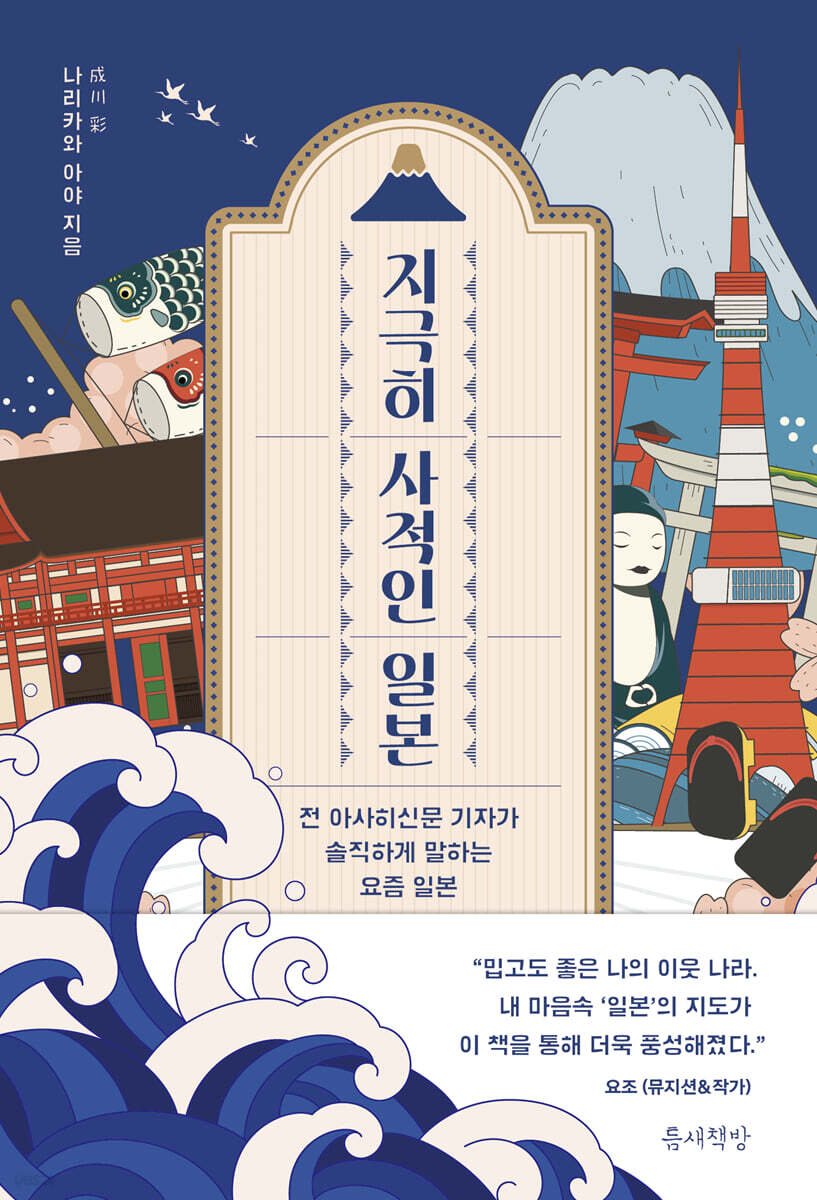
Extremely private Japan
 |
Description
Book Introduction
ㆍA small and diverse Japan hidden behind the familiarity of being a close neighbor
The author's heartfelt story that does not avoid uncomfortable questions between Korea and Japan.
ㆍA guide to Japan that we absolutely need to dispel misunderstandings and prejudices and become closer to.
A new book titled "A Guide for Global Travelers" has been released by Niche Bookstore, which is attracting readers' attention with the concept of foreigners introducing their own countries.
Following 『Extremely Private Italy』, 『Extremely Private France』, 『Extremely Private Russia』, and 『Extremely Private Nepal』, this time it is Japan.
Japan, the closest and most familiar country, but a country where misunderstandings and conflicts are repeated.
Author Aya Narikawa, a former reporter for the Asahi Shimbun, honestly tells the inside story of Japan that Koreans are curious about.
The author, who worked as a culture reporter at the Asahi Shimbun, left the company in 2017 and has since traveled back and forth between Korea and Japan, promoting Korean films and culture in Japan.
He writes columns for JoongAng Sunday and Kyodo News, and is currently introducing Korean culture on KBS World Radio's Japanese program Culture Lab K.
Having lived in Korea and as a border guard, the author understands the relationship and cultural differences between Korea and Japan better than anyone else. With his affection for Korea and a journalistic sense of balance, he interprets today's Japan in a way Koreans can understand.
The Japan this book presents is different from the superficial image we see through travel or news.
It delicately unravels the inner thoughts and emotions of the Japanese people, as well as the intimate structure of Japanese society.
In particular, it is a refreshing shock to readers that Japan, which we think of as a single identity called 'Japan', is actually a multi-layered and heterogeneous society with diverse and unique cultures in each region.
It dispels the illusion of a “one Japan” and offers the fun of discovering a small but diverse Japan.
The author also provides candid answers to sensitive questions that Koreans might be curious about, such as, “Why doesn’t Japan apologize for historical issues?” and “Why doesn’t it hold the Emperor accountable?”
It calmly explains the reactions and way of thinking of typical Japanese people based on the senses and logic within Japanese society.
His voice, which combines the insight of an insider with the distance of an outsider, dispels the misunderstandings and prejudices Korean readers harbor about Japan.
"Extremely Private Japan" breaks away from the conventional viewpoint of viewing the relationship between the two countries solely through the one-sided perspective of either Korea or Japan, opening up a more objective and three-dimensional perspective.
This book is the first step toward "understanding" and "respect" in Korea-Japan relations, and is an essential introduction to Japan for us to gain a deeper and broader perspective on our close neighbors.
The author's heartfelt story that does not avoid uncomfortable questions between Korea and Japan.
ㆍA guide to Japan that we absolutely need to dispel misunderstandings and prejudices and become closer to.
A new book titled "A Guide for Global Travelers" has been released by Niche Bookstore, which is attracting readers' attention with the concept of foreigners introducing their own countries.
Following 『Extremely Private Italy』, 『Extremely Private France』, 『Extremely Private Russia』, and 『Extremely Private Nepal』, this time it is Japan.
Japan, the closest and most familiar country, but a country where misunderstandings and conflicts are repeated.
Author Aya Narikawa, a former reporter for the Asahi Shimbun, honestly tells the inside story of Japan that Koreans are curious about.
The author, who worked as a culture reporter at the Asahi Shimbun, left the company in 2017 and has since traveled back and forth between Korea and Japan, promoting Korean films and culture in Japan.
He writes columns for JoongAng Sunday and Kyodo News, and is currently introducing Korean culture on KBS World Radio's Japanese program Culture Lab K.
Having lived in Korea and as a border guard, the author understands the relationship and cultural differences between Korea and Japan better than anyone else. With his affection for Korea and a journalistic sense of balance, he interprets today's Japan in a way Koreans can understand.
The Japan this book presents is different from the superficial image we see through travel or news.
It delicately unravels the inner thoughts and emotions of the Japanese people, as well as the intimate structure of Japanese society.
In particular, it is a refreshing shock to readers that Japan, which we think of as a single identity called 'Japan', is actually a multi-layered and heterogeneous society with diverse and unique cultures in each region.
It dispels the illusion of a “one Japan” and offers the fun of discovering a small but diverse Japan.
The author also provides candid answers to sensitive questions that Koreans might be curious about, such as, “Why doesn’t Japan apologize for historical issues?” and “Why doesn’t it hold the Emperor accountable?”
It calmly explains the reactions and way of thinking of typical Japanese people based on the senses and logic within Japanese society.
His voice, which combines the insight of an insider with the distance of an outsider, dispels the misunderstandings and prejudices Korean readers harbor about Japan.
"Extremely Private Japan" breaks away from the conventional viewpoint of viewing the relationship between the two countries solely through the one-sided perspective of either Korea or Japan, opening up a more objective and three-dimensional perspective.
This book is the first step toward "understanding" and "respect" in Korea-Japan relations, and is an essential introduction to Japan for us to gain a deeper and broader perspective on our close neighbors.
- You can preview some of the book's contents.
Preview
index
Recommendation_Yojo (musician & writer)
prolog
Japanese missionary work
PART Ⅰ.
The illusion that Japan is one country
ㆍ47 countries of color
ㆍIs Japan a small country?
Shikoku and Kyushu are close, but Hokkaido is too far.
ㆍLocal character and love for one's hometown
ㆍSince when has Tokyo been the capital?
Yamaguchi Prefecture, which has produced eight prime ministers
Osaka, which resembles Korea
ㆍLatin-speaking people
Kochi, a popular tourist destination thanks to animation and dramas
[Interview] A Designer Who Moved from Tokyo to the Rural Town of Kochi
PART Ⅱ.
Japanese people in my opinion
ㆍ“Would you like to eat Bubuzuke?”
ㆍFarmers rather than samurai
ㆍThe symbol of Japan as perceived by Japanese people
The origin of the theory that "Japanese = hardworking"
"Even if you harbor anger, your affection prevails."
ㆍWhy is ‘eating alone’ a problem?
PART Ⅲ.
The inside of Japanese society
ㆍ'Pressure to conform' to the same
Discrimination against Zainichi
[Interview] A Japanese Person Who Pays Attention to Zainichi
ㆍThe Light and Darkness of Manual Society
The Great East Japan Earthquake further conservatized Japanese society.
ㆍPut the lid on the smelly thing.
ㆍWeddings at churches, funerals at temples
PART IV.
The Emperor's Country
ㆍThe Emperor's presence
People above people
ㆍA brief summary of the history of the emperors
ㆍI have never sung Kimigayo properly
ㆍBackground of hereditary lawmakers
PART V.
Cheer up, Japanese women
ㆍWhen will we return to having separate surnames for couples?
Japanese version of #MeToo
The possibility of a female emperor
Japanese women suddenly announce a breakup.
Smile 0 yen
PART VI.
Education to enjoy youth
ㆍWhy are you curious about which university you graduated from?
ㆍ“You look happy.
“It was a good decision to quit the newspaper job.”
Enjoy your youth to the fullest
ㆍHas ‘Yutori Education’ failed?
PART VII.
Japan's slowly sinking economy
The 'lost 30 years' buried in my life
Japan avoids competition
ㆍA country with longevity is a super-aged society
ㆍCustomers are gods
ㆍThe dignity of freelancers and dispatched workers
The splendid '1970 Osaka Expo'
ㆍLow birth rate problem and utilization of closed schools
ㆍThe dim outlook for the Japanese economy
PART Ⅷ.
How Korea and Japan Can Become True Friends
ㆍHistory of neglecting the perpetrators
Dokdo, a Trauma
ㆍWhy it doesn't feel like an apology even if you apologize
ㆍKōhaku Uta Gassen and Korea-Japan relations
[Interview] Is Japanese broadcasting content on the decline?
Words that are difficult to translate
ㆍ'Pro-Japanese' and 'anti-Japanese'
PART IX.
From the tastes of warriors to those of commoners
ㆍRice is not that important
ㆍTaste of Kanto vs. Taste of Kansai
ㆍWhat food do you eat during interrogation? Katsudon?
ㆍJapanese mom's food, curry
Osaka's soul food, okonomiyaki and takoyaki
Sushi is not home cooking.
ㆍJapanese meat dishes
ㆍBoth beer and wine are 'sake'
Cheap and delicious Japanese cafes and kissaten
ㆍHot Korean food in Japan
Epilogue
prolog
Japanese missionary work
PART Ⅰ.
The illusion that Japan is one country
ㆍ47 countries of color
ㆍIs Japan a small country?
Shikoku and Kyushu are close, but Hokkaido is too far.
ㆍLocal character and love for one's hometown
ㆍSince when has Tokyo been the capital?
Yamaguchi Prefecture, which has produced eight prime ministers
Osaka, which resembles Korea
ㆍLatin-speaking people
Kochi, a popular tourist destination thanks to animation and dramas
[Interview] A Designer Who Moved from Tokyo to the Rural Town of Kochi
PART Ⅱ.
Japanese people in my opinion
ㆍ“Would you like to eat Bubuzuke?”
ㆍFarmers rather than samurai
ㆍThe symbol of Japan as perceived by Japanese people
The origin of the theory that "Japanese = hardworking"
"Even if you harbor anger, your affection prevails."
ㆍWhy is ‘eating alone’ a problem?
PART Ⅲ.
The inside of Japanese society
ㆍ'Pressure to conform' to the same
Discrimination against Zainichi
[Interview] A Japanese Person Who Pays Attention to Zainichi
ㆍThe Light and Darkness of Manual Society
The Great East Japan Earthquake further conservatized Japanese society.
ㆍPut the lid on the smelly thing.
ㆍWeddings at churches, funerals at temples
PART IV.
The Emperor's Country
ㆍThe Emperor's presence
People above people
ㆍA brief summary of the history of the emperors
ㆍI have never sung Kimigayo properly
ㆍBackground of hereditary lawmakers
PART V.
Cheer up, Japanese women
ㆍWhen will we return to having separate surnames for couples?
Japanese version of #MeToo
The possibility of a female emperor
Japanese women suddenly announce a breakup.
Smile 0 yen
PART VI.
Education to enjoy youth
ㆍWhy are you curious about which university you graduated from?
ㆍ“You look happy.
“It was a good decision to quit the newspaper job.”
Enjoy your youth to the fullest
ㆍHas ‘Yutori Education’ failed?
PART VII.
Japan's slowly sinking economy
The 'lost 30 years' buried in my life
Japan avoids competition
ㆍA country with longevity is a super-aged society
ㆍCustomers are gods
ㆍThe dignity of freelancers and dispatched workers
The splendid '1970 Osaka Expo'
ㆍLow birth rate problem and utilization of closed schools
ㆍThe dim outlook for the Japanese economy
PART Ⅷ.
How Korea and Japan Can Become True Friends
ㆍHistory of neglecting the perpetrators
Dokdo, a Trauma
ㆍWhy it doesn't feel like an apology even if you apologize
ㆍKōhaku Uta Gassen and Korea-Japan relations
[Interview] Is Japanese broadcasting content on the decline?
Words that are difficult to translate
ㆍ'Pro-Japanese' and 'anti-Japanese'
PART IX.
From the tastes of warriors to those of commoners
ㆍRice is not that important
ㆍTaste of Kanto vs. Taste of Kansai
ㆍWhat food do you eat during interrogation? Katsudon?
ㆍJapanese mom's food, curry
Osaka's soul food, okonomiyaki and takoyaki
Sushi is not home cooking.
ㆍJapanese meat dishes
ㆍBoth beer and wine are 'sake'
Cheap and delicious Japanese cafes and kissaten
ㆍHot Korean food in Japan
Epilogue
Into the book
I am not the average Japanese person, nor do I represent the Japanese people, but that is why I see things.
Although this is a very personal view, I think there is a high level of understanding of the fundamental differences between Japanese and Koreans.
Because Korea and Japan are close, people think they will be similar, so there are many misunderstandings.
That small misunderstanding could cause a major conflict between the two countries.
I hope that through this book, you will gain a deeper understanding of the Japanese people.
--- From the "Prologue"
Japan's provinces are more independent than Korea's provinces.
Korea has had a centralized system for a long time, but Japan's centralized system was established after the Meiji period.
Moreover, the country is long and divided into four large islands, making domestic travel difficult, and the influence of the capital, Tokyo, is not as great as that of Seoul, South Korea.
This is one of the differences from Korea, where everything is concentrated in Seoul.
--- From "The Country of 47 Colors"
Similar to how Jeju Islanders refer to the Korean Peninsula as “mainland,” Okinawans also refer to Japan, excluding Okinawa, as “Naichi (?地)” or “Yamato (大和).”
It's almost as if Okinawa isn't Japan.
When I see Okinawa, I think of Jeju Island.
Although the words are different, it reminds me of Jeju, which experienced the April 3 Incident, where many people were sacrificed.
To me, Okinawa and Jeju have a lot in common.
--- From "Shikoku and Kyushu are close, but Hokkaido is too far"
Japanese people are generally very delicate people.
To put it a little differently, it means that you are easily hurt.
When I first came to Korea to study abroad, I used to get hurt by my Korean friends who spoke directly to me, but now I'm comfortable with that.
Rather, I am a little cautious when talking to Japanese people.
When I say things like this, I think about whether I will be hurt or misunderstood.
--- From "Want to eat Bubuzuke?"
He seemed proud, saying, "It's amazing that such a small country is in second place."
But soon after, the bubble burst, and the 'lost 30 years' began.
Before, many people only thought about making money, but the bubble burst caused the Japanese people's values to change significantly.
There are very few people who work blindly like 'economic animals' these days.
The real world has changed, but I think the image of the Japanese people from the period of rapid economic growth remains with me.
--- From "The Origin of the 'Japanese = Diligent' Theory"
While I was in quarantine after arriving in Korea from Japan, relief supplies such as ramen and instant curry arrived from Goyang City, where I live.
I was grateful to receive relief supplies while I was unable to go out.
I posted a picture of something like this on Twitter (X), and suddenly I started getting a lot of critical comments.
It was something like, “Don’t come back to Japan,” or “Naturalize in Korea.”
I was surprised why he was doing this even though I hadn't bothered anyone.
--- From "The 'pressure to conform' that must be the same"
University professors who teach Korea-related courses are also noticing changes in their students.
Just 10 years ago, there were students who would cautiously confess to their professors that they were Zainichi, but these days, they say they speak confidently.
As Korea becomes an object of admiration for young people, it seems that they are feeling positive about being Zainichi.
--- From "Discrimination against Zainichi"
But in fact, the Japanese people were not very interested in President Lee Myung-bak's visit to Dokdo.
Rather, it was President Lee Myung-bak's demand for an apology from the Emperor after his visit to Dokdo that touched the Japanese people's hearts.
For most Japanese people, the reaction was, "Why would a politician from a neighboring country bother the Emperor, who is kind, gentle, and a pacifist?"
There are also comments that Emperor Heisei had intended to visit Korea, but this has made it difficult.
This is evidence that although the Emperor cannot intervene in politics, his influence in reality is much greater than Koreans think.
--- From "The Emperor's Presence"
I could guess what kind of incident it was just by hearing 'Nakai', 'Fuji TV', 'announcer', and 'trouble'.
Because a broadcast reporter I know had a similar experience.
I was invited to a Fuji TV dinner, but it was at a private home and there was only one man there.
The reporter escaped harm and was subsequently placed on leave.
A male broadcast reporter reportedly declined the offer to “call an announcer” at a Fuji TV dinner.
It was an organized and habitual incident.
--- From "Japanese version of #MeToo"
If you live in Korea, you will naturally learn about the history of Japan's aggression, but if you had lived in Japan all your life, you might not have known about it.
Because they don't teach it properly in school.
So, I try to convey this to Japan whenever I have the chance, but I am often rejected.
--- From "The History of Ignoring Harm"
I also hope that the Japanese Prime Minister will offer a sincere apology to the victims.
If you didn't feel that way even though you apologized in the past, I wish you would have done it again and again.
But I also feel like if I focus on 'sincere', it will never be resolved.
Although this is a very personal view, I think there is a high level of understanding of the fundamental differences between Japanese and Koreans.
Because Korea and Japan are close, people think they will be similar, so there are many misunderstandings.
That small misunderstanding could cause a major conflict between the two countries.
I hope that through this book, you will gain a deeper understanding of the Japanese people.
--- From the "Prologue"
Japan's provinces are more independent than Korea's provinces.
Korea has had a centralized system for a long time, but Japan's centralized system was established after the Meiji period.
Moreover, the country is long and divided into four large islands, making domestic travel difficult, and the influence of the capital, Tokyo, is not as great as that of Seoul, South Korea.
This is one of the differences from Korea, where everything is concentrated in Seoul.
--- From "The Country of 47 Colors"
Similar to how Jeju Islanders refer to the Korean Peninsula as “mainland,” Okinawans also refer to Japan, excluding Okinawa, as “Naichi (?地)” or “Yamato (大和).”
It's almost as if Okinawa isn't Japan.
When I see Okinawa, I think of Jeju Island.
Although the words are different, it reminds me of Jeju, which experienced the April 3 Incident, where many people were sacrificed.
To me, Okinawa and Jeju have a lot in common.
--- From "Shikoku and Kyushu are close, but Hokkaido is too far"
Japanese people are generally very delicate people.
To put it a little differently, it means that you are easily hurt.
When I first came to Korea to study abroad, I used to get hurt by my Korean friends who spoke directly to me, but now I'm comfortable with that.
Rather, I am a little cautious when talking to Japanese people.
When I say things like this, I think about whether I will be hurt or misunderstood.
--- From "Want to eat Bubuzuke?"
He seemed proud, saying, "It's amazing that such a small country is in second place."
But soon after, the bubble burst, and the 'lost 30 years' began.
Before, many people only thought about making money, but the bubble burst caused the Japanese people's values to change significantly.
There are very few people who work blindly like 'economic animals' these days.
The real world has changed, but I think the image of the Japanese people from the period of rapid economic growth remains with me.
--- From "The Origin of the 'Japanese = Diligent' Theory"
While I was in quarantine after arriving in Korea from Japan, relief supplies such as ramen and instant curry arrived from Goyang City, where I live.
I was grateful to receive relief supplies while I was unable to go out.
I posted a picture of something like this on Twitter (X), and suddenly I started getting a lot of critical comments.
It was something like, “Don’t come back to Japan,” or “Naturalize in Korea.”
I was surprised why he was doing this even though I hadn't bothered anyone.
--- From "The 'pressure to conform' that must be the same"
University professors who teach Korea-related courses are also noticing changes in their students.
Just 10 years ago, there were students who would cautiously confess to their professors that they were Zainichi, but these days, they say they speak confidently.
As Korea becomes an object of admiration for young people, it seems that they are feeling positive about being Zainichi.
--- From "Discrimination against Zainichi"
But in fact, the Japanese people were not very interested in President Lee Myung-bak's visit to Dokdo.
Rather, it was President Lee Myung-bak's demand for an apology from the Emperor after his visit to Dokdo that touched the Japanese people's hearts.
For most Japanese people, the reaction was, "Why would a politician from a neighboring country bother the Emperor, who is kind, gentle, and a pacifist?"
There are also comments that Emperor Heisei had intended to visit Korea, but this has made it difficult.
This is evidence that although the Emperor cannot intervene in politics, his influence in reality is much greater than Koreans think.
--- From "The Emperor's Presence"
I could guess what kind of incident it was just by hearing 'Nakai', 'Fuji TV', 'announcer', and 'trouble'.
Because a broadcast reporter I know had a similar experience.
I was invited to a Fuji TV dinner, but it was at a private home and there was only one man there.
The reporter escaped harm and was subsequently placed on leave.
A male broadcast reporter reportedly declined the offer to “call an announcer” at a Fuji TV dinner.
It was an organized and habitual incident.
--- From "Japanese version of #MeToo"
If you live in Korea, you will naturally learn about the history of Japan's aggression, but if you had lived in Japan all your life, you might not have known about it.
Because they don't teach it properly in school.
So, I try to convey this to Japan whenever I have the chance, but I am often rejected.
--- From "The History of Ignoring Harm"
I also hope that the Japanese Prime Minister will offer a sincere apology to the victims.
If you didn't feel that way even though you apologized in the past, I wish you would have done it again and again.
But I also feel like if I focus on 'sincere', it will never be resolved.
--- From "Why Apologizing Doesn't Feel Like an Apology"
Publisher's Review
ㆍHow should we understand Japan?
ㆍToday's Japan as reported by a former Asahi Shimbun reporter
ㆍThe small and diverse charm of Japan
"Extremely Private Japan" is the book published with the greatest amount of thought in the "Guide for Travelers of the Earth" series.
Countries like Italy, France, Russia, and Nepal are geographically, emotionally, and psychologically distant from Korea.
But Japan is different.
We are so close and so familiar that we mistakenly think we know Japan well.
We travel a lot and enjoy cultural content such as animation, games, and food, but the Japan we experience may only be the "tatemae" (outward appearance) that Japan wants to show us.
The essence of Japan—its complex inner workings, including regionalism, sentiment, political attitudes, and historical awareness—is difficult to grasp through short-term travel or media consumption.
This lack of understanding often serves as the backdrop for recurring historical issues and political conflicts.
This book tells the story of Japan's essence that we have not seen.
Author Aya Narikawa is a former reporter for the Asahi Shimbun. Since the early 2000s, she has been traveling between the two countries to study Korea and promote it in Japan.
His experience traveling between Korea and Japan made him more acutely aware of the emotional and cultural gap between the two countries.
This is why this book can explain in a subtle yet persuasive way the differences in Japanese thinking and culture that Koreans have found difficult to understand.
The greatest virtue of this book lies in its attitude of not avoiding answers to sensitive questions from a Japanese perspective.
From an insider's perspective, but with the detached perspective of a border guard, this book explains how Japanese people feel about topics that are difficult to bring up in general conversation, such as apologies for colonial rule, discrimination against Zainichi Koreans, and the Emperor's responsibility for war, and why they have such attitudes.
Meanwhile, this book also contains changes within Japanese society, especially the shift in perception of Korea.
The third and fourth generation Zainichi now proudly reveal that they are Zainichi.
This is a change that occurred as Korea's status rose as the Korean Wave deeply permeated Japanese society.
The fact that Korea's status in Japan is changing presents new possibilities for the relationship between the two countries.
This book shows us a new side of Japan that we didn't know about.
The fact is that the 47 prefectures that make up Japan each have different identities and individualities and are not a single identity.
As the author of the recommendation, Yozoh, said, you will truly experience the charm of “small and diverse Japan.”
Reading Aya Narikawa's writing makes me want to grab my passport and leave to discover a new Japan.
If you want to enrich the Japan in your heart, "A Very Private Japan" is the best place to start your journey.
ㆍToday's Japan as reported by a former Asahi Shimbun reporter
ㆍThe small and diverse charm of Japan
"Extremely Private Japan" is the book published with the greatest amount of thought in the "Guide for Travelers of the Earth" series.
Countries like Italy, France, Russia, and Nepal are geographically, emotionally, and psychologically distant from Korea.
But Japan is different.
We are so close and so familiar that we mistakenly think we know Japan well.
We travel a lot and enjoy cultural content such as animation, games, and food, but the Japan we experience may only be the "tatemae" (outward appearance) that Japan wants to show us.
The essence of Japan—its complex inner workings, including regionalism, sentiment, political attitudes, and historical awareness—is difficult to grasp through short-term travel or media consumption.
This lack of understanding often serves as the backdrop for recurring historical issues and political conflicts.
This book tells the story of Japan's essence that we have not seen.
Author Aya Narikawa is a former reporter for the Asahi Shimbun. Since the early 2000s, she has been traveling between the two countries to study Korea and promote it in Japan.
His experience traveling between Korea and Japan made him more acutely aware of the emotional and cultural gap between the two countries.
This is why this book can explain in a subtle yet persuasive way the differences in Japanese thinking and culture that Koreans have found difficult to understand.
The greatest virtue of this book lies in its attitude of not avoiding answers to sensitive questions from a Japanese perspective.
From an insider's perspective, but with the detached perspective of a border guard, this book explains how Japanese people feel about topics that are difficult to bring up in general conversation, such as apologies for colonial rule, discrimination against Zainichi Koreans, and the Emperor's responsibility for war, and why they have such attitudes.
Meanwhile, this book also contains changes within Japanese society, especially the shift in perception of Korea.
The third and fourth generation Zainichi now proudly reveal that they are Zainichi.
This is a change that occurred as Korea's status rose as the Korean Wave deeply permeated Japanese society.
The fact that Korea's status in Japan is changing presents new possibilities for the relationship between the two countries.
This book shows us a new side of Japan that we didn't know about.
The fact is that the 47 prefectures that make up Japan each have different identities and individualities and are not a single identity.
As the author of the recommendation, Yozoh, said, you will truly experience the charm of “small and diverse Japan.”
Reading Aya Narikawa's writing makes me want to grab my passport and leave to discover a new Japan.
If you want to enrich the Japan in your heart, "A Very Private Japan" is the best place to start your journey.
GOODS SPECIFICS
- Date of issue: May 30, 2025
- Page count, weight, size: 480 pages | 506g | 128*188*30mm
- ISBN13: 9791188949755
- ISBN10: 1188949756
You may also like
카테고리
korean


korean

![ELLE 엘르 스페셜 에디션 A형 : 12월 [2025]](http://librairie.coreenne.fr/cdn/shop/files/b8e27a3de6c9538896439686c6b0e8fb.jpg?v=1766436872&width=3840)


