

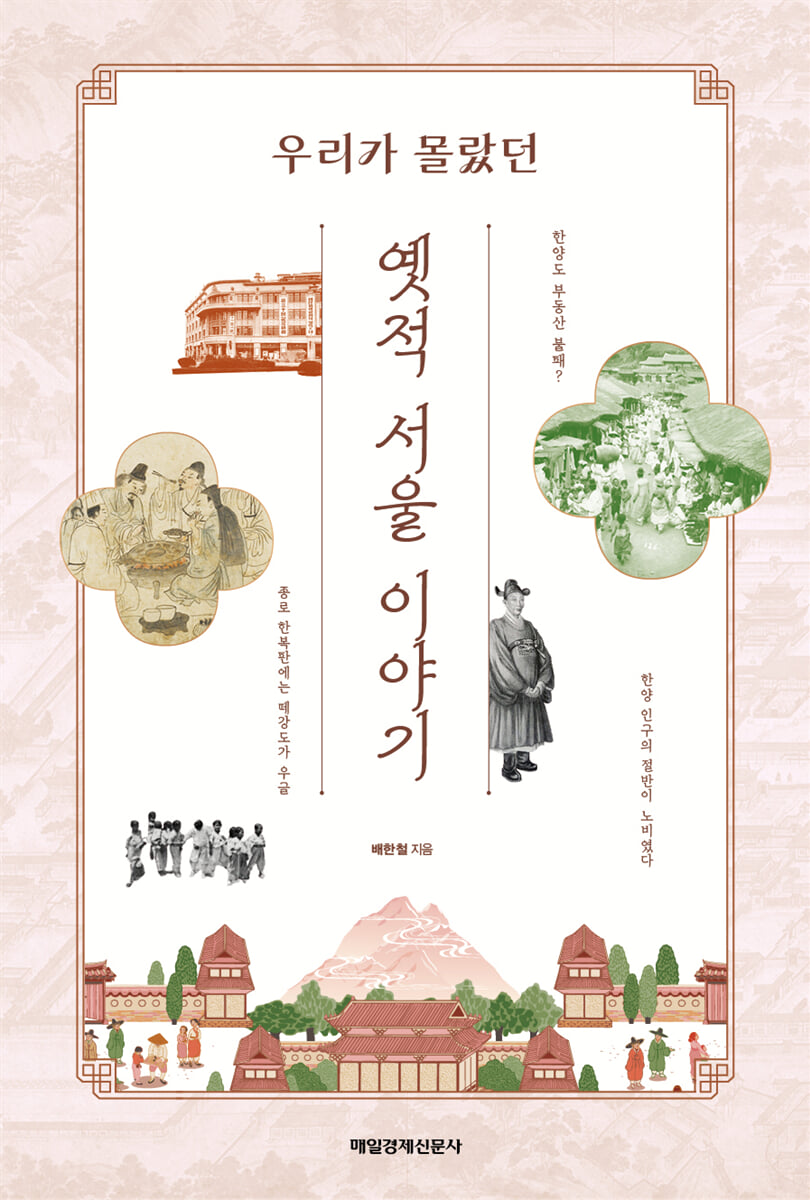
Old Seoul Stories
 |
Description
Book Introduction
Is it true that real estate in Hanyang during the Joseon Dynasty was also undefeated?
What if the hot place Itaewon was originally a cemetery?
What incident shook Joseon when a shaman of the lowest social class came to power?
The more you know, the more exciting the 'real' story of old Seoul becomes!
Today's Seoul is a city formed by the accumulation of the lives of the Joseon people over a long period of time.
Hanyang, the capital of Joseon, was a political center like Seoul today, and a huge living space where the lives of countless people were intertwined.
From the beef craze of King Sukjong's era, when the saying "It's not a feast without beef" was popular, to the Joseon Dynasty's invincible real estate phenomenon, when real estate prices soared due to overpopulation.
Also, as we follow the vivid lives of various characters within the social class system, such as eunuchs, shamans, slaves, and concubines, the reality of Hanyang in the past becomes more clearly revealed.
Unlike existing history books that focus on palaces, war, and politics, 『Stories of Old Seoul』 focuses on the daily lives and spaces of the Joseon people.
The stories contained in the city's alleys, customs, and people vividly bring to life the lives of people of that time.
The author, Bae Han-cheol, worked as a cultural heritage and Korean history reporter for Maeil Business Newspaper and as a cultural heritage expert for the National Heritage Administration. Based on various records such as the Annals of the Joseon Dynasty, anthologies of literary works, genre paintings, and geographical records, he directly reported and visited the site, meticulously reconstructing the lives of Joseon people in Hanyang.
Let's follow the traces of a five-hundred-year-old city and delve into history to see how today's Seoul was formed through the accumulation of time.
What if the hot place Itaewon was originally a cemetery?
What incident shook Joseon when a shaman of the lowest social class came to power?
The more you know, the more exciting the 'real' story of old Seoul becomes!
Today's Seoul is a city formed by the accumulation of the lives of the Joseon people over a long period of time.
Hanyang, the capital of Joseon, was a political center like Seoul today, and a huge living space where the lives of countless people were intertwined.
From the beef craze of King Sukjong's era, when the saying "It's not a feast without beef" was popular, to the Joseon Dynasty's invincible real estate phenomenon, when real estate prices soared due to overpopulation.
Also, as we follow the vivid lives of various characters within the social class system, such as eunuchs, shamans, slaves, and concubines, the reality of Hanyang in the past becomes more clearly revealed.
Unlike existing history books that focus on palaces, war, and politics, 『Stories of Old Seoul』 focuses on the daily lives and spaces of the Joseon people.
The stories contained in the city's alleys, customs, and people vividly bring to life the lives of people of that time.
The author, Bae Han-cheol, worked as a cultural heritage and Korean history reporter for Maeil Business Newspaper and as a cultural heritage expert for the National Heritage Administration. Based on various records such as the Annals of the Joseon Dynasty, anthologies of literary works, genre paintings, and geographical records, he directly reported and visited the site, meticulously reconstructing the lives of Joseon people in Hanyang.
Let's follow the traces of a five-hundred-year-old city and delve into history to see how today's Seoul was formed through the accumulation of time.
- You can preview some of the book's contents.
Preview
index
Entering
Part 1: Hanyang, the Seoul of Joseon
Chapter 1: Unfamiliar Joseon, Unexpected Seoul
Become addicted to the taste of beef
worship alcohol
Joseon Dynasty Hanyang's real estate was undefeated.
A bustling Lunar New Year in Hanyang
Chapter 2: The Worst Hell Joseon, Worse Than Hell
The great famine that swept through King Sukjong's heyday
A criminal's head hung outside Seosomun Gate
Hanyang is a tiger's den
Chapter 3: A History of Chaos and Turmoil
1592, when the Japanese army occupied
Even though the rebels are here, the king indulges in pleasure.
The Three Days of the Meiji Restoration in Korea
The owner of the sperm changes according to political changes
Chapter 4: Scenic spots everywhere you go
Hanyangdoseong, a sacred place for the Joseon Dynasty's eight provinces' civil service examination takers
From the residential area of the underprivileged aristocracy to an arena for foreign powers, Myeongdong
A field of monks preparing to take the ordination exam, Samseong-dong, Gangnam
Originally part of Ttukseom, Gangbuk, Jamsil
Part 2: People of Hanyang, Stories of Life
Chapter 5: The Masters of Joseon, the Gyeonghwa Sajok
The rulers of Joseon, the Dongbang Gapjok clan
The Beolyeol family that ruled the world
Half of Hanyang's population were slaves?
The highest minister of the Joseon Dynasty was a person with a spinal disability.
Chapter 6: Similar but Different Lives
The lowest shaman in Joseon is monopolizing state affairs.
Concubines with shaved heads become nuns
Castrated eunuchs were the best grooms?
Hanyang, a city of soldiers, with a military population of 50,000
Chapter 7: A Space Where Life and Death Coexist
Cheonggyecheon, the city's sewer
Seoul's official cemeteries, Mapo and Itaewon
Wangsimni and Seodaemun, famous for their cabbage and water parsley
Jongno and Jung-gu, a pass teeming with bandits
Chapter 8: The Ideology That Protected Sajik for Five Hundred Years
Yukjo Street, the playground of the officials in charge of music
Sungkyunkwan, a study mecca for students in their 70s and 80s
Palaces? The main stone mountains of the city walls, Samcheong-dong and Changsin-dong
Part 1: Hanyang, the Seoul of Joseon
Chapter 1: Unfamiliar Joseon, Unexpected Seoul
Become addicted to the taste of beef
worship alcohol
Joseon Dynasty Hanyang's real estate was undefeated.
A bustling Lunar New Year in Hanyang
Chapter 2: The Worst Hell Joseon, Worse Than Hell
The great famine that swept through King Sukjong's heyday
A criminal's head hung outside Seosomun Gate
Hanyang is a tiger's den
Chapter 3: A History of Chaos and Turmoil
1592, when the Japanese army occupied
Even though the rebels are here, the king indulges in pleasure.
The Three Days of the Meiji Restoration in Korea
The owner of the sperm changes according to political changes
Chapter 4: Scenic spots everywhere you go
Hanyangdoseong, a sacred place for the Joseon Dynasty's eight provinces' civil service examination takers
From the residential area of the underprivileged aristocracy to an arena for foreign powers, Myeongdong
A field of monks preparing to take the ordination exam, Samseong-dong, Gangnam
Originally part of Ttukseom, Gangbuk, Jamsil
Part 2: People of Hanyang, Stories of Life
Chapter 5: The Masters of Joseon, the Gyeonghwa Sajok
The rulers of Joseon, the Dongbang Gapjok clan
The Beolyeol family that ruled the world
Half of Hanyang's population were slaves?
The highest minister of the Joseon Dynasty was a person with a spinal disability.
Chapter 6: Similar but Different Lives
The lowest shaman in Joseon is monopolizing state affairs.
Concubines with shaved heads become nuns
Castrated eunuchs were the best grooms?
Hanyang, a city of soldiers, with a military population of 50,000
Chapter 7: A Space Where Life and Death Coexist
Cheonggyecheon, the city's sewer
Seoul's official cemeteries, Mapo and Itaewon
Wangsimni and Seodaemun, famous for their cabbage and water parsley
Jongno and Jung-gu, a pass teeming with bandits
Chapter 8: The Ideology That Protected Sajik for Five Hundred Years
Yukjo Street, the playground of the officials in charge of music
Sungkyunkwan, a study mecca for students in their 70s and 80s
Palaces? The main stone mountains of the city walls, Samcheong-dong and Changsin-dong
Detailed image

Into the book
When we think of the Joseon Dynasty, we tend to assume that only a small number of nobles monopolized all rights and lived in luxury, while the common people lived miserable lives like slaves.
It is also a common perception that they are materially backward and poor.
This stereotype may not be unrelated to the historical consciousness that was intentionally instilled to denigrate Joseon in order to justify and glorify Japanese colonialism during the colonial period.
Indeed, how much do we know about the city of Seoul in Joseon?
To grasp even a rough outline of the times, it is necessary to first understand the economic and historical background.
--- From "Entering"
In 『Bukhakui』 by Bak Je-ga (1750-1805), it is written, “A man bought two pigs and was carrying them when they got crushed by each other and the pigs died.
I had no choice but to sell the meat, but even after a whole day, the pork still wasn't sold.
“It’s not that people don’t like pork, it’s that they especially like beef,” he said.
Just as in Jeolla Province today, a banquet without fermented skate is not considered a banquet, in Seoul during the Joseon Dynasty, beef had to be served at the banquet table.
--- From "Intoxicated by the Taste of Beef"
In the late Joseon Dynasty, after the Imjin War and the Byeongja War were over and the economy entered a period of stabilization, extravagance became widespread throughout society.
Not only the prime ministers and the aristocrats, but also the common people and even the commoners, if they had some financial means, did not hesitate to indulge in ostentatious consumption.
Although he spent money like water on clothes, accessories, and food, as can be seen in the Seungjeongwon Diary, the pinnacle of luxury was his home.
--- From "The Unbeatable Real Estate of Hanyang in the Joseon Dynasty"
After the late Joseon Dynasty, with the addition of superstitious elements, the practice of pure ancestral rites became wildly popular.
The May 14, 1916 edition of the Maeil Shinbo reported in detail the origins of the pilgrimage, along with precautions, preparations, and schedule for the pilgrimage, in a pilgrimage guide article titled “Today is Sunseong.”
The newspaper introduces that the practice of seonseong was performed as a religious practice for passing the civil service examination.
(Omitted) If you go around the city once, it becomes a circle, and if you go through the diameter of the city again, the character 'middle' is completed.
The word '中' also means 'to hit or hit', so it was believed that if you hit the mark, you would be able to get the test questions right.
--- From "Hanyangdoseong, the sacred place for the Joseon Dynasty's eight provinces' civil service examination takers"
There were many cases of eunuchs voluntarily being castrated as a means of overcoming poverty and social limitations.
It is said that until just before the founding of the Korean Empire in 1897 (the 34th year of King Gojong's reign), a shack-like eunuch clinic was operating in Yeouido.
Although the eunuch had no reproductive function, he was able to have a wife and children.
After his wife died, he remarried and even had a concubine.
To escape the hardships of life and to get in line with the royal family, not only commoners but also noblewomen wanted to become eunuchs' wives.
--- From "Were the castrated eunuchs the best grooms?"
The Ima Building next to Jongno-gu Office was home to the Sapoksi, a horse breeding facility for the royal court, and the Majeongyo Bridge in Cheonggyecheon was home to a horse and cattle trading and leasing facility, which caused horse waste to flow directly into the river.
The country didn't even bother to crack down on it.
During the reign of King Sejong, he accepted Eo Hyo-cheom's argument that "it is natural for the capital to prosper and its streams to become polluted," and thus turned a blind eye to the dumping of waste.
Animal carcasses and even the bodies of infants were secretly dumped at night, and murders often occurred.
--- From "City Sewer, Cheonggyecheon"
Due to the influence of TV dramas, the images of Sungkyunkwan University and its students as 'young, pretty boys' and 'children from prestigious Hanyang families' easily come to mind, but as in the case of Kim Su-in, many of the students were from the countryside and many were elderly.
Even students who were still in school frequently died of old age.
It is also a common perception that they are materially backward and poor.
This stereotype may not be unrelated to the historical consciousness that was intentionally instilled to denigrate Joseon in order to justify and glorify Japanese colonialism during the colonial period.
Indeed, how much do we know about the city of Seoul in Joseon?
To grasp even a rough outline of the times, it is necessary to first understand the economic and historical background.
--- From "Entering"
In 『Bukhakui』 by Bak Je-ga (1750-1805), it is written, “A man bought two pigs and was carrying them when they got crushed by each other and the pigs died.
I had no choice but to sell the meat, but even after a whole day, the pork still wasn't sold.
“It’s not that people don’t like pork, it’s that they especially like beef,” he said.
Just as in Jeolla Province today, a banquet without fermented skate is not considered a banquet, in Seoul during the Joseon Dynasty, beef had to be served at the banquet table.
--- From "Intoxicated by the Taste of Beef"
In the late Joseon Dynasty, after the Imjin War and the Byeongja War were over and the economy entered a period of stabilization, extravagance became widespread throughout society.
Not only the prime ministers and the aristocrats, but also the common people and even the commoners, if they had some financial means, did not hesitate to indulge in ostentatious consumption.
Although he spent money like water on clothes, accessories, and food, as can be seen in the Seungjeongwon Diary, the pinnacle of luxury was his home.
--- From "The Unbeatable Real Estate of Hanyang in the Joseon Dynasty"
After the late Joseon Dynasty, with the addition of superstitious elements, the practice of pure ancestral rites became wildly popular.
The May 14, 1916 edition of the Maeil Shinbo reported in detail the origins of the pilgrimage, along with precautions, preparations, and schedule for the pilgrimage, in a pilgrimage guide article titled “Today is Sunseong.”
The newspaper introduces that the practice of seonseong was performed as a religious practice for passing the civil service examination.
(Omitted) If you go around the city once, it becomes a circle, and if you go through the diameter of the city again, the character 'middle' is completed.
The word '中' also means 'to hit or hit', so it was believed that if you hit the mark, you would be able to get the test questions right.
--- From "Hanyangdoseong, the sacred place for the Joseon Dynasty's eight provinces' civil service examination takers"
There were many cases of eunuchs voluntarily being castrated as a means of overcoming poverty and social limitations.
It is said that until just before the founding of the Korean Empire in 1897 (the 34th year of King Gojong's reign), a shack-like eunuch clinic was operating in Yeouido.
Although the eunuch had no reproductive function, he was able to have a wife and children.
After his wife died, he remarried and even had a concubine.
To escape the hardships of life and to get in line with the royal family, not only commoners but also noblewomen wanted to become eunuchs' wives.
--- From "Were the castrated eunuchs the best grooms?"
The Ima Building next to Jongno-gu Office was home to the Sapoksi, a horse breeding facility for the royal court, and the Majeongyo Bridge in Cheonggyecheon was home to a horse and cattle trading and leasing facility, which caused horse waste to flow directly into the river.
The country didn't even bother to crack down on it.
During the reign of King Sejong, he accepted Eo Hyo-cheom's argument that "it is natural for the capital to prosper and its streams to become polluted," and thus turned a blind eye to the dumping of waste.
Animal carcasses and even the bodies of infants were secretly dumped at night, and murders often occurred.
--- From "City Sewer, Cheonggyecheon"
Due to the influence of TV dramas, the images of Sungkyunkwan University and its students as 'young, pretty boys' and 'children from prestigious Hanyang families' easily come to mind, but as in the case of Kim Su-in, many of the students were from the countryside and many were elderly.
Even students who were still in school frequently died of old age.
--- From "Sungkyunkwan, the study mecca of students in their 70s and 80s"
Publisher's Review
Away from the politics-centered history, in the alleys, not the palaces,
Reading Joseon Dynasty Seoul from the people, not the king?
- Even during the Joseon Dynasty, Hanyang was undefeated in real estate?
- Mapo and Itaewon were originally Seoul's official cemeteries?
- Cheonggyecheon was actually a city sewer where feces floated and corpses were dumped?
Maeil Business Newspaper's Korean history expert reporter reports
The 'real' story of Seoul we didn't know about today.
Hanyang, the capital of the Joseon Dynasty.
It is often remembered as a political arena where kings and their subjects came and went, but in reality it was a much larger and more complex city where the lives of countless people were intertwined.
And their daily lives were not that different from the Seoul we live in now.
"Old Seoul Stories" breaks away from the boring political history and dynasty-centered Joseon Dynasty that we have learned so far, and reveals the true face of the city of Hanyang in its alleys and people.
You can travel back in time to Hanyang of the past by entering the residential areas, not the palaces, and the intimate daily lives of the common people, not the kings, and exploring the fascinating Hanyang of the Joseon Dynasty.
Part 1, 'Hanyang, Seoul of Joseon', covers the city's structure, economy, attractions, and crises.
Contrary to popular belief, Hanyang was a city of gastronomy with a huge beef consumption.
With its unique society of eunuchs and complex social order, and the housing boom and skyrocketing real estate prices that we see today during the late Joseon Dynasty, Hanyang was a vibrant city that transcended the political stage.
Part 2, 'People of Hanyang, Stories of Life,' traces the lives of slaves, shamans, soldiers, merchants, and women, people who are not easily found in history books.
The fact that Cheonggyecheon was used as a massive urban sewer, that present-day Itaewon and Hannam-dong were cemeteries, and that Wangsimni and Seodaemun were famous for their cabbage and water parsley fields that supplied Seoul with food allows us to rediscover a history of Seoul that we 'didn't know about.'
Forget boring history books!
This one book delves into the past of Seoul, the capital of South Korea!
This book is a historical textbook on Seoul, but it is different from existing urban histories.
This is a humanities content based on life history that looks into Joseon from the perspective of people other than the political elite, and naturally connects with the urban nature of Seoul today.
The present of Seoul is located on the alleys of Joseon.
"Old Seoul Stories" is a book that makes you walk again over the layers of time.
“Stand on a hill next to any building or street in Seoul and imagine what it was like 200 or 300 years ago.
Scenes from that time will be vaguely pictured in your mind, as if you were looking at a faded black and white photograph.
The renowned historian E.
Edward Hallett Carr said, "History is an unending dialogue between the present and the past."
“If we can cross the gates of time and communicate with the spaces of the past, we can gain a new perspective on history.”
- p.13, from “Entering”
Reading Joseon Dynasty Seoul from the people, not the king?
- Even during the Joseon Dynasty, Hanyang was undefeated in real estate?
- Mapo and Itaewon were originally Seoul's official cemeteries?
- Cheonggyecheon was actually a city sewer where feces floated and corpses were dumped?
Maeil Business Newspaper's Korean history expert reporter reports
The 'real' story of Seoul we didn't know about today.
Hanyang, the capital of the Joseon Dynasty.
It is often remembered as a political arena where kings and their subjects came and went, but in reality it was a much larger and more complex city where the lives of countless people were intertwined.
And their daily lives were not that different from the Seoul we live in now.
"Old Seoul Stories" breaks away from the boring political history and dynasty-centered Joseon Dynasty that we have learned so far, and reveals the true face of the city of Hanyang in its alleys and people.
You can travel back in time to Hanyang of the past by entering the residential areas, not the palaces, and the intimate daily lives of the common people, not the kings, and exploring the fascinating Hanyang of the Joseon Dynasty.
Part 1, 'Hanyang, Seoul of Joseon', covers the city's structure, economy, attractions, and crises.
Contrary to popular belief, Hanyang was a city of gastronomy with a huge beef consumption.
With its unique society of eunuchs and complex social order, and the housing boom and skyrocketing real estate prices that we see today during the late Joseon Dynasty, Hanyang was a vibrant city that transcended the political stage.
Part 2, 'People of Hanyang, Stories of Life,' traces the lives of slaves, shamans, soldiers, merchants, and women, people who are not easily found in history books.
The fact that Cheonggyecheon was used as a massive urban sewer, that present-day Itaewon and Hannam-dong were cemeteries, and that Wangsimni and Seodaemun were famous for their cabbage and water parsley fields that supplied Seoul with food allows us to rediscover a history of Seoul that we 'didn't know about.'
Forget boring history books!
This one book delves into the past of Seoul, the capital of South Korea!
This book is a historical textbook on Seoul, but it is different from existing urban histories.
This is a humanities content based on life history that looks into Joseon from the perspective of people other than the political elite, and naturally connects with the urban nature of Seoul today.
The present of Seoul is located on the alleys of Joseon.
"Old Seoul Stories" is a book that makes you walk again over the layers of time.
“Stand on a hill next to any building or street in Seoul and imagine what it was like 200 or 300 years ago.
Scenes from that time will be vaguely pictured in your mind, as if you were looking at a faded black and white photograph.
The renowned historian E.
Edward Hallett Carr said, "History is an unending dialogue between the present and the past."
“If we can cross the gates of time and communicate with the spaces of the past, we can gain a new perspective on history.”
- p.13, from “Entering”
GOODS SPECIFICS
- Date of issue: May 28, 2025
- Page count, weight, size: 396 pages | 598g | 152*225*25mm
- ISBN13: 9791164847785
You may also like
카테고리
korean


korean

![ELLE 엘르 스페셜 에디션 A형 : 12월 [2025]](http://librairie.coreenne.fr/cdn/shop/files/b8e27a3de6c9538896439686c6b0e8fb.jpg?v=1766436872&width=3840)


