

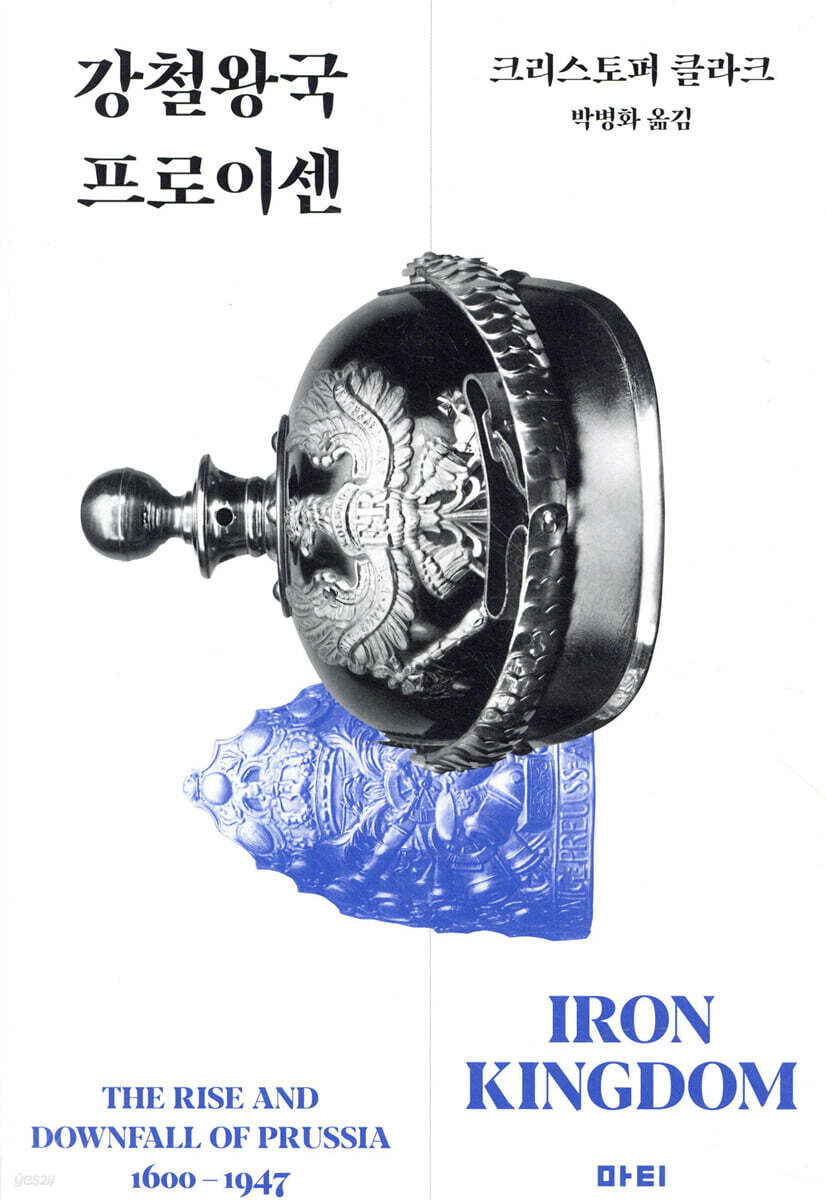
Steel Kingdom of Prussia
 |
Description
Book Introduction
Prussia is often mentioned in literature that links Bismarck and Hitler, and summarizes modern German history as progressing from the German Empire (via the Weimar Republic) to the Nazi Third Reich, but there has not been a single book in Korea that deals with Prussia in depth.
Considered the best history of Prussia in any language, this book will fill a gap without regret.
Considered the best history of Prussia in any language, this book will fill a gap without regret.
- You can preview some of the book's contents.
Preview
index
Acknowledgements
Entering
1. House of Hohenzollern of Brandenburg
Heartland | Dynasty | Reformation | High Expectations
2 disasters
Between the Fronts: 1618–40 | Politics | All in Ashes
3 Special Lights of Germany
Restoration | Expansion | Alliances | Sovereignty | Court and Countryside | Legacy
4 Kingship
Coronation | Cultural Revolution | Administration | Military | Father vs. Son | Limitations of a Nation
5 Protestants
Calvinist Monarchs, Lutheran People | The Third Way: Pietism in Brandenburg-Prussia | Faith and Policy
6 Powers on Earth
City | Landlord Aristocracy | Landlords and Peasants | Castles, Authority, and the Landlord Society | Industrious Prussia
7 The Struggle for Dominance
The One and Only Frederick | The Three Silesian Wars | The Legacy of Hubertusburg | Patriots | Prussian Poland | King and State
8 Dare to know!
Conversation | Jewish Enlightenment in Prussia | Obscurantism? | A Country of Two Faces
9 Pride and Karma: 1789–1806 _ 3 9 3
Prussia's Foreign Policy During the Revolution | The Adventure of Neutrality | From Neutrality to Defeat
10 The World Created by Bureaucrats
'New Dynasty' | Bureaucrats and Officers | Land Reform | Citizenship | Language
11 The Steel Age
False Expectations | Patriots and Liberators | Turning Points | 'Memories' of the War | Prussians or Germans?
12 God's March Through History
A New Dualism | A Turn to Conservatism | Political Change | Religious Conflict | A Missionary Nation | The Deification of the Nation
13 The spread of political turmoil
Political Romanticism | Popular Politics | Social Questions | Hardenberg's Time Bomb | Prussia on the Eve of Revolution
14 The Glory and Tragedy of the Prussian Revolution
Berlin Barricades | Turning Points | Germany Calls | Lessons from Failure | A New Integration
15 Four Wars
Italian Wars | Bismarck | Danish War | Prussian War against Germany | War against France | New Europe
16. Annexed by Germany
Prussia in the German Constitution | Political and Cultural Changes | Culture Wars | Poles, Jews, and Other Prussians | The Prussian King and the German Emperor | Soldiers and Civilians | The Army and the State | The King Leaves, the State Remains
17 End
Prussian Revolution | Prussian Democracy | The Dissolution of Prussia | Prussia and the Third Reich | The Exorcist | Back to Brandenburg
main
Translator's Note
Search
Entering
1. House of Hohenzollern of Brandenburg
Heartland | Dynasty | Reformation | High Expectations
2 disasters
Between the Fronts: 1618–40 | Politics | All in Ashes
3 Special Lights of Germany
Restoration | Expansion | Alliances | Sovereignty | Court and Countryside | Legacy
4 Kingship
Coronation | Cultural Revolution | Administration | Military | Father vs. Son | Limitations of a Nation
5 Protestants
Calvinist Monarchs, Lutheran People | The Third Way: Pietism in Brandenburg-Prussia | Faith and Policy
6 Powers on Earth
City | Landlord Aristocracy | Landlords and Peasants | Castles, Authority, and the Landlord Society | Industrious Prussia
7 The Struggle for Dominance
The One and Only Frederick | The Three Silesian Wars | The Legacy of Hubertusburg | Patriots | Prussian Poland | King and State
8 Dare to know!
Conversation | Jewish Enlightenment in Prussia | Obscurantism? | A Country of Two Faces
9 Pride and Karma: 1789–1806 _ 3 9 3
Prussia's Foreign Policy During the Revolution | The Adventure of Neutrality | From Neutrality to Defeat
10 The World Created by Bureaucrats
'New Dynasty' | Bureaucrats and Officers | Land Reform | Citizenship | Language
11 The Steel Age
False Expectations | Patriots and Liberators | Turning Points | 'Memories' of the War | Prussians or Germans?
12 God's March Through History
A New Dualism | A Turn to Conservatism | Political Change | Religious Conflict | A Missionary Nation | The Deification of the Nation
13 The spread of political turmoil
Political Romanticism | Popular Politics | Social Questions | Hardenberg's Time Bomb | Prussia on the Eve of Revolution
14 The Glory and Tragedy of the Prussian Revolution
Berlin Barricades | Turning Points | Germany Calls | Lessons from Failure | A New Integration
15 Four Wars
Italian Wars | Bismarck | Danish War | Prussian War against Germany | War against France | New Europe
16. Annexed by Germany
Prussia in the German Constitution | Political and Cultural Changes | Culture Wars | Poles, Jews, and Other Prussians | The Prussian King and the German Emperor | Soldiers and Civilians | The Army and the State | The King Leaves, the State Remains
17 End
Prussian Revolution | Prussian Democracy | The Dissolution of Prussia | Prussia and the Third Reich | The Exorcist | Back to Brandenburg
main
Translator's Note
Search
Detailed image
Publisher's Review
Prussia?
Prussia (Preussen, Prussia in English, 普魯士 in Chinese characters) is a forgotten name.
The country called 'Bo' (普) in the Boer War and the Franco-Prussian War, which are mentioned in world history textbooks for middle and high school students.
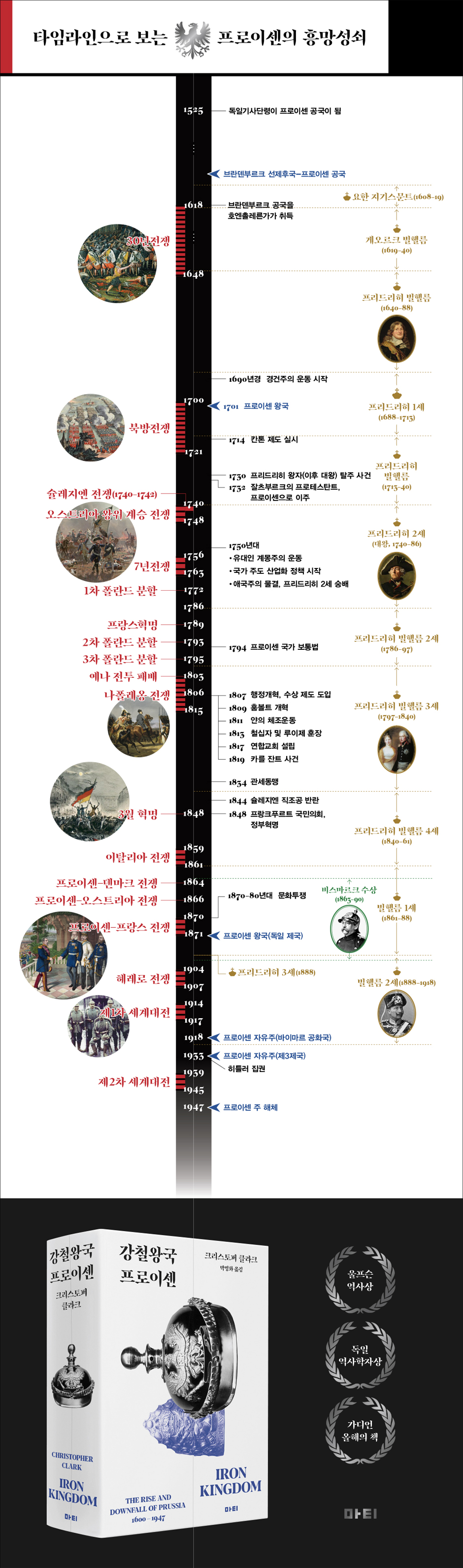
Prussia, a key state of a duchy, a kingdom, an empire, and a republic from the 17th to the 20th centuries, is no longer visible on world maps.
A vast land and power that once comprised 62 percent of Germany's population and 65 percent of its land area was completely erased.
This is a very exceptional event in European history, which places great importance on the heritage and memory of the past.
"The Iron Kingdom of Prussia," which vividly depicts the footsteps of the nation with that name on that land for hundreds of years, deals head-on with the history of this problematic nation, "Prussia."
The first Korean-language book to introduce Prussia in earnest
Prussia is often mentioned in literature that links Bismarck and Hitler, and summarizes modern German history as progressing from the German Empire (via the Weimar Republic) to the Nazi Third Reich, but there has not been a single book in Korea that deals with Prussia in depth.
Considered the best historical book on Prussia in any language, "Prussia the Iron Kingdom" will fill the gap without regret.
From Arch-Elector to Wilhelm II, from Duchy to Empire
『The Iron Kingdom of Prussia』 is a comprehensive history of Prussia that covers all the major events and figures.
It meticulously weaves together a series of turbulent events, from the acquisition of the Electorate of Brandenburg by the House of Hohenzollern, its growth into the Kingdom of Prussia, its unification of Germany, its rise to an empire, and its disappearance from history as the main culprit in two world wars.
The chapters on major rulers and events in the mid-1700s, when Germany was still a marginal kingdom, such as Frederick the Great, the hero of the Seven Years' War against the Habsburg Empire, France, and Russia; the humiliation of Napoleon and Prussia; the course and aftermath of the Revolution of 1848; Bismarck, the key figure in German unification; and Emperor Wilhelm II, known as the first media monarch, are concise and stand alone, making them worthy of being written in separate volumes.
Culture and society intricately intertwined with politics
"The Iron Kingdom of Prussia" is the history book that is furthest from a schematic listing of major political and diplomatic events.
As foreign media outlets have commented, "It possesses all the merits of a history book," the author weaves together the political events that marked a watershed in history with the socio-cultural changes that were both their causes and consequences in a remarkably close and fluid manner.
In particular, it traces the changes in Prussian society, focusing on the energy that worked to unify Germany as Prussia gradually grew in power.
Because the land of present-day Germany, where Prussia was located, had neither clear geographical boundaries nor a single, unique culture or language, the question of what aspects of Prussia served as cultural and political glue is a crucial one.
It is not a culture, society, or art that appears to fill the void after dealing with politics.
What Made Prussia
The author does not superficially define or refute the words that always appear when describing Prussia: pietism, the staid and modernizing Junker class, militarism and authoritarianism, and a strict and efficient administration.
Instead, it unfolds for the reader the complex historical meanings and diverse forms these words have taken.
For example, Pietist Protestantism was a form of social welfare, it strengthened and weakened power, and it played a role within the international order.
The same goes for the way we describe the Junker class, which is considered the main culprit in the disorganization of modern German history.
The author does not try to save Juncker by going against conventional wisdom or relying on conventional explanations.
Contemporary literature reveals who the Junkers were and what roles they played between landlords and tenants, gender, and city and countryside.
The passage tracing the process of strengthening administration in response to the French Revolution is no different.
The author traces how the Prussian state triumphantly proclaimed itself a model of a particular kind of modernization, yet he also points out that the authority and grandeur of the state envisioned by the intellectual elite of the time had little to do with the lives of the majority of its people.
The Trap of Hitler and the End of Prussia
Prussia led the way to German unification, but paradoxically, it also went down the path to destruction along with unification.
It was downgraded from an independent state to a state of unified Germany.
And after the end of World War II, in 1947, the Allied occupation authorities identified Prussia as the main culprit in Germany who started the war, and the state of Prussia, its central government, and its government institutions were all abolished, along with the name Prussia.
The second half of 『The Iron Kingdom of Prussia』 depicts the epic story of this great downfall.
The author coldly traces the role of Prussia and the Prussian people in this turbulent history that led to the Weimar Republic, the rise of the Nazis, and Germany's defeat.
By describing why the Prussian administration and military survived the Weimar Republic, how Hitler (who was Austrian and had established himself in Munich) and the Nazis exploited Prussian heritage, and how Prussian officers resisted during World War II, the author persuasively demonstrates how directly linking Bismarck to Hitler and Prussia to the Nazis flattens history.
Beyond mourning and praise
The author says that as an Australian and a professor at Cambridge University, he was able to deal with the Prussian record without the obligation or temptation to mourn or praise it, without judging its merits or demerits, without the burden of imparting moral lessons or political advice.
Instead, the author says he wanted to understand the forces that created and destroyed Prussia.
This is the explanation that allows us to understand how a nation that seemed so majestic could disappear so suddenly, so gracefully, and without any mourning.
Any reader who has read this 1000-page book will be able to fully accept the author's words.
Prussia (Preussen, Prussia in English, 普魯士 in Chinese characters) is a forgotten name.
The country called 'Bo' (普) in the Boer War and the Franco-Prussian War, which are mentioned in world history textbooks for middle and high school students.
Prussia, a key state of a duchy, a kingdom, an empire, and a republic from the 17th to the 20th centuries, is no longer visible on world maps.
A vast land and power that once comprised 62 percent of Germany's population and 65 percent of its land area was completely erased.
This is a very exceptional event in European history, which places great importance on the heritage and memory of the past.
"The Iron Kingdom of Prussia," which vividly depicts the footsteps of the nation with that name on that land for hundreds of years, deals head-on with the history of this problematic nation, "Prussia."
The first Korean-language book to introduce Prussia in earnest
Prussia is often mentioned in literature that links Bismarck and Hitler, and summarizes modern German history as progressing from the German Empire (via the Weimar Republic) to the Nazi Third Reich, but there has not been a single book in Korea that deals with Prussia in depth.
Considered the best historical book on Prussia in any language, "Prussia the Iron Kingdom" will fill the gap without regret.
From Arch-Elector to Wilhelm II, from Duchy to Empire
『The Iron Kingdom of Prussia』 is a comprehensive history of Prussia that covers all the major events and figures.
It meticulously weaves together a series of turbulent events, from the acquisition of the Electorate of Brandenburg by the House of Hohenzollern, its growth into the Kingdom of Prussia, its unification of Germany, its rise to an empire, and its disappearance from history as the main culprit in two world wars.
The chapters on major rulers and events in the mid-1700s, when Germany was still a marginal kingdom, such as Frederick the Great, the hero of the Seven Years' War against the Habsburg Empire, France, and Russia; the humiliation of Napoleon and Prussia; the course and aftermath of the Revolution of 1848; Bismarck, the key figure in German unification; and Emperor Wilhelm II, known as the first media monarch, are concise and stand alone, making them worthy of being written in separate volumes.
Culture and society intricately intertwined with politics
"The Iron Kingdom of Prussia" is the history book that is furthest from a schematic listing of major political and diplomatic events.
As foreign media outlets have commented, "It possesses all the merits of a history book," the author weaves together the political events that marked a watershed in history with the socio-cultural changes that were both their causes and consequences in a remarkably close and fluid manner.
In particular, it traces the changes in Prussian society, focusing on the energy that worked to unify Germany as Prussia gradually grew in power.
Because the land of present-day Germany, where Prussia was located, had neither clear geographical boundaries nor a single, unique culture or language, the question of what aspects of Prussia served as cultural and political glue is a crucial one.
It is not a culture, society, or art that appears to fill the void after dealing with politics.
What Made Prussia
The author does not superficially define or refute the words that always appear when describing Prussia: pietism, the staid and modernizing Junker class, militarism and authoritarianism, and a strict and efficient administration.
Instead, it unfolds for the reader the complex historical meanings and diverse forms these words have taken.
For example, Pietist Protestantism was a form of social welfare, it strengthened and weakened power, and it played a role within the international order.
The same goes for the way we describe the Junker class, which is considered the main culprit in the disorganization of modern German history.
The author does not try to save Juncker by going against conventional wisdom or relying on conventional explanations.
Contemporary literature reveals who the Junkers were and what roles they played between landlords and tenants, gender, and city and countryside.
The passage tracing the process of strengthening administration in response to the French Revolution is no different.
The author traces how the Prussian state triumphantly proclaimed itself a model of a particular kind of modernization, yet he also points out that the authority and grandeur of the state envisioned by the intellectual elite of the time had little to do with the lives of the majority of its people.
The Trap of Hitler and the End of Prussia
Prussia led the way to German unification, but paradoxically, it also went down the path to destruction along with unification.
It was downgraded from an independent state to a state of unified Germany.
And after the end of World War II, in 1947, the Allied occupation authorities identified Prussia as the main culprit in Germany who started the war, and the state of Prussia, its central government, and its government institutions were all abolished, along with the name Prussia.
The second half of 『The Iron Kingdom of Prussia』 depicts the epic story of this great downfall.
The author coldly traces the role of Prussia and the Prussian people in this turbulent history that led to the Weimar Republic, the rise of the Nazis, and Germany's defeat.
By describing why the Prussian administration and military survived the Weimar Republic, how Hitler (who was Austrian and had established himself in Munich) and the Nazis exploited Prussian heritage, and how Prussian officers resisted during World War II, the author persuasively demonstrates how directly linking Bismarck to Hitler and Prussia to the Nazis flattens history.
Beyond mourning and praise
The author says that as an Australian and a professor at Cambridge University, he was able to deal with the Prussian record without the obligation or temptation to mourn or praise it, without judging its merits or demerits, without the burden of imparting moral lessons or political advice.
Instead, the author says he wanted to understand the forces that created and destroyed Prussia.
This is the explanation that allows us to understand how a nation that seemed so majestic could disappear so suddenly, so gracefully, and without any mourning.
Any reader who has read this 1000-page book will be able to fully accept the author's words.
GOODS SPECIFICS
- Date of issue: July 20, 2020
- Format: Hardcover book binding method guide
- Page count, weight, size: 1,056 pages | 1,650g | 152*225*60mm
- ISBN13: 9791190853026
- ISBN10: 1190853027
You may also like
카테고리
korean


korean

![GQ KOREA Mark (Monthly): December [2025]](http://librairie.coreenne.fr/cdn/shop/files/8ef265dbbfbf186523ed75ba7319009d.jpg?v=1765340328&width=3840)


