

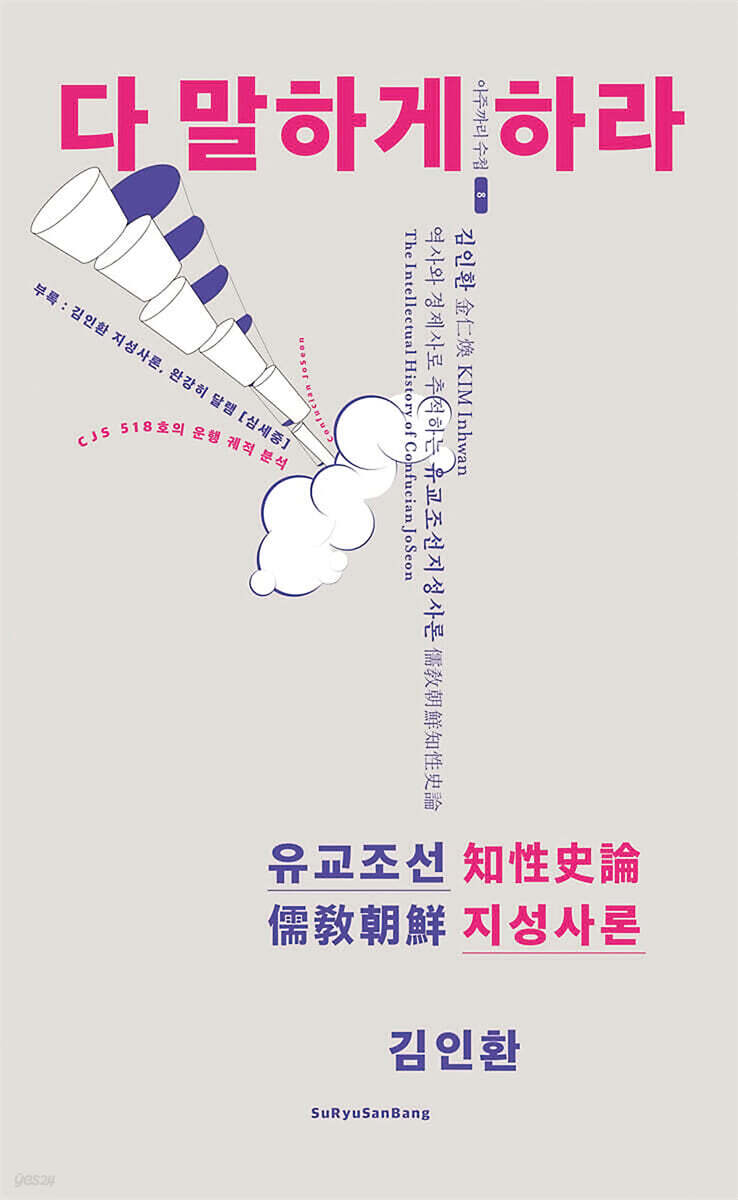
Let them say everything
 |
Description
Book Introduction
Break free from the yardstick of 'modernity' and gain an exceptional perspective that penetrates the 518 years of Joseon Dynasty!
① The final link in the four-part series on Kim In-hwan, the master of study of the times
② The Joseon Dynasty as reorganized through the methodology of intellectual history
③ Providing clues to the future we must open
④ A topographical map guiding Kim In-hwan's thought system from literary criticism to historical philosophy.
A new book by literary critic Kim In-hwan, professor emeritus at Korea University, was published by Suryusanbang in March 2025.
"Let them all speak: A Study of the Intellectual History of Confucian Joseon" is the fourth work in Kim In-hwan's four-part series, which seeks to rewrite the history of Korean poetry from ancient times to the present.
This book connects the gap between 『A Study of Ancient Korean Poetry』(2007), 『Three Hundred Poems of Goryeo』(2014), and 『Lectures on Modern Korean Poetry』(2024), which attracted the attention of the academic world every time they were published, and reveals the background of Joseon's intellectual history.
“I thought it would be meaningful to compile my theory of immanent analysis, which states that the past, whether in literature or thought, must be viewed within the past, into a single book, and this is the result of organizing it into a book, ‘A Study of the Intellectual History of Confucian Joseon.’”
The author names the 518 years of Joseon as 'Confucian Joseon' and divides the era into six stages: foundation, formation, unrest, stability, decline, and transition.
By explaining the political and economic aspects of each era using historical materials and figures, the reality of life by class is revealed, and then the major currents of thought that arise from or oppose them are read in various works, and each is grouped into formalism, idealism, normativity, realism, institutionalism, and empiricism.
It proposes a new framework for understanding the specific lives and mentalities of the people who lived in Joseon and each era within it.
As representative cases of intellectual history of six eras, Kim In-hwan discusses the creation of Hangul by King Sejong (formalism), Toegye Yi Hwang's words and deeds (idealism), Uam Song Si-yeol (normativity) and his counterarguments, Yeonam Park Ji-won (realism), Dasan Jeong Yak-yong (institutionalism) and a comparison of Suun Choi Je-u, and the autonomous interpretation of Yi Gi by Han Won-jin, Im Seong-ju, Gi Jeong-jin, and Choi Han-gi and its significance (empiricism).
Although the title of this book is 'Confucian Joseon,' the author did not select these scholars because they were outstanding Confucian scholars.
These are figures who embody one aspect of the intellectual history of each era within the Joseon Dynasty system, which held Confucianism as its ruling ideology.
① The final link in the four-part series on Kim In-hwan, the master of study of the times
② The Joseon Dynasty as reorganized through the methodology of intellectual history
③ Providing clues to the future we must open
④ A topographical map guiding Kim In-hwan's thought system from literary criticism to historical philosophy.
A new book by literary critic Kim In-hwan, professor emeritus at Korea University, was published by Suryusanbang in March 2025.
"Let them all speak: A Study of the Intellectual History of Confucian Joseon" is the fourth work in Kim In-hwan's four-part series, which seeks to rewrite the history of Korean poetry from ancient times to the present.
This book connects the gap between 『A Study of Ancient Korean Poetry』(2007), 『Three Hundred Poems of Goryeo』(2014), and 『Lectures on Modern Korean Poetry』(2024), which attracted the attention of the academic world every time they were published, and reveals the background of Joseon's intellectual history.
“I thought it would be meaningful to compile my theory of immanent analysis, which states that the past, whether in literature or thought, must be viewed within the past, into a single book, and this is the result of organizing it into a book, ‘A Study of the Intellectual History of Confucian Joseon.’”
The author names the 518 years of Joseon as 'Confucian Joseon' and divides the era into six stages: foundation, formation, unrest, stability, decline, and transition.
By explaining the political and economic aspects of each era using historical materials and figures, the reality of life by class is revealed, and then the major currents of thought that arise from or oppose them are read in various works, and each is grouped into formalism, idealism, normativity, realism, institutionalism, and empiricism.
It proposes a new framework for understanding the specific lives and mentalities of the people who lived in Joseon and each era within it.
As representative cases of intellectual history of six eras, Kim In-hwan discusses the creation of Hangul by King Sejong (formalism), Toegye Yi Hwang's words and deeds (idealism), Uam Song Si-yeol (normativity) and his counterarguments, Yeonam Park Ji-won (realism), Dasan Jeong Yak-yong (institutionalism) and a comparison of Suun Choi Je-u, and the autonomous interpretation of Yi Gi by Han Won-jin, Im Seong-ju, Gi Jeong-jin, and Choi Han-gi and its significance (empiricism).
Although the title of this book is 'Confucian Joseon,' the author did not select these scholars because they were outstanding Confucian scholars.
These are figures who embody one aspect of the intellectual history of each era within the Joseon Dynasty system, which held Confucianism as its ruling ideology.
index
0-0 Preface [Kim In-hwan]
0-1 Driving Record Order
Appendix Z: Kim In-hwan's Theory of Intellectual History, Stubbornly Consoling [Suryusanbang (+Sim Se-jung)]
Appendix Z Excerpt from Kim In-hwan's work
0-2 Introduction [Kim In-hwan]
0-3 boarding figures
A 15th century
A-1 Initial Stage
A-2 formalism
B 16th century
B-1 formation stage
B-2 Idealism
C 17th century
C-1 Agitation stage
C-2 Normativity
D 18th century
D-1 Stability Phase
D-2 Realism
E 19th century
E-1 descent stage
E-2 institutionalism
Late F Dynasty
F-1 transition phase
F-2 Empiricism
0-4 References
0-5 Afterword [Kim In-hwan]
0-1 Driving Record Order
Appendix Z: Kim In-hwan's Theory of Intellectual History, Stubbornly Consoling [Suryusanbang (+Sim Se-jung)]
Appendix Z Excerpt from Kim In-hwan's work
0-2 Introduction [Kim In-hwan]
0-3 boarding figures
A 15th century
A-1 Initial Stage
A-2 formalism
B 16th century
B-1 formation stage
B-2 Idealism
C 17th century
C-1 Agitation stage
C-2 Normativity
D 18th century
D-1 Stability Phase
D-2 Realism
E 19th century
E-1 descent stage
E-2 institutionalism
Late F Dynasty
F-1 transition phase
F-2 Empiricism
0-4 References
0-5 Afterword [Kim In-hwan]
Into the book
I thought it would be meaningful to compile my theory of immanent analysis, which states that the past, whether in literature or thought, must be viewed within the past, into a single book, and the result is this 『Let It All Speak (A Study of the Intellectual History of Confucian Joseon)』.
Since we always look at the past through the eyes of the present, we cannot avoid the tyranny of those born late unless we make an effort to look at the past through the eyes of the past.
For those who view the pre-modern era from a modern perspective, there is no reflection on how the modern era can serve as a standard for interpreting history.
Even a million years from now, humans will still be exploring unknown truths beyond existing knowledge and envisioning worlds different from their own.
Modernity cannot be an absolute standard for viewing history.
---From "Analysis of the Operational Trajectory of CJS 518"
Each faction tried to become a common party.
There were also aspects where the principles of inclusion and checks and balances, confrontation and balance, were at work between the factions.
However, as the conflict between one's own party and other parties began to be distinguished as a conflict between the gentleman's party and the petty party, the conflict between factions developed into a conflict between allies and enemies.
Originally, in Confucianism, the term "gentleman" (chuntzu, junzi) was a common noun referring to a seeker of the way, but they used it as a proper noun to refer to their own sect, distinguishing it from other sects.
In the 16th century, there was a debate over which came first, li or gi. While everyone agreed that li and gi were inseparably intertwined, the debate polarized along factional lines, and in the end, the yangban of Confucian Joseon ended up choosing either the Gyeonggi/Chungcheong faction or the Gyeongsang-do faction.
On the surface, it appeared to be a philosophical and moral debate, but in reality it was a selfish fight among factions over land, slaves, and government positions.
--- p.36
The Westerners thought that since they were subjects of the Ming Dynasty, it was natural to expel Gwanghaegun, who was a vassal of the Ming Dynasty but lacked loyalty to the Ming Dynasty. After the Ming Dynasty fell, they lived without even listening to music for the sake of the last emperor of the Ming Dynasty [Emperor Yizong (毅宗) Chongzhen (崇禎帝)] who committed suicide after being a tyrant.
The Westerners' normative doctrine that the Ming emperor must be loyal even if he made political mistakes and that the Joseon king must be expelled if he made political mistakes had its practical purpose in checks and balances on royal power.
The Noron faction's unrealistic anti-Qing and Ming stance, which held that the king and officials of Joseon were equal in that they were all subjects of the Ming emperor and that the difference was not an absolute difference but merely a relative difference based on the hierarchy of Ming officials, began to take effect in reality in the 19th century and ultimately ended up weakening the royal authority of Joseon.
--- p.105
While modern entrepreneurs try to prioritize investments based on profit rates and interest rates, Park Ji-won tried to prioritize policies based on the efficiency of welfare, which is the economic stability of farmers.
In any case, we cannot determine the direction of investment and policy without first understanding the technological production system of society.
Park Ji-won calculated the degree of land monopoly in 18th-century Joseon by comparing the average farmland per farmer in each county with the farmland per person actually owned by farmers.
Through the agricultural tools introduced in 『Gwanongsocho』, we come to understand that Park Ji-won's era was between the era of the hoe, plow, and hoe and the era of the cultivator, rice transplanter, tractor, and combine.
--- p.134
Choi Je-woo viewed divine descent, divine possession, and self-enlightenment as one.
Man is not an omnipotent being who can practice honesty and tolerance by his own will.
Humans should consider the simple and modest life they enjoy as a gift from God.
If so, then some people's falsehood and bigotry are God's punishment.
--- p.190
Labor is not simply an act of sweating, but an activity in which the human spirit is expressed outwardly and spiritual value is imprinted on material objects.
The belief that my work can be integrated into a larger system of labor and then flow back into a meaningful world of life, contributing to the creation of value, is the basis of my labor.
If my sweat only serves to deepen discrimination and dependence, my labor will lose its authenticity and fall into the abyss of futility.
--- p.192
The technical ideology of the reformists is clearly revealed in the memorial submitted by Yu Gil-jun to Sunjong on September 17, 1907 [the year of Sunjong's accession to the throne] [Jeongmi].
The petition clearly reveals the reason why the reformists had no choice but to become traitors.
Yu Gil-jun contrasted Japan and Korea, defining Japan as a country with only strengths and Korea as a country with only weaknesses.
--- p.218
Even after November 1939, when the Government-General forced Koreans to change their names, it did not allow Koreans to have Japanese nationality and allowed them to retain their Korean nationality.
The Japanese family register granted to Koreans during the Japanese colonial period was not Japanese citizenship, but rather ‘permanent residency in Japanese-controlled Joseon.’
If you abandon your Japanese family register, you become anti-Japanese, and if you abandon your sense of national identity, you become pro-Japanese.
Most people lived contradictory lives, straddling the line between anti-Japanese and pro-Japanese sentiments.
[…] Collaboration with Japan was an action that brought benefits, but it was an action that required enduring public contempt, and anti-Japanese activity was a valuable action, but it was an action that required leaving home and work.
Since we always look at the past through the eyes of the present, we cannot avoid the tyranny of those born late unless we make an effort to look at the past through the eyes of the past.
For those who view the pre-modern era from a modern perspective, there is no reflection on how the modern era can serve as a standard for interpreting history.
Even a million years from now, humans will still be exploring unknown truths beyond existing knowledge and envisioning worlds different from their own.
Modernity cannot be an absolute standard for viewing history.
---From "Analysis of the Operational Trajectory of CJS 518"
Each faction tried to become a common party.
There were also aspects where the principles of inclusion and checks and balances, confrontation and balance, were at work between the factions.
However, as the conflict between one's own party and other parties began to be distinguished as a conflict between the gentleman's party and the petty party, the conflict between factions developed into a conflict between allies and enemies.
Originally, in Confucianism, the term "gentleman" (chuntzu, junzi) was a common noun referring to a seeker of the way, but they used it as a proper noun to refer to their own sect, distinguishing it from other sects.
In the 16th century, there was a debate over which came first, li or gi. While everyone agreed that li and gi were inseparably intertwined, the debate polarized along factional lines, and in the end, the yangban of Confucian Joseon ended up choosing either the Gyeonggi/Chungcheong faction or the Gyeongsang-do faction.
On the surface, it appeared to be a philosophical and moral debate, but in reality it was a selfish fight among factions over land, slaves, and government positions.
--- p.36
The Westerners thought that since they were subjects of the Ming Dynasty, it was natural to expel Gwanghaegun, who was a vassal of the Ming Dynasty but lacked loyalty to the Ming Dynasty. After the Ming Dynasty fell, they lived without even listening to music for the sake of the last emperor of the Ming Dynasty [Emperor Yizong (毅宗) Chongzhen (崇禎帝)] who committed suicide after being a tyrant.
The Westerners' normative doctrine that the Ming emperor must be loyal even if he made political mistakes and that the Joseon king must be expelled if he made political mistakes had its practical purpose in checks and balances on royal power.
The Noron faction's unrealistic anti-Qing and Ming stance, which held that the king and officials of Joseon were equal in that they were all subjects of the Ming emperor and that the difference was not an absolute difference but merely a relative difference based on the hierarchy of Ming officials, began to take effect in reality in the 19th century and ultimately ended up weakening the royal authority of Joseon.
--- p.105
While modern entrepreneurs try to prioritize investments based on profit rates and interest rates, Park Ji-won tried to prioritize policies based on the efficiency of welfare, which is the economic stability of farmers.
In any case, we cannot determine the direction of investment and policy without first understanding the technological production system of society.
Park Ji-won calculated the degree of land monopoly in 18th-century Joseon by comparing the average farmland per farmer in each county with the farmland per person actually owned by farmers.
Through the agricultural tools introduced in 『Gwanongsocho』, we come to understand that Park Ji-won's era was between the era of the hoe, plow, and hoe and the era of the cultivator, rice transplanter, tractor, and combine.
--- p.134
Choi Je-woo viewed divine descent, divine possession, and self-enlightenment as one.
Man is not an omnipotent being who can practice honesty and tolerance by his own will.
Humans should consider the simple and modest life they enjoy as a gift from God.
If so, then some people's falsehood and bigotry are God's punishment.
--- p.190
Labor is not simply an act of sweating, but an activity in which the human spirit is expressed outwardly and spiritual value is imprinted on material objects.
The belief that my work can be integrated into a larger system of labor and then flow back into a meaningful world of life, contributing to the creation of value, is the basis of my labor.
If my sweat only serves to deepen discrimination and dependence, my labor will lose its authenticity and fall into the abyss of futility.
--- p.192
The technical ideology of the reformists is clearly revealed in the memorial submitted by Yu Gil-jun to Sunjong on September 17, 1907 [the year of Sunjong's accession to the throne] [Jeongmi].
The petition clearly reveals the reason why the reformists had no choice but to become traitors.
Yu Gil-jun contrasted Japan and Korea, defining Japan as a country with only strengths and Korea as a country with only weaknesses.
--- p.218
Even after November 1939, when the Government-General forced Koreans to change their names, it did not allow Koreans to have Japanese nationality and allowed them to retain their Korean nationality.
The Japanese family register granted to Koreans during the Japanese colonial period was not Japanese citizenship, but rather ‘permanent residency in Japanese-controlled Joseon.’
If you abandon your Japanese family register, you become anti-Japanese, and if you abandon your sense of national identity, you become pro-Japanese.
Most people lived contradictory lives, straddling the line between anti-Japanese and pro-Japanese sentiments.
[…] Collaboration with Japan was an action that brought benefits, but it was an action that required enduring public contempt, and anti-Japanese activity was a valuable action, but it was an action that required leaving home and work.
--- p.289~290
Publisher's Review
This book probably represents the highest level of Korean studies that a person born in the 1940s could achieve.
[...] This book is written by a scholar who has studied Korean studies for over 60 years, and after reading and researching materials from ancient times to the present, he has almost finished his studies and has unfolded the entire intellectual history of Confucianism (a blend of literature, thought, and history) of the Joseon Dynasty in one line.
Professor Kim In-hwan presents the history of intellectuals in the Joseon Dynasty in six major categories.
Form (Hangeul), ideal (Toegye), norm (Song Si-yeol), reality (Park Ji-won), system (Jeong Yak-yong), and experience (Han Won-jin).
And after the Confucian framework, comprehensive democracy (Choi Je-woo) appears.
These conclusions contain a consistent system underlying dozens of books the teacher has written since his youth.
This is the idea of a "stubborn appeaser", that is, a fighter.
At this time, stubbornness is assertion, and soothing is love.
In other words, it is a process of condensing the entire history of Korean intellectuals into a steady journey of those who have been deprived of their eyes and called the people, until they become people who speak equally and govern together.
[Literary critic Jang Eun-su]
"What we need now is the spirit of harmony and whiteness." Professor Emeritus Kim In-hwan of Korea University publishes "Let them speak." | "What we need now is the spirit of harmony and whiteness."
It is a word that means avoiding dogmatism and letting everyone speak.
Joseon is often considered an old feudal era, but it did its job well.
“The problem is that we don’t know what to do and how to do it in our time, and we can’t do it.” This is the question that Professor Emeritus Kim In-hwan (79) of Korea University, a leading scholar and storyteller of our time, posed to a Republic of Korea that has lost its direction.
The core is condensed into the ‘painter’s spirit.’
Although it is a Chinese character word, it is a unique word that is not found in China or Japan.
It is a combination of the character 'hwa', which means 'all', and the character 'baek', which means 'to report' or 'to speak'.
So, if you express the Chinese character 'painter' in Korean, it becomes 'Let them say everything', like the book title.
The book progresses very quickly.
It's breathless trying to keep up.
I recommend reading by looking at the subheadings and finding the relevant content.
For example, it is not difficult to start by reading the parts that interest you, such as 'Coup and Partisanship', and then slowly expand your perspective to the whole book.
[Reporter Son Won-cheon, Seoul Shinmun, March 19, 2025]
I spent the month of May with this book.
I was drawn to the title, “Let them say everything.”
The two key events of the Joseon Dynasty were the creation of Hangul and Donghak.
The title is based on the editor's interpretation that the world we live in today, where "everyone speaks," has finally opened thanks to the Donghak movement of Suun Choi Je-u, who first proposed the idea of an equal world and the Korean alphabet that everyone can read.
So I misunderstood the book.
It is said to be a book that describes the history of Joseon with Hangeul and Donghak as the two axes.
This book, in my own words, is “An Easy-to-Understand Story of the Joseon Dynasty with perspectives, interpretations, and harsh evaluations.”
I strongly recommend reading this book as a must-read for all ages, regardless of gender or age, starting from college students.
Textbooks are propagating conservative views under the guise of neutrality, and the best-selling Joseon Dynasty Annals, written by Ilta instructors, are full of perspectives, interpretations, and, above all, criticism.
It's common sense, not knowledge.
[…] Although it may be presumptuous, I defined this book as “An Easy-to-Understand Story of the Joseon Dynasty.”
However, it was described with the modifier “with perspective, interpretation, and harsh evaluation.”
Common sense (knowledge) related to administration and governance, such as Joseon's land system, currency system, tax system, taxation system, and military system, is neatly organized, including the background of why such systems were implemented.
Readers who are passionate about 'broad and shallow knowledge for intellectual conversation' must read this book.
If you read books to pretend to know a lot, this book gives you a way to reflect on yourself and a yardstick and attitude to criticize today's society.
[Reporter Son Young-ok]
"By creating Hangeul and Donghak, we have fulfilled our responsibility for pre-modern Korea." Professor Kim In-hwan, a senior scholar of Korean literature, publishes "A Study of the Intellectual History of Confucian Joseon" | "Joseon's Confucianism did not end with its obsession with Neo-Confucianism.
“We must see that he thoroughly analyzed Zhu Xi’s teachings and overcame them on his own.” The person who says this is not a history or philosophy major, but a Korean literature scholar and literary critic, Professor Emeritus Kim In-hwan (79) of Korea University.
While writing a series of essays on poetry from ancient times to the present, I dug through 3,000 anthologies to study Joseon poetry, and then I came across a grand undertaking: 'I should organize the intellectual history of the Joseon Dynasty for 500 years.'
The result is the recently published 'Let them say everything: A Study on the Intellectual History of Confucian Joseon' (Suryusanbang).
In each chapter, divided by century, political and economic history and ideological history are written in parallel, and the entire Joseon Dynasty is divided into six stages: foundation, formation, turmoil, stability, decline, and transition.
I tried to view history from a contemporary perspective.
[…] Professor Kim said, “Just by creating Hangeul and Donghak, we can say that pre-modern Korea has completed its mission.”
Hangul became a 'means to say everything' and Donghak granted 'the right to say everything'.
"The Korean intellectual community, currently focused solely on interpreting foreign philosophy, must begin by returning to the paths of Hyegang (Choi Han-gi) and Suun (Choi Je-woo)." [Reporter Yoo Seok-jae, Chosun Ilbo, May 12, 2025]
[...] This book is written by a scholar who has studied Korean studies for over 60 years, and after reading and researching materials from ancient times to the present, he has almost finished his studies and has unfolded the entire intellectual history of Confucianism (a blend of literature, thought, and history) of the Joseon Dynasty in one line.
Professor Kim In-hwan presents the history of intellectuals in the Joseon Dynasty in six major categories.
Form (Hangeul), ideal (Toegye), norm (Song Si-yeol), reality (Park Ji-won), system (Jeong Yak-yong), and experience (Han Won-jin).
And after the Confucian framework, comprehensive democracy (Choi Je-woo) appears.
These conclusions contain a consistent system underlying dozens of books the teacher has written since his youth.
This is the idea of a "stubborn appeaser", that is, a fighter.
At this time, stubbornness is assertion, and soothing is love.
In other words, it is a process of condensing the entire history of Korean intellectuals into a steady journey of those who have been deprived of their eyes and called the people, until they become people who speak equally and govern together.
[Literary critic Jang Eun-su]
"What we need now is the spirit of harmony and whiteness." Professor Emeritus Kim In-hwan of Korea University publishes "Let them speak." | "What we need now is the spirit of harmony and whiteness."
It is a word that means avoiding dogmatism and letting everyone speak.
Joseon is often considered an old feudal era, but it did its job well.
“The problem is that we don’t know what to do and how to do it in our time, and we can’t do it.” This is the question that Professor Emeritus Kim In-hwan (79) of Korea University, a leading scholar and storyteller of our time, posed to a Republic of Korea that has lost its direction.
The core is condensed into the ‘painter’s spirit.’
Although it is a Chinese character word, it is a unique word that is not found in China or Japan.
It is a combination of the character 'hwa', which means 'all', and the character 'baek', which means 'to report' or 'to speak'.
So, if you express the Chinese character 'painter' in Korean, it becomes 'Let them say everything', like the book title.
The book progresses very quickly.
It's breathless trying to keep up.
I recommend reading by looking at the subheadings and finding the relevant content.
For example, it is not difficult to start by reading the parts that interest you, such as 'Coup and Partisanship', and then slowly expand your perspective to the whole book.
[Reporter Son Won-cheon, Seoul Shinmun, March 19, 2025]
I spent the month of May with this book.
I was drawn to the title, “Let them say everything.”
The two key events of the Joseon Dynasty were the creation of Hangul and Donghak.
The title is based on the editor's interpretation that the world we live in today, where "everyone speaks," has finally opened thanks to the Donghak movement of Suun Choi Je-u, who first proposed the idea of an equal world and the Korean alphabet that everyone can read.
So I misunderstood the book.
It is said to be a book that describes the history of Joseon with Hangeul and Donghak as the two axes.
This book, in my own words, is “An Easy-to-Understand Story of the Joseon Dynasty with perspectives, interpretations, and harsh evaluations.”
I strongly recommend reading this book as a must-read for all ages, regardless of gender or age, starting from college students.
Textbooks are propagating conservative views under the guise of neutrality, and the best-selling Joseon Dynasty Annals, written by Ilta instructors, are full of perspectives, interpretations, and, above all, criticism.
It's common sense, not knowledge.
[…] Although it may be presumptuous, I defined this book as “An Easy-to-Understand Story of the Joseon Dynasty.”
However, it was described with the modifier “with perspective, interpretation, and harsh evaluation.”
Common sense (knowledge) related to administration and governance, such as Joseon's land system, currency system, tax system, taxation system, and military system, is neatly organized, including the background of why such systems were implemented.
Readers who are passionate about 'broad and shallow knowledge for intellectual conversation' must read this book.
If you read books to pretend to know a lot, this book gives you a way to reflect on yourself and a yardstick and attitude to criticize today's society.
[Reporter Son Young-ok]
"By creating Hangeul and Donghak, we have fulfilled our responsibility for pre-modern Korea." Professor Kim In-hwan, a senior scholar of Korean literature, publishes "A Study of the Intellectual History of Confucian Joseon" | "Joseon's Confucianism did not end with its obsession with Neo-Confucianism.
“We must see that he thoroughly analyzed Zhu Xi’s teachings and overcame them on his own.” The person who says this is not a history or philosophy major, but a Korean literature scholar and literary critic, Professor Emeritus Kim In-hwan (79) of Korea University.
While writing a series of essays on poetry from ancient times to the present, I dug through 3,000 anthologies to study Joseon poetry, and then I came across a grand undertaking: 'I should organize the intellectual history of the Joseon Dynasty for 500 years.'
The result is the recently published 'Let them say everything: A Study on the Intellectual History of Confucian Joseon' (Suryusanbang).
In each chapter, divided by century, political and economic history and ideological history are written in parallel, and the entire Joseon Dynasty is divided into six stages: foundation, formation, turmoil, stability, decline, and transition.
I tried to view history from a contemporary perspective.
[…] Professor Kim said, “Just by creating Hangeul and Donghak, we can say that pre-modern Korea has completed its mission.”
Hangul became a 'means to say everything' and Donghak granted 'the right to say everything'.
"The Korean intellectual community, currently focused solely on interpreting foreign philosophy, must begin by returning to the paths of Hyegang (Choi Han-gi) and Suun (Choi Je-woo)." [Reporter Yoo Seok-jae, Chosun Ilbo, May 12, 2025]
GOODS SPECIFICS
- Date of issue: March 20, 2025
- Page count, weight, size: 424 pages | 140*224*30mm
- ISBN13: 9788991555969
- ISBN10: 8991555969
You may also like
카테고리
korean


korean

![ELLE 엘르 스페셜 에디션 A형 : 12월 [2025]](http://librairie.coreenne.fr/cdn/shop/files/b8e27a3de6c9538896439686c6b0e8fb.jpg?v=1766436872&width=3840)


