

Daegu COD
 |
Description
Book Introduction
*Choi Jae-cheon, Choi Tae-seong, Lee Jeong-mo, Im So-mi, Suspicious Fish Recommended Books
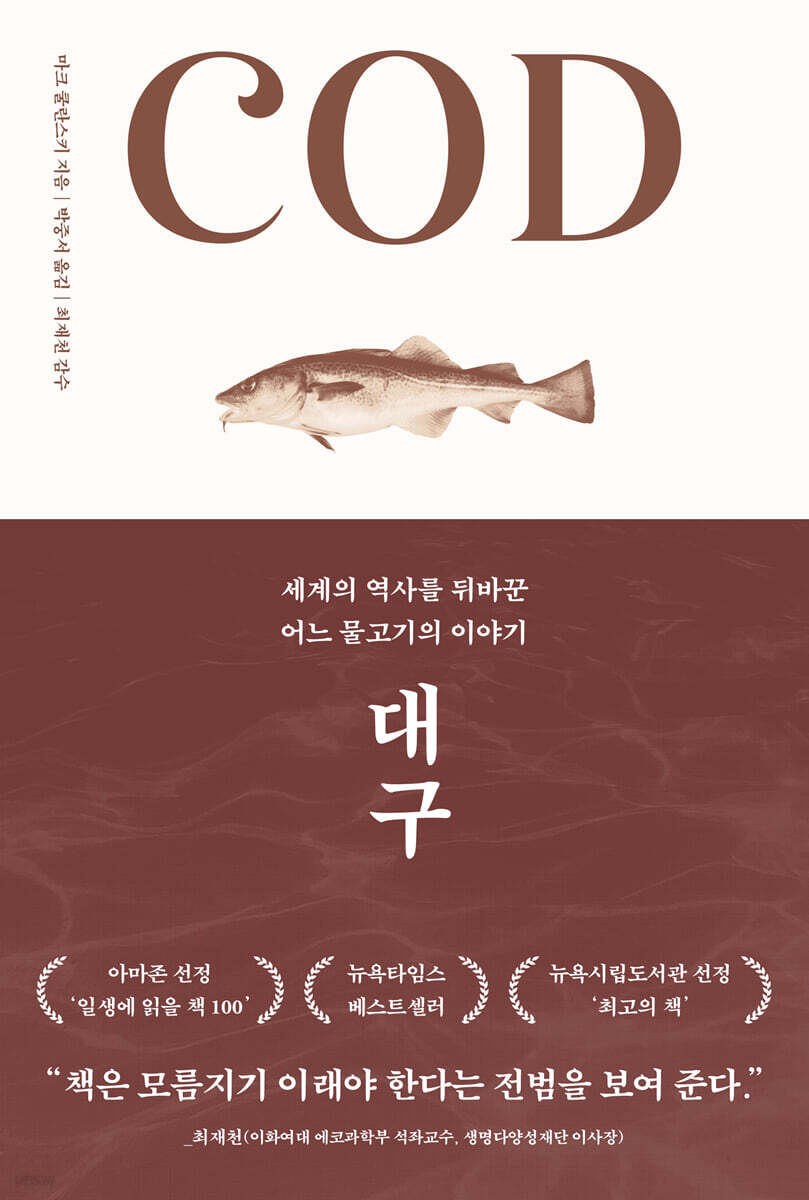
*Amazon's "100 Books to Read in Your Lifetime" *New York Times bestseller *Selected as a 'Best Book' by the New York Public Library Mark Kurlansky's masterpiece, Daegu, which established him as one of today's leading historical writers, is being republished with a new cover and the added supervision of Professor Jae-Cheon Choi of Ewha Womans University. This book is a masterpiece completed by Mark Kurlansky, who comes from a fishing family and has worked on cod fishing boats, after seven years of close coverage and research on cod as the Caribbean correspondent for the Chicago Tribune. Its value has been clearly recognized, including being named a New York Times bestseller, Amazon's "100 Books to Read in a Lifetime," and the New York Public Library's "Best Books." Through the fish called cod, it vividly covers human life, culture, history, and environmental issues from prehistoric times to the present with the cool perspective of a journalist. Let's enjoy the waves of world history that cod has created amidst the march of humanity, such as the Vikings' adventures across the rough seas, the birth of the New England nobility, the American Revolution, and the Cod Wars. |
- You can preview some of the book's contents.
Preview
index
Praise poured in for this book
Reviewer's note
A Timeline of World History Through Daegu
Prologue: The Watchman of the Protrusion (closest to Ireland)
Part 1: The Story of a Fish
In search of the land where Daegu is
With my mouth wide open
Daegu fever
1620: Rocks and Cod
certain inalienable rights
Cod Wars Around the World
Part 2 Limits
New ideas and 9 million eggs
Last two ideas
Finite universe discovered in Iceland
Three wars that closed the high seas
Part 3: The Last Hunters
Requiem for the Grand Banks
Risk levels in nature's resilience
Stop the Spanish fleet
Blocking the Canadian fleet
[Appendix] A Chef's Tale: Various Cod Recipes Over Six Centuries
The right way to wash cod
The sad news spread through Walden Pond
scrap parts
Chowder
The diaspora of West Indian processed goods
France's excellent camouflage
Wanja
Brandad
Cod speaking Basque
Recipe for the last big cod caught
Acknowledgements
Translator's Note
References
Reviewer's note
A Timeline of World History Through Daegu
Prologue: The Watchman of the Protrusion (closest to Ireland)
Part 1: The Story of a Fish
In search of the land where Daegu is
With my mouth wide open
Daegu fever
1620: Rocks and Cod
certain inalienable rights
Cod Wars Around the World
Part 2 Limits
New ideas and 9 million eggs
Last two ideas
Finite universe discovered in Iceland
Three wars that closed the high seas
Part 3: The Last Hunters
Requiem for the Grand Banks
Risk levels in nature's resilience
Stop the Spanish fleet
Blocking the Canadian fleet
[Appendix] A Chef's Tale: Various Cod Recipes Over Six Centuries
The right way to wash cod
The sad news spread through Walden Pond
scrap parts
Chowder
The diaspora of West Indian processed goods
France's excellent camouflage
Wanja
Brandad
Cod speaking Basque
Recipe for the last big cod caught
Acknowledgements
Translator's Note
References
Detailed image

Into the book
Despite limiting the amount of cod sold to 10 pounds per person, there wasn't enough that day.
In the end, some people had to turn back without being able to buy fish.
Someone asked the fisherman:
“Where on earth have all the fish gone?” The problem for the people of Petty Harbor, nestled on the tip of North America, was that they were at the very end of a millennium-long, thriving fishery.
---From the "Prologue"
British and Icelandic fishermen only reluctantly catch haddock after they have reached their cod quota.
Because between the two, Daegu always gets a better price.
However, Icelanders prefer haddock as their preferred fish and rarely eat cod except in dried form.
When asked why, Reykjavik-based chef Ulfar Eysteinsson said:
“We don’t eat money.”
---From "Part 1: The Story of a Fish"
By the 18th century, cod had elevated New England, once a distant colony of starving settlers, into an international commercial power.
Moreover, cod has been elevated from a mere commodity to an object of worship in Massachusetts.
In the 17th century, those who had amassed their wealth through the cod fishing industry were called "cod nobles," and members of these families openly worshipped the fish as a symbol of wealth.
---From "Part 1: The Story of a Fish"
So, is there really a limit to the catch? Is nature truly inexhaustible, as 19th-century folk believed? Fishermen are starting to worry.
By 1949, the International Northwest Atlantic Fisheries Commission was formed to find ways to regulate overfishing.
But technology continues to focus on the goal of catching more fish.
The vessel was extended to over 450 feet (about 130 meters) in length, had a displacement of over 4,000 tons, and was equipped with two diesel engines capable of producing over 6,000 horsepower, enabling it to pull a trawl net with an opening large enough to accommodate even a jumbo jet.
---From "Limitations of Part 2"
Ralph Mayo, a marine biologist with the National Marine Fisheries Service who studied George's Bank at the research facility in Woods Hole, Massachusetts, called it "a perception problem."
“We found a few cod, but we assumed they were just the tip of the iceberg.
But the truth is, the entire iceberg may be just those few pieces.”
---From "Limitations of Part 2"
Marine ecology is complex and closely interconnected.
In the North Sea, large fishing vessels overfished shad and other small fish (which in Denmark were ground up and used as heating fuel), causing starvation not only of cod but also of seabirds.
In 1986, seal colonies were established in several areas of the southern North Sea, preying on coastal fish off the coast of Norway, as overfishing of capelin left them with little food.
---From "Part 3, The Last Hunters"
Each vessel was limited to 139 days of seabed fishing each year.
Such measures could be aimed at ensuring that only 15 percent of the fish stocks are caught each year.
But a 1996 calculation showed that during the 139 fishing days each year, fishermen caught a whopping 55 percent of the fish stocks.
As a result, the number of days available for operation was further limited to 88 days.
In the end, some people had to turn back without being able to buy fish.
Someone asked the fisherman:
“Where on earth have all the fish gone?” The problem for the people of Petty Harbor, nestled on the tip of North America, was that they were at the very end of a millennium-long, thriving fishery.
---From the "Prologue"
British and Icelandic fishermen only reluctantly catch haddock after they have reached their cod quota.
Because between the two, Daegu always gets a better price.
However, Icelanders prefer haddock as their preferred fish and rarely eat cod except in dried form.
When asked why, Reykjavik-based chef Ulfar Eysteinsson said:
“We don’t eat money.”
---From "Part 1: The Story of a Fish"
By the 18th century, cod had elevated New England, once a distant colony of starving settlers, into an international commercial power.
Moreover, cod has been elevated from a mere commodity to an object of worship in Massachusetts.
In the 17th century, those who had amassed their wealth through the cod fishing industry were called "cod nobles," and members of these families openly worshipped the fish as a symbol of wealth.
---From "Part 1: The Story of a Fish"
So, is there really a limit to the catch? Is nature truly inexhaustible, as 19th-century folk believed? Fishermen are starting to worry.
By 1949, the International Northwest Atlantic Fisheries Commission was formed to find ways to regulate overfishing.
But technology continues to focus on the goal of catching more fish.
The vessel was extended to over 450 feet (about 130 meters) in length, had a displacement of over 4,000 tons, and was equipped with two diesel engines capable of producing over 6,000 horsepower, enabling it to pull a trawl net with an opening large enough to accommodate even a jumbo jet.
---From "Limitations of Part 2"
Ralph Mayo, a marine biologist with the National Marine Fisheries Service who studied George's Bank at the research facility in Woods Hole, Massachusetts, called it "a perception problem."
“We found a few cod, but we assumed they were just the tip of the iceberg.
But the truth is, the entire iceberg may be just those few pieces.”
---From "Limitations of Part 2"
Marine ecology is complex and closely interconnected.
In the North Sea, large fishing vessels overfished shad and other small fish (which in Denmark were ground up and used as heating fuel), causing starvation not only of cod but also of seabirds.
In 1986, seal colonies were established in several areas of the southern North Sea, preying on coastal fish off the coast of Norway, as overfishing of capelin left them with little food.
---From "Part 3, The Last Hunters"
Each vessel was limited to 139 days of seabed fishing each year.
Such measures could be aimed at ensuring that only 15 percent of the fish stocks are caught each year.
But a 1996 calculation showed that during the 139 fishing days each year, fishermen caught a whopping 55 percent of the fish stocks.
As a result, the number of days available for operation was further limited to 88 days.
---From "Part 3, The Last Hunters"
Publisher's Review
Viking adventures, cod nobles, cod wars…
The historical vortex caused by Daegu
This book unfolds along the course of world history from the 8th century, when the Viking Migration took place, to the present day.
By drying cod and using it as food, the Vikings were able to sail long distances and reach the Americas 500 years before Columbus.
The Puritans who fled religious persecution in England and crossed the sea were able to settle in North America because they caught and traded cod.
The power that allowed black slaves to endure the harsh labor of 16 hours a day was also found in salted cod.
Cod, which is large and prolific compared to other fish, became popular as a food ingredient among Europeans because its entire body, from head to roe, stomach, liver, and skin, was used for food.
Naturally, competition among European countries surrounding cod intensified, and the fierce conflict over cod fishing led to war, clearly demonstrating cod's presence in world history.
The restrictions on cod trade imposed by Britain in its New England colonies in the 1700s were the starting point of the American Revolutionary War.
As the number of cod in the Atlantic Ocean decreased due to the development of fishing technology caused by the Industrial Revolution, Iceland and the United Kingdom eventually fought three "Cod Wars" over cod fishing rights in the waters around Iceland.
This war led to countries around the world declaring 200-nautical-mile exclusive economic zones.
Daegu has endlessly influenced the course of humanity.
This is why former director of the National Science Museum in Gwacheon, Lee Jeong-mo, said, “Daegu is a link that connects the world.”
A sharp report on the boundless greed of mankind.
A wake-up call to the reality of climate crisis and resource depletion.
"Daegu" is not just the story of Daegu, which emerged in the flow of history, but also contains a warning message to humanity that ruthlessly covets the gifts of nature.
Cod, a fish species so important to human history that it is called the bread of the sea, is also a symbol of the destruction of fish resources.
Scientists in the 19th century argued that unlimited fishing of cod was acceptable, based on the cod's ability to lay millions of eggs. However, indiscriminate overfishing led to a decline in catch from 1.3 million tons in the 1940s to 200,000 tons in the 1990s, putting the fish on the brink of extinction.
Finally, in 1992, a ban on cod fishing was imposed on the Grand Banks fishing grounds, once considered one of the world's four largest fishing grounds.
The author emphasizes the importance of preserving the environment, which is being destroyed by human greed, and says that the story of nature will unfold depending on humanity's response.
As the New York Times called it “a new tool for illuminating world history,” and the Financial Times said it was “a celebration of nature’s gifts while also warning of what humanity stands to lose if it treats them rudely,” the value of this book should increase with each passing year.
As we face the challenges of climate crisis and resource depletion, we need to read this book again.
How Humans Cooked Cod
A World History Encyclopedia to See, Taste, and Savor
Kurlansky, who is also renowned as a 'humanist of gastronomy,' does not miss introducing various cod recipes from the Middle Ages to the present in this book.
At the end of each chapter, and in the appendix, he examines extensive literature from countless countries, including the United States, France, Italy, Spain, Brazil, Jamaica, and Puerto Rico, to present fascinating recipes for codfish prepared over the past six centuries.
The book is full of unique dishes whose names alone are hard to guess the taste of, such as ‘Fried Cod Head with Lips Removed’ and ‘Stuffed Cod Roe Dish.’
In addition, interesting origins related to cooking, such as how fish and chips became established as a representative British dish, serve as a licorice for understanding the lifestyle of the time.
The reason why "Daegu" won the James Beard Award, which is given only to famous food-related books, is because it is an unprecedented book that condenses a variety of Daegu recipes into one volume.
It is also a passage where we can see the true nature of Kurlansky, who is renowned for his writings based on thorough data collection.
This book, which allows us to observe the flow of world history through Daegu, savor the cultural life of the time, and ponder the future direction of humanity, is a veritable encyclopedia of world history.
The historical vortex caused by Daegu
This book unfolds along the course of world history from the 8th century, when the Viking Migration took place, to the present day.
By drying cod and using it as food, the Vikings were able to sail long distances and reach the Americas 500 years before Columbus.
The Puritans who fled religious persecution in England and crossed the sea were able to settle in North America because they caught and traded cod.
The power that allowed black slaves to endure the harsh labor of 16 hours a day was also found in salted cod.
Cod, which is large and prolific compared to other fish, became popular as a food ingredient among Europeans because its entire body, from head to roe, stomach, liver, and skin, was used for food.
Naturally, competition among European countries surrounding cod intensified, and the fierce conflict over cod fishing led to war, clearly demonstrating cod's presence in world history.
The restrictions on cod trade imposed by Britain in its New England colonies in the 1700s were the starting point of the American Revolutionary War.
As the number of cod in the Atlantic Ocean decreased due to the development of fishing technology caused by the Industrial Revolution, Iceland and the United Kingdom eventually fought three "Cod Wars" over cod fishing rights in the waters around Iceland.
This war led to countries around the world declaring 200-nautical-mile exclusive economic zones.
Daegu has endlessly influenced the course of humanity.
This is why former director of the National Science Museum in Gwacheon, Lee Jeong-mo, said, “Daegu is a link that connects the world.”
A sharp report on the boundless greed of mankind.
A wake-up call to the reality of climate crisis and resource depletion.
"Daegu" is not just the story of Daegu, which emerged in the flow of history, but also contains a warning message to humanity that ruthlessly covets the gifts of nature.
Cod, a fish species so important to human history that it is called the bread of the sea, is also a symbol of the destruction of fish resources.
Scientists in the 19th century argued that unlimited fishing of cod was acceptable, based on the cod's ability to lay millions of eggs. However, indiscriminate overfishing led to a decline in catch from 1.3 million tons in the 1940s to 200,000 tons in the 1990s, putting the fish on the brink of extinction.
Finally, in 1992, a ban on cod fishing was imposed on the Grand Banks fishing grounds, once considered one of the world's four largest fishing grounds.
The author emphasizes the importance of preserving the environment, which is being destroyed by human greed, and says that the story of nature will unfold depending on humanity's response.
As the New York Times called it “a new tool for illuminating world history,” and the Financial Times said it was “a celebration of nature’s gifts while also warning of what humanity stands to lose if it treats them rudely,” the value of this book should increase with each passing year.
As we face the challenges of climate crisis and resource depletion, we need to read this book again.
How Humans Cooked Cod
A World History Encyclopedia to See, Taste, and Savor
Kurlansky, who is also renowned as a 'humanist of gastronomy,' does not miss introducing various cod recipes from the Middle Ages to the present in this book.
At the end of each chapter, and in the appendix, he examines extensive literature from countless countries, including the United States, France, Italy, Spain, Brazil, Jamaica, and Puerto Rico, to present fascinating recipes for codfish prepared over the past six centuries.
The book is full of unique dishes whose names alone are hard to guess the taste of, such as ‘Fried Cod Head with Lips Removed’ and ‘Stuffed Cod Roe Dish.’
In addition, interesting origins related to cooking, such as how fish and chips became established as a representative British dish, serve as a licorice for understanding the lifestyle of the time.
The reason why "Daegu" won the James Beard Award, which is given only to famous food-related books, is because it is an unprecedented book that condenses a variety of Daegu recipes into one volume.
It is also a passage where we can see the true nature of Kurlansky, who is renowned for his writings based on thorough data collection.
This book, which allows us to observe the flow of world history through Daegu, savor the cultural life of the time, and ponder the future direction of humanity, is a veritable encyclopedia of world history.
GOODS SPECIFICS
- Date of issue: December 20, 2024
- Page count, weight, size: 380 pages | 530g | 147*215*24mm
- ISBN13: 9788925574202
- ISBN10: 8925574209
You may also like
카테고리
korean


korean

![ELLE 엘르 스페셜 에디션 A형 : 12월 [2025]](http://librairie.coreenne.fr/cdn/shop/files/b8e27a3de6c9538896439686c6b0e8fb.jpg?v=1766436872&width=3840)


