

Strange Night
 |
Description
Book Introduction
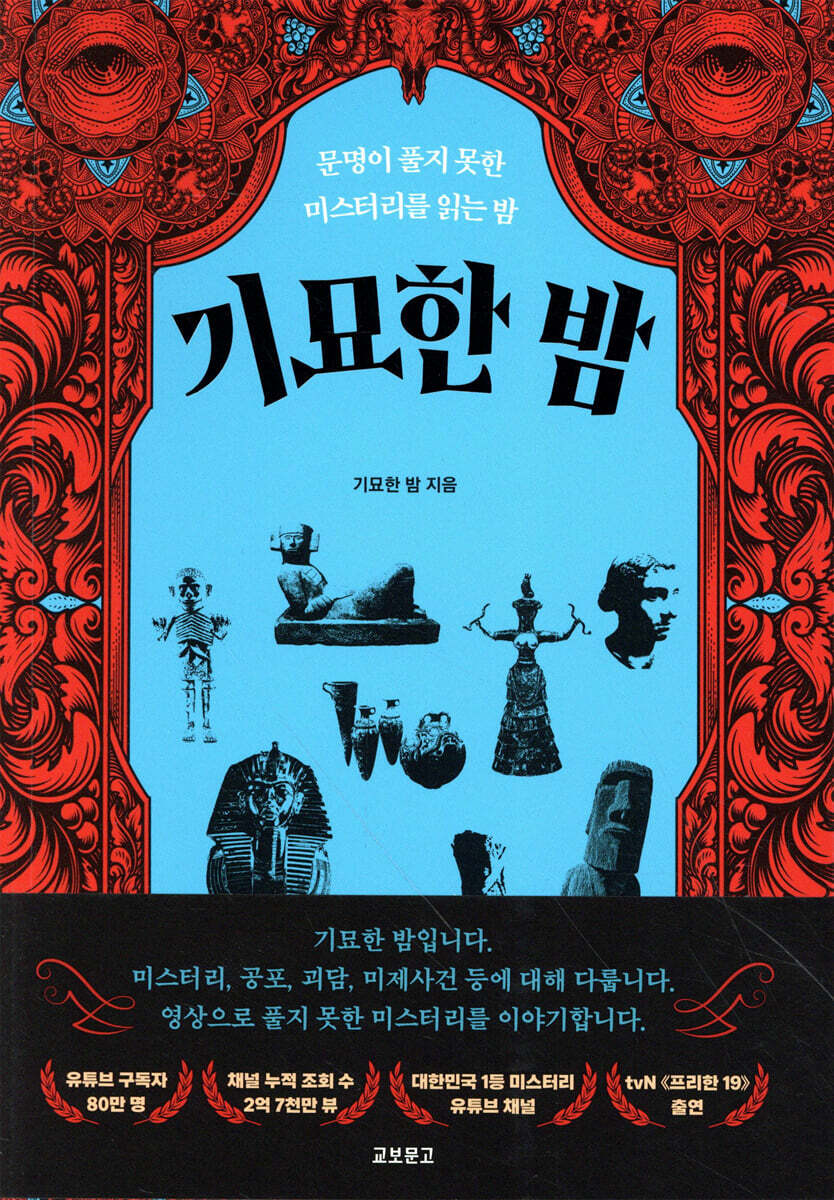
*** The first book of Korea's #1 mystery YouTube channel, 'Strange Night'
*** Contains only the essence of a channel with 750,000 subscribers and 250 million cumulative views.
*** The surprising discovery that will change the course of human history, and the hidden stories behind it.
“The more you know, the more mysterious the history of mankind becomes.
Secrets that may have existed since 3000 BC, or even earlier!”
The fragmented puzzle of history: questions science cannot solve.
Unraveling the mysteries that civilization has not been able to solve!
The popular videos of the #1 mystery channel in Korea, Strange Night, which boasts 750,000 YouTube subscribers and 250 million cumulative channel views, have been published as a book.
It contains a selection of historical mysteries from the most ancient civilizations before ancient Egypt to the present day.
This is something only a strange night can handle.
I am confident that the mysteries that we see by squeezing into the narrow gaps of history, hypothesis, conspiracy, and speculation will be more diverse than expected.
The book's unique appeal is enhanced by including a wealth of behind-the-scenes stories that could not be included in the video due to length and other circumstances.
『Strange Night』 was composed with popular elements in mind first and foremost in order to reach a wider audience.
The Seven Wonders of the World, Egyptian civilization, and Atlantis are names that everyone has heard of at least once.
But jumping to conclusions is forbidden.
This is because the content in the book is quite different from what is commonly known.
For example, in the case of Angkor Wat, which was built in present-day Cambodia in the 12th century and became known worldwide in the 19th century through the French explorer Henri Mouhot, the book includes stories of Mouhot's adventures and the wonders of his construction, as well as stories of dinosaur reliefs discovered there.
And that's not all.
It is even more interesting with recent issues such as Göbekli Tepe and Ciudad Blanca.
This is a book that anyone interested in the secrets hidden by history will enjoy.
*** Contains only the essence of a channel with 750,000 subscribers and 250 million cumulative views.
*** The surprising discovery that will change the course of human history, and the hidden stories behind it.
“The more you know, the more mysterious the history of mankind becomes.
Secrets that may have existed since 3000 BC, or even earlier!”
The fragmented puzzle of history: questions science cannot solve.
Unraveling the mysteries that civilization has not been able to solve!
The popular videos of the #1 mystery channel in Korea, Strange Night, which boasts 750,000 YouTube subscribers and 250 million cumulative channel views, have been published as a book.
It contains a selection of historical mysteries from the most ancient civilizations before ancient Egypt to the present day.
This is something only a strange night can handle.
I am confident that the mysteries that we see by squeezing into the narrow gaps of history, hypothesis, conspiracy, and speculation will be more diverse than expected.
The book's unique appeal is enhanced by including a wealth of behind-the-scenes stories that could not be included in the video due to length and other circumstances.
『Strange Night』 was composed with popular elements in mind first and foremost in order to reach a wider audience.
The Seven Wonders of the World, Egyptian civilization, and Atlantis are names that everyone has heard of at least once.
But jumping to conclusions is forbidden.
This is because the content in the book is quite different from what is commonly known.
For example, in the case of Angkor Wat, which was built in present-day Cambodia in the 12th century and became known worldwide in the 19th century through the French explorer Henri Mouhot, the book includes stories of Mouhot's adventures and the wonders of his construction, as well as stories of dinosaur reliefs discovered there.
And that's not all.
It is even more interesting with recent issues such as Göbekli Tepe and Ciudad Blanca.
This is a book that anyone interested in the secrets hidden by history will enjoy.
- You can preview some of the book's contents.
Preview
index
Introduction
Chapter 1: Philo's Seven Landscapes
1 Statue of Zeus - A statue that embodies the dignity of the supreme god
2 Colossus of Rhodes - Greek bronze giant
3 Temple of Artemis - The temple built three times and destroyed three times
4 The Lighthouse of Alexandria - A Lighthouse That Lived Forever in Language
5 Mausoleum - A beautiful and massive tomb
· The Top 5 Mysteries Selected by Strange Night
Chapter 2: Wonders of the World
1. Mausoleum of the First Qin Emperor - The Secret Hidden in the Emperor's Tomb
2 Moai - The Truth Only the Statues Know
3 Machu Picchu - The Mystery of the Ancient Incas
4 Chichen Itza - The Maya, a civilization built on skulls
5 Angkor Wat - The City of the Gods Discovered in the Jungle
· The Top 5 Mysteries Selected by Strange Night
Chapter 3: Traces of Mystery in the Ancient City
1 Göbekli Tepe - a city built 12,000 years ago
2 Punt - the city of the gods in Egyptian mythology
3 Ciudad Blanca - A white city in the dense jungle
4 Heracleion - The city that slept beneath the primordial sea
5. Jerzurah - A city buried in the Sahara Desert
· The Top 5 Mysteries Selected by Strange Night
Chapter 4: In Search of the Lost Continent of Atlantis
1 Atlantis - The Beginning of the Lost Continent
2 Candidate Site of Atlantis - Towards the Unknown Land
3 Survivors of Atlantis - Those Who Inherited the Blood of the Gods
· The Top 5 Mysteries Selected by Strange Night
Chapter 5: The Origin of Mystery: Ancient Egypt
1 Secret Room - Treasure Hidden in the Pyramid
2 Black Pyramid - The Fourth Pyramid Lost
3 The Pyramid of Baca - The Unfinished Dream of the Pharaoh
4 Akhenaten - the only pharaoh who worshipped one god
5 Cleopatra - The Last Pharaoh, the First Femme Fatale
· The Top 5 Mysteries Selected by Strange Night
reference book
Reference Link
Chapter 1: Philo's Seven Landscapes
1 Statue of Zeus - A statue that embodies the dignity of the supreme god
2 Colossus of Rhodes - Greek bronze giant
3 Temple of Artemis - The temple built three times and destroyed three times
4 The Lighthouse of Alexandria - A Lighthouse That Lived Forever in Language
5 Mausoleum - A beautiful and massive tomb
· The Top 5 Mysteries Selected by Strange Night
Chapter 2: Wonders of the World
1. Mausoleum of the First Qin Emperor - The Secret Hidden in the Emperor's Tomb
2 Moai - The Truth Only the Statues Know
3 Machu Picchu - The Mystery of the Ancient Incas
4 Chichen Itza - The Maya, a civilization built on skulls
5 Angkor Wat - The City of the Gods Discovered in the Jungle
· The Top 5 Mysteries Selected by Strange Night
Chapter 3: Traces of Mystery in the Ancient City
1 Göbekli Tepe - a city built 12,000 years ago
2 Punt - the city of the gods in Egyptian mythology
3 Ciudad Blanca - A white city in the dense jungle
4 Heracleion - The city that slept beneath the primordial sea
5. Jerzurah - A city buried in the Sahara Desert
· The Top 5 Mysteries Selected by Strange Night
Chapter 4: In Search of the Lost Continent of Atlantis
1 Atlantis - The Beginning of the Lost Continent
2 Candidate Site of Atlantis - Towards the Unknown Land
3 Survivors of Atlantis - Those Who Inherited the Blood of the Gods
· The Top 5 Mysteries Selected by Strange Night
Chapter 5: The Origin of Mystery: Ancient Egypt
1 Secret Room - Treasure Hidden in the Pyramid
2 Black Pyramid - The Fourth Pyramid Lost
3 The Pyramid of Baca - The Unfinished Dream of the Pharaoh
4 Akhenaten - the only pharaoh who worshipped one god
5 Cleopatra - The Last Pharaoh, the First Femme Fatale
· The Top 5 Mysteries Selected by Strange Night
reference book
Reference Link
Detailed image
Into the book
The reason the Colossus of Rhodes is thought to have spread its legs is because in an artist's conception by the 16th-century Dutch painter Martin Heemskerck, Helios is depicted standing with his legs spread.
But since this is only a prediction, there are of course some scenes where the legs are together.
In other words, nothing is certain.
Fortunately, we can get a rough idea of its appearance through ancient documents and coins from Rhodes.
The statue is said to have had curly hair that glowed golden and was posed as if shielding its eyes from the sun.
Uniquely, people could climb on top of Helios's head, which also served as a lighthouse to watch over ports and islands from enemies.
---From "Chapter 1: Philo's Seven Great Landscapes - The Colossus of Rhodes"
El Castillo is also famous for a strange phenomenon observed at certain times of the year.
At this time of year, when the sun rises, you can see a shadow that looks exactly like a snake slithering down the northern stairs.
It was the result of architects at the time mathematically and meticulously calculating the shadows created according to the layout of the building and the position of the sun.
For the Mayans, the snake god Kukulkan, represented as an image (shadow), served as a divine message announcing the beginning and end of the agricultural season.
What's interesting is that the areas that the Mayan civilization placed the most importance on and focused its efforts on were areas that didn't require any knowledge of astronomy or mathematics.
It was a 'sacrificial' culture.
They are famous for their practice of human sacrifice, in which living people are offered as sacrifices to honor the gods and appease angry gods.
---From "Chapter 2 Wonders of the World - Chichen Itza"
Archaeologists excavating Göbekli Tepe found another strange thing.
Unlike other historical sites, it was discovered that the soil was not covered by natural disasters or sedimentation, but rather that someone intentionally covered it with soil.
Because the site was so well preserved without any noticeable damage, scholars have speculated that someone covered Göbekli Tepe with dirt to hide or protect it.
If so, a new question arises.
Who would want to hide this massive temple? Why did he bury it underground? Excavations were temporarily halted due to the pandemic, and only 1 percent of the 60,000-square-meter site has been excavated. Yet, astonishing discoveries are continually being uncovered.
---From "Chapter 3: Traces of Mystery in the Ancient City - Göbekli Tepe"
Since the death of Mod, Ciudad Blanca has become legendary again.
Even the wealthy dismissed the white city in the Honduran jungle as a fairy tale, saying, “Morde took his own life when his lies became too much to bear.”
Still, rumors about Ciudad Blanca did not go away.
Mosquitia was a vast expanse of untouched jungle, and it was thought that at least hundreds of ruins were hidden within it.
The indigenous people who lived in the jungle also mentioned the legend of the 'lost city of the monkey god', so attempts to find Ciudad Blanca continued.
---From "Chapter 3: Traces of Mystery in the Ancient City - Ciudad Blanca"
The subsequent carbon dating results were enough to shock the archaeological community.
Harappa, the center of the Indus Valley Civilization, was a thriving city around 2500 BC, so the research team expected the Cambay Bay site to show similar dating.
But the results were far beyond our expectations.
This is because the artifacts discovered at the Kambei Bay ruins were found to date back to 7500 BC.
It was a full 5,000 years ahead of expectations.
The amount of time is not the issue.
The accepted theory in the archaeological world is that the oldest urban civilization in history was the Sumerian civilization around 5000 BC.
This means that a civilization existed 2,500 years before this.
---From "Chapter 4: In Search of the Lost Continent of Atlantis - Candidate Sites for Atlantis"
The three pyramids in Giza are representative relics of Egypt, built before the Common Era and still standing today.
There is a strange backstory related to this.
The fact is that there were 'four' pyramids, not 'three', on the Giza Plateau.
---From "Chapter 5: The Source of Mystery: Ancient Egypt - The Black Pyramid"
The name of the tenth king of the 18th Dynasty of Egypt, who lived in the 14th century BC, is Akhenaten.
His wife is Nefertiti, the representative beauty of Egypt, and his son is Tutankhamun, the boy king famous for wearing a golden mask.
Akhenaten is a pharaoh with a long backstory.
He is a mysterious figure who ruled the country for over 20 years, but all records after his death were erased.
At the same time, the protagonist is embroiled in suspicions about the 'Pharaoh Alien Theory'.
But since this is only a prediction, there are of course some scenes where the legs are together.
In other words, nothing is certain.
Fortunately, we can get a rough idea of its appearance through ancient documents and coins from Rhodes.
The statue is said to have had curly hair that glowed golden and was posed as if shielding its eyes from the sun.
Uniquely, people could climb on top of Helios's head, which also served as a lighthouse to watch over ports and islands from enemies.
---From "Chapter 1: Philo's Seven Great Landscapes - The Colossus of Rhodes"
El Castillo is also famous for a strange phenomenon observed at certain times of the year.
At this time of year, when the sun rises, you can see a shadow that looks exactly like a snake slithering down the northern stairs.
It was the result of architects at the time mathematically and meticulously calculating the shadows created according to the layout of the building and the position of the sun.
For the Mayans, the snake god Kukulkan, represented as an image (shadow), served as a divine message announcing the beginning and end of the agricultural season.
What's interesting is that the areas that the Mayan civilization placed the most importance on and focused its efforts on were areas that didn't require any knowledge of astronomy or mathematics.
It was a 'sacrificial' culture.
They are famous for their practice of human sacrifice, in which living people are offered as sacrifices to honor the gods and appease angry gods.
---From "Chapter 2 Wonders of the World - Chichen Itza"
Archaeologists excavating Göbekli Tepe found another strange thing.
Unlike other historical sites, it was discovered that the soil was not covered by natural disasters or sedimentation, but rather that someone intentionally covered it with soil.
Because the site was so well preserved without any noticeable damage, scholars have speculated that someone covered Göbekli Tepe with dirt to hide or protect it.
If so, a new question arises.
Who would want to hide this massive temple? Why did he bury it underground? Excavations were temporarily halted due to the pandemic, and only 1 percent of the 60,000-square-meter site has been excavated. Yet, astonishing discoveries are continually being uncovered.
---From "Chapter 3: Traces of Mystery in the Ancient City - Göbekli Tepe"
Since the death of Mod, Ciudad Blanca has become legendary again.
Even the wealthy dismissed the white city in the Honduran jungle as a fairy tale, saying, “Morde took his own life when his lies became too much to bear.”
Still, rumors about Ciudad Blanca did not go away.
Mosquitia was a vast expanse of untouched jungle, and it was thought that at least hundreds of ruins were hidden within it.
The indigenous people who lived in the jungle also mentioned the legend of the 'lost city of the monkey god', so attempts to find Ciudad Blanca continued.
---From "Chapter 3: Traces of Mystery in the Ancient City - Ciudad Blanca"
The subsequent carbon dating results were enough to shock the archaeological community.
Harappa, the center of the Indus Valley Civilization, was a thriving city around 2500 BC, so the research team expected the Cambay Bay site to show similar dating.
But the results were far beyond our expectations.
This is because the artifacts discovered at the Kambei Bay ruins were found to date back to 7500 BC.
It was a full 5,000 years ahead of expectations.
The amount of time is not the issue.
The accepted theory in the archaeological world is that the oldest urban civilization in history was the Sumerian civilization around 5000 BC.
This means that a civilization existed 2,500 years before this.
---From "Chapter 4: In Search of the Lost Continent of Atlantis - Candidate Sites for Atlantis"
The three pyramids in Giza are representative relics of Egypt, built before the Common Era and still standing today.
There is a strange backstory related to this.
The fact is that there were 'four' pyramids, not 'three', on the Giza Plateau.
---From "Chapter 5: The Source of Mystery: Ancient Egypt - The Black Pyramid"
The name of the tenth king of the 18th Dynasty of Egypt, who lived in the 14th century BC, is Akhenaten.
His wife is Nefertiti, the representative beauty of Egypt, and his son is Tutankhamun, the boy king famous for wearing a golden mask.
Akhenaten is a pharaoh with a long backstory.
He is a mysterious figure who ruled the country for over 20 years, but all records after his death were erased.
At the same time, the protagonist is embroiled in suspicions about the 'Pharaoh Alien Theory'.
---From "Chapter 5: The Source of Mystery: Ancient Egypt - The Pyramid of Bacca"
Publisher's Review
Forget the history you learned in school
Stories that shake up stereotypes about history
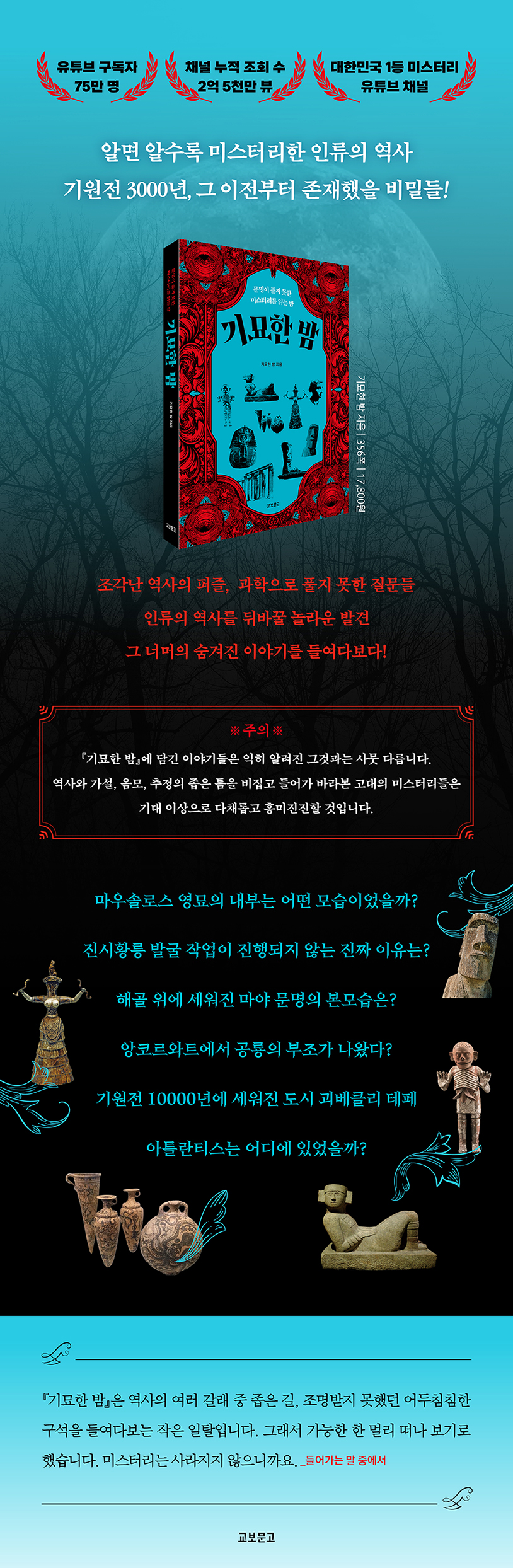
What did the interior of Mausoleum of Mausoleum look like? Why hasn't excavation of the Qin Shi Huang's tomb progressed? What was the true face of the Mayan civilization built atop skeletons? Did a fourth pyramid at Giza even exist? And more.
There are many unsolved mysteries in the long history of mankind.
Among these, some took a long time to be recognized as established theories, while others remain unsolved even by modern science.
In fact, there have been countless instances where the hands of history have been adjusted through newly discovered artifacts and evidence.
The strange night focuses here.
"Strange Night" was created based on the most interesting and well-received content among the over 600 videos posted by Strange Night so far.
Here, we've added backstory, rich illustrations, and historical stories not covered in the video.
This book will captivate both those who are new to historical mysteries and those who have already seen the film.
The author encourages us to step back a little from stereotypes and established beliefs to enjoy the book more.
"Strange Night" has both feet firmly planted in history, yet embraces a wide range of possibilities.
Because when curiosity disappears, exploration stops.
Beginning with the most ancient civilizations beyond Ancient Egypt
An expedition to uncover the secrets of history
"Strange Night" is composed of five chapters.
Chapter 1, 'The Seven Landscapes of Philo', introduces the ancient structures that were the origin of the 'O Wonders of the World' and first led us into the world of mystery.
Six of these are now lost, and although they are largely assigned from a Greek perspective and thus show a bias, they still remain influential for the majority of those initially interested in mystery, and cannot be overlooked.
Chapter 2, "Wonders of the World," explores mysteries that science has yet to unravel, such as the pyramids of Egypt, the moai of Easter Island, and the Great Wall of China.
However, it focuses on stories that have been rediscovered in modern times and unresolved questions, rather than those recorded in history.
Chapter 3, 'Traces of Mystery in Ancient Cities,' looks into the cities that lie behind the history of forgotten civilizations.
Just the names alone make your heart race, from Göbekli Tepe, built over 10,000 years ago, to Heracleion, named after the Greek mythological hero Hercules.
Chapter 4, 'In Search of the Lost Continent of Atlantis,' delves into all the mysteries surrounding Atlantis, which have long captivated our imagination.
We explore this from various angles and explore why this legendary continent lives vividly in the hearts of so many to this day.
Chapter 5, 'The Origin of Mystery: Ancient Egypt', features Egypt, a country full of stories and a treasure trove of mysterious civilization.
There are still many unanswered questions about the brilliant cities and culture that the ancient Egyptians achieved and enjoyed.
From the mystery surrounding the construction of the pyramids, which is added every year, to the suspicions surrounding King Akhenaten, who rejected polytheism and worshipped a single god, to the poisoning of Cleopatra, known as the last pharaoh, we unravel layer by layer of secrets that never get old.
The abundant illustrations and various materials add to the viewing pleasure, and we have also organized the contents of the strange night that are good to view together.
And the top 5 mysteries selected by the production team of Strange Night offer a different kind of enjoyment than the book itself.
The author says:
“This book is a small digression, a glimpse into the narrow paths and dark corners of history that have not been illuminated.
So I decided to go as far away as possible.
You can get off anywhere along the way during your adventure to ancient times.
Because the mystery never goes away.”
Stories that shake up stereotypes about history
What did the interior of Mausoleum of Mausoleum look like? Why hasn't excavation of the Qin Shi Huang's tomb progressed? What was the true face of the Mayan civilization built atop skeletons? Did a fourth pyramid at Giza even exist? And more.
There are many unsolved mysteries in the long history of mankind.
Among these, some took a long time to be recognized as established theories, while others remain unsolved even by modern science.
In fact, there have been countless instances where the hands of history have been adjusted through newly discovered artifacts and evidence.
The strange night focuses here.
"Strange Night" was created based on the most interesting and well-received content among the over 600 videos posted by Strange Night so far.
Here, we've added backstory, rich illustrations, and historical stories not covered in the video.
This book will captivate both those who are new to historical mysteries and those who have already seen the film.
The author encourages us to step back a little from stereotypes and established beliefs to enjoy the book more.
"Strange Night" has both feet firmly planted in history, yet embraces a wide range of possibilities.
Because when curiosity disappears, exploration stops.
Beginning with the most ancient civilizations beyond Ancient Egypt
An expedition to uncover the secrets of history
"Strange Night" is composed of five chapters.
Chapter 1, 'The Seven Landscapes of Philo', introduces the ancient structures that were the origin of the 'O Wonders of the World' and first led us into the world of mystery.
Six of these are now lost, and although they are largely assigned from a Greek perspective and thus show a bias, they still remain influential for the majority of those initially interested in mystery, and cannot be overlooked.
Chapter 2, "Wonders of the World," explores mysteries that science has yet to unravel, such as the pyramids of Egypt, the moai of Easter Island, and the Great Wall of China.
However, it focuses on stories that have been rediscovered in modern times and unresolved questions, rather than those recorded in history.
Chapter 3, 'Traces of Mystery in Ancient Cities,' looks into the cities that lie behind the history of forgotten civilizations.
Just the names alone make your heart race, from Göbekli Tepe, built over 10,000 years ago, to Heracleion, named after the Greek mythological hero Hercules.
Chapter 4, 'In Search of the Lost Continent of Atlantis,' delves into all the mysteries surrounding Atlantis, which have long captivated our imagination.
We explore this from various angles and explore why this legendary continent lives vividly in the hearts of so many to this day.
Chapter 5, 'The Origin of Mystery: Ancient Egypt', features Egypt, a country full of stories and a treasure trove of mysterious civilization.
There are still many unanswered questions about the brilliant cities and culture that the ancient Egyptians achieved and enjoyed.
From the mystery surrounding the construction of the pyramids, which is added every year, to the suspicions surrounding King Akhenaten, who rejected polytheism and worshipped a single god, to the poisoning of Cleopatra, known as the last pharaoh, we unravel layer by layer of secrets that never get old.
The abundant illustrations and various materials add to the viewing pleasure, and we have also organized the contents of the strange night that are good to view together.
And the top 5 mysteries selected by the production team of Strange Night offer a different kind of enjoyment than the book itself.
The author says:
“This book is a small digression, a glimpse into the narrow paths and dark corners of history that have not been illuminated.
So I decided to go as far away as possible.
You can get off anywhere along the way during your adventure to ancient times.
Because the mystery never goes away.”
GOODS SPECIFICS
- Date of issue: September 2, 2024
- Page count, weight, size: 356 pages | 600g | 145*210*20mm
- ISBN13: 9791170611707
- ISBN10: 1170611702
You may also like
카테고리
korean


korean

![GQ KOREA Mark (Monthly): December [2025]](http://librairie.coreenne.fr/cdn/shop/files/8ef265dbbfbf186523ed75ba7319009d.jpg?v=1765340328&width=3840)


