

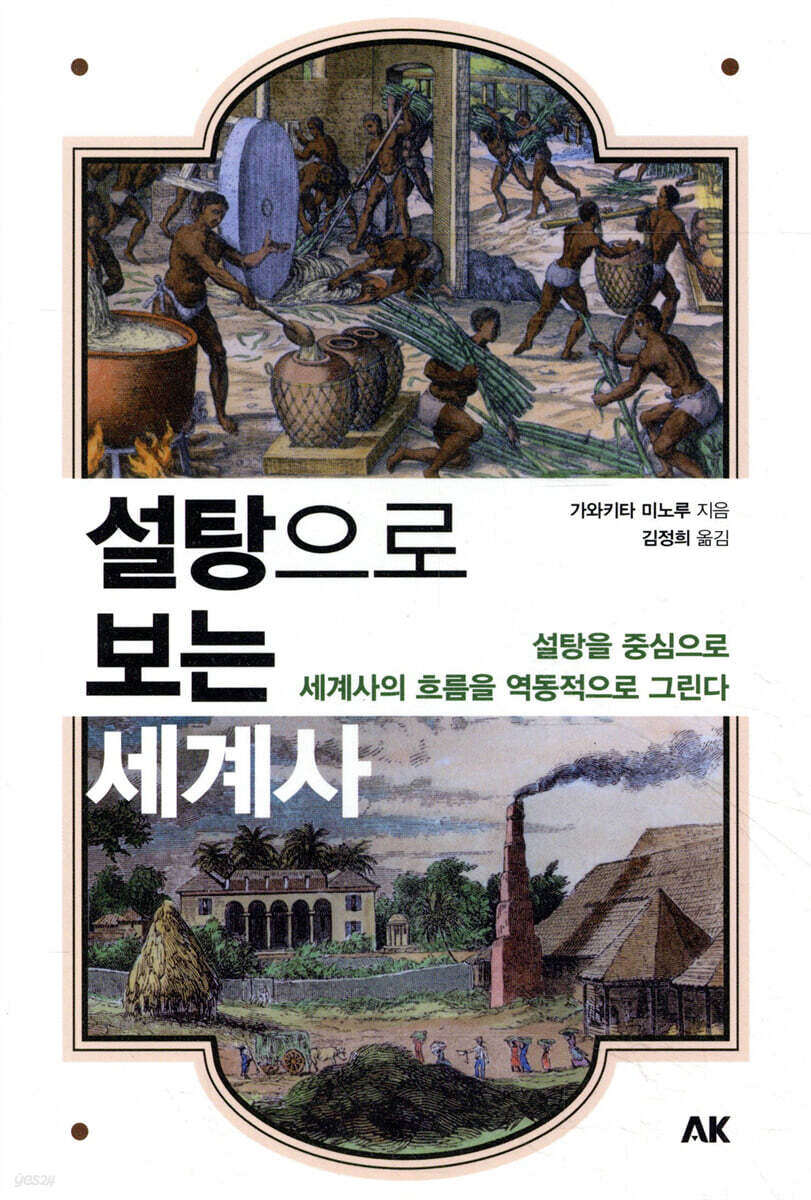
World History Through Sugar
 |
Description
Book Introduction
What new culture emerged in Europe when black tea, coffee, and chocolate met with sugar? How were the Age of Exploration, colonies, plantations, slavery, the Triangular Trade, and the Industrial Revolution all interconnected through sugar? We explore the birth of the political and economic systems that sustain the world and the interconnected threads of world history through the history of sugar.
index
Prologue - The Mystery of Sugar
Chapter 1: Where did Europe's sugar come from?
Chapter 2 The Caribbean and Sugar
Chapter 3: The Meeting of Sugar and Tea
Chapter 4: Modern Culture Fostered by Coffee Houses
Chapter 5 Tea, Coffee, and Chocolate
Chapter 6: "Where There's Sugar, There Are Slaves"
Chapter 7: The English Breakfast and the Tea Break - The Worker's Tea
Chapter 8: The Politics of Slavery and Sugar
Chapter 9: The End of the Sugar Cane Journey - Beat's Challenge
Epilogue - World History Through Objects - How Should We Learn World History?
Chapter 1: Where did Europe's sugar come from?
Chapter 2 The Caribbean and Sugar
Chapter 3: The Meeting of Sugar and Tea
Chapter 4: Modern Culture Fostered by Coffee Houses
Chapter 5 Tea, Coffee, and Chocolate
Chapter 6: "Where There's Sugar, There Are Slaves"
Chapter 7: The English Breakfast and the Tea Break - The Worker's Tea
Chapter 8: The Politics of Slavery and Sugar
Chapter 9: The End of the Sugar Cane Journey - Beat's Challenge
Epilogue - World History Through Objects - How Should We Learn World History?
Detailed image
Into the book
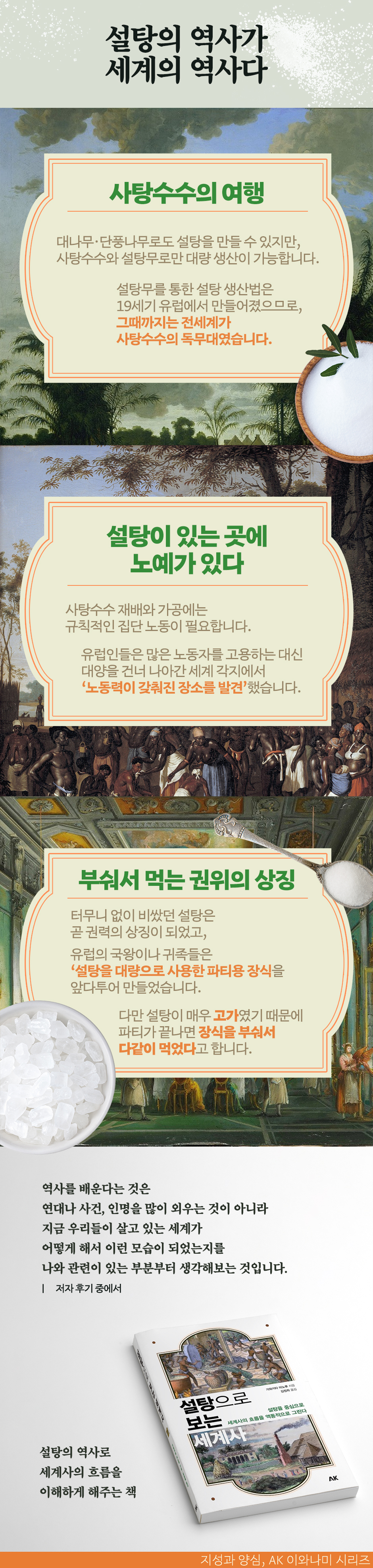
One of the earliest examples of a 'world commodity' that has shaped history is sugar.
So, from the 16th to the 19th centuries, politicians and businessmen around the world brainstormed ways to control sugar production and secure its distribution channels.
In Brazil and the islands of the Caribbean, large farms called plantations were created for sugar production.
The plantation was solely focused on growing sugarcane and processing it, with no other activities taking place.
For example, even basic foodstuffs such as grains were dependent on imports, and only sugarcane was grown.
--- p.11
Europeans spent a fortune building plantations in the Caribbean to produce sugar, the 'world commodity.'
To secure labor to cultivate these plantations, African slaves were brought in at a furious pace.
That is why the slave trade and the sugar import trade were connected from the beginning.
For example, slave trading ships that departed from Liverpool, England, carried guns, glass beads, cotton fabrics, and other items that African black kingdoms wanted to exchange for slaves.
They were traded for slaves in West Africa.
And after transporting the slaves they acquired along the tragic 'Middle Passage', they sold them in North and South America and the Caribbean, and returned to Liverpool, their starting point, with sugar (and in rare cases cotton).
This was a voyage that took more than two months, and this series of trade has often been called the "triangular trade" by historians.
--- p.61
There were also many coffee houses where people talked about literature, theater, and music.
The evaluation of literary works was decided through conversations in coffee houses.
Around this time, Daniel Defoe, who wrote Robinson Crusoe, and Jonathan Swift, who wrote Gulliver's Travels, appeared in England, and a new field of literature called the novel was born.
Coffee houses can also be said to have played a major role in the emergence of the novel.
Another important thing that was born in the coffee house is political parties.
The era of the Puritan Revolution, during which Cromwell seized power, came to an end, and Charles II, the son of Charles I, who had been executed by Cromwell, returned to England in 1660 after living in exile in France.
Around that time, groups similar to political parties, called Tories and Whigs, emerged in England.
So, from the 16th to the 19th centuries, politicians and businessmen around the world brainstormed ways to control sugar production and secure its distribution channels.
In Brazil and the islands of the Caribbean, large farms called plantations were created for sugar production.
The plantation was solely focused on growing sugarcane and processing it, with no other activities taking place.
For example, even basic foodstuffs such as grains were dependent on imports, and only sugarcane was grown.
--- p.11
Europeans spent a fortune building plantations in the Caribbean to produce sugar, the 'world commodity.'
To secure labor to cultivate these plantations, African slaves were brought in at a furious pace.
That is why the slave trade and the sugar import trade were connected from the beginning.
For example, slave trading ships that departed from Liverpool, England, carried guns, glass beads, cotton fabrics, and other items that African black kingdoms wanted to exchange for slaves.
They were traded for slaves in West Africa.
And after transporting the slaves they acquired along the tragic 'Middle Passage', they sold them in North and South America and the Caribbean, and returned to Liverpool, their starting point, with sugar (and in rare cases cotton).
This was a voyage that took more than two months, and this series of trade has often been called the "triangular trade" by historians.
--- p.61
There were also many coffee houses where people talked about literature, theater, and music.
The evaluation of literary works was decided through conversations in coffee houses.
Around this time, Daniel Defoe, who wrote Robinson Crusoe, and Jonathan Swift, who wrote Gulliver's Travels, appeared in England, and a new field of literature called the novel was born.
Coffee houses can also be said to have played a major role in the emergence of the novel.
Another important thing that was born in the coffee house is political parties.
The era of the Puritan Revolution, during which Cromwell seized power, came to an end, and Charles II, the son of Charles I, who had been executed by Cromwell, returned to England in 1660 after living in exile in France.
Around that time, groups similar to political parties, called Tories and Whigs, emerged in England.
--- p.108
Publisher's Review
The flow of world history centered around sugar
Draw dynamically!
What new culture emerged in Europe when black tea, coffee, and chocolate met with sugar? How were the Age of Exploration, colonies, plantations, slavery, the Triangular Trade, and the Industrial Revolution all interconnected through sugar? We explore the interconnected threads of world history through the history of sugar.
The political and economic system that supports the world
Understand the birth process!
The author states that he wrote this book using a perspective on history called 'world systems theory' and the methods of historical anthropology.
'World systems theory' is a position that considers the modern world as a single organism and examines its growth and development.
You will be able to see that the history of Europe, North and South America, Asia, and Africa is connected through this sugar, and furthermore, that the system of today's world was formed through the history of this sugar.
It's a fascinating look at how sugar, built on sacrifices in the Caribbean, Africa, and Asia, gave birth to new cultures throughout history, and how it shaped the world's political and economic systems.
You will come to understand that the lives of people living around the world, who at first glance seem unrelated, are in fact deeply intertwined.
Draw dynamically!
What new culture emerged in Europe when black tea, coffee, and chocolate met with sugar? How were the Age of Exploration, colonies, plantations, slavery, the Triangular Trade, and the Industrial Revolution all interconnected through sugar? We explore the interconnected threads of world history through the history of sugar.
The political and economic system that supports the world
Understand the birth process!
The author states that he wrote this book using a perspective on history called 'world systems theory' and the methods of historical anthropology.
'World systems theory' is a position that considers the modern world as a single organism and examines its growth and development.
You will be able to see that the history of Europe, North and South America, Asia, and Africa is connected through this sugar, and furthermore, that the system of today's world was formed through the history of this sugar.
It's a fascinating look at how sugar, built on sacrifices in the Caribbean, Africa, and Asia, gave birth to new cultures throughout history, and how it shaped the world's political and economic systems.
You will come to understand that the lives of people living around the world, who at first glance seem unrelated, are in fact deeply intertwined.
GOODS SPECIFICS
- Date of issue: June 10, 2023
- Page count, weight, size: 228 pages | 236g | 128*188*11mm
- ISBN13: 9791127462727
- ISBN10: 1127462725
You may also like
카테고리
korean


korean

![GQ KOREA Mark (Monthly): December [2025]](http://librairie.coreenne.fr/cdn/shop/files/8ef265dbbfbf186523ed75ba7319009d.jpg?v=1765340328&width=3840)


