

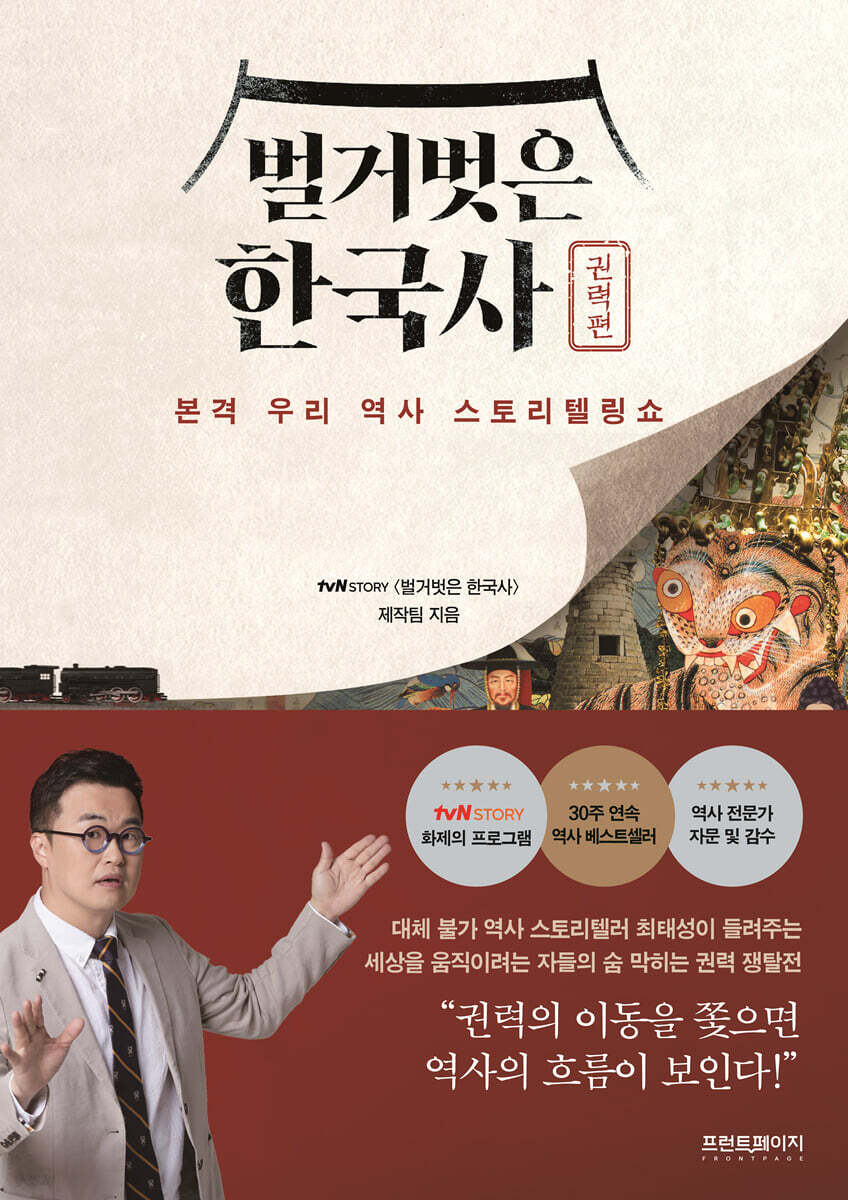
Naked Korean History: Power
 |
Description
Book Introduction
The return of the 30-week consecutive bestseller, 『Naked Korean History』!
Those who want to protect and those who want to take away
Moments of glory and downfall unfold like a panorama.
“If you follow the shift in power, you can see the flow of history!”
tvN STORY's popular program "Naked Korean History" has returned to readers with its third story, "Naked Korean History: Power."
"Naked Korean History," a historical storytelling show led by Choi Tae-seong, a leading Korean history lecturer, is gaining acclaim as an irreplaceable, premium Korean history lecture with each episode.
"Naked Korean History: Power" is a history textbook that contains the moments of power struggle and struggle that changed the landscape of Korean history, among the stories introduced in "Naked Korean History."
From Yeon Gaesomun, who sought omnipotent power, to Jeon Bong-jun, who led the revolution without being discouraged by reality, history is breathed into life by falling into the whirlpool of upheaval not taught in textbooks.
As you delve into the hidden stories of those who ruled an era with "Naked Korean History: Power," the grand history of Korea will unfold into a panorama encompassing human desire.
This book delivers profound knowledge with clear commentary, taking us to the turning points of history's rise and fall.
While the intense power game between those who seek to rule and those who are ruled is thrilling and entertaining, it also makes you think about true power and a better world.
History allows us to look back on our lives today and develop insight to look into the future.
If you'd like to embark on a historical journey that examines the events that shook the Korean Peninsula and charts the course for the future, board the Power Line History Train Express.
Those who want to protect and those who want to take away
Moments of glory and downfall unfold like a panorama.
“If you follow the shift in power, you can see the flow of history!”
tvN STORY's popular program "Naked Korean History" has returned to readers with its third story, "Naked Korean History: Power."
"Naked Korean History," a historical storytelling show led by Choi Tae-seong, a leading Korean history lecturer, is gaining acclaim as an irreplaceable, premium Korean history lecture with each episode.
"Naked Korean History: Power" is a history textbook that contains the moments of power struggle and struggle that changed the landscape of Korean history, among the stories introduced in "Naked Korean History."
From Yeon Gaesomun, who sought omnipotent power, to Jeon Bong-jun, who led the revolution without being discouraged by reality, history is breathed into life by falling into the whirlpool of upheaval not taught in textbooks.
As you delve into the hidden stories of those who ruled an era with "Naked Korean History: Power," the grand history of Korea will unfold into a panorama encompassing human desire.
This book delivers profound knowledge with clear commentary, taking us to the turning points of history's rise and fall.
While the intense power game between those who seek to rule and those who are ruled is thrilling and entertaining, it also makes you think about true power and a better world.
History allows us to look back on our lives today and develop insight to look into the future.
If you'd like to embark on a historical journey that examines the events that shook the Korean Peninsula and charts the course for the future, board the Power Line History Train Express.
- You can preview some of the book's contents.
Preview
index
Introduction | Let's go on a special journey together.
Recommended Reading | Stories of Power in History That Give You Insight into Life _____ Choi Tae-seong
[Part 1] People Who Wield the Power to Move the World
Chapter 1: The Real Power of Naked Goguryeo _____ Lim Ki-hwan
: How Yeon Gaesomun led Goguryeo to its destruction
Chapter 2: The Naked Silla General _____ Im Gi-hwan
: How did Gaya royal family member Kim Yu-sin become a key figure in the unification of the three kingdoms?
Chapter 3: The Naked Coup _____ Park Jae-woo
: Why did the masterminds of the coup d'état aim for each other's throats?
Chapter 4: The Naked Red Eldest Son _____ Kang Moon-sik
: Why did King Taejong Lee Bang-won abandon his eldest son, Prince Yangnyeong?
[Part 2] People Who Led Reform and Change
Chapter 5: The Designer of Naked Joseon _____ Kim Gyeong-su
Why did Jeong Do-jeon dream of a new nation?
Chapter 6: The Naked Heretic, Inspector _____ Kim Kyung-soo
: Why did Park Mun-su argue with the king?
Chapter 7: The Naked Enlightenment Elite _____ Hong Moon-gi
: Why did Kim Ok-gyun dream of reform?
Chapter 8: The Naked Green Bean General _____ Yubada
: How did Jeon Bong-jun end up holding a bamboo spear?
Recommended Reading | Stories of Power in History That Give You Insight into Life _____ Choi Tae-seong
[Part 1] People Who Wield the Power to Move the World
Chapter 1: The Real Power of Naked Goguryeo _____ Lim Ki-hwan
: How Yeon Gaesomun led Goguryeo to its destruction
Chapter 2: The Naked Silla General _____ Im Gi-hwan
: How did Gaya royal family member Kim Yu-sin become a key figure in the unification of the three kingdoms?
Chapter 3: The Naked Coup _____ Park Jae-woo
: Why did the masterminds of the coup d'état aim for each other's throats?
Chapter 4: The Naked Red Eldest Son _____ Kang Moon-sik
: Why did King Taejong Lee Bang-won abandon his eldest son, Prince Yangnyeong?
[Part 2] People Who Led Reform and Change
Chapter 5: The Designer of Naked Joseon _____ Kim Gyeong-su
Why did Jeong Do-jeon dream of a new nation?
Chapter 6: The Naked Heretic, Inspector _____ Kim Kyung-soo
: Why did Park Mun-su argue with the king?
Chapter 7: The Naked Enlightenment Elite _____ Hong Moon-gi
: Why did Kim Ok-gyun dream of reform?
Chapter 8: The Naked Green Bean General _____ Yubada
: How did Jeon Bong-jun end up holding a bamboo spear?
Detailed image

Into the book
They say there are no ifs in history, but when I hear stories, I often feel regretful and think, "What if it had been like this?"
One of the most common assumptions in Korean history is, "What if Goguryeo had unified the three kingdoms?"
This is probably an assumption that contains the hope that if Goguryeo, the strongest of the three kingdoms, had unified Baekje and Silla, our country would have acquired a larger territory.
But surprisingly, Goguryeo was destroyed because of the Yeon Gaesomun family, who held the highest power.
Why did Goguryeo, boasting a formidable military, collapse? How did Yeon Gaesomun and his family, who fought against the Tang invasion, lead Goguryeo to its downfall? Let's uncover the hidden story surrounding Goguryeo's demise.
---From "Chapter 1: The Real Power of Naked Goguryeo - How Yeon Gaesomun Led Goguryeo to Destruction"
Kim Yu-sin, who believed that Kim Chun-chu's bloodline would definitely help solidify his family, devised a way to strengthen his relationship with him.
One day, Kim Yu-sin, who was still pondering, suggested to Kim Chun-chu, “Let’s play a game of Chukguk.”
While they were playing happily for a while, Kim Chun-chu's jacket's lining was torn by Kim Yu-sin's foot.
Kim Yu-sin felt sorry and asked the embarrassed Kim Chun-chu to go to his house and hang his coat.
Kim Yu-sin returned home and had Kim Chun-chu wait in an empty room.
After a while, the door where Kim Chun-chu was was opened and Kim Yu-sin's second younger sister, Mun-hee, came in.
Why did Kim Yu-sin send his younger sister to Kim Chun-chu?
---From "Chapter 2: The Naked Silla General: How Gaya Royal Family's Kim Yu-sin Became a Key Player in the Unification of the Three Kingdoms"
King Taejong Yi Bang-won, the father of King Sejong and Prince Yangnyeong, was a man who had the principle of unconditionally appointing the right person as his successor.
There was a special reason why he insisted on this principle.
To understand the reason, we must go back to the time when Taejo Yi Seong-gye, the father of Taejong, was the first king of Joseon.
In August of the lunar calendar in 1398, an unprecedented storm of blood swept through the Joseon royal family.
The First Princes' Rebellion occurred when Yi Bang-won, the fifth son of King Yi Seong-gye, killed his half-brothers over the issue of succession to the throne.
Yi Bang-won, who had shown a strong desire for the throne, ascended to the throne as King Taejong, the third king of Joseon, in 1400 after many twists and turns.
Looking at his rise to the throne, you can understand why he insisted on a legitimate heir to the throne. He was the one who had instigated a bloodbath, killing his brothers in the name of legitimate succession, so he must have felt compelled to avoid leaving any seeds of conflict.
Taejong's dream of making the eldest son the successor even if it meant holding a knife to his neck may have been planted at this time.
---From "Chapter 4 The Naked Eldest Son of Joseon - Why Did Taejong Lee Bang-won Abandon His Eldest Son, Prince Yangnyeong"
Gyeongbokgung Palace was the center of the urban planning for Hanyang, the capital of the new nation, Joseon.
The founding powers of Joseon, who decided to leave Gaegyeong, the capital of the Goryeo Dynasty for 500 years, and move the capital to a new one, put a lot of effort into building the capital.
Care was also taken in deciding the location of the capital city.
Seoul is a place with all the qualities of a geomantic site, surrounded by mountain ranges on all sides and protected by them. Walking along Seoul's old streets, you will be amazed by the wisdom of our ancestors who recognized the true value of this city.
As we open the first page of Joseon history, the person responsible for the construction of the capital city of Hanyang was Jeong Do-jeon, who founded Joseon together with Yi Seong-gye.
---From "Chapter 5: The Naked Designer of Joseon _ Why Did Jeong Do-jeon Dream of a New Nation?"
There was also an incident where another minister pointed out that Park Mun-su was looking straight into the king's face while speaking.
He said that he dared to look at the dragon's face carelessly, and Park Mun-su's response to this was astonishing.
"What's wrong with a subject, a son, looking up to his father, the king? Don't just turn a blind eye to flattery. Let's talk face to face."
Wouldn't it be better to go one step further and ask the king to meet face to face and have a meeting?
---From "Chapter 6: The Naked Heretic Inspector - Why Did Park Mun-su Argue with the King"
Jeon Bong-jun had a great goal that was difficult to imagine at the time.
That was the ultimate goal of the letter written in the last entry.
Since Gobu was a region belonging to Jeolla-do, it meant that they would occupy Jeonju-seong, which meant the provincial government office, or Jeolla Gamyeong.
Going straight to the capital means advancing to Hanyang, where the Joseon government was located.
Surprisingly, the purpose of this gathering that planned the uprising was not simply to eliminate Jo Byeong-gap.
It was an attempt to overthrow the Joseon Dynasty government.
Peasants, including Jeon Bong-jun, believed that the government officials surrounding the king were the cause of the misery of the peasants' lives.
In the end, it was not enough to punish a single corrupt official like Jo Byeong-gap, but he felt that he had to go up to Hanyang and resolve the issue by correcting the ministers who were running the government.
One of the most common assumptions in Korean history is, "What if Goguryeo had unified the three kingdoms?"
This is probably an assumption that contains the hope that if Goguryeo, the strongest of the three kingdoms, had unified Baekje and Silla, our country would have acquired a larger territory.
But surprisingly, Goguryeo was destroyed because of the Yeon Gaesomun family, who held the highest power.
Why did Goguryeo, boasting a formidable military, collapse? How did Yeon Gaesomun and his family, who fought against the Tang invasion, lead Goguryeo to its downfall? Let's uncover the hidden story surrounding Goguryeo's demise.
---From "Chapter 1: The Real Power of Naked Goguryeo - How Yeon Gaesomun Led Goguryeo to Destruction"
Kim Yu-sin, who believed that Kim Chun-chu's bloodline would definitely help solidify his family, devised a way to strengthen his relationship with him.
One day, Kim Yu-sin, who was still pondering, suggested to Kim Chun-chu, “Let’s play a game of Chukguk.”
While they were playing happily for a while, Kim Chun-chu's jacket's lining was torn by Kim Yu-sin's foot.
Kim Yu-sin felt sorry and asked the embarrassed Kim Chun-chu to go to his house and hang his coat.
Kim Yu-sin returned home and had Kim Chun-chu wait in an empty room.
After a while, the door where Kim Chun-chu was was opened and Kim Yu-sin's second younger sister, Mun-hee, came in.
Why did Kim Yu-sin send his younger sister to Kim Chun-chu?
---From "Chapter 2: The Naked Silla General: How Gaya Royal Family's Kim Yu-sin Became a Key Player in the Unification of the Three Kingdoms"
King Taejong Yi Bang-won, the father of King Sejong and Prince Yangnyeong, was a man who had the principle of unconditionally appointing the right person as his successor.
There was a special reason why he insisted on this principle.
To understand the reason, we must go back to the time when Taejo Yi Seong-gye, the father of Taejong, was the first king of Joseon.
In August of the lunar calendar in 1398, an unprecedented storm of blood swept through the Joseon royal family.
The First Princes' Rebellion occurred when Yi Bang-won, the fifth son of King Yi Seong-gye, killed his half-brothers over the issue of succession to the throne.
Yi Bang-won, who had shown a strong desire for the throne, ascended to the throne as King Taejong, the third king of Joseon, in 1400 after many twists and turns.
Looking at his rise to the throne, you can understand why he insisted on a legitimate heir to the throne. He was the one who had instigated a bloodbath, killing his brothers in the name of legitimate succession, so he must have felt compelled to avoid leaving any seeds of conflict.
Taejong's dream of making the eldest son the successor even if it meant holding a knife to his neck may have been planted at this time.
---From "Chapter 4 The Naked Eldest Son of Joseon - Why Did Taejong Lee Bang-won Abandon His Eldest Son, Prince Yangnyeong"
Gyeongbokgung Palace was the center of the urban planning for Hanyang, the capital of the new nation, Joseon.
The founding powers of Joseon, who decided to leave Gaegyeong, the capital of the Goryeo Dynasty for 500 years, and move the capital to a new one, put a lot of effort into building the capital.
Care was also taken in deciding the location of the capital city.
Seoul is a place with all the qualities of a geomantic site, surrounded by mountain ranges on all sides and protected by them. Walking along Seoul's old streets, you will be amazed by the wisdom of our ancestors who recognized the true value of this city.
As we open the first page of Joseon history, the person responsible for the construction of the capital city of Hanyang was Jeong Do-jeon, who founded Joseon together with Yi Seong-gye.
---From "Chapter 5: The Naked Designer of Joseon _ Why Did Jeong Do-jeon Dream of a New Nation?"
There was also an incident where another minister pointed out that Park Mun-su was looking straight into the king's face while speaking.
He said that he dared to look at the dragon's face carelessly, and Park Mun-su's response to this was astonishing.
"What's wrong with a subject, a son, looking up to his father, the king? Don't just turn a blind eye to flattery. Let's talk face to face."
Wouldn't it be better to go one step further and ask the king to meet face to face and have a meeting?
---From "Chapter 6: The Naked Heretic Inspector - Why Did Park Mun-su Argue with the King"
Jeon Bong-jun had a great goal that was difficult to imagine at the time.
That was the ultimate goal of the letter written in the last entry.
Since Gobu was a region belonging to Jeolla-do, it meant that they would occupy Jeonju-seong, which meant the provincial government office, or Jeolla Gamyeong.
Going straight to the capital means advancing to Hanyang, where the Joseon government was located.
Surprisingly, the purpose of this gathering that planned the uprising was not simply to eliminate Jo Byeong-gap.
It was an attempt to overthrow the Joseon Dynasty government.
Peasants, including Jeon Bong-jun, believed that the government officials surrounding the king were the cause of the misery of the peasants' lives.
In the end, it was not enough to punish a single corrupt official like Jo Byeong-gap, but he felt that he had to go up to Hanyang and resolve the issue by correcting the ministers who were running the government.
---From "Chapter 8: The Naked Green Bean General - How did Jeon Bong-jun end up holding a bamboo spear?"
Publisher's Review
Irreplaceable historical storyteller Choi Tae-seong tells
A breathtaking power struggle among those who seek to move the world.
Every Korean has probably learned about our history at least once, but somehow, when faced with history, our voices become small and only fragmentary knowledge such as dates, events, and people come to mind.
This is because I approached history not as an interesting story, but as a lot of knowledge to memorize.
In order to gather scattered information and remember historical facts for a long time, we must pay attention to the essence of history as a 'story.'
tvN's STORY "Naked Korean History," which strips away key scenes from our history and tells interesting stories, also started from that very point.
Among the various stories introduced on the show, the moments when the desire for power and freedom exploded were collected and included in 『Naked Korean History: Power Edition』.
Choi Tae-seong, a leading Korean history lecturer in Korea, provides a clear and concise explanation of the difficult and complex struggle for power, providing the ultimate immersion.
In addition, it vividly conveys the moments of bloody power struggles and the march for freedom by adding various illustrations ranging from old maps to black-and-white photographs capturing modern history.
It is no exaggeration to say that the main culprit behind the turbulent twists and turns in Korean history over the past half-millennium is 'power.'
The reason we join hands and unite, as well as betray our comrades and kill our brothers, is to gain the power to create the world we each desire.
If you trace how these forces moved, the flow of history will be drawn naturally without any effort.
By examining history through the keyword of power, this book transforms history into a three-dimensional story in which prosperity and decline intertwine like warp and woof.
Readers will have the surprising experience of grasping the larger context of Korean history through 『Naked Korean History: Power Edition』, which magically connects the fragments of history that were previously fragmented.
From Yeon Gaesomun's hereditary succession of power that brought about the end of Goguryeo
Even Jeon Bong-jun, the green bean general who dreamed of a world where everyone was equal…
Uncover the behind-the-scenes stories of moments that changed the course of Korean history!
1.
naked coup
The Goryeo military officials who staged the military coup in 1170 enjoyed unprecedented power after successfully carrying out the coup, turning Goryeo into a world ruled by military officials.
However, less than six months after the coup, the masterminds of the military coup aimed their swords at each other's throats and once again incited a storm of blood in Goryeo.
Why did the military leaders who once united in a coup to change the world betray one another? What attitude was necessary for them to possess the power they dreamed of?
2.
The naked designer of Joseon
Jeong Do-jeon, who overthrew the Goryeo Dynasty and established a new country with Yi Seong-gye.
He was recognized as a public servant and established himself as a key figure.
From the design of the capital city of Hanyang to the name of Gyeongbokgung Palace, there was nothing that did not pass through his hands.
However, just six years after the founding of Joseon, he was assassinated by Yi Bang-won, the son of Yi Seong-gye.
Why was he murdered by Yi Bang-won, a comrade who once shared the same vision of revolution? Why did he, a founding father, disappear without a trace from Joseon history for 467 years?
『Naked Korean History: The Power Edition』 is a collection of eight scenes that depict the stories that turned Korean history upside down, from the moment when Yeon Gaesomun's family, the most powerful figures in Goguryeo, led Goguryeo to its downfall, to the moment when General Jeon Bong-jun led an army of 40,000 peasants and marched on Hanyang.
The various stories surrounding power contained in this book give us, living today, many things to think about.
Through Yeon Gaesomun, who led Goguryeo to its downfall by passing power to his incompetent son, we see the tragedy that the greed of those in power can bring to a country. And through the process by which Kim Yu-sin, a member of the royal family of Gaya, came to be praised as a famous general of Silla, we are made to think about the attitude of a respected leader.
Moreover, the story of the Donghak Peasant Army, which, despite knowing the outcome of the battle, rushed towards the bayonets of the Japanese army, shouting for equality for all people and against foreign powers, is a heartwarming and moving story.
Choi Tae-seong, who has stepped forward as a history guide, recommended this book and said this.
“History is where the saying, ‘A beautiful flower cannot stay red for more than ten days, and great power cannot last more than ten years’ is proven.
I hope this will be a time to examine the rise and fall of power throughout history and find lessons to apply to my own life.”
History is still relevant in that we can examine the choices made by people in the past and use them to inform our own choices.
Through this book, which exposes the hidden stories behind crucial choices, we encounter history as a key that connects the present and the future.
A breathtaking power struggle among those who seek to move the world.
Every Korean has probably learned about our history at least once, but somehow, when faced with history, our voices become small and only fragmentary knowledge such as dates, events, and people come to mind.
This is because I approached history not as an interesting story, but as a lot of knowledge to memorize.
In order to gather scattered information and remember historical facts for a long time, we must pay attention to the essence of history as a 'story.'
tvN's STORY "Naked Korean History," which strips away key scenes from our history and tells interesting stories, also started from that very point.
Among the various stories introduced on the show, the moments when the desire for power and freedom exploded were collected and included in 『Naked Korean History: Power Edition』.
Choi Tae-seong, a leading Korean history lecturer in Korea, provides a clear and concise explanation of the difficult and complex struggle for power, providing the ultimate immersion.
In addition, it vividly conveys the moments of bloody power struggles and the march for freedom by adding various illustrations ranging from old maps to black-and-white photographs capturing modern history.
It is no exaggeration to say that the main culprit behind the turbulent twists and turns in Korean history over the past half-millennium is 'power.'
The reason we join hands and unite, as well as betray our comrades and kill our brothers, is to gain the power to create the world we each desire.
If you trace how these forces moved, the flow of history will be drawn naturally without any effort.
By examining history through the keyword of power, this book transforms history into a three-dimensional story in which prosperity and decline intertwine like warp and woof.
Readers will have the surprising experience of grasping the larger context of Korean history through 『Naked Korean History: Power Edition』, which magically connects the fragments of history that were previously fragmented.
From Yeon Gaesomun's hereditary succession of power that brought about the end of Goguryeo
Even Jeon Bong-jun, the green bean general who dreamed of a world where everyone was equal…
Uncover the behind-the-scenes stories of moments that changed the course of Korean history!
1.
naked coup
The Goryeo military officials who staged the military coup in 1170 enjoyed unprecedented power after successfully carrying out the coup, turning Goryeo into a world ruled by military officials.
However, less than six months after the coup, the masterminds of the military coup aimed their swords at each other's throats and once again incited a storm of blood in Goryeo.
Why did the military leaders who once united in a coup to change the world betray one another? What attitude was necessary for them to possess the power they dreamed of?
2.
The naked designer of Joseon
Jeong Do-jeon, who overthrew the Goryeo Dynasty and established a new country with Yi Seong-gye.
He was recognized as a public servant and established himself as a key figure.
From the design of the capital city of Hanyang to the name of Gyeongbokgung Palace, there was nothing that did not pass through his hands.
However, just six years after the founding of Joseon, he was assassinated by Yi Bang-won, the son of Yi Seong-gye.
Why was he murdered by Yi Bang-won, a comrade who once shared the same vision of revolution? Why did he, a founding father, disappear without a trace from Joseon history for 467 years?
『Naked Korean History: The Power Edition』 is a collection of eight scenes that depict the stories that turned Korean history upside down, from the moment when Yeon Gaesomun's family, the most powerful figures in Goguryeo, led Goguryeo to its downfall, to the moment when General Jeon Bong-jun led an army of 40,000 peasants and marched on Hanyang.
The various stories surrounding power contained in this book give us, living today, many things to think about.
Through Yeon Gaesomun, who led Goguryeo to its downfall by passing power to his incompetent son, we see the tragedy that the greed of those in power can bring to a country. And through the process by which Kim Yu-sin, a member of the royal family of Gaya, came to be praised as a famous general of Silla, we are made to think about the attitude of a respected leader.
Moreover, the story of the Donghak Peasant Army, which, despite knowing the outcome of the battle, rushed towards the bayonets of the Japanese army, shouting for equality for all people and against foreign powers, is a heartwarming and moving story.
Choi Tae-seong, who has stepped forward as a history guide, recommended this book and said this.
“History is where the saying, ‘A beautiful flower cannot stay red for more than ten days, and great power cannot last more than ten years’ is proven.
I hope this will be a time to examine the rise and fall of power throughout history and find lessons to apply to my own life.”
History is still relevant in that we can examine the choices made by people in the past and use them to inform our own choices.
Through this book, which exposes the hidden stories behind crucial choices, we encounter history as a key that connects the present and the future.
GOODS SPECIFICS
- Date of issue: March 28, 2023
- Page count, weight, size: 344 pages | 578g | 152*215*20mm
- ISBN13: 9791198243409
- ISBN10: 1198243406
You may also like
카테고리
korean


korean

![ELLE 엘르 스페셜 에디션 A형 : 12월 [2025]](http://librairie.coreenne.fr/cdn/shop/files/b8e27a3de6c9538896439686c6b0e8fb.jpg?v=1766436872&width=3840)


