

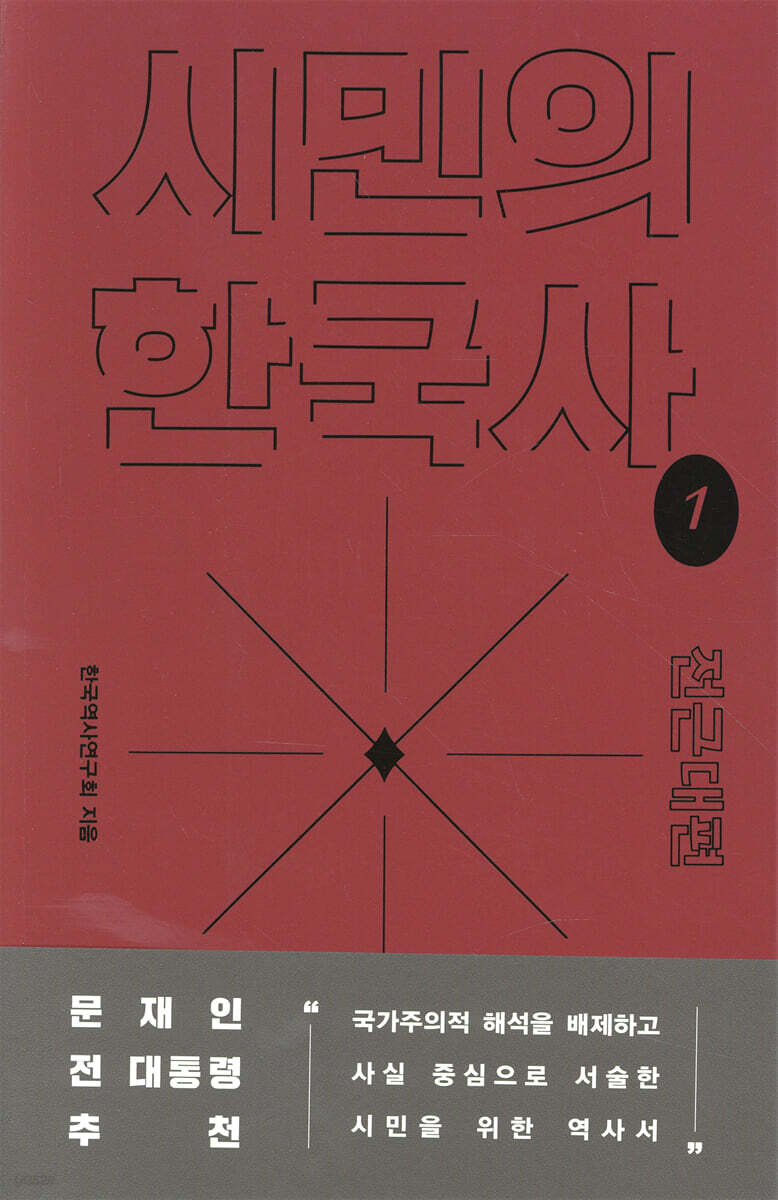
Citizen's Korean History 1
 |
Description
Book Introduction
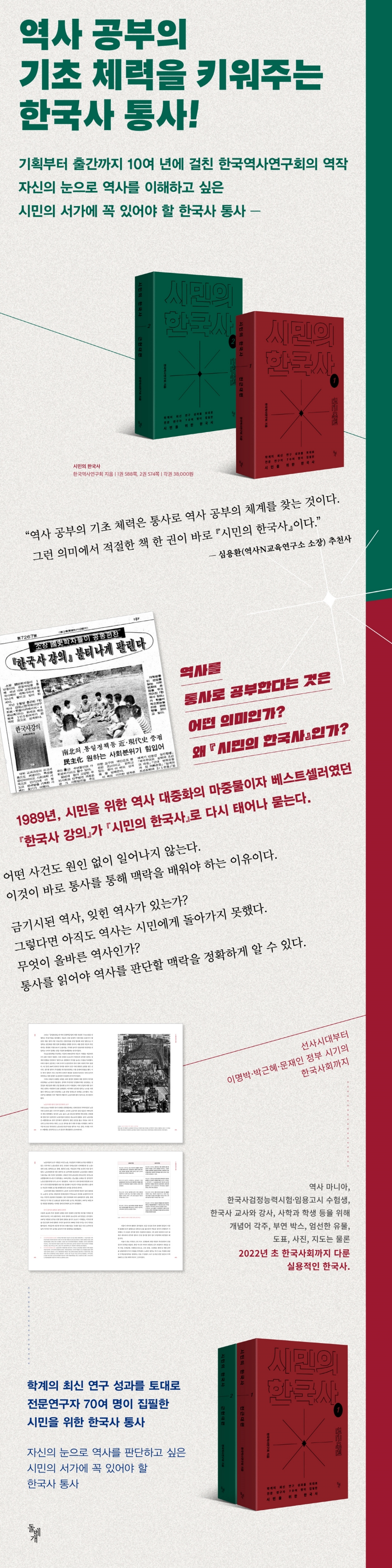
A Comprehensive History of Korea for the Citizens of the Republic of Korea, from Prehistoric Times to the Present A masterpiece by the Korean History Research Association, spanning over 10 years from planning to publication. A comprehensive history of Korea has been published, covering our long history from prehistoric times to the present. This is a joint work of the Korean History Research Association, which has had the largest number of members among domestic historical societies since its establishment in 1988 and has steadily accumulated achievements in both academic and liberal arts fields. The project was initiated by the 'Kyohaksa Book Controversy' in 2013 and the 'National Textbook Controversy' in 2015, and was planned with the awareness of the problem of creating a proper Korean history in response to the historical narrative that has been destroyed by power. The plan was to fill the writing staff with domestic experts, distance ourselves from uniform interpretations, and reflect the latest research findings. As the patience and effort required to finalize the composition, recruit authors, write, proofread, and edit and design the original issues gradually subsided, but the purpose of the publication within the editorial committee became clearer. During the considerable preparation process, I encountered a series of materials that were lacking in factual verification and information, and this expanded my sense of mission to leave behind an accurate "story of our history" that could be recommended to anyone, beyond a "textbook." In that respect, the title, “Citizens’ Korean History,” and the phrase “For Citizens” on the cover contain the hope that it will be widely read by all citizens of the Republic of Korea. We expect this to be extremely welcome news to the general public who have a deep interest in Korean history and enjoy reading history books, as well as to students preparing for the Korean History Proficiency Test and the Civil Service Examination, as well as to teachers and lecturers who teach Korean history. |
- You can preview some of the book's contents.
Preview
index
In publishing the book
Part 1 Prehistory
1.
Tool use and group living
2.
Farming and settled life
Part 2: Ancient Times
1.
Metal culture and Gojoseon
1. Class differentiation and the establishment of a nation | 2. Dangun and Gojoseon | 3. The evolution and fall of Gojoseon | 4. Han commanderies and indigenous powers
2.
The establishment and development of early states
1. The Establishment and Historical Development of Buyeo | 2. The Establishment and Development of Goguryeo | 3. Okjeo, Dongye, and the Small States of the Three Han Kingdoms
3.
The development of the Three Kingdoms and Gaya
1. Goguryeo's Expansion of Territory and the Establishment of its Ruling System | 2. Baekje's Rise and the Unification of Mahan | 3. From Jinhan to Silla | 4. The Various States of Gaya
4.
The Three Kingdoms' Resistance and the Reorganization of the Ruling System
1. Goguryeo's Territorial Expansion and the Relocation of the Capital to Pyongyang | 2. Baekje's Relocation of the Capital and the Reorganization of its Ruling System | 3. Silla's Reorganization of its Ruling System and Territorial Expansion
5.
Politics, society, and economy of the Three Kingdoms
1. Governing Structure and Political System | 2. Social Class and Class System | 3. Collection System and Economic Life
6.
Culture and Arts of the Three Kingdoms
1. Acceptance of Chinese Character Culture and the Compilation of History Books | 2. Faith and Religion | 3. Architecture and Art
Part 3: Unified Silla and Balhae
1.
East Asian situation and the unification war
1. Changing East Asian Politics and the Responses of the Three Kingdoms | 2. The Silla-Tang Alliance and the Fall of Baekje | 3. The Fall of Goguryeo and the Silla-Tang War
2.
Reorganization of Silla's ruling system and political changes
1. Systemic Stability in Peace | 2. Throne Wars and Political Chaos | 3. The Rise of Aristocrats and the Division of the Later Three Kingdoms
3.
Silla's politics, society, and economy
1. Governing Body and Ruling Organization | 2. Land System and Economic Life | 3. Social Structure and Lifestyle
4.
Thought and culture of the unified Silla period
1 Thought and Religion | 2 Literature and Art
5.
Balhae's ruling structure and culture
1. Foundation and Development | 2. The Fall of Balhae and the Movement of the Displaced People | 3. Political System and Population Structure | 4. Ideology and Culture
Part 4: Goryeo
1.
Politics and system reorganization in the early Goryeo period
1. The Founding of Goryeo and the Establishment of Royal Authority | 2. The Ruling Powers and the Establishment of the National System | 3. Political Changes during the Reigns of King Sukjong and King Injong
2.
Political and Regime Changes in the Late Goryeo Dynasty
1. The Formation of the Military Regime and the Popular Uprising | 2. Mongol (Yuan) Interference and Goryeo Politics | 3. Reform Politics and the Fall of Goryeo
3.
Goryeo's international relations, war, and exchanges
1. The Pluralistic International Order and International Relations | 2. The War and Peace with Mongolia | 3. The Shift to a Unilateral World Order
4.
Goryeo's economic structure and life
1. Land System and Farms | 2. Operation of the Land Collection System and Transportation | 3. Agricultural Productivity and Agricultural Technology | 4. Development of Commerce and Industry
5.
Goryeo's social structure and changes
1. The Operation and Unrest of the Caste System | 2. The Family System and the Status of Women | 3. Social Policy and the Code System
6.
Goryeo's thoughts and culture
1. Buddhist Trends and Buddhist Culture | 2. The Development of Confucian Thought and Confucian Rituals | 3. Taoism, Feng Shui, and Folk Religion | 4. The Development of Science and Culture
Part 5 Joseon
1.
The establishment and system of the Joseon Dynasty
1. The Establishment of the Joseon Dynasty | 2. The Establishment of a New National System | 3. Central and Local Administrative Organizations | 4. Foreign Relations and Military Organization | 5. Official Selection and Education System
2.
Economic management and social structure of the early Joseon Dynasty
1. Operation of the Overland Tax Law and Changes in the Collection System | 2. Development of Agricultural Management and Productivity | 3. National Commercial Control and the Formation of the State-Owned Industrial Enterprise System | 4. Structure and Operation of the Class System
3.
Development of learning and culture in the early Joseon Dynasty
1. The Acceptance and Spread of Neo-Confucianism | 2. The Development of Science and Technology | 3. The Development of Culture
4.
The growth of the Sarim and factions in the mid-Joseon period
1. The Rise of the Sarim | 2. The Rise of Factions | 3. The Deepening of Neo-Confucianism
5.
Two wars and post-war reconstruction
1. The Imjin War and Relations with Japan | 2. The Byeongja War and Relations with the Qing | 3. Postwar Reorganization of the National System | 4. Local Aristocrats and Local Society
6.
Political changes in the late Joseon Dynasty
1. Reorganization of the Political Order | 2. Implementation of Tangpyeong Politics | 3. The Emergence and Harmful Effects of Sedo Politics
7.
Economic development and social change in the late Joseon Dynasty
1. Reform of the Tax System | 2. Agricultural Development and Changes in the Landownership System | 3. Growth of Commerce and Industry and the Development of Trade | 4. Changes in Seoul and Local Societies | 5. Changes in the Caste System and the Family and Kinship Systems | 6. Aspects of Popular Resistance
8.
New trends in thought and culture in the late Joseon Dynasty
1. Theory of Fire and Neo-Confucianism | 2. The Development of Silhak and Historical Research | 3. The Emergence of Catholicism and Popular Thought | 4. New Trends in Culture
Visual materials collections and sources
Royal lineage
References
Search
Part 1 Prehistory
1.
Tool use and group living
2.
Farming and settled life
Part 2: Ancient Times
1.
Metal culture and Gojoseon
1. Class differentiation and the establishment of a nation | 2. Dangun and Gojoseon | 3. The evolution and fall of Gojoseon | 4. Han commanderies and indigenous powers
2.
The establishment and development of early states
1. The Establishment and Historical Development of Buyeo | 2. The Establishment and Development of Goguryeo | 3. Okjeo, Dongye, and the Small States of the Three Han Kingdoms
3.
The development of the Three Kingdoms and Gaya
1. Goguryeo's Expansion of Territory and the Establishment of its Ruling System | 2. Baekje's Rise and the Unification of Mahan | 3. From Jinhan to Silla | 4. The Various States of Gaya
4.
The Three Kingdoms' Resistance and the Reorganization of the Ruling System
1. Goguryeo's Territorial Expansion and the Relocation of the Capital to Pyongyang | 2. Baekje's Relocation of the Capital and the Reorganization of its Ruling System | 3. Silla's Reorganization of its Ruling System and Territorial Expansion
5.
Politics, society, and economy of the Three Kingdoms
1. Governing Structure and Political System | 2. Social Class and Class System | 3. Collection System and Economic Life
6.
Culture and Arts of the Three Kingdoms
1. Acceptance of Chinese Character Culture and the Compilation of History Books | 2. Faith and Religion | 3. Architecture and Art
Part 3: Unified Silla and Balhae
1.
East Asian situation and the unification war
1. Changing East Asian Politics and the Responses of the Three Kingdoms | 2. The Silla-Tang Alliance and the Fall of Baekje | 3. The Fall of Goguryeo and the Silla-Tang War
2.
Reorganization of Silla's ruling system and political changes
1. Systemic Stability in Peace | 2. Throne Wars and Political Chaos | 3. The Rise of Aristocrats and the Division of the Later Three Kingdoms
3.
Silla's politics, society, and economy
1. Governing Body and Ruling Organization | 2. Land System and Economic Life | 3. Social Structure and Lifestyle
4.
Thought and culture of the unified Silla period
1 Thought and Religion | 2 Literature and Art
5.
Balhae's ruling structure and culture
1. Foundation and Development | 2. The Fall of Balhae and the Movement of the Displaced People | 3. Political System and Population Structure | 4. Ideology and Culture
Part 4: Goryeo
1.
Politics and system reorganization in the early Goryeo period
1. The Founding of Goryeo and the Establishment of Royal Authority | 2. The Ruling Powers and the Establishment of the National System | 3. Political Changes during the Reigns of King Sukjong and King Injong
2.
Political and Regime Changes in the Late Goryeo Dynasty
1. The Formation of the Military Regime and the Popular Uprising | 2. Mongol (Yuan) Interference and Goryeo Politics | 3. Reform Politics and the Fall of Goryeo
3.
Goryeo's international relations, war, and exchanges
1. The Pluralistic International Order and International Relations | 2. The War and Peace with Mongolia | 3. The Shift to a Unilateral World Order
4.
Goryeo's economic structure and life
1. Land System and Farms | 2. Operation of the Land Collection System and Transportation | 3. Agricultural Productivity and Agricultural Technology | 4. Development of Commerce and Industry
5.
Goryeo's social structure and changes
1. The Operation and Unrest of the Caste System | 2. The Family System and the Status of Women | 3. Social Policy and the Code System
6.
Goryeo's thoughts and culture
1. Buddhist Trends and Buddhist Culture | 2. The Development of Confucian Thought and Confucian Rituals | 3. Taoism, Feng Shui, and Folk Religion | 4. The Development of Science and Culture
Part 5 Joseon
1.
The establishment and system of the Joseon Dynasty
1. The Establishment of the Joseon Dynasty | 2. The Establishment of a New National System | 3. Central and Local Administrative Organizations | 4. Foreign Relations and Military Organization | 5. Official Selection and Education System
2.
Economic management and social structure of the early Joseon Dynasty
1. Operation of the Overland Tax Law and Changes in the Collection System | 2. Development of Agricultural Management and Productivity | 3. National Commercial Control and the Formation of the State-Owned Industrial Enterprise System | 4. Structure and Operation of the Class System
3.
Development of learning and culture in the early Joseon Dynasty
1. The Acceptance and Spread of Neo-Confucianism | 2. The Development of Science and Technology | 3. The Development of Culture
4.
The growth of the Sarim and factions in the mid-Joseon period
1. The Rise of the Sarim | 2. The Rise of Factions | 3. The Deepening of Neo-Confucianism
5.
Two wars and post-war reconstruction
1. The Imjin War and Relations with Japan | 2. The Byeongja War and Relations with the Qing | 3. Postwar Reorganization of the National System | 4. Local Aristocrats and Local Society
6.
Political changes in the late Joseon Dynasty
1. Reorganization of the Political Order | 2. Implementation of Tangpyeong Politics | 3. The Emergence and Harmful Effects of Sedo Politics
7.
Economic development and social change in the late Joseon Dynasty
1. Reform of the Tax System | 2. Agricultural Development and Changes in the Landownership System | 3. Growth of Commerce and Industry and the Development of Trade | 4. Changes in Seoul and Local Societies | 5. Changes in the Caste System and the Family and Kinship Systems | 6. Aspects of Popular Resistance
8.
New trends in thought and culture in the late Joseon Dynasty
1. Theory of Fire and Neo-Confucianism | 2. The Development of Silhak and Historical Research | 3. The Emergence of Catholicism and Popular Thought | 4. New Trends in Culture
Visual materials collections and sources
Royal lineage
References
Search
Detailed image
Publisher's Review
A writing team of 70 professional researchers and proofreaders
A reliable Korean history book with accurate facts, information, and up-to-date discussions.
Korean history is a discipline in which previous discussions are overturned and history is rewritten as a single faint letter in an inscription is revealed and the personal relationships of previously anonymous people are revealed.
The hallmarks of history, which emphasizes rigor, meticulousness, and the humility to admit that mistakes can always be made, prove that the smallest things are the greatest, and this book demonstrates this without fail.
First, 'Citizens' Korean History' is filled with writers who are professional researchers with doctorates or higher who study and research Korean history.
The proportion of mid-career researchers or higher with accumulated research lists is higher than that of new researchers, and this is based on the idea of maintaining expertise in each field at each time period.
This is why I am divided into sub-sections.
For example, in this book, the 'culture' section was written in almost the same amount as the other political, social, and economic sections in each period, but in 'Part 5 Joseon' in particular, the authors in charge of the culture section of the early period and the culture section of the later period are different.
In the economic sector of the early Joseon Dynasty, the authors in charge of the land tax system and the caste system are different.
Furthermore, the fact that space was devoted to the ancient 'Buyeo History', which has been neglected in the general history of Korean history, and that the current state of discussions regarding the 'nine northeastern provinces' of Goryeo were described in detail is possible because specialized researchers can take responsibility for their assigned parts.
It doesn't end here.
After completing the writing, a separate proofreader was assigned for each period to recheck the facts and confirm any subjective interpretations that might have been included.
Afterwards, the editorial department conducted several rewrites to organize the various writing styles resulting from the joint work and to reduce the style of thesis delivery.
From accurate facts to the latest discussions, this process, which seems like a must-have for any comprehensive history of Korean history, involved 50 authors and 20 proofreaders, and the nearly 10 years of hard work from planning to publication are fully engraved in every sentence and word.
In an age where information can be obtained with a single click,
What does it mean to study history?
The process of preparing 'Citizens' Korean History' was also a process of repeatedly confronting the question of how to create a differentiated text amidst the readily available historical information.
In an age where access to any content is a single click away, can two massive 600-page volumes truly reach readers? Nevertheless, all those involved in this book assert that understanding our history within a broader context, tracing the flow of time, is the only way to gain insight.
This is because this book is filled with clear examples that no event occurs without a cause, and that the reality we are standing on determines the days to come.
The fact that the Korean History Research Association, which has considerable experience in producing general education books, did not prioritize making this book an “easy and fun” general education book is also in the same context.
In that respect, it might be a good choice to first read the two volumes of 'Part 8 Modern Times', which record the time closest to today.
The politics of the 2000s, which cannot be discussed without mentioning the successive candlelight vigils, the unpredictable nature of inter-Korean relations, and the Korean Wave culture that extends from dramas to music, literature, and picture books, make us wonder how far Korean history has been written, where we stand within it, and what the days to come will be like.
This process also touches on humanistic questions such as who am I and how should I live?
The power of studying history goes beyond simply conveying the past to envisioning the future, and this is the message that "Citizens' Korean History" ultimately wants to convey to its readers.
Details of the 『Citizens' History of Korea』 Compilation Committee
Volume 1 (Pre-Modern)
planning
Kwon Nae-hyun (Korea University), Kim Jong-bok (Andong National University), Park Jae-woo (Sungkyunkwan University), Yeo Ho-gyu (Hankuk University of Foreign Studies), Lee Ik-ju (Seoul City University), Oh Jong-rok (former Sungshin Women's University), Ha Il-sik (Yonsei University, Chairman)
proofreading, editing
Ko Young-jin (Gwangju University), Kwon Nae-hyun (Korea University), Kim Chang-seok (Kangwon National University), Park Jae-woo (Sungkyunkwan University), Park Jin-hoon (Myongji University), Yeo Ho-gyu (Hankuk University of Foreign Studies), Lim Ki-hwan (Seoul National University of Education), Jeong Dong-jun (Sungkyunkwan University), Jeong Yeon-sik (former Seoul Women's University), Jeong Yo-geun (Seoul National University), Jeong Jae-hoon (Kyungpook National University), Chae Woong-seok (Catholic University of Korea), Ha Il-sik (Yonsei University)
writing
Kang Jae-gwang (Academy of Korean Studies), Kang Ho-seon (Sungshin Women's University), Kwon Nae-hyeon (Korea University), Kim Jae-hong (Kookmin University), Kim Jong-bok (Andong National University), Kim Chang-seok (Kangwon National University), Kim Chang-soo (Chonnam National University), Park Jin-hoon (Myongji University), Park Hyeon-sun (Seoul National University), Song Ho-jeong (Korea National University of Education), Yeo Ho-gyu (Hankuk University of Foreign Studies), Oh Young-chan (Ewha Womans University), Yoon Kyung-jin (Gyeongsang National University), Lee Keun-ho (Chungnam National University), Lee Myeong-mi (Gyeongsang National University), Lee Seung-ho (Dongguk University), Lee Ik-ju (University of Seoul), Lee Jeong-ran (Chungnam National University), Lee Jeong-ho (Mokwon University), Lee Jeong-hoon (Seoul National University of Science and Technology), Lee Jong-seo (Ulsan University), Lim Ki-hwan (Seoul National University of Education), Jang Ji-yeon (Daejeon University), Jeon Deok-jae (Dankook University), Jeong Dong-jun (Sungkyunkwan University), Jeong Yo-geun (Seoul National University), Jeong Jae-hoon (Kyungpook National University), Chae Woong-seok (Catholic University of Korea), Choi Yeon-sik (Dongguk University), Choi Joo-hee (Dukseong Women's University), Ha Il-sik (Yonsei University), Han Jeong-su (Konkuk University), and Heo Tae-yong (Chungbuk National University)
Compilation secretary
Jang Byeong-jin (Yonsei University)
Volume 2 (Modern and Contemporary Times)
planning
Kim Jeong-in (Chuncheon National University of Education), Do Myeong-hoe (Daejeon University), Park Yun-jae (Kyunghee University), Park Chan-seung (former Hanyang University), Seo Young-hee (Korea National University of Engineering), Wang Hyeon-jong (Yonsei University), Jeong Yeon-tae (Catholic University of Korea), Jeong Yong-uk (Seoul National University), Ha Il-sik (Yonsei University, Committee Chair)
proofreading, editing
Kim Jeong-in (Chuncheon National University of Education), Kim Tae-woo (Hankuk University of Foreign Studies), Do Myeong-hoe (Daejeon University), Park Eun-sook (Dongguk University), Oh Je-yeon (Sungkyunkwan University), Jeong Sung-gyo (Social Criticism), Lee Ki-hoon (Yonsei University), Jeong Yeon-tae (Catholic University of Korea), Jeong Yong-uk (Seoul National University), Jo Jae-gon (Sogang University), Han Monika (Seoul National University), Hong Jong-wook (Seoul National University)
writing
Ki Gwang-seo (Chosun University), Kim Bo-young (Incheon Catholic University), Kim Jeong-in (Chuncheon National University of Education), Kim Je-jeong (Gyeongsang National University), Kim Jong-jun (Cheongju National University of Education), Kim Tae-woo (Hankuk University of Foreign Studies), Noh Yeong-gi (Chosun University), Do Myeong-hoe (Daejeon University), Ryu Si-hyeon (Gwangju National University of Education), Park Seong-jun (Kyunghee University), Park Yun-jae (Kyunghee University), Park Jong-rin (Hannam University), Park Tae-gyun (Seoul National University), Shin Ju-baek (Independence Hall of Korea), Shim Cheol-gi (Yonsei University), Yeom Bok-gyu (University of Seoul), Oh Je-yeon (Sungkyunkwan University), Wang Hyeon-jong (Yonsei University), Lee Gi-hoon (Yonsei University), Lee Song-soon (Korea University), Lee Eun-hee (Gachon University), Lee Tae-hoon (Yonsei University), Lee Ha-na (Yonsei University), Lee Hyeon-jin (National Institute of Korean History), Jeong Yeon-tae (Catholic University of Korea), Jeong Yong-wook (Seoul National University), Jeong Jin-ah (Konkuk University), Han Monika (Seoul National University), Han Seong-min (Sejong University), Han Seung-hoon (Konkuk University), Hong Seok-ryul (Sungshin Women's University), Hong Jong-wook (Seoul National University)
Compilation secretary
Jang Byeong-jin (Yonsei University)
* Alphabetical order (only affiliation is indicated without distinction between professor, lecturer, and researcher)
A reliable Korean history book with accurate facts, information, and up-to-date discussions.
Korean history is a discipline in which previous discussions are overturned and history is rewritten as a single faint letter in an inscription is revealed and the personal relationships of previously anonymous people are revealed.
The hallmarks of history, which emphasizes rigor, meticulousness, and the humility to admit that mistakes can always be made, prove that the smallest things are the greatest, and this book demonstrates this without fail.
First, 'Citizens' Korean History' is filled with writers who are professional researchers with doctorates or higher who study and research Korean history.
The proportion of mid-career researchers or higher with accumulated research lists is higher than that of new researchers, and this is based on the idea of maintaining expertise in each field at each time period.
This is why I am divided into sub-sections.
For example, in this book, the 'culture' section was written in almost the same amount as the other political, social, and economic sections in each period, but in 'Part 5 Joseon' in particular, the authors in charge of the culture section of the early period and the culture section of the later period are different.
In the economic sector of the early Joseon Dynasty, the authors in charge of the land tax system and the caste system are different.
Furthermore, the fact that space was devoted to the ancient 'Buyeo History', which has been neglected in the general history of Korean history, and that the current state of discussions regarding the 'nine northeastern provinces' of Goryeo were described in detail is possible because specialized researchers can take responsibility for their assigned parts.
It doesn't end here.
After completing the writing, a separate proofreader was assigned for each period to recheck the facts and confirm any subjective interpretations that might have been included.
Afterwards, the editorial department conducted several rewrites to organize the various writing styles resulting from the joint work and to reduce the style of thesis delivery.
From accurate facts to the latest discussions, this process, which seems like a must-have for any comprehensive history of Korean history, involved 50 authors and 20 proofreaders, and the nearly 10 years of hard work from planning to publication are fully engraved in every sentence and word.
In an age where information can be obtained with a single click,
What does it mean to study history?
The process of preparing 'Citizens' Korean History' was also a process of repeatedly confronting the question of how to create a differentiated text amidst the readily available historical information.
In an age where access to any content is a single click away, can two massive 600-page volumes truly reach readers? Nevertheless, all those involved in this book assert that understanding our history within a broader context, tracing the flow of time, is the only way to gain insight.
This is because this book is filled with clear examples that no event occurs without a cause, and that the reality we are standing on determines the days to come.
The fact that the Korean History Research Association, which has considerable experience in producing general education books, did not prioritize making this book an “easy and fun” general education book is also in the same context.
In that respect, it might be a good choice to first read the two volumes of 'Part 8 Modern Times', which record the time closest to today.
The politics of the 2000s, which cannot be discussed without mentioning the successive candlelight vigils, the unpredictable nature of inter-Korean relations, and the Korean Wave culture that extends from dramas to music, literature, and picture books, make us wonder how far Korean history has been written, where we stand within it, and what the days to come will be like.
This process also touches on humanistic questions such as who am I and how should I live?
The power of studying history goes beyond simply conveying the past to envisioning the future, and this is the message that "Citizens' Korean History" ultimately wants to convey to its readers.
Details of the 『Citizens' History of Korea』 Compilation Committee
Volume 1 (Pre-Modern)
planning
Kwon Nae-hyun (Korea University), Kim Jong-bok (Andong National University), Park Jae-woo (Sungkyunkwan University), Yeo Ho-gyu (Hankuk University of Foreign Studies), Lee Ik-ju (Seoul City University), Oh Jong-rok (former Sungshin Women's University), Ha Il-sik (Yonsei University, Chairman)
proofreading, editing
Ko Young-jin (Gwangju University), Kwon Nae-hyun (Korea University), Kim Chang-seok (Kangwon National University), Park Jae-woo (Sungkyunkwan University), Park Jin-hoon (Myongji University), Yeo Ho-gyu (Hankuk University of Foreign Studies), Lim Ki-hwan (Seoul National University of Education), Jeong Dong-jun (Sungkyunkwan University), Jeong Yeon-sik (former Seoul Women's University), Jeong Yo-geun (Seoul National University), Jeong Jae-hoon (Kyungpook National University), Chae Woong-seok (Catholic University of Korea), Ha Il-sik (Yonsei University)
writing
Kang Jae-gwang (Academy of Korean Studies), Kang Ho-seon (Sungshin Women's University), Kwon Nae-hyeon (Korea University), Kim Jae-hong (Kookmin University), Kim Jong-bok (Andong National University), Kim Chang-seok (Kangwon National University), Kim Chang-soo (Chonnam National University), Park Jin-hoon (Myongji University), Park Hyeon-sun (Seoul National University), Song Ho-jeong (Korea National University of Education), Yeo Ho-gyu (Hankuk University of Foreign Studies), Oh Young-chan (Ewha Womans University), Yoon Kyung-jin (Gyeongsang National University), Lee Keun-ho (Chungnam National University), Lee Myeong-mi (Gyeongsang National University), Lee Seung-ho (Dongguk University), Lee Ik-ju (University of Seoul), Lee Jeong-ran (Chungnam National University), Lee Jeong-ho (Mokwon University), Lee Jeong-hoon (Seoul National University of Science and Technology), Lee Jong-seo (Ulsan University), Lim Ki-hwan (Seoul National University of Education), Jang Ji-yeon (Daejeon University), Jeon Deok-jae (Dankook University), Jeong Dong-jun (Sungkyunkwan University), Jeong Yo-geun (Seoul National University), Jeong Jae-hoon (Kyungpook National University), Chae Woong-seok (Catholic University of Korea), Choi Yeon-sik (Dongguk University), Choi Joo-hee (Dukseong Women's University), Ha Il-sik (Yonsei University), Han Jeong-su (Konkuk University), and Heo Tae-yong (Chungbuk National University)
Compilation secretary
Jang Byeong-jin (Yonsei University)
Volume 2 (Modern and Contemporary Times)
planning
Kim Jeong-in (Chuncheon National University of Education), Do Myeong-hoe (Daejeon University), Park Yun-jae (Kyunghee University), Park Chan-seung (former Hanyang University), Seo Young-hee (Korea National University of Engineering), Wang Hyeon-jong (Yonsei University), Jeong Yeon-tae (Catholic University of Korea), Jeong Yong-uk (Seoul National University), Ha Il-sik (Yonsei University, Committee Chair)
proofreading, editing
Kim Jeong-in (Chuncheon National University of Education), Kim Tae-woo (Hankuk University of Foreign Studies), Do Myeong-hoe (Daejeon University), Park Eun-sook (Dongguk University), Oh Je-yeon (Sungkyunkwan University), Jeong Sung-gyo (Social Criticism), Lee Ki-hoon (Yonsei University), Jeong Yeon-tae (Catholic University of Korea), Jeong Yong-uk (Seoul National University), Jo Jae-gon (Sogang University), Han Monika (Seoul National University), Hong Jong-wook (Seoul National University)
writing
Ki Gwang-seo (Chosun University), Kim Bo-young (Incheon Catholic University), Kim Jeong-in (Chuncheon National University of Education), Kim Je-jeong (Gyeongsang National University), Kim Jong-jun (Cheongju National University of Education), Kim Tae-woo (Hankuk University of Foreign Studies), Noh Yeong-gi (Chosun University), Do Myeong-hoe (Daejeon University), Ryu Si-hyeon (Gwangju National University of Education), Park Seong-jun (Kyunghee University), Park Yun-jae (Kyunghee University), Park Jong-rin (Hannam University), Park Tae-gyun (Seoul National University), Shin Ju-baek (Independence Hall of Korea), Shim Cheol-gi (Yonsei University), Yeom Bok-gyu (University of Seoul), Oh Je-yeon (Sungkyunkwan University), Wang Hyeon-jong (Yonsei University), Lee Gi-hoon (Yonsei University), Lee Song-soon (Korea University), Lee Eun-hee (Gachon University), Lee Tae-hoon (Yonsei University), Lee Ha-na (Yonsei University), Lee Hyeon-jin (National Institute of Korean History), Jeong Yeon-tae (Catholic University of Korea), Jeong Yong-wook (Seoul National University), Jeong Jin-ah (Konkuk University), Han Monika (Seoul National University), Han Seong-min (Sejong University), Han Seung-hoon (Konkuk University), Hong Seok-ryul (Sungshin Women's University), Hong Jong-wook (Seoul National University)
Compilation secretary
Jang Byeong-jin (Yonsei University)
* Alphabetical order (only affiliation is indicated without distinction between professor, lecturer, and researcher)
GOODS SPECIFICS
- Publication date: June 24, 2022
- Page count, weight, size: 588 pages | 1,282g | 165*254*35mm
- ISBN13: 9791191438642
- ISBN10: 1191438643
You may also like
카테고리
korean


korean

![ELLE 엘르 스페셜 에디션 A형 : 12월 [2025]](http://librairie.coreenne.fr/cdn/shop/files/b8e27a3de6c9538896439686c6b0e8fb.jpg?v=1766436872&width=3840)


