

Japanese culture looks different when you know it
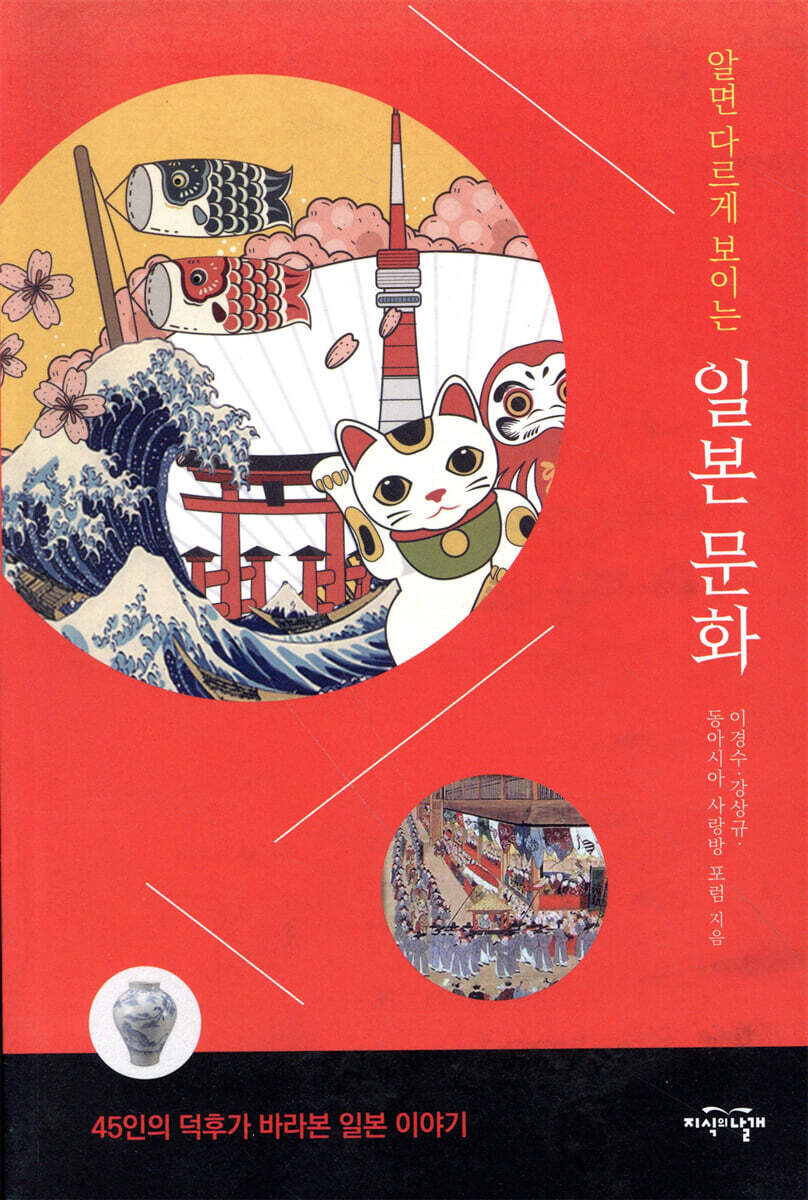 |
Description
Book Introduction
The Story of Japanese Culture by the 45 Joseon Tongsinsa, a 21st-Century Edition
The Joseon Tongsinsa served as a cultural mission between Joseon and Japan.
"Japanese Culture Seen Differently When You Know It" is a book about Japanese culture published based on the contents of studies and discussions about Japan conducted at the "East Asia Love Room Forum," which dreams of becoming a 21st century version of the Joseon Tongsinsa.
Japanese nerds who have studied and experienced Japan in various fields, including Japanese language and literature, history, politics, and economy, talk about Japanese culture with colorful photos.
In particular, the 45 Korean and Japanese forum members who participated as authors guide readers to view Japan in a diverse and three-dimensional way, free from bias and distortion.
Although the 45 authors have different areas of expertise, they share a common goal of viewing Japan “without prejudice.”
This book borrows the framework of collective intelligence in that it allows us to understand the overall characteristics of Japanese culture by looking at various aspects of it together.
As you follow vivid stories such as how the garbage island Naoshima was reborn as an art island, why Japan rebuilds the Ise Grand Shrine every 20 years by moving its location, why Japanese people use ambiguous language when refusing without specifying the circumstances, and whether seppuku, committing suicide for the monarch, was truly a righteous death recognized by all, you will see the difference between Japanese people and Japanese culture.
The Joseon Tongsinsa served as a cultural mission between Joseon and Japan.
"Japanese Culture Seen Differently When You Know It" is a book about Japanese culture published based on the contents of studies and discussions about Japan conducted at the "East Asia Love Room Forum," which dreams of becoming a 21st century version of the Joseon Tongsinsa.
Japanese nerds who have studied and experienced Japan in various fields, including Japanese language and literature, history, politics, and economy, talk about Japanese culture with colorful photos.
In particular, the 45 Korean and Japanese forum members who participated as authors guide readers to view Japan in a diverse and three-dimensional way, free from bias and distortion.
Although the 45 authors have different areas of expertise, they share a common goal of viewing Japan “without prejudice.”
This book borrows the framework of collective intelligence in that it allows us to understand the overall characteristics of Japanese culture by looking at various aspects of it together.
As you follow vivid stories such as how the garbage island Naoshima was reborn as an art island, why Japan rebuilds the Ise Grand Shrine every 20 years by moving its location, why Japanese people use ambiguous language when refusing without specifying the circumstances, and whether seppuku, committing suicide for the monarch, was truly a righteous death recognized by all, you will see the difference between Japanese people and Japanese culture.
- You can preview some of the book's contents.
Preview
index
ingress
1.
Soft power in Japanese communities
Naoshima, the Trash Island, Reborn as Art_Lee Kyung-soo (Professor, Department of Japanese Studies, Korea National Open University)
Japanese Railway Culture Through Rail Travel_Lee Dong-wook (Rail Travel Expert, Tour Guide), Park Eun-mi (Pharmacist, Star Pharmacy)
Nagoya's Power: Transforming from a Factory City to an Eco-Friendly City_Do Ji-young (Kwangwoon University Ph.D. Candidate, Eco-Friendly Factory CEO)
2.
A cross-section of Japanese politics and history
Mensore! Okinawa Historical Journey_Kang Sang-gyu (Professor, Department of Japanese Studies, Korea National Open University)
The Three True Heroes Who Laid the Foundation for the Meiji Restoration_Choi Gap-su (Financial Investment Association)
ㆍThe "Loyalty" of a Samurai: Chushingura and Hagakure_Yoshida Yuko (Ph.D. in Japanese Literature, Lecturer at Chonnam National University)
Japanese History and Culture Through Names_Tsuyuki Mitsuo (Easy Total Support System Engineer), Korean translation: Kim Kyeong-sook
3.
Japanese sentiment and culture
ㆍJapanese culture of randoseru that likes inconspicuous colors_Naomi Ishii (Japan Foundation Japanese Language Proficiency Test Center), Korean translation: Kyung-ae Park
ㆍJapan, the Land of Dolls_Lee Ju-young (Japonism researcher, French and English translator, Japanese doll collector)
ㆍJapanese Sake Culture: A Better Drink When You Know It_Kazumi Gokusho (Professor of Japanese Studies, Dongguk University)
Ise Shrine, a copy and original_Jeong Eun-sun (a person who loves study groups)
The Modern Japanese's Acceptance of Western Culture_Lee Han-jeong (Professor, Sangmyung University)
4.
Japanese architecture, gardens, and tea ceremony
The Japanese Mind in Japanese Cities and Architecture_Woo Chang-yoon (Chairman of the Korea Universal Design Association, Chief Architect, LH Korea Land and Housing Corporation)
A Paradise Created by Man: The Story of Japanese Gardens_Hong Hee-chang (Landscape Architect, Author of "Strolling Through Lee Gyu-bo's Garden")
ㆍJapanese and Tea Ceremony_Jo Yong-ran (Tea Ceremony Expert)
5.
Wisdom of Japan's Aging Society
Japan's Serious Aging Population and Vacant Home Problems_Jeong Woo-ri (Vacant Home Researcher)
Japan's Aging Policy and the Lives of Seniors_Lee Ok-ja (Social Welfare Expert)
6.
Japanese craftsmanship and inventions
Japanese Inventions Embedded in Our Lives_Kang Eun-mi (Former Hanjin Travel Guide Interpreter)
Depachika (Department Store Basement Food Sections) and Japanese Artisan Culture_Mari Nago (Professor, Department of Cultural Tourism Contents, Kyung Hee University)
7.
Traditional culture in modern Japanese society
ㆍA Look at Japanese Festivals_Jeong Su-mi (Cultural Center Instructor)
ㆍWhen you are born, you receive blessings at a shrine, when you are married, you receive happiness at a church, and when you die, you receive prayers at a temple. - Oh Young-sang (News Fim International Department Reporter)
ㆍDisappearing ?湯, Transforming Sento_Yu Chun-mi (Korean Language Instructor at the Sejong Institute of the Korean Cultural Center in Tokyo, Representative of the Majungmul Experience Research Group of the Korean Cultural Association)
Kimono, Fireworks, and Theme Parks_Hong Yu-seon (Japanese translator)
8.
The power that makes Japan a great nation, in its unique culture
Why Do Japanese People Want "Issue"? _ Miho Doi (Professor, College of Liberal Arts, Hansung University)
The Power of Japanese Manga and Animation_Koh Seong-uk (Children's Literature Writer, Former Principal)
Japanese and Club Activities_Tomoko Minezaki (Professor, Hongik University), Korean translation: Sang-Hyeon Park (Professor, Kyunghee Cyber University)
"You ran well." Japan, the land of the marathon_Lee Young-gi (sports reporter for Japan's TVSnext)
9.
Business with Japan
40 Years of Japanese Business - Characteristics of Japanese Society Different from Korea - Kim Hyung-ki (CEO of Maxtel Inc.)
ㆍ30 Years of Trade with Japan and the Japanese Economy_Yang Jae-geun (CEO of JC Harmony)
10.
A literary journey to Japan, a reading powerhouse
ㆍJapan's Reading Passion: Strolling the Used Bookstore Street of Kanda Jinbocho_Park Gyeong-su (Professor, Academic Research, Center for Japanese Culture, Chonnam National University)
ㆍJapanese Literature that Likes to Talk About 'I'_Kang Woo-won (Professor, VERUM College of Liberal Arts, Catholic Kwandong University)
ㆍMori Ogai's "The Abe Clan," a masterpiece of modern Japanese historical fiction - Nam I-sook (Professor of Japanese Language and Literature, Kunsan National University)
11.
Japanese expressions and communication
Are Chinese Characters Really Japanese?_Park Kyung-ae (Japanese Language Education Expert, Konkuk University Lecturer)
Tips for Escape Awkward Japanese Expressions_Sumiyo Ogura (Instructor at the Open University of Korea)
Are Japanese expressions of gratitude and apologies sincere? _Bang Geuk-cheol (Professor of Japanese Language and Culture, Suncheon National University)
ㆍThe Ambiguous Speech of the Japanese and the Janggu_Cho Young-nam (Professor of Japanese Language and Literature, Korea University; Discourse Analysis Researcher)
How often do you hear the Osaka dialect?_Shin Jae-gwan (former CEO of a trading company)
A Japanese Beginner's Tough Translation Story_Kim Min-cheol (Yumin International Law Research Institute, Open University Graduate Student, Attorney)
12.
The culture and history of Japan, a major tourist destination
A tourist destination blessed with natural beauty - Hokkaido, the land of pioneering - Ko Seon-gyeong (Hokkaido University Ph.D. candidate)
A Message of Peace Through Baseball: Hiroshima Carp_Kim Eun-hee (Professor, Department of Japanese Culture Contents, Jeju International University)
Have you heard of the world-renowned porcelain brand Noritake? _Lee Jeong (Adjunct Professor, Aichi Gakuin University)
Nagasaki, the Land of Martyrs, Becomes a Symbol of Japanese Christianity_Kim Kyung-ok (HK Research Professor, Hallym University Institute of Japanese Studies)
13.
The Similar Yet Different Relationship Between Korea and Japan
Koreans living in Shin-Okubo, Japanese visiting Shin-Okubo_Hong Yu-seon (Japanese translator)
Differences in Lifestyle and Culture between Koreans and Japanese_Hong Yu-seon (Japanese Translator)
Things that exist in Korea but not in Japan, and things that exist in Japan but not in Korea_Akiko Yamagishi (Professor of Liberal Arts Japanese, Pohang University)
ㆍEncounter with Princess Deokhye, the ill-fated princess of Joseon_Kazuko Murata (Kanagawa Learning Center, Japan National Open University), Korean translation: Jaegwan Shin
"Edo Period Women and Sexual Customs as Seen by the Joseon Tongsinsa" by Moon Hee-jin (Professor, Faculty of Liberal Arts, Aichi Gakuin University)
1.
Soft power in Japanese communities
Naoshima, the Trash Island, Reborn as Art_Lee Kyung-soo (Professor, Department of Japanese Studies, Korea National Open University)
Japanese Railway Culture Through Rail Travel_Lee Dong-wook (Rail Travel Expert, Tour Guide), Park Eun-mi (Pharmacist, Star Pharmacy)
Nagoya's Power: Transforming from a Factory City to an Eco-Friendly City_Do Ji-young (Kwangwoon University Ph.D. Candidate, Eco-Friendly Factory CEO)
2.
A cross-section of Japanese politics and history
Mensore! Okinawa Historical Journey_Kang Sang-gyu (Professor, Department of Japanese Studies, Korea National Open University)
The Three True Heroes Who Laid the Foundation for the Meiji Restoration_Choi Gap-su (Financial Investment Association)
ㆍThe "Loyalty" of a Samurai: Chushingura and Hagakure_Yoshida Yuko (Ph.D. in Japanese Literature, Lecturer at Chonnam National University)
Japanese History and Culture Through Names_Tsuyuki Mitsuo (Easy Total Support System Engineer), Korean translation: Kim Kyeong-sook
3.
Japanese sentiment and culture
ㆍJapanese culture of randoseru that likes inconspicuous colors_Naomi Ishii (Japan Foundation Japanese Language Proficiency Test Center), Korean translation: Kyung-ae Park
ㆍJapan, the Land of Dolls_Lee Ju-young (Japonism researcher, French and English translator, Japanese doll collector)
ㆍJapanese Sake Culture: A Better Drink When You Know It_Kazumi Gokusho (Professor of Japanese Studies, Dongguk University)
Ise Shrine, a copy and original_Jeong Eun-sun (a person who loves study groups)
The Modern Japanese's Acceptance of Western Culture_Lee Han-jeong (Professor, Sangmyung University)
4.
Japanese architecture, gardens, and tea ceremony
The Japanese Mind in Japanese Cities and Architecture_Woo Chang-yoon (Chairman of the Korea Universal Design Association, Chief Architect, LH Korea Land and Housing Corporation)
A Paradise Created by Man: The Story of Japanese Gardens_Hong Hee-chang (Landscape Architect, Author of "Strolling Through Lee Gyu-bo's Garden")
ㆍJapanese and Tea Ceremony_Jo Yong-ran (Tea Ceremony Expert)
5.
Wisdom of Japan's Aging Society
Japan's Serious Aging Population and Vacant Home Problems_Jeong Woo-ri (Vacant Home Researcher)
Japan's Aging Policy and the Lives of Seniors_Lee Ok-ja (Social Welfare Expert)
6.
Japanese craftsmanship and inventions
Japanese Inventions Embedded in Our Lives_Kang Eun-mi (Former Hanjin Travel Guide Interpreter)
Depachika (Department Store Basement Food Sections) and Japanese Artisan Culture_Mari Nago (Professor, Department of Cultural Tourism Contents, Kyung Hee University)
7.
Traditional culture in modern Japanese society
ㆍA Look at Japanese Festivals_Jeong Su-mi (Cultural Center Instructor)
ㆍWhen you are born, you receive blessings at a shrine, when you are married, you receive happiness at a church, and when you die, you receive prayers at a temple. - Oh Young-sang (News Fim International Department Reporter)
ㆍDisappearing ?湯, Transforming Sento_Yu Chun-mi (Korean Language Instructor at the Sejong Institute of the Korean Cultural Center in Tokyo, Representative of the Majungmul Experience Research Group of the Korean Cultural Association)
Kimono, Fireworks, and Theme Parks_Hong Yu-seon (Japanese translator)
8.
The power that makes Japan a great nation, in its unique culture
Why Do Japanese People Want "Issue"? _ Miho Doi (Professor, College of Liberal Arts, Hansung University)
The Power of Japanese Manga and Animation_Koh Seong-uk (Children's Literature Writer, Former Principal)
Japanese and Club Activities_Tomoko Minezaki (Professor, Hongik University), Korean translation: Sang-Hyeon Park (Professor, Kyunghee Cyber University)
"You ran well." Japan, the land of the marathon_Lee Young-gi (sports reporter for Japan's TVSnext)
9.
Business with Japan
40 Years of Japanese Business - Characteristics of Japanese Society Different from Korea - Kim Hyung-ki (CEO of Maxtel Inc.)
ㆍ30 Years of Trade with Japan and the Japanese Economy_Yang Jae-geun (CEO of JC Harmony)
10.
A literary journey to Japan, a reading powerhouse
ㆍJapan's Reading Passion: Strolling the Used Bookstore Street of Kanda Jinbocho_Park Gyeong-su (Professor, Academic Research, Center for Japanese Culture, Chonnam National University)
ㆍJapanese Literature that Likes to Talk About 'I'_Kang Woo-won (Professor, VERUM College of Liberal Arts, Catholic Kwandong University)
ㆍMori Ogai's "The Abe Clan," a masterpiece of modern Japanese historical fiction - Nam I-sook (Professor of Japanese Language and Literature, Kunsan National University)
11.
Japanese expressions and communication
Are Chinese Characters Really Japanese?_Park Kyung-ae (Japanese Language Education Expert, Konkuk University Lecturer)
Tips for Escape Awkward Japanese Expressions_Sumiyo Ogura (Instructor at the Open University of Korea)
Are Japanese expressions of gratitude and apologies sincere? _Bang Geuk-cheol (Professor of Japanese Language and Culture, Suncheon National University)
ㆍThe Ambiguous Speech of the Japanese and the Janggu_Cho Young-nam (Professor of Japanese Language and Literature, Korea University; Discourse Analysis Researcher)
How often do you hear the Osaka dialect?_Shin Jae-gwan (former CEO of a trading company)
A Japanese Beginner's Tough Translation Story_Kim Min-cheol (Yumin International Law Research Institute, Open University Graduate Student, Attorney)
12.
The culture and history of Japan, a major tourist destination
A tourist destination blessed with natural beauty - Hokkaido, the land of pioneering - Ko Seon-gyeong (Hokkaido University Ph.D. candidate)
A Message of Peace Through Baseball: Hiroshima Carp_Kim Eun-hee (Professor, Department of Japanese Culture Contents, Jeju International University)
Have you heard of the world-renowned porcelain brand Noritake? _Lee Jeong (Adjunct Professor, Aichi Gakuin University)
Nagasaki, the Land of Martyrs, Becomes a Symbol of Japanese Christianity_Kim Kyung-ok (HK Research Professor, Hallym University Institute of Japanese Studies)
13.
The Similar Yet Different Relationship Between Korea and Japan
Koreans living in Shin-Okubo, Japanese visiting Shin-Okubo_Hong Yu-seon (Japanese translator)
Differences in Lifestyle and Culture between Koreans and Japanese_Hong Yu-seon (Japanese Translator)
Things that exist in Korea but not in Japan, and things that exist in Japan but not in Korea_Akiko Yamagishi (Professor of Liberal Arts Japanese, Pohang University)
ㆍEncounter with Princess Deokhye, the ill-fated princess of Joseon_Kazuko Murata (Kanagawa Learning Center, Japan National Open University), Korean translation: Jaegwan Shin
"Edo Period Women and Sexual Customs as Seen by the Joseon Tongsinsa" by Moon Hee-jin (Professor, Faculty of Liberal Arts, Aichi Gakuin University)
Detailed image
.jpg)
Into the book
The more I learn about Japan, the more I realize that it is a country with a unique charm.
However, rather than simply dismissing Japan as a “peculiar and strange country,” we need to understand why Japan has these characteristics.
Understanding Japan like this is never easy.
This book contains various stories about Japan as seen through the eyes of Koreans and Japanese who are seriously studying Japan.
I hope that my efforts to gain a correct understanding of Japan through books and experiences will provide stimulation and inspiration to readers interested in Japan.
So, if the number of readers who want to understand Japan more objectively and three-dimensionally increases, I think it will be worthwhile for this book to be published.
I hope this book will serve as a small stepping stone in narrowing the gap with Japan.
--- p.11, from "Introduction"
The underground art museum he designed was built underground, as its name suggests, so as not to damage the scenery of the Seto Inland Sea.
Looking down from above, you can only see square, rectangular, and triangular holes, everything else is dirt.
The art gallery has a large open ceiling, so the expression of the artwork changes depending on the angle of the sunlight coming in.
Light and wind were incorporated into the work.
Tadao Ando said, “Architecture should not talk too much.
“Architecture should be quiet and let the wind and light speak instead,” he says.
Literally, the center of Ando's architecture is 'emptiness'.
The Jijung Art Museum is dominated by light, wind, emptiness, and nature.
Only the works of three artists are permanently exhibited here: Monet, James Turrell, and Walter de Maria.
--- p.17, from “Naoshima, the Trash Island, Reborn as Art”
In Shinto, a Japanese folk religion, it is believed that all things have a soul.
Dolls are no exception.
Of course, we cannot assume that all Japanese people living in the 21st century believe this, but there are quite a few who fundamentally treat dolls as if they were living beings.
A good example of this is the doll hospital and doll donation.
Doll hospitals that repair broken or worn-out dolls exist in the United States and France as well, so it cannot be said to be a culture unique to Japan.
But in Japan, there is a special doll hospital.
It is a workshop run by a family of doll craftsmen who repair or restore traditional dolls that have become worn out over time.
For example, in Chiba Prefecture, near Tokyo, there is a workshop belonging to the famous Iwamura family, which has been making Ichimatsu dolls (traditional Japanese dolls that realistically depict children) for four generations.
In addition to its own products, Iwamura Doll Workshop also repairs Ichimatsu dolls from other companies.
-- p.95~96, from “Japan, the Land of Dolls”
Even putting aside the emotional gap on historical issues, there are many parts that make you feel 'it's very different from Korea.'
One of them is related to religion.
Korea has a clear religious distinction.
It is difficult to imagine a Christian going to a temple to perform a ritual, or a Buddhist getting married in a church.
Still, Japan is different.
When a baby is born, people visit a shrine to pray for health and a bright future. When they get married, they hold a wedding ceremony at a church or cathedral. And when they have a funeral, they go to a temple and hold a Buddhist ceremony.
It is truly a country that is both close and far away, yet so unknown.
--- p.205, from “When you are born, you receive blessings at a ‘shrine’, when you get married, you receive happiness at a ‘church’, and when you die, you receive prayers at a ‘temple’”
Mori Ogai (1862-1922), a master of modern literature, used this incident as material for his novel “The Abe Clan” published in 1913.
According to Fujimoto Chizuko, this work is one of Ogai's finest and a representative masterpiece of historical novels, and much research has been conducted on it.
At the time the work was published, Japan had completed its modernization process and was on par with Western powers, forcibly annexing its neighboring country Joseon and burning with ambitions to invade the continent.
Why did the author, at this time, bring to the forefront the outdated feudal spirit of warriorism and write a work based on an incident in which a man followed his lord to his death?
Kikuchi Kan finds his motif in the seppuku incident of Army General Nogi Maresuke, who committed suicide after the death of Emperor Meiji, the pivotal figure in the construction of modern Japan.
-- p.311~312, from "Abe Clan, a masterpiece of modern Japanese historical novels, by Mori Ogai"
Regarding the Japanese way of refusing, “This week is a bit…”, Koreans feel uneasy about why they don’t clearly refuse without giving a reason.
However, the method of refusing without explaining the reasons in detail is naturally accepted among Japanese people.
Instead of explaining the reasons for refusal in detail, they sometimes use vague expressions like “I’m not in a good mood this week…”
By using this expression, you indirectly convey your unacceptable intentions and appeal to the other person to understand.
As mentioned above, Japanese is a language in which the intent of a utterance can be understood through context or situation even without the speaker having finished speaking, so ambiguous speech patterns in incomplete sentences are allowed.
This way of expression is possible because it is a language culture that respects the private space of individuals and prevents misunderstandings even when a specific reason is not given when refusing.
--- p.355, from “The Ambiguous Speech and Interjections of the Japanese”
In the early days of its founding, Hiroshima was in last place and was not even able to pay the players' salaries, which was a problem for the team.
The team became a burden to the league, and rumors of a merger were raised just two years after its founding.
The Kap fans opposed the merger and did everything they could to protect the club.
A fundraising campaign to save the club was launched when 400 police officers from the Hiroshima City Police Department donated money to the club.
A wooden barrel for soaking alcohol was placed in front of the baseball field to collect donations, so that people could freely donate at any time.
As a result of the fundraising campaign, KAPF was able to avoid the crisis of merger and dissolution and make a fresh start.
It was possible because it was a citizens' club.
More important than the story of the poor club and the struggles of the players who don't receive salaries is the love of baseball among the citizens of Hiroshima who did not hesitate to save their food expenses to pay the baseball game ticket price.
Their situation may have overlapped with that of the Kap, who was having a hard time winning.
In this way, KAPF, which comforted the sorrow of the people in the atomic bomb area, became a spiritual pillar of Hiroshima, and as times changed, it gradually became established as a local content.
However, rather than simply dismissing Japan as a “peculiar and strange country,” we need to understand why Japan has these characteristics.
Understanding Japan like this is never easy.
This book contains various stories about Japan as seen through the eyes of Koreans and Japanese who are seriously studying Japan.
I hope that my efforts to gain a correct understanding of Japan through books and experiences will provide stimulation and inspiration to readers interested in Japan.
So, if the number of readers who want to understand Japan more objectively and three-dimensionally increases, I think it will be worthwhile for this book to be published.
I hope this book will serve as a small stepping stone in narrowing the gap with Japan.
--- p.11, from "Introduction"
The underground art museum he designed was built underground, as its name suggests, so as not to damage the scenery of the Seto Inland Sea.
Looking down from above, you can only see square, rectangular, and triangular holes, everything else is dirt.
The art gallery has a large open ceiling, so the expression of the artwork changes depending on the angle of the sunlight coming in.
Light and wind were incorporated into the work.
Tadao Ando said, “Architecture should not talk too much.
“Architecture should be quiet and let the wind and light speak instead,” he says.
Literally, the center of Ando's architecture is 'emptiness'.
The Jijung Art Museum is dominated by light, wind, emptiness, and nature.
Only the works of three artists are permanently exhibited here: Monet, James Turrell, and Walter de Maria.
--- p.17, from “Naoshima, the Trash Island, Reborn as Art”
In Shinto, a Japanese folk religion, it is believed that all things have a soul.
Dolls are no exception.
Of course, we cannot assume that all Japanese people living in the 21st century believe this, but there are quite a few who fundamentally treat dolls as if they were living beings.
A good example of this is the doll hospital and doll donation.
Doll hospitals that repair broken or worn-out dolls exist in the United States and France as well, so it cannot be said to be a culture unique to Japan.
But in Japan, there is a special doll hospital.
It is a workshop run by a family of doll craftsmen who repair or restore traditional dolls that have become worn out over time.
For example, in Chiba Prefecture, near Tokyo, there is a workshop belonging to the famous Iwamura family, which has been making Ichimatsu dolls (traditional Japanese dolls that realistically depict children) for four generations.
In addition to its own products, Iwamura Doll Workshop also repairs Ichimatsu dolls from other companies.
-- p.95~96, from “Japan, the Land of Dolls”
Even putting aside the emotional gap on historical issues, there are many parts that make you feel 'it's very different from Korea.'
One of them is related to religion.
Korea has a clear religious distinction.
It is difficult to imagine a Christian going to a temple to perform a ritual, or a Buddhist getting married in a church.
Still, Japan is different.
When a baby is born, people visit a shrine to pray for health and a bright future. When they get married, they hold a wedding ceremony at a church or cathedral. And when they have a funeral, they go to a temple and hold a Buddhist ceremony.
It is truly a country that is both close and far away, yet so unknown.
--- p.205, from “When you are born, you receive blessings at a ‘shrine’, when you get married, you receive happiness at a ‘church’, and when you die, you receive prayers at a ‘temple’”
Mori Ogai (1862-1922), a master of modern literature, used this incident as material for his novel “The Abe Clan” published in 1913.
According to Fujimoto Chizuko, this work is one of Ogai's finest and a representative masterpiece of historical novels, and much research has been conducted on it.
At the time the work was published, Japan had completed its modernization process and was on par with Western powers, forcibly annexing its neighboring country Joseon and burning with ambitions to invade the continent.
Why did the author, at this time, bring to the forefront the outdated feudal spirit of warriorism and write a work based on an incident in which a man followed his lord to his death?
Kikuchi Kan finds his motif in the seppuku incident of Army General Nogi Maresuke, who committed suicide after the death of Emperor Meiji, the pivotal figure in the construction of modern Japan.
-- p.311~312, from "Abe Clan, a masterpiece of modern Japanese historical novels, by Mori Ogai"
Regarding the Japanese way of refusing, “This week is a bit…”, Koreans feel uneasy about why they don’t clearly refuse without giving a reason.
However, the method of refusing without explaining the reasons in detail is naturally accepted among Japanese people.
Instead of explaining the reasons for refusal in detail, they sometimes use vague expressions like “I’m not in a good mood this week…”
By using this expression, you indirectly convey your unacceptable intentions and appeal to the other person to understand.
As mentioned above, Japanese is a language in which the intent of a utterance can be understood through context or situation even without the speaker having finished speaking, so ambiguous speech patterns in incomplete sentences are allowed.
This way of expression is possible because it is a language culture that respects the private space of individuals and prevents misunderstandings even when a specific reason is not given when refusing.
--- p.355, from “The Ambiguous Speech and Interjections of the Japanese”
In the early days of its founding, Hiroshima was in last place and was not even able to pay the players' salaries, which was a problem for the team.
The team became a burden to the league, and rumors of a merger were raised just two years after its founding.
The Kap fans opposed the merger and did everything they could to protect the club.
A fundraising campaign to save the club was launched when 400 police officers from the Hiroshima City Police Department donated money to the club.
A wooden barrel for soaking alcohol was placed in front of the baseball field to collect donations, so that people could freely donate at any time.
As a result of the fundraising campaign, KAPF was able to avoid the crisis of merger and dissolution and make a fresh start.
It was possible because it was a citizens' club.
More important than the story of the poor club and the struggles of the players who don't receive salaries is the love of baseball among the citizens of Hiroshima who did not hesitate to save their food expenses to pay the baseball game ticket price.
Their situation may have overlapped with that of the Kap, who was having a hard time winning.
In this way, KAPF, which comforted the sorrow of the people in the atomic bomb area, became a spiritual pillar of Hiroshima, and as times changed, it gradually became established as a local content.
--- p.401~402, from "A Message of Peace Delivered through Baseball, Hiroshima Carp"
Publisher's Review
What 45 Fans Say
Vivid and specific Japanese culture
Geeks from various fields such as language, politics, history, emotions, architecture, and business gathered together.
What they have in common is that they study Japanese culture.
The members of the 'East Asia Love Room Forum', led by Professors Lee Kyung-soo and Kang Sang-gyu of the Department of Japanese Studies at the Korea National Open University, have different occupations and areas of interest, but have met twice a year since 2017 to discuss what they have learned about Japanese culture.
This book, "Japanese Culture: A Different Look When You Know It," is a compilation of essays by 45 members who gathered together with the aim of looking at Japan in a diverse and three-dimensional way, free from bias and distortion.
Both Korean and Japanese authors participate, providing a balanced perspective on Japanese culture.
Without prejudice and distortion
A Diverse and Three-Dimensional View of Japanese Culture
Naoshima Island, once abandoned as a dumping ground for Mitsubishi's industrial waste, has been reborn as an island of art and a world-renowned tourist attraction through the collaboration between the Benesse Group and architect Tadao Ando, a testament to Japan's strong focus on storytelling.
And the Ise Grand Shrine, which is relocated and rebuilt every 20 years, the traditional festival Matsuri, and the bathing culture of Sento clearly demonstrate Japan's unique way of preserving and developing ancient culture and passing it down to future generations.
In particular, Ise Grand Shrine is a "copy" that is rebuilt every 20 years to preserve its original appearance and pass down the construction techniques to future generations, but it represents the strong belief of the Japanese people that it is the "original" where the gods that have existed for 2,000 years still reside.
When Japanese people are in conversation, they tend to use ambiguous language and incomplete sentences at the moment of rejection. This is a hidden part of the Japanese language culture that respects private space and avoids misunderstandings even without revealing specific circumstances.
They also play the janggu (a Korean traditional drum) excessively often, and the janggu is considered an important communication technique in Japan that can greatly change human relationships.
In his novel "The Abe Clan," Mori Ogai, a master of modern literature, questions are raised about the practice of seppuku, the suicide of samurai in feudal Japan.
In a situation where committing seppuku without the permission of one's lord is condemned as a meaningless death that deserves to be condemned, the story of the protagonist Abe Yaichiemon, who was not permitted to commit suicide, and his family who eventually met a miserable death, makes the reader feel deep compassion.
In addition, it vividly examines aspects of Japanese culture, including Japanese architecture and gardens that make the most of the natural landscape without harming it, Japanese doll culture represented by doll hospitals and doll offerings, and Japanese religions that coexist with Shintoism, Christianity, and Buddhism.
The 21st century version of Joseon Tongsinsa dreams of
Future Relations between Korea and Japan
In “Japanese Culture: A Different Look When You Know It,” we can see traces of efforts to view Japan without prejudice or distortion.
Today, Korea-Japan relations are shrouded in fog, making it impossible to see even an inch ahead. However, I hope that this book will increase the number of readers who take an interest in Japan and seek to understand it more objectively and three-dimensionally.
If that happens, Japan will no longer be a “close yet distant country,” but will be reborn as a country that is psychologically close.
Vivid and specific Japanese culture
Geeks from various fields such as language, politics, history, emotions, architecture, and business gathered together.
What they have in common is that they study Japanese culture.
The members of the 'East Asia Love Room Forum', led by Professors Lee Kyung-soo and Kang Sang-gyu of the Department of Japanese Studies at the Korea National Open University, have different occupations and areas of interest, but have met twice a year since 2017 to discuss what they have learned about Japanese culture.
This book, "Japanese Culture: A Different Look When You Know It," is a compilation of essays by 45 members who gathered together with the aim of looking at Japan in a diverse and three-dimensional way, free from bias and distortion.
Both Korean and Japanese authors participate, providing a balanced perspective on Japanese culture.
Without prejudice and distortion
A Diverse and Three-Dimensional View of Japanese Culture
Naoshima Island, once abandoned as a dumping ground for Mitsubishi's industrial waste, has been reborn as an island of art and a world-renowned tourist attraction through the collaboration between the Benesse Group and architect Tadao Ando, a testament to Japan's strong focus on storytelling.
And the Ise Grand Shrine, which is relocated and rebuilt every 20 years, the traditional festival Matsuri, and the bathing culture of Sento clearly demonstrate Japan's unique way of preserving and developing ancient culture and passing it down to future generations.
In particular, Ise Grand Shrine is a "copy" that is rebuilt every 20 years to preserve its original appearance and pass down the construction techniques to future generations, but it represents the strong belief of the Japanese people that it is the "original" where the gods that have existed for 2,000 years still reside.
When Japanese people are in conversation, they tend to use ambiguous language and incomplete sentences at the moment of rejection. This is a hidden part of the Japanese language culture that respects private space and avoids misunderstandings even without revealing specific circumstances.
They also play the janggu (a Korean traditional drum) excessively often, and the janggu is considered an important communication technique in Japan that can greatly change human relationships.
In his novel "The Abe Clan," Mori Ogai, a master of modern literature, questions are raised about the practice of seppuku, the suicide of samurai in feudal Japan.
In a situation where committing seppuku without the permission of one's lord is condemned as a meaningless death that deserves to be condemned, the story of the protagonist Abe Yaichiemon, who was not permitted to commit suicide, and his family who eventually met a miserable death, makes the reader feel deep compassion.
In addition, it vividly examines aspects of Japanese culture, including Japanese architecture and gardens that make the most of the natural landscape without harming it, Japanese doll culture represented by doll hospitals and doll offerings, and Japanese religions that coexist with Shintoism, Christianity, and Buddhism.
The 21st century version of Joseon Tongsinsa dreams of
Future Relations between Korea and Japan
In “Japanese Culture: A Different Look When You Know It,” we can see traces of efforts to view Japan without prejudice or distortion.
Today, Korea-Japan relations are shrouded in fog, making it impossible to see even an inch ahead. However, I hope that this book will increase the number of readers who take an interest in Japan and seek to understand it more objectively and three-dimensionally.
If that happens, Japan will no longer be a “close yet distant country,” but will be reborn as a country that is psychologically close.
GOODS SPECIFICS
- Date of issue: May 3, 2021
- Page count, weight, size: 488 pages | 702g | 152*225*20mm
- ISBN13: 9788920040368
- ISBN10: 8920040362
You may also like
카테고리
korean


korean

![GQ KOREA Mark (Monthly): December [2025]](http://librairie.coreenne.fr/cdn/shop/files/8ef265dbbfbf186523ed75ba7319009d.jpg?v=1765340328&width=3840)


