

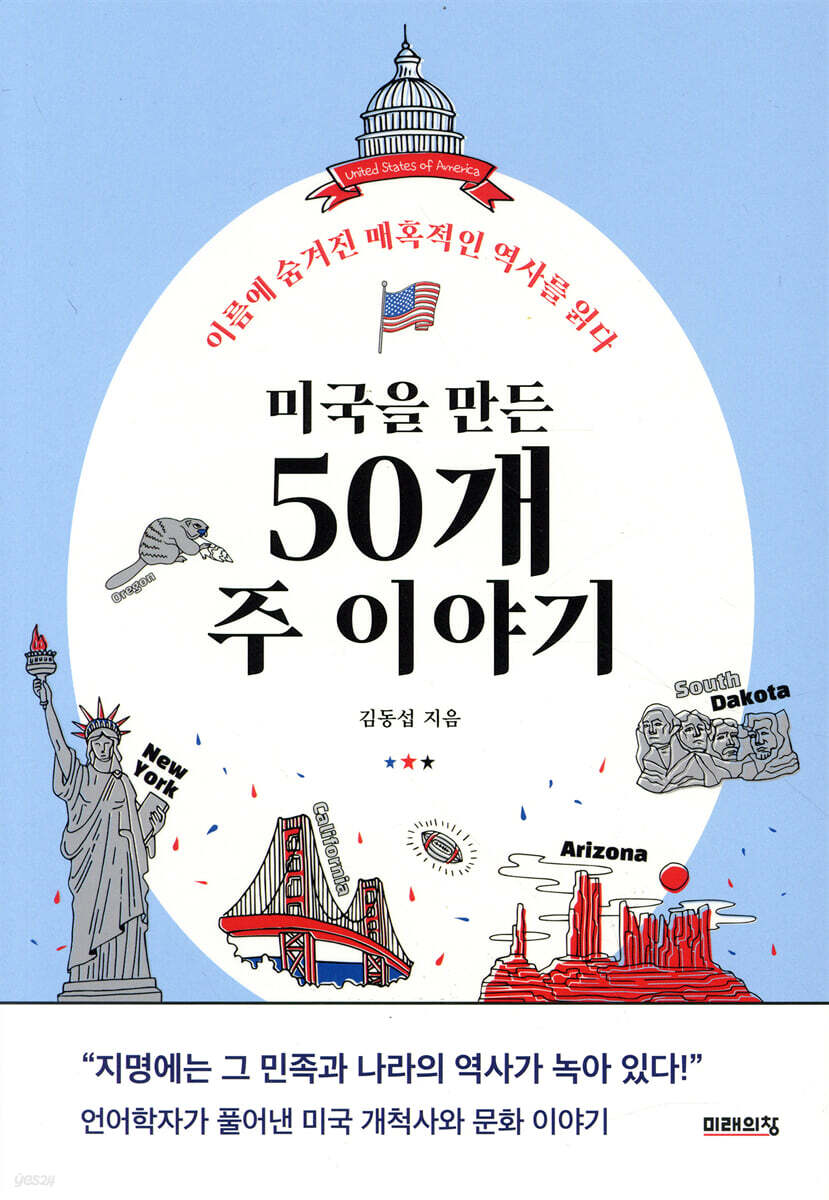
The Story of the 50 States That Made America
 |
Description
Book Introduction
How did the America we know today come to be?
An exciting historical and cultural journey through the 50 states of the United States!
* Which state in the United States has the largest white population?
* Where did the people of Roanoke, the first colony, disappear to?
* California was the name of an island that appeared in a Spanish novel.
* How did Mexico lose Texas?
* Minnesota, Missouri, Michigan… Why are there so many place names in the US that start with ‘mi’?
* Was Alaska really a useless land?
* Why did the United States annex Hawaii as its territory?
This book provides a glimpse into American history through the names of the 50 states and cities.
Place names contain the stories and history of the people who built that region.
The British who came in search of religious freedom, the French who settled in Canada, the Spanish who first established colonies, and even the indigenous people who were the original owners of this land.
What history did the North American continent undergo, and into whose hands did it come? How they created their own world on the continent can be revealed by examining the names they left behind.
The author, a linguist, explores the diverse landscape of America through linguistics, anthropology, and mythology.
It not only details the process by which the United States expanded its territory from the Atlantic to the Pacific, but also the sorrows of the indigenous people who lost their homelands and the unique cultures and episodes of each state, allowing for a comprehensive understanding of the United States.
As you read the story of the 50 states, you will find yourself with the entire history of the United States in your head.
An exciting historical and cultural journey through the 50 states of the United States!
* Which state in the United States has the largest white population?
* Where did the people of Roanoke, the first colony, disappear to?
* California was the name of an island that appeared in a Spanish novel.
* How did Mexico lose Texas?
* Minnesota, Missouri, Michigan… Why are there so many place names in the US that start with ‘mi’?
* Was Alaska really a useless land?
* Why did the United States annex Hawaii as its territory?
This book provides a glimpse into American history through the names of the 50 states and cities.
Place names contain the stories and history of the people who built that region.
The British who came in search of religious freedom, the French who settled in Canada, the Spanish who first established colonies, and even the indigenous people who were the original owners of this land.
What history did the North American continent undergo, and into whose hands did it come? How they created their own world on the continent can be revealed by examining the names they left behind.
The author, a linguist, explores the diverse landscape of America through linguistics, anthropology, and mythology.
It not only details the process by which the United States expanded its territory from the Atlantic to the Pacific, but also the sorrows of the indigenous people who lost their homelands and the unique cultures and episodes of each state, allowing for a comprehensive understanding of the United States.
As you read the story of the 50 states, you will find yourself with the entire history of the United States in your head.
- You can preview some of the book's contents.
Preview
index
Entering 4
Part 1: Colonial Development in North America
Spain, the pioneer of North America 17
28 from France, Canada to Louisiana
Britain, the last country to land but ultimately the victor
The French and Indian War, the New Hundred Years' War 49
Part 2: The Birth of New England: The Eastern Region
57 from New York, New Amsterdam to New York
Jersey Island 64 off the coast of Normandy, New Jersey
New Hampshire, State 68 in the election
Rhode Island, the smallest state with the longest name (76)
Connecticut, State 80 of the Constitution
Pennsylvania, Land of Penn's Woods 84
Delaware first admitted to the United States in 1889
Virginia, Birthplace of the Virgin Queen and American Presidents 93
West Virginia, the Mountain State 99
Maryland, Land of the French Princess 104
South Carolina, Charles II's Land 108
North Carolina, Lost Colony 112
Massachusetts, New England's largest city 116
Georgia, a colony born of humanity 122
Maine, the French region of Maine? The state of Maine? 127
Part 3: Central France's Perfume Region
Louisiana, one-quarter of the continental United States 133
Ohio, State 138 of the 3C
Vermont, the Blue Mountain State 143
Illinois, home to Chicago, the third-largest city in the country, is ranked 147th.
Kansas, The Wizard of Oz 152
Wisconsin, Badger County 156
Michigan, the Great Lakes State 160
Iowa, a weather vane for the presidential election 165
Mississippi, the State of Hospitality 170
Part 4: Footsteps of the Natives: Central Region
Alabama, Heart of Dixie 177
Arkansas, people living downstream of the river 182
Indiana, Native American 187
Kentucky, the home of Lincoln and bourbon whiskey 192
Minnesota, Descendants of the Vikings 197
Missouri, Show Me! 201
Nebraska, Warren Buffett's hometown 206
South Dakota, Presidents of Mount Rushmore 210
North Dakota, Germany in America 214
Oklahoma, Land of the First Settlers 217
Tennessee, Civil War Battlefield 220
Part 5: Descendants of Spain: Western Region
Arizona, State of the Grand Canyon 227
Florida, the State of Flowers and Sun 233
Idaho, the Gem State 238
Montana, the State of Gold and Silver 242
State 247, Las Vegas, Nevada
New Mexico, Land of Enchantment 251
Oregon, Beaver State 256
Texas, One Star 260
Utah, Mormon Holy Land 267
Washington, D.C., 88 Washington 271
Wyoming, State of the Great Plains 276
California, the Gold Rush State 280
Colorado, Centennial State 287
Alaska, Bering Sea Refrigerator 291
Hawaii, Aloha State 296
Note, image source 302
Part 1: Colonial Development in North America
Spain, the pioneer of North America 17
28 from France, Canada to Louisiana
Britain, the last country to land but ultimately the victor
The French and Indian War, the New Hundred Years' War 49
Part 2: The Birth of New England: The Eastern Region
57 from New York, New Amsterdam to New York
Jersey Island 64 off the coast of Normandy, New Jersey
New Hampshire, State 68 in the election
Rhode Island, the smallest state with the longest name (76)
Connecticut, State 80 of the Constitution
Pennsylvania, Land of Penn's Woods 84
Delaware first admitted to the United States in 1889
Virginia, Birthplace of the Virgin Queen and American Presidents 93
West Virginia, the Mountain State 99
Maryland, Land of the French Princess 104
South Carolina, Charles II's Land 108
North Carolina, Lost Colony 112
Massachusetts, New England's largest city 116
Georgia, a colony born of humanity 122
Maine, the French region of Maine? The state of Maine? 127
Part 3: Central France's Perfume Region
Louisiana, one-quarter of the continental United States 133
Ohio, State 138 of the 3C
Vermont, the Blue Mountain State 143
Illinois, home to Chicago, the third-largest city in the country, is ranked 147th.
Kansas, The Wizard of Oz 152
Wisconsin, Badger County 156
Michigan, the Great Lakes State 160
Iowa, a weather vane for the presidential election 165
Mississippi, the State of Hospitality 170
Part 4: Footsteps of the Natives: Central Region
Alabama, Heart of Dixie 177
Arkansas, people living downstream of the river 182
Indiana, Native American 187
Kentucky, the home of Lincoln and bourbon whiskey 192
Minnesota, Descendants of the Vikings 197
Missouri, Show Me! 201
Nebraska, Warren Buffett's hometown 206
South Dakota, Presidents of Mount Rushmore 210
North Dakota, Germany in America 214
Oklahoma, Land of the First Settlers 217
Tennessee, Civil War Battlefield 220
Part 5: Descendants of Spain: Western Region
Arizona, State of the Grand Canyon 227
Florida, the State of Flowers and Sun 233
Idaho, the Gem State 238
Montana, the State of Gold and Silver 242
State 247, Las Vegas, Nevada
New Mexico, Land of Enchantment 251
Oregon, Beaver State 256
Texas, One Star 260
Utah, Mormon Holy Land 267
Washington, D.C., 88 Washington 271
Wyoming, State of the Great Plains 276
California, the Gold Rush State 280
Colorado, Centennial State 287
Alaska, Bering Sea Refrigerator 291
Hawaii, Aloha State 296
Note, image source 302
Detailed image
.jpg)
Into the book
In fact, when Spain arrived in the Americas, there were a whopping 25 million people living in Mexico.
It was virtually impossible to conquer the natives by force.
However, smallpox, an infectious disease introduced by Europeans, killed 90% of the natives.
--- p.43
France abandoned the New World, which was just beginning to emerge, in order to seize the fading kingdom of Spain.
In 1754, the British colonial population reached one million, but the French population of New France was only 80,000.
Hegemony in North America had already shifted to Britain.
The fact that the French did not migrate to New France is proof that their home country was a comfortable place to live, and the decisive difference was that the French government prevented the immigration of the Huguenots, who formed the middle class.
In the end, the winner of the North American continent was Britain.
--- p.47~48
Wall Street, now Manhattan's most famous street, was once a place of frequent conflict between Dutch and Indian people.
The Dutch built a fence (wall) across the island here as a truce line to prevent attacks, and this is the origin of Wall Street.
--- p.59
The reason the United States does not designate an official language at the federal level is because many ethnicities and languages coexist in the United States, and to respect linguistic and cultural diversity.
--- p.62
The United States uses an indirect election system rather than direct elections.
Voters do not vote for a presidential candidate, but rather for a group of electors who have pledged to support a particular candidate, and the electors then choose the president.
The candidate who secures a majority of the electoral votes assigned to each state is elected president.
Because the so-called "winner-takes-it-all" system means that if a state has just one more vote for a particular candidate, the entire Electoral College will vote for that candidate, swing states that do not tend to support a particular party hold an important position.
--- p.73
Until recently, there have been many studies on the reasons for the disappearance of the Roanoke Island immigrants.
According to archaeological excavations at East Carolina University in 1998, a 16th-century British signet ring was discovered on the island.
A study of weather conditions in the late 16th century revealed that the Roanoke Island area was experiencing a severe drought.
Some scholars even claim that the Croats massacred the immigrants and offered them up as sacrifices.
Roanoke, the first British colony, disappeared overnight.
--- p.114
Ohio means "good river" in the language of the Iroquois tribe.
The French who settled in this area translated 'Ohio' into French as 'Bonne Riviere (good river).'
Among the names of states, those that come from the languages of the Indians are often derived from the names of rivers.
If France had conquered Britain in North America, Ohio might have been called Bonne-Rivière.
--- p.139
Minnesota, located in the northernmost part of the central United States, is one of the states with the highest percentage of white population in the country.
While the average white population in the United States is 72%, Minnesota's white population is nearly 90%.
What is unusual is that among them, 38% are of German descent and 32% are of Northern European descent.
Among the Nordic people, the largest number are Norwegians, followed by Swedes and Danes.
In other words, it can be said that Minnesota is the state in the United States where the largest number of Viking descendants live.
--- p.197
There are 565 Native American tribes in the United States, and the Navajo are the largest, with a population of approximately 300,000.
They live on Indian reservations in Arizona, New Mexico, and Utah, which together cover an area equivalent to 70% of South Korea (7,100 square kilometers).
The Navajo Nation makes Window Rock, Arizona, their capital, and calls the area they live in the Navajo Nation.
But do Indians really live freely in their own country on the reservation?
--- p.229
Three of the top 10 largest cities in the United States by population are located in Texas.
Examples include Houston (4th, population 2.3 million), San Antonio (7th, population 1.5 million), and Dallas (9th, population 1.34 million).
While Texas is often associated with oil and desolate land, it is also economically significant, with a GDP that would rank 10th in the world if it were a single country.
--- p.260~261
The word 'Texas' is a Spanish translation of the word 'Taisha', meaning 'friend' in the language of the Caddo people, the indigenous people of this region.
The United States annexed Texas, the "land of friends" that had called them home, through a war with Mexico.
And the official motto of the state was set as 'Friendship'.
It's ironic that he took his friend's land but still wanted to keep his friendship with him.
The United States, Spain, and France fought over control of Texas, but the United States ultimately prevailed, and Texas brought enormous wealth to the United States.
--- p.262~263
In the early 19th century, there were 60 million buffalo living in North America.
The Indians lived by eating buffalo meat and making clothes from its hide.
Since buffalo was a totemic symbol to the Indians, they hunted only as many buffalo as they needed.
As they pioneered the West, white people began slaughtering buffalo.
The reason was that buffalo were an obstacle to laying the railroad.
But the real reason was to take over the Indians' land by destroying the buffalo that provided food, clothing, and shelter for them.
--- p.277
By the end of the 19th century, the Kingdom of Hawaii was gradually modernizing itself by accepting Western civilization.
But at that time, many Americans came to Hawaii to manage sugarcane farms.
The same method used to incorporate Texas into the United States was also applied to Hawaii.
It was virtually impossible to conquer the natives by force.
However, smallpox, an infectious disease introduced by Europeans, killed 90% of the natives.
--- p.43
France abandoned the New World, which was just beginning to emerge, in order to seize the fading kingdom of Spain.
In 1754, the British colonial population reached one million, but the French population of New France was only 80,000.
Hegemony in North America had already shifted to Britain.
The fact that the French did not migrate to New France is proof that their home country was a comfortable place to live, and the decisive difference was that the French government prevented the immigration of the Huguenots, who formed the middle class.
In the end, the winner of the North American continent was Britain.
--- p.47~48
Wall Street, now Manhattan's most famous street, was once a place of frequent conflict between Dutch and Indian people.
The Dutch built a fence (wall) across the island here as a truce line to prevent attacks, and this is the origin of Wall Street.
--- p.59
The reason the United States does not designate an official language at the federal level is because many ethnicities and languages coexist in the United States, and to respect linguistic and cultural diversity.
--- p.62
The United States uses an indirect election system rather than direct elections.
Voters do not vote for a presidential candidate, but rather for a group of electors who have pledged to support a particular candidate, and the electors then choose the president.
The candidate who secures a majority of the electoral votes assigned to each state is elected president.
Because the so-called "winner-takes-it-all" system means that if a state has just one more vote for a particular candidate, the entire Electoral College will vote for that candidate, swing states that do not tend to support a particular party hold an important position.
--- p.73
Until recently, there have been many studies on the reasons for the disappearance of the Roanoke Island immigrants.
According to archaeological excavations at East Carolina University in 1998, a 16th-century British signet ring was discovered on the island.
A study of weather conditions in the late 16th century revealed that the Roanoke Island area was experiencing a severe drought.
Some scholars even claim that the Croats massacred the immigrants and offered them up as sacrifices.
Roanoke, the first British colony, disappeared overnight.
--- p.114
Ohio means "good river" in the language of the Iroquois tribe.
The French who settled in this area translated 'Ohio' into French as 'Bonne Riviere (good river).'
Among the names of states, those that come from the languages of the Indians are often derived from the names of rivers.
If France had conquered Britain in North America, Ohio might have been called Bonne-Rivière.
--- p.139
Minnesota, located in the northernmost part of the central United States, is one of the states with the highest percentage of white population in the country.
While the average white population in the United States is 72%, Minnesota's white population is nearly 90%.
What is unusual is that among them, 38% are of German descent and 32% are of Northern European descent.
Among the Nordic people, the largest number are Norwegians, followed by Swedes and Danes.
In other words, it can be said that Minnesota is the state in the United States where the largest number of Viking descendants live.
--- p.197
There are 565 Native American tribes in the United States, and the Navajo are the largest, with a population of approximately 300,000.
They live on Indian reservations in Arizona, New Mexico, and Utah, which together cover an area equivalent to 70% of South Korea (7,100 square kilometers).
The Navajo Nation makes Window Rock, Arizona, their capital, and calls the area they live in the Navajo Nation.
But do Indians really live freely in their own country on the reservation?
--- p.229
Three of the top 10 largest cities in the United States by population are located in Texas.
Examples include Houston (4th, population 2.3 million), San Antonio (7th, population 1.5 million), and Dallas (9th, population 1.34 million).
While Texas is often associated with oil and desolate land, it is also economically significant, with a GDP that would rank 10th in the world if it were a single country.
--- p.260~261
The word 'Texas' is a Spanish translation of the word 'Taisha', meaning 'friend' in the language of the Caddo people, the indigenous people of this region.
The United States annexed Texas, the "land of friends" that had called them home, through a war with Mexico.
And the official motto of the state was set as 'Friendship'.
It's ironic that he took his friend's land but still wanted to keep his friendship with him.
The United States, Spain, and France fought over control of Texas, but the United States ultimately prevailed, and Texas brought enormous wealth to the United States.
--- p.262~263
In the early 19th century, there were 60 million buffalo living in North America.
The Indians lived by eating buffalo meat and making clothes from its hide.
Since buffalo was a totemic symbol to the Indians, they hunted only as many buffalo as they needed.
As they pioneered the West, white people began slaughtering buffalo.
The reason was that buffalo were an obstacle to laying the railroad.
But the real reason was to take over the Indians' land by destroying the buffalo that provided food, clothing, and shelter for them.
--- p.277
By the end of the 19th century, the Kingdom of Hawaii was gradually modernizing itself by accepting Western civilization.
But at that time, many Americans came to Hawaii to manage sugarcane farms.
The same method used to incorporate Texas into the United States was also applied to Hawaii.
--- p.298
Publisher's Review
British, French, Spanish and indigenous peoples
The history of conquest and pioneering toward the New World
It is difficult to find a country in history that has built a great empire so quickly as the United States.
How did the United States conquer the vast North American continent and become a superpower in just 200 years? This book provides the answer.
The names of the 50 states in the United States are steeped in the history of pioneering.
Spain was the first country to establish a colony on this land; France, which settled in Canada and expanded its influence southward; England, which established colonies in the eastern region in search of religious freedom; and finally, the Native Americans, who were the owners of this land.
They fought fiercely to take over the American continent.
After numerous wars and negotiations, 50 states were created and when they became a federation, the United States was born.
Modern America has evolved beyond recognition of its former glory, but the traces of its fierce conflicts still remain in its current 'name'.
A new perspective on ‘language’
The colorful stories of the 50 states
The author, a linguist, explores the diverse landscape of America through linguistics, anthropology, and mythology.
Part 1 covers the basic history of North American settlement that you need to know before embarking on a full-scale historical journey through the 50 states, clearly explaining why Britain emerged victorious.
Part 2 examines the background of the birth of New England, focusing on the eastern region, and Part 3 shows the states in the central region pioneered by France.
Part 4 shows the traces of the indigenous people who were forcibly driven out of their homelands through their language and culture, and Part 5 traces the traces of Spanish settlement, focusing on the western region.
The names of states and cities in the eastern region include those of British monarchs and pioneers.
The eastern state of Virginia is named after the virgin queen, Elizabeth.
Louisiana, once large enough to occupy a quarter of the American continent, was given to Louis XIV of France.
When we look at place names that begin with 'mi', such as Minnesota, Missouri, and Mississippi, we can see the characteristics of the Indian languages that have long incorporated the topographical features of the region into their names.
California, a longtime Spanish colony, was originally named after the fantasy island of Calafia, which appears in Spanish novels.
In this way, this book does not simply list historical events, but rather tells an interesting story about the pioneering history, modern and contemporary history, society, and culture of each region.
If you follow the traces left in the place name
American history at a glance!
The United States is a federal republic with 50 states each having their own independent governments and laws.
Depending on which country pioneered the area, there are differences in many aspects, including language, ethnicity, population ratio, and culture.
Therefore, to understand the United States as a country, it is essential to understand the history of each state.
The author describes not only the process by which the United States expanded its territory from the Atlantic to the Pacific, but also the sorrows of Native Americans who lost their homelands and the unique cultures of each state.
To understand the world, you must know America, and to understand America, you must listen to the stories of the 50 states.
This book is the best guide to understanding America in three dimensions.
As you read the story of the 50 states, you will find yourself with the entire history of the United States in your head.
The history of conquest and pioneering toward the New World
It is difficult to find a country in history that has built a great empire so quickly as the United States.
How did the United States conquer the vast North American continent and become a superpower in just 200 years? This book provides the answer.
The names of the 50 states in the United States are steeped in the history of pioneering.
Spain was the first country to establish a colony on this land; France, which settled in Canada and expanded its influence southward; England, which established colonies in the eastern region in search of religious freedom; and finally, the Native Americans, who were the owners of this land.
They fought fiercely to take over the American continent.
After numerous wars and negotiations, 50 states were created and when they became a federation, the United States was born.
Modern America has evolved beyond recognition of its former glory, but the traces of its fierce conflicts still remain in its current 'name'.
A new perspective on ‘language’
The colorful stories of the 50 states
The author, a linguist, explores the diverse landscape of America through linguistics, anthropology, and mythology.
Part 1 covers the basic history of North American settlement that you need to know before embarking on a full-scale historical journey through the 50 states, clearly explaining why Britain emerged victorious.
Part 2 examines the background of the birth of New England, focusing on the eastern region, and Part 3 shows the states in the central region pioneered by France.
Part 4 shows the traces of the indigenous people who were forcibly driven out of their homelands through their language and culture, and Part 5 traces the traces of Spanish settlement, focusing on the western region.
The names of states and cities in the eastern region include those of British monarchs and pioneers.
The eastern state of Virginia is named after the virgin queen, Elizabeth.
Louisiana, once large enough to occupy a quarter of the American continent, was given to Louis XIV of France.
When we look at place names that begin with 'mi', such as Minnesota, Missouri, and Mississippi, we can see the characteristics of the Indian languages that have long incorporated the topographical features of the region into their names.
California, a longtime Spanish colony, was originally named after the fantasy island of Calafia, which appears in Spanish novels.
In this way, this book does not simply list historical events, but rather tells an interesting story about the pioneering history, modern and contemporary history, society, and culture of each region.
If you follow the traces left in the place name
American history at a glance!
The United States is a federal republic with 50 states each having their own independent governments and laws.
Depending on which country pioneered the area, there are differences in many aspects, including language, ethnicity, population ratio, and culture.
Therefore, to understand the United States as a country, it is essential to understand the history of each state.
The author describes not only the process by which the United States expanded its territory from the Atlantic to the Pacific, but also the sorrows of Native Americans who lost their homelands and the unique cultures of each state.
To understand the world, you must know America, and to understand America, you must listen to the stories of the 50 states.
This book is the best guide to understanding America in three dimensions.
As you read the story of the 50 states, you will find yourself with the entire history of the United States in your head.
GOODS SPECIFICS
- Publication date: February 10, 2021
- Page count, weight, size: 304 pages | 490g | 148*210*30mm
- ISBN13: 9791197293467
- ISBN10: 1197293469
You may also like
카테고리
korean


korean

![ELLE 엘르 스페셜 에디션 A형 : 12월 [2025]](http://librairie.coreenne.fr/cdn/shop/files/b8e27a3de6c9538896439686c6b0e8fb.jpg?v=1766436872&width=3840)


