

Traitor Gojong
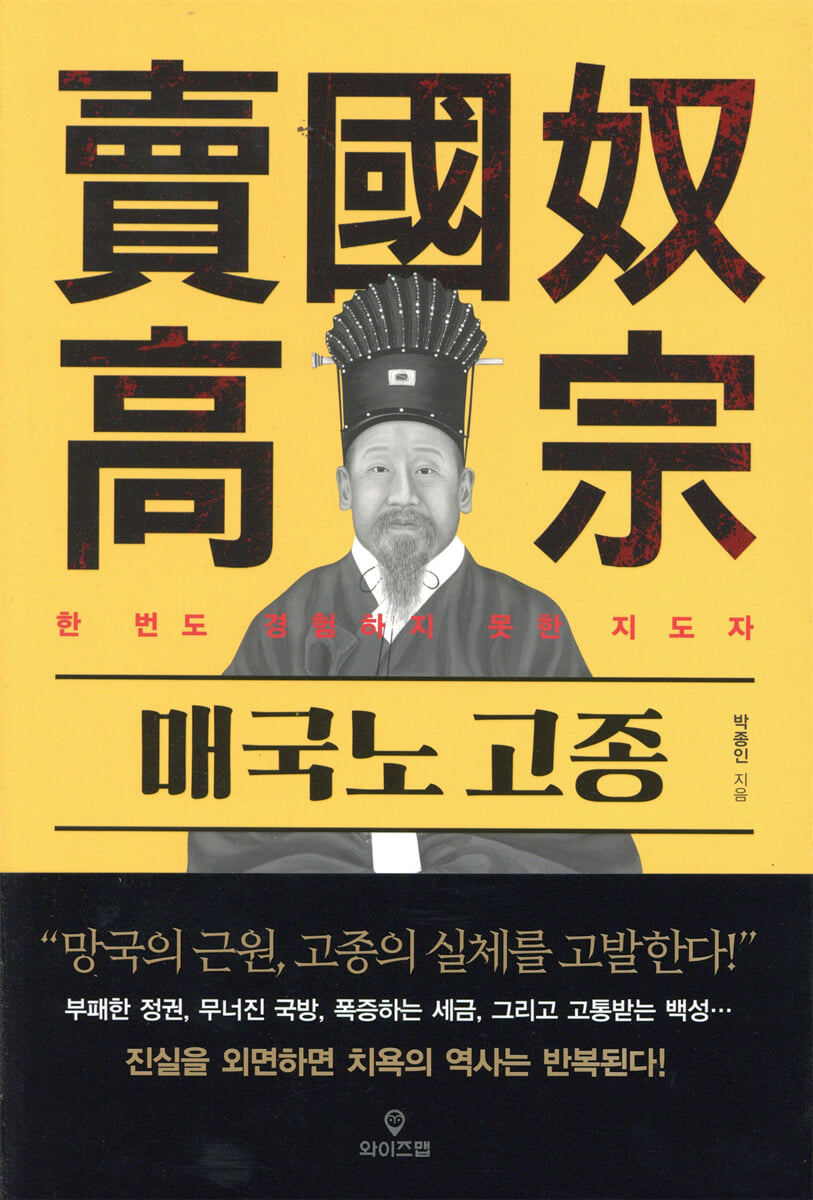 |
Description
Book Introduction
Exposing the hypocrisy and illusion of the 'unlucky reformist monarch'!
South Korea is currently filled with anger and frustration.
A lost leadership, a collapsed economy, skyrocketing taxes, and a diplomacy without direction…
These are words that express our current situation.
In the midst of such 21st century history, Emperor Gojong was summoned.
The reason is that the situation at the end of the Joseon Dynasty, which was in decline and eventually came to an end, overlaps with the current state of the Republic of Korea.
Emperor Gojong, known as the 'unlucky reformist monarch', is a figure whose evaluations have been sharply divided.
Reporter Park Jong-in, who has been working to uncover hidden history based on the belief that “only the history of truth can create the future,” has uncovered the truth about King Gojong.
After extensive research and verification of vast amounts of domestic and international historical materials and records, he was confronted with the fact that the image of King Gojong we had learned was all an illusion.
And we were also able to discover the reason why Joseon, with its long history, had to fall repeatedly and disappear without fighting a single battle.
He wrote a book titled “Traitor Gojong” in which he fully explained why Gojong must be held responsible for the tragic history and why he must be firmly called a “traitor.”
“The emperor, the worst and most cowardly of all those who wear the crown, cowers in his palace and causes suffering to others through his own wrongdoings.
The Emperor instructed the Minister of Foreign Affairs to sign the treaty, and then instructed him to say that he had not given the order.
So the foreign minister took all the blame.”
- US Vice Consul Willard Straight
South Korea is currently filled with anger and frustration.
A lost leadership, a collapsed economy, skyrocketing taxes, and a diplomacy without direction…
These are words that express our current situation.
In the midst of such 21st century history, Emperor Gojong was summoned.
The reason is that the situation at the end of the Joseon Dynasty, which was in decline and eventually came to an end, overlaps with the current state of the Republic of Korea.
Emperor Gojong, known as the 'unlucky reformist monarch', is a figure whose evaluations have been sharply divided.
Reporter Park Jong-in, who has been working to uncover hidden history based on the belief that “only the history of truth can create the future,” has uncovered the truth about King Gojong.
After extensive research and verification of vast amounts of domestic and international historical materials and records, he was confronted with the fact that the image of King Gojong we had learned was all an illusion.
And we were also able to discover the reason why Joseon, with its long history, had to fall repeatedly and disappear without fighting a single battle.
He wrote a book titled “Traitor Gojong” in which he fully explained why Gojong must be held responsible for the tragic history and why he must be firmly called a “traitor.”
“The emperor, the worst and most cowardly of all those who wear the crown, cowers in his palace and causes suffering to others through his own wrongdoings.
The Emperor instructed the Minister of Foreign Affairs to sign the treaty, and then instructed him to say that he had not given the order.
So the foreign minister took all the blame.”
- US Vice Consul Willard Straight
- You can preview some of the book's contents.
Preview
index
Introduction: Who is defending Gojong?
Part 1_Jangseong 1864-1873
Chapter 1: Father, Building a Fortune
Daewongun's Gapyusin 1864-1873
The Age of Yi Yang-seon | The Rise of Japan | The Age of Tyranny and Civil War | Heungseon Daewongun's Reforms, Gapyushin | Daewongun Strengthens Military Power | Daewongun Breaks the Logic of Factions | Daewongun Destroys Mandongmyo | Daewongun Destroys Seowon | Daewongun Reforms the Three Political Disorders | Daewongun's Generals | Daewongun's Missteps: Gyeongbokgung Palace, Dangbaekjeon, and National Isolation | Gapyushin Could Change Joseon
Chapter 2: Son, Breaking the Wall
Emperor Gojong's declaration of personal rule in 1873
Two Gates Opened at Unhyeongung Palace in 1864 | The Late-Night Meeting of November 4, 1873 | The Eve of the Storm | The Qing Emperor's Personal Rule and Emperor Gojong's Preliminary Stance | "Restore Everything": The Noron's Counterattack | Choi Ik-hyeon's Direct Strike: Drive Out Daewongun | The Noron's Deep Meaning | The Late-Night Counterattack and a Great Reversal | The Breakup
Part 2: The Ghost Ship Sets Sail, 1873–1882
Chapter 3: Playing Soldiers
Emperor Gojong's personal guard unit, Muwiso, and the missing Jinmuyeong
Official violence, military power, and money power | Suspicious incidents and Emperor Gojong's secret conspiracy | Emperor Gojong's greed: the personal guard unit, Muwiso | "It's always like this, I'm so ashamed" | Muwiso transformed into a monster | Emperor Gojong's military, for Emperor Gojong | The collapse of the Great Wall, Jinmuyeong | Bombardment by Japanese warships, August 1875
Chapter 4: Money Play
Abolition of Qing Dynasty money and coins
The currency reform that felt like a horror movie | The second authorized violence for power, money | Erasing Daewongun: 'For the people' | January 6, 1874, the day the Cheongjeon abolition order was issued | A week later, on January 13, Emperor Gojong's incompetence is revealed | Four days later, on January 17, Emperor Gojong's endless stubbornness | Three days later, on January 20, the king who did not give up | The aftermath, the abyss of poverty | Incompetence, ignorance, and selfishness | Evil, its consequences
Chapter 5: Playing Gangster
The swarming Min clans
Min Yeong-gyu of the Yeoheung Min Clan, Who Rejected the Prime Ministership in 1906 | Leaders and Emperor Gojong, Power and Vision | The Revived Secret Agreement of 250 Years | Royal Power and Authority Challenged | The Secret Agreement Reclaimed 1: Sungyong Forest and the Noron Faction | The Secret Agreement Reclaimed 2: An Alliance Stronger Than the Noron Faction, the Yeoheung Min Clan | The Min Clan Seizes High Positions
Part 3: Turning Joseon into Scrap, 1882–1894
Chapter 6: “I have already paid 50,000 nyang to the king.”
corruption
The Mad Tiger | The Im-o Incident, a Rebellion by Poor Soldiers | Killing All the Mins: Jinsaljemin | The Mins' Affair as Recorded by Hwang Hyeon | The Worst Corrupt Monarch Who Collected Bribes Directly | Corruption Without a Sense of Guilt | The Issuance of the Dang-o-jeon and the Revival of Nameless Taxes | A Country That Grew Poorer | A Monarch Who Grew Richer | Parasites That Led to the Ruin of a Nation
Chapter 7: This Country Is Mine
The Gapsin Coup and the Dictatorship of King Gojong 1884
Gojong's Partner Swapping | The Ideology of the Noron Regime: Theory of Expulsion | Noron Leader Kim Pyeong-muk's Theory of Expulsion | The Continued Bad Relations with the Noron | The First Reflection: "It's All My Fault" | The Second Reflection: "Are You Just Going to Talk About It Again?" | The Unfulfilled Reflection | A Leader Who Was Essentially Irrelevant to Reform
Chapter 8: People Massacred by Gatling Guns
Donghak Revolution of 1894
Instead, a certain royal meeting that shocked everyone | The causes and results of the Donghak Peasant Revolution | Emperor Gojong and Min Yeong-jun jointly summon the Qing army | The secret meeting between Min Yeong-jun and Yuan Shikai | What did they see in the people? | Elder Kim Byeong-si's determined remarks and Emperor Gojong's mask removed | Japan's participation in the war and massacre | The Min family and Jo Byeong-gap who were all pardoned
Part 4: The Lost Era of Peace 1895–1904
Chapter 9: The Frustration of the Gabo Reforms
The beginning of a backlash
A Wasted Decade | The Gabo Reforms Aimed to Resolve 500 Years of Contradiction | Signs of Rebellion | The Beginning of Rebellion | Reclaiming Power | Selling the Nation: A Year in the Legation | The Sale of the Nation as Recorded in the Annals
Chapter 10: Building a House
The Korean Empire and the Gwangmu Reform
Building an Empire | Perfecting the Monopoly of Power: The Great Korean International and the Independence Association | Perfecting the Monopoly of Economic Power: Naejangwon | The Resurrection of Official Merchantship | The Resurrection of Nameless Taxes: Taxing Even Seaweed | Perfecting the Monopoly of Military Power: The Great Korean Empire Army | The Empty Treasury and the Disappearance of Slush Funds | The Fiction of the Gwangmu Reform: Reform for the Emperor | Bluff and Waste: Palace Construction and Birthday Parties | Signs and Prophecies of the Fall of the Nation | Final Reflection in 1905 | The Laughed Emperor
Chapter 11: Abandoning the House
King Gojong's Seven Halls of Transmission
A bankrupt nation and a monarch on the run | The king and the Minister of War who summoned the Qing army | The Sino-Japanese War and Miguan's flight | To England in the meantime: Yeonggwan's flight | Successful exile, the flight of the A-guan | The second Miguan's flight in 1897 | The Russo-Japanese War and the mass flight attempt | The consequences of the mass flight attempt
Part 5: Selling Off Junk 1904-1910
Chapter 12: The Russo-Japanese War and the Battle of Juhapru
Hwangcheon Haenghae 1904-1905
A Frustrated Escape and the Russo-Japanese War | A Chilling Photograph | The Lost Decade, a Nation Turned into Obsolete | The Japanese Monument on Geoje Island and the Russo-Japanese War | Russia's Ostpolitik and Joseon | Joseon's Derangement and the Ignorance of Its Leadership | Jemulpo in 1904 and Geoje Island in 1905 | Koreans Executed by the Japanese Army, and the Korean Empire Consoling the Japanese Soldiers | Hwangcheon Haenghae
Chapter 13: Alice, the Woman the Emperor Leans On
September 1905, two months before the Eulsa Treaty
The Princess Descends from Heaven | May 1905, Japanese Imperial Family's Visit to Seoul | June 1905, U.S. Vice Consul Straight's Appointment | September 1905, Alice in Wonderland | 1882, the Treaty of Korea and the U.S. | Emperor Gojong's Unwavering Faith in the United States | Buffalo Bill's Appearance at Hongneung | The Katsura-Taft Secret Agreement, Unknown Only to Emperor Gojong
Chapter 14: The Death of Old Jo Byeong-se and the Rats of the Shipwreck
The eve of the Eulsa Treaty
A petition from the physician An Jong-deok | A conversation between the elder Jo Byeong-se and Emperor Gojong | Emperor Gojong, who turned the nation into a tattered relic | Rats fleeing a shipwreck | "The fish jumped in before the nets were cast."
Chapter 15: Emperor Gojong, the Traitor
The 1905 Eulsa Treaty and the 20,000 won bribe
Memories of Emma Kroebel | That gloomy and cowardly scene | Punish those who petitioned | The 20,000 won entertainment fee the emperor received | The 300,000 yen bribe and Gyeongbu Line shares | The 1.5 million yen bait | The petition of the Eulsa Five Traitors and Emperor Gojong's silence | "Go out and die!"
Chapter 16: Prince Dojuku Itaewon
The Hague envoy and the royal family
The Secret Envoys Who Never Returned | The Secret Envoys, After That Day | The Royal Family, Prince Itaewon Dojukun and Prince Shotoku | The Birth of the Royal Family | The Colonial Life of the Royal Family
Part 1_Jangseong 1864-1873
Chapter 1: Father, Building a Fortune
Daewongun's Gapyusin 1864-1873
The Age of Yi Yang-seon | The Rise of Japan | The Age of Tyranny and Civil War | Heungseon Daewongun's Reforms, Gapyushin | Daewongun Strengthens Military Power | Daewongun Breaks the Logic of Factions | Daewongun Destroys Mandongmyo | Daewongun Destroys Seowon | Daewongun Reforms the Three Political Disorders | Daewongun's Generals | Daewongun's Missteps: Gyeongbokgung Palace, Dangbaekjeon, and National Isolation | Gapyushin Could Change Joseon
Chapter 2: Son, Breaking the Wall
Emperor Gojong's declaration of personal rule in 1873
Two Gates Opened at Unhyeongung Palace in 1864 | The Late-Night Meeting of November 4, 1873 | The Eve of the Storm | The Qing Emperor's Personal Rule and Emperor Gojong's Preliminary Stance | "Restore Everything": The Noron's Counterattack | Choi Ik-hyeon's Direct Strike: Drive Out Daewongun | The Noron's Deep Meaning | The Late-Night Counterattack and a Great Reversal | The Breakup
Part 2: The Ghost Ship Sets Sail, 1873–1882
Chapter 3: Playing Soldiers
Emperor Gojong's personal guard unit, Muwiso, and the missing Jinmuyeong
Official violence, military power, and money power | Suspicious incidents and Emperor Gojong's secret conspiracy | Emperor Gojong's greed: the personal guard unit, Muwiso | "It's always like this, I'm so ashamed" | Muwiso transformed into a monster | Emperor Gojong's military, for Emperor Gojong | The collapse of the Great Wall, Jinmuyeong | Bombardment by Japanese warships, August 1875
Chapter 4: Money Play
Abolition of Qing Dynasty money and coins
The currency reform that felt like a horror movie | The second authorized violence for power, money | Erasing Daewongun: 'For the people' | January 6, 1874, the day the Cheongjeon abolition order was issued | A week later, on January 13, Emperor Gojong's incompetence is revealed | Four days later, on January 17, Emperor Gojong's endless stubbornness | Three days later, on January 20, the king who did not give up | The aftermath, the abyss of poverty | Incompetence, ignorance, and selfishness | Evil, its consequences
Chapter 5: Playing Gangster
The swarming Min clans
Min Yeong-gyu of the Yeoheung Min Clan, Who Rejected the Prime Ministership in 1906 | Leaders and Emperor Gojong, Power and Vision | The Revived Secret Agreement of 250 Years | Royal Power and Authority Challenged | The Secret Agreement Reclaimed 1: Sungyong Forest and the Noron Faction | The Secret Agreement Reclaimed 2: An Alliance Stronger Than the Noron Faction, the Yeoheung Min Clan | The Min Clan Seizes High Positions
Part 3: Turning Joseon into Scrap, 1882–1894
Chapter 6: “I have already paid 50,000 nyang to the king.”
corruption
The Mad Tiger | The Im-o Incident, a Rebellion by Poor Soldiers | Killing All the Mins: Jinsaljemin | The Mins' Affair as Recorded by Hwang Hyeon | The Worst Corrupt Monarch Who Collected Bribes Directly | Corruption Without a Sense of Guilt | The Issuance of the Dang-o-jeon and the Revival of Nameless Taxes | A Country That Grew Poorer | A Monarch Who Grew Richer | Parasites That Led to the Ruin of a Nation
Chapter 7: This Country Is Mine
The Gapsin Coup and the Dictatorship of King Gojong 1884
Gojong's Partner Swapping | The Ideology of the Noron Regime: Theory of Expulsion | Noron Leader Kim Pyeong-muk's Theory of Expulsion | The Continued Bad Relations with the Noron | The First Reflection: "It's All My Fault" | The Second Reflection: "Are You Just Going to Talk About It Again?" | The Unfulfilled Reflection | A Leader Who Was Essentially Irrelevant to Reform
Chapter 8: People Massacred by Gatling Guns
Donghak Revolution of 1894
Instead, a certain royal meeting that shocked everyone | The causes and results of the Donghak Peasant Revolution | Emperor Gojong and Min Yeong-jun jointly summon the Qing army | The secret meeting between Min Yeong-jun and Yuan Shikai | What did they see in the people? | Elder Kim Byeong-si's determined remarks and Emperor Gojong's mask removed | Japan's participation in the war and massacre | The Min family and Jo Byeong-gap who were all pardoned
Part 4: The Lost Era of Peace 1895–1904
Chapter 9: The Frustration of the Gabo Reforms
The beginning of a backlash
A Wasted Decade | The Gabo Reforms Aimed to Resolve 500 Years of Contradiction | Signs of Rebellion | The Beginning of Rebellion | Reclaiming Power | Selling the Nation: A Year in the Legation | The Sale of the Nation as Recorded in the Annals
Chapter 10: Building a House
The Korean Empire and the Gwangmu Reform
Building an Empire | Perfecting the Monopoly of Power: The Great Korean International and the Independence Association | Perfecting the Monopoly of Economic Power: Naejangwon | The Resurrection of Official Merchantship | The Resurrection of Nameless Taxes: Taxing Even Seaweed | Perfecting the Monopoly of Military Power: The Great Korean Empire Army | The Empty Treasury and the Disappearance of Slush Funds | The Fiction of the Gwangmu Reform: Reform for the Emperor | Bluff and Waste: Palace Construction and Birthday Parties | Signs and Prophecies of the Fall of the Nation | Final Reflection in 1905 | The Laughed Emperor
Chapter 11: Abandoning the House
King Gojong's Seven Halls of Transmission
A bankrupt nation and a monarch on the run | The king and the Minister of War who summoned the Qing army | The Sino-Japanese War and Miguan's flight | To England in the meantime: Yeonggwan's flight | Successful exile, the flight of the A-guan | The second Miguan's flight in 1897 | The Russo-Japanese War and the mass flight attempt | The consequences of the mass flight attempt
Part 5: Selling Off Junk 1904-1910
Chapter 12: The Russo-Japanese War and the Battle of Juhapru
Hwangcheon Haenghae 1904-1905
A Frustrated Escape and the Russo-Japanese War | A Chilling Photograph | The Lost Decade, a Nation Turned into Obsolete | The Japanese Monument on Geoje Island and the Russo-Japanese War | Russia's Ostpolitik and Joseon | Joseon's Derangement and the Ignorance of Its Leadership | Jemulpo in 1904 and Geoje Island in 1905 | Koreans Executed by the Japanese Army, and the Korean Empire Consoling the Japanese Soldiers | Hwangcheon Haenghae
Chapter 13: Alice, the Woman the Emperor Leans On
September 1905, two months before the Eulsa Treaty
The Princess Descends from Heaven | May 1905, Japanese Imperial Family's Visit to Seoul | June 1905, U.S. Vice Consul Straight's Appointment | September 1905, Alice in Wonderland | 1882, the Treaty of Korea and the U.S. | Emperor Gojong's Unwavering Faith in the United States | Buffalo Bill's Appearance at Hongneung | The Katsura-Taft Secret Agreement, Unknown Only to Emperor Gojong
Chapter 14: The Death of Old Jo Byeong-se and the Rats of the Shipwreck
The eve of the Eulsa Treaty
A petition from the physician An Jong-deok | A conversation between the elder Jo Byeong-se and Emperor Gojong | Emperor Gojong, who turned the nation into a tattered relic | Rats fleeing a shipwreck | "The fish jumped in before the nets were cast."
Chapter 15: Emperor Gojong, the Traitor
The 1905 Eulsa Treaty and the 20,000 won bribe
Memories of Emma Kroebel | That gloomy and cowardly scene | Punish those who petitioned | The 20,000 won entertainment fee the emperor received | The 300,000 yen bribe and Gyeongbu Line shares | The 1.5 million yen bait | The petition of the Eulsa Five Traitors and Emperor Gojong's silence | "Go out and die!"
Chapter 16: Prince Dojuku Itaewon
The Hague envoy and the royal family
The Secret Envoys Who Never Returned | The Secret Envoys, After That Day | The Royal Family, Prince Itaewon Dojukun and Prince Shotoku | The Birth of the Royal Family | The Colonial Life of the Royal Family
Detailed image

Into the book
Who defends Gojong?
No, not only is there no defense, but who praises Gojong as a reformist monarch who often desired independence?
The Gojong regime did not even think of 'fighting to face the situation coolly and set the right direction.'
It was because of King Gojong that the country was taken over by Japan, which had modernized at the end of the Joseon Dynasty, and it was also because of King Gojong that the country fell behind in modernization.
It was also because of King Gojong that the national economy collapsed to the point that foreigners visiting Joseon would click their tongues at the poverty and pity it was there.
Gojong is the root of all evil.
Until then, the Joseon Dynasty had been in a state of weakness for 400 years, but Gojong kicked away any opportunity to recover and overcome the illness.
He abandoned his country solely for his own life, power, and wealth.
So, Gojong is a traitor.
I wrote this book to specifically reveal why Emperor Gojong was a traitor.
The manipulation must be exposed before the fabricated myth turns into belief, turns into religion, and solidifies into fact.
---From the "Preface"
Qing Dynasty Minister Xu Shu-bung said:
“In less than ten years since the Qing Dynasty began selling off government officials, the world was in chaos and the dynasty was in danger.
However, even after 30 years of selling off official positions, the throne still remains intact.
“How could it be so if the fortune was not good and the customs were not beautiful?” When Emperor Gojong burst out laughing and showed no shame, Seo Su-bung went out and said to the people, “The Korean people are a sad people.”
---「Part 3.
From “Making Joseon into Scrap”
Where did all that money go?
It all went into King Gojong's pocket.
In that absurd beggar-state, the king was strangely wealthy.
The Ministry of Finance was the government office that took charge of national finances during the Korean Empire, replacing the old Ministry of Taxation.
The following year, in 1902, while the Ministry of Finance was spending endless amounts of money from the national treasury on the reconstruction of Gyeongungung Palace (now Deoksugung Palace), an incident occurred where they were unable to pay the salaries of government officials for August of that year.
Accordingly, the Ministry of Finance quickly borrowed 80,000 won in silver from the Ministry of Finance to cover the expenses.
Then, the Ministry of Finance demanded that the taxes be repaid immediately as soon as they were collected that year.
In this way, Gojong was a king who was ready to recoup the money he had lent to the country at any time.
Like a debt collector, Gojong was a man who insisted on the nation's debts being repaid quickly.
Maecheon Hwang Hyeon said, “Emperor Gojong regarded the Ministry of Finance as tribute and the Naejangwon as his personal property, as if he had no relation to the Jin and Yue dynasties.”
---「Part 3.
From “Making Joseon into Scrap”
Gojong said.
“There are precedents for each country borrowing military forces from other countries.” The conference room became noisy as if a hornet’s nest had been stirred.
As if waiting for the answer of the opposing ministers, Emperor Gojong opened his mouth.
“China has borrowed British troops before,” Prime Minister Jeong Beom-jo refuted this directly.
“Is this something we should emulate in China?” Even Gojong did not give up.
“I said this not because I wanted to borrow from other countries, but because I could use the Qing army,” Jeong Beom-jo retorted again.
“Even if they are Qing soldiers, how could it be better than not using them in the first place?” Gojong changed the subject, ordering, “If they won’t listen through persuasion, discuss it in the State Council and eliminate them.”
The meeting ended in shock.
---「Part 3.
From “Making Joseon into Scrap”
On April 4, before the fall of Jeonju Castle, a meeting was held with all current and former ministers in attendance.
Left State Councillor Jo Byeong-se asked King Gojong directly.
“The people were suffering and aggrieved, so they gathered together to appeal, and this is how things ended up like this. When was there ever a time when you eliminated even one evil or corrected even one suffering to respond to the people’s situation?” King Gojong answered as if it were someone else’s story.
“It is because I cannot endure the greedy and cruel government,” said Left State Councillor Jo Byeong-se.
“The people are extremely pitiful today.
A person with a four-room thatched-roof house pays about 100 nyang a year, and a person with five or six majigi of land pays more than four seok in taxes, so they are in dire straits and cannot even make ends meet.
If the people were settled and enjoying their livelihoods, why would they run around and make a fuss? Without major reforms and measures, it won't be effective."
---「Part 3.
From “Making Joseon into Scrap”
A crisis situation that determined the fate of the nation was also an opportunity.
If, as leaders and those in power, they had sacrificed their lust for power and used the resources they possessed for the good of their country and community, they would have achieved more powerful power.
But Gojong did not give up power until the end.
The crisis failed to turn into an opportunity and ended as a crisis.
Foreign powers targeting Joseon were merely tools for King Gojong to maintain his power.
Regardless of the fate of the nation, Gojong chose countries that would help him maintain and strengthen his royal authority as partners.
For this purpose, gold, silver, treasures, and trees on the land were sold to foreign countries.
The granary was empty, and finally the safe in the royal palace, to which Emperor Gojong himself held the key, was also empty.
The politics that began with taking power 'solely for the people' have completely regressed over the past 31 years, and the country has become a piece of junk, a piece of scrap metal that is too good to be sold off.
---「Part 5.
From "Selling Off Junk"
On November 11, 1905, six days before the signing of the Eulsa Treaty, Gonsuke Hayashi, the Japanese Minister to Korea, executed a confidential fee of 100,000 won in accordance with Japanese Ministry of Foreign Affairs Confidential Notice No. 119.
The full text of this Japanese embassy record is available in the National Institute of Korean History's 'Korean History Database'.
The document even contains notes calculating the amount spent.
In short, Emperor Gojong received 20,000 won from the Japanese minister six days before the treaty was signed.
According to statistics, five years later, in 1910, the daily wage for a skilled carpenter in Seoul was 1 won.
Assuming a carpenter's annual salary is 200 won, 20,000 won is equivalent to the carpenter's annual salary for 100 years.
As of 2010, the average annual salary of a South Korean worker is 25 million won, so 100 times that is 2.5 billion won.
The 2.5 billion won was said to be for entertainment expenses for Hirobumi Ito, and the reason was 'the lack of internal funds.'
It is a bribe that takes advantage of the plight of the other party to the treaty, and it is a bribe that sells the country that Emperor Taejo had worked hard to build.
---「Part 5.
From "Selling Off Junk"
The incense burning at Jongmyo Shrine continued until 1945, when the Japanese imperial family was disbanded due to defeat in the Pacific War.
The Imperial House was renamed the Yi Royal Family, and the direct descendants of Emperor Sunjong were treated as members of the Imperial Family, and their brothers were treated as members of the royal family.
The status of the royal family was equivalent to that of the Japanese imperial family.
It was higher than the Japanese royal family.
The wealth was enormous.
According to the treaty, the country was abolished, but the old imperial family continued to receive royalties from the following year.
According to the 'Statistical Yearbook of the Government-General of Korea', the annual salary was 1.5 million yen from 1911 to 1920.
And the 1.5 million yen increased by 300,000 yen from 1921 and remained at 1.8 million yen until 1945.
The expenditure budget of the Government-General of Korea for the fiscal years 1911-1913 was 50,469,000 yen.
Two percent of the colonial expenditures were paid annually to the families of the former rulers, who made up less than one-hundred-thousandth of the 20 million Koreans.
No, not only is there no defense, but who praises Gojong as a reformist monarch who often desired independence?
The Gojong regime did not even think of 'fighting to face the situation coolly and set the right direction.'
It was because of King Gojong that the country was taken over by Japan, which had modernized at the end of the Joseon Dynasty, and it was also because of King Gojong that the country fell behind in modernization.
It was also because of King Gojong that the national economy collapsed to the point that foreigners visiting Joseon would click their tongues at the poverty and pity it was there.
Gojong is the root of all evil.
Until then, the Joseon Dynasty had been in a state of weakness for 400 years, but Gojong kicked away any opportunity to recover and overcome the illness.
He abandoned his country solely for his own life, power, and wealth.
So, Gojong is a traitor.
I wrote this book to specifically reveal why Emperor Gojong was a traitor.
The manipulation must be exposed before the fabricated myth turns into belief, turns into religion, and solidifies into fact.
---From the "Preface"
Qing Dynasty Minister Xu Shu-bung said:
“In less than ten years since the Qing Dynasty began selling off government officials, the world was in chaos and the dynasty was in danger.
However, even after 30 years of selling off official positions, the throne still remains intact.
“How could it be so if the fortune was not good and the customs were not beautiful?” When Emperor Gojong burst out laughing and showed no shame, Seo Su-bung went out and said to the people, “The Korean people are a sad people.”
---「Part 3.
From “Making Joseon into Scrap”
Where did all that money go?
It all went into King Gojong's pocket.
In that absurd beggar-state, the king was strangely wealthy.
The Ministry of Finance was the government office that took charge of national finances during the Korean Empire, replacing the old Ministry of Taxation.
The following year, in 1902, while the Ministry of Finance was spending endless amounts of money from the national treasury on the reconstruction of Gyeongungung Palace (now Deoksugung Palace), an incident occurred where they were unable to pay the salaries of government officials for August of that year.
Accordingly, the Ministry of Finance quickly borrowed 80,000 won in silver from the Ministry of Finance to cover the expenses.
Then, the Ministry of Finance demanded that the taxes be repaid immediately as soon as they were collected that year.
In this way, Gojong was a king who was ready to recoup the money he had lent to the country at any time.
Like a debt collector, Gojong was a man who insisted on the nation's debts being repaid quickly.
Maecheon Hwang Hyeon said, “Emperor Gojong regarded the Ministry of Finance as tribute and the Naejangwon as his personal property, as if he had no relation to the Jin and Yue dynasties.”
---「Part 3.
From “Making Joseon into Scrap”
Gojong said.
“There are precedents for each country borrowing military forces from other countries.” The conference room became noisy as if a hornet’s nest had been stirred.
As if waiting for the answer of the opposing ministers, Emperor Gojong opened his mouth.
“China has borrowed British troops before,” Prime Minister Jeong Beom-jo refuted this directly.
“Is this something we should emulate in China?” Even Gojong did not give up.
“I said this not because I wanted to borrow from other countries, but because I could use the Qing army,” Jeong Beom-jo retorted again.
“Even if they are Qing soldiers, how could it be better than not using them in the first place?” Gojong changed the subject, ordering, “If they won’t listen through persuasion, discuss it in the State Council and eliminate them.”
The meeting ended in shock.
---「Part 3.
From “Making Joseon into Scrap”
On April 4, before the fall of Jeonju Castle, a meeting was held with all current and former ministers in attendance.
Left State Councillor Jo Byeong-se asked King Gojong directly.
“The people were suffering and aggrieved, so they gathered together to appeal, and this is how things ended up like this. When was there ever a time when you eliminated even one evil or corrected even one suffering to respond to the people’s situation?” King Gojong answered as if it were someone else’s story.
“It is because I cannot endure the greedy and cruel government,” said Left State Councillor Jo Byeong-se.
“The people are extremely pitiful today.
A person with a four-room thatched-roof house pays about 100 nyang a year, and a person with five or six majigi of land pays more than four seok in taxes, so they are in dire straits and cannot even make ends meet.
If the people were settled and enjoying their livelihoods, why would they run around and make a fuss? Without major reforms and measures, it won't be effective."
---「Part 3.
From “Making Joseon into Scrap”
A crisis situation that determined the fate of the nation was also an opportunity.
If, as leaders and those in power, they had sacrificed their lust for power and used the resources they possessed for the good of their country and community, they would have achieved more powerful power.
But Gojong did not give up power until the end.
The crisis failed to turn into an opportunity and ended as a crisis.
Foreign powers targeting Joseon were merely tools for King Gojong to maintain his power.
Regardless of the fate of the nation, Gojong chose countries that would help him maintain and strengthen his royal authority as partners.
For this purpose, gold, silver, treasures, and trees on the land were sold to foreign countries.
The granary was empty, and finally the safe in the royal palace, to which Emperor Gojong himself held the key, was also empty.
The politics that began with taking power 'solely for the people' have completely regressed over the past 31 years, and the country has become a piece of junk, a piece of scrap metal that is too good to be sold off.
---「Part 5.
From "Selling Off Junk"
On November 11, 1905, six days before the signing of the Eulsa Treaty, Gonsuke Hayashi, the Japanese Minister to Korea, executed a confidential fee of 100,000 won in accordance with Japanese Ministry of Foreign Affairs Confidential Notice No. 119.
The full text of this Japanese embassy record is available in the National Institute of Korean History's 'Korean History Database'.
The document even contains notes calculating the amount spent.
In short, Emperor Gojong received 20,000 won from the Japanese minister six days before the treaty was signed.
According to statistics, five years later, in 1910, the daily wage for a skilled carpenter in Seoul was 1 won.
Assuming a carpenter's annual salary is 200 won, 20,000 won is equivalent to the carpenter's annual salary for 100 years.
As of 2010, the average annual salary of a South Korean worker is 25 million won, so 100 times that is 2.5 billion won.
The 2.5 billion won was said to be for entertainment expenses for Hirobumi Ito, and the reason was 'the lack of internal funds.'
It is a bribe that takes advantage of the plight of the other party to the treaty, and it is a bribe that sells the country that Emperor Taejo had worked hard to build.
---「Part 5.
From "Selling Off Junk"
The incense burning at Jongmyo Shrine continued until 1945, when the Japanese imperial family was disbanded due to defeat in the Pacific War.
The Imperial House was renamed the Yi Royal Family, and the direct descendants of Emperor Sunjong were treated as members of the Imperial Family, and their brothers were treated as members of the royal family.
The status of the royal family was equivalent to that of the Japanese imperial family.
It was higher than the Japanese royal family.
The wealth was enormous.
According to the treaty, the country was abolished, but the old imperial family continued to receive royalties from the following year.
According to the 'Statistical Yearbook of the Government-General of Korea', the annual salary was 1.5 million yen from 1911 to 1920.
And the 1.5 million yen increased by 300,000 yen from 1921 and remained at 1.8 million yen until 1945.
The expenditure budget of the Government-General of Korea for the fiscal years 1911-1913 was 50,469,000 yen.
Two percent of the colonial expenditures were paid annually to the families of the former rulers, who made up less than one-hundred-thousandth of the 20 million Koreans.
---「Part 5.
From "Selling Off Junk"
From "Selling Off Junk"
Publisher's Review
The end of the country, by, and for Gojong!
To King Gojong, Joseon was not a country.
It was just personal property.
The people are a means to fill his stomach, and the only thing he cares about is his own comfort and luxury.
After seizing power, King Gojong concentrated all troops and military equipment in his personal guard unit, Muwiso, and disarmed the national defense force that was on par with the heavily armed Western fleets.
He also ordered the sending in of foreign troops to massacre the people who resisted the oppression.
In addition, Emperor Gojong's reckless currency reform caused the economy to collapse, and the abuse of grain exchange to fill the national treasury, which had become insufficient, worsened. Taxes were even imposed on logs and seaweed, putting the people in dire straits.
And he poured a huge amount of national treasury into all sorts of luxuries and pleasures, such as buying scrap ships for his own birthday party.
Meanwhile, he was preoccupied with filling his own coffers by selling national resources such as mining rights.
Even as the nation was shaken by all kinds of incompetence and corruption, Gojong filled the court with only the Min family, and those who supported the emperor engaged in extortion and tyranny, hastening the nation's downfall.
Gojong was thoroughly and miserably wrecking the fate of the nation and its people.
How an incompetent leader destroys history!
Even in times of incompetent leadership, opportunities for reform existed.
But Gojong destroyed each and every one of those opportunities.
The loyal subjects who risked their lives to petition fell one by one, and the forces that brought about reforms for the future of Joseon were brutally annihilated by King Gojong, who was furious that they were opposing his royal authority.
Foreign figures active in the Korean Empire at the time shared a common assessment of King Gojong.
American Minister Horace Allen said, “The Emperor (Gojong) is a terrible pest and a curse to this country,” and Qing Minister Xu Shu-pung sneered in front of Gojong, “Your country’s fortunes are good because the throne is still intact after 30 years of corruption.”
Even as the nation was sinking, Gojong trusted Japan and received large sums of money from Japan under the pretext of a bribe.
Above all, at the time of the Eulsa Treaty, he only took care of the clauses promising his own status and well-being, and peacefully(?) handed over the country and its people to Japan without firing a single shot.
He was neither a reformist monarch nor an unfortunate emperor, and even after the country disappeared, he enjoyed a status comparable to that of the Japanese imperial family and lived in luxury.
Through King Gojong, we saw how an incompetent leader can lead a nation and its people to ruin.
Reporter Park Jong-in, who wrote “Traitor Gojong,” asserts:
“Even uncomfortable history is our history.
And if we turn away from the truth, the history of shame will repeat itself.”
The purpose of this book is not simply to condemn someone by bringing up a shameful past that they would rather hide.
The goal is to prepare for a future of hope and prevent a recurrence of the crisis.
We live in the Republic of Korea, a country that has been resurrected thanks to the dedication and sweat of its citizens.
It is time to face the lessons of history and re-learn them to move forward into an unwavering future.
To King Gojong, Joseon was not a country.
It was just personal property.
The people are a means to fill his stomach, and the only thing he cares about is his own comfort and luxury.
After seizing power, King Gojong concentrated all troops and military equipment in his personal guard unit, Muwiso, and disarmed the national defense force that was on par with the heavily armed Western fleets.
He also ordered the sending in of foreign troops to massacre the people who resisted the oppression.
In addition, Emperor Gojong's reckless currency reform caused the economy to collapse, and the abuse of grain exchange to fill the national treasury, which had become insufficient, worsened. Taxes were even imposed on logs and seaweed, putting the people in dire straits.
And he poured a huge amount of national treasury into all sorts of luxuries and pleasures, such as buying scrap ships for his own birthday party.
Meanwhile, he was preoccupied with filling his own coffers by selling national resources such as mining rights.
Even as the nation was shaken by all kinds of incompetence and corruption, Gojong filled the court with only the Min family, and those who supported the emperor engaged in extortion and tyranny, hastening the nation's downfall.
Gojong was thoroughly and miserably wrecking the fate of the nation and its people.
How an incompetent leader destroys history!
Even in times of incompetent leadership, opportunities for reform existed.
But Gojong destroyed each and every one of those opportunities.
The loyal subjects who risked their lives to petition fell one by one, and the forces that brought about reforms for the future of Joseon were brutally annihilated by King Gojong, who was furious that they were opposing his royal authority.
Foreign figures active in the Korean Empire at the time shared a common assessment of King Gojong.
American Minister Horace Allen said, “The Emperor (Gojong) is a terrible pest and a curse to this country,” and Qing Minister Xu Shu-pung sneered in front of Gojong, “Your country’s fortunes are good because the throne is still intact after 30 years of corruption.”
Even as the nation was sinking, Gojong trusted Japan and received large sums of money from Japan under the pretext of a bribe.
Above all, at the time of the Eulsa Treaty, he only took care of the clauses promising his own status and well-being, and peacefully(?) handed over the country and its people to Japan without firing a single shot.
He was neither a reformist monarch nor an unfortunate emperor, and even after the country disappeared, he enjoyed a status comparable to that of the Japanese imperial family and lived in luxury.
Through King Gojong, we saw how an incompetent leader can lead a nation and its people to ruin.
Reporter Park Jong-in, who wrote “Traitor Gojong,” asserts:
“Even uncomfortable history is our history.
And if we turn away from the truth, the history of shame will repeat itself.”
The purpose of this book is not simply to condemn someone by bringing up a shameful past that they would rather hide.
The goal is to prepare for a future of hope and prevent a recurrence of the crisis.
We live in the Republic of Korea, a country that has been resurrected thanks to the dedication and sweat of its citizens.
It is time to face the lessons of history and re-learn them to move forward into an unwavering future.
GOODS SPECIFICS
- Publication date: December 30, 2020
- Page count, weight, size: 360 pages | 626g | 152*225*30mm
- ISBN13: 9791189328351
- ISBN10: 1189328356
You may also like
카테고리
korean


korean

![ELLE 엘르 스페셜 에디션 A형 : 12월 [2025]](http://librairie.coreenne.fr/cdn/shop/files/b8e27a3de6c9538896439686c6b0e8fb.jpg?v=1766436872&width=3840)


