

Kingdom of Witchcraft
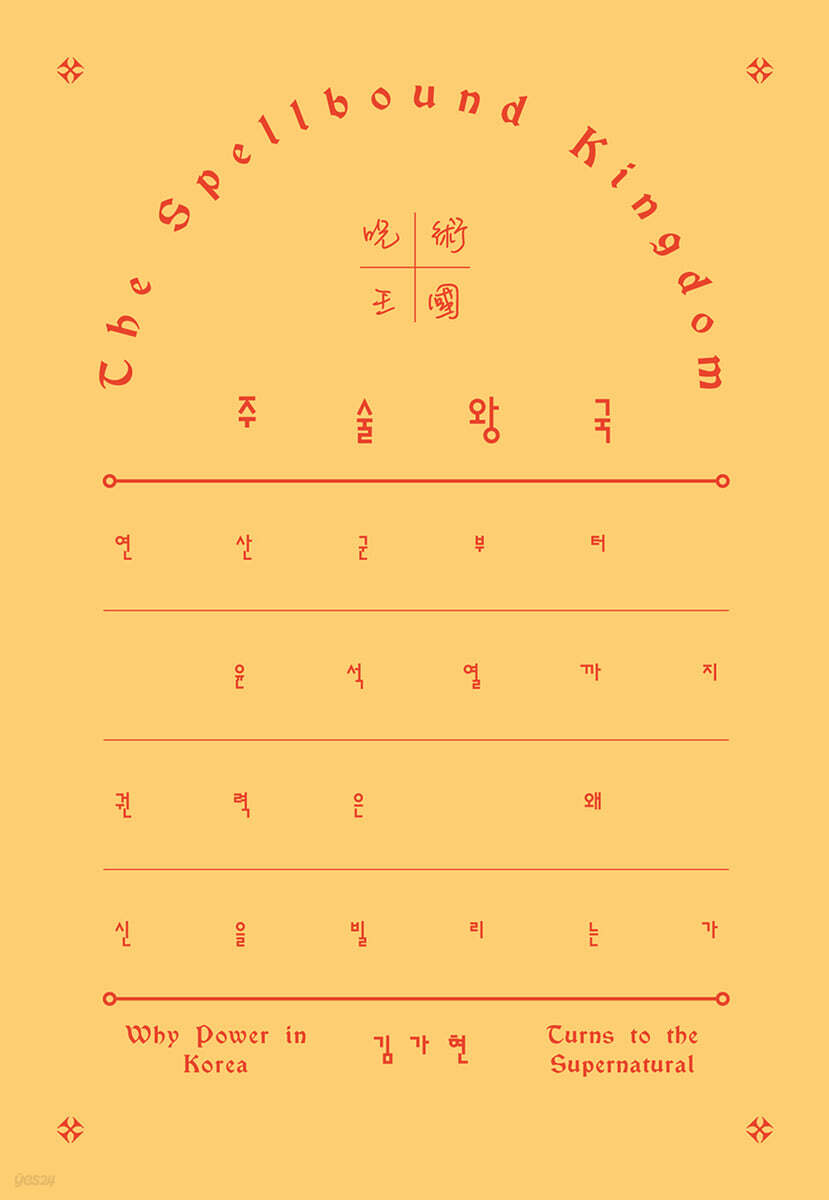 |
Description
Book Introduction
From King Yeonsangun's anger and madness, to King Gwanghaegun's anxiety and obsession, to King Gojong's incompetence and escapism, and on to Yoon Seok-yeol, this provocative book delves into the uncomfortable truth of the "collusion between power and sorcery" that recur throughout history.
Why does the "shamanism controversy" so relentlessly recur in Korean political history? This book juxtaposes the problematic monarchs of Joseon and Yoon Seok-yeol through the sharp lens of "historical parallel theory."
And it is the first report to trace how power, in times of crisis, relies on irrational beliefs to destroy itself.
Why does the "shamanism controversy" so relentlessly recur in Korean political history? This book juxtaposes the problematic monarchs of Joseon and Yoon Seok-yeol through the sharp lens of "historical parallel theory."
And it is the first report to trace how power, in times of crisis, relies on irrational beliefs to destroy itself.
- You can preview some of the book's contents.
Preview
index
Prologue: The Powers That Borrowed God 6
Part 1: Shamanism and Politics: The Dangerous Symbiosis of Faith and Power
Shamanism and the Shamanism Controversy 12
What is Shamanism? 13
From Shamanism to Feng Shui and Docham: The Formation of the World of Korean Shamanism 17
The Innate Limitations and Political Function of Shamanism 21
How Crisis Brings God In 25
The Role of Shamanism in the Joseon Dynasty: The Language of Community in Everyday Life and Crisis 26
Shamanism 29, called upon in times of crisis
The Media Age: The Resurgence of Witchcraft 34
Stage 4 of Destruction: The Collapse of Power Based on Sorcery Model 38
Part 2: Parallel Theory of Self-Destruction: The Throne Encroached by Sorcery
Shadow of Royal Power: The Dual Status of Shamanism in the Joseon Dynasty 44
The Confucian state of Joseon defined shamanism as "eumsa" (literally, "negative shamanism").
Calling on Shamanism as an Emergency Measure 47
When Power Meets Sorcery: A History of Three Catastrophes, Part 49
King Yeonsangun, the King of Wrath: Emotional Politics 52
The Prelude to Tyranny: How Anger Became Politics 54
Two Massacres 57
Reign of Terror and Reliance on Shamanism 62
The Furious President: Authority Without Power 75
What is the rage for? 76
Is this a modern-day Shinunpae? 79 Gap-Sticking Security Guards
82 Gwanbongkwon, also found in the house of a Joseon Dynasty shaman
King Gwanghaegun, the King of Anxiety: Docham Politics 91
A Throne Filled with Anxiety 92
Obsession with Feng Shui 108
The President Who Would Become Emperor: Manipulated, or rather, Crude Authority 127
The Republic of Prosecutors: Modern Transformations of "Oksa" and "Reign of Terror" 127
The Itaewon Tragedy: A Tragedy of Administrative Stagnation and Neglect of People's Livelihoods 136
Yongsan Relocation and the Skywalk: A Modern-Day Feng Shui Tragedy? 141
Modern "Wanggi Theory" and the Regression of the Times 145
The Incompetent King, Gojong: Illicit Politics 150
Heungseon Daewongun: Building Legitimacy Through Docham 151
Empress Myeongseong: Shamanism, a means of maintaining power and manipulating state affairs 159
Gojong: The Downfall of Reliance on Shamanism 180
Again, Shamanism 197
Prince's Palm: A Modern Variation on the Do-Cham 197
The Yongsan Era: A True 200 Year Anniversary
The Queen Mother and the Shaman's Secret 209
Romance of the Three Kingdoms vs. the Far Right YouTube Channel 222
The End of the Fake Commute Show: When a Farce Repeats It, It Becomes Tragedy 227
Epilogue: Power Swallows Its Own Tail 231
Part 1: Shamanism and Politics: The Dangerous Symbiosis of Faith and Power
Shamanism and the Shamanism Controversy 12
What is Shamanism? 13
From Shamanism to Feng Shui and Docham: The Formation of the World of Korean Shamanism 17
The Innate Limitations and Political Function of Shamanism 21
How Crisis Brings God In 25
The Role of Shamanism in the Joseon Dynasty: The Language of Community in Everyday Life and Crisis 26
Shamanism 29, called upon in times of crisis
The Media Age: The Resurgence of Witchcraft 34
Stage 4 of Destruction: The Collapse of Power Based on Sorcery Model 38
Part 2: Parallel Theory of Self-Destruction: The Throne Encroached by Sorcery
Shadow of Royal Power: The Dual Status of Shamanism in the Joseon Dynasty 44
The Confucian state of Joseon defined shamanism as "eumsa" (literally, "negative shamanism").
Calling on Shamanism as an Emergency Measure 47
When Power Meets Sorcery: A History of Three Catastrophes, Part 49
King Yeonsangun, the King of Wrath: Emotional Politics 52
The Prelude to Tyranny: How Anger Became Politics 54
Two Massacres 57
Reign of Terror and Reliance on Shamanism 62
The Furious President: Authority Without Power 75
What is the rage for? 76
Is this a modern-day Shinunpae? 79 Gap-Sticking Security Guards
82 Gwanbongkwon, also found in the house of a Joseon Dynasty shaman
King Gwanghaegun, the King of Anxiety: Docham Politics 91
A Throne Filled with Anxiety 92
Obsession with Feng Shui 108
The President Who Would Become Emperor: Manipulated, or rather, Crude Authority 127
The Republic of Prosecutors: Modern Transformations of "Oksa" and "Reign of Terror" 127
The Itaewon Tragedy: A Tragedy of Administrative Stagnation and Neglect of People's Livelihoods 136
Yongsan Relocation and the Skywalk: A Modern-Day Feng Shui Tragedy? 141
Modern "Wanggi Theory" and the Regression of the Times 145
The Incompetent King, Gojong: Illicit Politics 150
Heungseon Daewongun: Building Legitimacy Through Docham 151
Empress Myeongseong: Shamanism, a means of maintaining power and manipulating state affairs 159
Gojong: The Downfall of Reliance on Shamanism 180
Again, Shamanism 197
Prince's Palm: A Modern Variation on the Do-Cham 197
The Yongsan Era: A True 200 Year Anniversary
The Queen Mother and the Shaman's Secret 209
Romance of the Three Kingdoms vs. the Far Right YouTube Channel 222
The End of the Fake Commute Show: When a Farce Repeats It, It Becomes Tragedy 227
Epilogue: Power Swallows Its Own Tail 231
Into the book
In the modern political history of South Korea, the combination of shamanism and power has been covert but persistent.
As the anxiety of those in power deepened, sorcery and secret advice penetrated beyond the boundaries of public institutions and into the very heart of power.
--- p.6 From the "Prologue"
Korean shamanism was formed through mutual influence with various religions such as Buddhism and Taoism.
Among them, it was Taoism that played the greatest role in deepening the mysticism of this unique faith.
--- p.17 From “Shamanism and the ‘Shamanism Controversy’”
People who feel powerless in the face of an uncertain and uncontrollable reality develop a strong desire to understand the situation and predict the future.
In particular, it is difficult for the general public to properly understand the inside story of power struggles or political events.
At this time, 'unofficial stories' such as magical interpretations or conspiracy theories penetrate the public's mind by explaining complex reality in a simple and clear structure like 'good and evil'.
--- p.35 From “How Crisis Brings God”
Cases of collecting taxes from shamans have been confirmed since the reign of King Taejong in the early Joseon Dynasty.
In the third year of King Seongjong's reign (1472), the Office of the Inspector General created enforcement regulations to crack down on shamans and received the king's approval. Among them was a provision stating, "If a person in mourning goes to a shaman's house to perform a ritual, not only the mourner but also the shaman will be punished."
This shows that the suppression of shamanism has been institutionalized as a legal device.
--- p.46 From “Shadow of Royal Power: The Dual Status of Shamanism in the Joseon Dynasty”
Yeonsangun's rule was a 'politics of emotion' in which private anger and anxiety took center stage in state affairs.
The entire administration of state was decided solely based on the king's feelings.
He did not hide his feelings, but rather used them as a driving force in his rule.
The language that suited this abnormal ruling style could only be magical symbols such as talismans and rituals, rather than rational institutions.
--- p.68 From “King of Anger, Yeonsangun: Emotional Politics”
Ultimately, the administrative paralysis caused by Gwanghaegun's public security situation led to the worst possible outcome, such as the collapse of public order in the capital city of Hanyang.
At that time, the agency in charge of public security in Hanyang was the Police Department.
However, as the Grapevine Office's personnel were deployed to investigate treason cases or to protect the king and the palace, a vacuum was created in the city's security.
--- p.103 From “King Gwanghaegun, the King of Anxiety: Politics of Docham”
During the reign of King Gwanghaegun, the ruler's blind obsession with dealing with treason cases paralyzed the entire state administration and resulted in the tragedy of neglecting the people's livelihood.
The Itaewon massacre in South Korea in 2022 is a painful example of how "administrative stagnation" and "neglect of people's livelihoods" are recurring in modern society.
--- p.136 From “The President Who Tried to Become Emperor: Manipulated, No, Crude Authority”
Empress Myeongseong exercised influence over virtually all areas of personnel authority, including key central government posts such as Hongmungwan and the Six Ministries, as well as local government posts such as county magistrates and county magistrates, and even interpreters and military officials.
The letter contained specific instructions such as “Appoint Kim Cheol-hui as the pastor of Naju,” indicating that Empress Myeongseong was deeply involved in the final decision.
--- p.162 From “The Incompetent King, Gojong: Illegal Politics”
The character 'king' on Yoon Seok-yeol's palm itself became a perfect answer.
It was the clearest evidence yet of how anachronistic, shamanistic politics can undermine a leader's credibility, turn society into a place of ridicule and division, and ultimately undermine his own authority.
As the anxiety of those in power deepened, sorcery and secret advice penetrated beyond the boundaries of public institutions and into the very heart of power.
--- p.6 From the "Prologue"
Korean shamanism was formed through mutual influence with various religions such as Buddhism and Taoism.
Among them, it was Taoism that played the greatest role in deepening the mysticism of this unique faith.
--- p.17 From “Shamanism and the ‘Shamanism Controversy’”
People who feel powerless in the face of an uncertain and uncontrollable reality develop a strong desire to understand the situation and predict the future.
In particular, it is difficult for the general public to properly understand the inside story of power struggles or political events.
At this time, 'unofficial stories' such as magical interpretations or conspiracy theories penetrate the public's mind by explaining complex reality in a simple and clear structure like 'good and evil'.
--- p.35 From “How Crisis Brings God”
Cases of collecting taxes from shamans have been confirmed since the reign of King Taejong in the early Joseon Dynasty.
In the third year of King Seongjong's reign (1472), the Office of the Inspector General created enforcement regulations to crack down on shamans and received the king's approval. Among them was a provision stating, "If a person in mourning goes to a shaman's house to perform a ritual, not only the mourner but also the shaman will be punished."
This shows that the suppression of shamanism has been institutionalized as a legal device.
--- p.46 From “Shadow of Royal Power: The Dual Status of Shamanism in the Joseon Dynasty”
Yeonsangun's rule was a 'politics of emotion' in which private anger and anxiety took center stage in state affairs.
The entire administration of state was decided solely based on the king's feelings.
He did not hide his feelings, but rather used them as a driving force in his rule.
The language that suited this abnormal ruling style could only be magical symbols such as talismans and rituals, rather than rational institutions.
--- p.68 From “King of Anger, Yeonsangun: Emotional Politics”
Ultimately, the administrative paralysis caused by Gwanghaegun's public security situation led to the worst possible outcome, such as the collapse of public order in the capital city of Hanyang.
At that time, the agency in charge of public security in Hanyang was the Police Department.
However, as the Grapevine Office's personnel were deployed to investigate treason cases or to protect the king and the palace, a vacuum was created in the city's security.
--- p.103 From “King Gwanghaegun, the King of Anxiety: Politics of Docham”
During the reign of King Gwanghaegun, the ruler's blind obsession with dealing with treason cases paralyzed the entire state administration and resulted in the tragedy of neglecting the people's livelihood.
The Itaewon massacre in South Korea in 2022 is a painful example of how "administrative stagnation" and "neglect of people's livelihoods" are recurring in modern society.
--- p.136 From “The President Who Tried to Become Emperor: Manipulated, No, Crude Authority”
Empress Myeongseong exercised influence over virtually all areas of personnel authority, including key central government posts such as Hongmungwan and the Six Ministries, as well as local government posts such as county magistrates and county magistrates, and even interpreters and military officials.
The letter contained specific instructions such as “Appoint Kim Cheol-hui as the pastor of Naju,” indicating that Empress Myeongseong was deeply involved in the final decision.
--- p.162 From “The Incompetent King, Gojong: Illegal Politics”
The character 'king' on Yoon Seok-yeol's palm itself became a perfect answer.
It was the clearest evidence yet of how anachronistic, shamanistic politics can undermine a leader's credibility, turn society into a place of ridicule and division, and ultimately undermine his own authority.
--- p.200 From “Again, Shamanism”
Publisher's Review
"The Kingdom of Witchcraft" was published in December 2024, sparked by the anger and concerns raised by the martial law declaration.
The author cross-analyzes cases where power relied on sorcery and irrational beliefs to its own destruction, from King Yeonsangun, King Gwanghaegun, King Gojong and Empress Myeongseong to Yoon Seok-yeol and Kim Kun-hee.
He systematized this into a “model of power collapse dependent on sorcery,” dividing it into three types: psychological catastrophe due to the psychological vulnerability of the leader, spatial catastrophe dependent on spatial logic such as feng shui and Taoism, and relational catastrophe where private networks encroach on the public system.
The reader gets a sense of the model's true nature through several impressive scenes.
For example, King Yeonsangun's obsession with 'Shin-eon-pae' and shamanistic rituals that blocked the channels of communication, Empress Myeongseong's record of effectively granting a title to the shaman 'Jin-ryeong-gun' and even protecting the buying and selling of official positions, and the recent controversy over the character 'wang' in the palm of one's hand, the debate over the relocation of the presidential office surrounding a geomantic site, suspicions surrounding shamans and fortune tellers, and the scandal over cashing in government bonds, vividly testify to the book's core proposition that "magic does not create power, but rather, dangerous power calls forth magic."
The focus of this book is not simply a 'list of events'.
By weaving together historical records, academic papers, and media reports, this book diagrams the mechanisms by which power invokes its spells and diagnoses the dangers of today's institutions, such as closed-door decision-making, delegitimization, and evasion of responsibility.
Furthermore, it emphasizes that citizens must constantly demand open procedures and fact-checking to break the cycle of recurring catastrophe, and respond critically to the unreasonable language of those in power.
The Inconvenient Truth: The Collusion of Power and Witchcraft
From King Yeonsangun's anger and madness, to King Gwanghaegun's anxiety and obsession, to King Gojong's incompetence and escapism, and on to the Yoon Seok-yeol administration, "The Kingdom of Witchcraft" delves into the uncomfortable truth of the collusion between power and witchcraft that has resurfaced endlessly in Korean political history.
Why does the shamanism debate so relentlessly recur in Korean politics? The author juxtaposes Joseon's problematic monarchs with modern political power, tracing how power, in times of crisis, relies on irrational beliefs to its own destruction.
This book provides a wealth of examples of how shamanism transcended folk beliefs and cultural customs and has encroached upon the heart of power throughout the ages.
From the Joseon royal family's case, where Confucian rituals alone failed to resolve the national crisis of drought and war, and the court called on shamanism as an unofficial solution, to the feng shui controversy surrounding the relocation of the presidential office and the suspicion of secret intervention, shamanism has served as a political tool that unstable regimes invoke to conceal their own vulnerabilities.
The author interweaves these historical and contemporary scenes, stating that “magic was not a power that could save a precarious throne, but rather a facade that covered up incompetence, shifted responsibility, and undermined the public system.”
A model of power collapse dependent on magic: The three catastrophes of psychology, space, and relationships.
Drawing on a wide range of data, from the Annals of the Joseon Dynasty to recent media reports, the author presents an original analytical framework called the "Sorcery-Reliant Power Collapse Model," which describes the process by which power with weak legitimacy invites isolation and ultimately leads to self-destruction.
This model goes through four stages: 1) the emergence of power base vulnerability and insecurity → 2) the collapse and isolation of public systems → 3) the rise and instrumentalization of irrational alternatives → 4) a self-destructive vicious cycle and collapse.
And the author divides them into three types.
Psychological catastrophe occurs when a leader's unstable inner self takes over state affairs, like Yeonsangun's emotional politics.
Spatial catastrophe is a case where, like King Gwanghaegun's reign, an obsession with feng shui led to financial ruin and public discontent.
Relational catastrophes are examples of private networks encroaching on public systems and causing national crises, such as the Empress Myeongseong and Prince Jinryeong, the Park Geun-hye and Choi Soon-sil scandals, the Yoon Seok-yeol administration's controversy over its involvement in shamanism, and the December 3 martial law incident.
The Historical Trajectory of Shamanism: From Folk Belief to Tool of Power
The book analyzes the trajectory through which shamanism and folk beliefs were transformed into tools of power in Korean society.
In agricultural societies, rites of passage such as village ancestral rites, rites of passage, births, weddings, and funerals served to appease the anxiety of the community.
Joseon, a Confucian state, suppressed this by defining it as "eumsa," but repeatedly called upon rain-making rituals and palace shamanic rituals as emergency measures in the face of national crises such as drought, epidemics, and war.
During the Japanese colonial period, shamanism experienced both suppression and reorganization.
While fortune telling, fortune telling, and amulets are regulated in the name of 'security,' some are institutionalized to fit the imperial order and transformed into supplements to colonial rule.
As we navigate the turbulent modern and contemporary times, including war, urbanization, and foreign exchange crises, shamanism and fortune-telling resurfaced amidst waves of anxiety, and today, they are rapidly amplifying through online platforms.
And now, the chronic structure of power invoking sorcery in times of crisis is revealed to be still ongoing, with controversies over feng shui surrounding the relocation of the presidential office, controversies over the influence of unofficial figures such as Cheongong and Geonjinbeopsa, and suspicions of the president's spouse's secret involvement.
By interweaving these historical and contemporary scenes, this book compellingly demonstrates how shamanism, beginning as a source of psychological comfort and healing for the common people, has evolved into a political tool that encroaches on the heart of power and circumvents public systems.
A Warning from History: Why Common Sense and Civil Solidarity Are Needed
The author reminds us that “the phenomenon we face today is not a remnant of the past, but the result of repeated choices.”
The moment rule colludes with beliefs outside the system, reality is distorted and responsibility is shifted to the incomprehensible language of "spirit" and "revelation."
Where common sense breaks down, informal authority always creeps in, and the result is always self-destruction.
So what should we do?
“What is needed to break this old and dangerous cycle is no longer a leader who dreams of dragons, but a solidarity of citizens who want to wake up from the myth of the dragon,” the author says.
In an era where political language, meant to reduce uncertainty, instead exacerbates confusion, citizens must demand institutional explanations and public procedures, and be skeptical of decisions disguised as "illegible" and "intimate."
When shamanistic and conspiratorial rhetoric dominates the public sphere, rather than consuming it as light gossip, we recognize it as a danger signal threatening the community and respond accordingly. This very chain of awakening is the first step toward protecting democracy.
Introduction to the structure of the book
The prologue, "Those in Power Who Borrowed God," raises the issue of the collusion between shamanism and power that has persisted from King Yeonsangun to the Yoon Seok-yeol administration, impressing on readers that this book is not simply a history book, but is deeply connected to today's reality.
Part 1, ‘Shamanism and Politics: The Dangerous Symbiosis of Faith and Power,’ is a section that organizes concepts and context.
It covers what shamanism is, how the world of Korean shamanism, including feng shui and Docham, was formed, and what political functions and inherent limitations it has.
Next, we explore how shamanism has been invoked in times of crisis and how sorcery has been revived in the media age, and present the 'Shamanism-dependent power collapse model', which generalizes the process by which power falls due to its reliance on shamanism.
This section provides a framework for analysis that allows the reader to understand the entire book.
Part 2, “Parallel Theory of Self-Destruction: Thrones Encroached by Sorcery,” proves the parallel theory by juxtaposing the problematic monarchs of Joseon with the cases of modern Korean politics.
After analyzing King Yeonsangun's politics of anger (psychological catastrophe), King Gwanghaegun's obsession with feng shui (spatial catastrophe), and King Gojong and Empress Myeongseong's secret politics (relational catastrophe), it connects these to the controversy over the Yoon Seok-yeol administration's intervention in shamanism, politics of rage, the Yongsan relocation, and the December 3 martial law incident.
The author demonstrates through various examples that shamanism did not create power, but rather that power invoked sorcery to conceal its own insecurity and incompetence.
The epilogue, "Power Swallows Its Own Tail," warns of a recurring vicious cycle and leaves a message that we need common sense, the restoration of institutions, and civic solidarity, rather than politics based on shamanistic authority.
This structure, through a narrative strategy that cuts through past, present, and future, leads readers to reflect on today's political reality.
"The Kingdom of Witchcraft" lucidly analyzes the instability of Korean politics and the covert nexus of witchcraft authority through historical and contemporary examples, reminding us that witchcraft has never protected power.
『The Kingdom of Witchcraft』 goes beyond simply listing historical facts; it is read as a language of political practice that stimulates the constitutional vitality of the masses to move again.
The author cross-analyzes cases where power relied on sorcery and irrational beliefs to its own destruction, from King Yeonsangun, King Gwanghaegun, King Gojong and Empress Myeongseong to Yoon Seok-yeol and Kim Kun-hee.
He systematized this into a “model of power collapse dependent on sorcery,” dividing it into three types: psychological catastrophe due to the psychological vulnerability of the leader, spatial catastrophe dependent on spatial logic such as feng shui and Taoism, and relational catastrophe where private networks encroach on the public system.
The reader gets a sense of the model's true nature through several impressive scenes.
For example, King Yeonsangun's obsession with 'Shin-eon-pae' and shamanistic rituals that blocked the channels of communication, Empress Myeongseong's record of effectively granting a title to the shaman 'Jin-ryeong-gun' and even protecting the buying and selling of official positions, and the recent controversy over the character 'wang' in the palm of one's hand, the debate over the relocation of the presidential office surrounding a geomantic site, suspicions surrounding shamans and fortune tellers, and the scandal over cashing in government bonds, vividly testify to the book's core proposition that "magic does not create power, but rather, dangerous power calls forth magic."
The focus of this book is not simply a 'list of events'.
By weaving together historical records, academic papers, and media reports, this book diagrams the mechanisms by which power invokes its spells and diagnoses the dangers of today's institutions, such as closed-door decision-making, delegitimization, and evasion of responsibility.
Furthermore, it emphasizes that citizens must constantly demand open procedures and fact-checking to break the cycle of recurring catastrophe, and respond critically to the unreasonable language of those in power.
The Inconvenient Truth: The Collusion of Power and Witchcraft
From King Yeonsangun's anger and madness, to King Gwanghaegun's anxiety and obsession, to King Gojong's incompetence and escapism, and on to the Yoon Seok-yeol administration, "The Kingdom of Witchcraft" delves into the uncomfortable truth of the collusion between power and witchcraft that has resurfaced endlessly in Korean political history.
Why does the shamanism debate so relentlessly recur in Korean politics? The author juxtaposes Joseon's problematic monarchs with modern political power, tracing how power, in times of crisis, relies on irrational beliefs to its own destruction.
This book provides a wealth of examples of how shamanism transcended folk beliefs and cultural customs and has encroached upon the heart of power throughout the ages.
From the Joseon royal family's case, where Confucian rituals alone failed to resolve the national crisis of drought and war, and the court called on shamanism as an unofficial solution, to the feng shui controversy surrounding the relocation of the presidential office and the suspicion of secret intervention, shamanism has served as a political tool that unstable regimes invoke to conceal their own vulnerabilities.
The author interweaves these historical and contemporary scenes, stating that “magic was not a power that could save a precarious throne, but rather a facade that covered up incompetence, shifted responsibility, and undermined the public system.”
A model of power collapse dependent on magic: The three catastrophes of psychology, space, and relationships.
Drawing on a wide range of data, from the Annals of the Joseon Dynasty to recent media reports, the author presents an original analytical framework called the "Sorcery-Reliant Power Collapse Model," which describes the process by which power with weak legitimacy invites isolation and ultimately leads to self-destruction.
This model goes through four stages: 1) the emergence of power base vulnerability and insecurity → 2) the collapse and isolation of public systems → 3) the rise and instrumentalization of irrational alternatives → 4) a self-destructive vicious cycle and collapse.
And the author divides them into three types.
Psychological catastrophe occurs when a leader's unstable inner self takes over state affairs, like Yeonsangun's emotional politics.
Spatial catastrophe is a case where, like King Gwanghaegun's reign, an obsession with feng shui led to financial ruin and public discontent.
Relational catastrophes are examples of private networks encroaching on public systems and causing national crises, such as the Empress Myeongseong and Prince Jinryeong, the Park Geun-hye and Choi Soon-sil scandals, the Yoon Seok-yeol administration's controversy over its involvement in shamanism, and the December 3 martial law incident.
The Historical Trajectory of Shamanism: From Folk Belief to Tool of Power
The book analyzes the trajectory through which shamanism and folk beliefs were transformed into tools of power in Korean society.
In agricultural societies, rites of passage such as village ancestral rites, rites of passage, births, weddings, and funerals served to appease the anxiety of the community.
Joseon, a Confucian state, suppressed this by defining it as "eumsa," but repeatedly called upon rain-making rituals and palace shamanic rituals as emergency measures in the face of national crises such as drought, epidemics, and war.
During the Japanese colonial period, shamanism experienced both suppression and reorganization.
While fortune telling, fortune telling, and amulets are regulated in the name of 'security,' some are institutionalized to fit the imperial order and transformed into supplements to colonial rule.
As we navigate the turbulent modern and contemporary times, including war, urbanization, and foreign exchange crises, shamanism and fortune-telling resurfaced amidst waves of anxiety, and today, they are rapidly amplifying through online platforms.
And now, the chronic structure of power invoking sorcery in times of crisis is revealed to be still ongoing, with controversies over feng shui surrounding the relocation of the presidential office, controversies over the influence of unofficial figures such as Cheongong and Geonjinbeopsa, and suspicions of the president's spouse's secret involvement.
By interweaving these historical and contemporary scenes, this book compellingly demonstrates how shamanism, beginning as a source of psychological comfort and healing for the common people, has evolved into a political tool that encroaches on the heart of power and circumvents public systems.
A Warning from History: Why Common Sense and Civil Solidarity Are Needed
The author reminds us that “the phenomenon we face today is not a remnant of the past, but the result of repeated choices.”
The moment rule colludes with beliefs outside the system, reality is distorted and responsibility is shifted to the incomprehensible language of "spirit" and "revelation."
Where common sense breaks down, informal authority always creeps in, and the result is always self-destruction.
So what should we do?
“What is needed to break this old and dangerous cycle is no longer a leader who dreams of dragons, but a solidarity of citizens who want to wake up from the myth of the dragon,” the author says.
In an era where political language, meant to reduce uncertainty, instead exacerbates confusion, citizens must demand institutional explanations and public procedures, and be skeptical of decisions disguised as "illegible" and "intimate."
When shamanistic and conspiratorial rhetoric dominates the public sphere, rather than consuming it as light gossip, we recognize it as a danger signal threatening the community and respond accordingly. This very chain of awakening is the first step toward protecting democracy.
Introduction to the structure of the book
The prologue, "Those in Power Who Borrowed God," raises the issue of the collusion between shamanism and power that has persisted from King Yeonsangun to the Yoon Seok-yeol administration, impressing on readers that this book is not simply a history book, but is deeply connected to today's reality.
Part 1, ‘Shamanism and Politics: The Dangerous Symbiosis of Faith and Power,’ is a section that organizes concepts and context.
It covers what shamanism is, how the world of Korean shamanism, including feng shui and Docham, was formed, and what political functions and inherent limitations it has.
Next, we explore how shamanism has been invoked in times of crisis and how sorcery has been revived in the media age, and present the 'Shamanism-dependent power collapse model', which generalizes the process by which power falls due to its reliance on shamanism.
This section provides a framework for analysis that allows the reader to understand the entire book.
Part 2, “Parallel Theory of Self-Destruction: Thrones Encroached by Sorcery,” proves the parallel theory by juxtaposing the problematic monarchs of Joseon with the cases of modern Korean politics.
After analyzing King Yeonsangun's politics of anger (psychological catastrophe), King Gwanghaegun's obsession with feng shui (spatial catastrophe), and King Gojong and Empress Myeongseong's secret politics (relational catastrophe), it connects these to the controversy over the Yoon Seok-yeol administration's intervention in shamanism, politics of rage, the Yongsan relocation, and the December 3 martial law incident.
The author demonstrates through various examples that shamanism did not create power, but rather that power invoked sorcery to conceal its own insecurity and incompetence.
The epilogue, "Power Swallows Its Own Tail," warns of a recurring vicious cycle and leaves a message that we need common sense, the restoration of institutions, and civic solidarity, rather than politics based on shamanistic authority.
This structure, through a narrative strategy that cuts through past, present, and future, leads readers to reflect on today's political reality.
"The Kingdom of Witchcraft" lucidly analyzes the instability of Korean politics and the covert nexus of witchcraft authority through historical and contemporary examples, reminding us that witchcraft has never protected power.
『The Kingdom of Witchcraft』 goes beyond simply listing historical facts; it is read as a language of political practice that stimulates the constitutional vitality of the masses to move again.
GOODS SPECIFICS
- Date of issue: September 25, 2025
- Page count, weight, size: 240 pages | 254g | 130*188mm
- ISBN13: 9788961953993
You may also like
카테고리
korean


korean

![ELLE 엘르 스페셜 에디션 A형 : 12월 [2025]](http://librairie.coreenne.fr/cdn/shop/files/b8e27a3de6c9538896439686c6b0e8fb.jpg?v=1766436872&width=3840)


