

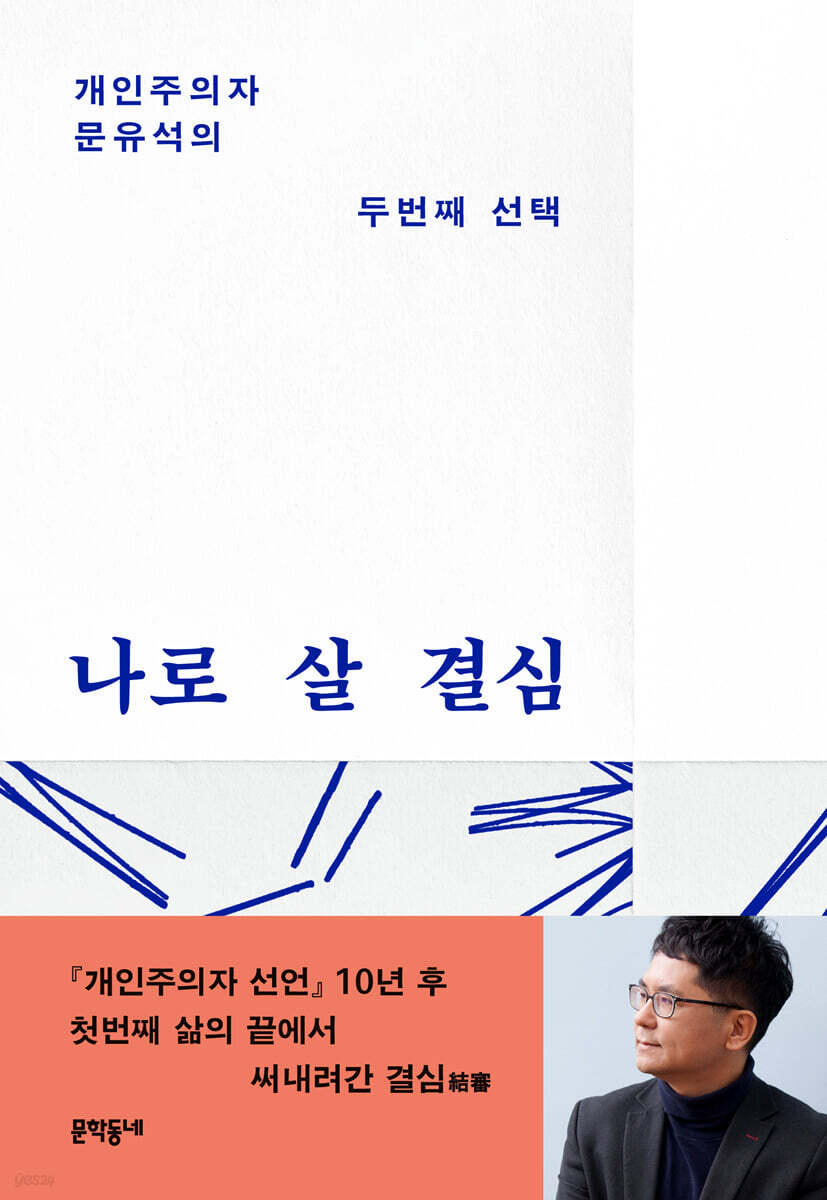
I decided to live as myself
 |
Description
Book Introduction
- A word from MD
- Moon Yoo-seok, a story told as a complete 'self'Moon Yoo-seok, who took off his judicial robe and became a full-time drama writer.
This new work captures his determination to make new choices and the moments he struggles to live as a complete individual.
He tells his story, without reservation, of how he was able to safely navigate his new life because he was faithful to his previous life.
December 2, 2025. Essay PD Lee Ju-eun
Moon Yu-seok has captured the basic principles of rational individualism and democracy in a playful manner through works such as "Declaration of an Individualist" and "Minimum Goodwill."
What was his second life like after stepping down from his judicial duties in 2020 and becoming a full-time freelance screenwriter? After breaking free from the organization, did he achieve both financial and mental freedom, pioneering a new path?
It wouldn't be easy for anyone to give up a stable job and start a new life, and it didn't take long for him to decide on a second life.
After witnessing decisive moments in the court that were more dramatic than dramas, such as the blacklist of judges during his time at the Supreme Court, Yang Seung-tae finally decided to leave his judicial career, but what awaited him was not only a 'free life'.
Living as a complete individual was no less difficult than surviving within an organization, and the struggle within 'society' was never-ending.
Now, he changes his vocation from judging the lives of others to questioning them, and from a life of questioning the justice clouded by drama, and he unravels the trials and tribulations and struggles he faces in his new life.
From everyday issues like financial planning, health management, and time management to growth as a professional drama writer, and even to the very foundation of our lives, the book aims to gauge one's own position by traversing the entire spectrum, including the law and the workings of democracy.
Even though the foundation of life has changed, the author consistently emphasizes.
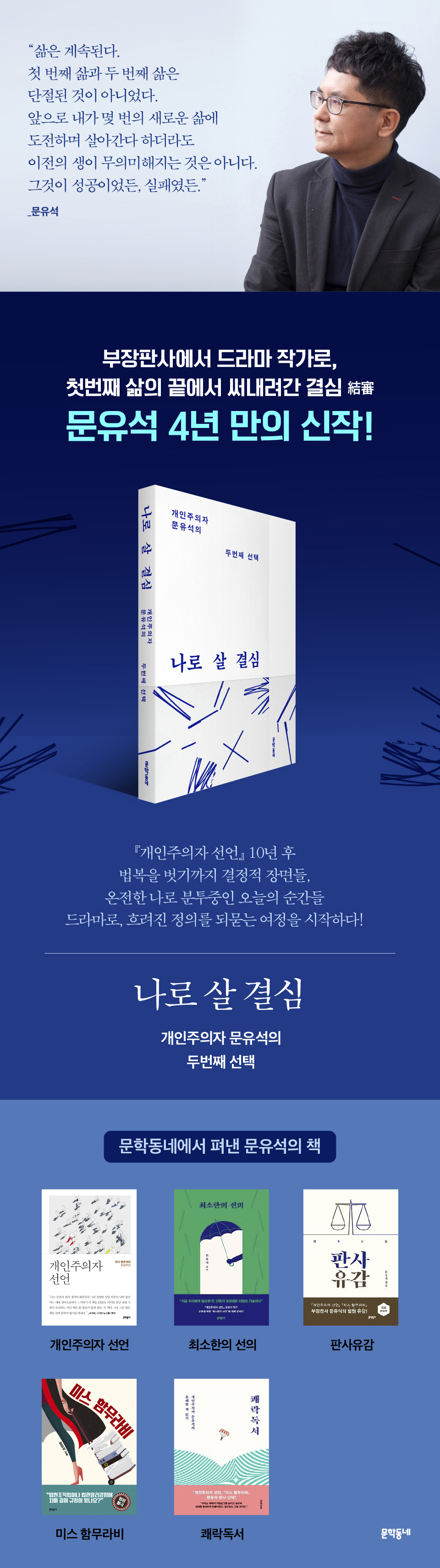
“Even if I live a few new lives in the future, my previous lives will not become meaningless.
“Whether it was a success or a failure,” he said, “the first life and the second life were not disconnected.”
This book, which can be called a 'Moon Yoo-seok-style full-time diary', shows that a second life comes only when one is faithful to the first life, and that only by honestly writing about the mistakes, frustrations, and anxieties of the second life can one safely pass through the new life.
What was his second life like after stepping down from his judicial duties in 2020 and becoming a full-time freelance screenwriter? After breaking free from the organization, did he achieve both financial and mental freedom, pioneering a new path?
It wouldn't be easy for anyone to give up a stable job and start a new life, and it didn't take long for him to decide on a second life.
After witnessing decisive moments in the court that were more dramatic than dramas, such as the blacklist of judges during his time at the Supreme Court, Yang Seung-tae finally decided to leave his judicial career, but what awaited him was not only a 'free life'.
Living as a complete individual was no less difficult than surviving within an organization, and the struggle within 'society' was never-ending.
Now, he changes his vocation from judging the lives of others to questioning them, and from a life of questioning the justice clouded by drama, and he unravels the trials and tribulations and struggles he faces in his new life.
From everyday issues like financial planning, health management, and time management to growth as a professional drama writer, and even to the very foundation of our lives, the book aims to gauge one's own position by traversing the entire spectrum, including the law and the workings of democracy.
Even though the foundation of life has changed, the author consistently emphasizes.
“Even if I live a few new lives in the future, my previous lives will not become meaningless.
“Whether it was a success or a failure,” he said, “the first life and the second life were not disconnected.”
This book, which can be called a 'Moon Yoo-seok-style full-time diary', shows that a second life comes only when one is faithful to the first life, and that only by honestly writing about the mistakes, frustrations, and anxieties of the second life can one safely pass through the new life.
- You can preview some of the book's contents.
Preview
index
Prologue: Ten years after the declaration of individualism
Part 1: Farewell to the First Life
The day a certain chief judge resigned
I wanted to change it
naive idealist
The truly harmless Don Quixote
That day, I completely broke down.
As expected, there is no such thing as a free lunch.
Things I learned in my first life
Part 2 Everyone Has a Plan
Life is a real battle
Freedom isn't free
The body rules the mind
Achieving Financial Freedom 1 #Dream
Achieving Financial Freedom 2 #Reality
Getting out of a slump
How to Live with Anxiety
Will I be happy if I don't work?
After taking off the armor of being a judge,
Part 3: A Life of Writing Attractive Wrong Answers
Why I Became a Full-Time Writer
I will write the story I can write
The Third Way to Make Your Dreams Come True
Sleepless nights and reflux esophagitis
I remember that name
The work of a judge and the work of a writer
Things I want to write
Epilogue Life Goes On
Part 1: Farewell to the First Life
The day a certain chief judge resigned
I wanted to change it
naive idealist
The truly harmless Don Quixote
That day, I completely broke down.
As expected, there is no such thing as a free lunch.
Things I learned in my first life
Part 2 Everyone Has a Plan
Life is a real battle
Freedom isn't free
The body rules the mind
Achieving Financial Freedom 1 #Dream
Achieving Financial Freedom 2 #Reality
Getting out of a slump
How to Live with Anxiety
Will I be happy if I don't work?
After taking off the armor of being a judge,
Part 3: A Life of Writing Attractive Wrong Answers
Why I Became a Full-Time Writer
I will write the story I can write
The Third Way to Make Your Dreams Come True
Sleepless nights and reflux esophagitis
I remember that name
The work of a judge and the work of a writer
Things I want to write
Epilogue Life Goes On
Detailed image
Into the book
Just because the 'job' assigned to me is important doesn't mean the 'person' doing it is important. I wonder if I've been living under the delusion that I was a very important person.
That might be the case.
Because when I was a young judge, I actually had some pretty grand dreams.
It's embarrassing and humiliating to write this now, but I'm over 50 and I'm wondering what there is to be ashamed of, so I'm confessing.
I wanted to change the court.
So, I wanted to change our society.
--- pp.29-30 From "I Wanted to Change"
Only then did I truly grasp my subject.
I thought I had given witty and pointed advice with a smile even in front of the Chief Justice.
Just the year before, at an event hosted by Chief Justice Yang Seung-tae, he jokingly said, “Why do you keep telling young judges to resign if they can’t do their job properly? Those guys haven’t even been in the court long enough to do anything wrong.
He said, “If you are going to ask people to leave in the new year, I hope you ask the senior judges to leave first,” and was pleased to see the high-ranking judges in attendance fidgeting.
I thought that writing columns, books, and dramas was in my own way a contribution to the courts by serving as a bridge between the courts and civil society.
It was all a mistake.
I was just a court jester.
--- pp.72-73 From "There Was No Free Lunch in This World"
What is even more surprising, from a former legal professional's perspective, is the blatant disregard for the law and the partisan behavior of the acting presidents.
Even though the Constitutional Court ultimately ruled through a ruling on a dispute over authority that it was unconstitutional not to appoint a Constitutional Court justice recommended by the National Assembly, the acting presidents ignored this ruling and persisted.
The acting presidents were not politicians.
These are people who have lived their entire lives as high-ranking officials.
The bureaucracy is conservative.
No matter what you may be thinking, it is difficult to openly violate the law and procedures.
Because you will be held legally responsible.
The rule of law system is maintained by a conservative bureaucracy that fears legal accountability.
But surprisingly, officials began to openly disregard the law.
It is no different from the 'judicial corruption' incident led by judicial officials of the Supreme Court Administration.
Isn't it because they believe that at least one political force will protect them as long as it serves their partisan interests, even if the law is ignored?
Like a Supreme Court Justice who attempted to intervene in a trial and still completed his term.
--- pp.79-80 From "Things I Learned in My First Life"
I started a new life because I enjoyed writing, but after being rejected repeatedly, I became afraid of writing.
The fear of not being able to write something interesting, of being rejected, of disappointing someone was turning into a cowardly attempt to escape from writing.
If you just prepare without starting, you haven't failed yet.
Because I can remain a writer who is always preparing for the next work.
--- p.138 From "Getting Out of a Slump"
In the five years since I started my career as a full-time writer, I honestly haven't been as happy as I was when I was working as a judge.
Of course, income has increased and so has leisure time.
The reason is simple.
Because I am not yet a capable writer who can feel fulfillment and happiness in my work.
I'm still adapting to new things through trial and error.
But at least now I know.
That neither investing nor traveling can guarantee happiness.
Work-life balance comes when you work hard and live hard.
--- pp.157-158 From “Will I be happy if I don’t work?”
It was bitter.
I thought that if I let go of all the self-confidence, vanity, pretense, and ambition, there would be a sincere and humble core, but what I found was only blatant and selfish desires.
(…) I am just that kind of person.
By studying hard on that topic, I got a job that commanded a lot of social respect and lived a stable and predictable life.
Due to the nature of my job as a judge, I naturally had no choice but to think about society.
But with all that, and even the confidence and energy that comes with youth, gone, I was left naked and naked.
From now on, nothing is given to you on your own.
You have to consciously study, think, face challenges, and grow.
Just because you get older doesn't mean you become an adult.
If you don't worry and grow until you die, you will only regress.
--- pp.229-230 From "Things I Want to Write"
There are things I learned in my first life.
(…) Above all, I learned about myself.
About my limitations, my desires, and the real me.
Supreme Court Justice Yang Seung-tae evaluated me like this in his personnel records.
“It’s too individualistic and self-serving.” I readily agreed with the first part.
That's right.
He is an individualist who even wrote a book to declare it, so he is suddenly saying this.
But my back hurt.
Has a strong sense of resonance.
It's a sense of resonance.
Resonance.
(…)
At first, I was angry and hurt, but strangely, as time passed, the word 'empathy' became a topic that lingered in my mind.
I have lived my life saying a lot of words and writing a lot.
Inside and outside the court.
From the time I started writing books and newspaper columns, I began to criticize all the problems in Korean society from all angles.
And then I kept asking myself:
When you write, don't you really have a desire to be praised for saying something nice and right? When you babble about how the courts need to change, introducing various advanced cases, don't you really have a desire to exalt yourself and say, "I'm different," to be seen as someone ahead of the curve?
--- From "Epilogue" pp.235-236
In reality, I was more interested in 'stories' with myself as the main character than in politics in the broad sense, which is about changing the world.
I wanted to live as a cool character in a cool story.
In reality, I had no intention of making sacrifices like rolling in shit, making dirty compromises if necessary, or enduring relentless personal attacks from annoying people to change the world.
I wanted to be a character in a Hollywood movie, not an independent film or documentary.
If that greed is a sense of resonance, it cannot be denied.
There was a reason why I was only righteous part-time.
That might be the case.
Because when I was a young judge, I actually had some pretty grand dreams.
It's embarrassing and humiliating to write this now, but I'm over 50 and I'm wondering what there is to be ashamed of, so I'm confessing.
I wanted to change the court.
So, I wanted to change our society.
--- pp.29-30 From "I Wanted to Change"
Only then did I truly grasp my subject.
I thought I had given witty and pointed advice with a smile even in front of the Chief Justice.
Just the year before, at an event hosted by Chief Justice Yang Seung-tae, he jokingly said, “Why do you keep telling young judges to resign if they can’t do their job properly? Those guys haven’t even been in the court long enough to do anything wrong.
He said, “If you are going to ask people to leave in the new year, I hope you ask the senior judges to leave first,” and was pleased to see the high-ranking judges in attendance fidgeting.
I thought that writing columns, books, and dramas was in my own way a contribution to the courts by serving as a bridge between the courts and civil society.
It was all a mistake.
I was just a court jester.
--- pp.72-73 From "There Was No Free Lunch in This World"
What is even more surprising, from a former legal professional's perspective, is the blatant disregard for the law and the partisan behavior of the acting presidents.
Even though the Constitutional Court ultimately ruled through a ruling on a dispute over authority that it was unconstitutional not to appoint a Constitutional Court justice recommended by the National Assembly, the acting presidents ignored this ruling and persisted.
The acting presidents were not politicians.
These are people who have lived their entire lives as high-ranking officials.
The bureaucracy is conservative.
No matter what you may be thinking, it is difficult to openly violate the law and procedures.
Because you will be held legally responsible.
The rule of law system is maintained by a conservative bureaucracy that fears legal accountability.
But surprisingly, officials began to openly disregard the law.
It is no different from the 'judicial corruption' incident led by judicial officials of the Supreme Court Administration.
Isn't it because they believe that at least one political force will protect them as long as it serves their partisan interests, even if the law is ignored?
Like a Supreme Court Justice who attempted to intervene in a trial and still completed his term.
--- pp.79-80 From "Things I Learned in My First Life"
I started a new life because I enjoyed writing, but after being rejected repeatedly, I became afraid of writing.
The fear of not being able to write something interesting, of being rejected, of disappointing someone was turning into a cowardly attempt to escape from writing.
If you just prepare without starting, you haven't failed yet.
Because I can remain a writer who is always preparing for the next work.
--- p.138 From "Getting Out of a Slump"
In the five years since I started my career as a full-time writer, I honestly haven't been as happy as I was when I was working as a judge.
Of course, income has increased and so has leisure time.
The reason is simple.
Because I am not yet a capable writer who can feel fulfillment and happiness in my work.
I'm still adapting to new things through trial and error.
But at least now I know.
That neither investing nor traveling can guarantee happiness.
Work-life balance comes when you work hard and live hard.
--- pp.157-158 From “Will I be happy if I don’t work?”
It was bitter.
I thought that if I let go of all the self-confidence, vanity, pretense, and ambition, there would be a sincere and humble core, but what I found was only blatant and selfish desires.
(…) I am just that kind of person.
By studying hard on that topic, I got a job that commanded a lot of social respect and lived a stable and predictable life.
Due to the nature of my job as a judge, I naturally had no choice but to think about society.
But with all that, and even the confidence and energy that comes with youth, gone, I was left naked and naked.
From now on, nothing is given to you on your own.
You have to consciously study, think, face challenges, and grow.
Just because you get older doesn't mean you become an adult.
If you don't worry and grow until you die, you will only regress.
--- pp.229-230 From "Things I Want to Write"
There are things I learned in my first life.
(…) Above all, I learned about myself.
About my limitations, my desires, and the real me.
Supreme Court Justice Yang Seung-tae evaluated me like this in his personnel records.
“It’s too individualistic and self-serving.” I readily agreed with the first part.
That's right.
He is an individualist who even wrote a book to declare it, so he is suddenly saying this.
But my back hurt.
Has a strong sense of resonance.
It's a sense of resonance.
Resonance.
(…)
At first, I was angry and hurt, but strangely, as time passed, the word 'empathy' became a topic that lingered in my mind.
I have lived my life saying a lot of words and writing a lot.
Inside and outside the court.
From the time I started writing books and newspaper columns, I began to criticize all the problems in Korean society from all angles.
And then I kept asking myself:
When you write, don't you really have a desire to be praised for saying something nice and right? When you babble about how the courts need to change, introducing various advanced cases, don't you really have a desire to exalt yourself and say, "I'm different," to be seen as someone ahead of the curve?
--- From "Epilogue" pp.235-236
In reality, I was more interested in 'stories' with myself as the main character than in politics in the broad sense, which is about changing the world.
I wanted to live as a cool character in a cool story.
In reality, I had no intention of making sacrifices like rolling in shit, making dirty compromises if necessary, or enduring relentless personal attacks from annoying people to change the world.
I wanted to be a character in a Hollywood movie, not an independent film or documentary.
If that greed is a sense of resonance, it cannot be denied.
There was a reason why I was only righteous part-time.
--- p.236 From "Epilogue"
Publisher's Review
Ten years after the "Individualist Manifesto,"
A resolution written at the end of the first life
Crucial scenes leading up to taking off the robe
Moon Yu-seok has provided a sharp and balanced perspective on our society and legal culture through books such as “Declaration of an Individualist,” “Miss Hammurabi,” and “Pleasure Reading.”
Having worked as a judge since 1997, he ended his 23-year career as a judge in 2020 and chose a life as a drama writer.
However, the depth of the worries that came with leaving the socially respected profession of a judge, especially a stable job, to become a freelancer was considerable.
What was the decisive factor that led you to take the first step into your second life?
In various publications, including “A Letter to the Chiefs of the Nation,” Moon Yoo-seok has emphasized his life as an individualist and liberal.
Here, the 'individual' is a modern individual, that is, a citizen who faithfully fulfills his or her rights and duties, and the idea is that the 'individual' is the foundation that supports a healthy democracy.
At the same time, the reason he emphasized the individual as a judge was because he believed that the independence of judges was the basis for the fairness of trials and the foundation for the proper functioning of a country governed by the rule of law.
However, he loses trust in the system after witnessing judicial corruption, such as the intervention of the Chief Justice during the Lee Myung-bak and Park Geun-hye administrations and the creation of a blacklist of Supreme Court judges by Supreme Court Justice Yang Seung-tae.
Above all, he was shocked to the point of feeling as if the sky was falling when a document was discovered showing that the Supreme Court Administration, where he worked, had tried to use him as the “puppet research group president” to diminish the influence of the “International Human Rights Law Research Association,” which was critical of the Supreme Court’s policies.
Having criticized the court from within but not being a party to the problematic cases, he was unable to avoid being a party to the situation for the first time, and he reached a decision at this 'dead end'.
“Taking off the heavy clothes that don’t fit the theme” and “returning to being a complete individual and living a life where I take responsibility for myself.”
In addition to ‘결심’, which means to make up one’s mind, there is also ‘결심’, which means to conclude a trial.
Once the trial is concluded, no further claims or evidence will be accepted.
There is only a judgment.
I had been hesitating and worrying about the court for over a year, but now was the time to make up my mind.
Sadly, I was no longer happy in court.
I wanted to spend the rest of my life freely living as a complete individual, pursuing my childhood dream of writing.
I left the court in 2020 and started a new life as a writer.
He is not even a lawyer, so he is not even a legal professional.
_「Prologue」, pages 11-12
Part 1, "Farewell to the First Life," which documents the process of choosing a second life, overlaps with today's judicial reform issues and may at first be read as a history of the judiciary's suffering. However, it is also a work diary that those who have dedicated themselves to an organization for a long time can relate to.
This is because, although they entered the organization with absolute trust and grand ideals, they simultaneously felt anger when the system did not function properly, a sense of helplessness about their role as an accessory, and a worry that the principles would not function properly in the future.
He left the court he loved so much and wanted to change, as if he had lost his “first love.”
In my second life, will I be able to realize my life as a complete individual as I intended?
Freedom vs.
Duty, Liberation vs.
unrest……
Moments of today where I struggle to be my whole self
"Even if I keep losing, I'm willing to keep going and get hit."
While working as a judge, he continued to write columns and publish books, and he also pursued a life as a writer. However, he never expected that his series "Miss Hammurabi," which was intended to introduce the everyday concerns of judges, would be produced as a drama and that he would be in charge of writing the screenplay for it.
For Moon Yoo-seok, writing was nothing more than a “fun game,” and he had no doubts about living his life as a judge until the “decisive incident” occurred.
So, was his transition to screenwriting purely a coincidence? Facing numerous criminal cases, including murder, rape, and fraud, he was forced to confront the diverse lives of others, and he confesses that these struggles paved the way for him to become a screenwriter.
“Whether you’re a judge or a writer, it’s a job that requires you to look deeply into the lives of others.”
Ironically, it was the life of a judge, chosen for practical reasons after giving up his dream of becoming a storyteller, that paved the way for him to become a writer.
This is because a judge's job is to spend his or her entire life looking into countless 'real stories' from every corner of society and thinking hard about them.
(…)
The world was filled with terrible poverty and violence beyond my imagination.
(…) When I was losing sleep for days, worrying about the guilt or innocence of a murder case that was hotly contested, it really felt like my life was getting shorter.
Because a judge is a position that can make one a legal murderer if he makes a mistake.
In this process, the real experiences I experienced through my own body and the real emotions that shook me made me a writer.
Without even realizing it, I was gradually becoming a writer.
_“Why I Became a Professional Writer,” pp. 174-175
Even though it was my second life, following my first, living as a commuter and a salaried worker for 23 years, suddenly becoming a writer was completely unpredictable.
Issues like finances, time management, aging, creative stress, and slumps came up, and I had to find the answers myself.
Part 2, "Everyone Has a Plan," chronicles all these trials and errors, serving as a primer for those who dream of a life as a freelance creator. As he wastes long hours addicted to OTT, vacillates between the ups and downs of stock investing, and navigates the sleepless menopause, he gradually develops his own survival strategy.
After much struggle, what was needed to finally say, “Even if I keep losing, I will keep going and take the hit,” was an honest admission.
Accepting that “failure and frustration can come at any time” and “that I am weak and foolish.”
Living as a complete individual was no easy task, just as surviving within an organization, and the struggles of drama writers within the 'society' they found themselves in were never-ending.
It's so ironic.
In my first life, I lived a busy life, writing and traveling, making the most of my free time. But now, I can't control the time I have left, so I waste it pointlessly and end up living a busy life, chased by deadlines.
In my first life, I yearned for freedom in a tightly packed life, but now, unable to handle the overflowing freedom, I try to create my own limits and restrictions.
Freedom Isn't Free, pp. 99-100
Nothing was certain in the stock market.
The FDA application, which the company, investors, and so-called experts had so rosily predicted, has been indefinitely postponed for unknown reasons.
That day, I remembered the title of a novel by Lee Mun-yeol that I had read when I was young.
'What falls has wings.'
But in reality, there were no wings.
Like Icarus, whose wings melted and fell off as he flew too high and too close to the sun, the stock account that had been rising madly took the gyro drop at an equally fierce speed.
_「Achieving Economic Freedom 2 #Reality Edition」, p. 123
Living as a professional storyteller to the core
Through drama, we begin a journey to question the blurred justice!
About the second life that comes only when you are faithful to the first life
Just as the first life opened the door to a second life, the shadow cast by the judge's life on the life of the dramatist is long.
Even though he was burdened by the need to write a story that would sell, author Moon Yu-seok ultimately turned to stories of ordinary people changing the world little by little with good intentions.
His upcoming drama "Pro Bono" (airing on tvN in early December) centers on a public interest lawyer who specializes in public interest litigation on issues such as the rights of the disabled, sexual violence, animal rights, and migrant rights. This, too, is based on his experience considering both sides of the conflict while judging related cases.
By showing the process of achieving a difficult social consensus through the clash of idealism and realism in a courtroom, he seeks to question the blurred justice through drama.
Now, I've decided to let go of all my vain desires and delusions and focus only on the stories I'm good at and the stories I want to write.
I love stories about honest people who are passionate about their work.
I want to talk about the various problems that our society is currently facing and will face in the future.
I like realistic characters who are moderately selfish and moderately materialistic rather than natural heroes.
I like stories about people like that, loosely but firmly united.
(…) I think the world goes round because there are people like that.
They are the main characters of my story.
_「I will write the story I can write」, pp. 188-189
Above all, he confesses that the question he never stopped asking during the process of changing his life was, 'What is my true desire?' and that the biggest thing he learned in his first life was 'myself.'
Regarding Supreme Court Justice Yang Seung-tae's personal record about himself - "overly individualistic and self-centered" - he asks himself if his driving force in writing was not a desire for recognition, and confesses that he was more interested in "stories with myself as the main character" than in actually changing the world, and that he simply "wanted to live as a cool character in a story."
Ten years after declaring himself an individualist, what Moon Yoo-seok faced after deciding to live as himself was his 'naked self'.
"The Resolution to Live as Myself" doesn't offer a grand second life model, nor does it contain practical advice for those considering quitting their jobs.
It's full of self-awareness, struggles, and reflections from one person who moved the second half of their life to a completely different habitat.
The author consistently emphasizes the changed life situation.
“Even if I live a few new lives in the future, my previous lives will not become meaningless.
“Whether it was a success or a failure,” he said, “the first life and the second life were not disconnected.”
This book, which can be called a 'Moon Yoo-seok-style full-time diary', shows that a second life comes only when one is faithful to the first life, and that only by honestly writing about the mistakes, frustrations, and anxieties of the second life can one safely pass through the new life.
A resolution written at the end of the first life
Crucial scenes leading up to taking off the robe
Moon Yu-seok has provided a sharp and balanced perspective on our society and legal culture through books such as “Declaration of an Individualist,” “Miss Hammurabi,” and “Pleasure Reading.”
Having worked as a judge since 1997, he ended his 23-year career as a judge in 2020 and chose a life as a drama writer.
However, the depth of the worries that came with leaving the socially respected profession of a judge, especially a stable job, to become a freelancer was considerable.
What was the decisive factor that led you to take the first step into your second life?
In various publications, including “A Letter to the Chiefs of the Nation,” Moon Yoo-seok has emphasized his life as an individualist and liberal.
Here, the 'individual' is a modern individual, that is, a citizen who faithfully fulfills his or her rights and duties, and the idea is that the 'individual' is the foundation that supports a healthy democracy.
At the same time, the reason he emphasized the individual as a judge was because he believed that the independence of judges was the basis for the fairness of trials and the foundation for the proper functioning of a country governed by the rule of law.
However, he loses trust in the system after witnessing judicial corruption, such as the intervention of the Chief Justice during the Lee Myung-bak and Park Geun-hye administrations and the creation of a blacklist of Supreme Court judges by Supreme Court Justice Yang Seung-tae.
Above all, he was shocked to the point of feeling as if the sky was falling when a document was discovered showing that the Supreme Court Administration, where he worked, had tried to use him as the “puppet research group president” to diminish the influence of the “International Human Rights Law Research Association,” which was critical of the Supreme Court’s policies.
Having criticized the court from within but not being a party to the problematic cases, he was unable to avoid being a party to the situation for the first time, and he reached a decision at this 'dead end'.
“Taking off the heavy clothes that don’t fit the theme” and “returning to being a complete individual and living a life where I take responsibility for myself.”
In addition to ‘결심’, which means to make up one’s mind, there is also ‘결심’, which means to conclude a trial.
Once the trial is concluded, no further claims or evidence will be accepted.
There is only a judgment.
I had been hesitating and worrying about the court for over a year, but now was the time to make up my mind.
Sadly, I was no longer happy in court.
I wanted to spend the rest of my life freely living as a complete individual, pursuing my childhood dream of writing.
I left the court in 2020 and started a new life as a writer.
He is not even a lawyer, so he is not even a legal professional.
_「Prologue」, pages 11-12
Part 1, "Farewell to the First Life," which documents the process of choosing a second life, overlaps with today's judicial reform issues and may at first be read as a history of the judiciary's suffering. However, it is also a work diary that those who have dedicated themselves to an organization for a long time can relate to.
This is because, although they entered the organization with absolute trust and grand ideals, they simultaneously felt anger when the system did not function properly, a sense of helplessness about their role as an accessory, and a worry that the principles would not function properly in the future.
He left the court he loved so much and wanted to change, as if he had lost his “first love.”
In my second life, will I be able to realize my life as a complete individual as I intended?
Freedom vs.
Duty, Liberation vs.
unrest……
Moments of today where I struggle to be my whole self
"Even if I keep losing, I'm willing to keep going and get hit."
While working as a judge, he continued to write columns and publish books, and he also pursued a life as a writer. However, he never expected that his series "Miss Hammurabi," which was intended to introduce the everyday concerns of judges, would be produced as a drama and that he would be in charge of writing the screenplay for it.
For Moon Yoo-seok, writing was nothing more than a “fun game,” and he had no doubts about living his life as a judge until the “decisive incident” occurred.
So, was his transition to screenwriting purely a coincidence? Facing numerous criminal cases, including murder, rape, and fraud, he was forced to confront the diverse lives of others, and he confesses that these struggles paved the way for him to become a screenwriter.
“Whether you’re a judge or a writer, it’s a job that requires you to look deeply into the lives of others.”
Ironically, it was the life of a judge, chosen for practical reasons after giving up his dream of becoming a storyteller, that paved the way for him to become a writer.
This is because a judge's job is to spend his or her entire life looking into countless 'real stories' from every corner of society and thinking hard about them.
(…)
The world was filled with terrible poverty and violence beyond my imagination.
(…) When I was losing sleep for days, worrying about the guilt or innocence of a murder case that was hotly contested, it really felt like my life was getting shorter.
Because a judge is a position that can make one a legal murderer if he makes a mistake.
In this process, the real experiences I experienced through my own body and the real emotions that shook me made me a writer.
Without even realizing it, I was gradually becoming a writer.
_“Why I Became a Professional Writer,” pp. 174-175
Even though it was my second life, following my first, living as a commuter and a salaried worker for 23 years, suddenly becoming a writer was completely unpredictable.
Issues like finances, time management, aging, creative stress, and slumps came up, and I had to find the answers myself.
Part 2, "Everyone Has a Plan," chronicles all these trials and errors, serving as a primer for those who dream of a life as a freelance creator. As he wastes long hours addicted to OTT, vacillates between the ups and downs of stock investing, and navigates the sleepless menopause, he gradually develops his own survival strategy.
After much struggle, what was needed to finally say, “Even if I keep losing, I will keep going and take the hit,” was an honest admission.
Accepting that “failure and frustration can come at any time” and “that I am weak and foolish.”
Living as a complete individual was no easy task, just as surviving within an organization, and the struggles of drama writers within the 'society' they found themselves in were never-ending.
It's so ironic.
In my first life, I lived a busy life, writing and traveling, making the most of my free time. But now, I can't control the time I have left, so I waste it pointlessly and end up living a busy life, chased by deadlines.
In my first life, I yearned for freedom in a tightly packed life, but now, unable to handle the overflowing freedom, I try to create my own limits and restrictions.
Freedom Isn't Free, pp. 99-100
Nothing was certain in the stock market.
The FDA application, which the company, investors, and so-called experts had so rosily predicted, has been indefinitely postponed for unknown reasons.
That day, I remembered the title of a novel by Lee Mun-yeol that I had read when I was young.
'What falls has wings.'
But in reality, there were no wings.
Like Icarus, whose wings melted and fell off as he flew too high and too close to the sun, the stock account that had been rising madly took the gyro drop at an equally fierce speed.
_「Achieving Economic Freedom 2 #Reality Edition」, p. 123
Living as a professional storyteller to the core
Through drama, we begin a journey to question the blurred justice!
About the second life that comes only when you are faithful to the first life
Just as the first life opened the door to a second life, the shadow cast by the judge's life on the life of the dramatist is long.
Even though he was burdened by the need to write a story that would sell, author Moon Yu-seok ultimately turned to stories of ordinary people changing the world little by little with good intentions.
His upcoming drama "Pro Bono" (airing on tvN in early December) centers on a public interest lawyer who specializes in public interest litigation on issues such as the rights of the disabled, sexual violence, animal rights, and migrant rights. This, too, is based on his experience considering both sides of the conflict while judging related cases.
By showing the process of achieving a difficult social consensus through the clash of idealism and realism in a courtroom, he seeks to question the blurred justice through drama.
Now, I've decided to let go of all my vain desires and delusions and focus only on the stories I'm good at and the stories I want to write.
I love stories about honest people who are passionate about their work.
I want to talk about the various problems that our society is currently facing and will face in the future.
I like realistic characters who are moderately selfish and moderately materialistic rather than natural heroes.
I like stories about people like that, loosely but firmly united.
(…) I think the world goes round because there are people like that.
They are the main characters of my story.
_「I will write the story I can write」, pp. 188-189
Above all, he confesses that the question he never stopped asking during the process of changing his life was, 'What is my true desire?' and that the biggest thing he learned in his first life was 'myself.'
Regarding Supreme Court Justice Yang Seung-tae's personal record about himself - "overly individualistic and self-centered" - he asks himself if his driving force in writing was not a desire for recognition, and confesses that he was more interested in "stories with myself as the main character" than in actually changing the world, and that he simply "wanted to live as a cool character in a story."
Ten years after declaring himself an individualist, what Moon Yoo-seok faced after deciding to live as himself was his 'naked self'.
"The Resolution to Live as Myself" doesn't offer a grand second life model, nor does it contain practical advice for those considering quitting their jobs.
It's full of self-awareness, struggles, and reflections from one person who moved the second half of their life to a completely different habitat.
The author consistently emphasizes the changed life situation.
“Even if I live a few new lives in the future, my previous lives will not become meaningless.
“Whether it was a success or a failure,” he said, “the first life and the second life were not disconnected.”
This book, which can be called a 'Moon Yoo-seok-style full-time diary', shows that a second life comes only when one is faithful to the first life, and that only by honestly writing about the mistakes, frustrations, and anxieties of the second life can one safely pass through the new life.
GOODS SPECIFICS
- Date of issue: November 14, 2025
- Page count, weight, size: 244 pages | 392g | 145*210*15mm
- ISBN13: 9791141613990
- ISBN10: 1141613999
You may also like
카테고리
korean


korean

![GQ KOREA Mark (Monthly): December [2025]](http://librairie.coreenne.fr/cdn/shop/files/8ef265dbbfbf186523ed75ba7319009d.jpg?v=1765340328&width=3840)


