

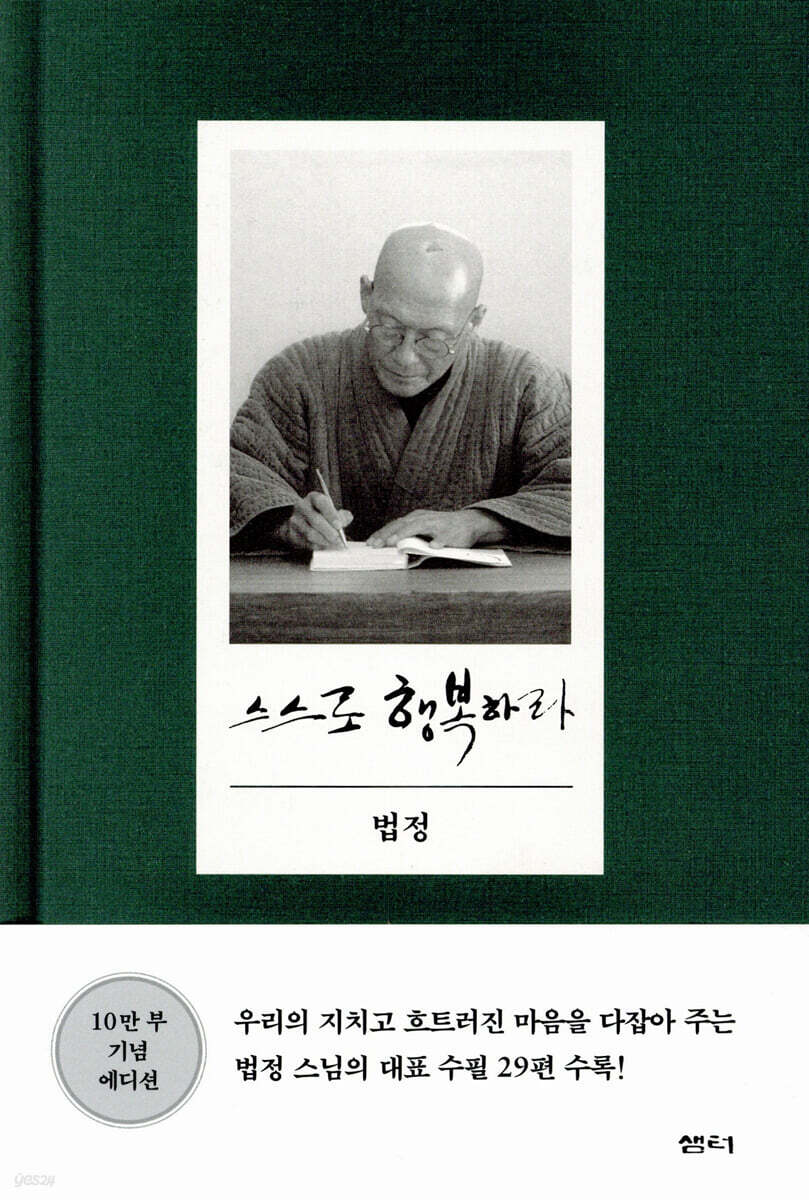
Be Happy Yourself (100,000-Copy Commemorative Edition)
 |
Description
Book Introduction
"No Possession", "Empty Fullness", etc.
It soothes our tired and confused minds.
A collection of representative essays by the monk Beopjeong
『Be Happy Yourself』 100,000-copy commemorative hardcover edition!
To celebrate the publication of 100,000 copies, "Be Happy Yourself" is being published in hardcover with a new cover.
As we live in this completely unexpected world of the COVID-19 pandemic, we struggle with anxiety and depression, and it's easy to feel like we're drifting further and further away from happiness.
In early 2020, when the COVID-19 era began in earnest, "Be Happy Yourself," published to commemorate the 10th anniversary of the death of Venerable Beopjeong, soothed our weary and distraught minds and gave us the courage to overcome hardship.
The book became a bestseller immediately after its publication and was widely loved, including being selected as the book of the year by major bookstores and readers.
"Be Happy Yourself" is a book that selects and compiles writings left by the monk Beopjeong that are helpful in living a happy life.
Chapter 1, “Happiness,” contains the teachings of the Buddhist monk Beopjeong on where to place the value of life, and Chapter 2, “Nature,” contains writings that preach a fulfilling life in harmony with nature.
In Chapter 3, “Books,” the monk Beopjeong shares the wisdom he discovered in books such as “The Little Prince,” “Momo,” and “Zorba the Greek.” In Chapter 4, “Sharing,” he says, “To love is to give, to share.
It contains the message of sharing: “The more you give, the more you share, the more abundant and abundant your heart becomes.”
To us who are struggling in the midst of our difficult daily lives, the monk Beopjeong poses this question.
“Are we as happy as we have?” The monk Beopjeong, who personally practiced a life of non-possession and whose writings, filled with the truth and philosophy of life, deeply resonated with us.
We, who are caught up in our obsessions and are at a loss as to how to live, can gain wisdom for a humane and valuable life through the writings of the Venerable Beopjeong.
We present 『Be Happy Yourself』, filled with the clear and fragrant wisdom of the Venerable Beopjeong, in a hardcover edition so that you can keep it by your side and read it for a long time.
It soothes our tired and confused minds.
A collection of representative essays by the monk Beopjeong
『Be Happy Yourself』 100,000-copy commemorative hardcover edition!
To celebrate the publication of 100,000 copies, "Be Happy Yourself" is being published in hardcover with a new cover.
As we live in this completely unexpected world of the COVID-19 pandemic, we struggle with anxiety and depression, and it's easy to feel like we're drifting further and further away from happiness.
In early 2020, when the COVID-19 era began in earnest, "Be Happy Yourself," published to commemorate the 10th anniversary of the death of Venerable Beopjeong, soothed our weary and distraught minds and gave us the courage to overcome hardship.
The book became a bestseller immediately after its publication and was widely loved, including being selected as the book of the year by major bookstores and readers.
"Be Happy Yourself" is a book that selects and compiles writings left by the monk Beopjeong that are helpful in living a happy life.
Chapter 1, “Happiness,” contains the teachings of the Buddhist monk Beopjeong on where to place the value of life, and Chapter 2, “Nature,” contains writings that preach a fulfilling life in harmony with nature.
In Chapter 3, “Books,” the monk Beopjeong shares the wisdom he discovered in books such as “The Little Prince,” “Momo,” and “Zorba the Greek.” In Chapter 4, “Sharing,” he says, “To love is to give, to share.
It contains the message of sharing: “The more you give, the more you share, the more abundant and abundant your heart becomes.”
To us who are struggling in the midst of our difficult daily lives, the monk Beopjeong poses this question.
“Are we as happy as we have?” The monk Beopjeong, who personally practiced a life of non-possession and whose writings, filled with the truth and philosophy of life, deeply resonated with us.
We, who are caught up in our obsessions and are at a loss as to how to live, can gain wisdom for a humane and valuable life through the writings of the Venerable Beopjeong.
We present 『Be Happy Yourself』, filled with the clear and fragrant wisdom of the Venerable Beopjeong, in a hardcover edition so that you can keep it by your side and read it for a long time.
- You can preview some of the book's contents.
Preview
index
Preface | Be Happy Yourself
Chapter 1 Happiness
To you who dreams of becoming a monk now
In the hut of a slash-and-burn farmer
Cabin Letter
The nest of the tit
Pre-written will
Empty fullness
Chapter 2 Nature
Flowers bloom on the mountain
The sound of water and wind
The forest is quiet after the birds have left.
Abandon and leave
Rainy season story
The moon is like the sun, the moon is like the sun
Listen to the sounds of nature
Use less, throw away less
Tales from the Forest
Chapter 3 Book
Rain falling at dawn
Holy poverty
Soundless sound
A Collection of Souls - Letters to the Little Prince
Pablo Casals
In the typhoon
Under two candles
Chapter 4 Sharing
When we share, we become human.
No possessions
Right here, right here
Who gives blessings and punishments?
Water flows and flowers bloom
Become a person who lives better than the rich
Chapter 1 Happiness
To you who dreams of becoming a monk now
In the hut of a slash-and-burn farmer
Cabin Letter
The nest of the tit
Pre-written will
Empty fullness
Chapter 2 Nature
Flowers bloom on the mountain
The sound of water and wind
The forest is quiet after the birds have left.
Abandon and leave
Rainy season story
The moon is like the sun, the moon is like the sun
Listen to the sounds of nature
Use less, throw away less
Tales from the Forest
Chapter 3 Book
Rain falling at dawn
Holy poverty
Soundless sound
A Collection of Souls - Letters to the Little Prince
Pablo Casals
In the typhoon
Under two candles
Chapter 4 Sharing
When we share, we become human.
No possessions
Right here, right here
Who gives blessings and punishments?
Water flows and flowers bloom
Become a person who lives better than the rich
Detailed image
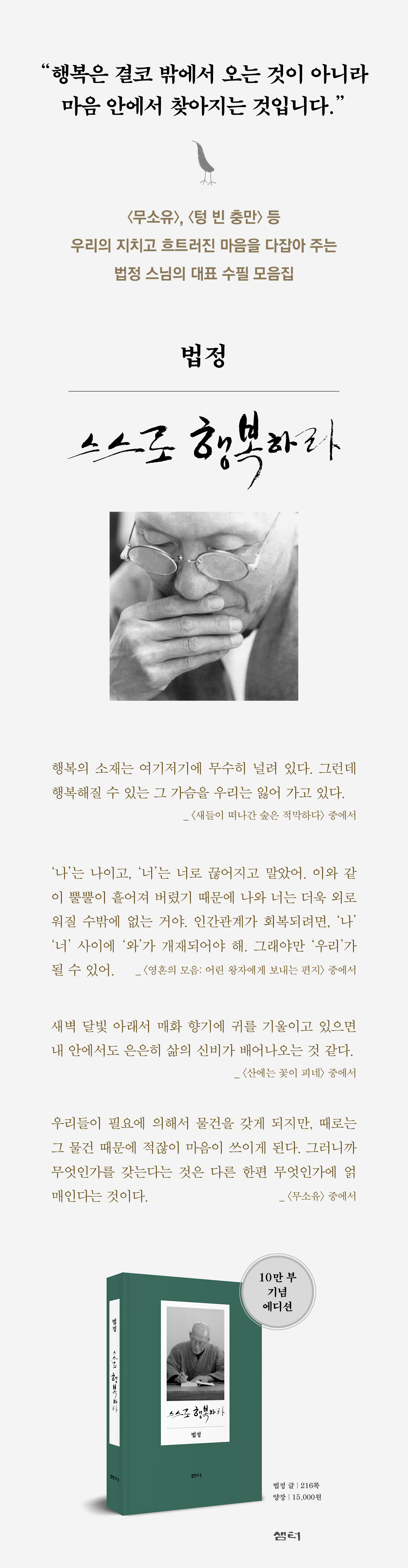
Into the book
Renunciation is the act of breaking free from all attachments and entanglements.
This is not just for practitioners.
This spirit of renunciation is necessary for anyone who wants to live a true life.
If you've ever thought, "This isn't right," you need to change your life and break free from old habits.
I'm not telling you to get a divorce and leave home.
It is to break free from wrong lifestyle habits and wrong karma.
It is to create new karma.
--- p.23, from “To You Who Dreams of Leaving Home Now”
Now, in the sound of the wind blowing through the bamboo forest, in the clear-flowing mountain stream, or in the birdsong in the forest, I can hear music more profound than the melodies of Vivaldi or Bach.
When I sit alone in an empty room, everything is ample and sufficient.
Because it is empty, it is more full than when it is full.
--- p.68, from “Empty Fullness”
The saying goes, 'Now is the time, there will be no next time.'
Every time I encounter this teaching that tells me to live to the fullest right here and now, without ruminating on the past or pinning my hopes on a future that hasn't even arrived yet, I feel energized.
We live right here and now.
If we can live each moment in this place, doing our best to be ourselves, we will live a life we will never regret, no matter what the circumstances.
--- p.82, from “The Sound of Water, the Sound of Wind”
It was sunset, and there was a thin mesh-like net covering the sky that day.
I glanced out the car window and saw that the sun was as gray as the moon.
Thanks to the path that embraced the sun, I was able to see the moon-like sun and the moon-like moon, setting and rising again with each change of mountain ridge, over and over again.
But every time I saw that light, it was a new sight, and I wanted to bow my head and worship before the beauty of nature.
I thought that perhaps the life and death that we have been repeating endlessly for countless kalpas are like this month, like the year and the moon.
--- pp.109~110, from “The Moon Like the Sun, the Moon Like the Sun”
It is only when I am alone that my ears open and I hear something.
I hear the birds chirping, the wind chimes, and the rustling of rabbits and deer as they pass by.
I hear the sound of flowers blooming, withering, falling, and sometimes sighing as time passes.
Therefore, listening is like looking into the garden within me.
--- p.143, from “Soundless Sound”
As the year changes, we add one more year to this physical age, whether we want it or not.
For children and young people, it is like growing older, and for those who are past their prime, it is like losing a year.
This is a natural phenomenon that applies to everyone.
Rather than regretting the passing years and feeling empty, we should be more concerned about how we use each moment of the life we have been given.
--- pp.157~158, from “Pablo Casals”
The human nature is like a spring; the more you draw from it, the clearer it becomes.
If you don't spread it out, it will become cloudy and spoiled.
The more you give, the more you receive.
Since giving itself is receiving, we give not to receive, but simply because we want to give.
Through such actions, people can awaken the humanity that lies dormant within us.
--- p.182, from “When we share, we become human”
We acquire things out of necessity, but sometimes we become quite anxious because of those things.
So, to have something is to be bound to something else.
When we say that what we had out of necessity actually ties us down and makes us unfree, the roles are reversed and we end up being possessed.
Therefore, having a lot is often a source of pride, but it also carries the aspect of being entangled with many things.
This is not just for practitioners.
This spirit of renunciation is necessary for anyone who wants to live a true life.
If you've ever thought, "This isn't right," you need to change your life and break free from old habits.
I'm not telling you to get a divorce and leave home.
It is to break free from wrong lifestyle habits and wrong karma.
It is to create new karma.
--- p.23, from “To You Who Dreams of Leaving Home Now”
Now, in the sound of the wind blowing through the bamboo forest, in the clear-flowing mountain stream, or in the birdsong in the forest, I can hear music more profound than the melodies of Vivaldi or Bach.
When I sit alone in an empty room, everything is ample and sufficient.
Because it is empty, it is more full than when it is full.
--- p.68, from “Empty Fullness”
The saying goes, 'Now is the time, there will be no next time.'
Every time I encounter this teaching that tells me to live to the fullest right here and now, without ruminating on the past or pinning my hopes on a future that hasn't even arrived yet, I feel energized.
We live right here and now.
If we can live each moment in this place, doing our best to be ourselves, we will live a life we will never regret, no matter what the circumstances.
--- p.82, from “The Sound of Water, the Sound of Wind”
It was sunset, and there was a thin mesh-like net covering the sky that day.
I glanced out the car window and saw that the sun was as gray as the moon.
Thanks to the path that embraced the sun, I was able to see the moon-like sun and the moon-like moon, setting and rising again with each change of mountain ridge, over and over again.
But every time I saw that light, it was a new sight, and I wanted to bow my head and worship before the beauty of nature.
I thought that perhaps the life and death that we have been repeating endlessly for countless kalpas are like this month, like the year and the moon.
--- pp.109~110, from “The Moon Like the Sun, the Moon Like the Sun”
It is only when I am alone that my ears open and I hear something.
I hear the birds chirping, the wind chimes, and the rustling of rabbits and deer as they pass by.
I hear the sound of flowers blooming, withering, falling, and sometimes sighing as time passes.
Therefore, listening is like looking into the garden within me.
--- p.143, from “Soundless Sound”
As the year changes, we add one more year to this physical age, whether we want it or not.
For children and young people, it is like growing older, and for those who are past their prime, it is like losing a year.
This is a natural phenomenon that applies to everyone.
Rather than regretting the passing years and feeling empty, we should be more concerned about how we use each moment of the life we have been given.
--- pp.157~158, from “Pablo Casals”
The human nature is like a spring; the more you draw from it, the clearer it becomes.
If you don't spread it out, it will become cloudy and spoiled.
The more you give, the more you receive.
Since giving itself is receiving, we give not to receive, but simply because we want to give.
Through such actions, people can awaken the humanity that lies dormant within us.
--- p.182, from “When we share, we become human”
We acquire things out of necessity, but sometimes we become quite anxious because of those things.
So, to have something is to be bound to something else.
When we say that what we had out of necessity actually ties us down and makes us unfree, the roles are reversed and we end up being possessed.
Therefore, having a lot is often a source of pride, but it also carries the aspect of being entangled with many things.
--- p.187, from “Non-possession”
Publisher's Review
“Happiness never comes from outside,
“It is found within the heart.”
The longing voice of the monk Beopjeong, who said, "Be happy on your own."
Beginning with the prose collection “No Possession” first published in 1976, Monk Beopjeong has published several exquisite essay collections filled with clear and deep thoughts, including “The Forest Is Silent After the Birds Have Left,” “Abandoning and Leaving,” and “Letters from the Cabin.”
However, he left a will stating that he would not take the 'debt of words' he had released to the next life, so most of his books went out of print, and many who liked the monk Beopjeong's writings were saddened by this.
In January 2020, to commemorate the 10th anniversary of the passing of Venerable Beopjeong, Samteo, in collaboration with the Clean and Fragrant Non-profit Organization, which has inherited the Venerable Beopjeong's legacy, published "Be Happy Yourself," a collection of Venerable Beopjeong's representative essays.
Master Beopjeong's famous essays that touch his soul, such as "Non-possession," "Empty Fullness," "Flowers Bloom on the Mountain," and "The Forest Is Silent After the Birds Have Left," have been published again.
Compared to the past, the world has become more materially affluent, but how many people can boast of having achieved that level of happiness? The Venerable Beopjeong once said, "All suffering ultimately stems from attachment," and "The door to happiness opens depending on how free you are from the unnecessary."
“Because it is empty, it is fuller than when it is full,” he said.
He lived the last years of his life without possessions, gathering firewood and cultivating the fields in an ownerless hut in the mountains of Gangwon Province where slash-and-burn farmers lived.
By letting go of my obsession with unnecessary things and emptying myself, I lived a happy and fulfilling life.
The monk also emphasized that one must create one's own life.
“Who will create my life?
“I just build my life layer by layer.” “Everyone must follow the path they have discovered for themselves.
So, you must let your own flower bloom.” The desirable attitude toward life that we can learn from the writings of the monk Beopjeong is to empty our hearts of attachments, get close to nature, and share joy and sorrow with others.
It is when you create this life for yourself that you can find true happiness.
The title of this book, 'Be Happy Yourself', contains the teachings of the monk Beopjeong.
“We live here and now.”
The teachings of the Venerable Beopjeong on 'How to Live'
Kim Seong-gu, publisher of Samteo, recalls that his first impression of the monk Beopjeong, whom he met at Bul-il-am in 1988, was that he was like a blunt old man. He says that the monk's words, such as "The farther you get from nature, the closer you get to the hospital," "If you want to be healthy, change into winter clothes the latest, and don't take them off too quickly because it's hot," "When you're young, your age increases by one, but as you get older, it decreases by one," and "The more you throw away, the richer you become," served as a guiding light for him on 'how to live.'
“Be Happy Yourself” contains the teachings of the monk Beopjeong on “how to live” and “what is happiness.”
As author Jeong Chae-bong said, "It's like a sharp knife," the monk Beopjeong sharply rebukes us for our obsession with possessions, but soon warmly embraces us as we struggle to live each day.
In this book, you will fully experience the warm rebuke and comfort of the monk Beopjeong, which will give you the strength to overcome difficult times.
“It is found within the heart.”
The longing voice of the monk Beopjeong, who said, "Be happy on your own."
Beginning with the prose collection “No Possession” first published in 1976, Monk Beopjeong has published several exquisite essay collections filled with clear and deep thoughts, including “The Forest Is Silent After the Birds Have Left,” “Abandoning and Leaving,” and “Letters from the Cabin.”
However, he left a will stating that he would not take the 'debt of words' he had released to the next life, so most of his books went out of print, and many who liked the monk Beopjeong's writings were saddened by this.
In January 2020, to commemorate the 10th anniversary of the passing of Venerable Beopjeong, Samteo, in collaboration with the Clean and Fragrant Non-profit Organization, which has inherited the Venerable Beopjeong's legacy, published "Be Happy Yourself," a collection of Venerable Beopjeong's representative essays.
Master Beopjeong's famous essays that touch his soul, such as "Non-possession," "Empty Fullness," "Flowers Bloom on the Mountain," and "The Forest Is Silent After the Birds Have Left," have been published again.
Compared to the past, the world has become more materially affluent, but how many people can boast of having achieved that level of happiness? The Venerable Beopjeong once said, "All suffering ultimately stems from attachment," and "The door to happiness opens depending on how free you are from the unnecessary."
“Because it is empty, it is fuller than when it is full,” he said.
He lived the last years of his life without possessions, gathering firewood and cultivating the fields in an ownerless hut in the mountains of Gangwon Province where slash-and-burn farmers lived.
By letting go of my obsession with unnecessary things and emptying myself, I lived a happy and fulfilling life.
The monk also emphasized that one must create one's own life.
“Who will create my life?
“I just build my life layer by layer.” “Everyone must follow the path they have discovered for themselves.
So, you must let your own flower bloom.” The desirable attitude toward life that we can learn from the writings of the monk Beopjeong is to empty our hearts of attachments, get close to nature, and share joy and sorrow with others.
It is when you create this life for yourself that you can find true happiness.
The title of this book, 'Be Happy Yourself', contains the teachings of the monk Beopjeong.
“We live here and now.”
The teachings of the Venerable Beopjeong on 'How to Live'
Kim Seong-gu, publisher of Samteo, recalls that his first impression of the monk Beopjeong, whom he met at Bul-il-am in 1988, was that he was like a blunt old man. He says that the monk's words, such as "The farther you get from nature, the closer you get to the hospital," "If you want to be healthy, change into winter clothes the latest, and don't take them off too quickly because it's hot," "When you're young, your age increases by one, but as you get older, it decreases by one," and "The more you throw away, the richer you become," served as a guiding light for him on 'how to live.'
“Be Happy Yourself” contains the teachings of the monk Beopjeong on “how to live” and “what is happiness.”
As author Jeong Chae-bong said, "It's like a sharp knife," the monk Beopjeong sharply rebukes us for our obsession with possessions, but soon warmly embraces us as we struggle to live each day.
In this book, you will fully experience the warm rebuke and comfort of the monk Beopjeong, which will give you the strength to overcome difficult times.
GOODS SPECIFICS
- Publication date: May 19, 2021
- Format: Hardcover book binding method guide
- Page count, weight, size: 216 pages | 374g | 140*205*16mm
- ISBN13: 9788946421813
- ISBN10: 8946421819
You may also like
카테고리
korean


korean

![GQ KOREA Mark (Monthly): December [2025]](http://librairie.coreenne.fr/cdn/shop/files/8ef265dbbfbf186523ed75ba7319009d.jpg?v=1765340328&width=3840)


